



IntelliPaper
Abstract
The thermochemical characteristics (the standard enthalpy of combustion and the standard enthalpy of formation) of the block copolymer chitosan with methyl acrylate of various composition were determined. The diagrams of thermochemical characteristics – composition were plotted. It was found that there is an S-shaped dependence of thermochemical characteristics on the composition of the copolymer.
Explore Digital Article Text
I. INTRODUCTION
Chitosan (CTS) copolymers with methyl acrylate (MA) and aliphatic polyester could be successfully used as biodegradable composite materials such as packaging, membranes, disposable tableware, etc. [1-4]. We have established that there is a dependence of the thermodynamic and thermochemical characteristics of copolymers on their composition, molecular and supramolecular structures [5–8]. Therefore, it is of great scientific and applied interest to establish such a relationship for block copolymers CTS with MA. Prior publications contain research data regarding the thermochemical characteristics of CTS, poly(methyl acrylate) (PMA), and several CTS block copolymers with MA (1:2.5 and 1:3 by moles) [6, 7]. However, the data obtained in [6, 7] are not enough to establish the exact relationship between the standard enthalpies of combustion ( ) and formation ( ) of the block copolymer CTS with MA and its composition. Therefore, in this work, we determined and calculated for two block copolymers of CTS with MA (composition by moles 3:1 and 1:1).
II. MATERIALS AND METHODS
2.1. Materials
CTS ( -glucosamine, ) produced by "Shanghai AZ Import & Export Co., Ltd" (China), obtained from chitin, extracted from crabs' shells. The viscometric molecular mass ( ) of CTS is Da, and the degree of deacetylation (DD) is 78%. The content of the main substance was no less than 99%. The molar mass (M) of a repeating unit of CTS (base-mol) considering DD is 168.84 g base-mol . DD was determined by potentiometric titration in 0.1 mol l HCl solution using 0.1 mol l NaOH as a titrant [9]. The was determined at 21°C in 0.33 mol l CH COOH and 0.3 mol l NaCl solution using Ubbelohde-type viscometer. The was calculated according to the equation (1):
where – intrinsic viscosity, , .
Acetic acid (AcA) (Sigma Aldrich, ACS reagent, 99.7%, ) was used to obtain CTS solutions.
MA was dried with and distilled using a total condenser, collecting the fraction with and . Poly(methyl acrylate) , the molar mass of a repeating unit 86.09 g base- ), was synthesized by solution polymerization of MA in acetone at in the presence of azobisisobutyronitrile (0.5 mass% by monomer mass) until 7% conversion [7]. The polymer was isolated by triple reprecipitation from an acetone solution with diethyl ether. Weight average molecular mass of PMA ( ) was determined by gel permeation chromatography at using liquid chromatograph Prominence LC–20VP "Shimadzu" (Japan) with a set of columns filled with polystyrene–divinylbenzene standards with pore sizes 10 – 100 m and a differential refractometer as a detector. Tetrahydrofuran was used as an eluent. Poly(methyl methacrylate) standards with narrow distribution were applied for calibration.
The block copolymer synthesis was performed according to the technique proposed by the authors . It lies in MA block copolymerization in CTS solution in aqueous AcA directly in the process of CTS macro chains radical destruction under the action of the redox system hydrogen peroxide ( ) – ascorbic acid (ASA). The concentration of AcA solution in water was six mass%, and CTS concentration in it was three mass%. Block copolymerization was conducted for 24 h at . MA was gradually added to the CTS solution under stirring (CTS/MA ratio in the copolymer was 3:1 and 1:1 base-mol/mol), as well as ASA ( ) and ( ). The resulting copolymer was precipitated by twice the amount of precipitant and desiccated under vacuum at until a constant mass was reached. Films based on CTS with MA block copolymer were prepared by reaction mixture casting onto the polyethylene terephthalate substrate. Copolymer films were treated with a five mass% solutions of NaOH (for 5 min) followed by washing with distilled water to pH 7 to convert a salt form of CTS into protonated form.
The conversion of MA during copolymerization with CTS was determined via the gas chromatographic analysis of the residual monomer. The concentration of the residual monomer was estimated on a gas chromatograph type GCMS-QP2010 ("Shimadzu", Japan). The chromatographic system consisted of a gas chromatograph equipped with a thermal conductivity detector, a computer registration system, and Equity-1 columns (length – 30 m, diameter – 0.25 mm, sorbent size – 0.25 m); helium was used as a carrier gas. The flow velocity of the carrier gas in the system was 1 mL/min, and the temperature of the column for determination of MA was 40°C.
The formation of MA with CTS block copolymers was proved by IR-spectroscopy ("Perkin-Elmer" spectrophotometer). Samples of reaction products for the IR-spectroscopy analysis were prepared by PMA homopolymer extraction with acetone in a Soxhlet extractor for 48 h. In preliminary experiments on mixtures of chitosan with PMA, it was found that the indicated time is sufficient for the complete extraction of the homopolymer.
To estimate the molecular mass of PMA blocks in copolymers, the degradation of CTS chains by nitric acid formed during the mixing of with HCl. For this purpose, the product isolated from the reaction system was washed on the Soxhlet extractor. Then it was dissolved in 0.01 mol l HCl, and an equimolar amount of was added (calculated per glucosamine repeating unit). After 24 h, PMA was isolated and studied by IR-spectroscopy (Infralum FT801 spectrophotometer, Novosibirsk, Russia). Additional experiments on the treatment of PMA with the solution of under the same conditions revealed that the composition of synthetic polymer chains remained the same. The molecular-mass distribution (MMD) of PMA blocks was investigated by gel-permeation chromatography at C on a Prominence LC-20VP liquid chromatograph "Shimadzu" (Japan) equipped with a set of columns packed with polystyrene–divinylbenzene standards with pore sizes of and nm. A differential refractometer was used as a detector. Tetrahydrofuran was used as an eluent. Narrowly dispersed poly(methyl methacrylate) criteria were used for calibration.
The IR-spectrum of the block copolymerization product, purified by homopolymer extraction in Soxhlet extractor, revealed a characteristic band at , corresponding to stretching vibrations of carbonyl groups, which indicates the formation of CTS with MA block copolymer. Extraction showed that the content of PMA in the synthesis products is relatively low (5 mass%). The block copolymerization efficiency was 95 mass%, and the degree of block copolymerization was 62 mass%. PMA blocks in the studied copolymers ranged from to , and the .
2.2. Methods
The enthalpy of combustion of the samples was determined in an improved calorimeter with a static calorimetric bomb type V–08MA (Lobachevsky State University of Nizhny Novgorod, Russia) [8]. Calibration of the calorimetric system was carried out using standard benzoic acid ( J g when weighed in the air) [11]. The energy equivalent of the system is J K with 0.02% doubled quadratic deviation from the average. Polymer samples were transformed into tablets filled with molten paraffin and burnt in oxygen at pressure 3 Pa. According to the chromatography results, oxygen contained the following impurities, mol%: N – 0.8; CO and CO – 0.002; hydrocarbons – 0.001. The samples were placed in a quartz crucible and ignited by discharging a capacitor onto a platinum wire connected with a substance by a cotton thread. Two platinum resistance thermometers and a digital voltmeter included in the bridge circuit were used to measure the temperature rise. The ratio of CO (experimental) to CO (calculated) in percent of weight is 99.97 – 100.03% for the studied samples.
Calculations were carried out for the following combustion reactions of the CTS block copolymers with MA 3:1 (equation 2) and 1:1 (equation 3):
While deriving the gross formula of the block copolymer, it was assumed that CTS (as a part of this copolymer) has DD 100%. The molar mass of the repeating unit of the CTS block copolymer with MA 3:1 and 1:1 was calculated, based on the obtained formula. The molar mass of the repeating unit of the CTS block copolymers with MA (1:2.5 and 1:3 by moles) [6, 7] was calculated similarly.
The energy of combustion was determined in the conditions of a calorimetric bomb. Standard values and for combustion reactions (2) and (3) were calculated based on the average value , molar mass, taking into account the Washburn correction and the correction due to the change in a number of moles of gases. Standard enthalpy of formation was calculated for samples in the solid state at using the obtained values of , kJ mol and kJ mol [11].
The surface topography of films composed of CTS block copolymers with MA (1:1 and 1:3 mole ratio) was studied by scanning probe microscopy (SPM) on a Solver-P47 atomic-force microscope (Zelenograd, Russia). Samples were prepared by copolymer solutions casting onto silicon substrate followed by solvent evaporation in the equilibrium conditions at C. Scanning was performed in the tapping mode [1]. of PMA blocks in a copolymer with a molar ratio of components 1:1 is Da, and in a copolymer with a molar ratio of components 1:3, it reaches Da.
III. RESULTS AND DISCUSSION
The combustion energy values for the CTS block copolymers with MA determined experimentally are presented in Table 1, and the standard values calculated from its average value , and in solid state at - in Table 2 as well as the results of our previous studies [6, 7]. Based on the obtained data for CTS block copolymers with MA, the dependencies of and on copolymer's composition were plotted (Figures 1, 2).
{"image_source":{"path":"images/c62159546a195ab48bcb4d0d6794c4535dd963a781d32a2e74901a089f5f2014.jpg"},"content":"","chart_caption":[],"chart_footnote":[]} {"image_source":{"path":"images/5df509a182c7ca0e10c96a4a4d68ddd628b5788645fb1c43920478924b2e3c6a.jpg"},"content":"","chart_caption":[{"type":"text","content":"Figure 1: Dependence of the standard enthalpy of combustion "},{"type":"equationinline","content":"\Delta\{\mathrm{c}}H^{\mathrm{o}}"},{"type":"text","content":" of block copolymer CTS with MA on the methyl acrylate content in block copolymer "},{"type":"equation_inline","content":"x"},{"type":"text","content":"."},{"type":"text","content":"Figure 2: Dependence of the standard enthalpy of formation "},{"type":"equationinline","content":"\Delta\{f}H^{o}"},{"type":"text","content":" of block copolymer CTS with MA on the methyl acrylate content in block copolymer x."}],"chart_footnote":[]}
Table 1: The results of experiments to determine the combustion energy of block copolymers CTS with MA at K.
| m/g | ΔT/K | qpar/J | qthread/J | q(HNO3)/J | qc/J | -ΔcU/J g-1 |
| CTS block copolymer with MA (3:1) | ||||||
| 0.1794 | 2.510224 | 33737.2 | 30.1 | 7.03 | --- | 18893.7 |
| 0.1628 | 2.464745 | 33379.6 | 34.1 | 9.96 | 3.28 | 18858.5 |
| 0.1895 | 2.503799 | 33455.4 | 35.1 | 8.20 | 3.28 | 18856.6 |
| 0.2274 | 2.553415 | 33447.4 | 41.3 | 17.57 | --- | 18896.4 |
| Average | 18876.3±21.7 | |||||
| CTS block copolymer with MA (1:1) | ||||||
| 0.2978 | 2.601002 | 32532.2 | 37.7 | 17.5 | --- | 19880.6 |
| 0.2833 | 2.575089 | 32465.3 | 34.1 | 9.95 | 4.95 | 19836.9 |
| 0.3167 | 2.633678 | 32647.5 | 35.1 | 11.1 | 3.51 | 19897.1 |
| 0.2724 | 2.563990 | 32509.9 | 41.3 | 8.20 | --- | 19825.5 |
| 0.3015 | 2.595218 | 32383.8 | 37.0 | 9.96 | 5.24 | 19889.5 |
| Average | 19865.9±29.0 | |||||
Figures 1 and 2 show that there is an S-shaped dependence of and from composition of the block copolymer of CTS with MA. Before the MA content ( ) of mol%, the deviation of the curve from additive dependence towards the axis of the composition (Figure 1). As our investigations of the thermochemical characteristics of cellulose and chitin have shown [5-8, 12-15], when the degree of ordering and the strength of intermolecular bonds increase, there is a decrease in the absolute value of the enthalpy of the reaction of combustion of polysaccharides. This could be explained by the fact that it is necessary to expend energy to break intermolecular bonds. As a result, energy is expended on the destruction of highly ordered microscale regions of polysaccharides. Thus, the variation of the curve plotted in Figure 1 in the range mol% MA can be explained by an increase in the strength of the intermolecular bonds of the copolymer upon the introduction of PMA blocks into CTS. With a higher MA content, the dependence is close to additive.
Table 2: Standard energy, enthalpy of combustion, and formation of the samples of CTS, PMA, and CTS block copolymers with MA at base- .
| Sample | x/mol% | $-\Delta_cU^o$ | $-\Delta_cH^o$ | $-\Delta_fH^o$ | Reference |
| CTSDD = 78%M = 168.84g base-mol $^{-1}$ | 0 | 3305.4±13.4 | 3307.6±13.3 | 822.6±13.3 | [6, 7] |
| CTS – MA (3:1)M = 142.39g base-mol $^{-1}$ | 25 | 2686.1±3.1 | 2686.9 ±3.1 | 870.8±3.1 | This work |
| CTS – MA (1:1)M = 123.62g base-mol $^{-1}$ | 50 | 2454.4±3.6 | 2455.3±3.6 | 727.0±3.6 | This work |
| CTS - MA (1:2.5)M = 108.51g base-mol-1 | 71.43 | 2298.1±2.0 | 2299.2±2.0 | 561.4±2.0 | [6, 7] |
| CTS - MA (1:3)M = 104.86g base-mol-1 | 75.00 | 2309.2±4.7 | 2310.3±4.7 | 496.7±4.7 | [6, 7] |
| PMAM = 86.09g base-mol-1 | 100 | 2005.0±2.7 | 2006.2±2.7 | 425.35±2.7 | [6, 7] |
More clearly, the S-shaped dependence is manifested for (Figure 2) in the interval MA. The absolute value of is observed to increase in comparison with the additive values. Further, the curve deviates from the additive dependence towards the axis of the composition.
In [2, 3], for CTS block copolymers with polylactide (PL) containing 0, 18.1, 22.5, and PL, the enthalpies of combustion were determined, and the standard formation enthalpies of formation were calculated. Authors [2, 3] observed additive dependence of and on the copolymer composition. Probably, ester groups in MA blocks are forming stronger intermolecular bonds in comparison to the carbonyl groups in lactide blocks.
The obtained dependences and are approximated by equations (4) and (5):
The obtained thermochemical data correlate with the results of the SPM study of CTS block copolymer with MA at components ratio by moles: 1:1 and 1:3 (Figure 3). It is shown that the roughness parameters and change. For the first copolymer, nm, and the second nm. For the sample with a components ratio of 1:1, the fibrillar structure of CTS remains when macromolecules form the film (Figure 3a). In the CTS – MA copolymer (1:3) the molecular mass of PMA blocks increases. In this case, the macromolecule is placed mostly over each other when forming the film. Surface structures of the same type are formed over the entire surface, although they are deeper ( increases up to 110 nm). These structures are like a uniform "brush" (Figure 3b).
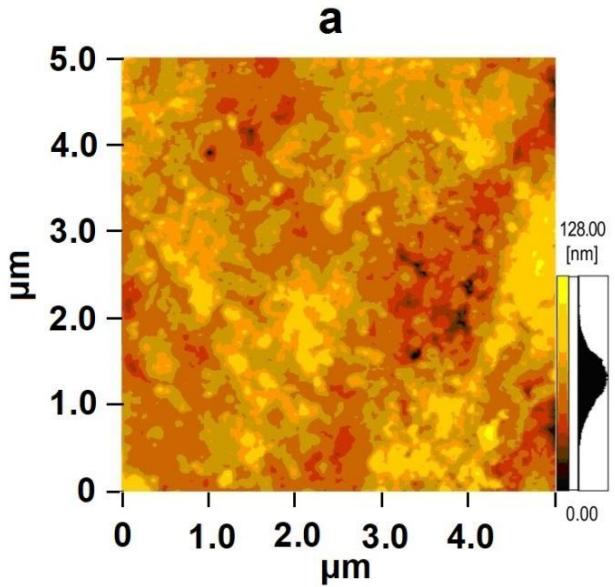
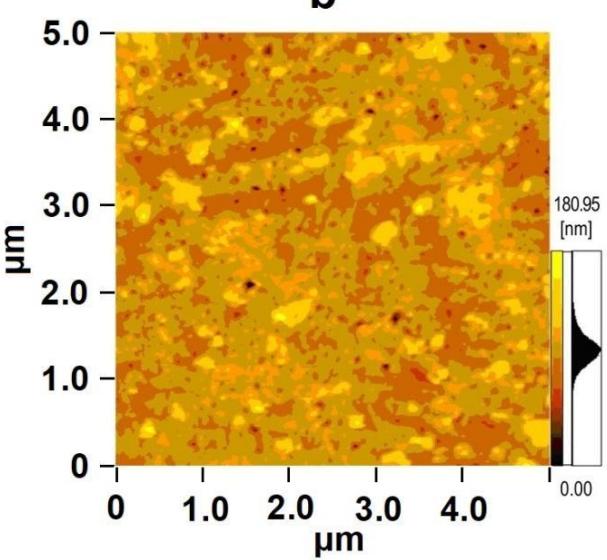 b Figure 3: The surface topography of films of bock copolymers CTS with MA. CTS: MA ratio in moles are: a - 1:1, b - 1:3.
IV. CONCLUSION
As a result of our studies of the enthalpies of combustion and formation of CTS, PMA, and block copolymers of CTS with MA (molar composition 3:1, 1:1, 1:2.5, and 1:3), an S-shaped dependence of thermochemical characteristics was established at different ratios of components copolymer. In this case, the more indicated dependence is manifested for . The curve deviates from the additive dependence towards the axis of the composition in the concentration range MA from 0 to 70 mol%. This can be explained by an increase in the strength of intermolecular bonds of the copolymer when PMA blocks are introduced into the CTS. At an MA content of more than 70 mol%, the dependence is close to additive. The obtained thermochemical data correlate with the results of the SPM study of films of block copolymer CTS with MA.
Author contribution: All authors read and approved the final manuscript.
Research funding: This research did not receive any specific grant from funding agencies in the public, commercial, or not-for-profit sectors.
Conflict of interest: The authors declare that they have no conflict of interest.
Conflict of Interest
The authors declare no conflict of interest.
Ethical Approval
Not applicable
Data Availability
The datasets used in this study are openly available at [repository link] and the source code is available on GitHub at [GitHub link].
Funding
This work did not receive any external funding.
References
Cite this article
Related Research



Special Issue
Launch a focused special issue to highlight research, emerging trends, and expert insights in your academic field.
