



IntelliPaper
Abstract
This paper introduces the Mnolahma Nelca effect, discovered when J.B. Le Kervinec attempted to fly a paramotor beyond the Ice Wall and was inexplicably returned. This effect posits a space-time deformation around the terrestrial disc, modeled as a hyperbolic umbilic, which repels any object crossing the Ice Wall's boundary. This phenomenon is proposed to explain the stable orbits of the sun and moon, and the containment of water on the disc. Anthropological research suggests the effect underlies a Humano-murian rite of passage involving a "leap into the unknown," where adolescents are seemingly propelled into the air and return transfigured. This ritual is linked to the Easter Island birdman legend and the widespread mythology of angels. The knowledge of this effect by the Humano-murians is also suggested as a potential origin for the concept of a dome or firmament surrounding the terrestrial disc.
Explore Digital Article Text
I. CLARIFICATIONS ON THE MNOLAHMA NELCA EFFECT: ASTROPHYSICAL AND GEODYNAMIC CONSIDERATIONS
The Mnolahma Nelca effect was discovered by Jean-Bart Le Kervinec (Hipe, Le Kervinec, 2025), who was unceremoniously catapulted back to where he came from when he attempted the extraordinary feat of escaping the Ice Wall by paramotor, heading straight into the unknown.
This effect sends back any object that crosses the boundary of the Ice Wall, regardless of its ejection force or angle of attack, in the opposite direction, forcing its immediate return to the terrestrial disc:to its starting point,
In the opposite direction,
Immediately,
Without the object sustaining any damage whatsoever.
This effect leads us to believe that the entire terrestrial disc is bordered by a deformation of the space-time fabric, which could be imagined as having the form of an immense wave in the periterrestrial universe's fabric, which sends back any object attempting to cross it in the opposite direction. This deformation/wave encompasses the entire terrestrial disc, well above and below the physical limits of the Ice Wall. The figuration of this effect is modeled by the hyperbolic umbilic model (the wave) (Potential Jp (x1,x2) = x13+x23+p1x1x2-p2x2-p3x1) according to René Thom's catastrophe theory (Thom, 1975).
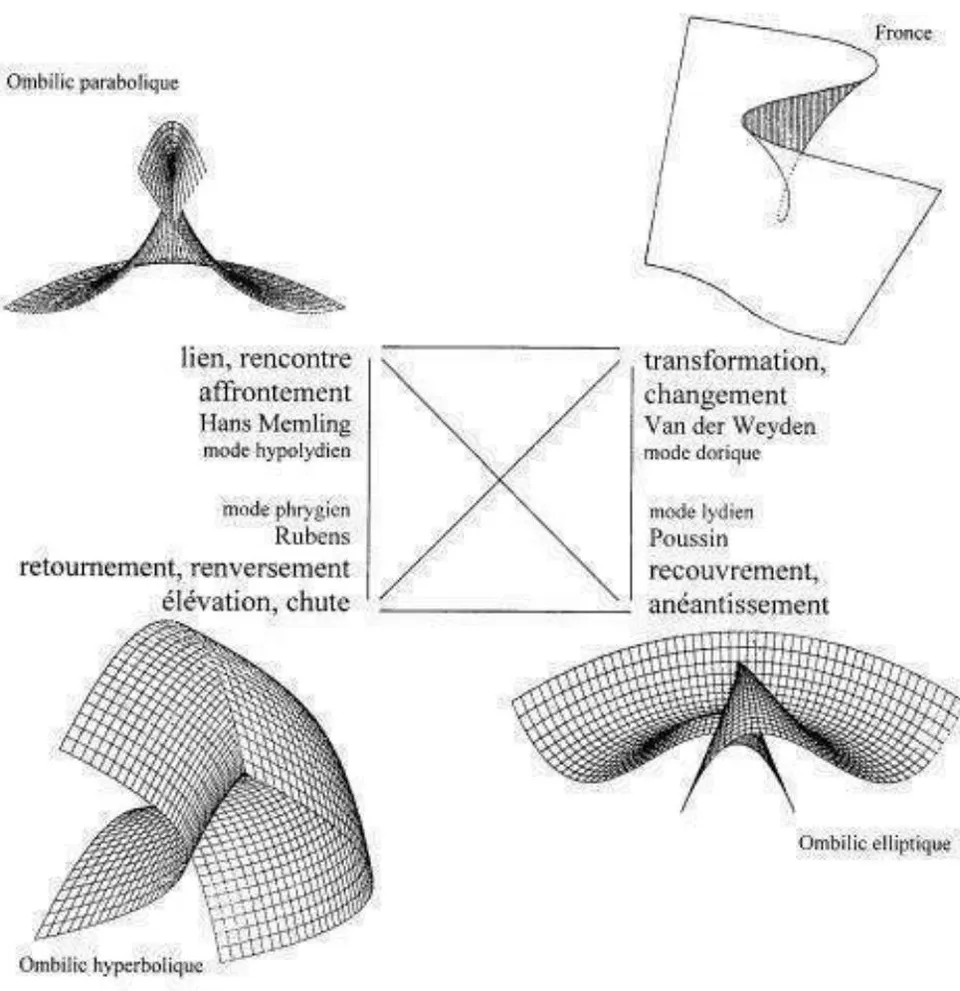
1.1 surrounding the Entire Terrestrial Disc
This effect obviously applies
To the sun, which therefore cannot be ejected from its supra-terrestrial orbit by centrifugal force, as one might logically expect.
To the moon for the same reasons.
To water that escapes or flows below, above, and through the inevitable cracks in the Wall. Thus, the terrestrial disc never empties, as the attached photo humorously suggests (this is a flat-Earther archive; let's not mock them, they are timidly approaching the Great Truth).
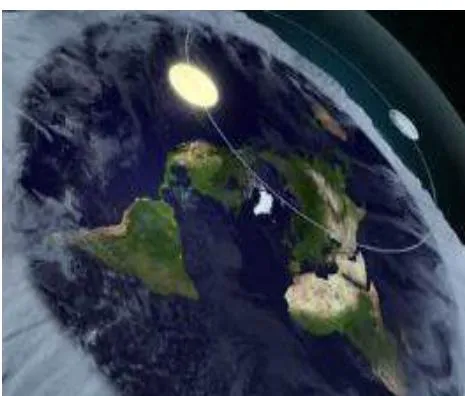

Expressing the naivety of thought detached from all scientific basis (artist's impression because no flat- Earther is capable, unlike the IFPEA, of providing the slightest proof or any authenticated document).
The Humano-murians' knowledge of this effect provides an additional source for the origin of the
Dome legend: indeed, if we wanted to imagine the entire wave around the terrestrial disc, it would roughly result in the shape of a dome. "Q.E.D.", the most mischievous among us would say, "globularists in a fetal position," the most cunning would retort.
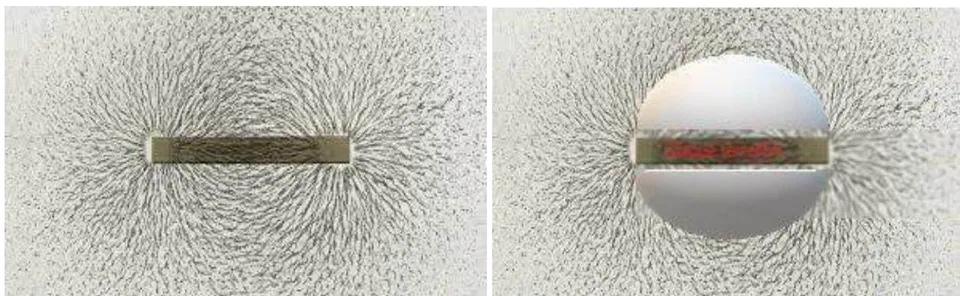
For plattismological theorists, the dome (firmament) does not exist, but a dome-shaped force field is therefore located all around the terrestrial disc, likely the origin of this legend.
II. ANTHROPOLOGICAL CONSEQUENCES OF THE MNOLAHMA NELCA EFFECT: AN ANCESTRAL RITE OF PASSAGE TO ADULTHOOD AND ITS SUBSEQUENT VARIATIONS
Lindsay Dave-Port, our anthropologist, has provided us with the following observations: A ritual marking the passage to adulthood is offered to Humano-murian adolescent boys and girls. In the purest shamanic tradition, a decidedly as if Castanedian initiation of the "leap into the unknown" type was observed by the tp-2021 team. Indeed, under the guidance of the local shaman, the adolescent candidates for the Mnolahma Nelca undergo prolonged fasting and sleep deprivation in secret locations (likely gathered for several days and confined in cave recesses). On the day of the initiation, they must run and jump beyond the Wall, without any hesitation or fearful movement, and without looking back. Suddenly disappearing from the sight of the population gathered to witness the initiation, the candidates reappear floating in the air, like angels, ecstatic, transfigured. Then they gently land back on their launch platform. They are no longer children. They have now become adults, "Mnoléca Nald Léet" in the Humanomurian language, which literally means "one who has passed through Mnolahma Nelca."

This rite is at the origin of the similar practice that took place on Easter Island, in the now-disappeared village of Orongo, giving rise to the Pascuense legend of the "birdman," and, without a doubt, to the mythology of angels found in all the religions of our terrestrial disc. It is certain that the observation that the same civilization (with some local variations) exists across the entire ice arc surrounding the terrestrial disc has necessarily generated a very strong cultural influence, continuously, everywhere at once on the terrestrial continents. It is highly likely that it is from these multi-millennial leaps into the void, where the "Mnoléca Nald Léet" reappeared on the Wall after their flight, that the Syrianite angels, archangels, seraphim, and other cherubim have invaded all human cults and cultures.

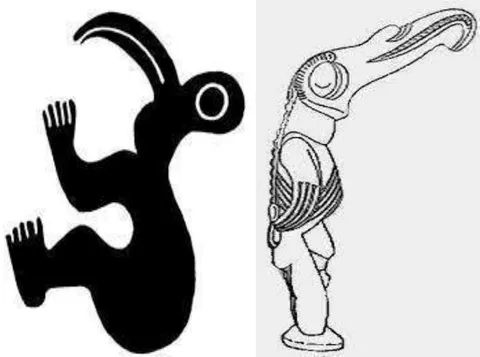

The young Humano-Murian Tsédal (figure 10) was interviewed by our team of researchers, describing in detail his leap into the unknown. The interview, to say the least fascinating, is available in its entirety as a podcast (free access) on the tp-2021 expedition website (5 hours of interview, English and French translation).

III. CONCLUSION
In conclusion, the Mnolahma Nelca effect, initially conceived through the unexpected experience of Jean-Bart's paramotor flight against the Ice Wall, presents a compelling framework for understanding certain geophysical phenomena and intriguing anthropological practices. The concept of a space-time deformation, modeled by the hyperbolic umbilic, offers a unique explanation for the stability of celestial bodies within the terrestrial disc and the containment of its waters. Furthermore, the anthropological insights provided by Lindsay Dave- Port suggest a profound link between this effect and the Humano-murian rite of passage, potentially serving as a foundational element for widespread myths and religious figures across the disc, from the Pascuense birdman to the ubiquitous image of winged angels. The ongoing research, including the detailed account of Tsédal's initiation, promises further exploration into the multifaceted implications of the Mnolahma Nelca effect and its enduring influence on both the physical and cultural landscapes of our world.
Conflict of Interest
The authors declare no conflict of interest.
Ethical Approval
Not applicable
Data Availability
The datasets used in this study are openly available at [repository link] and the source code is available on GitHub at [GitHub link].
Funding
This work did not receive any external funding.
References
Cite this article
Related Research


Special Issue
Launch a focused special issue to highlight research, emerging trends, and expert insights in your academic field.