


IntelliPaper
Abstract
Although the prevalence of adult obesity in the United States in 2011-2012 was 34.9%[1], it increased to 39.8% in 2015-2016, affecting about 93.3 million adults. [2] Physicians and researchers are constantly looking for a better way to manage obesity, yet the prevalence of obesity has constantly been rising over the years. People with obesity are at an increased risk for serious health consequences such as hypertension, type 2 diabetes, dyslipidemia, coronary artery disease, stroke, and mortality,[3] burdening the healthcare cost of the nation. However, many obesity-related consequences are preventable and reversible by maintaining a healthy body weight, keeping the population healthy. In this case series, we present a retrospective study of a successful correlation of significant weight loss with a "zero-to-minute carbohydrate diet," which is based on corrections of the most fundamental issues of weight gain, postprandial hyperglycemia, and subsequent hypoglycemia associated overcompensated carbohydrate consumption model. The results (i.e., the amount of weight loss in lbs, and the duration of weight loss) were collected from patients' medical records and further corroborated with patients by clinic visit or telephone call. We hypothesized the mechanism pathway regarding the "zero-to-minute carbohydrate diet" as follows. Physiologically, in people with obesity, after carbohydrate intake, the increase in glucose level causes insulin overproduction in response to underlying insulin resistance, leading to an unintended hypoglycemic episode that triggers reflex sympathetic activity, i.e., hunger, palpitations, sweating, etc., resulting in overcompensation with carbohydrate food and the vicious cycle continues until bed-time, with triglyceride related fat gain. As minimal carbohydrate is given, the stored fat is burned as energy fuel to form glucose (via lipolysis and gluconeogenesis), leading to body fat loss.
Explore Digital Article Text
I. INTRODUCTION
Obesity has been a center of focus for solutions, as both are associated with metabolic syndrome and various diseases, increasing morbidity and mortality. To treat this, the only option is to lose fat weight. There have been different weight loss programs, including bariatric surgery, yet the prevalence of obesity is constantly rising. In addition, weight regain is a common issue after the most successful weight loss programs.[4][5]With this report, we suggest considering the effective weight loss method as one of the best options. This case series consist of ten patients, who followed the "zero-to-minute carbohydrate diet" plan.
Adult Obesity Rate by State, 1990
Select years with the slider to see historical data. Hover over states for more information. Click a state to lock the selection. Click again to unlock.
{"image_source":{"path":"images/22a37cb2ce54ed784abc09ddd375862891bbfa80dfeae23011df5692921dec06.jpg"},"content":"","chart_caption":[],"chart_footnote":[{"type":"text","content":"Adult Obesity Rate by State, 2017"},{"type":"text","content":"Select years with the slider to see historical data. Hover over states for more information. Click a state to lock the selection. Click again to unlock."}]}
{"image_source":{"path":"images/c64037c90b789dcc486a080d7f917cea2f47e0b588b0b83fd6214611639f59e7.jpg"},"content":"","chart_caption":[{"type":"text","content":"Figure 1: Obesity prevalence increasing over time [6]"}],"chart_footnote":[]}
Carbohydrate diets can be categorized as follows: [7]
| Description | Amount of carbohydrate (g/day) |
| Very low-carbohydrate diet | 20-50 |
| Low-carbohydrate diet | <130 |
| Moderate carbohydrate diet | 130-230 |
| High carbohydrate diet | >230 |
Liu S. et al suggested that a very low carbohydrate diet refers to zero to <60 g/day of carbohydrates. [8] While a very low carbohydrate diet is defined differently, we use the term "zero-to-minute carbohydrate diet". In our diet, it is restricted to consume major carbohydrate sources such as starch and grains. Scientifically, even vegetables and beans contain certain amounts of carbohydrates. In the "zero-to-minute carbohydrate diet" plan, carbohydrates should only come from undeniable carbohydrate content from non-starchy vegetables.
After a glycemic load, the body increases the blood insulin level. In contrast to the insulin level in a healthy person (i.e. insulin is produced to the amount that is needed without subsequent hypoglycemia), the insulin is produced more than necessary to overcome the insulin resistance in a person with obesity. In other words, the increase in blood glucose from the baseline induces secretion of insulin to the extent that it causes a hypoglycemic attack in people with obesity. To counteract hypoglycemia, people eat more carbohydrates, leading to the unintentional weight gain of adipose tissue. The increased insulin level also leads to an anabolic state, reduces lipolysis in adipose tissue, and increases fat storage and weight. This, in turn, worsens insulin resistance.
However, in the "zero-to-minute carbohydrate diet", the lack of increase in blood glucose from the baseline promotes the adipose release of free fatty acids and hepatic gluconeogenesis to maintain blood glucose level, thus burning the body fat. This not only helps weight loss, but also reduces insulin resistance, and keeps the blood glucose within the normal range. [9] It is hypothesized as above regarding the mechanism behind our weight loss diet plan.
![Figure 2: Blood Insulin Level in People with Normal Weight and Obesity [10]](https://doc.journalspress.com/leju68_64779/ocr/images/derivatives/89/89f424b785550bc48f58c1b35199fb0a5570ac116d593f1a4e50e76bd08278d6.webp)
II. MATERIALS AND METHODS
This is a retrospective case study. The patients with obesity (i.e. who are BMI≥30 kg/m2) were given the diet plan. Those who accomplished losing their weight have been selected for this report. The net loss of weight (lbs) and the time period to lose that weight were retrieved from the medical records, and the data collected was confirmed by the patients.
2.1 Exclusions for patient selection for the diet plan
Before starting the above diet plan, we make sure that:
The patient is not on insulin or insulin secretagogues, due to the risk of hypoglycemia.
The patient is Helicobacter pylori negative, due to the risk of GI upset.
2.2 Study settings
Case Presentation
Nephrology Hypertension Renal Transplant & Renal Therapy, LLC, Avenel, New Jersey, United States of America
| Age (yrs) | Sex | Comorbidities | |
| Patient 1 | 56 | F | Hypertension, GERD |
| Patient 2 | 40 | F | Hypertension, Type 2 diabetes, Hypercholesterolemia, cholelithiasis |
| Patient 3 | 61 | M | Hypertension, Type 2 diabetes, Ischemic heart disease, Chronic kidney disease on dialysis, Diverticulitis |
| Patient 4 | 90 | F | Hypertension, Type 2 diabetes, Atrial fibrillation, Coronary artery disease, Chronic obstructive pulmonary disease, Obstructive sleep apnea, Dementia, Uterine cancer |
| Patient 5 | 69 | M | Hypertension, Type 2 diabetes, Chronic kidney disease on dialysis, Chronic obstructive pulmonary disease, Osteoporosis |
| Patient 6 | 49 | F | Hypercholesterolemia, GERD, Migraine, Seizures, Vitamin D deficiency |
| Patient 7 | 64 | F | Hypertension, Type 2 diabetes, Ischemic heart disease, Chronic kidney disease on dialysis, Hypothyroidism, Schizophrenia |
| Patient 8 | 44 | F | Type 2 diabetes (borderline), Gastroesophageal reflux disease (GERD) |
| Patient 9 | 62 | M | Hypertension, Hypercholesterolemia, Chronic kidney disease |
| Patient 10 | 85 | M | Hypertension, Hypercholesterolemia, Type 2 DM, Chronic kidney disease |
| Initial weight (lbs) | Weight after the diet plan (lbs) | Total weight loss (lbs) | Initial BMI (kg/m2) | Final BMI (kg/m2) | |
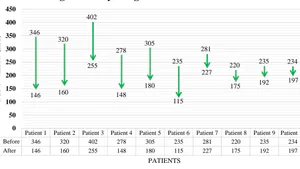
| Patient 1 | 346 | 146 | 200 | 65.4 | 27.6 |
| Patient 2 | 320 | 160 | 160 | 53.3 | 26.6 |
| Patient 3 | 402 | 255 | 147 | 66.9 | 42.4 |
| Patient 4 | 278 | 148 | 130 | 47.7 | 25.4 |
| Patient 5 | 305 | 180 | 125 | 39.2 | 23.1 |
| Patient 6 | 235 | 115 | 120 | 44.4 | 21.7 |
| Patient 7 | 281 | 227 | 54 | 51.4 | 41.5 |
| Patient 8 | 220 | 175 | 45 | 41.6 | 33.1 |
| Patient 9 | 235 | 192 | 43 | 33.7 | 27.5 |
| Patient 10 | 234 | 197 | 37 | 35.6 | 30 |
{"image_source":{"path":"images/ffb233f5c67f2cd32441ccf3a882da6c9ce8ce27515f3f2fae04f8bb7fae6b91.jpg"},"content":"","chart_caption":[{"type":"text","content":"Changes in Body Weight Before and After the Diet Plan"},{"type":"text","content":"Figure 3: Changes in body weight before and after the diet plan"}],"chart_footnote":[]}
III. RESULTS
It is believed that even though the patients were given the same diet plan, depending on how committed the patients are to lose weight and the degree of adherence to the diet plan, the amount of weight loss varies among the patients.
Regarding the weight maintenance, we got the data either from the medical records (of 2018 or 2019) or latest clinic visit or telephone follow up.
| Initial weight (lbs) | Weight after the diet plan (lbs) | Ongoing weight (lbs) | Time of record | |
| Patient 1 | 346 | 146 | 146 | 5/2019 |
| Patient 2 | 320 | 160 | 161 | 1/2019 |
| Patient 3 | 402 | 255 | 251 | 12/2018 |
| Patient 4 | 278 | 148 | 164 | 4/2018 |
| Patient 5 | 305 | 180 | 221 | 1/2018 |
| Patient 6 | 235 | 115 | 115 | 5/2019 |
| Patient 7 | 281 | 227 | 189 | 11/2017 |
| Patient 8 | 220 | 175 | 176 | 1/2019 |
| Patient 9 | 235 | 192 | 192 | 2/2019 |
| Patient 10 | 264 | 197 | 197 | 2/2019 |
The above table shows that 8 out of 10 patients maintain their weight in the range of 5 lbs after their weight loss, or lost more weight. Patients 4 and 5 gained back some weight, but compared with their initial weight, the amount of weight loss is still remarkable.
When reviewing the cases with rebound weight gain, it is found out that Patients 4 and 5 did not maintain the weight with low carbohydrate diet as recommended.
IV. DISCUSSION
The national dietary guidelines provide healthy diet recommendations. However, the section for weight loss diet for people with obesity or overweight is not available. So, we propose a strategy weight loss diet for people with obesity or overweight based on the correction of the fundamental defects of weight gain.
4.1 Postprandial hyperglycemia, subsequent hypoglycemia, and insulin resistance
As mentioned above, insulin resistance in individuals with obesity causes a higher amount of insulin than healthy individuals in response to glucose intake. As a result, after a meal, there is postprandial hyperglycemia, and in response to higher insulin level, the sugar level goes down to the level that it can cause subsequent hypoglycemia. Then, the body responds to hypoglycemia, by activating the sympathetic nervous system, and causes tremor, anxiety, palpitations, sweating, and hunger, leading to increased energy intake and unintentional weight gain.
4.2 Sugar addiction and insulin resistance
Sugar can be an addictive substance as compared to substances of abuse such as cocaine, heroin, and amphetamine. Sugar, when ingested in large amount, causes an increase in dopamine release in the nucleus accumbens. Also, as mentioned above, postprandial hyperglycemia and subsequent hypoglycemia in individuals with obesity or overweight encourages not only sugar intake but also in a large amount that it reinforces sugar addiction. One should take this into account when dealing with insulin resistance in individuals with obesity or overweight.
4.3 Initial Phase ("Zero-to-minute Carbo-hydrate Diet")
The "zero-to-minute carbohydrate diet" promotes the adipose release of free fatty acids and hepatic gluconeogenesis to maintain blood glucose level, thus burning the body fat, and weight loss. Also, by preventing postprandial hyperglycemia, and excessive insulin release, we can avoid subsequent hypoglycemia and insulin resistance as explained above.
The patients are recommended to limit carbohydrate intake to a minimum with reference to the table below for three months or until they accomplish their desirable weight.
| Do not Eat | Eat |
| Fruit, juice, soda | All kinds of beans |
| Milk, dairy products (cheese, butter, etc) | White meat (fish, chicken breast, etc) |
| Rice, pasta, potato, bread, corn | Vegetables (NB: no beetroot) |
| Red meat, seafood | Salad (NB: no dressing) |
| Chicken leg, chicken wing | Fried food is allowed |
4.4 Maintenance Phase
Once the initial weight loss is achieved, the patients are recommended to continue taking the food allowed in our diet plan. In addition, they may taste, without eating much, the foods that are restricted in the initial phase of our diet plan. This is allowed just for the satisfaction of mind while overcoming sugar addiction of obesity or overweight. As mentioned above, if we just taste carbohydrate, we can reduce the amount of sugar intake, thus preventing the development of sugar addiction. Effective weight loss also plays an important role in controlling sugar addiction by eliminating insulin resistance, thereby preventing the development of postprandial hyperglycemia, subsequent hypoglycemia, and increased energy intake.
4.5 Comparison with Other Studies
"Diet alone" studies such as Bowen et.al [13] and Ditschuneit et. Al [14] show 9.7 +/- 3.8 kg over 16 weeks and 7.1 +/- 3.5 kg weight loss over 3 months respectively. "Exercise alone" studies such as Donnelly JE, Honas JJ, Smith BK, et. Al. [15] show 3.9 +/- 4.9 kg and 5.2 +/- 5.6 kg weight loss in 400 and 600 kcal/session groups respectively over 10 months. "Diet + Exercise" studies such as Bryne NM, Meerkin JD, Laukkanen R, Ross R, Fogelholm M, Hills AP [16] show 6.2 +/- 3.4 kg weight loss over 32 weeks period. In bariatric surgery group, weight loss was found to be 17%, 16% and 18% in 5 years, 15 years, and 20 years following surgery respectively. [17] In our study, we have patients who have lost more than 100 pounds over 5-7 months. But, regardless of the duration it takes to lose weight that varies individually, the crucial point is the gradual and sustainable weight loss.
4.6 Benefits of caffeine in weight loss
In order to reduce the psychological effect of weight loss in patients, we also encourage the intake of black coffee without any sugar, cream or milk. As a biological stimulant, caffeine lowers the stress level, reduces fatigue and stimulates alertness. It is also proved that caffeine consumption is associated with successful weight loss maintenance . Regards the debate through the benefits and risks of caffeine intake, it is stated that coffee is generally safe with the intake of three to four cups a day, and outweighs the harm.
4.7 Benefits of weight loss
Losing weight is the key for lowering the risk of cardiovascular diseases, benefits for glycemic control, and prevention of progression for chronic kidney disease, etc. Consistent with the globally accepted concept, we observed that there is an improvement in BMI, HbA1c, blood pressure and cholesterol levels with weight loss . In addition, patients describe the quality of life enhanced after the diet as follows:
1. The disappearance of obstructive sleep apnea/exertion
2. Breathing better
3. Sense of well-being
4. Memory improvement
5. A feeling of being more energetic (mentally + physically)
4.8 Benefits and limitations
Firstly, this study is done by observation in the clinic. Therefore, we do not know what exactly the patients have had for their meals, and what is their adherence to the diet plan. The advantage here is that the meals are prepared by the patients, and fitted well in their daily lives by themselves. So, the long-term maintenance is more likely to be expected, when the patients' self-control is assured. In addition, the environment is stable since the diet plan, i.e. weight loss diet is followed in real life.
One can also say that this study is biased, as the cases are picked up specifically for this report. However, at the best of our knowledge, this is the first report of successful weight loss following the "zero-to-minute carbohydrate diet" done at the general practice setting in the literature.
V. CONCLUSION
We conclude that the "zero-to-minute carbohydrate diet", if strictly applied, can lower the body weight effectively. When the target weight is accomplished with the "zero-to-minute carbohydrate diet", we recommend the patients to maintain body weight with a low carbohydrate diet. Further research is needed to obtain stronger evidence, and to get a better understanding of the science behind this hypothesis.
Conflict of Interest
The authors declare no conflict of interest.
Ethical Approval
Not applicable
Data Availability
The datasets used in this study are openly available at [repository link] and the source code is available on GitHub at [GitHub link].
Funding
This work did not receive any external funding.
References
Cite this article
Related Research


Special Issue
Launch a focused special issue to highlight research, emerging trends, and expert insights in your academic field.