


IntelliPaper
Abstract
Public awareness campaigns are a strategic tool to inform, educate, and influence behavioural outcomes within targeted populations. University students represent a valuable demographic for such campaigns because they represent a critical stage of cognitive, social, and identity development.
This paper provides a study of the effectiveness of public awareness campaigns in shaping attitudes and behaviours of students in “Aleksander Moisiu” University of Durres, in Albania. Referring to behavioural science theories, recent empirical research, communication studies, and primary analysis deriving from students’ participation in an online questionnaire, the paper discusses factors that influence campaign success. These factors include credibility, message framing, delivery channels, and engagement strategies.
The study highlights that public awareness campaigns can significantly influence university students’ attitudes and behaviours when addressing issues perceived as immediate or personally meaningful and designed with intentionality, relevance, and student engagement in mind.
Recommendations for designing effective campaigns tailored to university contexts are also synthesized.
Explore Digital Article Text
I. INTRODUCTION
Public awareness campaigns are essential communication strategies used to address large-scale social, health, or environmental issues. These campaigns aim to increase public knowledge, shift attitudes, and ultimately influence individual and collective behaviour. University students made up a unique audience: they are technologically connected, socially engaged, and highly exposed to information flows, yet often sceptical of institutional messaging. Is this duality that makes them both promising and challenging targets for awareness initiatives.
The purpose of this paper is to explore the extent to which public awareness campaigns influence university students' attitudes and behaviours in Aleksander Moisiu University of Durres. Which sources do students trust mostly and how do they react to information presented through these platforms. It examines theoretical frameworks that explain behaviour change, evaluates empirical findings from previous studies, and evaluates as well as primary sources that include opinions and suggestions that come from university students of Bachelor and Master's Programmes in University Aleksander Moisiu. It aims to identify critical elements that contribute to campaign success in university settings.
II. LITERATURE REVIEW
2.1 Theoretical Approaches to Behaviour Change
Public awareness campaigns use strategic communication to educate the public and motivate change. In order to understand how campaigns shape behaviour this study refers firstly to previously established psychological and communication theories. The following theories explain about campaign impact and how social environments influence behaviour, how people learn and adapt new behaviours, or factors that may make it easier or harder for people to adopt healthier or safer behaviours.
a. The Theory of Planned Behaviour (Ajzen, 1985) implies that behavioural intention that is shaped by attitudes, subjective norms, and perceived behavioural control, predicts actual behaviour. This theory is frequently applied in campus campaigns promoting health and sustainability behaviours. As a general rule, the stronger the intention to engage in a behaviour, the more likely should be its performance (Ajzen, 1991, p. 181).
b. Social Cognitive Theory (Bandura, 1986), as one of the most frequently applied theories of health behaviour emphasizes observational learning, social influence, and self-efficacy. Peer-led initiatives based on SCT have proven effective among university populations because students tend to model behaviours demonstrated by relatable peers.
c. While Health Belief Model of Hochbaum explains behavioural choices through perceived susceptibility, severity, benefits, and barriers. Campaigns targeting mental health or substance use often apply HBM to highlight risks and promote help-seeking.
d. The Elaboration Likelihood Model was developed by Richard E. Petty and John T. Cacioppo in the 1980s. It's a theory of persuasion that explains how people process messages through the central route (deep, thoughtful processing) and peripheral route (surface-level cues). According to the theory, students are more persuaded by messages that they find relevant and credible, particularly when processed through the central route.
Based on these theories, other characteristics of students and the way they approach to latest internet-based platforms, a connection may be found that gives a better understanding of how to organise public awareness campaigns that increase students' engagement.
2.2 Characteristics of University Students as an Audience
University students have distinct traits that impact how they respond to campaigns. These characteristics require campaigns to be relatable, evidence-based, and interactive.
It is a fact that the young generation has a high digital exposure, and they rely on digital platforms for information gathering. Gen Z uses online platforms deeply for learning, health, and social interaction.
A 2023 study published in JMIR looked at Gen Z and their exposure to and use of digital media for self-relevant health topics. Participants age varied from 18 to 26 and the study found that, compared to previous generations they rely more on the internet for information related to health. The same study found that digital health literacy predicts their information-seeking behaviour, but that higher use of digital media does not always lead to more health empowerment for them (Jiao et al. 2023).
Another global survey found that Gen Z and Millennials heavily favour social media platforms like YouTube, Instagram, or TikTok for health-related or scientific information (Blandi Lorenzo et al. 2022). According to (West et al, 2024) adolescent social media use (including high exposure) plays a strong role in shaping their digital competence or their ability to navigate, assess, and interact with digital content. While, in the study "The Moderating Effects of Young Adults' Personality Traits on Social Media Immersion," researchers found that personality traits influence how deeply young people get immersed in social media (Yu et al. 2020). In addition, according to West et al. (2024b) reveal as well that social media use during adolescence can boost digital competence like communication or information seeking but may also displace other developmental activities.
Also, according to Schwarze (2025), Gen Z young adults are very attuned to social groups, inclusion, and diversity. This suggests how deeply peer group norms and identities matter. Adolescent development research notes as well that during teenage years, key areas of the brain (like those for self-regulation) are still developing, which makes them more sensitive to emotional or peer-driven decisions (Carolin Falcon et al. 2023).
Social media is more than entertainment. It is a space where young people try out identities, evaluate their values, and clarify who they are. A coherent review (Avci et al. 2024) in Adolescent Research Review found that active participation on social media (not just passive scrolling) is strongly tied to identity exploration. The authors also note that authenticity in online self-presentation (vs. idealized "perfect" selves) correlates with greater self-concept clarity.
Another study (2024) specifically looked at how social media affects adolescents' self-esteem and self-presentation, supporting the idea that as Gen Z uses these platforms, they are forming and assessing their values, identity, and peer relationships (Agarwal, 2024). This explains how the developmental stage of exploration and value formation is very much supported by social media as a space where identity is shaped.
One other student's trait is that their trust in information and their identity is strongly shaped by peer networks and social contexts. There's strong peer network influence on how they interpret information, and their trust, including scepticism, is formed in social contexts.
A 2023–2024 design-oriented study on how young adults assess online information highlighted that trust decisions are socially motivated. People consult peers, rely on group norms, and their assessments are "social and collaborative." (Vlachokyriakos et al. 2024)
Relatedly, a 2023 arXiv study found that Gen Z does not just evaluate online info individually, rather they interpret it in social groups. Their "information sensibility" is socially embedded (Hassoun et al. 2023)
Last but not least, this generation tends to have a feeling of scepticism in institutions. Research on Gen Z and civic engagement points to vulnerability to fake news and a somewhat detached relationship with traditional institutions. They often rely on social feedback (likes, shares) and peer networks to assess credibility (Alexandra-Niculina et al. 2025) Distrust in higher education or other formal institutions is backed by survey data, and their social information practices reflect that scepticism. They lean toward peers or social cues rather than top-down messaging. These findings tie into the assumption that there's measurable distrust in institutional sources among Gen Z, especially in academic settings, and social media plays a role in how they form their beliefs and attitudes. A 2022 survey by Inside Higher Ed found that a considerable percentage of Gen Z aged 18 to 25 years does not trust higher education institutions (Knott, 2022). Another study found that Gen Z students lean heavily on digital platforms (social media) for news and school-related information, and many of them consider themselves "social activists." (A. Buzzetto et al. 2024). More broadly, a 2023 review of social media's impact on adolescents noted that social media use is linked to both positive and negative developmental outcomes (mental health, identity), which can feed scepticism about traditional institutions, especially if those institutions don't reflect or address what youth experience online (Carolina Falcon Linares et al. 2023)
While Perez-Escoda et al. in 2021 found that young people aged 18 to 22 years show low trust in politicians, media, and journalists and many of them associate misinformation with manipulation, distrust, and danger.
| They have a high exposure to digital and social media content |
| The influence from peer networks and campus culture is strong |
| They experience a developmental stage marked by exploration and value formation |
| They show a tendency toward scepticism of institutional or government messaging |
Source: Jiao et al. 2023, Blandi Lorenzo et al. 2022, West et al 2024, Carolin Falcon et al. 2023, Avci et al. 2024, Agarwal, 2024, Knott, 2022, A. Buzzetto et al. 2024 and more.
In conclusion, previous studies on campaign effectiveness across multiple domains, such as mental health awareness, environmental sustainability, sexual health, and substance use, highlight several findings:
- Campaigns using interactive digital content (videos, gamified challenges, social media influencers) show higher engagement.
- Peer-led interventions increase trust and message acceptance.
- Campaigns that integrate on-campus events, workshops, or student ambassador programs achieve stronger behavioural outcomes compared to purely digital campaigns.
- Repetition and cross-platform messaging strengthen retention.
However, limitations such as message fatigue, scepticism about sponsorship motives, and the gap between attitude formation and actual behaviour may be noted as well.
III. METHODOLOGY
This chapter delineates the research design and methods used to investigate the influence of public awareness campaigns on Students' Attitudes and Behaviours. The study employs a mixed-methods approach, combining secondary research with primary data collection conducted through a structured survey targeting students at the University of Durres. The use of both data types allows for a more comprehensive understanding of the research problem, enabling cross-validation of findings and the identification of patterns that may not be visible through a single method.
3.1 Survey design
The research adopts a mixed design. Secondary research was used to establish the theoretical framework, review existing literature, and position the study within current academic and professional discussions. Primary research was conducted to obtain first-hand insights from UAMD students, capturing their perspectives, experiences, and attitudes related to public awareness campaigns. This dual approach ensures that the study is grounded in established knowledge while also reflecting the specific context of the student population.
3.2 Sampling and participants
Primary data was collected using an online survey administered to students enrolled at UAMD. The survey aimed to gather quantifiable information on the topic of this paper. The questionnaire consisted of closed-ended questions (Likert scales, multiple choice) and open-ended items. The survey was designed based on insights from the secondary research to ensure content validity. A convenience sampling method was used. Students from various departments and study levels were invited to participate. In total, 67 responses were collected.
3.3 Data Collection Procedure and Analysis
The survey was distributed via email and social media. Participation was voluntary, anonymous, and in accordance with ethical research guidelines. Quantitative responses were analysed using Excel to identify trends and frequencies.
3.4 Ethical Considerations and Limitations
The research adhered to ethical standards, ensuring confidentiality, informed consent, and voluntary participation. No personal identifying information was collected. Limitations include the use of a non-probability sample and the potential for respondent bias. Additionally, the findings based on UAMD students may not be generalizable to other populations.
IV. RESULTS
4.1 Results of the quantitative analysis
Two groups of Bachelor's and Master's students participated in the questionnaire. The answers were collected from "Google Forms". The questionnaire structure and its main pillars include Demographics, Campaign Exposure,
Overall, 67 students participated in the survey "How do public awareness campaigns influence university students' attitudes and behaviours".
There was a significant overrepresentation of women in the sample, comprising of the respondents. This is also related to the fact that in the Programs offered by the Public Administration Department, the majority of students are female. Age distribution and education level are presented as follows: Table 2a: Age of participants
| Age | |
| 18-25 | 62.50% |
| 25-35 | 21.90% |
| over 35 | 15.60% |
Responses from the questionnaire reveal that public campaigns watched by students were mostly about civic participation. In second place are education and health with an equal percentage of $21.9\%$ . Table 2b: Education level of participants
| Education | |
| Bachelor | 84.40% |
| High school | 15.60% |
Source: author's analysis, 2025
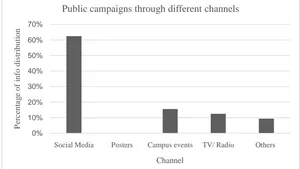
As explained in Figure 1, most students have watched the latest public campaigns through social media.
Figure 1: Channels where students encounter public campaigns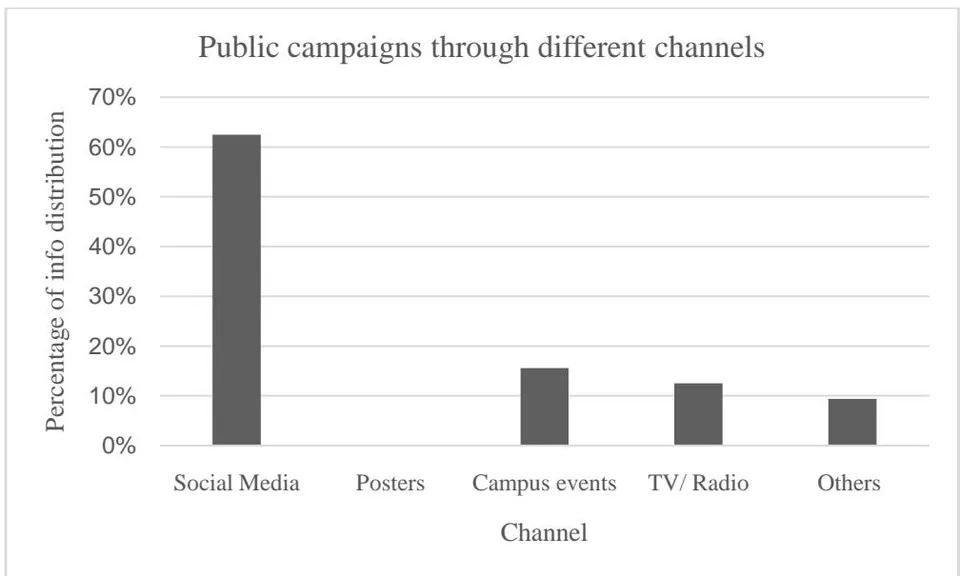
Source: author's analysis, 2025 In addition, students consider public campaigns as an important part of their lives. What they seem to be a little more confused and insecure about is the clarity of the message of these campaigns and the level of trust in public institutions. About of participants declare to be neutral regarding these issues. According to the responses presented in Figure 2, their engagement with public campaigns seems to be good enough and promising for the future. If better-organised campaigns are to be presented to them, their engagement may as well increase.
Figure 2: Students' engagement with public campaigns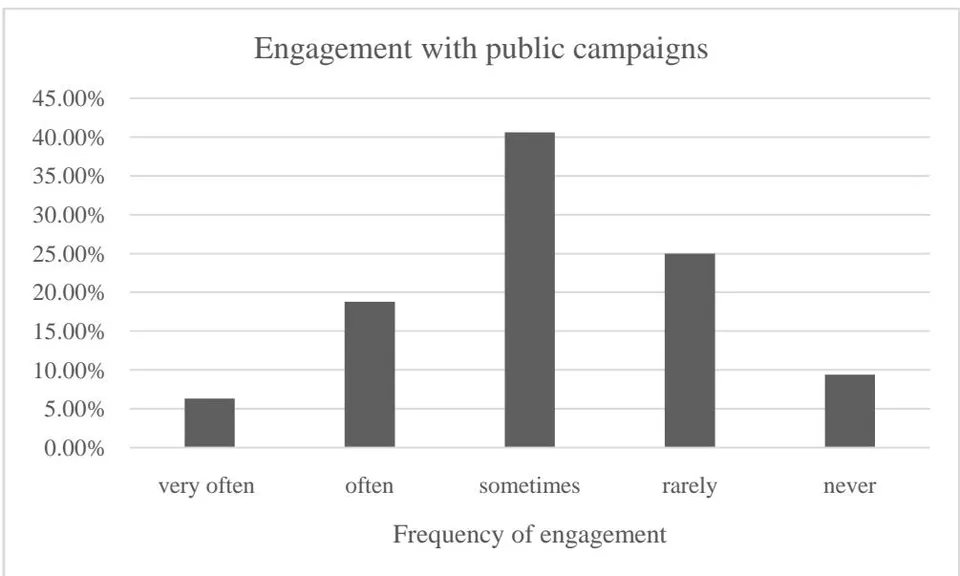
Source: author's analysis, 2025 There is a higher tendency among students to believe more in campaigns that are shared by peers or influencers. About of participants agree and strongly agree with that. After watching a public campaign, of participants always try to apply its message in their daily life (e.g., recycling, safe driving, voting, etc.) While do this very often, show a medium engagement initiative, do it rarely, and declare to never take engagement. However, a considerable proportion of participants, exactly are interested or very interested in helping design or promote public campaigns for students. In reference to the main reasons that usually stop students from engaging with such campaigns, the following Figure 3 has been generated. Figure 3: Reasons that influence students not to engage with public campaigns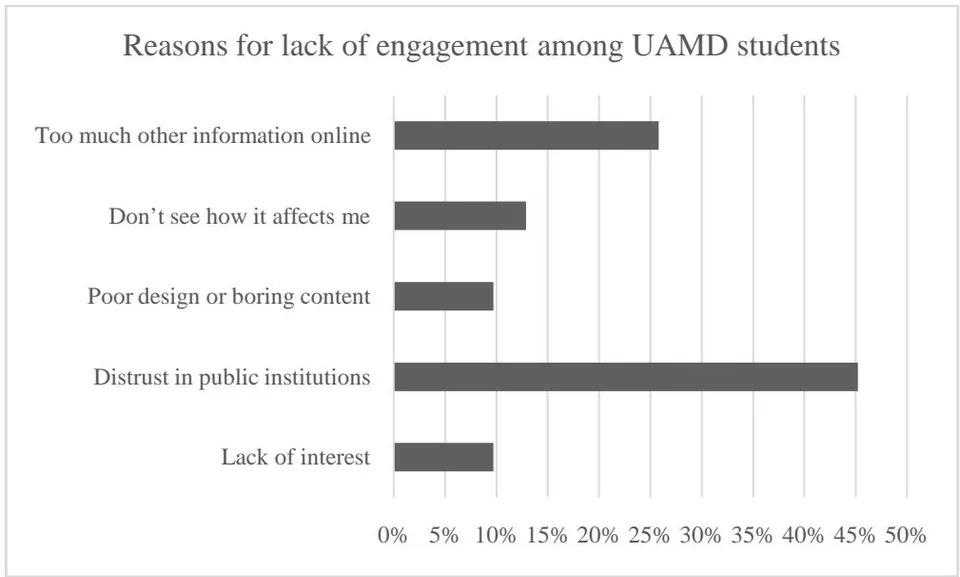
Source: author's analysis, 2025 Questionnaire results contribute to the analysis in terms of awareness and exposure, revealing how well public campaigns reach student audiences. They also show the lack of trust in public institutions or messages that come from public campaigns. Students' engagement and action show behavioural or attitudinal influence from these campaigns. Additionally, students' qualitative insights offer creative input for improving youth-targeted public communication.
4.2 Main Findings from the Quantitative Analysis Show That
Students are aware of public campaigns, but they selectively engage, mostly through social media.
Campaigns perceived as authentic and relatable, not overly formal are more effective.
Visual storytelling and peer involvement increase engagement.
There's room for co-creation between students and public institutions.
V. DISCUSSION
Evidence from previous studies and from primary data from the questionnaire suggests that awareness campaigns are most successful when they incorporate the following:
Relevance and Personalisation: Tailoring messages to the lived experiences of students improves cognitive engagement.
Credible Sources: Peers, student leaders, and academic experts are perceived as more trustworthy than corporate or governmental sources.
Interactive and Multimedia Formats: Videos, infographics, live events, and social media challenges increase message retention and appeal.
Opportunities for Participation: Allowing students to co-create content or lead initiatives fosters ownership and behavioural commitment.
In Table 3 are presented some main factors that have an influence on students, according to studies and primary research as well.
| Factor | Description |
| Message Relevance | Tailored messages resonate more with students |
| Credible Source | Peer-led or expert messaging improves persuasion |
| Multimedia Use | Videos/interactive tools increase engagement |
| Repetition | Repeated exposure reinforces attitudes |
| Participation | Student involvement boosts ownership |
5.1 Ongoing Challenges
Despite their potential, public awareness campaigns face several obstacles:
Information overload weakens attention and engagement.
- Message fatigue occurs when campaigns lack novelty or appear redundant.
- Credibility concerns, particularly for campaigns tied to government or corporate sponsors.
- Behaviour-attitude gaps persist, meaning students may express positive attitudes without adopting new behaviours.
- Digital scepticism, where students question the authenticity and motives of widely circulated online messages.
VI. CONCLUSION
Public awareness campaigns can significantly influence university students' attitudes and behaviours when addressing issues perceived as immediate or personally meaningful and designed with intentionality, relevance, and student engagement in mind.
Campaign components such as message framing, source credibility, and delivery channels interact with students' beliefs, social influences, and perceived control, as explained by the Theory of Planned Behaviour and Social Cognitive Theory and as revealed by current students of Aleksander Moisiu University in the city of Durrës.
The most effective campaigns utilise credible sources, resonant message framing, and multi-channel communication strategies. Digital platforms that align with student media habits would contribute to better engagement. To maximise impact, future campaigns must embrace co-creation, digital interactivity, and continuous evaluation. Doing so will help educators, policymakers, and campus organisations foster meaningful behavioural change among students.
Conflict of Interest
The authors declare no conflict of interest.
Ethical Approval
Not applicable
Data Availability
The datasets used in this study are openly available at [repository link] and the source code is available on GitHub at [GitHub link].
Funding
This work did not receive any external funding.
Cite this article
Related Research

Special Issue
Launch a focused special issue to highlight research, emerging trends, and expert insights in your academic field.