

IntelliPaper
Abstract
Recycled concrete aggregate (RAC) can be used in structural concrete to lessen the environmental impact of waste concrete and the use of natural resources. The current study summarized the mechanical performances of concrete and assessed the synergistic impacts of recycled aggregate, likely at 100% content, with silica fume (SF) partially substituting cement. The study's primary variables included the dosage of silica fume used as a partial replacement of ordinary Portland cement (OPC) at five different percentages: 0%, 4%, 8%, 12%, and 16% by weight.Five distinct mixtures, designated RACSF-0, RACSF-4, RACSF-8, RACSF-12, and RACSF-16, were made using differing concentrations of silica fume for M30 concrete.The workability of concrete mixes was examined using the slump test. After increasing the proportion of SF, a declining trend was observed in the test results. The mechanical characteristics of RACSF were examined at 7 and 28 days using compressive and splitting tensile tests. The results demonstrated that adding SF enhanced RACSF's performance at both early and later curing ages, with the highest results occurring at 12% SF addition. As a result, it is advised to partially substitute 12% SF for cement in RAC.
Explore Digital Article Text
I. INTRODUCTION
A major step toward sustainable construction, recycled aggregate concrete (RAC) addresses the growing global concerns about the depletion of natural resources and the increasing amounts of construction and demolition waste (CDW). The total produced amount of CDW worldwide is approximately 3 billion tons per year, which not only pollutes the ecological environment but occupies a large amount of land resources [1]. In the meantime, conventional concrete production uses a lot of virgin aggregates, which are usually taken from riverbeds and quarries. This causes both ecological disruption and environmental deterioration. RAC, on the other hand, uses aggregates made from processed construction and demolition waste, which has two advantages: it reduces the environmental effect of waste disposal and preserves the depleting natural aggregate supplies [2]. Nevertheless, there are inherent difficulties in using recycled aggregates in the manufacturing of concrete. When compared to natural aggregates, recycled aggregates which are made of crushed concrete, often have unique properties. The presence of adhered mortar, a remnant of the original concrete mix, results in increased porosity, higher water absorption, and a greater tendency for crushing. These factors can compromise the mechanical properties and durability of RAC, leading to reduced strength, increased permeability, and heightened susceptibility to deterioration [3]. In response to these challenges, extensive research has been undertaken to enhance the performance of RAC. One promising avenue involves the incorporation of supplementary cementitious materials (SCMs), which serve as partial replacements for Portland cement. Among the various SCMs explored, silica fume (SF) has garnered considerable attention due to its exceptional pozzolanic and micro-filling properties . A highly reactive amorphous silica, silica fume is a byproduct of the manufacturing of silicon and ferrosilicon alloys . Its exceptional capacity to improve the qualities of concrete is a result of its incredibly fine particle size, which is usually several times smaller than cement particles. Silica fume, when added to RAC, engages in pozzolanic interactions with the calcium hydroxide (CH) that is liberated during cement hydration. A denser and more precise microstructure results from this reaction, which also forms more calcium silicate hydrate (C-S-H) gel, the main binding phase in concrete.
The addition of silica fume to RAC gives a plethora of benefits. Firstly, it improves the strength and durability of the concrete . Greater C-S-H gel synthesis strengthens the link between the recycled aggregates and the cement matrix, increasing the material's tensile, flexural, and compressive strengths. Secondly, silica fume decreases RAC's permeability, increasing its resistance to water and hostile chemicals like sulfates and chlorides. The long-term endurance of RAC structures is greatly increased by this increased impermeability, which shields them against deterioration and corrosion. In addition, utilizing silica fume in concrete results in a finer pore structure, which reduces the possibility of the alkali-silica reaction (ASR), a harmful occurrence that can cause concrete to expand and break. Through the mitigation of RAC's inherent limitations, silica fume facilitates the further use of this eco-friendly material in a range of structural applications. In addition to encouraging waste reduction and resource conservation, this strategy aids in the creation of concrete infrastructure that is more durable and resilient. A recent study expressed, addition of 10% SF increased both compressive and splitting tensile strength of RAC. Meanwhile the decreasing trend of strength was found for 15% SF content [3]. Another study revealed that after 28 days, compressive strength increased by 8.5% to 24% and tensile strength improved by 15% to 49.43% due to the addition of 12% SF in RAC [7]. So, this research aims to observe the mechanical performance of concrete having 100% RAC and an optimal percentage of SF which can be used as the partial replacement of cement. Alongside usage of recycled aggregate concrete with silica fume is expected to become more significant in determining the direction of building and construction in the future as the industry looks for sustainable alternatives, recycling of materials, and ensure long term cost effectiveness of structures [8-9].
II. MATERIALS AND METHODS
2.1 Materials
In this study, locally available 43G Ordinary Port and Cement (OPC) was used. The coarse material used in this investigation was gathered from nearby vendors. In this investigation, recycled coarse aggregate with a maximum particle size of 20 mm was taken from crushed concrete slabs that had been removed. Also, Sylhet sand was collected from the local market. Table 1 shows the results of the property tests for coarse recycled stone and fine aggregate [10].
| Properties | Fine aggregate (FA) | Coarse aggregate |
| Fineness modulus | 2.61 | 7.31 |
| Specific gravity | 2.63 | 2.78 |
| Moisture content (%) | 1.83 | 2.01 |
| Loose density (kg/m3) | 1465 | 1457 |
| Bulk density (kg/m3) | 1555 | 1572 |
| Void ratio (%) | 40.75 | 43.33 |
Silica fume was collected from the local supplier. An ultrafine powder has been collected as a byproduct of the manufacture of silicon and ferrosilicon alloys. The chemical compositions of the OPC and silica fume are shown in Table 2.
| Constituents | Weight of OPC (%) | Weight of Silica fume (%) |
| 19.01 | 89.94 | |
| 4.58 | 0.51 | |
| 3.20 | 0.65 | |
| CaO | 66.89 | 0.75 |
| MgO | 1.26 | 1.52 |
| 1.205 | 0.21 | |
| MnO | 0.19 | - |
| 2.76 | 0.47 | |
| 0.45 | 0.09 |
2.2 Mix Design of Concrete
Concrete mix proportions of 1: 1.90: 2.50 (Cement: FA: CA), water to cement ratio (W/C) 0.46 were obtained and was utilized for making M30 concrete according to the ACI 211.1-91. The process of concreting works was performed manually conforming ASTM C685 guidelines. Silica fume was used as a cement substitute led to different concrete mix designations at the rate of
0%, 4%, 8%, and 16%. Five concrete mixes have been done with respect to the silica fume percentage variation shown in Table 3. The reference mix was done with 0% silica fume and identified as RACSF-0, and the other mixes were identified as RACSF-0, RACSF-4, RACSF-8, RACSF-12, and RACSF-16. Requisite materials per cubic meter concrete are detailed below in Table 3.
| Specimen type | Cement (Kg/m3) | Water (L) | W/C | Fine aggregate (Silica sand) (Kg/m3) | Coarse aggregate (Recycled stone) (Kg/m3) | Silica fume (%) |
| RACSF-0 | 386 | 185 | 0.46 | 762 | 1006 | 0 |
| RACSF-4 | 371 | 185 | 0.46 | 762 | 1006 | 4 |
| RACSF-8 | 355 | 185 | 0.46 | 762 | 1006 | 8 |
| RACSF-12 | 340 | 185 | 0.46 | 762 | 1006 | 12 |
| RACSF-16 | 325 | 185 | 0.46 | 762 | 1006 | 16 |
2.3 Tests on Concrete
2.3.1 Workability Test
This test was carried out using slump cone, plate and tamping rod by following ASTM C143 [11]. Workability test shows the impact of silica fume on slump value of concrete.
2.3.2 Compressive Strength Test
This test was performed by following ASTM C140. Three cubes having standard size of 150 mm x 150 mm x 150 mm were required for each percentage of silica fume [12]. Saving cost and easy working process were major concerns regarding the selection of cubical specimens.
2.3.3 Splitting Tensile Strength Test
According to the ASTM C496 standard, the cylinder specimen used in this investigation underwent split tensile testing.
III. RESULTS AND DISCUSSIONS
3.1 Workability of Concrete: Slump Test
The changes in slump values with the addition of silica fume in RAC are demonstrated in Figure 3. Silica fume significantly reduces the slump of recycled aggregate concrete. This happens because silica fume particles are extremely fine and possess a very large surface area. From the graphical representation, it is seen that the slump values decrease with the increase in silica fume percentages from 79 mm to 64 mm. Relevant works have also shown that adding silica fume to concrete causes slump values to decrease . Due to the cementitious qualities, silica fume binds the components of concrete together and is the primary reason why slump value decreases. Similar type of decreasing trend is found in concrete made with recycled aggregate and steel fiber . The processing of recycled aggregate also increases surface roughness, which tends to reduce slump value and flow characteristics. More precisely, the rough texture and irregular shape of RACSF may cause resistance mobility and grain locking in concrete.
{"image_source":{"path":"images/cffaf8f769837fd18076a122eac6c6b2cba550a3d4cff07a2039379c6de5b4d0.jpg"},"content":"","chart_caption":[{"type":"text","content":"Figure 1: Fluctuation of Slump Based on Silica Fume Content"}],"chart_footnote":[]}
3.2 Impact of Silica Fume on Compressive Strength of Concrete
Table 4 summarizes the compressive strength test results of concrete mixes in terms of the mean strength, standard deviation, and lower and greater range of 95% confidence intervals.
| Mixes | Days | Mean strength (MPa) | Standard Deviation, σ | 95% confidence interval | |
| Lower range | Upper range | ||||
| RACSF-0 | 7 | 19.82 | 0.110 | 19.66 | 19.98 |
| 28 | 30.12 | 0.144 | 29.95 | 30.29 | |
| RACSF-4 | 7 | 20.39 | 0.069 | 20.34 | 20.44 |
| 28 | 30.38 | 0.116 | 30.12 | 30.64 | |
| RACSF-8 | 728 | 20.6931.27 | 0.0240.137 | 20.6230.97 | 20.7631.57 |
| RACSF-12 | 7 | 21.77 | 0.185 | 21.32 | 22.22 |
| 28 | 32.87 | 0.198 | 32.47 | 33.27 | |
| RACSF-16 | 7 | 21.81 | 0.175 | 21.52 | 22.10 |
| 28 | 31.49 | 0.076 | 31.38 | 31.60 | |
Three specimens were tested in the laboratory for each silica fume concentration, and mean values were computed to obtain the final test results for compressive strength at 7 and 28 days. According to statistical analysis, the compressive strength fluctuated from 19.82 MPa to 31.49 MPa. Alongside, the standard deviation of tested specimens ranges from 0.024 to 0.198. The lowest compressive strength was 30.12 MPa with a 95% confidence interval bound of 29.95 MPa to 30.29 MPa and the highest compressive strength was 32.87 MPa with a 95% confidence interval bound of 32.47 MPa to 33.27 MPa. Furthermore, a standard deviation of strength less than 1 MPa indicates that the concreting work for this study was done with satisfactory quality control, because a deviation of up to 1.3 MPa indicates that the degree of quality control of concreting work complies with the laboratory precision according to the code of ACI [10]. Figure 3 simply visualizes the variation of mean compressive strength of RACSF specimens at 7 days and 28 days of curing.
{"image_source":{"path":"images/9358758671781e8c5804b783fe489fa14715873d997b1aeb9b036a4fc1c93ad0.jpg"},"content":"","chart_caption":[{"type":"text","content":"Figure 2: Compressive Strength Test Results of Racsf Mixes At 7 and 28 Days"}],"chart_footnote":[]}
Figure 3 illustrates how well the concrete created from silica fume and reclaimed stone worked by providing the necessary strength. The mean compressive strength of RACSF specimens was found to rise steadily up to 12% substitution of cement by silica fume. Concrete's compressive strength began to decline when the replacement level reached 16%. Therefore, after 7 and 28 days of curing, the investigation unequivocally showed that recycled aggregate concrete containing a certain amount of silica fume had a better compressive strength than control concrete specimens. A recent work shown that the strength increased with age for concrete that was younger than 28 days and peaked at 2 percent for concrete that was older. When the RA replacement was 50%, the compressive strength of RAC decreased with a low nano-silica (NS) concentration of 1%. NS improved the compressive strength of RAC at early curing ages for a 100% RA substitution [16].
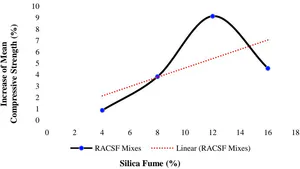
Figure 4 shows that at 28 days, silica fume concentrations of 12% result in a more gradual percentage change in the compressive strength of RACSF in comparison to the control specimen. By adding silica fume of 12%, the compressive strength is improved by up to 9.13%. While using 16% SF content, compressive strength increasing rate went downward at 4.55%. To comprehend the effect of silica fume substitution, the outcome is contrasted with a linear trend. A recent work indicated that the inclusion of silica fume at about
5 to 25% in concrete increases its compressive strength from 6% to 30% [17]. So, after taking into account the 28-day compressive strength test, the 12% incorporation rate of silica fume is decided to be optimal.
{"image_source":{"path":"images/ffa47bc1232432b0b8f675df932293bc50f9397cf232f3a275dae45c11e5466f.jpg"},"content":"","chart_caption":[{"type":"text","content":"Figure 3: Percentage Increase of Compressive Strength 28 Days"}],"chart_footnote":[]}
3.3 Impact of Silica Fume on Splitting Tensile Strength of Concrete
After completing the splitting tensile strength test, Table 4 summarizes the test results of concrete mixes in terms of the mean strength, standard deviation, and lower and greater range of 95% confidence intervals.
| Mixes | Days | Mean strength (MPa) | Standard Deviation, σ | 95% confidence interval | |
| Lower range | Upper range | ||||
| RACSF-0 | 7 | 1.55 | 0.017 | 1.53 | 1.57 |
| 28 | 2.67 | 0.056 | 2.57 | 2.77 | |
| RACSF-4 | 7 | 1.65 | 0.044 | 1.56 | 1.74 |
| 28 | 2.83 | 0.025 | 2.74 | 2.92 | |
| RACSF-8 | 7 | 1.74 | 0.047 | 1.64 | 1.84 |
| 28 | 3.13 | 0.040 | 2.93 | 3.33 | |
| RACSF-12 | 7 | 1.88 | 0.081 | 1.72 | 2.04 |
| 28 | 3.37 | 0.059 | 3.19 | 3.55 | |
| RACSF-16 | 7 | 2.04 | 0.127 | 1.84 | 2.24 |
| 28 | 3.22 | 0.023 | 3.09 | 3.35 | |
Three specimens were tested in the laboratory for each silica fume concentration, and mean values were computed to obtain the final test results for compressive strength at 7 and 28 days. The splitting tensile strength fluctuated from 1.55 MPa to 3.37 MPa. Alongside, the standard deviation of tested specimens ranges from 0.017 to 0.127. The lowest tensile strength was 2.67 MPa with a 95% confidence interval bound of 2.57 MPa to 2.77 MPa and the highest tensile strength was 3.37 MPa with a 95% confidence interval bound of 3.19 MPa to 3.55 MPa. Moreover, a standard deviation of strength less than 1 MPa indicates that the concreting work for this study was done with satisfactory quality control, according to the code of ACI. Figure 4 simply visualizes the variation of mean splitting tensile strength of RACSF specimens at 7 days and 28 days of curing.
The visualization of Figure 5 shows that the concrete made from recycled stone and silica fume performed well according to expectation. It was noticed that mean tensile strength of RACSF specimens increased gradually up to 12% replacement of cement by silica fume. When the replacement level was 16%, the tensile strength of concrete started to decrease. As a result, the study showed that recycled aggregate concrete with certain percentage of silica fume had higher strength compared to control concrete specimens after 7 and 28 days of curing.
{"image_source":{"path":"images/e994756ced81bca961a78294bf2740bf5f028c3e4e8b3bf97e6310aa3f9c90cb.jpg"},"content":"","chart_caption":[{"type":"text","content":"Figure 4: Splitting Tensile Strength Test Results of Racsf Mixes at 7 and 28 Days"}],"chart_footnote":[]}
Figure 6 shows that for silica fume concentrations nearby 12 percent, the gradual percentage change in splitting tensile strength of RACSF relative to the control specimen is greater (26.21%) at 28 days. The result is compared to a linear trend to verify the impact of silica fume replacement. Therefore, 12% is recommended to be optimal silica fume level. The lower value of the split tensile strength is caused by the decreased cohesive force between the aggregate surfaces and cement matrix, which enhances the lower binding tendency in the concrete mix. This conclusion is consistent with the findings of past tests .
{"image_source":{"path":"images/580db198a9d710e1c0244ed68c5e7bac0575031ae2925d92d2d07b58a605baf8.jpg"},"content":"","chart_caption":[{"type":"text","content":"Figure 5: Percentage increase of splitting tensile strength 28 days"},{"type":"text","content":"Effectiveness of Silica Fume as a Partial Cement Replacement in Recycled Aggregate Concrete"}],"chart_footnote":[]}
IV. CONCLUSIONS
Fifteen cube and fifteen cylindrical specimens with different replacement percentages of silica fume were put through compression and splitting tensile testing in this study. The following conclusions can be drawn based on the experimental findings:
Slump of concrete specimens decreased from 79 mm to 64 mm for the addition of silica fume.
For compressive strength, 12% addition of silica fume provided desired results. The maximum increase in concrete strength at 28 days was found to be 9.13% for RACSF-12 specimen compared to the reference specimen RACSF-o.
In case of splitting tensile strength, the percentage increase is much higher than compressive strength. The maximum increase in concrete strength at 28 days was found to be 26.21% for RACSF-12 specimen compared to the reference specimen RACSF-0. Thus 12% replacement of cement by silica fume is recommended as the optimal quantity for both compressive and splitting tensile strength.
Conflict of Interest
The authors declare no conflict of interest.
Ethical Approval
Not applicable
Data Availability
The datasets used in this study are openly available at [repository link] and the source code is available on GitHub at [GitHub link].
Funding
This work did not receive any external funding.
References
Cite this article
Related Research


Special Issue
Launch a focused special issue to highlight research, emerging trends, and expert insights in your academic field.