



IntelliPaper
Abstract
Generative artificial intelligence represents a significant opportunity, particularly in educational settings, as it has the potential to enhance the teaching, learning process. However, its use should aim to integrate and augment, rather than replace, human thought—adopting a logic of inclusion (et, et) rather than exclusion (aut, aut) (Prencipe & Sideri, 2023, p. 99). Firstly, this approach counters the apocalyptic tendency (Eco, 1964) to reject technology—specifically, in this case, AI—on the mistaken assumption that it substitutes human intelligence and, consequently, the learning process. Instead, AI should be framed as a tool designed to facilitate human learning processes (Prencipe & Sideri, 2023, pp. 100, 102). Nevertheless, a fundamental shift must be acknowledged: learning should transition from a focus on merely identifying solutions to a practice centered on formulating well, structured questions, which, in turn, generate meaningful content—whether in the form of images, videos, text, or other media. This is the space within which educators must operate when teaching the use of generative digital tools. In doing so, they should engage with themes of lateral and divergent thinking (Sibilio, 2014, 2016) and embrace the human creative capacity to envision and construct new possible worlds (Berthoz, 2015; Sibilio, 2017). At the same time, the challenge between the various nations is only just beginning, both in terms of the chips that can be used for computing power, and in terms of performance in the generation of multimedia content through artificial intelligence. That is why it is important for a nation to be among those allowed to use top, of, the, line technologies. In the context of increasing regulations on the dissemination of artificial intelligence (AI), the U.S. Framework for Artificial Intelligence Diffusion, introduced by the United States, imposes restrictions that may impact not only global security and the economy but also access to AI, based educational technologies. By limiting the availability of advanced models and specialized hardware, these measures risk creating a divide between countries with privileged access and those subject to restrictions, potentially affecting education, research, and innovation in the educational sector. The U.S. Framework for Artificial Intelligence Diffusion is a regulatory framework issued by the U.S. Department of Commerce on January 13, 2025, with the objective of managing the global dissemination of advanced AI technology through export controls. This regulatory framework aims to balance the protection of U.S. national security and foreign policy interests with the promotion of economic and social benefits derived from the responsible dissemination of AI. Key measures introduced include global licensing requirements for the export of advanced computing, integrated circuits and the "weights" of the most sophisticated AI models, as well as the implementation of licensing exceptions for low, risk destinations and end users. The regulation officially took effect on January 13, 2025. The U.S. Framework for Artificial Intelligence Diffusion also includes restrictions on the types of advanced chips that can be exported, particularly high, performance processors used for training and executing sophisticated AI models. The United States seeks to limit access to these chips by countries deemed high, risk for national security or potential military applications. Countries classified as "high, tier" (low, risk countries, among which Italy) benefit from licensing exceptions, meaning they can more easily access advanced hardware and the most sophisticated AI models without undergoing lengthy approval processes. This facilitates technological innovation, research, and development without significant restrictions. Conversely, lower, tier countries may face limited access or be required to obtain case, by, case approvals, slowing the adoption of advanced technologies and putting them at a disadvantage compared to nations with fewer restrictions (Clifford Chance, 2025; Rand Corporation, 2025).
The U.S. Framework for Artificial Intelligence Diffusion could also affect AI, related educational software in three main areas: 1) Access to Advanced AI Models (if an educational software application relies on advanced AI models for virtual tutoring, content generation, or personalized learning, it may be subject to restrictions if these models require advanced hardware or neural network weights that fall under export controls); 2) Availability of Hardware for Training (schools, universities, and startups in restricted countries may face challenges in accessing GPUs and advanced chips necessary for research and development in the educational sector. This could limit the adoption of AI, based educational tools or slow down the development of new applications); 3) International Collaborations and Exchanges (if a country is not classified as "high, tier," obtaining licenses to use state, of, the, art AI software and hardware may be difficult. This could impact global educational projects, such as Massive Open Online Courses (MOOCs) or advanced e, learning platforms that leverage AI). In modern education this will have a strong impact, due to the fact that digital technology plays a crucial role in enhancing learning experiences.
Explore Digital Article Text
I. INTRODUCTION
Intelligence Diffusion also includes restrictions on the types of advanced chips that can be exported, particularly high, performance processors used for training and executing sophisticated AI models. The United States seeks to limit access to these chips by countries deemed high, risk for national security or potential military applications. Countries classified as "high, tier" (low, risk countries, among which Italy ) benefit from licensing exceptions, meaning they can more easily access advanced hardware and the most sophisticated AI models without undergoing lengthy approval processes. This facilitates technological innovation, research, and development without significant restrictions. Conversely, lower, tier countries may face limited access or be required to obtain case, by, case approvals, slowing the adoption of advanced technologies and putting them at a disadvantage compared to nations with fewer restrictions (Clifford Chance, 2025; Rand Corporation, 2025).
The U.S. Framework for Artificial Intelligence Diffusion could also affect AI, related educational software in three main areas: 1) Access to Advanced AI Models (if an educational software application relies on advanced AI models for virtual tutoring, content generation, or personalized learning, it may be subject to restrictions if these models require advanced hardware or neural network weights that fall under export controls); 2) Availability of Hardware for Training (schools, universities, and startups in restricted countries may face challenges in accessing GPUs and advanced chips necessary for research and development in the educational sector. This could limit the adoption of AI, based educational tools or slow down the development of new applications); 3) International Collaborations and Exchanges (if a country is not classified as "high, tier," obtaining licenses to use state, of, the, art AI software and hardware may be difficult. This could impact global educational projects, such as Massive Open Online Courses (MOOCs) or advanced e, learning platforms that leverage AI). In modern education this will have a strong impact, due to the fact that digital technology plays a crucial role in enhancing learning experiences.
II. NPC: THE STATE OF THE ART
Non-Player Characters (NPCs) are characters within a game that cannot be directly controlled by the player. They can be neutral, allies, or adversaries, and they can exhibit different interactions or behaviors based on variables such as the environment or interactions with the player character. The first definition of NPCs (West N., 1996) describes them as non playable characters specifically created by the Game Master in a role, playing game, thus originating as functional elements for creating interactions alternative to player, to, player interactions. The potential arising from the creation of this type of player, game interaction can be expressed in multiple aspects of a game, from the more superficial, related to specific functions for game progression, to the deeper, related to the immersiveness of the game itself. The dual objective of functionality and immersiveness remains even with the increasingly widespread application in video games. What changes with the new application context is rather the management of NPCs. While in role, playing games it is the game master, or sometimes the players themselves, who trigger NPCs through random events like dice rolls or player decisions, in the case of video games, the automated management of NPCs effectively becomes a programmer's problem. This problem is solved from the outset thanks to the application of a theory that computer scientists had known long before the 1980s, namely that of finite state machines (FSM). An FSM contains a set of states and conditions that allow the machine to transition from one state to another. The FSMs that are assigned to NPCs allow them to behave accordingly based on their current state, and when a condition is met, the machine can transition to another state (Uludağlı, M. Ç., & Oğuz, K., 2023). The solution strategy proposed by FSMs is still used today for a large portion of the NPCs present in video games, however, the intrinsic limitations of the theoretical model continue to require a progressive effort in the search for alternative solutions. In order to keep the number of transition states low, which grows exponentially with respect to the number of states, there is a tendency to reduce the number of states, often causing anomalous or approximate behaviors compared to what a player expects. Naturally, as in reality, most individual interactions with the environment can be well approximated by an FSM model. An example of this is all those people with whom we have disposable interactions. Conversely, in a small part of our relational system, a much higher number of different interactions are concentrated. An example of this is the teachers we had during our school period. These cases, therefore, even if smaller in number, are of greater importance. In other words, to improve the level of immersiveness, it is necessary that some NPCs can satisfy multiple functionalities and realize multiple interactions with the player. As it results from a much more extensive literature than that relating to FSM, based NPCs, the most versatile and widely discussed theoretical model is decision trees. A tree, defined as an acyclic and connected graph (Harju, T., 2011), lends itself easily to modeling the action, consequence schemes that regulate the behaviors of NPCs. In fact, each NPC always possesses a default behavior, usually associated with the base of the tree called the start node, a set of conditions structured hierarchically and associated with the intermediate nodes, and a set of final behaviors associated with the leaves that are realized based on whether or not the previous conditions are met (Millington, I., 2019). In addition to identifying characteristics common to all NPCs, the new model proves to be much more expressive than the FSM model, as each action of the NPC occurs as a result of one or more series of events or paths of the tree. The different paths, on one hand, efficiently address the need to have the NPC perform certain actions or functionalities, on the other hand, they highlight the problem of repetitive action typical of, for example, early fighting video games (Lie and Istiono, 2022). The player who has identified a certain strategy, therefore an effective path for a certain response from the NPC, will tend to apply it in subsequent times as well, risking in the short term to deprive themselves of part of the gaming experience and in the long term to lower the level of engagement. This phenomenon, which is certainly the primary enemy of companies that develop video games as it could lead to a drop in sales, also has an impact on the quality of the player themselves, increasingly tending towards sterile automatism and less competent regarding the game. The resolution of this problem plays a central role in the introduction of Artificial Intelligence, based methods in video games. The works in the literature that deal with the application of AI in video games are numerous. In this contribution, however, we will focus on a particular class of NPCs that are equipped with AI methods in order to improve their own credibility, understood as similarity to the human being in expressive and social capabilities. Particularly in cases where the purposes of the game are educational, AI regulates the behaviors of NPCs not to oppose the player's strategies in an adaptive way, but rather to cooperate for the educational experience proposed to the student or, more generally, to the player. The work of Cassel, J. et al. (1999) is one of the first to present an NPC of this type. Real Estate Agent, simply called REA, has a human, like face and body, gestures, is able to interpret the audio and video information provided by the player, and produces responses based on functions that make the conversational module versatile. In the work of Mateas, M., & Stern, A., (2003), the emulation of a daily life scene is proposed where multiple interactions are possible in a virtual environment shared with a couple of NPCs. The interactions, and in particular the text typed to communicate with the NPCs, constitute the information processed by an abstract entity that manages the course of the storyThe NPC described in the work of Poggi, I. et al., (2005), although it may seem rudimentary in some respects today, contains multiple key components of communication. In fact, the generated responses can be enjoyed both by reading and listening to the respective audio file; furthermore, the phonemes present in the audio file constitute part of the input of a module that modifies the facial expression of the NPC in a manner consistent with the potential emotional state of the NPC. The emotional component, in fact, remains one of the main objects of research, as evidenced by the article by Rowe, J. et al., (2009), in which the group investigates a strategy that can make NPCs dynamic also with respect to the player's emotional state. In the virtual environment presented, the dialogues of the NPCs are not static but are generated in a manner consistent with the character's characteristics, the narrative context, and the NPC's own communicative objectives. Over the years, the potential of these tools has sparked the interest of an increasing number of application contexts, with the development of NPCs verticalized on increasingly specific tasks. The research group of McCoy, J. et al. (2011) presents a social simulation game for adolescent students in which AI is used to manage the evolution of social relationships between the player and the various NPCs, while the edugame developed by Yunanto, A. A. et al., (2019) is designed for a much younger student audience. In this case, the highly cartoonized NPCs use a Natural Language Processing model to analyze English grammar questions and respond from among the possible alternatives before the player. In the serious game proposed by Tato, A. et al. (2020), the player must overcome 5 levels, and in each level, there are various NPCs who can help in reflecting on the social issue proposed in the level. The video game detects emotion through the analysis of facial expressions, but this information does not influence the type of interactions with the NPCs, who can express agreement or disagreement with what the player has typed only through the appearance or absence of a downward, pointing arrow. An example for a type of adult student comes from the serious game developed by Panopoulou, E., Aversa, D., & Vassos, S., (2023), where the virtual experiences are of interest to Law Enforcement Agencies, such as police officers.
III. NPC VS HUMAN TEACHING TRAINER
One innovative approach to education is the integration of digital assets, such as videos and 3D objects, into virtual educational environments managed by Non-Player Characters. These environments offer new opportunities for interactive and personalised learning, catering to different learning styles and increasing accessibility (Yannakakis & Togelius, 2018). By leveraging curated digital resources within virtual spaces, educators can create engaging, flexible, and collaborative educational experiences that adapt to students' needs and preferences (McCoy et al., 2011).
Recent meta-analytic evidence on Virtual Digital Human Pedagogical Agents (VDHPAs), a category that also includes NPCs equipped with human-like interaction capabilities, confirms their significant pedagogical potential in immersive Virtual Reality contexts. The analysis conducted by Zhang and Mo (2025), based on a synthesis of 36 empirical studies published between 2013 and 2023, reveals that although VDHPAs do not lead to a significant reduction in cognitive load, they foster a moderate yet significant increase in students perceived social presence. This finding aligns with the definition of social presence as the degree to which a learner perceives themselves to be in the company of another intelligent and attentive interlocutor (Biocca et al., 2003). Research in immersive virtual environments (Kyrlitsias & Michael-Grigoriou, 2022) indicates that high levels of social presence contribute to stronger engagement, increased trust, and more collaborative learning behaviours. Such effects are amplified when NPCs or other pedagogical agents employ non-verbal cues, such as simulated eye contact, synchronous gestures, and expressive intonation, that enhance the sense of co-presence and emotional connection with the learner.
Even more noteworthy is their positive impact on learning-related variables such as knowledge retention, the transfer of skills to new context, and other assessment outcomes.
From a technological perspective, an educational NPC relies on artificial intelligence modules capable of processing multimodal input (text, voice, and gestures) and delivering adaptive responses (Cassell et al., 1999; Poggi et al., 2005). Machine learning algorithms, particularly in the domains of Natural Language Processing (NLP) and Dialogue Management, enable the NPC to interpret student queries, retrieve relevant information from structured knowledge bases, and tailor explanations to the learner's profile (Rowe et al., 2009). Through speech synthesis and embodied conversational agents, the NPC can present information in a human-like manner, using voice modulation and gestures to enhance engagement (Mateas & Stern, 2003). Indeed, the studies by Zhang and Mo (2025) also highlighted how agent design features, such as gestures, facial expressions, and human-recorded voices, significantly moderate effectiveness, with gestures enhancing clarity and voice naturalness increasing emotional engagement. In addition to emotional engagement, these design features enhance both social presence and telepresence, the latter referring to the subjective feeling of "being inside" the virtual environment (Steuer, 1992). Studies in VR-based learning contexts (Kyrlitsias, & Michael-Grigoriou, 2022) indicate that when social presence and telepresence are both high, learners are more likely to internalise complex concepts and sustain attention over longer periods.
Embedded analytics modules allow tracking of learners' progress in real time, identifying gaps and reinforcing content where necessary, aligning with principles of adaptive learning (Panopoulou et al., 2023). In this regard, du Plooy et al. (2024) highlight that personalised adaptive learning approaches, supported by AI-driven feedback and continuous performance monitoring, can significantly improve academic performance and engagement. Their review of 69 studies in higher education reports that approximately observed measurable performance gains, while recorded improvements in student engagement, confirming that adaptivity is a key factor in sustaining motivation and optimising learning trajectories.
From a pedagogical perspective, NPCs excel in tasks where repetition and standardisation are essential, such as providing consistent explanations of core concepts and delivering targeted practice exercises (Tato et al., 2020). They can instantly adjust the pace and complexity of instruction according to learner performance data, thus enabling a form of differentiated instruction that is otherwise challenging for a single human trainer to achieve simultaneously across a large group (Yunanto et al., 2019).
However, the human trainer brings irreplaceable skills in emotional intelligence, improvisation, and socio-cultural sensitivity, which remain critical for fostering deep learning and higher-order thinking (Sibilio, 2014; Berthoz, 2015). One of the most significant strengths of NPC-based training lies in accessibility and inclusivity. Equipped with assistive technologies, NPCs can provide captions, real-time translations, and alternative content formats, such as simplified text, interactive diagrams, and audio descriptions, allowing learners with diverse cognitive and physical abilities to engage fully with the material (Aiello, 2024). This capability aligns with Universal Design for Learning (UDL) principles, which emphasise multiple means of representation, engagement, and expression.
Nevertheless, challenges persist. Current conversational AI still struggles with sustaining long-term contextual memory and recognising nuanced emotional states, meaning that the human element remains essential for promoting critical thinking, creativity, and socio-emotional development (Sabir et al., 2024).
From a broader perspective, the combination of adaptive instructional capabilities and the ability to simulate social presence positions NPCs as powerful facilitators of learner engagement. By reducing the psychological distance between instructor and student, NPCs can transform remote or virtual settings into emotionally rich learning spaces, comparable in some respects to face-to-face interactions (Kyrlitsias & Michael-Grigoriou, 2022). In practice, the most effective model appears to be hybrid, where NPCs handle routine instructional tasks and adaptive content delivery, while human trainers focus on mentoring, fostering creativity, and managing complex classroom dynamics (Beatini et al., 2024).
In other words, NPCs should not be seen as replacements for human educators, but as pedagogical amplifiers, tools that extend the reach of teachers, ensure continuity of instruction, and enrich the learning experience through adaptive, data-driven strategies. Their successful integration depends on aligning technical capabilities with clearly defined pedagogical objectives, ensuring that technology support the human dimension of teaching.
IV. NON-PLAYER CHARACTER WITHIN A VIRTUAL MUSEUM
An alternative to the conventional linear approach to museum visits, often solitary experiences for visitors who may not be well, versed in the subject matter before them, can be found in multimedia and multimodal technologies. Consider, for instance, a tourist exploring a capital city who decides to visit a major museum, or a traveler on a day trip who stumbles upon a historic castle, enters, and encounters a museum filled with remarkable artworks, yet explained only through cold, static captions placed beside the objects. In such cases, digital tools such as edugames, virtual reality, and 3D printing offer valuable opportunities for engaging visitors with different learning styles. For these technological tools to be truly effective, they must be adapted to accommodate diverse cognitive styles, recognizing that each form of intelligence encompasses a set of psychological processes. The virtual environment represents a significant departure from traditional museum education, which is primarily structured around display cases and textual descriptions, relying almost exclusively on linguistic abilities. This approach does not always succeed in stimulating curiosity and interest in all visitors (Sibilio, 2024).
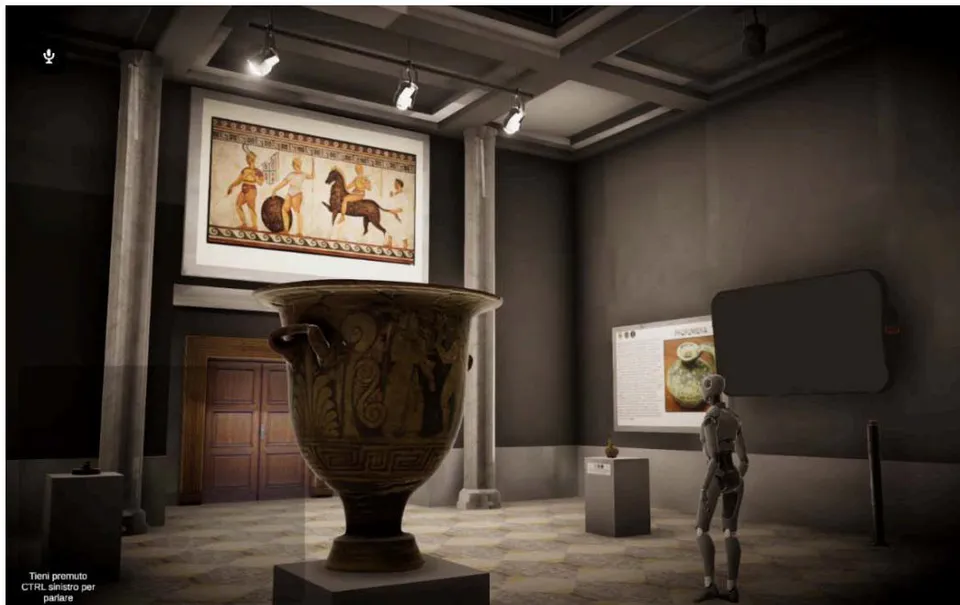
This potential becomes even more powerful when 3D environments feature a NPC capable of responding to visitors' questions. If properly trained using materials provided by museum directors, art historians, archaeologists, and experts, such an NPC could effectively communicate with both children and specialists alike, offering tailored and contextually relevant information. More in detail, An NPC (Non-Player Character) in a virtual museum serves as an essential tool for enriching user experience through various interactive functions. Firstly, it can act as a virtual guide, providing detailed information about artworks, exhibited objects, and the museum's history while allowing users to engage through questions and receive personalized responses. Additionally, the NPC can introduce storytelling elements by narrating historical contexts and anecdotes about artists and their works, making the experience more immersive and engaging. From an educational perspective, the NPC can facilitate learning through interactive activities and quizzes, promoting user engagement with the exhibited content. Moreover, it can offer technical support and accessibility features, such as adjusting brightness, contrast, and viewpoint, ensuring an inclusive experience for individuals with learning disabilities, special educational needs, or physical limitations; or consider intellectual disability, which is a condition characterized by significant limitations in intellectual functioning and adaptive behavior, affecting conceptual, social, and practical domains (Aiello, 2024).
The NPC can also personalize interactions by recommending artworks based on users' interests and preferences, enhancing their exploration. Finally, it can introduce entertainment and social interaction components, incorporating jokes, games, or casual conversations to make the visit more enjoyable. Overall, the presence of an NPC in a virtual museum significantly enhances the interactivity, educational value, and engagement of the user experience.
The implementation of an NPC within a virtual museum requires the integration of multiple technological components, ranging from artificial intelligence to real-time computer graphics, and extending to museum information systems management.
Over the years, the Teaching Learning Center for Education and Inclusive Technologies – Elisa Frauenfelder of the Department of Human, Philosophical, and Educational Sciences at the University of Salerno has collaborated with numerous museums to refine techniques for managing the virtualization process of cultural heritage. Notable examples include the Virtual Museum of Herculaneum, the National Archaeological Museum of Sannio Caudino, the Civic Museum of Carife and Baronia, the Filangieri Museum in Naples, the Historical Museum of Villamaina, the Museum of Memory and Peace – Giovanni Palatucci National Study Center, and the De Chiara De Maio Foundation. Theoretical reflections on how the edugame should function were inspired by numerous exchanges with the Collège de France and Professor Emeritus Alain Berthoz (Di Tore, Todino, Di Tore, Sibilio & Berthoz, 2023), as well as with the University Hospitals Pitié Salpêtrière (Beatini, Cohen, Di Tore, Pellerin, Aiello, Sibilio & Berthoz, 2024). Additionally, further contributions came from collaborations with the Città della Scienza in Naples and the Cité des Sciences et de l'Industrie in Paris.
V. LOADING DIGITAL ASSETS INTO A VIRTUAL EDUCATIONAL ENVIRONMENT MANAGED BY AN NPC
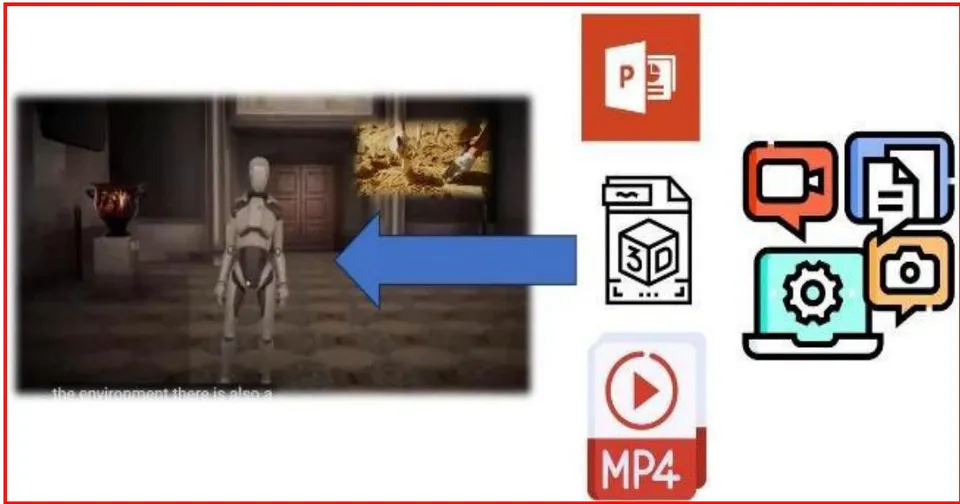
In recent years, the evolution of virtual learning environments has made it possible to integrate heterogeneous digital assets, 3D models, interactive videos and multimedia repositories, into an instructional framework mediated by NPCs. This synergy between multimedia content and artificial intelligence enables the design of personalized and adaptive learning experiences that can respond in real time to students' needs, adjusting the difficulty and the mode of information delivery (Mayer, 2022). Literature highlights that diversifying input channels, visual, auditory, and kinesthetic, promotes better comprehension and retention of information, especially when content is contextualized within immersive and narratively coherent scenarios (Moreno & Mayer, 2007).
From an engineering perspective, the operation of a virtual learning environment managed by an NPC relies on a multi-layer architecture. The content layer hosts and organizes multimedia assets within a content management system (CMS) compatible with international educational standards, such as SCORM, ensuring not only interaction tracking but also granular analysis of performance and learning sequences. At this stage, external repositories and libraries of 3D objects optimized for real-time, reducing loading times and improving usability even in low-bandwidth contexts.
The processing layer constitutes the intelligent core of the system, implementing pedagogical rules and machine learning algorithms to adapt content delivery. Here, Natural Language Processing systems are employed to interpret student questions, predictive analytics models to anticipate difficulties and attention drops, and recommender systems to suggest supplementary materials based on the learner's progress and preferences. Personalization is achieved through learner profiling models that integrate historical data, real-time performance, and behavioral indicators, enabling the modulation not only of conceptual complexity but also of the NPC's communicative style.
The presentation layer manages visual rendering and interaction, integrating assets and interfaces into navigable three-dimensional environments developed with graphic engines such as Unity or Unreal Engine, and enriched with embodied interaction elements and multimodal interfaces. In this context, the NPC acts as an interface orchestrator, managing procedural animations, lip-sync, gestures, and emergent behaviors to enhance realism and presence.
VI. CONCLUSIONS
Within this ecosystem, the NPC serves as an intelligent instructional mediator. In addition to selecting and presenting the most relevant content based on the learner profile, it provides immediate feedback, guides learning through targeted exercises, and fosters metacognitive reflection. Recent studies indicate that the presence of conversational agents in VR environments can significantly increase social presence and telepresence, elements strongly correlated with sustained attention and intrinsic motivation (Zhang & Mo, 2025).
From an interoperability standpoint, adopting semantic standards such as CIDOC CRM and the Europeana Data Model allows the integration of resources from different institutions, ensuring broad reusability and enriching the shared educational heritage (Doerr, 2003). These standards can be combined with security protocols and privacy-by-design approaches to ensure personal data protection, a fundamental requirement in international educational contexts.
The use of NPCs in digital asset management also opens significant prospects for educational inclusion. Features such as automatically generated audio descriptions, real-time adaptive captions, and voice-controlled interfaces can make the learning experience truly universal. Despite technological advancement, the literature agrees that the role of the human educator remains indispensable, as a bearer of emotional competence and critical judgment that AI, at its current state, is not yet able to replicate (Sibilio, 2014).
Looking ahead, the convergence of digital assets, immersive environments, and advanced NPCs could redefine the concept of the virtual classroom, transforming it into an open, adaptive, and culturally rich space where physical distance is no longer a barrier but an opportunity to expand the boundaries of learning and foster truly global and connected education.
Conflict of Interest
The authors declare no conflict of interest.
Ethical Approval
Not applicable
Data Availability
The datasets used in this study are openly available at [repository link] and the source code is available on GitHub at [GitHub link].
Funding
This work did not receive any external funding.
References
Cite this article
Related Research

Special Issue
Launch a focused special issue to highlight research, emerging trends, and expert insights in your academic field.