


Abstract
Purpose - The purpose of this research was to explore the needs for which new ventures seek support from regional innovation clusters in Franconia.
Design/methodology/approach - A qualitative, embedded case-study approach was implemented to investigate startup company cases within a regional innovation cluster. Semi-structured interviews were used to question ten innovative German startup founders located in Franconia. A nonprobability purposive sampling technique compilation of the surveyed startups resulted from a list of Center for Digital Innovation Franconia clients, classified into five foundation phases.
Findings - The analysis showed a significant dissonance between the resources required by entrepreneurs and the services offered by innovation clusters.
Research limitations/implications - The results of the study provide further insights into the increasingly digital startup culture in Franconia. Results are limited to startups founded by German entrepreneurs and their network within a local innovation cluster. A comparison with other areas and (less digital/service-oriented) industries is the logical continuation of this research.
Practical Implications - The study provides essential indications for private and public stakeholders of innovation centers to optimize the support factors for business startups. Furthermore, the findings may be helpful for decision-makers to understand that digital startups need different and faster support than in the past.
Originality - Unlike many other studies that examined the economic impact, innovativeness of a region, and usability for established companies, or impact on jobs, this study is one of the few focusing directly on young entrepreneurs and their needs. The paper shows that there is a gap in the literature on this topic, and this analysis is intended to fill this gap by comparing the founders’ needs with the actual support provided by innovation clusters.
Paper type - Qualitative embedded case study
Explore Digital Article Text
I. INTRODUCTION
According to Schumpeter (1943), economic change and technological innovation start with the action of an individual entrepreneur. Groth, Esposito, & Tse (2015) saw the economic renewal in Europe as being outdated; it was "no longer in line with the needs and speed of today's business landscape" (p. 263), and the researchers argued for an update, calling "for an entrepreneur-driven innovation ecosystem (EDIE) in Europe" (p. 263). Although Germany's ranking on the World Innovation Index at ninth place in 2019 was above average (Global Innovation Index, 2019), the country "identified its weakness in commercializing innovation through entrepreneurship" (Maritz, Koch, & Schmidt, 2016, p. 8). Both the overall number of startup companies and the percentage startup ratio fell in Germany during the period 2000-2015 (Heilman, Jung, &
Reichart, 2015). While many studies have discussed innovation clusters and regional innovation systems from a general perspective, relatively little is known about why entrepreneurs build on external support and what are the most needed support factors for success (Brown, Gregson, & Mason, 2015; Engel, 2015; Groth et al., 2015; Heilman et al., 2015; Loué & Ben Slimane, 2017; Maritz et al., 2016; Mubarak AL-Mubaraki & Busler, 2014; O'Dwyer, O'Malley, Murphy, & McNally, 2015; Pinkwart, 2016; Sonn & Kang, 2015; Thomas, Passaro, & Quinto, 2019; Tsai & Chang, 2016; Uzlov & Li-chun, 2017).
This research focused on a specific innovation cluster in Bavaria, Germany, and the article is structured as follows. The introduction presents the main topic of the paper, some background information about the Franconian innovation cluster, startups, and the importance for the economic landscape. The second section introduces a theoretical framework that connects a resource-based view on companies to entrepreneurship followed by a comprehensive literature review on cluster and entrepreneurship theories, from which a conceptual framework is adopted to start the analysis. The general research question was, which support from a local innovation cluster is useful for startups and which is less important. To answer this, the expectations of individual entrepreneurs were identified using a qualitative interview technique. Finally, the expectations of the interviewed founders were examined and discussed regarding selected elements of cluster theories. Conclusions, limitations, and research implications complete the picture.
II. BACKGROUND OF THE STUDY
The region of Franconia is adjacent to the economically important area of the Rhine-Main east of Frankfurt, Germany. Not only did Frankfurt host the world's largest internet exchange point (in terms of traffic), the region was often compared to Silicon Valley (Elbert, Müller, & Persch, 2009). Analyzing IT clusters in the USA, Finland, India, and Germany, Elbert et al. (2009) concluded that the Rhine-Main area as a cluster for information and communication technology was leading in Germany, but it was still in the development stage in a global comparison. Compared with other IT clusters, there was a particular backlog in the field in terms of providing startup capital, immigration of highly qualified professionals, software patents, and cultural factors such as job-hopping (Elbert et al., 2009). The Global Startup Ecosystem Report listed Frankfurt as one of the hot spots, especially for financial technology entrepreneurs, called FinTech (Startup Genome Project, 2017). Considering the potential, economic dynamics, and digitization, the Wirtschaftswoche magazine listed the cities of Frankfurt, Würzburg, and Erlangen in the top ten cities with the best future prospects, followed by Fürth and Nuremberg in 15th and 16th place as an axis through Franconia in the middle of Germany (Losse & Crocoll, 2019). In 2017, the new Center for Digital Innovation Franconia was founded in Würzburg (Andersen, 2018). Focusing on digital innovations was supported by the fact that most German startups in the second decade of the century were based on IT/Software , eCommerce , and other digital topics like Online-Platforms , FinTech , or Gaming . Previously typical German business domains such as Hardware/Industrial Engineering or NanoTech/BioTech lagged far behind (Kollmann, Stöckmann, Hensellek, & Kensbock, 2017). Local companies, universities, cities, the Bavarian government, and organizations like the chamber of commerce and business incubators formed a founding support ecosystem to increase the start-up activity in the field of digitization. It was the umbrella structure for several business incubators and co-working spaces for entrepreneurs in different stages, the science park with laboratories, entrepreneurship lectures, networking events, contests, startup coaching, and funding or legal advice (Andersen, 2018). Furthermore, regular workshops were organized to connect the various groups of students, founders, entrepreneurs, and public institution representatives. Topics included design thinking, funding sources, digital innovation, and digitization intellectual property rights (Andersen, 2018). Equivalent structures were initiated in the Franconian cities of Schweinfurt and Bad
Kissingen, and similar institutions in the cities of Aschaffenburg, Nürnberg, Erlangen, Schwabach, Ansbach, Bamberg, and Hof (Walther, 2018). With regard to the literature, this seemed to be a mixed approach of a traditional cluster with elements of a regional innovation system (Häfner, 2014).
Through innovation systems, politicians expected greater regional innovation and economic growth, and a dynamic within the cluster that enhanced productivity, innovativeness, and networking among universities, startups, and established businesses (Rösler, 2012; Engel, 2015). Elsewhere in Germany, similar facilities sprouted up, and politicians hoped for a new Silicon Germany (Keese, 2016). Amorós, Felzensztein, and Gimmon (2011) noted that governments worldwide were increasingly trying to support entrepreneurship in peripheral regions. Engel (2015, p. 36) saw the regional economic scene "littered with Silicon Valley imitators" while Fritsch and Wyrwich (2013) found a positive relationship in Germany between business startups and regional population density. Consequently, attempts were made in this study to address the questions of (a) whether it would make more sense to concentrate efforts to a few hot spots in Germany, Berlin for example, to consider the needs of the local startup culture more closely, and (b) which external support factors are relevant to make startup companies successful.
The "easy adoption of a one-size-fits-all solution in regional strategy production" has been criticized scientifically (Makkonen & Inkinen, 2014, p. 216). Makkonen & Inkinen thought that instead of an unbiased adoption and cloning of competitiveness rhetoric, it might be better to differentiate among the underlying compositions of the regions (2014). While Groth et al. (2015) compared innovation ecosystems in Europe with California's Silicon Valley, Häfner (2014) remembered that in Silicon Valley the roots were grounded more in defense policy and did not represent an explicit cluster policy, which was supported in the historical analysis of O'Mara (2019). Engel (2015) attributed the success of Silicon Valley, among other things, to the entrepreneurial spirit and willingness to take big risks among the population during the California Gold Rush days. Engel felt it was still not clear if top-down activities, supported and financed by the government, could compete with the bottom-up infrastructures and networks that originated (2015). Consequently, there were examples of terrific failed regional innovation policies like Scotland's Intermediate Technology Initiative (Brown et al., 2015). As a result, the need for more research regarding policymaking in regional entrepreneurship ecosystems has been continuously expressed (He, MacNeill, & Wang, 2014; Amorós et al., 2011; Brown et al., 2015; Sonn & Kang, 2015).
Purpos of the study
Innovation-driven ecosystems for entrepreneurs require a variety of factors such as "knowledge and intellectual property (IP), capital, talent, relationship, and trust among multiple stakeholders, such as governments, corporations, startups, private equity, private laboratories, public laboratories, and universities" (Groth et al., 2015, p. 265). This study focused on external resources and support for early-stage innovators. Specifically, the research explored the needs for which new ventures seek support from regional innovation clusters in Franconia. Groth et al. suggested that an excellent start would be to ask all actors about activities, interactions, and interests to identify possible "gaps and hurdles in order to understand motivations and possible ways to add value" (2015, p. 265). Monsson and Jørgensen (2016, p. 224) likewise recommended further research "in order to learn which elements provide the different kinds of entrepreneurs with a critical factor in determining their success or failure." Thomas et al. (2019, p. 15) formulated the literature gap in the following way:
Future surveys should focus their analyses at least on three directions. Firstly, a clear individuation of the needs and resources requested by digital firms and startups in the light of their own specificities; secondly, the detailed examination of the operative mechanisms of existing ecosystems precisely focused on digital technologies; and lastly, an investigation on the coherence among digital technologies with the local background of competencies and knowledge to individuate possible gaps to fill.
The aim of this study was to help fill this gap by comparing a group of founder's needs with the offered and experienced external support by innovation clusters. Special attention was given to the Franconian environment and the field of digital industries. The strategy to find out why and how startups accept external support was through the use of an embedded case study (Yin, 2017). This embedded case study involved a major unit (Franconian Innovation Cluster) and individual subunits (digital startups).
III. RELATED RESEARCH
In the first decades of the 21 century, scientists of various disciplines repeatedly dealt with the phenomenon of innovation clusters around the world. Ibata-Arens (2008) described it as a critical mass that had to be reached to transform Kyoto, Japan's conservative and traditional capital into a vibrant, successful startup ecosystem. Likewise, network governance seemed to have an encouraging effect on supporting entrepreneurship in regional clusters of Romania (Dodescu & Pop-Cohut, 2012).
However, analyzing the success factors within incubators, the finding of the Salvador, Mariotti, and Conicella study was that the physical location in a science park or incubator and the virtual participation in an innovation cluster could be more a supplement than a substitute (2013). This correlated with the Heilman et al. study which suggested integrating incubators into a larger innovation cluster in order to exploit strengths successfully (2015).
Exploring entrepreneurship at the periphery in Chile, Felzensztein et al. (2013) observed that those startups miss entrepreneurial resources and access to markets, but surprisingly, saw more significant business opportunities in the region. He, MacNeill, and Wang (2014) concentrated on the core elements of networks and embeddedness for regional innovation systems in the UK, identified weaknesses in the cluster policy and for the overall network structure, and formed a model of regional development based on learning.
Makkonen and Inkinen (2014) described innovation systems and clusters as "the most widely used concepts found in recent economic geography literature focusing on innovative industrial production and locational agglomeration" (p. 216). However, several researchers also critically explained political activism with which regional economic development was conducted in a populist and short-term manner (Makkonen & Inkinen, 2014; Häfner, 2014). In the meantime, scientific policy advice with its theories and models could not catch up fast enough. Economic geographers feared an improper application of the cluster concept, which could lead to unsatisfactory results (Häfner, 2014) or the reduction to buzzwords in policymaking (Makkonen & Inkinen, 2014). General criticism of Porter's cluster theory came mainly from the ill-defined spatial classification of clusters and the insufficient consideration of social processes. It was difficult to fathom that the activities in a cluster on the scale of a city triggered the same effects as on the state or country level (Häfner, 2014).
Consistently, studies about regional innovation systems highlighted "the weakness in the theoretical underpinnings of policy making, particularly regarding the overall network structure" (He et al., 2014, p. 1555). Thus, researchers pleaded for the cluster theory to be supplemented by a theory of cluster politics (Häfner, 2014).
In Germany as well, the development of clusters has become one of the most popular goals of regional economic development since 2000 (Häfner, 2014). This is also apparent from the publications of the Federal Ministry of Economics and Energy (Rösler, 2012). Likewise, in Bavaria exists a funding program called Cluster-Offensive Bayern (Häfner, 2014).
Fritsch and Wyrwich (2013) investigated regional differences in Germany in terms of new business formation from 1925 to 2005. It turned out that the regional culture of entrepreneurial independence was persistent throughout the 80-year period in spite of profound changes in the political and economic environment. Engel (2015) compared Silicon Valley with different worldwide approaches to promote innovation clusters and concluded that the "major reason why efforts to transplant the ecosystem of Silicon Valley to other locations have not been successful is that the local context – key players, economic strengths and weaknesses, political realities, and cultural norms – have been ignored rather than incorporated" (p. 47). Unlike a planned approach, Engel (2015) knew that many of the vibrant, innovative clusters "evolved rapidly from a startup history" (p. 37). He emphasized that "resources of people, capital, and know-how are fluidly mobile, and the pace of transactions is driven by a relentless pursuit of opportunity, staged financing, and short business model cycles" (p. 37).
Disappointing experiences were made with the RIS in South Korea (Sonn & Kang, 2015). They accused politics of abusing academic concepts "to legitimize the continuation of its old politics" (p. 548). The reinterpretation of RIS theories led to bureaucrats picking out individual measures that served individual interests.
Nevertheless, there exist successful examples like The Lowry in Salford/Manchester or The Guggenheim Museum in Bilbao where lighthouse projects in a region could initiate a "culture-led regeneration" (Sonn & Kang, 2015, p. 549). This is supported by Florida's theory of the creative class (Florida, 2014). Florida saw an advantage in those places where technology, talent, and tolerance could be combined. Creative people were most likely to settle where these three factors are encouraged (2014).
Numerous studies and analyses highlighted individual aspects that helped to develop and support innovative new businesses. Thus, studies have examined the importance of external networking within business incubators (Cantù, 2015), which in turn could be an integral part of an innovation cluster. While multinationals within innovation clusters can mobilize multiple resources (O'Dwyer et al., 2015), startup companies face major challenges regarding financing, legal issues, bureaucratic startup formalities, staffing and space issues, building a technical infrastructure, supplier relationships, or access to markets and marketing support. As a result, startups were heavily dependent on external support, especially in the initial phase (Heilman et al., 2015).
Brown et al. (2015) analyzed the reasons why the Scottish regional innovation policy failed after ten years and an initial budget of 450 million Euro. It had its critical point in the commercial exploitation of the inventions. University spin-offs just did not meet expectations. Furthermore, it turned out that regional SMEs in Scotland did not have the technology and knowledge to take advantage of the market opportunities. They were not able to utilize enough generated intellectual property so that there could be an economic benefit to the regional environment. Moreover, some academic high-technology ideas were not immediately ready for commercialization. They would have needed global players to advance platform technologies with further research and development work, for which no multinationals existed in Scotland. In the end, Scottish intellectual property (funded by the regional program) ended in acquisitions of the new ventures by US global players (Brown et al., 2015).
Nevertheless, an entrepreneurship-friendly ecosystem could also be identified as a growth factor for emerging countries such as Morocco (Kabbaj, Hadi, El Ouazzani, Elamrani, & Lemtaoui, 2016). A key benefit for science parks in Taiwan seemed to be a good relationship with partner and parent companies (Tsai & Chang, 2016).
Moreover, scholars outlined differences in the use of the possibilities within a business incubator network, depending on the entrepreneurs' characteristics and experience (Monsson & Jørgensen, 2016). One of the few studies that reviewed success factors in a larger scale by direct interviews with entrepreneurs was carried out in Berlin. Nearly 200 internet technology startups were interviewed about fostering and hindering factors (Richter, Schildhauer, Volquartz, &
Neumann, 2016). However, the focus was encouraged by a methodology that took Human Resources, Financing, Marketing, Sales, and the Business Model into account. External support, for example from innovation clusters, was queried only marginally.
With reference to the Organization for Economic Co-operation and Development (OECD), Brown et al. (2015) confirmed that "the focus of industrial and technology policies has shifted from science and technological development in favour of interventions that help build innovation systems, foster networks, develop institutions and align strategic priorities" (p. 1261). Businesses fail much faster today than in the past (Govindarajan & Srivastava, 2016). This was confirmed by a study that examined the survival of companies. Companies that had been admitted to the US market prior to 1970 had a 92% chance of surviving the next five years. For those that had been listed between 2000 and 2009, there was only a 63% chance of survival, although the researchers adjusted the findings for the impact of the collapsed internet bubble and the 2008 financial crisis. One reason is that today's startups, in percentage terms, spend twice as much money on organizational capital as older companies. On the one hand, new business models, such as digital services, can be started and distributed very quickly and are very flexible. On the other hand, digital companies are much more susceptible to imitators (Govindarajan & Srivastava, 2016).
IV. METHOD
The entrepreneurship ecosystem for startups in Franconia is still in need of improvement (Kollmann, Hensellek, Jung, & Kleine-Stegemann, 2019; Rudolph, 2019). Furthermore, there is little, if any, evidence that some current offers within the cluster network were not needed or were hardly ever claimed. These offers may have resulted, in part, from initiatives based on prestige reasons, political motives, or simply because of the eligibility for state funding. The overarching research question for this study was which support from a local innovation cluster is useful for startups and which is less important. The ancillary research questions were as follows.
Research Question 1: Why do startups build on external support?
Research Question 2: What are the most needed external support success factors?
Research Question 3: How was support from local digital innovation clusters experienced in the past?
Research Question 4: What makes the ecosystem in Franconia special for startups?
Case Study Method
For this research, a qualitative, embedded case-study approach was implemented (Yin, 2017) because it is grounded on an empirical inquiry that investigates a contemporary phenomenon (the startup company cases) with in-depth-interviews (qualitative approach) within its context (regional innovation cluster). Case studies include descriptive and explanatory research methods to understand the complexity of a problem (Yin, 2017). Hence, primary and secondary data were applied. The exploratory design of this case tried to get insights into the structure of the phenomenon startup support in order to develop a model. Its product should be a holistic and intensive description of the relationship between startups and their local digital innovation cluster, and could answer questions related to why and how external support was experienced by the new companies (unlike for example a survey). Proceeding from why and how questions were the focus of the study, Yin recommended to think about the "extent of control over behavioral events and degree of focus on contemporary as opposed to historical events" (2017, p. 8). For this research, the case study method was the preferred approach in examining contemporary events, but where the relevant behavior could not be manipulated (unlike for example in an experiment).
V. RESEARCH STRATEGY
The process of preliminary considerations, data acquisition, and the continuous approach to the topic resembles the model of a hermeneutic circle. Such an approach lends itself to qualitative investigations since the comparability among the cases was not in the foreground, but the object of investigation, and should be illuminated as profoundly as possible (Paterson & Joy, 2005).
First, background material was examined, notably reports from the local center of digital innovation, business plan competitions, chamber of commerce records, and documents describing the services and intentions of the innovation center. Because the documents were not publicly available on the internet, reports for research were provided by Dr. Christian Andersen, Director of the Center for Digital Innovation Franconia. Second, a workshop was organized at the Center for Digital Innovation. Several startups and representatives of local supporters within the startup network discussed how to improve cooperation. Third, using semi-structured in-depth interviews with startup companies (n = 10), multiple sources could be used as evidence.
The execution of the empirical investigation was as follows. After preparatory work based on scientific literature and research in various documents, a generally recommended first field test interview took place (Kallio, Pietilä, Johnson, & Kangasniemi, 2016). An ideation workshop at the Center for Digital Innovation with startups and supporters suggested further topics for the development of the interview guide. The workshop at the Center for Digital Innovation was co-organized with the participation of several startups and representatives of the local supporters and startup network. It was discussed how the cooperation in the network with startups could be improved. Topics and insights were derived for the research interviews with an observation protocol.
Following the advice of Kallio et al. (2016), the results of the field test were used to prepare the next interviews. Changes were made regarding questions about the Franconian environment, since most startups had no real comparison but could undoubtedly be queried about loyalty to the region. Because the research also sought which available external startup support was not or not so much needed, some offers were explicitly mentioned in a last question (unless the offers were already mentioned in the open questions). Other examples were the bureaucratic hurdles and tax aspects mentioned in one of the first interviews. However, specifically addressed, state bureaucracy turned out to be less problematic for all other nine startups in the following interviews.
Participants
Because startups are a recent phenomenon, it did not make it easy to select a representative target group among the population (Talaia, Pisoni, & Onetti, 2016). In fact, there exist several definitions in Germany of what a startup is and how it distinguishes itself from normal business foundations of established business models. For this study, startups were defined as companies less than ten years old, based on an innovative technology or innovative business model, and geared to significant growth. These proposed elements were in line with the definition of the German Startups Association (Kollmann et al., 2017).
Franconia, the northern half of Bavaria (and some adjacent areas of Germany around the cities of Frankfurt and Heilbronn), was for centuries independent until the territorial reorganization by Napoleon Bonaparte beginning in 1803 and is still today called Franconia (Planert, 2006). Culturally it is in many ways different from South-Bavaria and thus justified a clear demarcation for this study.
Sampling Design
For this research, a nonprobability purposive sampling technique was applied due to the number of startup companies, limited resources, and time (Etikan, Musa, & Alkassim, 2016). A purposive sampling strategy helped "to identify and select the information-rich cases for the most proper utilization of available resource" (Etikan et al., 2016, p. 2), and the emergent critical cases were sampled during the process of collecting data. Etikan et al. (2016) recommended purposive sampling to concentrate on people with particular characteristics (in this case innovative startup founder, located in Franconia, integrated in a support network, and already experienced support within the last years) as these participants were better able to help answer the research question.
The compilation of the surveyed startups in this study resulted from a list of clients, supervised by the Center for Digital Innovation Franconia, as of February 2019 (Burger, 2019). It was restricted to founding projects in the field of digitization. The 42 startups were also classified into five foundation phases:
| Stage | Foundation Phase | Total of the companies |
| A | Idea Stage | 1 founding project |
| B | Concretization Stage | 2 founding projects |
| C | Business Plan Implementation Stage | 7 startups |
| D | Set-Up Phase | 15 companies |
| E | Financing Stage | 17 companies |
With the use of this official source, a neutral preselection and evaluation of the current startups took place. The author focused on the 17 companies in the most advanced financing stage (E, Table 1) because these companies already experienced support of the local innovation network within the significant first early-stage phases. Purposive sampling methods focus primarily on saturation, i.e. gaining a comprehensive understanding rather than generalization as in convenience sampling (Etikan et al., 2016). Among several models of saturation for qualitative research, this study was based on the inductive thematic saturation which focuses on the identification of new codes or themes (Saunders et al., 2018). Saturation was indicated by the extent to which new topics could be identified, and theoretical insights could be gained from the data. Due to the regional limitation, this saturation point could be reached with ten interviewed startups that represented 59% of the advanced stage companies and 24% of the total population of supported startups in the targeted region.
VI. DATA COLLECTION
September 2019) and the data analyzed in the third round of interviews.
To establish credibility and dependability, Brislin's method of back-translation was adopted as a well-known method for cross-cultural research (Brislin, 1970; Jones, Lee, Phillips, Zhang, & Jaceldo, 2001; Son, 2018). The interviews were conducted in German, and then translated to English by a bilingual German and English native speaker. Finally, the transcript was back-translated to German and compared with the original answers by another person (Brislin, 1970). If there were differences from the original transcript of the interview, these were corrected in the English translation. This was the only way to ensure that technically correct translated words with multiple connotations in the respective languages also corresponded to the original meaning. For example, the German term aus der Gründerzeit was once translated as the Wilhelmine Period (period at the beginning of the 20th century in Germany) when actually it meant the first months of the newly founded company. Although all interviews were conducted in German, the company founders used many English terms from the IT sector (software development; product-market-fit) or the startup scene (risk hatch; elevator pitch), which could be attributed to the strong American influence. These words were already marked in the German transcript of the interviews to keep the English translation as close as possible to the original word choice.
Ethical Considerations
A sign off sheet for companies was not used, because the results of the interviews were anonymized. All entrepreneurs voluntarily participated in the study, agreed to audio recording, and were informed about the nature of the research.
VII. DATA ANALYSIS
Interviews were recorded, transcribed, translated, back translated, and then analyzed with the help of the computer tool NVivo12. The structuring and summarizing qualitative content analysis, according to Mayring (2015), was used as the evaluation method. The qualitative content analysis is used to analyze texts of all kinds by a systematic procedure. In deductive category formation, also called structuring by Mayring, categories were developed from existing theories and studies. For the inductive category formation, these were derived directly from the material, without referring to previously used theory concepts. Mayring calls this type of category formation a summary content analysis (Mayring, 2015).
VIII. RESULTS
8.1 Descriptives
There were 10 participants. The participants were 32 years old on average (ranging from a minimum of 24 to a maximum of 41), 20 percent were female, 80 percent male, and 100 percent had a university degree. All participants were founders and in an executive role in the company. Table 2 presents a composite summary of participant characteristics.
| Participant | Age | Gender | Educational background | Position | Duration of interview |
| A | 37 | Male | University business graduate | CEO | 42 minutes |
| B | 25 | Male | Bachelor of Science E-Commerce | CEO | 21 minutes |
| C | 34 | Female | PhD in Computer Science/Robotics | Co-Founder | 68 minutes |
| D | 34 | Male | Master of Business Administration (MBA) | CEO | 25 minutes |
| E | 32 | Male | Bachelor of Arts Digital Media | CEO | 22 minutes |
| F | 32 | Male | Master of Science Software Engineering | CTO | 44 minutes |
| G | 27 | Male | Master of Science Business Management | CEO | 18 minutes |
| H | 24 | Female | Bachelor of Science E-Commerce | COO | 26 minutes |
| I | 31 | Male | Bachelor of Science Business Informatics | CEO | 48 minutes |
| J | 41 | Male | PhD Molecular Biology | CEO | 24 minutes |
All startups were founded in Franconia, and the companies were between one and five years old at the time of the interview. Regarding the number of employees, there was a wide range from eight full time equivalents (FTE) up to 100 FTEs. Regarding the industry sector, all startups had a primary IT focus; 80 percent were purely oriented towards a business-to-business (B2B) market, and
20 percent addressed both consumers (B2C) and businesses with a marketplace platform. Except for one startup, all operated as limited liability companies. At the time of the interview, one startup was still operating as a private partnership (company constituted under civil law). The startup company characteristics are captured in Table 3.
| Participant | Foundation Year | Located in | Number of employees | Market orientation | Field of activity |
| A | 2013 | Würzburg | 19 | B2B | Digital Sensor Technology |
| B | 2018 | Rottendorf | 9 | B2B/B2C | Car Sharing E-Commerce Platform |
| C | 2017 | Würzburg | 20 | B2B | Life Science Software Virtual Reality (VR) / Augmented Reality (AR) |
| D | 2015 | Würzburg | 100 | B2B | Industrial Software Artificial Intelligence |
| E | 2015 | Würzburg | 49 | B2B | Customer Relationship Management Software |
| F | 2016 | Würzburg | 16 | B2B | E-Commerce Consultancy |
| G | 2016 | Würzburg | 9 | B2B | Drone Tech Experts |
| H | 2017 | Würzburg | 20 | B2B | Chatbot Communication |
| I | 2017 | Würzburg | 8 | B2B | E-Commerce Logistics |
| J | 2016 | Würzburg | 18 | B2B/B2C | eSport Game Platform |
8.2 Thematic Analysis
The following thematic analysis dissects the qualitative data. This chapter is based on the descriptive approach in coding the data into dimensions and categories of the content analysis. It provides a purely qualitative, detailed look, focuses on examining patterns of meaning within the data, and is built around the four research questions and the sub-themes (highlighted in bold and italics). Analyzing the results, a model was developed based on observations, previous academic work and work experience with startups inside the local innovation cluster.
Research Question 1: Why do startups build on external support?
Research question 1 was addressed with responses to interview questions 1-6. Three themes and six sub-themes emerged from the data. The first theme to emerge was reasons for external assistance.
Nine of the ten participants mentioned contacts into new networks "for exchange" (Participant E). Some of the reasons to build on external support included a "cluster meeting," or "the network of other companies" (Participant A), contacts to supporters that later became customers, the press and the industry (Participant B), "networking stories" which resulted in cooperation partners (Participant C), or contacts to angel investors (Participant J). Institutions like the Center for Digital Innovation helped "a lot to connect with the right people" (Participant D) or established the contact to project partners and sponsors (Participant G). It turned out that sometimes "the most trivial events at the end of the day are the ones where the most important contacts are made" with "interesting people who can help" (Participant H). Some of the founders pointed out the importance of private contacts (Participants F and I) and the need to have the courage to approach people and "simply ask" (Participant I). One founder emphasized that the concrete origin or the basis for the success of a good network contact could not always be pinned down to one particular entity (Participant I). Hence, to be open-minded for new contacts was described as a fundamental prerequisite for founders, "because the contacts really come from many corners" (Participant C), "a whole host of multipliers" (Participant B), and even from unexpected locations like at a wine festival (Participant A). According to Participant I, founders need to take care of themselves. "Nobody comes to me and rings the doorbell or calls me and says: Look, you are a founder and I would like to support you on xyz!" (Participant I).
Although all startups had only been on the market for a few years, know-how in the core competencies of the business area was mentioned only once as a reason for external support: "We just came from the eCommerce sector and had no idea about car sales. And then we got a lot of input from them" (Participant B). From a technical point of view, most of the startups thought hardly anyone could hold a candle in the IT sector. Statements like "we first have to find someone better" (Participant C), "we develop everything from scratch" (Participant B), "we don't really have any real cooperation partners for know-how" (Participant E), "we don't really have anybody there" (Participant G), "in eCommerce zero" (Participant F), "it's more like we support others" as "hardcore technicians" (Participant J), or "not at all. Nothing. We built it all ourselves" (Participant D), testified a high opinion of information technology abilities. Nevertheless, startups also relied on external skills with the help of "freelancers" (Participant E), cooperation partners who were experts in sales (Participant F), financial services (Participants F, G, H, and I), or partnerships with other IT companies (Participants A and H).
Multiple participants (A, D, E, F, and I) claimed to keep processes in the startup as lean as possible. While in the beginning, startups tried to make everything themselves (Participant A), outsourcing was later an adequate means for bringing external partners on board. This allowed peaks to be captured (Participant E) where additional capacity was needed to concentrate on core areas (Participants E and F), and sometimes even to save money (Participant I).
Many years of business experience were welcomed when sub-areas such as sales (Participants E and F) were outsourced, or angel investors had been entrepreneurs themselves (Participant J). Some young founders mentioned the lack of business experience (Participants B and H).
An external view of the project could provide valuable, constructive feedback (Participants A and F). Additionally, partnerships often served as door openers, which especially at the beginning increased trust with more substantial companies (Participants B and E).
The second theme to emerge in response to research question 1 was first contact and awareness of support institutions. As shown in Table 2, all entrepreneurs had an academic background. Therefore, it is not surprising that half of the startups (Participants A, B, C, H, J) stated that the contact and awareness for support offers came through the university. Special founding lectures (Participant A), but also individual professors (Participants B and H) introduced the founders to the support offers. According to some older founders (Participant C), the perception of startup offers in the network has improved significantly during the last ten years. However, competitions (Participants D and G), events (Participant I), and the financial funding programs arranged by these agencies (Participant E) also appeared to offer an attractive entry into the support network for founders in Franconia. Nevertheless, among the participants, there was also one founder who had only a vague idea about the network and how his startup had even made it onto the ZDI's list (Participant F).
The third theme to emerge was selection process of external partners, which turned out to be very different. While some startups tended to be more influenced by the first initial contact (Participant B), others proceeded very systematically: "As usual, we created a matrix and contacted five or six" (Participant F).
Research Question 2: What are the most needed external support success factors?
Research question 2 was addressed with responses to interview questions 7-15. Two themes and 14 sub-themes emerged from the data. The first theme to emerge was external support factors. A good network represented the most important external support factor for the interviewed startups (Participants A, B, C, D, E, G, H, I, and J). Good support (Participant B) and "reciprocal effects" (Participant C) could be drawn from network partners. In addition, sometimes decisive milestones were traced back to them, for example, an investor could be convinced (Participants B and J), a major customer could be won (Participants D and I), political issues with permissions could be solved (Participant E), key personnel could be hired (Participant J), or it enabled participation in an accelerator program (Participant H). "Meeting the right person at the right time and the right place" (Participant H) seemed essential for the initial company success.
Almost all the startups interviewed (Participants A, B, C, D, E, F, H, and I) were able to name at least one very close relationship with another company that had helped to set up the new venture. A cooperative relationship to another company expressed itself, for example, in customers who made exceptional deals. Particularly in the initial phase, it helped when customers guaranteed sales for several years and thus contributed to planning security (Participant A). A proof of concept could also help initially to test the planned business model on the market (Participant B). One venture even used the term to be in love, because the first customer made "incredible lot possible" and came up "with lots of ideas" (Participant C). Others mentioned to be happy that someone was willing to upgrade from a free basic version to certain premium features (Participant E). Of course, the product must also fit. In the best case, both profited from a win-win situation (Participant D). A professional accelerator initiative of a large company also brought beneficial support and advice for the first months (Participant H). However, the help of medium-sized companies, for example, with rooms for events, infrastructures such as hosting a test server, or the temporary assumption of bookkeeping services were rated as extremely valuable in retrospect (Participant I). Over time, customers could develop into partners who were ultimately even responsible for parts of the startup, for example, as sales representatives (Participant F).
What half of the startups also mentioned was the contact to successfully scaled other startups (Participants A, B, D, E, and J): "We need the other big players that have made it" (Participant A). Whether it was the mediation of customers (Participant A), already existing learnings, experience with scaling a company, or introductions to investors (Participant B), and higher credibility towards venture capitalists: "whenever a portfolio company of a VC gives an intro to its VC, it is always a very positive signal for the VC. Then they will definitely look at the case" (Participant B). Expertise how startups above a certain level were built could not be found in any offered university course or education course (Participant D). As concrete examples, participants mentioned the selection of technologies, the establishment of a startup in the form of a cascaded GmbH (limited liability company) (Participant D), an employee participation program with virtual shares (Participant J), or "expansion into neighboring European countries" (Participant E). Franconian startups were currently more likely to get into contact with such a "top-notch expert to impart further knowledge" (Participant D) in Munich or Berlin through conferences, for example (Participants D and E). "However, the local exchange is of little help to us" (Participant E). Even startups that needed venture capital over a long period in order to grow described themselves more like a "test case" for the region, the relationship to local supporters as a "two-way learning" and had to look for national contacts at a similar level (Participant J).
For half of the founders interviewed (Participants A, B, C, F, and I), family and friends played an important role in the first months. Whether convertible loans as seed-funding (Participant A), subordinated loans (Participant C), other financial support (Participant B), general encouragement in decisions (Participant I), or simply "little things like building a table" or the repair of a toilet bowl, were warmly welcomed when money was too tight to pay a craftsman (Participant F).
In the beginning, the conviction of major pilot customers was seen as a milestone, built credibility, a certain name, and gave trust for the negotiations with other potential customers (Participants A, B, E, F, and H): "This has already helped us to get into a class of bigger customers" (Participant E). "Big-name customers like Bosch, Innogy, Porsche, Telekom. That always leaves an impression" (Participant H).
Finally, yet importantly, the initial team-building process to establish a startup was often supported by an external factor. Thus, some of the teams got to know each other through joint studies at the university, which was part of the founding network cluster (Participants B, C, F, H, and I). Nevertheless, spin-offs of teams out of companies should not remain unmentioned (Participant J).
The second key theme to emerge for research question 2 was challenges within the first years. Especially in the early years, all startups referenced confrontation with great challenges. Several startups had issues with human resources (Participants A, D, F, I, and J). Serious problems with personnel once even ended with the expulsion of a founder (Participant A). Situations in which founders were not involved full-time at the beginning were challenging regarding the work-life balance (Participant C). It turned out that for startups it was difficult to get experienced employees (Participants J, I, F, D, and H). From a technical perspective, the startups were very far ahead – "this means that there is no training on the market that would fully accommodate" (Participant F). "Getting the first good developer is really hard. We didn't have the option of hiring a headhunter in any way" (Participant H). People with many years of professional experience did not apply to a young startup (Participant I). It was a huge problem to acquire top talents, to convince them to come to Franconia instead of hotspots like Berlin or Munich with lots of alternative jobs (Participant D). Of course, it must be possible to pay the salaries for such experienced people (Participants C and D). Working with freelancers turned out to be a good compromise (Participant C). The basic need for employees did not usually pose a problem (Participants B, C, D, and E). Still, close ties to the university not only helped with interns, working students, the awarding of bachelor and master theses, doctoral students (Participants A, B, C, E, F, G, H, I, and J), but also unusual training cooperation such as with the German Federal Armed Forces (Participant A). The work in agile and virtual teams with many rights of co-determination (Participant C), a good working environment (Participants C, D, F, E, H, and J), and the spread of a good employee climate via word-of-mouth propaganda, good ratings on internet platforms and social media (Participants C, D, F, and E) made working attractive, especially for job starters. It helped to give the employees a high level of responsibility right from the start, to develop skills, an interesting "hip" topic (Participant J), "value" to work on a "cool" product and to see "how happy people are because they have an app built" (Participant C), something "meaningful" that really matters (Participant D), or "to work on something moving, and not on the hundredth pizza ordering app. If you give them the option of moving something big with large amounts of data, then they actually get an intrinsic motivation to move something like that" (Participant D).
One of the greatest challenges identified by the participants was "entering the scale-up area" (Participant A). This growth process of startups was characterized not only by acquisition efforts to increase the number of customers (Participants A, B, C, E, and I), but also by personnel and organizational changes (Participants D, E, and H). The day-to-day work of a founder shifted from operational matters and work on the product increasingly into a strategic direction to lead the organization (Participant D). Sometimes the business model had to be rethought and developed from individual support to standard products (Participants H and F). However, the founders sometimes viewed the generally prevailing expectation and pressure on a startup to scale quite critically and not sustainable: "what really annoys me about the general startup support is the focus on pure scaling" (Participant C).
Problems with debtors could pose serious challenges for some startups, such as customers that suddenly canceled large order volumes (Participants A and I) or did not pay bills (Participants A and C), "even though they are a large corporation and not particularly known for money problems" (Participant A). Payment problems were also caused by funded projects, in which the authorities with a delay (Participant C) released subsidies. Only a few institutions allowed "upfront funding, for example from the BMBF" such as the Federal Ministry of Education and Research (Participant C). Marketplaces also had the problem of making two customer sites happy (Participant B). Furthermore, the corporate lifecycle for decisions was often perceived as very slow (Participants C, D, and H).
This naturally also had an impact on the overall very unstable liquidity situation of the startups. It was important to get a supply of money at short notice (Participant A), to plan finances according to sales cycles of months or even years (Participant D), to constantly fill the project pipeline (Participant H), to find investors (Participant J), and to become aware as a founder of the responsibility toward employed personnel and remuneration (Participant I).
In other cases, participants perceived several loops to meet the product-market fit (Participants D, E, G, and I). "It's about really growing a product that someone likes and coping with the fact that mostly your idea is not what the market needs" (Participant D). By repeatedly obtaining feedback from customers, a kind of trial-and-error principle finally led to the desired result. "But you still have to offer something that somebody needs." (Participant I).
High customer requirements for documentation, certifications and a lengthy onboarding process with customer audits resulted in barriers to market entry. Such hurdles occurred for example in the medical devices sector (Participant C), but also for complex sensor technologies (Participant
A), and highly sensitive purchasing processes in corporations (Participant D).
One startup also had considerable creditor problems. "We once had a supplier who completely let us down" (Participant A). Such a disappointment especially in an early phase of the startup led to serious problems.
The complex German tax system also posed a severe challenge to one startup. "Tax is a disaster. Tax is a horror catastrophe for startups" (Participant F). However, when this challenge was addressed in the other interviews, it turned out that most other startups saw it rather as an annoying standard problem that could easily be solved by a good service provider (tax office). "Everybody has that by default" (Participant A); "the standard: tax advice" (Participant B), "no, we didn't have that problem (...), and we also had an accountant with us" (Participant D) or "I'm not really worried about that. Besides, you also have a tax advisor behind you" (Participant I). The fundamental problems with tax law issues were also confirmed. "I can already imagine that this is a pain in the neck for other startups" (Participant E). However, it was pointed out that there are special offers for startups within the founding network (Participant G), or at least an advantageous financing, such as special prices at the beginning of business (Participant H), the willingness of partner companies to cooperate (Participant I) and a generally ready offer on the market. "We simply get that from the market" (Participant C).
Research Question 3: How was support from local digital innovation clusters experienced in the past?
Research question 3 was addressed with responses to interview questions 16-26. Eleven themes and five sub-themes emerged from the data. The first theme to emerge was attitudes towards subsidized office spaces.
The provision of state-subsidized discounted office space for startups was one of the core services of the Franconian startup and innovation cluster. In Würzburg alone, two buildings were available supervised by the Center for Digital
Innovation. At the same time, further subsidized premises were provided by the Technology and Startup Center (TGZ) of the Chamber of Industry and Commerce and another building by the Innovation and Startup Center (IGZ) in Würzburg. Two additional co-working spaces were provided the city of Würzburg supplemented by private co-working space offers from various companies. Other Franconian cities such as Schweinfurt, Bamberg, and Nuremberg housed similar infrastructures. It is even more surprising, however, that only half of the startups interviewed made use of these offers (Participants A, C, G, I, and J). One startup (Participant B) used the Cube of the ZDI for the first three months but then moved out very quickly. Instead, another startup (Participant I) used premises at a befriended company for the first year and then moved into the IGZ. Asked about the reasons, it turned out that the advantages mentioned on the one hand like price (Participant J), flexibility to expand (Participants A, C, and J), and exchange with other startups (Participants C, I, and J) were sometimes even seen as disadvantages by the non-users. Thus, Participant B mentioned the flexibility to grow as the reason for moving out after three months, ultimately into the building of an investor. Other companies also felt that the opportunities for expansion on the free market were better (Participants D, E, F, and H). "We knew that we would grow quickly. Therefore, coworking was not really an option for us at first. Precisely, we wanted a real office" (Participant H), or "we have office space in the city center with an option to expand even further" (Participant E). For some (Participants D and F), even the prices of the subsidized office buildings were still too expensive compared to cheap free market offers. "We went to Bergtheim to a village and rented a small apartment for 250 Euro" (Participant D). It turned out that, especially in the first months, there were enough possibilities to use premises of the university (Participant H) or in private surroundings (Participant F) for the setup and meetings. Volume and clairaudience in co-working spaces were also identified as disadvantages (Participant C). This even went so far that the interaction with other startups was perceived as annoying and distracting from the actual core business. "It would have been the worst poison, which we could have made, to go into an incubator or the startup hub where the startups advise each other, all day long" (Participant F). For two companies, it was probably just convenience and proximity to the university that tipped the scales (Participants C and G).
Opinions were also divided on the second key theme for research question 3, the use of financial sponsorship programs. Five startups were happy to take advantage of various support programs such as EXIST (Participant J), a program of the Federal Ministry of Economics and Energy, so-called innovation vouchers (Participant D), a program of the Bavarian government, ZIM (Participants A and G), a program of the Federal Ministry of Economic Affairs, and several programs of other state ministries (Participant C). The rest of the startups perceived these programs as inappropriate, not needed (Participants B, E, H, and I), or the application process too time-consuming and bureaucratic (Participant F). Even among the recipients, subsidies were elementary on the one hand – "without state support, it wouldn't have been possible" (Participant C) – while on the other hand, subsidies had more of a deadweight effect, "of course a drop in the ocean" (Participant D). One founder even went as far as to claim, "in our case funding would even have had a negative influence. I even go that far" (Participant F). Nevertheless, these startups were not averse to using discounts for new ventures, for example, for exhibition stands (Participant I).
The third key theme to emerge for research question 3 was the openness for financial investments. At the time of the interviews, all the startups were on a list of the Center for Digital Innovation in phase five, which represented the highest stage of development, and recommended for financing rounds. In the end, however, only one company was open to financial investments by angel investors or venture capital firms (Participant G), and three more had already raised external capital (Participants B, D, and J). The reluctance was partly expressed clearly. "I don't want anybody to talk us into it" (Participant
C), or "we simply don't want it" (Participant F), or "we have no money from outside" (Participant A). In some cases, despite good development, it was considered too early for investors to get involved. "I think it's still too early at the moment" (Participant H).
Offered workshops and seminars turned out to be another key theme for research question 3. Most startups (Participants A, B, C, D, G, H, I, and J) could remember having participated in workshops and seminars. While some startups found these offers helpful, especially soft skill topics about team-building, leadership, or personnel management (Participants H and I), at the same time several founders emphasized that the offered workshops "were not suitable for raising IT companies" (Participant D) or were at a basic level and not helpful (Participants E and F).
In contrast, the events on offer, such as the regulars' table for founders, network events, conferences, and trade fairs with startup focus, such as MobileMediaDay or WürzburgWebWeek, were positively evaluated across the board. This also correlated with the urgent need for networks expressed above. At such events, contacts with customers (Participants B and C) and multipliers (Participants A, F, and I) were established. These platforms were used for talent acquisition (Participants D and E), to get constructive feedback (Participant F), or contact to accelerators (Participant H) and investors (Participant J). Some startups also actively offered events and meetups (Participants D, E, and F). Nevertheless, in the opinion of one or the other, more could happen here. "It is a very small community compared to Berlin, Cologne, Leipzig, or Munich" (Participant D) or "it is too uncoordinated" (Participant G).
A sixth key theme for research question 3 was the exchange with regional startups. In the beginning, the exchange with other regional startups seemed to be quite important for most of the founders, for example, to share know-how (Participant H) and feedback (Participant J) from a benchmark perspective (Participant D) or in order not to get out of the startup mentality with increasing growth (Participant A). Over time, the founders often concentrated more on the exchange with nationwide startups on the same level and with similar challenges (Participants C, D, and E). "When it comes to the regular get-together for founders, many startups are still in the idea phase and we need companies with whom we can talk about expansion into neighboring European countries" (Participant E). One tenant in the IGZ complained that the startup exchange was not even supported in the special startup facilities. "Networking with other startups, if it were to happen! That really won't happen. So apart from the fact that there is a Christmas drink during Christmas, or that you might run into each other in the stairwell or something like that. Because if I don't approach other people on my own, there won't be a great exchange between us" (Participant I). However, there were also established companies who generally refused the exchange with other startups. "We don't have contact with a single startup" (Participant F) or "startup-exchange or similar with other tenants – maybe that's not the case. Rather less important. Or at least that had less impact" (Participant G).
The seventh key theme to emerge for research question 3 was competitions. Founders who took part in competitions (for example, Business Plan Competition North Bavaria or Startup-Prize Würzburg) generally found this helpful, although some apparently "were actually talked into it" (Participant A). Here, too, the resulting network (Participants A and J) and the accompanying publicity (Participants B, H, and E) were particularly beneficial. Even here, there were critics who found the "monothematic story" approach and the "typical pitching act" difficult, especially for "nerds" in technology startups (Participant C).
An eighth key theme concerned consulting, mentoring, and legal advice that were experienced from consultants at ZDI/IGZ (Participants A, B, C, D, E, H, and J), BayStartUp, the Bavarian startup association (Participants B, G, and J), professors at the universities (Participants A, B, H, I, and J), tax consultants and law firms (Participants B, F, I), banks (Participant B) and the IHK (Participants C and G) Chamber of Industry and Commerce
Würzburg which provided, for example, patent consulting. However, IHK got rather a bad report. "IHK not at all. I think we were there once, and I had the feeling that they themselves had no idea. It is always difficult to talk to people who have never founded a company themselves" (Participant B) or "There was a lot from the IHK, but there one learned decisively how to set up a small business, but not how to build up a large IT corporate and how the fundamental structure of this company should be built up" (Participant D). The traditional approach of covering a single topic and describing its business model with a business plan was also criticized (Participant C). Furthermore, the consultants overcharged when it came to advice for fast-scaling IT companies. "It was no real help, I must say. There are just so many pitfalls that the founder simply cannot know. For example, there was the issue of establishing a cascaded GmbH [limited liability company]" (Participant D). Regarding "legal advice and technology consulting on a very, very high level," one would have wished even better for the region (Participant D). A venture capital structure was felt as "rather unusual for the ZDI" consultants, and topics like an employee stock option pool were new for both sides (Participant J).
In a ninth key theme dependency on institutional support was identified. In addition to the founding institutional support already mentioned above, the universities (University Würzburg; University of Applied Sciences Würzburg) played an important role for many startups, for example in the use of premises (Participants B and J), test facilities such as a flight lab (Participant G), but also in the form of joint work projects (Participants C, E, I, and J). Furthermore, the cooperation with scientific laboratories such as the Center for Telematics in Würzburg was mentioned positively (Participant C).
The usefulness of a "Makerspace" infrastructure for prototyping and "Design Thinking" was acknowledged by only three startups (Participants C, G, and J). It forms the tenth key theme. For most of the interviewed startups with innovative digital background without a haptic product, such offered support was of no importance. "I think it's awesome for people who create a product. We just don't have a product" (Participant F).
Finally, the interviews on experienced external support in the Franconian startup and innovation cluster also revealed a certain clash of cultures with the attitude of young startup founders as eleventh key theme which was analyzed in the following five sub-themes. The first sub-theme to emerge was lean startup thinking. In comparison with the business world in medium-sized companies and corporations as perceived by the author of this study, strong lean management thought prevailed and was mentioned in many of the interviews as a distinguishable approach (Participants A, D, E, F, and I). Based on Eric Ries' theory (Ries, 2011) the new ventures tried "to start lean" (Participant D), kept "processes as lean as possible and as digital as possible" (Participant F), and outsourced peaks (Participant E), to "minimize the risk and increase scalability" (Participant A). Obviously, there was a concrete world view behind it, as the following statements showed. "We simply see this idea of cooperation as a future perspective for all companies that are more closely linked and deal with each other much more openly. We believe that this is the way of the future, and that is why we want to take it today" (Participant A), or "Everything that can somehow be given away for little money, better give it to somebody else. Instead of trying to acquire this internally for hours on end, I'd rather ask someone quickly" (Participant I). Of course, care was taken to keep core competencies in-house and to build up the necessary skills to be able to communicate adequately with external partners and to exercise control (Participant A).
Some startups also missed the need for change management and digital transformation among medium-sized cooperation partners (Participant C). This was also expressed by unsuccessful sales attempts with the help of traditional distribution partners. "Normal salespeople just can't manage to do that properly" (Participant A). Although founders saw a great potential for the cooperation with startups, especially for "our traditional industries" and "classic medium-sized" companies (Participant C), the starting points for modern digital technologies often turned out to be difficult. "If somebody still walks off with packing slips that are printed out and then somehow picks up goods, then he is far away from what is actually state of the art" (Participant I).
Research Question 4: What makes the ecosystem in Franconia special for startups?
Research question 4 was addressed with responses to interview questions 27-31. Three themes and five sub-themes emerged from the data. The first theme to emerge was entrepreneurship environment in Franconia in general.
While not all the interviewed entrepreneurs were able to make a direct comparison with other regions, it was certainly possible to ask about dependency on the regional ecosystem in
Franconia. All ten startups interviewed felt that the entrepreneurship environment in Franconia, in general, was pleasant and developed well. "There is hardly an area in Germany, whether it is Munich, Stuttgart, or Berlin, where one can find a more solid (...) foundation" (Participant A). The winning of several national start-up prizes in recent years for Franconian startups (Participant A), the many support facilities within the founding network (Participants A, B, C, G, H, I, and J), and the generally high quality of life with a dynamic structure (Participants A, D, F, and J) were highlighted. Besides, there were good transport connections to all major centers in Germany mentioned (Participants A and J). "From Würzburg to Stuttgart, Munich, Frankfurt, Hamburg – we have a good position to achieve everything" (Participant A). Several founders had lived and worked in other areas (Participants C, D, F, I, and J). Compared to hotspots like Berlin, it seemed easier for startups "to somehow break out of the masses" (Participants B and E). On the other hand, it appeared simpler to access capital and corporations in larger cities (Participants F and I). With a view to possible further development, it was suggested that Franconia should not necessarily orient itself to the American market. "We're all doing it like Silicon Valley is such a stupid idea (...) There are completely different mechanisms at work there" (Participant C). In contrast, others, inspired by the well-known vine variety, wished for a future Silvaner Valley, which would make a name for itself nationwide (Participant B).
A second key theme to emerge for research question 4 were missing support factors. The founders interviewed in Franconia mostly lacked major local companies (Participants C, F, G, and I), certain risk appetite of local clients to give startups a chance for example,
with a proof-of-concept (Participants A, E, G, H, and I),
a general entrepreneurship spirit in society for example, open-minded trying out startup innovations like robotics in agriculture, small craft firms or bakeries (Participants C, D, G, and H),
more spin-off-intensions at the universities to encourage students (Participants C, G, H, and J),
and venture capital (Participants D and J).
However, the desire for more industry and large corporations was also contradicted. "If you need large companies that are not based here, you're on the road nationally, if not internationally anyway. For them, it doesn't matter, and the traffic situation is top" (Participant A).
A third key theme to emerge for research question 4 was the solidarity to the region Franconia. The literature analysis showed that some regions could hardly profit from the success of startups because prosperous companies switched to hotspots or were bought up by large American companies. Regarding the solidarity to the region Franconia, it was therefore surprising that all founders intended to remain with the region in the long term. Although all founders could imagine opening further locations in capital cities or abroad, and some already had, founders believed the headquarters or at least essential core areas of the company should, in any case, remain in Franconia.
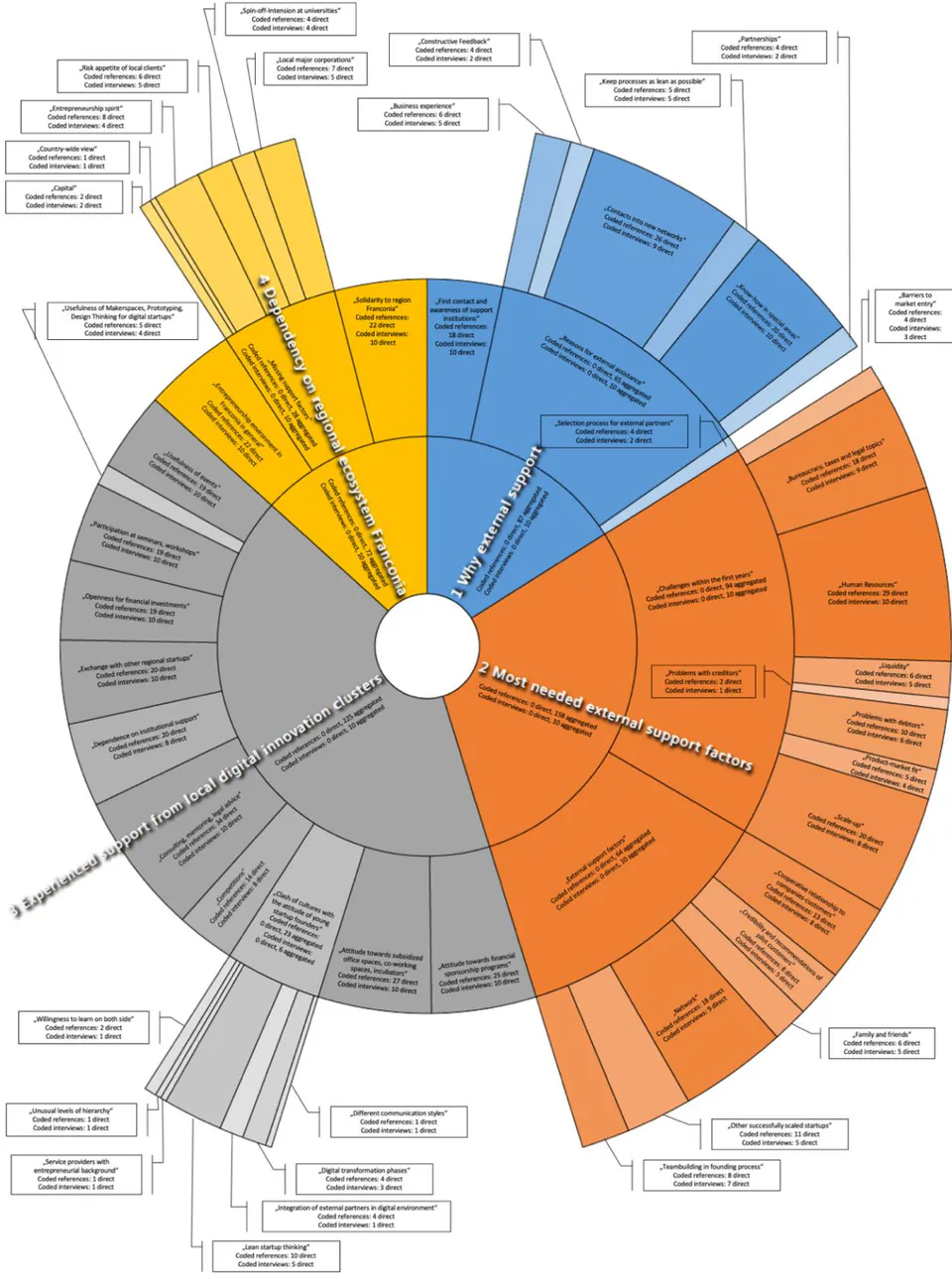
The following graphic visualizes the results of the thematic analysis. Figure 1 sliced each category in a sunburst diagram. The color intensity represents the number of coded objects/interviews, the legend also explains the number of coded references.
X. DISCUSSION
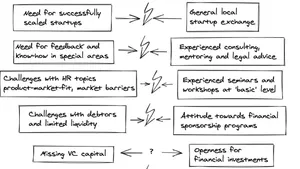
The results of this study show accordance, indicate dissonance, and raise new questions about the resources required by entrepreneurs and the services offered by innovation clusters, compared in Figure 2.
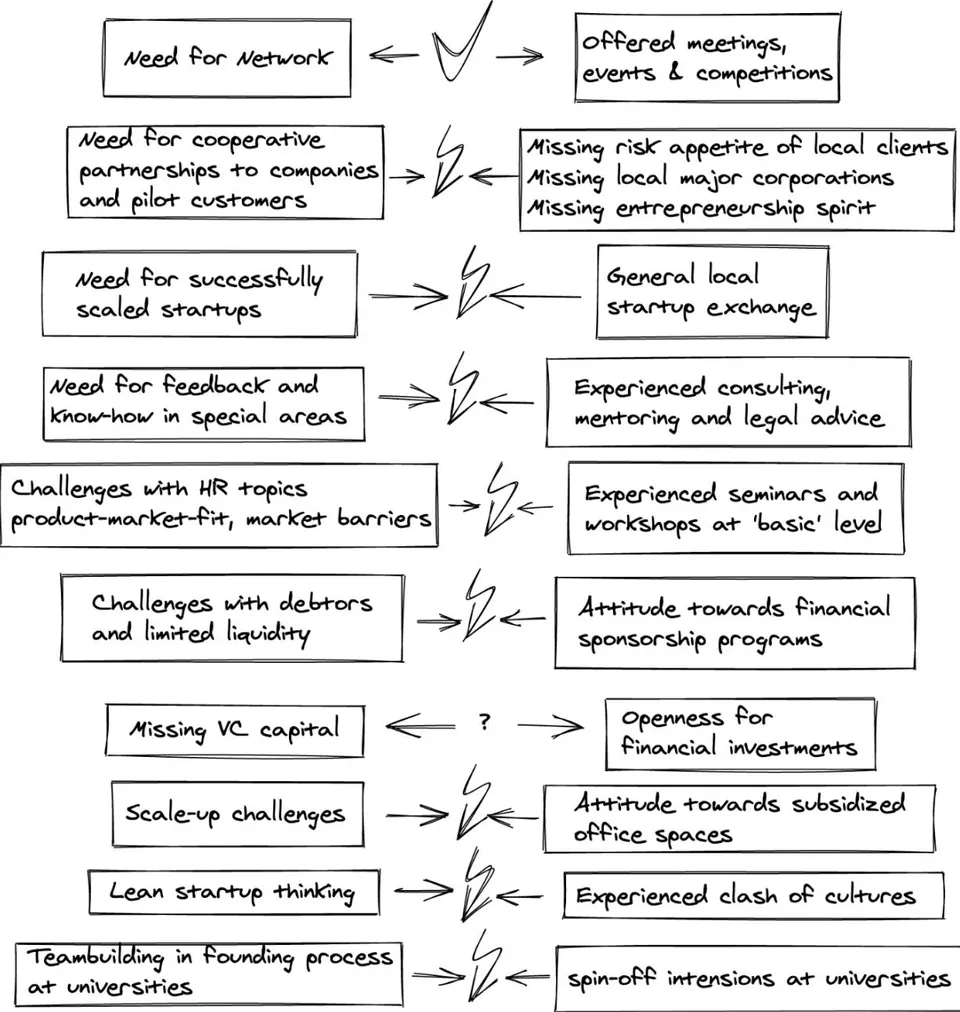
However, entrepreneurs needed much support during the start-up phase. Founders were dependent on external help. It turned out that the main reason for building on external support was to network with people who can supplement knowledge. Technology-oriented founders often had an academic background in computer science or engineering. As a result, the team often lacked a degree in business administration. Management and finance skills were welcome, but startups also needed access and contacts with larger companies. This demand was mainly satisfied with the many networking events and competitions offered. These were assessed as extremely valuable and decisive in the first months of each company's foundation. As a result, the founders' expectations of an entrepreneurship-friendly environment were largely fulfilled.
All new ventures found good cooperative collaboration with a larger company, some partners, and some pilot customers as very helpful. This contrasts with the urgent desire of many founders for more such companies, whether larger corporations in the region, a little more willing to take risks with medium-sized companies, or a general entrepreneurship spirit, and to be open to the innovative achievements of startups even in smaller companies. Here the region could be even more open-minded. This is also where different attitudes towards the organization of companies sometimes clash, such as lean startup thinking, digital communication channels, or flat hierarchies, which are perhaps not yet so distinctive in traditional companies.
In view of these results and the literature, a critical discussion would conclude on the one hand, that the typical elements of a regional innovation system still need improvement (Häfner, 2014), particularly with regard to the classic resources of a firm (Groth et al., 2015). The fact that a larger population density in conurbations promotes the activity of startups (Fritsch & Wyrwich, 2014) leads here in return to a disadvantage for Franconia. On the other hand, the lively further training and initiative on the part of the founders testify to the fact that today's Multipreneurs create innovation in a social process requiring interaction with others (Harkiolakis, 2014).
Networking events were popular. These provided contacts to other new ventures, but also to investors and entrepreneurs. However, in the growth phase of the companies interviewed, the general local exchange with people interested in setting up a company was no longer sufficient. Decisive progress could only be made with the exchange of successfully scaled other startups at a similar level. It will, therefore, be decisive for the Franconian region to bring such successful companies into permanent contact. The recommendations of Engel (2015) for global clusters of innovation were also largely valid from the point of view of young entrepreneurs in Franconia. Founders demanded a local adaptation of actions, building on strength instead of establishing new concepts from scratch, access to the resources of educational institutions, the acceptance of an export dependency for digital innovations and networks to multinational players in a globalized world. This is in line with the cluster theory in regional innovation systems (Elbert et al., 2009).
The experienced consulting, mentoring, and legal advice could be more aligned with the growth and size of IT startups. Preferably free training events around the creation of business plans, elevator pitch exercises, legal topics, funding applications, and financing were well attended. Nevertheless, offered seminars were too much on a base level. Instead, offered workshops could focus not only more on the frequently mentioned challenges with human resources topics, but also to fulfill the product-market-fit and to overcome market barriers. This corresponds to the local competitive environment, often described by the five forces model (Pinkwart, 2016).
Especially with digitally-oriented startups, a fast market launch was essential (Govindarajan & Srivastava, 2016). As a result, resources were urgently needed to test digital ideas quickly, bring these ideas to market, and grow as fast as possible. Scale-up challenges were both product-related and in terms of the growth of the company itself (space, employees). However, unlike the industrial sector, most startups needed no hardware development. Mechanical workshop areas, offered by several innovation hubs in Franconia and equipped with 3D-printers, laser cutters, or wooden prototyping construction machines were therefore hardly used. For other offers, such as Design Thinking workshops, it has yet to be seen if these fit the digital target audience. An important phase of design thinking is prototyping, while similar user-interface-tests are much more commonplace for digital services. In the end, quite different innovation methods and support options could turn out to be more successful.
Only half of the startups did draw from resources like subsidized office spaces that were often offered in incubators or science parks. On the one hand, founders happily fell back on low-cost rents for offices in co-working spaces or incubators at a later development stage. On the other hand, most of them would be buildable at any place with fast internet. Many early-stage IT startups unofficially used rooms of university libraries, cafés, or worked from home, especially in the first few months. Some even considered office space available on the free market as more flexible and cheaper. In this respect, showcase buildings (which are so welcome in politics) must be called into question. On this point, the results support skeptical voices that criticized political programs to copy Silicon Valley at any price (Engel, 2015; Häfner, 2014; Keese, 2016; Makkonen & Inkinen, 2014).
On the one hand, the limited liquidity in the thrifty founding period was mentioned repeatedly, and there were defaults with debtors. On the other hand, offered financial sponsorship programs were described as unsuitable or insufficient. It turned out that most startups were financially quite well positioned as soon as corresponding orders and partnerships with customers were available.
Cases varied regarding external capital. While most of the new ventures trusted in turnover, current income, and no more than initially grants or smaller seed financing (mostly from the family environment), only three of the ten startups actively watched for venture capital. These, in turn, found the supply of VC and angel investors in the region insufficient. Entrepreneurs still saw much catching up to do when it came to high venture capital investment that enabled rapid scaling. This correlates with statements by Carsten Rudolph, the Managing Director of BayStartUp, who believed that the investor scene is well-positioned for the early phase in Bavaria, but saw a hole in the middle of the market and from ten million euro upwards, for example expansion abroad (Rudolph, 2019). However, it depended a lot on the business model.
Half of the startup teams were made up of people who had met during studies. Nevertheless, only two teams (both students of the University of Applied Sciences Würzburg) were introduced to the startup network by professors and specifically supported in building the company. The spin-off intentions of the University of Würzburg were rather criticized. The interest on the part of the faculties might not be as strong.
However, regarding the key framework conditions, summarized by the Global Entrepreneurship Monitor, Franconia seemed to offer all essential parts: access to entrepreneurial finance, government support, entrepreneurship programs, educational background, research and development transfers, commercial infrastructure, market dynamics, physical infrastructure and social and cultural norms (Bosma et al., 2020).
Frightening was the high degree of the unfamiliarity of services within the cluster. While consulting meetings, events, and competitions were usually immediately mentioned as offers, facilities that are more specialized, workshops, and offers were unknown, or the interview partners only commented on them when explicitly asked. However, this coincides with the German Startup Monitor 2017. The researchers (n = 1,254) found that one-third of German startups do not even know if there is a local founder network or innovation cluster. Of the young entrepreneurs who are informed about such a network, only half agree to be part of it (Kollmann et al., 2017).
Implications
Founders should feel encouraged to build up the largest possible network. Offered meetings, events and competitions have often led to amazing support for startups. With all the external support required, it also seemed to be an advantage to keep processes as lean as possible. Furthermore, the exchange with other founders should not be limited to the local startup scene. Rather, it is important to orientate supra-regionally also at already successfully scaled startups of similar fields. In order to take the biggest challenges in the personnel area in the first years, it is advisable to attend offered additional courses in the area of soft skills, which may sometimes be neglected in technical and business studies.
Practitioners must come to terms with the fact that working with young founders often involves cultural differences. A little concession from both sides will certainly not hurt here, for example regarding preferred communication channels. Especially for medium-sized companies it often does not seem clear that a close cooperation with a startup can be beneficial for both sides. Particularly in the case of digital transformation, which many established companies find difficult to deal with, a learning effect has emerged in the examples examined.
Policy makers ought to increase efforts to bring founders into contact with larger companies, rather than focus on infrastructural support. Instead of giving money away but tying funding programs to strict (and in some cases inappropriate) conditions, government institutions should perhaps consider providing some form of default guarantee. This would minimize the risk for potential customers and partners as mentioned above and help startups in the long run more like a one-time start-up financing (EXIST scholarship or innovation vouchers). Because, if the order situation is right, all other problems are usually solved as well. The identified gap for high venture capital investment that enables rapid scaling should also be taken into account at events or even competitions, where startups have always been considered as an investment case. Furthermore, the supra-regional exchange with already scaled startups could be promoted more. In any case, more public relations work should be done to transparently communicate the support services offered by various institutions.
XI. LIMITATIONS AND FUTURE RESEARCH
Future researchers are invited to expand the findings. This study intended to compare the founders' needs with the actual support provided by an innovation cluster. A limitation was in the selection of entrepreneurs based on the list of the Center for Digital Innovation Franconia and the local conditions near the city of Würzburg. This could affect the generalization of results. It could be addressed in the investigation of other startups. A comparison with other areas or a cross-country comparison is recommended. Moreover, further research work could investigate other (less digital/service-oriented) industries as the logical continuation of this research. It would also be conceivable to investigate the influence of startup cooperations in medium-sized partner companies. However, more research about the needs and resources requested by digital startups is required in order to learn which external support provides the best catalyst, as it has already been demanded by other researchers (Groth et al., 2015; Monsson & Jørgensen, 2016; Thomas et al., 2019).
XII. CONCLUSION
This research focused on the factors that were needed for entrepreneurs regarding external support, provided by local innovation clusters in Franconia. The literature review underlined a lack of empirical studies analyzing which offers for startups were essential during the early-stage development and which were not. The innovativeness of this study was framed in the direct questioning of young entrepreneurs with in-depth interviews about the already used and experienced offers and urgent external support needs. In the past, innovation clusters were more likely to be prearranged by institutions (universities, chambers of commerce), local companies, politicians, or groups of consultants. Not surprising that the interests of these groups were more critical in the selection of the services offered. For the first time in Franconia, the target group itself was questioned in detail. Although there has been a recent online questionnaire survey asking for interests, only an in-depth interview could reveal the actual motivations of young people. Consistent with previous studies, the strong orientation of innovation clusters to the functional relationships in the cluster, and the interests and expectations of the members, leads to very context-specific funding and has limited effects (Häfner, 2014).
In conclusion, this study provided further insight into the relationship between startup entrepreneurs and innovation clusters in Franconia. Policy makers and practitioners who have either a role or vested interest in startups should consider the results in the future planning of offers for this target group. It would be desirable if young entrepreneurs would not only act as supplicants within innovation clusters but also contribute through self-initiative and support each other more strongly.
Declaration of Conflicting Interest
The author declared no conflicts of interest with respect to the authorship and/or publication of this article.
ACKNOWLEDGEMENTS
The authors would like to acknowledge all startups under supervision of the ZDI that participated for this study and École des Ponts Business School where this embedded case study was written by Simon Kiesel in partial fulfillment of the requirements for the Executive Doctorate of Business Administration (EDBA) degree.
Biography of the Authors
Since 2010, Simon Kiesel, DBA, is a volunteer judge for the Business Plan Competition of Northern Bavaria, organized by BayStartUp. He is a consultant and coach for startups and organizes and awards the Würzburg Startup Prize each year. Furthermore, the author works in the IT environment as a Head of Marketing and Customer Relationship Management for a German publishing company that has gone through the transition from telephone directory production to various digital service offerings.
Annette E. Craven, PhD, CPA, ACC is Professor of Management Emeritus from University of the Incarnate Word, owner/CEO of AEC Coaching, LLC. and an international faculty member of the Ecole des Ponts executive DBA program. In addition to her teaching activities, she has consulted, coached, and mentored organizations and individuals around the world for more than 20 years.
APPENDIX
Interview Protocol
How did you become involved with the ZDI and their local innovation cluster?
Why are you counting on support from ZDI?
In which cases does your startup build on external assistance?
Why does your startup build on external support?
How did the contact come about to cooperation partners with technical support and know-how?
How did you select external partners?
How has your development been in the last few years, from the idea of founding a new company, to the implementation of a business plan, up to the first years?
What are the most needed external support success factors?
Which external partners have brought you the most progress?
When you think of all the services and offers of the local startup network, what helped you the most so far?
What were the biggest challenges for your company within the last years?
How did you get first (pilot) customers?
How do you get qualified experts in a currently tense IT job market?
How did you get publicity, reach multipliers?
Do you remember any other external support factors from the first years in your company that might be relevant?
How was support from the local digital innovation cluster experienced in the past?
Why are you not in one of the state subsidized office spaces, a co-working space or an incubator?
How do you finance your company?
Why didn't you benefit from any financial funding?
To what extent do you plan to bring in outside capital from angel investors or VCs?
Who helped you with the business plan preparation, legal advice, or mentoring?
What do you think about the offered seminars, training workshops and events?
In what way did winning competitions help you?
How important is it for you to network with other startups?
How was the offered support with these external partners experienced?
What problems arose in the collaboration with external partners?
Could you describe in your own words what a regional innovation cluster in Franconia means for new ventures now and what is missing to make founders even more successful?
What makes the ecosystem in Franconia special for startups?
Conflict of Interest
The authors declare no conflict of interest.
Ethical Approval
Not applicable
Data Availability
The datasets used in this study are openly available at [repository link] and the source code is available on GitHub at [GitHub link].
Funding
This work did not receive any external funding.
References
Cite this article
Related Research


Special Issue
Launch a focused special issue to highlight research, emerging trends, and expert insights in your academic field.