


Abstract
This paper analyses economic growth of Nicaragua under the theoretical frameworks of the Harrod-Domar Model, Lewis’s Model of Dual Sector Growth and Structural Adjustment, and the Neo-Classical Model of Economic Growth since 1990. While Nicaragua is the 2nd poorest country in the Western Hemisphere, it has experienced stable economic development in recent years and claims to be pulling her population out of poverty. Last few months notwithstanding, Nicaragua also enjoys a relatively low violent crime rate when compared to the rest of Central America, which may also be partly responsible for her economic development. After discussing the main theoretical arguments of the above-mentioned theories, we plan to apply them to the case of Nicaragua. Our experiment showed a correlation between the Neo-classical argument of more open international trade, open markets, fewer trade restrictions and economic growth
Explore Digital Article Text
I. INTRODUCTION
This paper will analyze economic development of Nicaragua under the theoretical frameworks of the Harrod-Domar Model, Lewis's Dual Sector Model, and the Neo-Classical Model. Some historical context will be provided with references dating back to data from the 70's and 80's as it relates to the development of Nicaragua's economy. While this Nicaragua is still the poorest in the Western Hemisphere behind Haiti, it has experienced stable economic growth since 2010 and has been recognized for its achievements in poverty alleviation (United Nations). Nicaragua interestingly enjoyed a relatively low violent crime rate as compared to the rest of Central America, which had facilitated its economic stability and development until the recent 2018 protests.
Before entering into the theoretical review of the three economic models mentioned, we will provide historical and geographical context for Nicaragua as it relates to the development of its economy. In the field of economics there is a tendency to focus primarily on quantitative analysis and theory as a starting point before proceeding to look for countries and examples to apply it to. While this approach is valuable and is applied in many useful ways, we argue it runs the risk of being disconnected from practical considerations "on the ground", often imposes ethno-centricities on developing nations and it uses as a mechanism for accomplishing political and economic interests. Economists, in other words sometimes prescribe theory frameworks, assumptions, and corresponding policies before diagnosing what is really happening in a designated area and why. If the goal of economic development is indeed human development, and not just GDP growth, then we argue that it is vital that we remember to integrate historical geopolitical and social considerations contributing to the context of a designated area of study into the quantitative and theoretical economic analysis. The False Paradigm Model as defined in Economic Development is;
"The proposition that developing countries have failed to develop because their development strategies (usually given to them by western economists) have been based on an incorrect model of development, on that, for example, overstresses capital accumulation or market liberalization without giving due consideration to needed social and institutional change" (Todaro 124).
It is important to reference the false paradigm model as a reminder of the limitations of quantitative and theoretical analysis and to help explain our overall approach. We argue that the most important application of economic theory is its use as a tool, or general guide to understanding how we may improve human welfare. Throughout the literary and theoretical sections of this paper we will highlight human and historical context as they are relevant to the theoretical models of Harrod-Domar, Lewis's Dualistic Model and Neo-Liberal Model. Not only do we believe human security and welfare are of utmost importance to society, but also the way those conditions have been shaped throughout history have an important role in explaining economic tendencies.
Nicaragua proves to be a fascinating example of exceptions to what mainstream belief thinks should happen. One could argue that political thinkers in USA historically believed that economic partnerships with the country would be beneficial for both Nicaragua and the United States. The Hoover and FDR administrations therefore supported the ascendency of Anastasio Somoza to be General of the Nicaraguan National Guard, and then the President of Nicaragua. The irony is that the US's involvement in Nicaragua did not lead to a peaceful economic partnership and democracy, but rather, created substantial political and social conflict. Augusto Cesar Sandino led an army against the U.S. marines to drive them out before he was assassinated a few years later by Somoza and his guardsmen. Somoza, with U.S. support, orchestrated the assassination of the Nationalist hero to remove the last substantial barrier between him and the
Nicaraguan presidential office. After Anastasio Somoza became president, the Somoza family ruled Nicaragua as a dynastic dictatorship with a very close economic and political relationship with the United States for the next 42 years. Roosevelt said, "He may be a son of a bitch, but he's our son of bitch" when speaking of Somoza in the early 1930's . Despite the overall decline in the majority of the population's welfare during those years, (access to education and health care were at an all-time low with 70% of the rural population being illiterate ) the revolution that took place to depose Somoza was one that has been internationally renowned and studied for its normative framework and massive popular support. The revolutionary junta was hopeful and idealistic immediately following the 1979 revolution at which time they implemented massive literacy campaigns, promoted political advocacy and community-based organizing, and almost completely removed the violent Somoza controlled National Guard military before implementing innovative new community-based policing reforms. Ironic again is that Nicaragua, a country devastated by dictatorship, war and natural disasters, has an incredibly low, relative violent crime rate. The United States and institutions such as the World Bank and International Monetary Fund attribute Nicaragua's economic stability (prior to 2018) to the post democratic neo-liberal reforms of the 1990's. However, it can be argued that it was the U.S. supported Contra Revolutionary War in the 1980s and semi-democratic nature of the country since the 1990 election which left Nicaragua vulnerable to falling back into authoritarianism. Unfortunately, this is now the case with once Sandinista revolutionary leader turned authoritarian president, Daniel Ortega and his wife, Vice President, Chayo Murrillo consolidating power since 2006. For these reasons, Nicaragua is an interesting case study for examining where geopolitical influences human development interface with economic theories. As it will be evident, we focus only for the period before 2017 and have not really done analysis for the recent chaos happening in Nicaragua even if we are aware of these recent challenges. We summarize the current situation in Nicaragua in the last part of the paper.
Section 1: Literary Review
In order to better understand economic growth in Nicaragua, one might start with an understanding of its geography, history and economy. The Central American nation, slightly smaller than the state of New York is famous for being the land of lakes and volcanoes. Geographical factors such as Nicaragua's size, resource wealth, biodiversity and proximity to the United States have profoundly influenced the country's economic growth. Historical components such as the Spanish Colonization beginning in 1550, their independence from Spain in 1821 and US intervention throughout the century have all profoundly impacted the social, political and economic institutions that exist in Nicaragua today. Textiles and agriculture combined account for nearly of Nicaragua's exports. Beef, coffee and gold are Nicaragua's top three export commodities (CIA World FactBook). Nicaragua's economy has a healthy growth rate between and from 2015 to 2017 although it still struggles with acute underemployment and poverty (CIA World Factbook).
Worth noting are the historical components which have imprinted Nicaragua's institutions and economy still today. Loveman among others have written extensively using a historical institutions approach to civil-military relations (CMR) that can explain some aspects of economic growth in Latin America. This approach is particularly useful for analyzing the relationship between civil society, the military and implications for Nicaragua. Legacies of Spanish religious conquest, patronage, and resource extraction remain today as we measure inequality of income distribution, heavy reliance on textiles and commodity exports such as gold. It was not long after Nicaraguan independence from Spain that the United States started being more involved in the region. The US established the National Guard, the nation's military, in the 1920's, a vehicle used by the Somoza dictatorship to secure economic and political power. Like in several other Latin American countries, Standard Fruit, Del Monte and United Fruit's exploitative business practices and use of the dangerous chemical, DBCP had detrimental effects on the health of the workforce while generating massive economic gains for the country . The Somoza dictatorship was backed by support from Washington and National Guardsmen were among those trained at the School of the Americas in the United States. The relationship between the Somoza dictatorship and Washington was a collaborative political and economic alliance.
In accordance with this alliance, the Somoza dictatorship 1937 – 1979 was characterized by both economic growth and human right abuses. There were developments in modern infrastructure with a metropolitan capital city built and roads and trains all over the country to transport coffee and bananas. The benefits of economic growth during this period were consolidated into the hands of a few, the largest holder of wealth was the Somoza family. Their family alone owned a television station, radio station, construction companies, fishing companies, a port, vast amounts of land for cattle/beef industry, not to mention millions of dollars stashed abroad and in trust funds (New York Times). Meanwhile, by the end of the Somoza dictatorship, over 70% of the rural population was illiterate, living in abject poverty with no means for political mobilization except with what became the Sandinista revolutionary forces. Anastasio Somoza was bombing Nicaraguan cities before the Sandinista forces took control and he fled the country in July 1979.
The popular revolution's hope for rebuilding its economy and restructuring civil society were diminished by the US-backed counterrevolution forces battling against the Sandinistas in a civil war throughout the 1980's. The Sandinistas did manage to lead a rather successful literacy campaign to educate rural workers and worked with Cuba to improve health care for the population before the devastating effects of the contra war slowed their progress. The United States trained and funded the counter-revolution forces of former national guardsmen, and disgruntled small farmers on the Honduran side of the Nicaragua-Honduran border. The losses from the revolution and the contra war resulted in over 35,000 deaths and caused the adult male dominated work force to decline dramatically. Throughout the 80's there was a steady decrease in GDP per capita, high levels of hyperinflation and degradation of social indicators such as infant mortality rate, maternal mortality rate and moderate to severe malnutrition. The US embargo on the Nicaragua, support for the Contra forces and increased international pressure to host elections, slowed the possibilities for social and economic progress made by the Sandinista forces and significantly weakened their popular support by the time all was for the 1990 elections.
The Sandinista revolutionary FSLN leader, Daniel Ortega, lost the 1990 election to Violeta Chamorro, the leader of the National Opposition Union (UNO) candidate. From 1990 to 1997, President Chamorro reversed a number of Sandinista policies, privatized state-owned industries, and reduced the size of the army. She also lifted censorship and sold the railway tracks and cars to Costa Rica and El Salvador (Britannica). With the election of an anti-Sandinista coalition government, the following years were characterized by liberal government's efforts to implement Neo-liberal policies. The World Bank Report on Nicaragua in 2016 credited Nicaragua's economic upturn to the neo-liberal policies. While this is a point of contention and debate, one cannot argue that Nicaragua did manage to substantially reduce its foreign debt during the neo-liberal era. There was also a push to privatize public water, utility, and education systems. As the utility system was being restructured, for example, there was not enough power to reach the whole population, and therefore large swaths of the country went without power for 10 to 12 hours a day (Telasur). In a less developed country like Nicaragua, privatization leads to barriers for access to health care, education, and utilities by populations living in poverty who are most vulnerable. There are cases where the model has been applied successfully, such as in Taiwan, South Korea, and Singapore. However, it has also led to 'failures of the public-interventionist economies of Africa and Latin America.'(Todaro 136). Ultimately, the neo-liberal model was applied to Nicaragua and helped the country reduce its foreign debt. The social costs incurred on the population's most vulnerable people, however, made this model in the case of Nicaragua more of a failure than a success.
Worth noting is the perceived correlation between neo-liberalism and democracy as they pertain to Nicaragua. Scholars and economists generally tend to think that the two go hand in hand. "Democracy" and neo-liberalism went hand in hand in Nicaragua from 1990 – 2006 before Daniel Ortega was elected back into office. He stays as the President still today after being re-elected in the highly controversial and opaque elections in 2016. He has taken direct measures to consolidate and centralize his power over time by revising the constitution, removing opposition members from congress and consolidating his control of the Supreme Court. While Nicaragua was never considered a strong democracy, the shift back to authoritarianism following the proclaimed democratic, neo-liberal era in Nicaragua (and all-over Latin America) was not anticipated and is a subject being researched further. References to the failures of "open markets" and laissez-faire are numerous but despite the political shift back toward authoritarianism in the country, the World Bank and International Monetary Fund congratulated the Ortega administration for its achievements in the poverty reduction. The 2016 World Bank report on Nicaragua recognizes Nicaragua's achievements in reducing poverty and inequality, raising productivity, diversifying economic activity and promoting security and stability. These were all promising reports before the 2018 protests resulted in violent repression by the government and human rights abuses documented by the United Nations Human Right Commission.
Nicaragua is still the 2nd poorest country in the western hemisphere, but had shown progress in overall welfare of the population as indicated by Human Development indicators data until the recent chaos started taking place. Here we will focus on economic growth from 1990 to 2015, and make references back to data in prior decades when possible and relevant. Each twist and turn in Nicaragua's history, tells a story about its economic growth and has therefore been emphasized.
that is worn out or needs replaced such as buildings, equipment, and materials. However, reinvesting to replace existing worn out capital is not enough to stimulate economic growth. For a country's economy to grow, net additions to capital stock (aka investment) are necessary (Todaro 121). To determine if the Harrod-Domar Model has been a successful model for economic growth in Nicaragua we must examine variables such as national consumption rates, capital investment, capital output ratio and interest rates. Although the data on Nicaragua's savings rate is unavailable, we can examine other variables and their relationship to each other to make inferences about whether the Harrod-Domar Model applies to Nicaragua, or not. The variable which will be used to inform us about investment and therefore savings over time, as per Harrod-Domar Model, will be gross capital formation as a percent of GDP. Figure 1.1 below demonstrates a weak to moderate positive correlation between Gross Capital Formation and Time.
Section 2: Theoretical Review
The Harrod-Domar Model argues that a country's savings rate is critical for reinvesting into capital {"image_source":{"path":"images/41957f893d8026f8f3acb83eb16e1290d6a46c18c7d51273e4f639f497ec30ad.jpg"},"content":"","chart_caption":[],"chart_footnote":[]}
The gross capital formation, also expressed as the net additions to capital stock, or investment, increased in the long run with variation in the short term. There is a distinct dip in the early 1990's right after the first internationally supervised democratic elections since the 1979 revolution. In these elections immediately following the contra war, investment in capital was low due to rebuilding and renegotiation efforts between the FSLN and UNO parties. The figures of capital formation then climb back up before a decrease again in the late 1990's to early 2000's. The capital formation steadily increases again before the dramatic decrease in 2008 when the severe economic recession hit the United States and caused economic recoil effect in Nicaragua and the rest of the world.
Based on the steady increase in capital formation over the last 50 years, from about in the 1960's to nearly in 2016, we may infer that Nicaragua has had sufficient investment, and therefore, savings, over the long run for its economy to grow. Savings equals investment according to the Harrod-Domar model if interest rates remain flexible. The model also says that net additions to investment will create economic growth in conjunction with a country's capital output ratio. If this is true, we can expect Nicaragua's total GDP to increase in accordance with the country's capital output ratio. We can compare Figure 1.2 to Figure 1.1 to observe that gross capital formation and total GDP output both have positive slopes, and therefore, possible positive correlation with time.
{"image_source":{"path":"images/7106e959d59ec6c8fef6099990aaa79d99df6c6d6aa9f22a9055090149a0a7a0.jpg"},"content":"","chart_caption":[],"chart_footnote":[]}
GDP increases steadily from 1989 to 2016 which is congruent with the rise in Gross Capital Formation, or investment. The positive correlation between gross capital formation and GDP output in Nicaragua indicates that one variable can explain the other to a certain degree. To stay consistent with data expressed as percentages, we will show the correlation between the two variables using GDP growth expressed as an annual percent and Gross Capital Formation expressed as a percent of GDP. We emphasize that variables have a relationship which explains the other to a certain degree (as expressed by the coefficient of determination, or ), not that either variable in fact causes the other. There may be any number of other variables contributing to the rise in GDP, or economic growth. While GDP is a widely accepted form of measuring economic growth, it is also an imperfect and limited one since it does not consider a country's population, price increases or distribution of wealth. To acknowledge some of these shortcomings and other variables which can affect total GDP output, we will also discuss GDP per capita, Total Debt Service (Internal Debt), External Debt Stocks and Military Expenditure in the analysis of Harrod-Domar model's applicability to Nicaragua.
First, we will take a closer look at the correlation between GDP Growth (annual percent) and Capital Formation. Using GDP growth rather than total GDP gives us a more accurate story of the relationship between GDP and capital formation over time. The growth of GDP (or lack thereof) is more representative of socio-historical factors and can therefore have an even stronger correlation with net additions to capital. Refer to Table 1.3 to see Nicaragua's GDP Growth over the last 50 years. Then to Figure 1.4 for the correlation between GDP Growth and Gross Capital Formation as a percent of GDP.
{"image_source":{"path":"images/46b975030cdbb6558b25e742497a0bbf8a6f6d374c00c55c57e2c7a92436adf1.jpg"},"content":"","chart_caption":[],"chart_footnote":[]} {"image_source":{"path":"images/40534105b0ee931b5707b0e5f9f56e876bbe6e12d0b6e2d8f3e6a2b672600117.jpg"},"content":"","chart_caption":[{"type":"text","content":"1.4."}],"chart_footnote":[]}
The outlier in the negative quadrant of figure 1.4 is for the year 1979 when the Sandinista revolutionary forces overthrew the Somoza dictatorship. During that time Anastasio Somoza and the National Guard were dropping bombs on Nicaraguan cities and the majority of the population was at war to depose the president, an therefore not working or producing outputs. These circumstances ensured there was a high degree of destruction of capital rather than net additions to capital investment during 1779. The positive slope of the regression model in figure 1.4 illustrates the moderate positive correlation between GDP growth and gross capital formation. The coefficient of determination, or R value of 0.42 tells us that forty two percent of the variation in GDP growth (annual percent) is explained by the variation in gross capital formation (percent of GDP). This correlation is a strong indicator that Harrod-Domar model applies to Nicaragua's economy.
Other variables that may explain GDP growth are External Debt Stocks (DOD, current US$) which increase in the 1980's during the contra war and drop significantly in 1995. As the debt goes down in the mid 1990's and early 2000's, GDP increases. We may infer from this that the foreign loans taken out were put to good use to ensure enough economic growth for Nicaragua to pay off its foreign debt and continue to grow. In 2006, when Sandinsita president Daniel Ortega was elected back into office we can see that foreign debt rose again. GDP growth however stays relatively stable during that time period. See figure 1.5 below.
In the same way external debt is one variable which can explain variation in GDP, the internal debt as expressed in Figures 1.6 and 1.7 does as well.
{"image_source":{"path":"images/fa1cb5cf9488f91b4da71f7670d3a09d5f9850e41dcc666614d0e7a06cd532c8.jpg"},"content":"","chart_caption":[{"type":"text","content":"1.5."}],"chart_footnote":[]}
{"image_source":{"path":"images/18b9cefd5ee79f8f70263babe299daa766e4f7e06253c7c8b5423a3c814f458b.jpg"},"content":"","chart_caption":[{"type":"text","content":"1.6."}],"chart_footnote":[]}
{"image_source":{"path":"images/88d424ba71bf846c92d8ae7fe5475281579a406931dcba468a938fd876bd1410.jpg"},"content":"","chart_caption":[{"type":"text","content":"1.7."}],"chart_footnote":[]}
There is a very weak positive correlation between the total debt service (% of exports of goods, services and primary income) and GDP growth (annual ) as seen by the slope of the regression model equalling 0.1142 and being equal to 0.043. The coefficient of determination tells us that only of variation in GDP growth is explained by variation in total debt service.
As demonstrated in Figure 1.8 and Figure 1.9, military expenditure has a negative correlation with GDP growth. Thirteen percent of variation in GDP growth is explained by military expenditure as per the negative coefficient of determination. This can be seen most clearly in the 1980's during the contra war where military expenditure was extremely high, and correspondingly during the same time period, GDP growth is relatively low.
Net official development assistance as described in Figure 2.0 shot up in the 1990's neo liberal period. GDP growth increased during that time period as well. Although development aid has come down over the last 10 years, GDP growth has remained stable.
Military expenditure, internal debt, external debt and development assistance are all variables which may affect how much investment can be made, and therefore the country's savings in the long run. The data indicate that Harrod-Domar model does fit Nicaragua's economic growth in the long run.
We now direct our attention to Arthur Lewis's Dual Sector Growth Model which suggests a developing country's economy will shift from the traditional sector where marginal productivity is low, to the industrial sector due to wage rates, labor productivity and technology of production are higher. This model assumes that higher profits made in the industrial sector will be reinvested to create industry growth and jobs. However, in the case of Nicaragua, the Ragnar Nurkse's “International Demonstration Effect” (IDE) may be one reason why the industrial sector has not grown significantly. IDE claims that it is possible that as the income of the wealthy increases, they spend their income on travel, shopping in Miami, cars, houses, etc. (conspicuous consumption) to adopt a more “western lifestyle” instead of reinvesting back into the industrial sector to create more jobs. Whether wealthy people’s incomes are being spent abroad or in the industrial sector does not make a whole lot of difference for inequality however. “Dualism is the existence and persistence of substantial and even increasing divergences between rich and poor nations and rich and poor people on various levels” (Todaro 133). Lewis’s dual sector model embraces four key arguments; 1. Different sets of conditions, “superior” and “inferior” 2. Growing international inequalities, 3. Production gap widens, degrees of “superiority” and “inferiority” increase, 4. Interrelations between the two elements are to develop the underdevelopment of the “inferior”. (134) Lewis’s model applies in a slight way to Nicaragua particularly because services, job opportunities, etc., value added (% of GDP) are attractive forces for labor to move from rural to urban areas. See figure 2.1 how the number of services added has been significant since the 1990’s, particularly throughout the 2000’s.
Services added were at their highest after Daniel Ortega was elected president in 2006 and peaked for a few years before dropping significantly in 2010. In figure 2.2, 2.3 and 2.4 we examine the trends in Industry, Agriculture and Urban Population Growth, respectively.
{"image_source":{"path":"images/3fca929612585e5dac71a90a199016e3a299163038a6c456a76fade37a054d70.jpg"},"content":"","chart_caption":[{"type":"text","content":"ximately the same degree. Urban population continued to grow, however at a decreasing rate over the last 50 years. The growth has plateaued since 2000 at just under "},{"type":"equation_inline","content":"2\%"},{"type":"text","content":" annual growth. Based on this data we may conclude that Lewis's"}],"chart_footnote":[]}
Industrial production's share increased from to from 1995 to 2015 while agriculture's share declined from to from 1990 to 2015. As industry's production increases, agriculture production decreases by appro-
1.8.
model applies to Nicaragua to a slight degree because Industry has grown and Agriculture as a percent of GDP has declined.
The last model we will test is the Neo-Classical model. Robert Solow, Jagdish Bhagwati and Ian Little, the creators of the Neo-Classical Model have focused on the variables found in the Cobb-Douglas production function. Total output or GDP (Y) is equal to a constant (A) times capital employment times labor units employed times a time period (T) times the “Solow Residual” (U). The Solow Residual represents all exogenous factors, or other ingredients of economic growth such as technology, human capital, education, health of labor force, international trade, liberalized markets, less taxation and regulation, etc. According to this model, labor and capital individually produce diminishing returns to scale individually and constant returns to scale when applied simultaneously. Neo-classical economists argue for “freer markets”, less regulation and more international trade in order to stimulate exogenous variables and create economic growth.
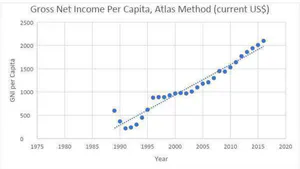
In the case of Nicaragua, variables such as gross net income per capita, imports of goods and services, exports of goods and services, foreign direct investment and poverty headcount will be analyzed in accordance with neo-classical model. To begin, figure 2.4 shows a steady increase in GDP per capita since the 1990's when neo-liberal policies were implemented. This is a strong indicator that the neo-liberal model has been successful for creating economic growth in Nicaragua.
{"image_source":{"path":"images/ba2952b30b6af5992e971dfcddc6b12b7c8d4572a5145741a2b1a1e9072bfa80.jpg"},"content":"","chart_caption":[],"chart_footnote":[]}
1.9.
Particularly in 2003, the gross net income per capita (current US$) began to rise steadily with the linear regression model. The steady increase in GDP per capita may be explained by the increase in foreign direct investment which also increases steadily after the 1990 election of the liberal UNO party. Foreign direct investment increased significantly after the Central American Free Trade Agreement-Dominican Republic (CAFTA-DR) in 1994. CAFTA-DR was met with both acceptance and opposition in Nicaragua and the region before it was ultimately signed and opened markets for more international trade and foreign direct investment. See Figure 2.5.
Besides a few short-term fluctuations as foreign direct investment increases for exports such as gold, palm oil and cattle, the variable increases rapidly. When markets open up and foreign direct investment increases, one can expect the imports and exports of goods and services to increase as well.
Although imports and exports of goods and services as a percent of GDP go down in the first half of the 1990's they steadily increase thereafter. The decline from to from 2012 to 2016 could have something to do with the presidential elections and Daniel Ortega getting re-elected.
Finally, Figure 2.8 shows the poverty head count ratio decreasing significantly from 2005 to 2016. Data prior to 2005 was unavailable however, it is significant to see a decrease in poverty from 50% to 25% in just over 10 years.
As GNI per capita goes up, foreign direct investment goes up, and imports and exports of goods and services also go up, we argue that it is natural for poverty to decline although we are skeptical about how it was measured. Overall the neo-classical model and policies have proven to be successful in Nicaragua. It is important to recognize that as economic growth takes place, some sectors will always benefit more than others, as explained by Kuznets curve and the four characteristics of Lewis's dual sector model. This means that there will always be sectors which are not included in the growth or suffer at the hands of corporate interests. One example of this is the interoceanic canal project in Nicaragua with a Chinese run company, HKND Group which was highly controversial due to the devastating environmental and social ramifications it would have. The project would not provide significant benefits for increasing GNI per capita or create jobs for any considerable number of Nicaraguans. It would also displace thousands of indigenous peoples and small farmers from their homes and create irreparable environmental damage. This model, therefore, has worked well to stabilize Nicaragua's economy coming out the Contra war in the 1980's but has invited foreign direct investment and mega development projects that may have severe negative externalities for many industries and peoples in the country.
Nicaragua has a rich history which has been riddled with violence and suffering. However, legacies of the accomplishments from 1979 revolution live on. If it were not for the revolution, the foundations laid for economic growth may not have been possible. After understanding the importance of Nicaragua's historical and geographical context and outlining the importance of expressing caution when applying theoretical models to practical realities, and people, we analyzed the data and different variables as they pertain to Harrod-Domar Model, Lewis' Dual Sector Model and Neo-Classical Model. Evidence suggests that all three models have a degree of applicability to Nicaragua and may, to some degree, explain its economic growth. The Harrod-Domar model illustrated how Nicaragua's savings equaled its investment over time if interest rates remain flexible. Capital investment went up in correlation with GDP growth. Lewis's Dual Sector Model can be applied due to the industry sector in urban areas increasing slightly and agriculture in the traditional sector decreasing accordingly. The neo-liberal model, we argue is the most applicable and relevant model for economic growth in Nicaragua according to the data.
Section 3: Current Situation in Nicaragua:
While the tone of the paper is to show the positive results from freer trade in Nicaragua the political climate in last 2-3 years has tremendously changed and has taken a turn for the worse. The opposition parties have started a significant campaign to overthrow repressive government but that has led to more suppression. Violent uprising has had some success, but the government is taking out all the freedom of expression. New wave of some re-conciliation has started in February 2019 but it not clearly now how the talks and negotiations will be handled. It is sadly noted that about 300 people have been killed, an official figure that can be a conservative estimate of actual figure. There is a significant exodus of migrants walking to nearby Costa Rica to run away from President Daniel Ortega's regime. His wife Mrs. Ortega is the Vice President of the country whose self-appointment is strongly opposed by the "Civil Alliance". As recent Fox News report notes, "the previous round (of negotiations) in July (2018) was attended by student, business and civic groups organized in the Civic Alliance. But many of the leaders of the 2018 protests that led to the talks have been arrested or gone into hiding or exile." Civil protest comes as the government faces an economic crisis and a $315m deficit, and also as it struggles without funding and loans that would usually come in from multilateral organizations.
Protests initially started April 2018 over pension reform (later revoked) and escalated quickly as they were met by a brutal government crackdown. The social services system is severely curtailed when it is needed the most as the public defiance continues to harass the administration. President Ortega has shown inclination to discuss the situation with opposition, but he does not want to meet with the "Civic Alliance" to achieve that objective. Demonstrations against the regime are now outlawed (since September 2018) and the power is back in the hands of the Ortega supporters. Taxes in February 2019 increased, and social benefits curtailed. But no one dares to question the policies and any opposition is met with the heavy hand. Therefore, as far as the political changes do not completely give a set direction to the future of the economy, it is hard to predict where the country is headed from here. We conclude this paper with the positive expectation that both sides come to a peaceful resolution and the Nicaraguan economy once again follows a growth path.
BIBLIOGRAPHY AND REFERENCES
- "Human Development Report." Human DevelopmentReport. http://hdr.undp.org/en/content/human-development-index-hdi.
Conflict of Interest
The authors declare no conflict of interest.
Ethical Approval
Not applicable
Data Availability
The datasets used in this study are openly available at [repository link] and the source code is available on GitHub at [GitHub link].
Funding
This work did not receive any external funding.
References
Cite this article
Related Research


Special Issue
Launch a focused special issue to highlight research, emerging trends, and expert insights in your academic field.