



IntelliPaper
Abstract
If internal interactions exist in isolated systems, entropy decrease will be possible. From this we discuss management as a typical mode, which includes much internal adjustment and control, and through them to achieve more ordered, more efficient, competitive, and can better survive and develop. A key of management is to change the natural tendency disorganized with entropy increase, and build the best system with entropy decrease. It is the thermodynamic meaning of management. Further, this theoretical mode may be extended to ecology, biology, and sociology, etc. The naturally formed and artificially intervened ecosystems are all through interaction and regulation within the systems to reach the dynamic balance, order and entropy decrease. These systems have all some constant evolutions, and reach optimization processes with order and entropy decrease. In a word, much social systems and human society are dominated by non-equilibrium dynamic processes, which are accompanied often by order and entropy decrease.
Explore Digital Article Text
I. INTRODUCTION
As in life and science, entropy is inevitable in any system. Entropy, as a new world view [1], also governs the system's evolution and human development.
So far, general people have believed that entropy must increase in isolated systems. But, its preconditions are: (1) Various internal interactions in the system must be neglected, i.e., it has the statistical independence [2] and the additivity of entropy. (2) They must be thermal equilibrium systems. We proposed that if interactions exist among various subsystems of an isolated system, in which entropy decrease is possible . They include physics , chemistry , astronomy , geoscience , biology , and social sciences . An isolated system may form a self-organized structure with lower entropy for these cases of attractive processes, internal energy, system entropy, nonlinear interactions, etc. Some possible entropy decreases are calculated quantitatively . We proposed quantitatively a total formula of the entropy change for the universal evolution of any natural and social systems. As long as we break through the bondage of the second law of thermodynamics, the rich and complex world is full of examples of entropy decrease . In this paper, we research possible entropy decrease in management, ecology, sociology, and so on.
II. ENTROPY CHANGE IN MANAGEMENT
Management is defined as the process of administering and controlling the organization, and its nature, type, structure, and size. It is an act of creating and maintaining such a system in which the members of the organization can work together, and achieve the objectives efficiently and effectively. Management acts as a guide to a group of people working in the organization and coordinating their efforts, towards the attainment of the common objective . This is a classical internal interaction in isolated systems.
In other words, this is concerned with optimally using the 5M's, i.e., men, machine, material, money, and methods. This is possible only when there are proper direction, coordination, and integration of activities, and achieve the desired results.
Characteristics of management include: 1. Universal nature.
-
Goal-oriented, every organization is set up with a predetermined objective and management helps to reach those goals.
-
Continuous process tends to persist the organization exists, and requires that the organization is production, human resource, finance or marketing. This is a nonequilibrium dynamic process.
-
Multi-dimensional.
-
Group activity, every member has different needs, expectations, and beliefs, and joins other motives, but after becoming a part of the organization, they must work to achieve the same goal. It requires supervision, teamwork, and coordination. It is also the classical internal interaction in an isolated organization.
-
Dynamic function: An organization exists in a business environment that has various factors like social, political, legal, technological, and economic. A slight change of these factors will affect the organization's growth and performance. It is also the nonequilibrium dynamic process.
-
Management can form supernatural force. This force is the internal attraction to create an orderly party, i.e., unity is strength. More generally, order is power, knowledge is power, and reason is power. These characteristics are represented by Fig.1. They are all for system order with entropy decrease.
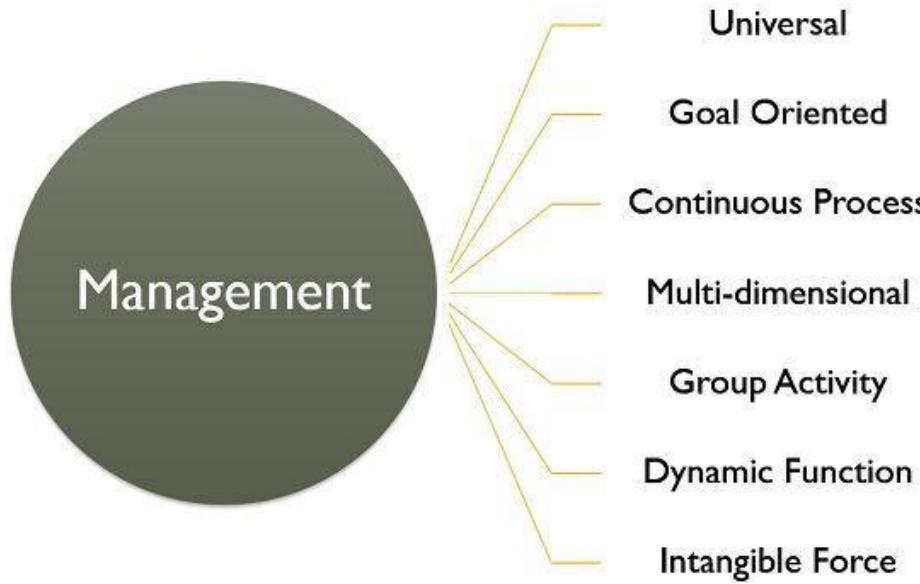 Fig. 1: Management and its characteristics
Precisely, all the functions, activities, and processes of the organization are interconnected to one another. And it is the task of the management to bring them together in such a way that they help reach the intended result. Leadership has different levels. They form some fractal structures. Top-level management is responsible for defining the objectives, and formulating plans, strategies, and policies.
Based on the thermodynamic entropy of physics, Chappell and Dewey define the entropy of hierarchical organizations. It measures and calculates the order within an organizational structure . It might classify systems designed for specific functions and indicate when an optimal system has been achieved.
In a world where entropy has become the order of the day, leadership becomes even more central to organizational transformation. Leaders should devote their attention, focus, skills, techniques, efforts, and values toward eradicating entropy in organizations or at least reducing it where possible. Entropy change can be positive and negative, and positive change renders the organization chaotic, complex, and extinction. There is a need to focus leadership potential on managing entropy in organizations.
Ercetin and Acikalin proposed that Lead-Entropy as a combination of leadership and entropy. It is assumed that a leadership paradigm, leadership traits, functions, skills, and techniques are directed toward reducing or eradicating organizational entropy as a modus operandi. This subject is of paramount importance consequent to contemporary trends in organizations [25].
In the McKinsey 7S model [26], structure, strategy, system, skills, style, and staff are all internal relations, then shared values are results. For the core technology and confidential information, management must be an isolated system.
One thing that creates chaos, complexity, and uncertainty in organizations can be entropy. Leader's behaviors become an important issue, and are also internal interactions in organization. Such research efforts have been pivotal to exploring the key dimensions of entropy and its intricate implications for various social and scientific phenomena.
M. Sanchez, et al., researched the four principles of change management, and the five principles of change management, which include: 1. Change must be human-centered.
-
Today's businesses are digital-first.
-
Lead from the top.
-
Support from the bottom.
-
Constantly improve. From the classical perspective, the humanistic perspective of Follett-Barnard, to the human-resources perspective, and the behavioral sciences these approaches are all internal interactions.
Daft and Marcic discussed plan, policy, tissue, structure, control, motivation of management process . They and feedback, merger, focus, learning, train are all internal regulations and interactions to achieve more ordered, more efficient, competitive, and better survive and develop. The organizational behavior dynamics is more clear research interactions in the system , and improving the attitude can promote unity within the system, and have more prominent competitiveness.
In a word, it is natural for things to become disorganized with entropy increase. Management's key is to change this natural tendency and build the best system with an entropy decrease, and the group forms a new competitive advantage. It is the thermodynamic meaning of management.
P.F. Drucker published a well-known book Management Challenges for the 21st Century [28], one of which is information, i.e., entropy. From early a proper form of organization and an appropriate way of managing to a new paradigm, in which management is the leader. The goal is to give full play to and make use of everyone's advantages and knowledge, and improve the productivity of knowledge personnel. The self-management is based on internal regulation and interaction, and is through the coordination organization's existing resources (this is an isolated system), and obtain an effective result.
One of the primary purposes of normative management is to achieve increasing order and reduction disorder with entropy decrease through regulation and interaction in the system after the natural entropy increase. This is consistent with Fig.2.
So long as different entropy states exist for any system, entropy must decreases in the transformation process from a higher entropy state to a lower entropy state (in Fig. 2 from A to B), for example, from disorder to order, from war to peace, and so on [7,21]. If this system is isolated, it will correct and develop the second law of thermodynamics.
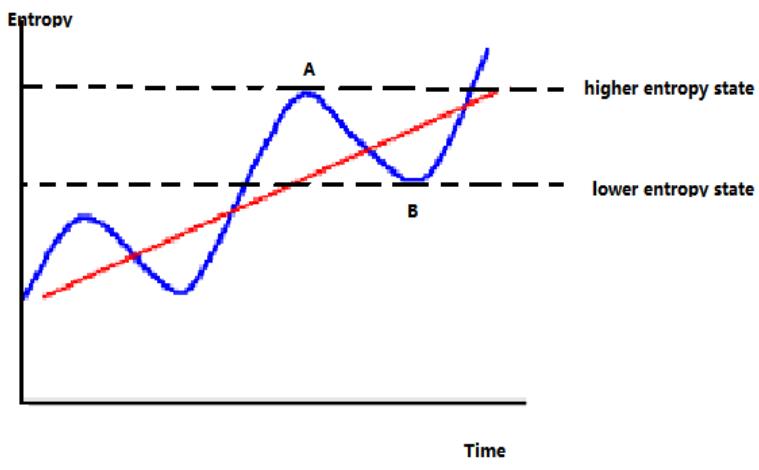 Fig. 2: Transformation processes between states with higher entropy and lower entropy
Based on thermodynamics in management we may use the method of coevolution and self-optimization [19]. For a corporation, its self-evolution process corresponds to self-optimization, different decrement of entropy correspond to different stages of an evolutionary process, and additional phase transitions. It compares own before and after, and entropy may decrease constantly. For both similar corporations of competition each other, their decrements of entropy may compare the entropy of each corporation A and B: and . If their original entropies are the same, and , a corporation A will excel another corporation B. It is the comparison between corporations each other.
The culture of group-corporate is an internal environment. A good culture can form self-organization, whose collectivism automatically creases a resultant force of cohesiveness. It is similar to magnetization. The Japanese management model and corporate culture may be studied.
III. ENTROPY CHANGE IN ECOLOGY AND BIOLOGY
Ecology studies organisms and how they interact with the environment around them. Ecologists study the relations between living things and their habitats, and observe all forms of life and their ecosystems of our world.
Ecology is closely related to the rise and fall of human society. We proposed the nonlinear whole ecology and its four basic rules . Entropy plays an essential role in ecological economics, and the cycle of resources and the general recycling economy cannot be a single increase process of entropy. We researched possible entropy decrease. To achieve sustainable development, society must realize the recycling economy. We studied the applications of hypercycle in ecology and corresponding equations of ecosystem. The critical factor in the cycle is the conversion of waste. We proposed the talent ecology, which studies the relations between talent and circumstances (esp., the social circumstances), and searched its three basic principles. The base of talent is education. The mechanism of academic development is freedom. The aim is innovation. The talent ecology must encourage intellectual diversity. The structure-function-result mode of the ecosystem is proposed. We discussed the recycling ecosystem of traditional Chinese agriculture and Chinese cultural-social ecology.
Various complex biological systems provide rich platform for study of entropy decrease . In biology and neuroscience, the permeable membrane, the molecular motor, etc., are all some internal interactions. These and physiology, psychology, and Qigong and various practices are related to order states with entropy decrease.
Darwinian evolution and mutual help seem to conflict each other. But, since the second law of thermodynamics is based on isolated-equilibrium systems, it is constrained. In essence, the most systems in the universe and nature are constantly changing and evolving with "life". Based on biophysics we researched coevolution from thermodynamics and entropy by a unified method. Let the decrement of entropy of subsystem A is a set of its elements , which may include various internal interactions, and cooperation and complement each other, so that entropy may be decreased. It includes self-evolution, competition with each other, etc. Development may combine self-optimization and self-organization. Brain control of the body is the most typical of internal interaction. No one would think that this only leads to an entropy increase. We discussed biological synergetics, ecosystems, and sustainable development. Cooperation-competition is a common phenomenon in the ecosystem. Coevolution is the more general evolution-development law of biological and active systems. It can unify natural competition and mutual help in ecology, and is an essential model for human development direction [19].
During sleep and hibernation people or animals as individuals may through internal regulation reduce metabolism with entropy decrease.
In the animal world, unity and cooperation are strengths, for example, the cooperative hunting of animals. It corresponds to the mutual help theory, which reaches the competitive advantage . Lotka-Volterra equations in ecology describe the period change, corresponding entropy period change. It is impossible to increase the entropy forever.
The thermodynamic meaning for the naturally formed ecosystem is through interaction and regulation within the system to reach the dynamic balance, order, and entropy decrease. For artificially intervened ecosystem this is also the same, for example, in national parks. Traditional Chinese agriculture forms a typical recycling ecosystem, and sustainable development.
IV. ENTROPY CHANGE IN SOCIOLOGY
Sociology studies human social relationships. Its subject is diverse, from crime to religion, from the family to the state, from social stability to radical change in whole societies. These relationships are usually some internal interactions. From the solidarity of Durkheim, the association of Simmel, to the structural functionalism of Parsons and Merton, which focuses on the structures of society and their functional significance for other forms, they and exchange theory are all various internal interactions in the social systems . Integration requires that a system regulates the interrelationship of its component parts. The micro-social order and a more integrative exchange theory are discussed .
Balch researched hierarchic social entropy for an information-theoretic measure of robot group diversity . Stepanic, et al., examined an approach to a quantitative description of social systems based on thermodynamic formalism . Stepanic, et al., described social systems using social free energy and social entropy . Bailey discussed social entropy theory and its application of nonequilibrium thermodynamics in human ecology and living systems theory, and discussed living systems theory and social entropy theory .
We discuss generally the four variables and the eight aspects in social physics, and search social thermodynamics and the five fundamental laws of social complex systems, whose second law is extensive entropy S change law: S=klnW, where W is the number of possible states of all elements in this system. The extensive entropy is connected with the adequate free energy. Usually it increases in an isolated system, but it may decrease with internal interactions or for an open system.
Humanity as an inseparable whole on the Earth possesses a common environment and benefits. Based on the inseparability and correlativity of the social systems, we proposed the nonlinear whole sociology and the four fundamental laws :
First law: The inseparability always exists among different organizations, structures, functions, and levels within various social systems, which determines the globality of the social systems.
Second law: Many main characteristics, for example, self-organization and self-adjustment of social system are produced from some special structures of complex subsystems. From this theory the interaction and nonlinearity exist necessarily. It includes fractal structures and chaos, etc.
Third law: From a microscopic community, city, the clime to a gigantic nation and country, various social systems of different levels possess totality and nonlinearity. Their diversity and complexity originate from various nonlinear interactions.
Fourth law: A fundamental property of any social system as an open system is that this system and its environment (for example, nature, geography, polity, culture, etc., and other social systems) must be a whole. It corresponds to a generalized metabolism. Usual environment is regarded as a boundary condition of the system, but it and the social systems often have various nonlinear relations.
In modern and postmodern sociological theory , systems theory, network theory, the globalization theory are whole theories. In contrast, structural functionalism, neo-functionalism, conflict theory, structuralism, poststructuralism, existentialism, and symbolic interactionism, etc., are inevitably nonlinear theories. The totality and the nonlinearity are two primary social characteristics. They are closely related. Because of the complexity, inseparability, and correlativity of the social systems, their description must apply the nonlinear theory with the interaction terms. Reversibly, if there is no totality, any society cannot be formed. Single people are not a society. Without nonlinear interaction, the system cannot create a social structure. Even the gregarious animal forms also a whole nonlinear society.
We researched possible unification of some ideal social sciences. The science of law should be based on ethics. Ethics is based on anthropology.
Politics should be found on the science of law. The ideal sociology and economics should be based on ethics. Various outstanding social sciences should be based on anthropology, in particular, social anthropology and culture anthropology. Further, differences between different nations must exist for some specific rules in social sciences. Therefore, we should study universality and particularity in social sciences simultaneously [38].
In a word, the rule of law is more orderly than the no rule of law. Many social sciences are designed to develop the order of various social systems.
V. SUMMARY
The development history of human society is not consistently declining and pessimistic. Throughout the history of the world, order and disorder, war and peace usually alternate (Fig. 2). Through scientific management and control, ecology and human society can be entropy decrease.
Management is a typical mode, which and ecology and sociology can be all through internal adjustments and interactions to achieve more orderly, more efficient, better competitive and better survival and development. These systems have some constant evolutions and try to reach optimization processes with order and entropy decrease.
Strictly isolated systems do not exist because gravity always exists, in which celestial evolutions and simulations prove many phenomena of entropy decrease . However, a galaxy may be considered as an isolated system . The Earth can be approximated as an isolated system, and many systems in nature and human society exist as isolated systems at some stages.
Moreover, one of the primary purposes of learning is to improve your reason so that you can handle things in more orderly way. For this purpose, Maslow's psychology proposed the well-known hierarchy of needs theory . This is further simplified by the ERG theory of Clayton Alderfer.
In the face of ChatGPT's challenge to all humankind, innovative education must be fully emphasized. It corresponds to talent ecology [29], which is based on the learning process and innovation. Communication and dialogue in a system may form new creativity. ChatGTP is also constantly improving himself in the learning.
In a word, many natural-social systems can never increase entropy forever. We researched many phenomena of entropy decrease in natural science . Further, some social sciences and human society are the nonequilibrium dynamic processes, which are usually accompanied by order and entropy decrease. Even in an interval they can be an isolated system.
Conflict of Interest
The authors declare no conflict of interest.
Ethical Approval
Not applicable
Data Availability
The datasets used in this study are openly available at [repository link] and the source code is available on GitHub at [GitHub link].
Funding
This work did not receive any external funding.
References
Cite this article
Related Research



Special Issue
Launch a focused special issue to highlight research, emerging trends, and expert insights in your academic field.
