




IntelliPaper
Abstract
This proposal aims to explore emerging topics about the relationship between the moving image and the arts of the body in the production of contemporary audiovisual. To this end, we intend to address the theme of time as a force/intensity that crosses and constitutes creation in the contemporary audiovisual context, investigating its possible effects on the tensions between cinema, body and scenic dance. Such an approach is located at a zone of confluence, where Eastern and Western artistic-philosophical concepts meet. In this sense, we propose the exhaustion of the cinematographic device in the processes of creation and circulation as a form of invitation to another poetic treatise of time. Thus, from the intersections of this field of forces and relations between cinema, body and time, we propose to question whether it would be possible to devise a butoh effect in the context of contemporary audiovisual.
Explore Digital Article Text
I. INTRODUCTION
Reflection on the moving image and the body as subjects-objects-subjects is a matter of great interest to this study, due to its potential in contemporary audiovisual, especially in Brazilian productions in recent decades. Understanding the body in relation to image and movement offers a unique perspective for the analysis of the forces that cross the audiovisual field, where the body becomes an axis that organizes and permeates creation itself. First, it is important to explain, albeit briefly, our line of thought and our conception of body, exploring its full potential as the fulcrum of the creative process. In this work, the body is approached from the Nietzschean conception, in which it becomes the guiding thread of thought and, by extension, of aesthetic experience, being understood as a field of forces in constant movement, permeated by tensions between these forces.
By agreeing with the proposal of the body as the guiding thread of thought, we understand that it becomes essential for the creation of what we call contemporary audiovisual, once we can propose that the body is the original and possible place of cinema – or, rather, of the moving image. "To this day, I have asked myself if philosophy in general has been just an interpretation of the body and a misunderstanding of the body" (Nietzsche, 2001, Prologue: p. 2) . The body is, therefore, a field of forces in constant confrontation and friction of intensities, since it is composed of a plurality of forces in dynamic and intense crossings. From this perspective, the body is configured as a multiplicity of possibilities, a plurality of possibilities. As affirmative forces in constant motion, the body can be considered the ultimate expression of becoming, a living manifestation of the flow, movement, and restlessness that defines human experience at its fullest potency. When reflecting on the body, Nietzsche invites us to live aesthetically, understanding life as a work of art in which the body and its tensions become a "great reason". "The body is a great reason, a multiplicity with a single trajectory, a war and a peace, a flock and a shepherd" (Nietzsche, F., 1998). We don't know where this can take us, how far the body can go, but we can explore how this concept reverberates in certain artistic movements, and specifically in this case, in the moving image and the arts of the body.
The body is a multiple phenomenon, being composed of a plurality of irreducible forces; Its unity is that of a multiple phenomenon, "unity of domination". In a body, the superior or dominant forces are said to be active, the inferior or dominated forces are said to be reactive. Active and reactive are precisely the original qualities, which express the relationship of force to force. For the forces which enter into relation have no quantity, and each at the same time does not possess the quality which corresponds to its difference in quantity as such. This difference of forces qualified according to their quantity will be called hierarchy: active and reactive forces. (cit. Deleuze, G., 2001, 21)
Considering the body as the original place of cinema is both a challenging and non-absolute proposal. If we understand the body as this field of forces, contemporary audiovisual works also present themselves as fields of forces crossed by multiple intensities and layers of signification. In this context, one force/intensity that we would like to highlight and explore in this paper is time. This force/intensity has been shown to be increasingly crucial, critical and challenging throughout the investigation, as we understand that the time force is configured as a dominant active power in the field of forces of the works, being a point of relevance in the creation and/or production of certain contemporary Brazilian audiovisual works. Time, which we will discuss later as dilated time, explores the potentialities of the body for and in the archaeological space of the camera and of the moving image, promoting an experience of time-sensation and an alchemical carnality, as we will explore later.
Time dilation is not limited to a mere chronological extension; on the contrary, it reveals itself as an intensification of perception, an enlargement of the sensitivity and the awareness of one's own body. It is a time that is rooted in movement, that goes beyond the conventional structures of narrative and form, establishing an aesthetic experience in which body and time become inseparable.
Before proceeding, we would like to introduce the dialogue, still in the experimental phase, between Eastern and Western arts of movement. It is important to emphasize that this dialogue will take place in a microcosm of the artistic language we are working on, not intending to encompass all the complexity and dimension that the East-West imaginary can evoke. This dialogue seeks, above all, to explore how different sensibilities deal with body and time, enriching the aesthetic investigation of contemporary audiovisual.
The proposal for dialogue presented here occurs between the artistic language of contemporary audiovisual and the poetics – or even the philosophy – of butoh, the Japanese dance that gained expression in the post-war context. Butoh is, in itself, a dance of resistance and a visceral expression of the human condition, embodying a slow and dense temporality that defies the Western logic of efficiency and speed. The present dialogue will develop between butoh and the language of contemporary Brazilian audiovisual, through filmmakers such as Gustavo Gelmini and Cao Guimarães, whose works unfold time and the body in sensorial and aesthetic layers that transcend the visible. To this end, we will carry out an experimental and, to a certain extent, wild appropriation of the dance and movement of butoh as an artistic practice and, above all, as a philosophy of life, seeking to reflect on the dilated time in contemporary audiovisual productions. This appropriation allows us to reinterpret movement, body and image, which are configured not only as form, but as substance, intensities, and tensions in transformation.
This paper advances the proposition of exploring this field of forces in order to consider initial reflections on the time force in two interconnected paths: on the one hand, time as sensation, or time-sensation. On the other hand, the possibility of a butoh-effect in the moving image and in its multiple dimensions. To carry out such an analysis in an experimental field, we will establish a dialogue with the work "Variações de um Tema de Resistência" (2022), a videodance by Brazilian director and choreographer Gustavo Gelmini. This work stands out for its exploration, through repetition, of time as dramaturgical possibilities, configuring itself as an experience of contemplation and suspension. Before proceeding, it is important to point out the inspiration and initial source of this research theme, the filmmaker and visual artist Cao Guimarães. The starting points were, and continue to be, the filmography and concepts elaborated by Cao Guimarães, a Brazilian filmmaker who has explored the subtleties of time and form in his cinematographic practice. It was from films such as "Sopro" (2000) and "O Inquilino" (2010), together with the proposal elaborated by him as a "micro-drama of form", that time began to seem to us not only an essential element in cinematographic creation, but also a central force for the creation of a pulsating dramaturgy. In this paper, we will advance a dialogue about dilated and spiraling time, exploring these new and other ways of making cinema that manifest themselves in these filmmakers' works. By expanding the notion of time and body, we seek to outline an aesthetics that is rooted not only in the visible, but in the intensity of an experience that transforms, in Nietzsche's words, into a great reason, an aesthetic living that unfolds in cinema.
II. THE MOVING IMAGE AND THE CONTEMPORARY AUDIOVISUAL
It is not new that artists and researchers have been generating reflections on the forms and possibilities of filmmaking. Since its origins, cinema has gone through numerous artistic propositions and conceptualizations, which have multiplied into nomenclatures, categories and fields of study, revealing the many layers of meaning that cinematographic practice can encompass. Some of these concepts have become especially dear to the present research, such as Experimental Cinema, Artist Cinema and Exhibition Cinema, as discussed by André Parente . However, in addition to these broader approaches, we also find specific debates that arise from the artists' own process, reflecting practices that cross the boundaries between cinema and other arts, such as Choreocinema (by Maya Deren), Dancine (by Carolina Natal) and Cinedança (by Gustavo Gelmini). Such proposals point to an expanded way of thinking about cinema, in which the boundaries between languages become permeable and, in a way, overflowing.
We consider that these multiple possibilities of cinematographic creation constitute what we call contemporary audiovisual nowadays, when there is an overflowing encounter between artistic languages and the means of institutionalizing these practices. Throughout this research, contemporary audiovisual is articulated around two fundamental traits: the Body and circulation/institutionalization.
The first trait, which concerns the Body, emerges as a central axis in the process of creation of contemporary audiovisual, not only as a support for action or visual element, but as a fulcrum of cinematographic meaning and experience. The body acts here as a source of visceral expression and a sensitive interface between the space of the image and the space of the spectator, encompassing the kinesthetic dimensions of the audiovisual experience. This centrality of the body connects with the way in which contemporary audiovisual has explored gesture, movement, and bodily intensities, proposing a cinema in which physicality and somatic perception are forms of creation and reception, capable of involving the viewer in an immersive experience.
The second trait, circulation/institutionalization of the works, encompasses the multiple possibilities of exhibition that break with the centrality of traditional movie theaters. The works circulate beyond established cinematographic spaces, reaching galleries, museums, online virtual spaces and expanded projections on facades, such as video-mapping. This expansion of exhibition venues reflects not only a transformation in artistic practices, but also the adaptation of artists to a scenario where cinema reinvents itself and spreads to new circuits and audiences. This phenomenon gained strength with the expansion of online exhibitions during the pandemic, which accelerated the insertion of audiovisual into digital spaces, now consolidated as part of the circuit for the dissemination of contemporary works.
Another point of interest in this context is the idea of contemporary. The question of contemporaneity in audiovisual leads us to an essential question: what makes a work contemporary? Is it contemporary simply because it is produced in the present day, or because of an aesthetic and conceptual principle that goes beyond the temporality of its creation? Beyond common sense, which relates the contemporary to the chronological present, we seek to understand the concept as an opening to what Giorgio Agamben (2009) describes as the virtualities of the contemporary – an effort to shed light on the potentialities latent in the present time, a search to bring to the visible the shadows and gaps that inhabit it. This understanding allows us to think of the contemporary as a critical and creative updating of virtualities not yet realized, in a continuous process of confrontation of becoming.
To perceive in the darkness of the present this light that seeks to reach us but cannot do so, this means being contemporary. That is why contemporaries are rare. And, so, being contemporary is, above all, a matter of courage: because it means being able not only to keep one's gaze fixed on the darkness of the time, but also to perceive in that darkness a light that, directed towards us, is infinitely distant from us. Or even: being punctual to an appointment that can only be missed. (cit. Agamben 2009, 65)
Within the scope of this investigation, we believe that this second approach – contemporaneity as a concept – makes more sense. Thus, in order to better define the field of study, we will affirm that contemporary audiovisual, in this perspective and in the Brazilian context, is an overflow of cinema to other areas and artistic fields. It is important to highlight that this does not necessarily imply a hybrid language, but rather an experience of overflowing, where the boundaries between film and other forms of art blur, creating a zone of deterritorialization – a place and a non-place of the audiovisual. These spillovers and intersections occur especially between the visual arts, dance and performance, areas that intertwine and feed each other in processes of collective and interdisciplinary creation. In this way, the arts of movement, with their explorations of image, body, time, space, sounds, listening and intuition constitute a fertile field of expression and innovation for contemporary cinema. In view of this, we can reiterate, from these fields, that their circulation – as previously exposed – is not limited to festivals and movie theaters, but also occurs in galleries, museums and virtual environments. Currently, the possibility of online exhibitions has opened up a new space for the audiovisual, allowing a wider and more diversified diffusion of works, which has found particular resonance during the pandemic and which continues, to a lesser extent, in the post-pandemic scenario.
Thus, the contemporary audiovisual is articulated through dilutions and overflows, expanding beyond the conventional limits of cinema and configuring itself into a field of artistic and conceptual experimentation. In addition to the two main traits addressed – the Body and circulation/institutionalization – this investigation is in a parallel confrontation with another force: Time. The crossing of Time in the works of the last decade emerges as a central dimension which operates beyond traditional space-time. This confrontation aims to explore the role of Time not only as an agent of spatial construction, but as a force that organizes and disorganizes space, constituting itself as a dramaturgical layer in the forms of contemporary cinema-making.
Time, then, ceases to be just a chronological or structural condition and becomes part of the audiovisual dramaturgy itself. From this perspective, cinema becomes a space of confrontation with durations, with the temporal folds and gaps that cross the body and space, and that build an intimate relationship between work and spectator. Therefore, contemporary audiovisual becomes not only an aesthetic field, but also a philosophical one, in which Time and Body become agents of meaning and transformation, exploring the multiplicity of forms and perceptions that cinema can achieve.
III. DILATED TIME OR TIME AS SENSATION
Time as sensation is a proposal that has been investigated during the research of the doctoral thesis, in a practical-theoretical artistic laboratory. Inspired by works and studies of the moving image, the proposition of time-sensation, an idea that breaks with chronological time to expand as a sensitive and almost tactile experience, has been explored. This conception opens into several possibilities, among them the investigation and realization of artistic practices that aesthetically interrogate the perception of a dilated time, a time that is not only felt, but experienced in the depth of its layers. Performing/investigating works that deal with time as a dramaturgical agent, in addition to proposing a manifesto through contemplation, experiments with a poetics of impermanence, where the poetics happens in the state-between, between pauses and movements. It is an invitation to dilated time in audiovisual works, encouraging contemplation and manifesting itself in favor of it, reinforcing the value of an attentive presence.
First, it is important to support the poetics of time-sensation as a spatial-temporal proposal that is rooted in and from the body. Time is a sensation that emerges between the tensions of the force field of this body. Thus, the body not only reveals new dramaturgical layers, but also establishes another space, which we call space-between: the space between the body of the actor/dancer and the body of the spectator; the "space between", the "time between". This proposal of space-between is still in the investigative phase, in laboratory and experimentation, requiring a continuous listening to the tensions and resonances that cross the body and its interactions with the other. However, it is appropriate here to tension such threads and forces to give meaning (as far as possible) to what we are proposing as dramaturgical and spatial layers mediated by the force/intensity "Time".
These raised threads, still loose, refer to the analogy of a skein of time, as there is a need to travel a structural path to unveil them. Time-sensation goes beyond a simple experience; It is a wandering experience, with a power diluted in the actions of everyday life, and which is intertwined with the aesthetics of existence. It is an ethereal aesthetic experience, which gradually incarnates and connects us in a silent gesture of recognition. From this proposal and from the investigation of time and works related to Cao Guimarães, the possibility arose of thinking of a "butoh effect" proposal, as we will see below. We would therefore like to raise some important points in the work and in the proposed debate about the metamorphic processes that have guided us so far: time, body, contemplation and wandering as dramaturgical processes, the latter being inspired by the work of André Lepecki (2016).
Time, as an essential factor in making and thinking about the audiovisual, has been a force of many questions and propositions throughout the research project, sharpening our understanding of its ability to reconfigure the audiovisual field. Time is a central element for the study. We propose to begin with a reflection on dilated time, starting from the exhaustion of the audiovisual and cinematographic device. The possibility of exhausting the cinematographic device in the creative processes of director and choreographer Gustavo Gelmini instigates us, therefore, not with the intention of refusing time, or proposing any other rupture whatsoever, but as a proposal for another poetic treatise of time. At this point, we would like to call into question two forces exhausted in "Variations of a Theme of Resistance" (2022): Time and Motion. From these exhausted forces, we intend to raise aesthetic questions about the work of the director and choreographer on screen, as well as to provoke discussions about repetitions, detail-shots, record breaks as elements of time dilation, and, as a possible abstract dramaturgy, a poetics that crosses the narrative field to suggest a sensorial field.
The dynamics of Time in Gelmini cannot be dissociated from the notion of movement and, consequently, from choreographic montage and a wandering dramaturgy. Thus, this interrelation between time-movement-dramaturgy (abstract) constitutes an essential source for understanding what we are proposing as time and dilated time. In this sense, time has two important points in the construction and exhaustion of the cinematographic device, namely:
3.1 Observation/Contemplation
The contemplation of everyday life appears as a maximum power. Idleness, that which remains in the limbo of attention, that which escapes the hurried gaze and requires an active disposition to be revealed. Contemplation emerges here as a crucial factor in the processes of the filmmaker in question, an attitude that is not limited to observing, but that dives into the folds of the ordinary, revealing what is profoundly human in what, at first glance, may seem trivial. The repeated and modulated gestures of the actor/ dancer's body and of the movement of the camera worked on in post-production are configured as a provocation to the spectator, a poetic call to contemplate that which is "not contemplable", which usually does not offer itself to the gaze. The "not contemplable" is found in ordinary gestures, in the banal, in that which is often ignored, but which carries within it a silent force, a kind of resistance to the speed and superficiality of the contemporary world. It is the seemingly common gesture that persists as a reflection of our cultural and social reality – a reality that, in Brazil, requires visibility and understanding. This everyday gesture, simple and almost invisible, resonates as a silent resistance, as an affirmation of the importance of what is usually neglected. Thus, the filmmaker invites us to look, to observe, and to find beauty, depth and meaning in the seemingly insignificant, establishing a poetics that is, above all, a practice of attention, of being present.
3.2 The Editing Process: Another Choreography
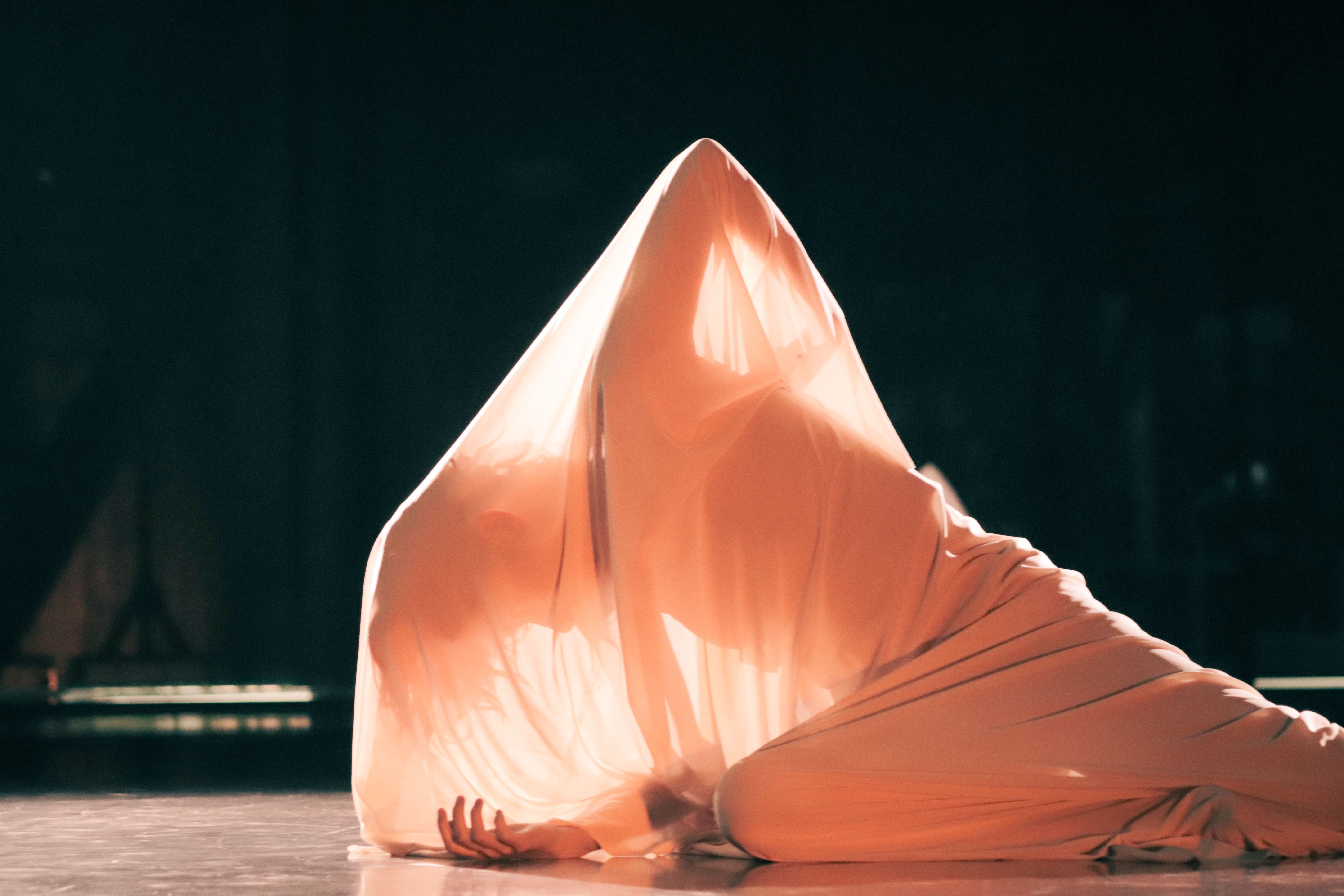
Through editing, Gustavo Gelmini seeks to dilate time, in repetitions of shots and raccord breaks. It is important to highlight the space in which the body is inserted: a bubble, which consequently generates a sensation of suspension of time. This bubble is incarnated on the screen, dramatically charging and adding bodily presence. The change in velocity through image repetitions, transitions of plans, circular movements and the "wave" soundtrack are processes of time dilation. This dilation begins in the sensitive experience of the artist's life and living, moving through the handling of the device during capture, the editing and the exhibition of the work, and finally arriving at the encounter with the spectator.
The spectator, invited to the movement of contemplation, comes into contact with the work. With each contemplation, with each encounter with the spectator, with each exhibition of the work – in all these encounters – the videodance on screen gains new poetics, updated contemplations, new layers of meaning, always forming new "spaces-between". The editing and exhibition repetitions, the exhausted movement of dilated time, the montage and its choreographic-dramaturgical charges bring us the perception and expectation of a movement to come, or rather, of a body to come.
IV. DANCE-EFFECT AND THE BUTOH EFFECT
The exploration of the force-idea of the butoh effect is the most experimental moment of the present paper. Here, we seek to think collectively and exploratorily about the ideas that were germinated during the research laboratories and in dialogues with Eastern arts. The butoh effect, in this sense, is proposed as a conceptual opening, an attempt to expand the understanding of body, gesture and time based on an encounter between East and West.
First, it is important to outline what constitutes this proposal and the driving bases of this dialogue between Eastern and Western arts and philosophies. The first theoretical basis for this paper is found in a fundamental text for the dialogue between Western and Eastern philosophy: "From a conversation about language between a Japanese and a thinker" (Heidegger, 2003).6 This text/dialogue results from the meeting between Martin Heidegger, a German philosopher, and Tomio Tezuka, a Japanese Germanist, and was produced in a series of conversations with other Japanese scholars and philosophers. The work in question follows a dialogue format in which both interlocutors discuss issues of language and aesthetics, but in a way that breaks with traditional Western precepts and tries to capture a form of understanding that had not yet been translated in Japan. The word "aesthetics" would only have an equivalent in Japanese language with the Kyoto School of Philosophy.
Another essential point of basis is the contact with the work of Kuniichi Uno, a contemporary Japanese philosopher whose thesis, "The genesis of an unknown body" (2012), elucidates the vision of an Eastern philosopher on Gilles Deleuze and Antonin Artaud's concept of body. In this text, Uno explores the conceptions of body and movement as fields of intensities that are located beyond objective corporeality, seeking an opening to the body as an entity in constant formation, a body that is never complete or fixed, but that manifests itself as a "body without organs", according to Deleuze (2012) and Artaud (2015). The intersection between these ideas of the body and the butoh dance offers us a radically new perspective to understand the body as a space of sensations and temporal crossings, breaking with the Western paradigm of an instrumentalized body.
From these philosophical bases and the dialogue between different languages and aesthetics, it is important to emphasize that, at this initial stage of the investigation, our appropriation of the poetics of butoh occurs in an experimental and somewhat wild way. This movement is not without risks, as it adapts a complex and deeply cultural Japanese artistic practice to the context of a Western philosophical piece of research. However, this appropriation, by its very nature open and under construction, allows a conception of the butoh effect to emerge – a concept in formation, which seeks to translate and communicate the resonances of this artistic practice within a Western investigative language.
The butoh effect, as we understand it here, is not reduced to a literal translation or a formal adaptation of butoh. On the contrary, it is a field of forces, a vector of intensities that manifests itself both in the poetics of movement and in the suspension of the body on stage, in a temporality of its own. This conception may seem premature in some aspects, but it represents a pulsating force that instigates the investigation to explore developments that are still unexplored, stimulating new discoveries and achievements in the course of research. The butoh effect, therefore, is a notion that points to the unfinished, to the ever-under-construction, where the body and the gesture merge in an intermediate, at once poetic and unspeakable space of existence, which challenges the very idea of a conclusion or an end. The butoh-effect points, primarily, to a dilated time and a body that is constantly moving, even if infinitesimally. The butoh-effect points, primarily, to a dilated time and a body that is constantly moving, even if infinitesimally.
Butoh emerged in Japan, in the 1950s, as a dance of slow movements and contorted, white-painted bodies. It is, in essence, a post-war dance, a visceral expression of an era marked by devastation and the search for a new form of existence. "The same moment you try to define what butoh is, it will no longer be butoh" (Aurich, 2022). Without seeking restrictive definitions, we were able to understand Butoh not only as a dance, but also as a philosophy of life, a state of the body in continuous transformation. To explore the idea of the butoh effect, we must first consider some essential dimensions: time, as a possible response to this poetics; but also eternity, death, and the carnality inherent in the butoh movement. Each of these dimensions constitutes an opening to a deeper understanding of what we are proposing as the butoh effect. In the context of contemporary audiovisual, the butoh effect proposes an alchemical carnality – a materiality of the body that, although diluted, becomes an alchemical element both on the screen and for the screen. In this study, we focused on two specific aspects of butoh: flesh and time. Time, as previously discussed, is elaborated from the bodily and audiovisual experience of dilation, which exhausts the cinematographic device in search of an expanded temporality. In the case of the butoh effect conjecture, this dilation of time occurs through a more intense body movement and a markedly deep perception of oneself.
We understand that, in order to achieve this perception of oneself and perform gestures of such intensity as in butoh dance, it is necessary to have a state of contemplation of everyday life, a relationship of understanding and "feeling" of one's own body as a powerful force field that, at the same time, belongs to the here and now – a body that "inter-is". This experience has been studied through filmed shows, photographs, readings and interviews with artists, including the Brazilian body artist Emilie Sugai. In an interview with the UnB's "The body that is told" project (2022), Sugai states that "butoh is a philosophy of life", emphasizing that he learned to "be in butoh" with his masters, including Takao Kusuno and, inevitably, Kazuo Ohno, one of the great pioneers of this practice.
and with the research we have been developing in the ethical and aesthetic field of the potentialities of the body and the audiovisual. Thinking of life as a work of art, with the body as a field of forces, is a central point for the creation of the body and time-sensation, which now converses with butoh in the conception of the butoh effect.
"According to Tanaka, it is not so much a matter of butoh aesthetics, but mainly a specific understanding of body perception that enhances space-time intervals and awareness of internal movements, such as breathing" (Greiner, 2019, 13) .
The concept of "effect" to which we refer so much here is inspired by the dance-effect of Carolina Natal (2014) and the cinema-effect of Philippe Dubois (2009) , both exploring the power of transposing certain technical conventions, promoting a kind of overflowing of movements from both dance and cinema. In our proposal, the butoh effect also seeks this plasticity of time and space, not only as a technique, but as a way of inserting the butoh philosophy of life in a cinematographic and audiovisual practice. The intention is to bring to the screen a dance, a body-camera-screen-body relationship that generates as an effect a dilation of time, a time with dramaturgical intensity that manifests itself in the lights, bodies, movements and repetitions. This effect proposes a deliberate slowness, a time of sensations and contemplations, which creates an experience between, between the real and the fabled real, between living and dying, as butoh itself suggests.
It is a "being-in-the-world" as proposed by Heidegger in Being and Time (2015), a being in the world that is a being between, in a continuous and interdependent existence. This Heideggerian reference points to the ontology of the body in butoh, a being that is never concluded, but that perpetually intertwines with time and space in its bodily and dramatic expression. However, we will limit ourselves here to mentioning these influences, without delving deeper into these terms, despite the desire to expand these musings.
In this way, the butoh effect is born from the possibility of an art that overflows its boundaries – between dance, visual arts, cinema and the screen – structured on the axes of Time and Movement. From this perspective, the butoh effect does not simply seek to integrate languages, but explores the poetic and transformative force that arises from the intertwining of these dimensions. Time, here, ceases to be a mere chronological flow to become a manipulable, dilatable substance, capable of creating a sensation of suspension and an ephemeral eternity. Movement, on the other hand, is understood as the vehicle of this sensitive transformation, where body, image, and perception merge, establishing an aesthetic experience that transcends the limits of representation itself.
"Dance not only displaces or 'deterritorializes' the image of the body by introducing this body into another dimension (which may be that of the body without organs that crosses it), but this image also reveals an image of time without measure that equals the order or orders of life lived by the body outside the standards. We are, therefore, inside and before an immense chaos, but also inside and before the crystals that correspond to this body, to this life and its time. Thoughts reveal themselves like these crystals." (Kuniichi Uno, 2012, 15)
The ideation of the butoh effect and the slowing down of time, however, should not be interpreted as a literal representation of butoh, since the butoh effect is not limited to the emulation of the aesthetic elements of this dance. Instead, the butoh effect emerges as a poetic and philosophical inspiration to conceive fragmented bodies, disintegrated images, canvases that multiply into fractals, proposing a form of visual and sensorial experience that seeks to destabilize the conventions of temporality and perception. The dilation of time, achieved by the exhaustion of the cinematographic device, expands the potential of the screen as a field of creation, not only reflecting the flow of images, but imposing on them a rhythm that challenges and intensifies the viewer's time. These deterritorializations – of body, of time, of space – drive an experience of cinema and aesthetics at its maximum power, where the butoh effect causes the overflow of the boundaries between the arts and transforms the reception space into a field of intensities and sensations. By proposing a dilation of temporal perception and by opening the way for the contemplation of the "not contemplable", the butoh effect not only challenges the viewer's gaze, but demands from them an active presence, an engagement that transforms the aesthetic experience into a sensitive dialogue, in an experience of a time that fluctuates.
Conflict of Interest
The authors declare no conflict of interest.
Ethical Approval
Not applicable
Data Availability
The datasets used in this study are openly available at [repository link] and the source code is available on GitHub at [GitHub link].
Funding
This work did not receive any external funding.
References
Cite this article
Related Research



Special Issue
Launch a focused special issue to highlight research, emerging trends, and expert insights in your academic field.
