




IntelliPaper
Abstract
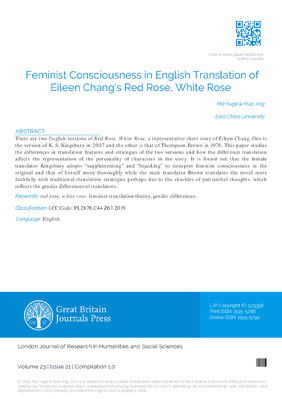
There are two English versions of Red Rose, White Rose, a representative short story of Eileen Chang. One is the version of K. S. Kingsbury in 2007 and the other is that of Thompson Brown in 1978. This paper studies the differences in translation features and strategies of the two versions and how the difference translation affects the representation of the personality of characters in the story. It is found out that the female translator Kingsbury adopts “supplementing” and “hijacking” to interpret feminist consciousness in the original and that of herself more thoroughly while the male translator Brown translates the novel more faithfully with traditional translation strategies perhaps due to the shackles of patriarchal thoughts, which reflects the gender differences of translators.
Explore Digital Article Text
I. INTRODUCTION
"Where there are Chinese literature in the world, there are people talking about Eileen Chang". [1] Eileen Chang, a genius emerging from 1940s, had created numerous novels, essays and translation works in the history of modern Chinese literature. As is acknowledged, literature is an international language. Eileen Chang's creativity has also spread into Western world through her works translated in different versions, which provides a channel for foreign readers to touch Chinese literature. Several translated works of Eileen
Chang have been published, for instance, Love in a Fallen City [2] and Lust, Caution and Other Stories [3]. However, studies on Eileen Chang are limited to the literary or realistic values while few scholars focus on the translations of her works from the perspective of translation and feminist translation theory. As such, there is an immense value in studying translation versions of Eileen Chang's novels in a new light.
Red Rose, White Rose [4], a landmark of Eileen Chang's short stories, depicts the emotional entanglement between the protagonist Tong Zhenbao() and two women, Wang Jiaorui (王娇蕊) and Meng Yanli(). From the perspective of feminism, the novel reproduces the plight of women living in the society ruled by patriarchal consciousness, which subverts the distorted gender concept in the patriarchal society and conveys the women's consciousness in China at that time.
The two versions of translation studied in this paper are from K. S. Kingsbury [5] and C. T. Brown [6]. The female translator, Kingsbury's version in 2007, reflects the female consciousness contained in the novel, which critically acquaints Western readers with Eileen Chang's original story-telling styles. However, another version was produced in 1978 by C. T. Brown, a male professor from American University. This version is selected from Brown's thesis, Eileen Chang's "Red Rose and White Rose" A Translation and Afterward.
K. S. Kingsbury, the female translator of Red Rose, White Rose has devoted herself to the translation career of Chinese modern literary and Eileen Chang's novels. The Chinese original version of Red Rose, White Rose awakened women's consciousness in China and in Kingsbury's translation version those women's consciousness are fully represented. This paper, based on feminist translation theory, intends to explore the specific expressions of the female translator and the male translator, and their respective translation methods and features by analyzing Kingsbury's and Brown's translation versions of Red Rose, White Rose, aiming to find out the gender differences of translators in translating Chinese feminist novels from the perspective of feminist translation theory.
II. PREVIOUS STUDIES ON RED ROSE, WHITE ROSE
The studies of Red Rose, White Rose done in recent years mainly focus on the main character in the novel, the male character Tong Zhenbao, writing technique and female consciousness in the patriarchal society. Among them, 14 theses probe into the image of the main character, Tong Zhenbao. Researchers like Wu Guofu [7] analyzed Tong Zhenbao's separation of social personality and private characters through "disposition" and "narrative strategy" theory; there are 9 essays concerning writing technique of the novel, particularly the rhetoric. Fang Tingting [8] pointed out that Zhang Ailing used the strategy of "Double Voice Discourse" to show her unique ways of rebellion and challenge to the authoritative awareness of the patriarchal culture in modern China's society; 14 researches the dilemma of women's life and female consciousness in the patriarchal society.
Comparatively, few scholars have approached Eileen Chang's works and the translations of her works from the perspective of translation studies. In 2011, Chen [9] studied two translated versions of Red Rose, White Rose and the roles different agents play in both versions of translation. Based on the analyses of translation phenomena and the translation errors, the author put forward some requirements for translators that valuing the source text and adopting the strategy of collaborative translation could help reduce the undesired translation phenomena and the translation errors, making the translation more accurate. Inspired by Liu Miqing's [10] papers on style translation, Zhang [11] figured out that the translation of Red Rose, White Rose, reproduced Eileen Chang's eloquent and evocative style accurately and properly in Kingsbury's translation. Then Liu Weiwei [12] analyzed the phrasing and syntactic examples in the English translation of Red Rose, White Rose. In 2017, through the application of relevance translation theory to the analysis of figurative rhetoric in the original text and translation, Ren [13] emphasized the importance of this theory; according to the functional theory, it is proposed by Liu Qian [14] that Kingsbury, the translator of Red Rose, White Rose used literal translation, annotation, free translation and other methods to deal with simile sentences flexibly which helped readers to understand.
In conclusion, the comparative studies of feminist translation theory in China mainly center at several classic books whereas there is relatively little research on Eileen Chang's works from the perspective of feminist translation theory. Furthermore, though research of the main character in the novel, writing technique, female consciousness in Red Rose, White Rose has proliferated in recent years, the majority in the aspect of translation are accustomed to investigating a single translation version with a certain theory. Efforts in deeply analyzing its translation versions and gender differences of translators from the comparison of different versions are lacking. Thus, in order to make up for the shortage of this field in conformity with the hot research topic of feminism, it's of paramount significance to study the gender differences of translators in the two versions of Red Rose, White Rose from the perspective of feminist translation theory.
III. GENDER DIFFERENCES IN THE TWO ENGLISH VERSIONS
3.1 Gender Differences at Lexical level
In traditional translation, authors of original works are often considered sacred and inviolable while the importance of translators is comparatively neglected, so that translators must adhere very strictly to the original text. However, as for feminist translation works, Simon argued, faithfulness is "to be directed toward neither the author nor the reader, but toward the writing project—a project in which both writer and translator participate". [15] Based on this viewpoint, translators should allow language to speak not only for the author, but also for women, so as to subvert the male-oriented translation theory, eliminate the sexist language in the translation and highlight their own personality. In the two versions, the main difference between Kingsbury and Brown is that Kingsbury neutralizes the derogatory words related to female characters and even changes them into the commendatory ones to protect women's image and reveal women's consciousness and the creativity of female translators, while Brown follows the tone of the original text without changing the lexical tendency in order to defend the men's image and the male domination in the novel.
3.2 Names of Main Characters
Character names in a novel are the carrier of cultural association and reveals cultural information. [16] Mr. Siguo once pointed out, from the translation of names, people could see the difficulty of translation. [17] Names of characters carry a lot of cultural connotation, through which, readers are able to catch a glimpse of social conditions and cultural background in a certain period. So when translating surnames and first names, it is important to study the relative cultural information, conventions and regulations. In the two versions of Red Rose, White Rose, considering gender differences, living habits and cultural background of Brown and Kingsbury, methods of name translation are also various.
To translate the names of main characters in the novel, Brown and Kingsbury adopt different transliteration schemes. In Brown's version, Wade-Giles Romanization is frequently used. Wade-Giles Romanization, a Latin alphabet scheme, was formulated according to Beijing dialect by Wade, British minister to China, which was known at home and abroad before the publication of the scheme of the Chinese phonetic alphabet in 1950. However, Wade-Giles Romanization was classified as a scheme based on Western cultural habits. From the perspective of discourse power, China was in a state of "aphasia" in the name translation at that time. On the other hand, Kingsbury, as a sinologist familiar with Chinese cultural habits, applies the Chinese phonetic alphabet. Although it retains only the representation of names, this scheme contains the original flavor of the exotic atmosphere, which is also conducive to the cultural output of Chinese characters.
(2)振保一看, 纸上歪歪斜斜写着"王娇蕊"三个字, 越写越大, 一个"蕊"字零零落落, 索性成了三个字, 不觉扑哧一笑。(张爱玲, 2012:61)
Written askew on the paper were three characters, "Wang Chiao-jui," each written progressively larger. The "jui" character was so dispersed that it might as well have been three characters. He couldn't help laughing. (Brown, 1978:18) When Zhenbao saw the three crooked words on the paper, each one bigger than the last, and the last one breaking apart into three distinct fragments-wang jiAO RUI-he really had to laugh. (Kingsbury, 2007:215)
In the original text, Eileen Chang tries to depict of Jiaorui's poor writing by means of embellished description of each character in order to convey a whiff of amusement. Extremely faithful to the original, Brown chooses the classic translation method to translate word by word, which is concise but plain and ungarnished considering cultural differences. By contrast, Kingsbury produces "wang jiAO RUI" in accordance with the intention of Eileen Chang's humor. Askew characters seems to leap off the page, one bigger than the former, making foreign readers resonate with the author. This innovative and flexible translation, when retaining the original author's ingenuity, highlights the female translator's sense of existence.
3.3 Feminine Expressions
According to Steiner, there exists gender language in literary translation activities that male and female translators tend to use synonyms with different tendencies. [33] Lexical tendency refers to that words in the original text belong to neutral expressions without any sexist color. However, male translators often add derogatory sense to words. Irigaray, a French feminist translator, held that "male language reflected men's discrimination, derogation and control over women". [34] In other words, women should get rid of language shackles in the patriarchal world, able to arouse the whole society to pay more attention to women and women's social value. Carrying on this belief, when it comes to words referring to or addressing female characters, Kingsbury expresses her self-identity and awakening of self-consciousness by using more euphemistic expressions. Brown, however, preserves the malicious and ironic expressions of the original text.
(1)想到王士洪这太太, 听说是新加坡的华侨, 在伦敦读书的时候也是个交际花。(张爱玲, 2012:58)
He had heard that she was an overseas Chinese from Singapore, who had led a promiscuous life. (Brown, 1978:12)
He'd heard that she was an overseas Chinese from Singapore who, when she was studying in London, was quite a party girl. (Kingsbury, 2007:209)
The word "交际花" refers to a woman who is active and famous in social circles. In Brown's version, "promiscuous", a derogatory term, directly implies that Wang Jiaorui has many sexual partners, dirty and shameless, by which men's natural discrimination against women is displayed. But "a party girl" translated by Kingsbury describes Wang Jiaorui as an outgoing and popular existence when studying abroad in London, playing down the insulting implication in the original text and boosting the image of female characters.
(2)现在的女人没有这种保护了, 尤其是地位完全没有准绳的杂种姑娘。(张爱玲, 2012:75)
Women nowadays don't have this kind of protective buffer, especially not mixed-blood girls, whose status is so entirely undefined. (Brown, 1978:42)
Today's women don't have this kind of protection, especially Eurasian girls whose positions provide them with no norms at all. (Kingsbury, 2007:238) In Chinese, "杂种" is reckoned as an offensive term of abuse. Tong Zhenbao called Miss Ashe "杂种姑娘", which conveyed a whiff of contempt for the lower-class girl of mixed race. Brown renders this negative expression into "mixed-blood girls", a pejorative term with a hint of racial discrimination. It is more suitable for the original context but less appropriate to address women from an equal sex angle. In Kingsbury's version, she replaces "mixed-blooded girls" with "Eurasian girls", a neutral expression to dispel the racial and gender discrimination against women from Zhenbao in the original text, which shows her feminist consciousness.
(3)下贱东西, 大约她知道自己不太行, 必须找个比她再下贱的, 来安慰她自己 (张爱玲, 2012:91)
The vile thing. She herself probably knew that she was inadequate, and so she needed to find someone even more vile to comfort her.(Brown, 1978:70)
Such a lowly little thing! Prob-ably she knows she's nothing-she wants to find someone even lower than she is if only for comfort's sake.(Kingsbuey, 2007:266) With the anger at his wife's betrayal, Zhenbao compared his wife—a worthless woodworm only attached to her husband—to a vile thing. Brown translates the address "下贱东西" into "the vile thing". The word "vile" is a pejorative term meaning "morally bad", which mocks Yanli's adultery. Kingsbury writes down the expression "a lowly little thing" where the word "lowly" means "inferior in station" to portray Zhenbao's comtept for his wife. Kingsbury and Brown both translate the derogatory address correctly. Thus, the decent and tolerant mask of Zhenbao is torn off, with his ruthless and disrespectful attitudes towards Yanli appearing.
3.4 Adjectives
The gender differences of the two translators are also revealed by the choices of adjectives. Kingsbury is used to adding more detailed and commendatory expressions to underline feminine features in the original while Brown conducts the description more objectively and even avoid using feminine words to describe men.
(1)那是个森冷的,男人的脸,古代的兵士的脸。(张爱玲, 2012:54)
It was a chilling face, a man's face, that of an ancient soldier. (Brown, 1978:6)
It was a cold, severe, masculine face, the face of an ancient warrior. (Kingsbury, 2007:204)
The "insignificant whore" encountered leaves Zhenbao with a terrible perception that even a prostitute cannot be controlled by him. The word "森冷" means "frightful and cold". In Brown's version, the word "chilling" indicates that Zhenbao would feel creepy at the sight of the woman, which uglifies the prostitute's image and expresses Brown's disrespect for her identity. Comparatively, Kingsbury renders the word as "cold, severe" more mildly out of the maintenance of women's image.
(2)他喜欢的是热的女人, 放浪一点的, 爱不得的女人。(张爱玲, 2012:58)
The women he liked were fiery, a little loose, the women one couldn't marry. (Brown,1978:14)
He liked women who were fiery and impetuous, the kind you couldn't marry. (Kingsbury, 2007:211)
Apparently, the word "loose" is more faithful to the original. Both of the male character, Tong Zhenbao and the male translator, Brown disapproves of women with many sexual relationships, deliberately taking "放浪" or "loose" as a put-down of women. However, female translators get accustomed to replace lower words with neutral ones to remove the sense of superiority over women by arbitrary comments. Thus, Kingsbury translates the word into the adjective "impetuous" describing women lacking in thoughts or deliberation, which successfully weakens the implication of Wang Jiaorui's misconduct.
(3)男人美不得, 男人比女人还要经不起惯。(张爱玲, 2012:65)
Men shouldn't be handsome. Men aren't women; they mustn't be spoiled. (Brown, 1978:25-26)
Men should not be pretty. Men get spoiled even more easily than women do. (Kingsbury, 2007:223) In common cases, "handsome" refers to a man with good looking while "pretty", a beautiful and delicate woman. On the basis of traditional male-oriented translation theory, it is improper to decorate men with female traits such as beauty, delicacy and so forth, because it is universally acknowledged that beauty, a feature to please others, does not fit with men noted for great deeds in their own right. So Brown would rather violate Eileen Chang's intention than admit men's beauty. Similarly, as a feminist translator, Kingsbury maintains the meaning of the original word "美" by the word "pretty" to break the gender stereotypes and call for the gender equality.
(4)她是细高身量, 一直线下去, 仅在有无间的一点波折是在那幼小的乳的尖端, 和那突出的胯骨上。(张爱玲, 2012:81)
She was tall and thin, flat all the way down, except for the points of her young breasts and her hipbones. (Brown, 1978:52)
Yanli was tall and slender, like a single straight line; the only hint of a twist or turn came at the tips of her girlish breasts and the jutting bones of her hips. (Kingsbury, 2007:248)
The first time Zhenbao met Meng Yanli, she was reckoned only as a thin and pale woman. Thus, the appearance description in this paragraph shows Zhenbao's indifferent attitude towards his marriage. Under this context, Kingsbury chooses "slender" meaning "thin in an attractive or elegant way" and "girlish" to appreciate Yanli's figure, which gives prominence to feminine charm. Instead, Brown's choices of flat and insipid expressions such as "thin" and "young", deliberately covers up and ignores the feminine features of Meng Yanli, which highlights Zhenbao's inappreciation of her.
(5)振保这才认得是娇蕊, 比前胖了但也没有如当初担忧的, 胖到痴肥的地步。(张爱玲, 2012:84)
She was fatter, but not as fat as he had feared she would become. (Brown, 1978:58)
She was plumper than before, though certainly not paunchy, as she'd once feared would happen to her. (Kingsbury, 2007:254) In the context, the word "胖" means "obese". As for Brown's translation, "fat" carries the ring of disparagement, considering Wang Jiaorui imperfect and depraved. Throughout history, women have been the objects recklessly gazed by men, with body shame emerging in an endless stream. To stop from being gazed, feminist translators do well in publicizing self-identity. In Kingsbury's version, the complimentary word "plump" means "curvy and attractive" to indicate a sort of kindness towards the female character, which reduces the harm of sexism in language to women.
3.5 Verbs
Action description cannot only highlight the characters in the novel, but also the writing level of the author. In the two versions, even though Kingsbury and Brown are capable of translating the action description of Eileen Chang intactly, Kingsbury differs from Brown with more accuracy and exquisiteness:
(1)再拥抱的时候, 娇蕊极力紧箍着他, 自己又觉羞惭。(张爱玲, 2012:71) When they embraced again, Chiao-jui held him tightly. (Brown, 1978:36)
When they embraced again, Jiaorui wrapped herself around him so tightly that she blushed. (Kingsbury, 2007:32)
This example describes Jiaorui's deep love for Zhenbao. The word "紧箍" means "hold tightly". The verb "wrap" means "cover sth. tightly", more tightly than that of the word "hold". As such, Kingsbury's version succeeds in describing that Jiaorui firmly hugs around Zhenbao, which endows Jiaorui with a feature of the brave pursuit for love. On this point, Kingsbury highlights Jiaorui's good characteristics, which coincides with Eileen Chang much more than Brown.
(2)烟鹂迎上前来答应着,似乎还有点心慌一双手没处安排,急于要做点事,顺手捻开了无线电。(张爱玲,2012:90) As if she were a bit nervous, she didn't know where to put her hands, anxiously looked for something to do with them, and then turned on the radio. (Brown, 1978:69)
Her hands wandered around, finding no place to rest but anxious to be doing something. She flipped on the radio. (Kingsbury, 2007:65)
The word "捻开" means "open unintentionally", which indicates that Yanli was suffering excessive nervousness after her first adultery, but her abnormal behavior gave her away. Brown uses the verb "turn" out of context. Compared with Brown's plain version, Kingsbury reproduces the feelings of embarrassment, anxiety and fear through the verb "flipped" meaning "open with a small quick hit", which symbolizes Yanli's unconscious gesture. Therefore, the female character's psychology and personality jumps off the paper.
IV. GENDER DIFFERENCES IN TRANSLATION STRATEGIES
For the purpose of making female images seen and women's voice heard in literary works, it is necessary to use "a lot of different strategies that came from the translator's or the author's own subjectivities".[35] There are three feminist translation strategies: "supplementing", "prefacing and footnoting", and "hijacking". In
Kingsbury's version, she principally applies two of them including supplementing and hijacking and in addition, domestication so as to make women's image visible and promote women's consciousness. In terms of Brown's version, he carries out one of the traditional translation strategies, word-for-word translation which often misses the implication of the original.
4.1 Supplementing
Supplementing is a strategy used by feminist translators to supplement the translation in detail based on the original content. Unlike ordinary translation works, most contents added by female translators would intervene the source text, with feminist translators' role matured and developed.
(1)士洪笑道;"你不知道他们华侨——"才说了一半,被娇蕊打了一道:"又是'他们华侨'!不许你叫我'他们'!"(张爱玲,2012:61)
Shih-hung said smiling, "you don't know these overseas Chinese—" Before he could finish his sentence, Chiao-jui hit him. "Again, it's 'these overseas Chinese.' I won't like you call me 'them.'" (Brown, 1978:19)
"You don't know about those overseas Chinese, they—" Shihong started to say, hut Jiaorui hit him. "It's always 'they, them, those overseas Chinese'!" she said. "Don't call me 'them'!" (Kingsbury, 2007:215) In comparison with Brown's word-for-word translation, Kingsbury adds three synonyms of the pronoun "them" to the translation of the phrase "他们华侨", revealing Jiaorui's discontent with the masculine address, which plays an important role in portraying the female character, Wang Jiaorui as brave, open-minded and progressive. Meanwhile, the female consciousness of Kingsbury and the awakening consciousness of Jiaorui are incarnated and pass on to the readers effectively and completely.
(2)烟鹂现在一下子有了自尊心, 有了社会地位, 有了同情与友谊。(张爱玲, 2012:94)
Yen-li suddenly had self-respect, had social position, had sympathy and friendship. (Brown, 1978:76)
All at once Yanli gained self-confidence. She had social status. She had sympathy. She had friends. (Kingsbury, 2007:272) In the old patriarchal society, women's sense of existence was deliberately omitted in most instances which was usually indicated by the disappearance of feminine pronouns due to the paternal discourse manipulation. Compared with Brown, Kingsbury adds three pronouns "she" to the original sentence, in order to highlight women's identity. In the novel, Yanli had changed from being completely attached to men to degenerate, then to seek a way out. The foreshadowing of the coordinate sentences shows a strong emotion, the rebirth of Meng Yanli, and Kingsbury's emphasis on women's existence.
4.2 Hijacking
Hijacking is a very radical approach, through which, translators forcibly embed expressions with feminist values in the neutral original text, and delete or even reverse the words with patriarchal color for the improvement of the status of female characters.
(1)他是个正经人,将正经女人和娼妓分的很清楚。(张爱玲, 2012:54)
He was an upright young man, and distinguished clearly between upright girls and prostitutes. (Brown, 1978:7)
He was a nice fellow, and he wanted to meet a nice girl, not some prostitute. (Kingsbury, 2007:203)
Seemingly gentle as Tong Zhenbao is, in fact connecting with the Chinese context, he is so sanctimonious and hypocritical that he despises prostitutes secretly. Only the female translator who penetrates into Eileen Chang's irony, manipulates the text to tear up Zhenbao's disguise, which exposes the deep-rooted bad habits of the male protagonist.
(2)女人有改变主张的权利。(张爱玲, 2012:64)
Woman have the right to change their minds. (Brown, 1978:24)
It's a woman's prerogative to change her mind. (Kingsbury, 2007:221)
"Right" is a neutral term while "prerogative" represents the right belonging to some particular persons. Under the oppression of patriarchy, women face the crisis of survival while only men enjoy privilege. The usage of male language in literary translation reflects the subjective desire of men to dominate everything, consciously or unconsciously revealing their social status superior to women. In the sentence, Kingsbury specially selects the word "prerogative" to prove that women can also feel entitled to certain advantages, which unfolds the pursuit of gender equality in line with Eileen Chang's giving publicity to female consciousness.
(3)可是振保的快乐更为快乐, 因为觉得不应该。(张爱玲, 2012:71) But because she was forbidden, Chen-pao's happiness was even greater. (Brown, 1978:35)
But feeling that he shouldn't be doing this only made his happiness more perfect. (Kingsbury, 2007:231)
The sentence illustrates an epitome of the patriarchal society. In the superior and sneering tone of Brown, women are forbidden from having affairs with men or violating so-called social norms. Besides, it is women who should bear countless moral constraints to be blame. On the contrary, Kingsbury's version, empowered with feminist consciousness, holds that other than the comments on Jiaorui, it is Zhenbao's fault to court a married woman, which assails the oppression made by Chinese traditional male-centered culture.
(4)他母亲略有点疑心娇蕊和他有点首尾,故意当着娇蕊的面劝他。(张爱玲, 2012:79)
His mother, somewhat suspicious that he and Chiao-jui had some special relationship, deliberately lectured him in front of her. (Brown, 1978:49)
His mother suspected that something was going on between them, and she made sure to scold him in front of Jiaorui. (Kingsbury, 2007:244)
Concerning about the interaction between Zhenbao and Jiaorui, Zhenbao's mother doubted that Jiaorui had an illicit association with her son. Brown translates the word "首尾" into "special relationship" with similarly preconceived notions. Comparatively, Kingsbury objectively renders it as "something going on between them", a neutral phrase as an uncertain conjecture, which minimizes the whiff of male chauvinism and protects the female character from groundless accusation.
4.3 Domestication
According to feminist translation theory, fidelity does not refer to be simply faithful to the original text, but translators' own feminist thoughts so as to highlight their position. It is translators' freedom to apply different translation methods and leave their own imprint in literary works. The committed feminist translator, Susanne once pointed out, her translation practice was a political activity aiming to make language speak for women. So every translation strategy she used was to make the feminine visible in language". [36] As a feminist translator, Kingsbury chooses sense-for-sense translation in concert with feminist translation. Through various sentence patterns and grammatical features, her language is so flexible and fluid that there is no translationese at all. Instead of retelling the novel, her version conveys the underlying language and female consciousness in Red Rose, White Rose. In her translation, the employment of domestication attains the highest perfection. Domestication is a strategy which changes the translation into the target language naturally to avoid the misunderstandings during the reading process. For example, Kingsbury translates the phrase "劲道"(2012:60) into the English idiom "hit the nail right on the head" (2007:14), more vividly than Brown's choice of "mince words"(1978:17); she renders the phrase "绝无问题"(2012:73) as "clear sailing"(2007:35) instead of Brown's plain expression "no problem"(1978:39). Kingsbury turns Chinese language into idioms familiar to foreigners to build bridges between the cultural gaps, which strengthens the connection between
Eileen Chang and the readers around the world, and showcases the irreplaceable value of the translator.
V. IMPLICATION OF FEMINISM TRANSLATION
It is normally expected that translators can reproduce and convey the creative information and intention of the original literary works to readers truthfully, so that the target readers can experience the same while reading. The two translation versions of Red Rose, White Rose have done that, which not only demonstrate the gender differences of translators, but also dig out the social reflections behind the feminism translation. Setting it apart from each other, Brown follows traditional translation strategies without in-depth analysis, which largely covers up the feminine elements in the original text and endorses the patriarchal rules at that time, whereas Kingsbury sticks up for female characters and expresses the feminine awareness through feminist translation strategies. Quite different as they are, both of their versions act out the tragic social reality in 1940s.
5.1 Implication on Social Images and Positions of Women
In the Chinese traditional cultural and social system, male chauvinism has continually occupied the major position. The objectification of women is the crime inconceivable to obliterate committed by the patriarchal society. Under the criteria of suitability for marriage, women are categorized as three types in the novel: prostitutes, "innocent girls" ("天真的女孩子") such as Rose and Wang Jiaorui, and "nice girls" ("正经的女人") like Meng Yanli.
For prostitutes, Zhenbao wishes to "control them" ("掌控她们") as "the master of his own world" ("他的世界里的主人"). In the world dominated by Tong Zhenbao, prostitutes are so "sleazy, low-class, and filthy-miserable" ("下流、随便、肮脏黯败") that they fit for nothing more than arrow fodders to vent. For "innocent girls" ("天真的女孩子") seemingly untrammeled like Jiaorui, her valiant pursuit of love is construed as "feigning love" ("爱匠"); her personality is trampled under Zhenbao's feet; her behavior is criticized by a fellow woman, Zhenbao's mother, with all her action beneath contempt. For "nice girls" ("正经的女人"), as the accessory of Zhenbao, Yanli loses all her self-esteem becoming a "boring young matron" ("很乏味的妇人") under the constraints of behavioral and ideological norms for "ideal wife" formulated by men. Over time, even nobody shows due respect for her.
To summarize, regardless of the females' identity, their lower social status should be the same. Even if Kingsbury endeavors to promote the social images of female characters in her translation, undeniably, women are compelled to bear the discrimination and oppression imposed on them in the men-ruled society, which sows the seeds of their miserable life.
5.2 Implication of Personality of Women
At the beginning of the novel, Eileen Chang utilizes two images of "red rose" and "white rose" to symbolize the main female characters: Wang Jiaorui and Meng Yanli. With a stark contrast between the two beautiful women, neither of them can escape the ending of tragedy. During the process of moulding their images, Brown weakens their good manners and virtues as women which Kingsbury however, underscores.
5.2.1 Personality of Wang Jiaorui
As long as Eileen Chang showcases Jiaorui's bravery of fighting against social shackles and chasing her freedom of love, Brown would reduce the power of these sentences through plain translation. For instance, When describing Jiaorui's strong social skills, Brown depicts Jiaorui "who had led a promiscuous life" ("是个交际花"); when describing Jiaorui's feminine consciousness, Brown shortens the phrase "他们华侨" into "these overseas Chinese" with no hint of her advanced thoughts; when describing Jiaorui's ideas on men, Brown sticks to the word "handsome" men instead of "pretty" ("美") men, which neglects Jiaorui's awareness of gender equality. Therefore, Wang Jiaorui is presented as an ordinary woman in the old society.
In Kingsbury's version, before her acquaintance with Tong Zhenbao, Wang Jiaorui operated an equal and harmonious marriage with Wang Shihong. She dared to resist masculine labels of "they, these, those overseas Chinese" ("他们华侨") with the early feminine consciousness. After meeting Zhenbao, she was determined to "inform Shihong about everything, divorce him, and marry Zhenbao" ("把一切都告诉王士洪,和他离婚,再嫁给振保"). If it was an unconscious betrayal of the traditional morality to play with different "boyfriends" ("男朋友们"), Jiaorui's "real love" ("真爱") for Zhenbao at this time subjectively revolted against the decaying marriage concept of women. Ironically, such a "hot" ("热情"), iconoclastic and courageous women managed to plead for Zhenbao's pardon humbly, and even depended on another marriage for survival. In the end, Wang Jiaorui got caught in the cross hairs of feudal ethics again.
5.2.2 Personality Characteristics of Meng Yanli
Comparatively, beautiful as Meng Yanli looks on the outside, she pervades a sense of decaying at heart. But Brown even deprives Yanli of her external beauty. At her first meeting with Zhenbao, Brown describes Yanli as a "thin, pale" ("单薄、白皙") woman without any other features while Kingsbury uses words like "slender" ("细高身量"), "girlish" ("幼小的"), and "frail" ("单薄") to strengthen her feminine beauty. Except for that, Kingsbury and Brown consist with each other during the description of Yanli's characteristics. In conformity with the social standards and male needs, Yanli could be anything like a puppet, from a smart and filial daughter to a "refined, ideal wife" ("美丽娴静的、最合理想的太太"); she could be anything except herself, which caused her silence on the chaotic private life of her husband. Under stifled resentment, she degraded herself from a holy rose to a "lower little thing" ("下贱东西") guilty for adultery with a tailor. Facing with Zhenbao's revenge, she could only beg for mercy and pray for Zhenbao's protection, without any independent consciousness from beginning to end.
5.3 Implication of Weaknesses of Male Characters
Red Rose, White Rose is narrated from the perspective of Tong Zhenbao, which inevitably engages the readers in what Zhenbao himself desires to say, to experience, and to cover up. The most irony and tricky is down to the unilateral information provided by Eileen Chang, among which the weakness of male characters is the message Eileen Chang intends to deliver implicitly, which is better revealed by the female translator, Kingsbury.
On the one side, Kingsbury interprets the weakness of Tong Zhenbao well to unmask his disgusting features. In Kingsbury's version, with a condescending attitude towards women, Zhenbao disrespected women attached to men in the old society. He was determined to "create a world that was right" ("创造一个对的世界"); he "wanted a nice girl, not some prostitute" ("将正经女人与娼妓分得很清楚") out of his discrimination on whores; he imaged Jiaorui as "a naive, passionate girl who had doted on him" ("痴心爱着他的天真热情的女孩子") to enjoy physical happiness; he married Yanli to collect "a perfect backdrop for men" ("男人们高谈阔论的背景"). However, he pampered himself by rationalizing his bad conduct. For his poor self-control, he shattered the serenity of Jiaorui's life by an excuse that "there really weren't many women of this sort" ("这一路的人究竟少"); for his own future, he said to Jiaorui, "then you have to consider my situation" ("就不能不为我着想"); for his anger, he "started drinking a lot, openly consorting with women outside the house" ("常常喝酒,在外面公开的玩女人") then. Generally speaking, Tong Zhenbao is shaped into a splitting existence, half self-disciplined, half self-indulgent, which is rooted in the common weakness of men in the male-dominated ideology where women are fettered by the rigid gender role which requires them to be weak, dependent and docile.
On the other side, Zhenbao's image is much glorified in Brown's version. As a "filial, considerate and thoughtful" ("周到、认真、经心") man, if Zhenbao had an affair with Wang Jiaorui, it was Jiaorui "who had led a promiscuous life"
("是个交际花") to be blame; if Zhenbao indulged in the physical happiness with Jiaorui, it was Jiaorui who was "forbidden"("") that seduced him; if Zhenbao made a snide comment about Miss Ashe, it was the "mixed-blood girl"("") who was inferior to him; if Zhenbao "hung around with women"(""), it was his wife, Meng Yanli who "found someone even more vile to comfort her"("找个比她再下贱的,来安慰她自己"). Brown attributes all of Zhenbao's misconduct to the female characters in order to maintain Zhenbao's "perfect"("") image with perfect excuses on account of the unavoidable patriarchal thoughts of the male translator.
VI. CONCLUSION
Regarding the gender differences in lexical translation, the male translator, Brown's literal translation uglifies women's images and weakens women's voice while Kingsbury mostly speaks for women by translating the derogatory language into neutral and even commendatory words, in order to manifest the feminist awareness of the characters and herself. Moreover, even if Brown's word-for-word translation is more faithful to the original text than Kingsbury's version, Kingsbury adds more explicit and detailed description of female appearance and action to the translation, which emphasizes women's consciousness continuously and improves their image.
Regarding the gender differences in translation strategies, because of Brown's patriarchal thoughts as a male translator, he mainly adopts word-for-word translation, which restores all the information but camouflages the shortcomings of male characters. Kingsbury, however, adopts supplementing, hijacking and domestication to extoll the virtues of female characters and discloses the weakness of men incisively.
Regarding the reflections behind the two versions, the male translator and the female both more or less reflect the social reality and the dilemma of women, which echoes with Eileen Chang's creative intention. The difference lies in that Brown weakens the characteristics of women and the defects of male characters while Kingsbury points out the good virtues of female characters and the weakness of men more explicitly than Brown.
Conflict of Interest
The authors declare no conflict of interest.
Ethical Approval
Not applicable
Data Availability
The datasets used in this study are openly available at [repository link] and the source code is available on GitHub at [GitHub link].
Funding
This work did not receive any external funding.
References
Cite this article
Related Research



Special Issue
Launch a focused special issue to highlight research, emerging trends, and expert insights in your academic field.
