



IntelliPaper
Abstract
The safety of life at sea is a very important aspect in terms of navigation. The purpose of the study is to determine the level of awareness of the Boat Captains in terms of sounds and light signals and lights and shapes on Collision Regulations by using the validated questionnaires that the author was provided based on the International Collision Regulations for Preventing Collision at Sea. The study was conducted in the different areas of Region V1 namely: Boracay Island Malay, Aklan, Estancia, Roxas City Capiz, and Guimaras Province. The study was conducted last November 2018 to November 2019. Participants of the Modified Basic Safety Training Course with Typhoon Awareness and Collision Regulations conducted by the Maritime Industry Authority, Region VI Iloilo City, and Iloilo State College of Fisheries, were utilized as respondents of the study. The respondents were composed of One Hundred Eighty boat captains through stratified sampling using Slovin’s formula. A qualitative/Quantitative research design was employed in the study. Open-ended validated questionnaires were administered to the selected respondents. Focus group discussion was conducted to get reliable data from their personal experiences at sea. Answered questionnaires were gathered, tabulated, and analyzed using appropriate statistical tools. The results of the study in the sounds and lights signal the mean of the pretest is 3.05 knowledgeable and the level of awareness in terms of lights and shapes the mean of pretest is 5.86 it is knowledgeable. The Collision Regulations training for the boat captains must be continued to improve their level of awareness and they need it in their profession. The MARINA must provide a Memorandum Circular about the Boat Captains that they must have a Certificate on the "International Collision Regulations Course" so that they are aware of the Rules of the Road and they can apply their profession and minimize or prevent whatever accidents happen onboard.
Explore Digital Article Text
I. INTRODUCTION
Basic safety training offers maritime students as well as professionals different training on personal survival techniques, disaster management, and others while disaster preparedness is a process of ensuring that an organization has complied with the prevention measures. It is assumed as a state of readiness to contain the effects of a forecasted disastrous event to minimize loss of life, injury, and property damage. It is extensively defined as a way to provide rescue, relief, rehabilitation, and other services in the aftermath of a disaster. It entails the capability and resources to continue to sustain its essential functions without being overwhelmed by the demand placed on them, first and immediate response – emergency preparedness. Training is not a "recreational" luxury to be implemented when times are good, but a continuous effort that is even more valuable when times are rough. Proper planning of disaster awareness and disaster preparedness activities in isolation from people's daily lives and everyday concerns will rarely succeed. This is because people's interest in disaster preparedness fades if it has been a long time between disaster events. Typhoons affect the natural environment and cause harm to trees and other vegetation, including crops that communities may rely on for sustenance trade or both. In addition, these typhoons not only destroyed agricultural and industrial properties but also killed thousands of lives. Equally, the Philippines is a nation surrounded by water. In so much so, the nation sees many water-related accidents and disasters on a yearly basis. Thousands of people have been killed by ferry and boating accidents in the Philippines. Due to the fact, that our nation consists of 7,563 islands, and many are not able to afford air travel or are located too remote to an airport facility, ferry boats are the predominant mode for national travel. Likewise, bad weather, especially during typhoon season, poor maintenance, overloading of vessels -- especially during the Christmas season as families return to their villages for reunions -- and lax enforcement of regulations have brought many tragedies. Natural disasters caused by eliminate change are among the greatest threats faced by the world, especially the developing countries.
II. STATEMENT OF THE PROBLEM
This study aims to determine the level of awareness of the Boat Captain in terms of sounds lights signals and light and shapes on Collision Regulations.
-
What is the level of awareness of the Boat Captains in terms of sounds and light signals on Collision Regulations?
-
What is the level of awareness of the Boat Captains in terms of lights and shapes on Collision Regulations?
III. METHODOLOGY
This chapter presents the research design, locale of the study/site, respondents, sample size, sampling technique, research instrument, data gathering procedure, and data analysis.
3.1. Research Design
Descriptive qualitative/quantitative research design.
3.2. Locale/Study Site
Selected areas in Region VI namely: Boracay Island Malay, Aklan, Estancia, Roxas City Capiz, and Guimaras
3.3. Respondents
Boat Captains in selected areas in Region VI namely: Boracay Island Malay, Aklan, Estancia, Roxas City Capiz, and Guimaras
3.4. Sampling Techniques
Stratified sampling using Slovin's formula
3.5. Research Instrument
Validated Survey Questionnaires in sounds and light signals and light and shapes based on international collision regulations 1972.
3.6. Data Gathering Procedure
Propose the MBSTC training with Typhoon Awareness to be approved by the President of the Administration then after the approval sends an invitation letter to the MARINA for the resource speaker and after the approval make a courtesy call to the Mayor of every selected area to inform about the training to be conducted after the approval of the Mayor coordinate with the president of the organization and met the boat owners to inform the training to be conducted by the MARINA and ISCOF so that they will inform their crew to participate in that said training.
3.7. Data Analysis
Data gathered will be recorded and subject to statistical analysis.
IV. RESULTS AND DISCUSSION
4.1 Findings with analysis and interpretation
The study aimed to know the level of awareness of Boat Captains in selected areas of Region V1. It also assessed the experiences of the Boat Captains in maneuvering and handling the ship in terms of bad weather. The response for each question and its findings are presented in the succeeding table.
The Level of awareness of sounds and light signals result was presented using the following:
| Scale | Description | |
| 5 | 5.00 - 4.21 | Very Much Knowledgeable |
| 4 | 4.20 - 3.41 | Much Knowledgeable |
| 3 | 3.40 - 2.61 | Knowledgeable |
| 2 | 2.60 - 1.81 | Less Knowledgeable |
| 1 | 1.80 - 1.00 | Very Less Knowledgeable |
| Scale | Description | |
| 5 | 5.00 - 4.21 | Very Much Knowledgeable |
| 4 | 4.20 - 3.41 | Much Knowledgeable |
| 3 | 3.40 - 2.61 | Knowledgeable |
| 2 | 2.60 - 1.81 | Less Knowledgeable |
| 1 | 1.80 - 1.00 | Very Less Knowledgeable |
The following tables are the results of the pretest exam on sounds and light signals on collision regulations.
| Item | Correct | Wrong |
| 1. One short blast to mean. (Isa ka utod nga pag busina) | 124 | 58 |
| 2. Two short blasts to mean (Duha ka utod utod nga pagbusina) | 103 | 79 |
| 3. Three short blasts to mean (Tatlo ka utod utod nga pag busina) | 120 | 62 |
| 4. One flash to mean (Isa ka pag igpat sang suga) | 114 | 68 |
| 5. Two flashes to mean (Duha ka pag igpat sang suga) | 94 | 88 |
| Scale | Description | |
| 5 | 8-10 | Very much knowledgeable |
| 4 | 6-7.99 | Much Knowledgeable |
| 3 | 4-5.99 | Knowledgeable |
| 2 | 2-3.99 | Less Knowledgeable |
| 1 | 0-1.99 | Very Less Knowledgeable |
The Level of awareness in lights and shapes result was presented using the following:
The following tables are the results of the pretest exam on light and shapes on collision regulations.
| Item | Correct | Wrong |
1. What does this represent? 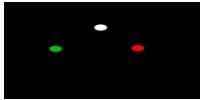 | 121 | 61 |
2. What does this represent? 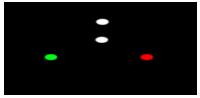 | 120 | 62 |
3.. What does this represent?  | 124 | 58 |
4. What does this represent?  | 114 | 68 |
5. What does this represent?  | 105 | 77 |
6. What does this represent?  | 98 | 84 |

7. What does this represent?[108][74]

. What does this represent?

102
80
9. What does this represent

92
90
10. What does this represent?[82][100]
The result of the mean on the pretest in sound and light signals and the pretest in lights and hapes.
T-test
| Mean | N | Std. Deviation | Std. Error Mean | |
| Pretest in sounds and light signals | 3.0495 | 182 | 1.34730 | .09987 |
| Pretest in lights and shapes | 5.8571 | 182 | 2.13920 | .15857 |
V. CONCLUSIONS
-
In terms of sound and light signals in the pretest result the highest score is item number one. One short blast to mean (isa ka utod nga pag busina) got 124 respondents answered correctly out of 182 respondents.
-
In terms of light and shapes the pretest result in the highest item is number three 124 respondents answered correctly.
-
Based on the T-test result the mean of sound and light signals in the pretest is 3.0495 which means that it is knowledgeable based on the scale I was presented.
-
Based on the T-test the result of the mean of light and shapes in the pretest is 5.8571 which means that it is knowledgeable based on the scale that I was presented.
RECOMMENDATIONS
The result of the research study the following recommendations were drawn:
-
The training on Collision Regulations for the boat captains must be continued to improve their level of awareness.
-
The boat owners must send their boat captains for the training.
-
The MARINA must provide a Memorandum Circular about the Boat Captains that they must have a Certificate on the "International Collision Regulations Course" so that they are aware of the Rules of the Road and they can apply their profession and minimize and prevent whatever accidents happen onboard.
Conflict of Interest
The authors declare no conflict of interest.
Ethical Approval
Not applicable
Data Availability
The datasets used in this study are openly available at [repository link] and the source code is available on GitHub at [GitHub link].
Funding
This work did not receive any external funding.
References
Cite this article
Related Research


Special Issue
Launch a focused special issue to highlight research, emerging trends, and expert insights in your academic field.
