



IntelliPaper
Abstract
Female students are underrepresented in science subjects, including chemistry. In Ghana, the West African Examination Council noted that male students outperform females, particularly in atomic orbitals and hybridisation. We examined female chemistry students' understanding of these concepts, considering school types, using an embedded mixed methods design. A total of 304 students, selected through multistage sampling, took a two-tier Atomic Orbitals and Hybridisation Diagnostic Test. Means, standard deviations, frequencies, and percentages were used to analyse the quantitative data on students' conceptual understanding of atomic orbitals and hybridisation. The Mann-Whitney U test compared the mean understanding between female students from single- and mixed-sex schools. Inductive thematic analysis was applied to the qualitative data, supporting the quantitative findings. Female students from single-sex schools exhibited a higher level of conceptual understanding than those from mixed-sex schools, although both groups showed partial understanding. Consequently, it is recommended that the Ministry of Education and Ghana Education Service should provide support services for female students in mixed-sex schools to enhance their learning of chemistry concepts.
Explore Digital Article Text
I. INTRODUCTION
The beginning teaching and learning chemistry at the SHS level is to assist first-year students in understanding and appreciating the concept of atomic orbitals and hybridisation of molecules (Ministry of Education [MOE], 2010). Besides, understanding these concepts help students to describe the kind of hybridisation of elements in molecules and their shapes. This, also, enables students account for the bonding scheme in molecules because the third Section in the chemistry curriculum has the general objectives, which aid first-year students in understanding that atoms combine to form molecules, sharing valence electrons to form covalent or metallic bonds, exchanging electrons to form ionic bond, and recognising the role of modelling, evidence and theory in explaining and understanding the structure, chemical bonding, and properties of ionic and molecular compounds (MOE, 2010, p.7). All these chemistry concepts are in relation to atomic orbitals and hybridisation, making the selected area of study important to chemistry education. The specific objectives outlined for students' learning hybridisation in the chemistry curriculum in the Ghanaian SHS are for students to explain the term hybridisation; describe how , and hybrid orbitals are formed; describe how sigma and pi-bonds are formed; and illustrate the shapes of given molecular compounds (MOE, 2010, p. 10).
To this important chemistry, research over the years show that concepts of atomic orbitals and hybridisation are difficult for students to understand (Abukari et al., 2022; Marifa et al., 2023a; Salaha & Dumon, 2011; Salamea et al.,
2022). Understanding the concept of hybridisation requires students to appreciate the connection of different abstract concepts such as atomic orbitals, chemical bonding, and molecular compounds. Atomic orbitals basically involve the study of how electrons in atoms are distributed within the available orbitals under the various energy levels. This indicates that understanding such chemistry concepts would help students understand the basic concepts, facilitating their conceptualisation of many important chemistry concepts like chemical bonding. However, Ghanaian students exhibit conceptual difficulties when answering questions about concepts in hybridisation and atomic orbitals in their final school year examinations (WAEC, 2017; 2018; 2019; 2020), and elsewhere, students interchange meanings of atomic orbitals when explaining concepts in hybridisation (Gillespie, 2004; Stefani & Tsaparlis, 2009; Taber, 2001; Zoller, 1990).
The concept of hybridisation was proposed by Linus Pauling in 1931 to explain how different atomic orbitals of different energies and shapes of a particular atom combine to produce more stable orbitals with the same energy. Hybrid orbitals are formed by blending atomic orbitals in an atom, usually the central one, to enable the sharing of valence electrons for chemical bonding (Chang, 2010; Gillespie, 2004; Petrucci et al., 2016). This concept of hybridisation is an extension of the valence bond (VB) theory and the valence shell electron pair repulsion model (VSEPR) theory. VB theory explains covalent bond formation, focusing on the overlap of atomic orbitals. It considers interactions between a partially filled, or in some cases, a filled orbital from one atom and an empty orbital from another. The theory maintains that core electrons and unpaired valence electrons stay in their original orbitals. It highlights that bonding electrons are densely packed within the overlapping regions of the orbitals (Petrucci et al., 2016).
According to Chang (2010), VB theory offers a more comprehensive understanding of chemical bond formation than the Lewis theory. VB theory posits that a stable molecule forms when the interacting atoms lower the system's potential energy. In contrast, the Lewis theory does not consider the energy alterations during chemical bond formation. VB theory considers the variations in potential energy as the distance between the reacting atoms changes. This diversity in orbitals involved helps to comprehend why there are differences in bond enthalpies and lengths among molecules like , , and HF. Unlike Lewis theory, which treats all covalent bonds uniformly, VB theory does not explain their differences (Chang, 2010). To describe bonding in polyatomic molecules, hybridisation was added to VB theory (Chang, 2010; Ebbing & Gammon, 2005; Petrucci et al., 2016).
The relationship between hybridisation and the VSEPR models defines hybridisation describing bonding scheme only in molecules when the electron pair arrangement has been identified by using VSEPR theory. If the VSEPR theory predicts the electron arrangement of the molecule to be tetrahedral, then there is an assumption of the molecule, specifically the central atom to form four hybrid orbitals, being a mixture of one s and three p orbitals. There are other types of hybrid orbitals, sp and , that depict the linear and trigonal planar shapes, respectively, of the VSEPR model (Chang, 2010; Ebbing & Gammon, 2005; Petrucci et al., 2016). In this, carbon as a unique atom forms all these three types of hybrid orbitals (sp, , and ) in its compounds (Lamoureux & Ogilvie, 2019a; 2019b), leading to hybridisation being used often very well in organic chemistry (Petrucci et al., 2016).
As mentioned earlier, for bonding in molecules, the central atom must undergo hybridisation. The number of bonding sites and hybrid orbitals formed equals the orbitals involved in hybridisation. The symbols indicate the number and type of orbitals involved. Hybrid orbitals contain both bonding electrons and lone pairs. For instance, in the methane molecule, carbon in its ground state can form only two bonds as it has two unpaired electrons in the 2p orbitals to form the molecule , which is highly unstable, hence carbon would gain energy in order to create space for the four bonds to be formed with hydrogen (Atkins & Jones, 1997;
Bettelheim et al., 2004; Chang, 2010; Gillespie, 2004; Petrucci et al., 2016).
A comprehension of atomic orbitals, their designations (s, p, d, and f), and their directional orientations are crucial for a scientific understanding of hybrid orbitals and hybridisation (Chang, 2010). For instance, for students to explain hybridisation as not only involving s and p atomic orbitals, but also, elements in period three account for hybridisation using their d atomic orbitals, is crucial. Additionally, understanding why it is in , , , in , , sp in , in , and in is also crucial (Chang, 2010; Ebbing & Gammon, 2005; Petrucci et al., 2016). This scientific understanding is fundamental for comprehending other critical and complex concepts in chemistry, such as covalent bonding, molecular structure, organic chemistry, and the nature of matter (Chang, 2010; Petrucci et al., 2016). Nakiboglu (2003) indicated that students who perceive atomic structure in terms of electron shells face challenges when attempting to learn and understand the atomic orbital concept. Moreover, as students delve much deeper into the finer details of orbital shapes and designations, it hinders their ability to think about molecular structure in relation to molecular orbitals (Nakiboglu, 2003). Students with difficulties in understanding atomic orbitals could likely exhibit similar difficulties in grasping concepts of structural formulae and shapes of molecules in organic chemistry.
Furthermore, understanding concepts such as hybridisation of atoms of elements in molecules in organic chemistry and resonance structures, and how these molecules are shaped is really important for truly understanding organic chemistry (Oyakhirome, 2020). However, the way hybridisation is often explained in textbooks and by teachers can be too simplistic. That is, teachers (Hashweh, 2005) and textbook writers usually just focus on figuring out certain numbers and pairs, which does not help students deeply understand the idea (Salamea et al., 2022). This leads students to memorise the concepts instead of learning to scientifically understand the underlying principles. Again, when it comes to scientific understanding the very concepts of hybridisation and hybrid orbitals, it gets even trickier for students because these things are hard to picture in your mind (Salamea et al., 2022).
More so, students mistakenly equate the term orbitals with shells or orbits, using these three terms interchangeably (Hanson et al., 2012; Taber, 2001). That is, students most often confuse molecular orbitals with atomic orbitals, incorrectly assuming that bonding electrons in molecules occupy orbitals denoted as s or p, or conflating sets of rehybridised molecular orbitals (like hybrids) with molecular orbitals. The formation of hybrid orbitals, which are physically present, occurs spontaneously (Stefani & Tsaparlis, 2009). Students' difficulties in comprehending the concept of hybridisation are due to lack of foundational knowledge in atomic orbital concept and the correlation between orbital designations (s, p, d, and f) and their directional characteristics (Nakiboglu, 2003; Stefani & Tsaparlis, 2009; Zoller, 1990). These further affect students' scientific understanding of other relevant concepts in chemistry as earlier mentioned.
Research in education and learning of scientific concepts focusing on gender have shown that female students have been underrepresented (Crossdale et al., 2022; Klinger & Findenig, 2014) as most of this research have focused on male students. A report by UNESCO (2017) indicated that education is undeniably a fundamental human right that should be accessible to all, regardless of gender. Nevertheless, a clear gender disparity persists, with girls consistently having fewer opportunities compared to their male counterparts in science-related subjects or courses. This inequality is most evident at the upper primary and secondary education levels, due to various contributing factors like deeply entrenched social and cultural norms that favour boys' education, inadequate sanitation facilities within educational institutions, classrooms marked by violence and unequal treatment, and a shortage of female educators and role models to inspire and guide female students (UNESCO, 2017).
Also, a report by UNICEF (2022), made in their Global Annual Results Report 2021 on Gender Equality, revealed that the importance of investing in girls' education. Educated girls have more opportunities for healthy, productive lives, earn higher incomes, and play an active role in decisions affecting their lives. Girls' education also contributes to stronger economies and reduced inequalities, benefiting society as a whole; a contributing factor to the attainment of the fifth sustainable development goal (SDG 5). However, it is not just about access to school; it is about creating safe and supportive environments for girls to pursue their interests and careers. Despite the evidence highlighting the significance of girls' education, gender disparities persist, with millions of girls globally out of school, especially in conflict-affected areas. Globally, 129 million girls are not attending school, with 32 million in primary school, 30 million in lower-secondary school, and 67 million in upper-secondary school age. In conflict-affected countries, girls face more than double the likelihood of being out of school compared to their counterparts in non-affected nations (UNICEF, 2022).
Research shows that male students outperform female students (Crossdale et al., 2022). For instance, a study conducted by Oladejo et al. (2023) in Nigeria showed that female students do not perform well in chemistry and are underrepresented in science and science-related courses. Male students perform better in science-based subjects, such as chemistry and physics than their female counterparts (Oladejo et al., 2023). Female students' performance in science subjects, such as chemistry, has persistently been poor as they move up the academic ladder (Oladejo et al., 2023). Male students perform better in chemistry than females at the upper secondary level. However, it is noteworthy that students' success in learning chemistry amounts to their success in science.
More recent research revealed that male students outperform their female counterparts in science courses, such as chemistry and physics (Wrigley-
Asante et al., 2023). This could be because of female students perceiving these science courses to be male-oriented subjects with its effects influencing their attitude towards, interest, and performance in these courses (Wrigley-Asante et al., 2023). Hence, there was a need to examine the level of conceptual understanding of female chemistry students and what accounts for their conceptual difficulties in chemistry concepts, such as atomic orbitals and hybridisation. This research answered the research question.
What is the conceptual understanding of female chemistry students, in single-and mixed-sex schools, in atomic orbitals and hybridisation?
The significance of this research lies in enhancing chemistry education through understanding female students' conceptual mastery of atomic orbitals and hybridisation. Findings could help educators identify student misconceptions and develop effective instructional strategies. Teachers can use these instructional strategies to address misunderstandings and improve learning in senior high school. Additionally, any differences in understanding between students from single-sex and mixed-sex schools can guide school managers in supporting female students learning chemistry.
1.1 Factors Affecting Female Students' Understanding
Moreover, empirical works have shown that there are a number of factors that account for the poor performance of students in learning science-related subjects (Adu-Gyamfi & Anim-Eduful, 2022; Adu-Gyamfi & Asaki, 2022), such as school type (Adu-Gyamfi & Anim-Eduful, 2022; Van de Gaer et al., 2004; Yalcinkaya & Ulu, 2012) and gender (Adu-Gyamfi & Anim-Eduful, 2022; Oladejo et al., 2023). Regarding school classification, the construct has been identified as either single-sex or mixed-sex schools, as well as well-endowed, endowed and less-endowed schools. Yalcinkaya and Ulu (2012) revealed that in terms of academic achievement, there was little difference found between females in single-sex schools and those in mixed-sex schools. However, students in single-sex schools were seen to perform better in academic orientation and had a greater interest in their homework than those in the mixed-sex schools, while students in the mixed-sex schools performed better in social skills and real-life situations.
Similarly, Campbell and Wahl (1998) identified that females in single-sex schools did better in science with them getting least amount of harassment from teachers and much interaction with teachers than the females in the mixed-sex schools who had greater amount of harassment from teachers and less interaction with their teachers. Sax et al. (2009) analysed the differences between female students in single-sex and mixed-sex schools in relation to their academic engagement, their interest in graduate schools, academic self-confidence, and their predisposition towards co-curricular engagement. Sax et al. reported that female graduates of single-sex school demonstrated high academic engagement than their counterparts in mixed-sex schools based on the time they spent doing their homework, tutoring and learning with their peers and interacting with their teachers. The single-sex graduates had greater interest in attending graduate schools than those in mixed-sex schools and in terms of academic self-confidence, and their predisposition towards co-curricular engagement, female graduates in the single-sex schools did better than those in the mixed-sex schools (Sax et al., 2009). Adu-Gyamfi and Anim-Eduful (2022) investigated the interaction effect of gender and school-type on students' development of experimental reasoning on organic qualitative analysis and found that there was no interaction effect of gender across the three school-types (less-endowed, endowed, and well-endowed school) on students' development of experimental reasoning on organic qualitative analysis.
Although research works have been done on students' scientific understanding in hybridisation (Abukari et al., 2022; Çalış, 2018; Klinger & Findenig, 2014; Marifa et al., 2023b; Oladejo et al., 2023; Salaha & Dumon, 2011; Salamea et al., 2022) and accompanied misconceptions in learning hybridisation (Hanson et al., 2012; Nakiboglu, 2003; Zoller, 1990) these studies in atomic orbitals and hybridisation have focused on examining students' scientific understanding without considering whether their conceptual difficulties are influenced by gender or whether the school type influences the conceptual understanding of the female student.
1.2 Misconceptions in Learning Hybridisation
In terms of hybridisation, misconceptions also persist. Students often perceive hybrid orbitals as physical entities rather than theoretical constructs (Salamea et al., 2022). This misconception is exacerbated by the way hybridisation is commonly taught (as a set of memorisation rules linking specific hybridisation types, such as or to molecular geometries). Hybridisation is a mathematical model used to explain observed molecular shapes and bond angles, yet it is often presented as a rigid rule rather than a dynamic concept influenced by the molecular environment (Hanson et al., 2012). This leads to another misconception that, hybridisation is a universal property of atoms, particularly carbon atoms, causing students to incorrectly assume that all carbon atoms are hybridised regardless of the molecular context (Stefani & Tsaparlis, 2009). This misconception overlooks the fact that hybridisation adapts to different bonding environments, impacting molecular properties such as bond angles, polarity, and reactivity (Hanson et al., 2012; Nakiboglu, 2003). Rather than understanding how hybridisation influences these properties, students often memorise hybridisation types without mastering the reasoning behind them, limiting their ability to apply these concepts to novel situations (Talanquer, 2006).
To overcome these misconceptions, educators must adopt a more comprehensive approach to teaching atomic orbitals and hybridisation (Çalış, 2018). Incorporating quantum mechanical principles and emphasising the probabilistic nature of orbitals can help students develop a more accurate conceptual understanding (Orchin et al., 2005). Visual aids, such as molecular modelling software and 3D representations, are essential tools in bridging the gap between abstract concepts and tangible visualisations (Boachie et al., 2023). Encouraging active learning through problem-solving exercises and interactive simulations can challenge misconceptions and allow students to apply theoretical principles to real-world scenarios (Boachie et al., 2023). That is, hybridisation should be taught as a flexible model adaptable to various molecular contexts, not as rigid rules. This approach helps students better understand atomic orbitals and hybridisation, overcoming misconceptions and improving their mastery of molecular bonding and chemical behaviours (Bain & Towns, 2021; Dulmen et al., 2022).
Also, some students have alternating conceptions because of introducing misconceptions in an attempt to explain concepts simply (Talanquer, 2006). Talanquer classified these misconceptions students have as commonsense reasoning. This common reasoning can be seen to be association misconceptions, reduction misconceptions, fixation misconceptions, and linear sequencing misconceptions. Association heuristics involve making inferences based on observed associations between phenomena (Adu-Gyamfi et al., 2015). Students often apply these heuristics when trying to understand cause-and-effect relationships in chemistry (Talanquer, 2006). For instance, many molecules with bonds (double/triple bonds) involve or hybridisation (as ethene ( ) is , ethyne ( ) is ). A student might conclude that all molecules with bonds must be or hybridised. However, some molecules can have bonds without being or hybridised (Chang, 2010; Petrucci et al., 2016).
Reduction heuristics occur when students oversimplify complex concepts by focusing on a single defining feature while ignoring other relevant factors. This can lead to misconceptions when learning about hybridisation and atomic orbitals (Talanquer, 2006). For instance, students often learn that the type of hybridisation depends on the number of bonding pairs around an atom (as four bonding pairs, ; three bonding pairs, ; and two bonding pairs, sp). They assume only bonding pairs influence hybridisation, ignoring lone pairs. However, lone pairs also contribute to hybridisation (Chang, 2010; Petrucci et al., 2016).
Fixation heuristics happen when students rigidly use prior knowledge, hindering adaptation to new information (Talanquer, 2006). They might rely on rote rules rather than critically evaluating new concepts. Linear sequencing heuristics occur when students assume chemical processes follow a strict, step-by-step sequence, ignoring parallel interactions or alternative paths. This can lead to oversimplified understandings of atomic orbitals, hybridisation and molecular bonding. For instance, students are taught that electrons fill atomic orbitals according to the Aufbau principle , etc.). They assume electrons must fill one subshell before moving to the next, following a strict sequence. In actual atoms, overlapping energy levels cause deviations from strict filling order, 3d orbitals in transition metals; sometimes fill after 4s orbitals, leading to unexpected electron configurations (for instance, Cr: instead of ) (Chang, 2010; Ebbing & Gammon, 2005; Petrucci et al., 2016).
II. RESEARCH METHODS
This research used both quantitative and qualitative methods to study female chemistry students' understanding of atomic orbitals and hybridisation in senior high school. Postpositivist assumptions focused on objectivity and measurement, while constructivist assumptions emphasized subjective meaning through student explanations of these concepts.
2.1 Research Design
To examine the conceptual understanding of atomic orbitals and hybridisation, the researchers employed embedded mixed methods design. In this embedded mixed methods design, the one-phase approach was employed, where the qualitative approaches played a minor role to the quantitative approaches, using a two-tier diagnostic test. Philosophically, the researchers wanted to find the level of female students' conceptual understanding of atomic orbitals and hybridisation through quantitative approaches with a diagnostic test. However, we needed to construct female students' conceptual understanding by embedding qualitative approaches, hence, the use of a two-tier diagnostic test on atomic orbitals and hybridisation. Consequently, our qualitative data provided depth to the level of conceptual understanding of female chemistry students in atomic orbitals and hybridisation.
The quantitative dataset, primarily consisting of test scores, was analysed using means, standard deviations, frequencies, and the Mann-Whitney U test. The qualitative data from the reason-tier of the two-tier diagnostic test were analysed through inductive thematic analysis. The results of the qualitative analysis were embedded within the quantitative findings to provide detailed insights into the conceptual understanding of female chemistry students regarding atomic orbitals and hybridisation.
2.2 Sampling Procedures
The Cape Coast Metropolitan was one of the 261 Metropolitan, Municipal, and District Assemblies (MMDAs) in Ghana and formed part of the 22 MMDAs in Central Region. The Metropolis covered an area of 122 square kilometres and is the smallest metropolis in the country. It was located at longitude 1° 15'W and latitude 5°06'N. It occupied an area of approximately 122 square kilometres. With its administrative capital as Cape Coast, it is one of the oldest MMDAs in Ghana. Cape Coast Metropolitan community was bounded on the south by the Gulf of Guinea, west by Komenda Edina Eguafo Abrem Municipal, east by the Abura Asebu Kwamankese District, and north by the Twifo Hemang Lower Denkyira District. The population of the metropolis according to the 2021 population and housing census stood at 189,925, where 48.9% were males and 51.1% were females (Ghana Statistical Service, 2024).
Cape Coast Metropolis was predominantly inhabited by the Fante people, along with Ewe, Gas, and other Akan groups. The main languages spoken were Fante, Twi, and English. The city was a major educational hub, hosting Ghana's oldest primary and high schools, as well as a traditional university, technical university, nursing and midwifery colleges, and teacher training institutions. This attracted students from across the country, contributing to its youthful population. Notably, Cape Coast also hosted two renowned single-sex female high schools that are well-known in Ghana. The reason the researcher studied female chemistry students' conceptual understanding of atomic orbitals and hybridisation in this metropolis.
There were 11 public senior high schools in the Cape Coast Metropolis, with 10 offering elective chemistry. Among them, five were mixed-sex schools, three were male-only, and two were female-only. This research focused on female SHS students learning chemistry, targeting those in the two female-only schools and the five mixed-sex schools. It was estimated that there were 1218, 840, and 1120 female students offering chemistry at each level (first, second, and third years) respectively, leading to a sum of 3178 female students offering chemistry in the seven schools in Cape Coast Metropolis in the 2023/2024 academic year. The research focused on 840 second year female chemistry students in the Cape Coast Metropolis for the 2023/2024 academic year. These students had learned atomic orbitals and hybridisation in their first year, as per the chemistry curriculum (MOE, 2010), and their experiences were significant to the research.
A multistage sampling technique selected female students for the research. Purposive sampling was used to choose the Metropolis and seven of 11 schools that had female students learning elective chemistry, as their experiences were vital to the research. Second year female chemistry students in these schools were also purposively sampled. There were approximately 840 such students in the 2023/2024 academic year: 545 from two single-sex schools and 295 from five mixed-sex schools. Proportionate stratified random sampling selected 265 female students: 64.9% from single-sex schools and 35.1% from mixed-sex schools. According to Krejcie and Morgan (1970), a sample of 265 represented a population of 850. Thus, selecting 304 from a population of 840 was reasonable. Specifically, 178 were chosen from two single-sex schools and 126 from five mixed-sex schools.
2.3 Data Collection Instruments
2.3.1 Atomic Orbitals and Hybridisation Diagnostic Test (AOHDT)
Researchers constructed AOHDT, which had two sections: Section A covered student demographics like school type and age, while Section B included 12 items (3-14) focused on female students' understanding of atomic orbitals, molecular shapes, and hybridisation (Appendix A). Female students responded to six multiple-choice items, justifying their selections to reveal their conceptual mastery. Four items centred on atomic orbitals, while two addressed molecular shapes. Literature showed that concepts like hybrid orbitals, pure orbitals, chemical bonding, orbital designation (Hanson et al., 2012; Taber, 2001), and molecular shapes (Abukari et al., 2022; Nakiboglu, 2003) often pose challenges for students. Six text items were open-ended questions. Of the six items, one item comprised the concept of atomic orbitals, two items constituted the concept of shapes of molecules, and other three test items on hybridisation. According to the table of specifications, atomic orbitals accounted for 45.4% (five items) of AOHDT, shapes of molecules constituted 27.3% (three items) and hybridisation represented 27.3% (three items).
AOHDT was designed by the researchers according to the chemistry curriculum (MOE, 2010) and WAEC examination standards, ensuring content validity. A chemistry educator reviewed it for clarity, face, and content validity, which refined the items further. The test was pilot-tested with 20 second year female chemistry students from both single-sex and mixed-sex schools in Accra. Item analysis and difficulty indices were used to determine the Kuder-Richardson (KR-20) reliability coefficient. The test's reliability coefficient was.98, indicating high reliability.
2.4 Data Processing and Analysis Plan
On the AOHDT, each item received 2 scores to convert data into a numeric dataset, following Necor's (2018) rubric. Students earned 2 points for correct responses with correct explanations (Full Understanding), 1 point for correct responses with incorrect explanations or incorrect responses with correct explanations (Partial Understanding), and o points for blank or incorrect responses with incorrect explanations (No Understanding). Thus, a mean of 1.5 to 2.0 represented female chemistry students having full understanding of atomic orbitals and hybridisation, a mean from.5 but below 1.4 indicated that female chemistry students had partial understanding of atomic orbitals and hybridisation, and a mean between the range of.0 to.4 indicated that students had no understanding of atomic orbitals and hybridisation.
The research question was answered with percentages, frequencies, means, standard deviation, and Mann-Whitney U test as the most appropriate statistics. The Mann-Whitney U test was used to compare differences in conceptual understanding between female chemistry students in single-sex and mixed-sex schools. This data analysed were used to establish female students' conceptual understanding in single-and-mixed-sex schools.
The qualitative data were analysed using inductive thematic analysis. We read the dataset several times to get understanding of the ideas given by students. The data were then broken down into segments and each segment was given a code. After that, each code was then reviewed and given a theme. Themes that were overlapping were integrated into one. Narrations from the AOHDT were used to further give a better understanding of female students' conceptual understanding of atomic orbitals and hybridisation.
III. RESEARCH METHODS
3.1 Female Students' Conceptual Understanding in Atomic Orbitals and Hybridisation
This research question examined the conceptual understanding of female students, in single-sex and mixed-sex schools, in learning atomic orbitals and hybridisation. To achieve this, the diagnostic test, AOHDT, was given to 304 female chemistry students to respond, and Table 1 shows the mean scores of female students' conceptual understanding in atomic orbitals and hybridisation.
| Item | NU | PU | FU | M | Std. | |||
| N | % | N | % | N | % | |||
| 3 | 56 | 18.4 | 148 | 48.7 | 100 | 32.9 | 1.1 | .702 |
| 4 | 204 | 67.1 | 70 | 23.0 | 30 | 9.9 | 0.4 | .666 |
| 5 | 27 | 8.9 | 222 | 73.0 | 55 | 18.1 | 1.1 | .512 |
| 6 | 21 | 6.9 | 191 | 62.8 | 92 | 30.3 | 1.2 | .564 |
| 7a | 95 | 31.3 | 137 | 45.1 | 72 | 23.7 | 0.9 | .739 |
| 7b | 97 | 31.9 | 159 | 52.3 | 48 | 15.8 | 0.8 | .673 |
| 7c | 222 | 73.0 | 44 | 14.5 | 38 | 12.5 | 0.4 | .700 |
| 7d | 189 | 62.2 | 91 | 29.9 | 24 | 7.9 | 0.5 | .638 |
| 8 | 177 | 58.2 | 122 | 40.1 | 5 | 1.6 | 0.4 | .528 |
| 9 | 249 | 81.9 | 50 | 16.4 | 5 | 1.6 | 0.2 | .440 |
| 10 | 203 | 66.8 | 70 | 23.0 | 31 | 10.2 | 0.4 | .677 |
| 11 | 293 | 96.4 | 6 | 2.0 | 5 | 1.6 | 0.1 | .293 |
| 12 | 242 | 79.6 | 41 | 13.5 | 21 | 6.9 | 0.3 | .589 |
| 13 | 273 | 89.8 | 27 | 8.9 | 4 | 1.3 | 0.1 | .358 |
| 14a | 292 | 96.1 | 12 | 3.9 | 0 | 0 | 0.0 | .202 |
| 14b | 295 | 97.0 | 9 | 3.0 | 0 | 0 | 0.0 | .170 |
| 14c | 299 | 98.4 | 4 | 1.3 | 1 | 0.3 | 0.0 | .161 |
| 14d | 291 | 95.7 | 10 | 3.3 | 3 | 1.0 | 0.1 | .264 |
Average Mean =.5, Average of Standard Deviation =.493
From Table 1, the result shows that female students have partial understanding of concepts on atomic orbitals and hybridisation as evident by the overall mean of.5 (Std. =.493). However, there was variability in the mean scores of students' conceptual understanding of atomic orbital and hybridisation from item to item due to the high value of the standard deviation. That is, there were instances students demonstrated no understanding on items, whereas in others, students demonstrated partial understanding. For instance, on Items 3, 5, 6, 7a, 7b, and 7d, female students demonstrated partial understanding of concepts on atomic orbitals and hybridisation. For Item 3, where students were to demonstrate their conceptual understanding of the shape of the s-orbital of sodium atom, of 304 students, 48.7% at a mean of 1.1 (Std.=.702) demonstrated partial understanding of this concept, with 32.9% of the students demonstrating full understanding that the s-orbital is a spherical shape. In several cases, students were able to select the right response, however, they could not give the right explanations for their selections. For example, a student who selected the option spherical gave the reason, this is because the valence electron enters the s-orbital (Student 9).
This demonstrates a partial understanding and misconception of what the shape of the s-orbital in sodium atom is. Additionally, a student also gave the reason, because its bond formed is a linear type, and when two linear bonds overlap, it forms a partial shape (Student 42).
This is a demonstration of a misconception of the concept of atomic orbitals and chemical bonding.
For Item 4, 67.1% of the female students with a mean of.4 (std.=.666) demonstrated no understanding of the concept of principal quantum number, a crucial concept in atomic orbitals and hybridisation. This means that only 23.0% and 9.9% demonstrated a partial and full understanding of the concept respectively. This is very alarming. Some excerpts of the reasons students gave that demonstrated no understanding are:
5, this is because d-orbital can take up to five electrons (Student 137).
3, because if it is half filled, the principal quantum number is known by (Student 169).
5, the d-orbital can have 5 sub-energy levels (Student 164).
Some excerpts of students having partial understanding of the concept of principal quantum number are:
4, because it has four orbitals (Student 060).
4, it shows the energy of the orbital (Student 162).
4, it is in the fourth orbital (Student 241).
The above results showed that female students could not conceptualise the difference between principal quantum number and orbitals. They often confuse the concept of orbitals with energy levels. Most students misinterpreted the concept of the principal quantum number of 4d in contrary to the 4 representing the energy level or shell and the d representing the orbital type.
Item 5 examined students' understanding of the type of orbitals that exists, and from Table 1, the results revealed that out of 305 students, 222 (73.0%) demonstrated partial understanding with a mean of 1.1 (Std.=.511). This means that 27 (8.9%) of the students demonstrated no understanding, while 55 (18.1%) demonstrated full understanding of the concept of atomic orbitals and hybridisation. Proof of students demonstrating partial understanding are:
2d, because every atom has an orbital it falls under and since 1s, 2s, 2p, 3s, 3d. 2d doesn't exist (Student 042).
2d, this is because the d atomic orbitals have a maximum of 3-orbitals (Student 009)
2d, does not exist because in the electronic configuration of atomic orbitals, 2d does not form part of the series (Student 296).
From the above on Item 5, students were able to identify the types of orbitals in an atom, however, they were not able to explain the nature of the orbitals at the second energy level. In this case, students were unable to explained that 2d atomic orbital does not exist in any atom. That is, there exists only two sub-atomic orbitals at energy level 2 as 2s and 2p, where the 2s can accommodate two electrons and the 2p can accommodate six electrons, summing up to eight electrons.
From the answers above on Item 6, students were asked to select the correct electronic configuration for aluminium metal. Results from Table 1 revealed that majority of students (62.8%) had partial understanding of the concept (M = 1.2, Std. =.563). This further revealed that 30.3% of the students had full understanding of the concept while 6.9% of the students demonstrated no understanding of the correct electron of configuration of aluminium, . Most students were able to select the right response; however, they could not provide the right explanation for their choice. Some excerpts are:
The answer is , because aluminium has the atomic number 13 and has 3 shells (Student 174).
The answer is , because the degenerate orbitals must be fully filled before others are filled (Student 200).
The answer is , because s-orbitals take a maximum of 2 electrons in each s-orbital while p-orbitals take a maximum of 6 electrons: 2 in each sub-orbital (Student 213).
The answer is , because aluminium has 13 electrons (Student 292).
In the above on Item 6, though students described the electron of an atom, they were unable to explain how electronic configurations are written with the help of the Aufbau rule, Hund's rule, and Pauli's exclusion rule. These rules guide how electrons are arranged in orbitals of an atom.
The concept of atomic orbital diagrams was measured on Items 7a-d. For Items 7a and 7b, results from Table 1 shows that of 304 students,
45.1% and 52.3% of the students demonstrated partial understanding with misconceptions of atomic orbital diagrams at a mean of.9 (Std. =.739) and.8 (Std. =.673) respectively. This explains that 95 and 97 students had no understanding of atomic orbitals diagrams while 23.7% and 15.8% students demonstrated full understanding. Some students were unable to demonstrate how orbital diagrams are drawn while others also could not give the right explanations of how electrons are arranged in the orbitals. For instance, Student-271 and Student-279 were able to write the electronic configuration of atoms, however, was unable to draw the right orbital diagram.
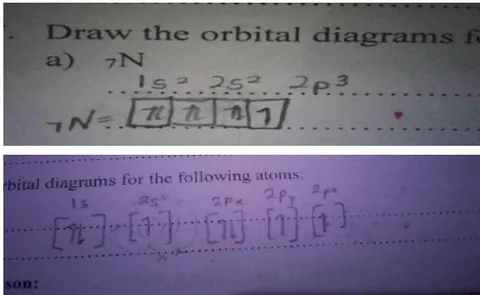
Some students were also able to draw the orbital diagrams for the atoms but were unable to explain the reason for the orbital diagrams drawn. Some reasons provided were;
2p has a higher energy than that of 2s and 2s has a higher energy than 1s (Student 152).
Shells have to be partially filled before they are filled with opposite spin of equivalent energy (Student 159).
First spins are to be filled first throughout the orbital before opposite spins (Student 268).
Furthermore, female students demonstrated no understanding on Items 4, 7c, 8, 9, 10, 11, 12, and 14 (a-d). This implies that majority of the female students were unable to select a right response and explain the reason for their selection. For instance, for Item 4, 67.1% of the 304 female students at a mean of.4 (Std. =.666) were unable to select the right response and explain the reason for their selection of the principal quantum number for a 4d orbital as 4 being the fourth energy level in the said atom. This means that only 9.9% of the female students were able to respond correctly and explain the reason for their selection and 23.0% of the female students selected the right responses but were unable to explain the reason for their selection. Some of the conceptual difficulties demonstrated by the female chemistry students on the identification of principal quantum from a given notation or electronic configuration of an atom are demonstrated below:
3, because if it is half filled, the principal quantum number is known by (Student 169).
5, the d-orbital can have 5 sub-energy levels (Student 164).
4, it is in the fourth orbital (Student 241).
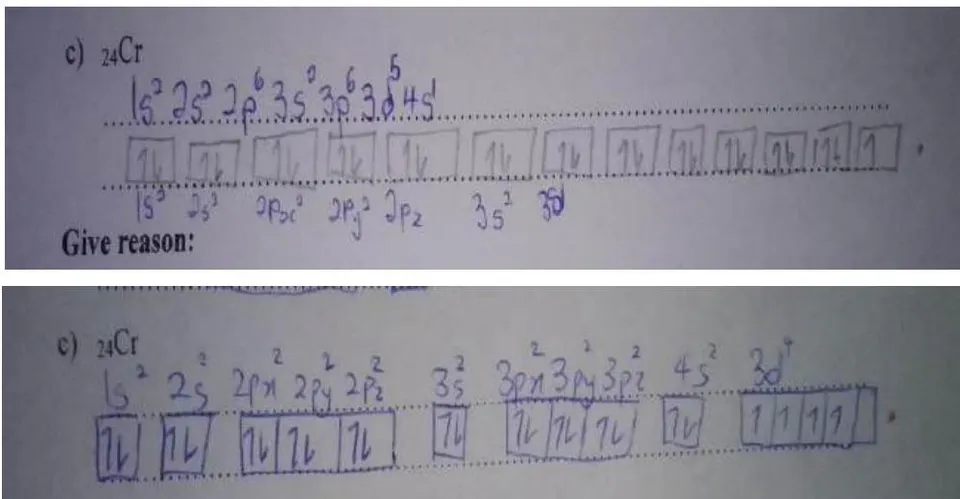
For Item 7c, out of 304 students, 73.0% of them at a low mean of.4 (Std.=.700) demonstrated no understanding on drawing the orbitals diagram for the element, Cr. Thus, 14.5 and 12.5 of the female students demonstrated partial understanding and full understanding of the concept. This implies that female students demonstrated weak procedural and conceptual knowledge of the electronic configuration of chromium using the orbital diagram. This was most evident when applying the rules to fill partially full atomic orbitals. For instance, Student-157 was able to write the electronic configuration, however, she was unable to draw the orbital diagram. Alternatively, Student-179 was unable to demonstrate the exception of partially filled orbitals where chromium has only one orbital in the 4s orbital with 5 electrons in the 3d orbitals. This is evidenced in Figure 2.
For Item 9, 81.9% of the female students at a very low mean of.2 (Std. =.440) demonstrated no understanding on the concept that the shape of is bent. Most female students identified the shape to be linear shape, implying that most female students predicted the shape based on the subscript on oxygen without drawing the Lewis structure to identify the electron groups around sulphur, the central atom. This emphasises that teachers are to explain to learners the need for drawing the Lewis structure of molecules to guide students in predicting the shapes of molecules. For instance, Student-150 explained that
... The shape of was linear because the central atom was sp hybridised. On the contrary, one of the female students selected the right option, however, she had misconceptions on the central atom of the compound. She explained that
Oxygen has two lone pairs which repel the S atom when it forms a bond, giving it a bent shape (Student 131).
This is a clear indication of the misconception female students have regarding the central atom of molecules aiding in determining the geometry of a molecule.
For Items 14 a-d, more than 90% of the female students demonstrated no understanding of predicting the type of hybridisation that occurs in the central atoms of , , , and molecules. Most of the female students only stated the kind of hybridisation that occurs in the molecules without indicating the processes involved in predicting the type of hybridisation that occurs. Students were unable to scientifically conceptualise how to predict the hybridisation of the molecules by stating the ground state and where there is a gain of energy with an electron(s) moving from the s orbital to the p or d orbital. After this, the orbitals are mixed depending on the number of bonding sites needed by the central atom to form the molecules. This is evidenced in Figure 3.
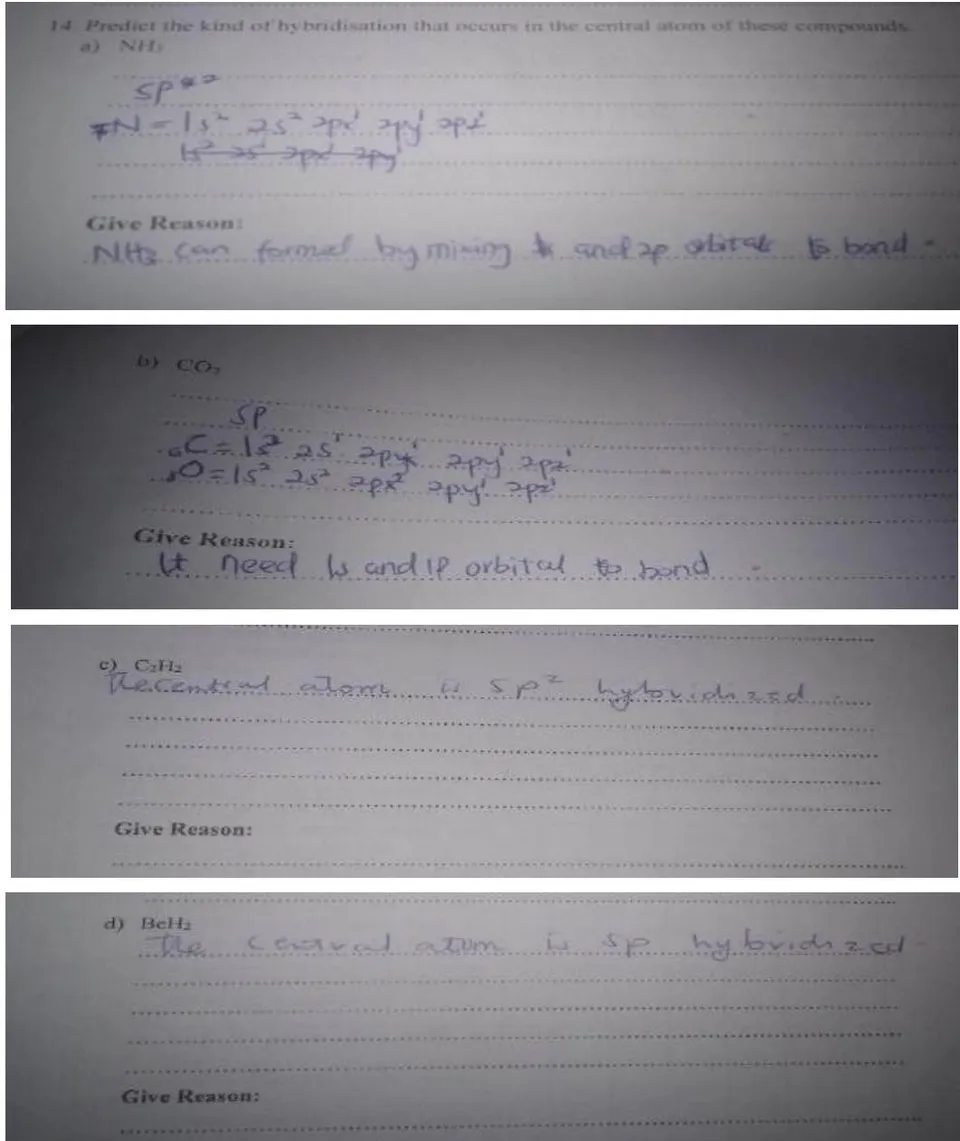
This indicated that most female students memorise the type of hybridisation that occurs in molecules without considering the processes involved in the hybridisation of atomic orbitals. This finding confirms the findings of Danipog and Ferido (2011) and Meydan (2021) that regardless of every lesson aiming to enhance conceptual understanding, rote learning (memorisation) superseded learning chemistry concepts.
To some extent, female students selected the right answers but gave unscientific reasons for the options. These reasons were analysed under Talanquer (2006) four categories of misconceptions (Association, Reduction, Fixation, and Linear Sequencing). Female students' misconceptions were categorised under association, reduction and fixation misconceptions, however, none of their misconceptions were found to be under linear presence of the forms of misconceptions are sequencing misconception. The results on the represented diagrammatically in Figure 4.
{"image_source":{"path":"images/ce7c335abbb777dec7242136e76732d5b61467db5f860d839338bce05a82aeec.jpg"},"content":"","chart_caption":[{"type":"text","content":"Figure 4: Forms of misconceptions of female students on learning atomic orbitals and hybridisation."}],"chart_footnote":[]}
Association misconceptions: This deals with students using past experiences to conclude chemical phenomena, often incorrectly linking unrelated concepts. About 30% of 130 identified female chemistry students associated scientific concepts simplistic in an attempt to explain them. Some excerpts are:
The 4d-orbital has 5 degenerate orbitals, hence, n = 5 (Student-56).
is sp hybridised because it forms two double bonds with 2 oxygen atoms (Student-256).
The above excerpts demonstrate that female students in an attempt to explain the principal quantum number of a 4d atomic orbital being 4 showed association misconception for conceptualising that the d-orbital has five degenerate orbitals, hence, a principal quantum number of 5 instead of 4 for a 4d atomic obital.
Reduction Misconceptions: This deals with students over-simplifying complex chemical phenomena by focusing on limited factors, which leads to misunderstandings of how substances interact. On reduction misconceptions, 47% of the female chemistry students simply explained geometry of molecules by merely observing the number of surrounding atoms around the central atom without taking into consideration the Lewis structure of the molecules and any presence of lone pairs in the molecule. Some excerpts are:
is linear formed from s and p orbitals. The sp hybrid orbitals are linear in shape and the bond angle is (Student-78).
N in is hybridised because it creates 3 hybrid orbitals for bonding (Student-166).
Fixation Misconceptions: This refers to the tendency to rigidly apply learned rules or patterns to new situations without considering context, perpetuating misconceptions. Concerning fixation misconceptions, 27% of the female chemistry students were unable to explain why concepts such as atomic orbitals and hybridisation were expressed. Female chemistry students merely relied on information given by their teachers and textbooks without necessarily understanding them scientifically. Some excerpts are:
2d does not exist because I have not seen any 2d in my chemistry textbook or my chemistry teacher never talked about 2d in atomic orbitals (Student-98).
is sp hybridised because it creates two atomic orbitals for bonding (Student-159).
Having established that female chemistry students demonstrate partial understanding with misconceptions in learning atomic orbitals and hybridisation, there was a need to further examine the conceptual understanding of female students in single-sex schools and those in mixed-sex schools, comparing the conceptual understanding of the two student groups. That is, the school type, being the independent variable, was at two levels (single-sex and mixed-sex) and students' conceptual understanding, being the dependent variable, was continuous variable. To achieve the comparison of the means of the two school types, the dataset was first examined using a boxplot. The results from the boxplot are presented in Figure 5. The results from Figure 5 indicated that female chemistry students in the single-sex schools had a higher conceptual understanding as compared to their counterparts in the mixed-sex schools. Although the presence of outliers as observed in Figure 5 could have influenced this difference.
{"image_source":{"path":"images/925a456a68979c53b9e8baa0c0a522c7941c3a3ab382bbe426d42bf538b165b4.jpg"},"content":"","chart_caption":[{"type":"text","content":"Figure 5: Boxplot comparing female students' conceptual understanding of atomic orbitals and hybridisation across school-type"}],"chart_footnote":[]} To confirm the results of the conceptual understanding of female students in the single-sex schools and those in the mixed-sex schools as observed from the boxplot, the researchers compared the partial understanding of the two student groups, first, with the help of independent-samples t-test. Hence, there was the need for the normality of the data to be checked to determine whether the independent-samples t-test was the most appropriate for the analysis. However, the Kolmogorov-Smirnov test value was found to be significant for both students in the single-sex and mixed-sex schools ( ). This indicated that the normality test was violated (Bennett et al., 2023). Consequently, a non-parametric test (Mann-Whitney U Test) for independent-samples t-test was deemed appropriate to examine further the conceptual understanding of female chemistry students in the single-sex and mixed-sex schools. Table 2 presents the results of the Mann-Whitney U test.
| School type | N | Mean Rank | Mann-Whitney U | Wilcoxon W | Z | (2-tailed) |
| Single-sex | 178 | 168.05 | 8446.500 | 16447.500 | -3.680 | .000 |
| Mixed-sex | 126 | 130.54 |
From Table 2, the results showed that there was a statistical difference in the conceptual understanding of students from single-sex and mixed-sex schools on learning atomic orbitals and hybridisation in the SHS. This is because the Mann-Whitney U test revealed that female students in single-sex schools (Mean Rank = 168.05, N= 178) demonstrated statistical significantly higher conceptual understanding than their female counterparts in mixed-sex schools (Mean Rank = 130.54, N = 126). The test yielded a U value of 8446.500, z = -3.680 (adjusted for ties), and p =.000 (two-tailed) with an effect size of.21 which can be described as a small effect (Cohen, 1988). This result implies that female students in single-sex schools perform 21% better than their counterparts in mixed-sex schools.
The finding that Ghanaian SHS female chemistry students are at the partial conceptual understanding level in atomic orbitals and hybridisation may not be new to only this current research when it comes to SHS chemistry students' conceptual understanding of chemistry concepts. That is, some empirical studies in Ghana, such as that of Anim-Eduful and Adu-Gyamfi (2022) have reported on students' partial scientific understanding in many areas of organic qualitative analysis. It is worthy to note that this female chemistry students' partial understanding of atomic orbitals and hybridisation could be attributed to their conceptual difficulties (Abukari et al., 2022; Hanson et al., 2012) and misconceptions (Adu-Gyamfi et al., 2015; Anim-Eduful & Adu-Gyamfi, 2022) in learning atomic orbitals and hybridisation. As crucial as misconceptions could be in preventing scientific understanding of chemistry concepts, this study only unearthed association, reduction and fixation misconceptions, implying that female chemistry students learning chemistry concepts in the SHS have no linear sequencing misconceptions as reported by Talanquer (2006). Notwithstanding female chemistry students are still using commonsense reasoning in learning chemistry concepts in the SHS. This calls for chemistry educators and research to design and develop instructional strategies that could restrict students' application of commonsense reasoning in learning chemistry.
This finding on statistical difference in the conceptual understanding of female chemistry students from single-sex and mixed-sex schools aligns closely with the study of Yalcinkaya and Ulu (2012) that there is little difference in the academic achievement between females in single-sex schools and those in mixed-sex schools. Similarly, the finding agrees with the study of Chansa (2023) and Razak et al. (2018) in that, there is a significant difference between the performance of female students in single-sex and the performance of female students in mixed-sex schools in learning science, however, it contrasts with Clavel and Flannery (2022), on a statistical significance difference in the performance of female students in single-sex schools and those in mixed-sex schools.
Furthermore, the level of conceptual understanding observed among female students in single-sex schools may be linked to several advantages often associated with these educational environments. In that this finding of the current study aligns with Rojas-Oviedo et al. (2018) and Sikora (2013) that single-sex schools can enhance student engagement and boost confidence, particularly in academic areas where gender stereotypes might otherwise discourage participation, such as mathematics and science. Also, it could be that in the single-sex female schools, certain social distractions may be eliminated, reducing the influence of gender-related biases (Cherny & Campbell, 2011), fostering an environment more supportive of focused learning and active engagement evidence of the finding of the current study can be a contributing factor to the difference in the conceptual understanding of female chemistry students by school-type.
In another development, mixed-sex schools may present challenges stemming from social dynamics and gender-based interactions (Jackson, 2010) as evidence of the low performance of female students in the mixed-sex schools of the current study. Hence, this current study went further to investigate the probable factors. It should be noted that the interplay of gender roles and expectations in coeducational settings can influence academic behaviour and outcomes. These dynamics can sometimes divert attention away from academic activities, potentially contributing to the comparatively lower performance of female students in mixed-sex environments. These findings point to the need for further exploration into how school environments shape academic experiences and outcomes for female students.
IV. CONCLUSION
In this research, female chemistry students from both single-and mixed-sex schools' conceptual understanding of atomic orbitals and hybridisation were investigated through embedded mixed methods approach. That is, both quantitative and qualitative datasets were collected from 304 female chemistry students in examining their conceptual understanding. Through this research, it has been revealed that female chemistry students demonstrated partial understanding of atomic orbitals and hybridisation. This partial understanding of atomic orbitals and hybridisation was due the presence of misconceptions in female chemistry students' learning of the concepts in the senior high school level. These misconceptions in atomic orbitals and hybridisation were observed as association misconceptions, reduction misconceptions, and fixation misconceptions (Talanquer, 2006), based on commonsense reasoning among female chemistry students in learning atomic orbitals and hybridisation. Thus, this research has added to the literature that not only are female chemistry students at partial conceptual understanding level in atomic orbitals and hybridisation (another chemistry concept), but they also use commonsense reasoning, which they do not rigidly apply a step-by-step approach in their reasoning. That is, female chemistry students demonstrated no linear sequencing misconceptions in learning atomic orbitals and hybridisation. In furtherance, this partial conceptual understanding with the addend misconceptions statistically differed among female chemistry students, with those from the single-sex schools outperforming others from the mixed-sex schools.
V. IMPLICATIONS
Female chemistry students from single-sex schools show better conceptual understanding of atomic orbitals and hybridisation than their peers in mixed-sex schools. Therefore, the Ministry of Education and Ghana Education Service should provide support services for female students in mixed-sex schools to enhance their learning of chemistry concepts.
Also, to address female chemistry students' misconceptions about atomic orbitals and hybridisation, educators should implement targeted interventions to correct association, fixation, and reduction errors in learning.
Additionally, female chemistry students from single-sex schools showed better conceptual understanding than those in mixed-sex schools. Educators should develop gender-sensitive strategies to enhance female students' learning in mixed-sex environments.
APPENDIX A
Atomic Orbitals and Hybridisation Diagnostic Test
This diagnostic test seeks female students' conceptual understanding of atomic orbitals and hybridisation. Your participation will provide valuable insights into how well these concepts are understood in developing current teaching methods and identifying areas for improvement in chemistry education.
Please DO NOT write your name and the name of your school, as your responses will be confidential and used for research purposes only. You will be given 60 minutes to complete this test.
Your contributions are greatly appreciated
SECTION A: DEMOGRAPHICS
School Type: Single-sex [] Mixed-sex []
Age: 10 – 15 years [] 16 – 20 years [] Above 20 years []
SECTION B
Instruction: For each of the items below, kindly circle the best response and indicate your reason for your selection in the space provided.
- The shape of the s-orbital in Sodium atom is ____.
a. daisy-like b. dumbbell
c. spherical d. tetrahedral
Give reason:
- The principal quantum number (n) for a 4d orbital will be ____.
a. 3 b. 4
c. 5 d. 6
Give reason:
Which of the following orbitals does NOT exist in atoms? a. 2d b. 2p c. 3d d. 3p
Which of the following is the CORRECT electronic configuration of Aluminium ?
a.
b.
c.
d.
Give reason:
- Draw the orbital diagrams for the following atoms:
a.
Give reason:
b.
Give reason:
c. Cr
Give reason:
d. Fe
The molecular geometry of the compound is ____. a. linear b. square planar c. tetrahedral d. trigonal planar Give reason:
The shape of molecule is ____. a. bent b. linear c. tetrahedral d. trigonal planar
Give reason:
Account for the differences in shape of and molecules.
Describe the geometries of each of the carbon atoms in the molecule .
Using as an example, distinguish between atomic orbitals and hybrid orbitals.
Sketch the sigma and pi bonds that exist in .
Give reason:
- Predict the kind of hybridisation that occurs in the central atom of these compounds. a.
Conflict of Interest
The authors declare no conflict of interest.
Ethical Approval
Not applicable
Data Availability
The datasets used in this study are openly available at [repository link] and the source code is available on GitHub at [GitHub link].
Funding
This work did not receive any external funding.
References
Cite this article
Related Research


Special Issue
Launch a focused special issue to highlight research, emerging trends, and expert insights in your academic field.