

IntelliPaper
Abstract
These is a challenge of determining the physical basis for light polarization by chiral molecules. In this paper we consider the molecule of methanol. We see that it is the electron spin that determines the polarization of light for an organic molecule. Electrons obey a wave equation; therein my lie the answer as to why an electron has a positive or negative spin. Civil Engineers don’t study Quantum Mechanics. So I leave this problem for those who do study QM. Funny, I wanted to take Modern Physics when I was in year two if my bachelor’s degree.
Explore Digital Article Text
I. INTRODUCTION
In this paper, we will show why a chiral organic molecule rotates polarized light sometimes clockwise and other times contraclockwise. The answer is that it depends on the spin on the electrons.
An electron has a vector pointing up or down depending upon whether it is spinning one way or the opposite. This, of course is treated mathematically with the vector cross product. We see the formula often in AT Math for space as:
theta is the angle between the two vectors. Spin creates a vector either pointing up or down since it is dependent on the sine curve.
Sun light has vectors pointing in all directions around an axis or progression., the Z acis. Electrons have angular momentum.
So how do we solve our problem? The answer is that it is a random event whether a free electron, on say Methanol (Methyl Alcohol CH3OH). This evokes the Fair coin solution viz the GMP. The GMP models the flip of a fair coin as discussed in previous papers on gambling by this author.. If you flip it enough times, it with by Heads 50% of the time and Tails 50% of the time. The average of a random number between 0 and 9 is 5 or 50% also. We know that if we plug 0.50 into the GMP, we get -1.25 which is the minimum for the GMP (t=1/2).
Electron Spin or Spin Quantum Number is the fourth quantum number for electrons in atoms and molecules. Denoted as ms, the electron spin is constituted by either upward (ms=+1/2=+1/2) or downward (ms=-1/2=-1/2) arrows.[3]
Example:
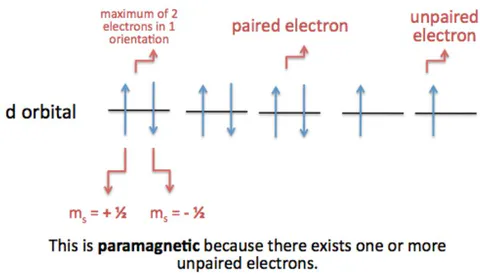
The experiment mentioned above by Otto Stern and Walter Gerlach was done with silver which was put in an oven and vaporized. The result was that silver atoms formed a beam that passed through a magnetic field in which it split in two.
An explanation of this is that an electron has a magnetic field due to its spin. When electrons that have opposite spins are put together, there is no net magnetic field because the positive and negative spins cancel each other out. The silver atom used in the experiment has a total of 47 electrons, 23 of one spin type, and 24 of the opposite. Because electrons of the same spin cancel each other out, the one unpaired electron in the atom will determine the spin. There is a high likelihood for either spin due to the large number of electrons, so when it went through the magnetic field it split into two beams.[3]
Now we will provide the calculations to show that the electron spin on Methanol, a chiral molecule, and the GMP can be derived from a capacitor. We also calculate the mass of an electron that passes through the dielectric plates. Note figure 1. This shows how we go from Methanol to Carboxylic Acid such as L-tryptophan, the precursor to testosterone and serotonin.
![Figure 2: Methanol to Carboxylic Acid [1]](https://doc.journalspress.com/yucr43_93948/ocr/images/derivatives/c0/c0a4e21c8c9a83161d36966009e6799bea3813c79bcd0dfe77faa57461cb172a.webp)
Methanol Characteristics {"code_caption":[],"code_content":[{"type":"text","content":"Diameter =3.77 A\npKa=15.5\n=Ln t\nt=2.7408\n\nGMP=3.77=E\n\nα=1.31\nρ=0.78\n\nεs=1+2ye/1-ye\n=1+2(1)/1-1=3/0=3\n\nεs-1/ε2+2\n=4π/3 ρα\n=4/3(π)(ol.78)(1.31)\n=4.280\n\nεs=-2.915\n\nT(k)=-8/3π(1/19905)\n\nεs=2.915\n\nP=1.602/19905=8.04\n\nELoc=Eo-8π/3P\n=Eo-8π/3(8.04)\n=Eo-6.742\n\ne-6.742=1.1797≈118=Mass of the Periodic Table\n\n118 (938+5.1099)=1.11262=1/898777=1/2.99792=1/c2=M\n\nELocL3=(εs+2)3εs\n=(78.5+2)(3(78.5)\n=341.8\n\nELocL=(εs+2)/3εsEo\n=(2.915+2)/3(2.915) (341.8)\n=192.1037\n\nM=NαElocL\n=N(1.31)(341.8)=Fxd=Fxt=8/3xπ\n\nN=0.01871\n\nN/s=0.01871/3.77=4.96≈5=E y=y't=3\n\nM/c=1.7077/2.9979=56.96≈57\n\n4.96 x 57=2828"}],"code_language":"txt"}
{"algorithm_caption":[],"algorithm_content":[{"type":"text","content":"2828/4=0.7072=1/ "},{"type":"equation_inline","content":""},{"type":"text","content":"=v=a\nCH3OH=12.11+1.078+15.999+1.078=301.66\nt=3=e "},{"type":"equation_inline","content":"^{}"},{"type":"text","content":"\nM=1.0986≈11\n1.096/6.023=181969\n1819/3.0166=16.57≈1/6=60°\nM=NαE "},{"type":"equation_inline","content":"{}^{}"},{"type":"text","content":" =N(1.47)(341.81) =0.502N\nM=0.5N\n8/3(π)=1/2N\nN=1.6688≈1/6=60°/360°\nReflective index:\nn "},{"type":"equation_inline","content":"{}"},{"type":"equation_inline","content":"^{2}"},{"type":"text","content":"=ε "},{"type":"equation_inline","content":"{}"},{"type":"text","content":" =2.91469\nn "},{"type":"equation_inline","content":"{}"},{"type":"text","content":"=1707\nMass of OH−=1.078 +15.999=17.07\nn α 1/v\n1.707=1/v\nv=5.858\nn "},{"type":"equation_inline","content":"{1}"},{"type":"text","content":"/n "},{"type":"equation_inline","content":"{2}"},{"type":"text","content":"=5858/2=2929=1/341.4=1/E=t\nPauking of the Spheres\nn "},{"type":"equation_inline","content":"{}"},{"type":"text","content":"=4π/3 a "},{"type":"equation_inline","content":"{}"},{"type":"equation_inline","content":"^{3}"},{"type":"text","content":"ρ\n=s t a "},{"type":"equation_inline","content":"^{3}"},{"type":"text","content":"ρ\n=(4/3)(π)(1.31) "},{"type":"equation_inline","content":"^{3}"},{"type":"text","content":"(0.78)\n=7.345\n=1/0.26549\n=1/F\n=E-1/E\nn=(E "},{"type":"equation_inline","content":"^{2}"},{"type":"text","content":"-1)/E\nnE=E "},{"type":"equation_inline","content":"^{2}"},{"type":"text","content":"-1\nE "},{"type":"equation_inline","content":"^{2}"},{"type":"text","content":"-nE-1=0 GMP = the Fair Coin Equation\nE "},{"type":"equation_inline","content":"^{2}"},{"type":"text","content":"-nE-1=0\nderivative E=5 t=3"}]}
Polarized Light
Circular:
Capacitor
Now
Dispersion Formula:
Jone's vector
{"code_caption":[],"code_content":[{"type":"text","content":"=1/√2-(1)-1/√2(-0.618)=1/√2-1√2(0.618)=-4.1\nI_outgoing=I_ingoing·cos 2θ\nPeriod T=cos2θ=250=cos 2θ\nθ=60°\nE2=cos2θ\nE=cos θ=P̄=Mv\n=(1.7077)(2.9979)\n=51119\n=Me−\nE=Me−=Ln t\nt=e^M=e^{5.11}=1.6726=1/6=60°/360°\nk=λ/4=2π/4=π/2=90°\nEx=E0x^e^{jωt-kz}\n=√2e^{√-1(125.66)(e511)-12.04t}\n=0.865≈0.866=sin 60°\nEy=E0y e^{jωt-kz-λ/4}\n=2.185≈2200\ncos θ=1350=TE=Mc2=1.5M(9)=1350M\n1.350(1.7077=1/0.4337≈1/43.4\nThe Ether =Teflon\nρ_teflon=2200 kg/m3\n2200/(4/π)=57.11°≈1 rad\nρ_OH=751\n57.11-751=180°\nRHP:\nE=E0e^{jωt}\n=√2e^{√-1(1-.25)(e5.1099)}\n=373.4\n=1/2.67\n=1/SF\n=E\nLHP\nE=E0e^{-jωt}\n=√2e^{-√-1)(-1.25)(e5.1099)}"}],"code_language":"txt"}
=373.4 =1/2.67 =1/SF =E
Spin
Tt2-t-1=E
II. CONCLUSION
We see that the polarization of light by a chiral molecule is dependent upon the random direction spin of an electron. It is statistically equal to 0.5. The universe is not chiral. There are two signals, sin and cos. Where they, meet ids where the one universe exists.
ACKNOWLEDGEMENTS
I've reached the limit of what I can calculate with this paper. My eyesight is failing me using a laptop computer. My old HP Envy was destroyed by the cleaning lady who insisted on using a wet rag to clean a touch screen computer even though she was warned several times. My boss bought me a new computer at a cost of $883! That is money I don't have. His name is Greg Hebert. He is a good man. We needed to find a way to pay people who do research. It is the purpose of humanity to forge ahead with the unknown. We have lots of money for basketball stars yet no money for those actually doing something production for the world. Will it ever change?
Conflict of Interest
The authors declare no conflict of interest.
Ethical Approval
Not applicable
Data Availability
The datasets used in this study are openly available at [repository link] and the source code is available on GitHub at [GitHub link].
Funding
This work did not receive any external funding.
References
Cite this article
Related Research


Special Issue
Launch a focused special issue to highlight research, emerging trends, and expert insights in your academic field.