





IntelliPaper
Abstract
The article focuses on studying the notion of overtone, suggesting detailed research of its application in different disciplines, including linguistics. Mainly, the author investigates emotional and evaluative overtones, defining them as hidden inherent meaningful components of the semantic word structure revealed in situations of the deterministic context. Research methods include a definition analysis of linguistic means of representing emotions selected by the continuous sampling method from English fiction and contextual and cognitive interpretation methods. The novelty of the article lies in the fact that emotions are examined as part of a broader scenario, where they combine and interact. Approaching emotions as a complex and diverse ensemble, the author constructs and studies lexico-semantic fields with words that express them in the English language, allowing for the analysis of emotional and evaluative overtones discovered in the overlap process of these fields. In turn, the overlap occurs due to the ability of a linguistic unit expressing emotion to move within its lexico-semantic field or to the lexico-semantic field of a different linguistic unit. An in-depth analysis has allowed for a more profound comprehension of how emotions emerge and affect each other. Moreover, English fiction has been confirmed to be a valuable source of the expression and implication of emotional states, and the context has proven to help create and reveal emotional and evaluative overtones. The analysis has also shown that the experience of emotions heavily relies on appraisal and, consequently, is subjective and depends on an individual’s world perception.
Explore Digital Article Text
I. INTRODUCTION
The complexity of human emotions has continued to spark researchers' interest for several decades for the following reasons. First, emotions substantially influence major cognitive processes, including memory, learning, perception, attention, decision-making, reasoning, and problem-solving. Second, they play the role of an interlink between a man and the surrounding world. As a mediator in transforming material external and internal influences into psychic energy that includes the energy from multiple sources (intellect, abilities and makings, worldviews, needs, habits, moods, knowledge, desires, personality traits, etc.), emotions help people "come into contact with reality and the environment" (Boiko, 1996, p. 7). Third, emotions act as a filter that evaluates the extent of usefulness or danger of the trigger to the person. In other words, emotional reactions are based on appraisal, and people typically reflect the world selectively, considering only what is valuable for them at the moment (Shakhovsky, 2019, p. 31). In fact, it is the criterion of appraisal that lies in the core of the primary classification of emotions into positive and negative as well as in the division of emotions into basic, complex and disclaimed action emotions. Namely, basic emotions (anger, fear, happiness, disgust, surprise, and sadness) are fast physiological and behavioral responses to the environment based on the appraisal of a limited range of perceptual inputs, whereas complex emotions (guilt, envy, jealousy, shame, embarrassment) rely on the appraisal of a broader range of information and are more integrated with cognitive activity and mental life. Unlike primary and complex, disclaimed action emotions manifest a more developed cognitive activity based on manipulating social relations (Griffiths, 1997). Such an approach confirms the complex and heterogeneous nature of emotions and demonstrates that emotion is a cluster concept that "gathers quite diverse phenomena under a single conventional label" (Caro & Marraffa, 2014, p. 566).
Given the significant role of the appraisal aspect in the emotion classification and that appraisal is done in accordance with one's values assigned to the surrounding environment and "gradients of involvement, interest and importance" (Caro & Marraffa, 2014, p. 570), it is possible to allege that emotions can manifest themselves in different degrees of intensity. In turn, the intensity of emotion reflects its gradation, which can differ in "clarity, duration, and force" (Romanov, 2004, p. 16). Examples of emotions that vary in their intensity include upset – downcast – gloom – sadness – sorrow – misery – grief – mourning, or gladness – joy – happiness – felicity – elation – exhilaration – ecstasy – euphoria, or worry – anxiety – fear – fright – dread – panic – horror – terror. The latter is of particular interest to many philosophers. Specifically, in The Nicomachean Ethics, when talking about the intensity of emotions, Aristotle (2003, pp. 67–68) provides an illustration of the degrees of fear and fearfulness, stating that "things within the limits of human endurance differ in the magnitude and intensity of the fear that they inspire" and that "it is possible to fear these things too much or too little." Montaigne (1994, p. 15), who states that "it is fear that I am most afraid of," also gives examples of different levels of fear, such as anxiety, fright, and panic terror. Apart from fear, there are examples of philosophical interpretations of other emotions that also demonstrate their intensity levels. To illustrate, when contemplating anger, Seneca (2009, p. 20) refers to the emotion as fury, madness, cross, rage, tempest, and being afraid. In his search for the road to the happiest life, Hume (1987, p. 93) dedicates many of his essays to happiness that implies "ease, contentment, repose, and pleasure" and that subjectively varies from cheerfulness and enjoyment to lively joy and delight. In fact, the philosopher writes a lot about degrees of emotions and their dependence on a particular subject: "Benevolence, therefore, arises from a great degree of misery, or any degree strongly sympathiz'd with: Hatred or contempt from a small degree; or one weakly sympathiz'd with" (Hume, 2017, p. 435). Viewing happiness as the ability to understand that life is suffering, which, however, does not last for too long, Schopenhauer (1958) also talks about different degrees of emotions and happiness, in particular, mentioning semi-satisfaction, long- and short-lived happiness, supreme, serene and perfect happiness, and a mischievous delight in seeing other people suffer (so-called Schadenfreude). In other words, all the abovementioned examples confirm that emotions are gradient and can occur to a greater or lesser extent.
The cognitive nature of emotions as reactions based on the hierarchy of values also results in their subjective manifestation. It leads to their ambivalence, or the ability of the same emotion to perform both positive and negative functions (Zhgun, 2017). Again, the phenomenon is supported by several philosophers. For instance, Aristotle (2003, p. 41) believes that feeling emotions (anger, fear, pity, pleasure, etc.) "at the right times on the right grounds towards the right people for the right motive and in the right way" is a sign of virtue. Montaigne (1994, p. 14) expresses a similar idea about fear, stating that sometimes it "puts wings on our heels; at others it hobbles us and nails our feet to the ground." To put it another way, the ambivalence of emotional states is stipulated by their essential and functional duality which is based on the simultaneous presence of several needs, which also underscores the complexity of emotions and their ability to combine and appear not in their pure form. As a result, emotions of the same or even different valence can co-occur and intertwine, leading to paradoxical emotional states such as monstrous joy, positive anger, righteous rage, happy sadness, or loving hate. This brings us to the notion of emotional and evaluative overtone.
II. LITERATURE REVIEW
This part investigates some theoretical premises of the notion of overtone in various fields of scientific knowledge, including linguistics, explains the reasons behind the complexity of the phenomenon, and reveals its uniqueness and importance.
To begin with, it is significant to highlight the role of language in the representation of human sensations. Surely, as an attribute of human nature, language has a rich repertoire of means of expressing and implying emotional states: "emotions are "stored," "preserved" in a word in the form of an idea about it, and this idea can "come to life," "be actualized," "unfold," "extend," "stretch" till the emotion that one feels and that corresponds to the moment (Shakhovsky, 2019, p. 31). To put it differently, people try to convey their emotions through language which helps define and express what they feel.
Naming and defining any phenomenon certainly allows people to understand its essence because, otherwise, "it is hard indeed to notice anything for which the languages available to us (whether verbal, mathematical, or musical) have no description" (Watts, 1973, p. 28). In addition, a word is one of the forms of thinking and comprehending the world (Vygotsky, 1982), or rather, it is something that "creates thoughts," and coming into contact with a word helps one discover "a thought, a feeling, an understanding within oneself" (Mamardashvilli, 2009, pp. 82–83). Therefore, the role of a word should not be downplayed.
Nevertheless, when it comes to complex notions, it is often hard to convey their true meaning verbally and in a single definition because frequently, no single word, taken in isolation, can express something whole. The idea has found numerous expressions among philosophers ("To define is to limit, to set boundaries" (Watts, 1973, p. 103)), scientists ("Giving expression to thought by the observable medium of words is like the work of the silkworm. In being made into silk, the material achieves its value. But in the light of day it stiffens; it becomes something alien, no longer malleable" (Schrödinger, 1963, p. 15)), linguists ("Map is not the territory (and the word is not the thing)" (Korzybski, 1995, p. 58), and writers ("Words are solely coins of thought and not its denomination" (Sontag, 2009, p. 137)).
It is particularly challenging to reflect and precisely code an individual's emotional experience in words because of its constant change and context dependence. To illustrate, Kierkegaard (1993, p. 236) was convinced that the one who truly loves is "unlikely to find happiness and satisfaction in tiring himself with defining love." Although referred to supernatural concepts such as God, love, justice, and beauty, Wittgenstein's statement that "Whereof one cannot speak, thereof one must be silent" (1998, p. 225) also supports the belief that language cannot always resist the weight and complexity of human emotions and has to resort to coding them by means other than direct verbal nominations, which do not always suffice. More specifically, with over 34,000 unique, distinguishable emotions that people can experience (Plutchik, 1980), the number of emotion-related terms in English only ranges between 500 and 2,000 (Averill, 1975). Moreover, the fact that researchers still cannot come to a consensus on what should be considered an emotion complicates the situation even more. Constant attempts to define, classify, and "dissect" the phenomenon only lead away from its essence. For example, anger can be defined as a strong feeling of displeasure, a threatening or violent state; it also includes components such as tension, annoyance, discomfort, resentment, and uneasiness (Merriam-Webster Dictionary), which proves a complex structure of the emotion but does not fully reveal its nature.
Indeed, some members seem to be better examples of the category than others (Rosch, 1977), and giving definitions can ease the task of mutual understanding, but it is more complicated when it comes to emotions because they build "a fuzzy hierarchy" (Russell & Fehr, 1994, p. 202). In other words, the focus on definitions can result in what Tolstoy (1984, p. 12) called a "shift of the meaning," when the primary meaning of a notion (in his case, it was life) taken in its central meaning loses it owing to constant disputes, and acquires another, unrelated meaning. Such an obsession with definitions and words can be explained by man's strong dependence on the language and everything that "has already been uttered, written, and accomplished in it" (Brodsky, 1990, p. 14). Yet, this dependence also gives freedom, for language "still possesses the colossal centrifugal energy imparted to it by its temporal potential – that is, by all time lying ahead (ibid). In this regard, the role of language is not to limit by defining but to "push" one for further discoveries of hidden connections because "between two very related morphophysiological properties one can find the third one" (Nalimov, 1989, p. 71). One such concealed phenomenon is overtone.
The term is widely used in music (a tone that sounds several times higher than the fundamental tone), art (a shade in the color palette), and psychology (an intermediate psychic process that constituents the transition between consciousness and unconscious psychic activity). In linguistics, overtone is often used synonymously with a connotation and is defined as an additional connotation that overlaps with the primary word meaning (Bondarko, 1999) or a contextually driven connotation (Bredikhin & Makhova, 2018). Connotation and overtone are also used interchangeably by other researchers (Alefirenko, 2005; Cherneiko, 2019), who define connotation as associative, expressive emotional and evaluative overtones that constitute the periphery of the informational potential of the lexical meaning and appear as a result of the overlap of new semantic shades with the denotative meaning.
In this paper, however, the distinction is drawn between the notions of connotation and overtone, and the latter is studied from the perspective of the subjective (personal), ambivalent (capable of manifesting itself both positively and negatively), and gradient (gradually distributed based on the intensity degree) nature of emotions as well as the ability of opposite emotional qualities to create poles among which various shades are located. In addition, since emotional reactions are based on an individual's appraisal and emotions constantly engage with cognition, it is more precise to use the term emotional and evaluative overtone to convey the complex nature of emotions and the fuzzy nature of the words that express them. In this regard, the term can be defined as a concealed, inherent component of the semantic structure of a word, revealed within specific contextual determinants. In other words, unlike connotation that is typically viewed as a secondary, often implied associative word meaning that has an emotional, evaluative, and stylistic shade, an emotional and evaluative overtone in this study is considered a kind of an immanent phenomenological given of emotions that most people experience, but must put effort to reveal and convey in language that allows their inherent nature to appear.
Often, implied emotional and evaluative overtones can be revealed in the process of the analysis of mixed emotions, to the usage of which one has to resort in order to convey their complex emotional states. Mixed, or blended emotions are a combination of more than one emotion, but not necessarily emotions of opposite valence (Scherer, 1998). In mixed emotions, two or more identically or oppositely valenced emotions can co-activate, leading to the subjective experience of these emotions. The occurrence of blended emotions can be explained by the versatility and elasticity of the human affective system, which includes appraisals and valence and allows people to "combine, aggregate, and fluctuate between different emotions" (Berrios, 2019, p. 4). Examples of emotion blends can be found in many fields of study. For instance, Kierkegaard (2005), when speculating about fear, distinguishes between a regular fear based on comprehension (Furcht) and an inexplicable fear-sadness or fear-terror (Angst). In his essays, Montaigne (1994, p. 13) also talks about fear but blended with madness, rapture, and ecstatic behavior.
Other examples of emotion blends are culturally-specific emotions, including Danish Hygge (mood of coziness with feelings of wellness, contentment, and joy), Dutch Gezellig (coziness, a shared sense of joy of spending time together with friends), Russian toska (a sensation of sadness, melancholy or spiritual anguish often without any specific cause), or Japanese tokimeki (beating of the heart with joy and excitement, a fluttering feeling of falling in love). In turn, English has many blends formed from parts of two words that convey emotional and evaluative overtones, viz. rembarrassment (an overwhelming feeling of humiliation at the memory of an awkward or shameful experience from the past), gleemort (happiness felt during an otherwise sad event), and pretedium (the mixture of frustration, boredom, and anxiety felt when meeting a long-talker).
To discover emotional and evaluative overtones, one must be reflexive, i.e., possess a highly-developed reflexive consciousness. In this regard, reading fiction can be quite productive, for it is known to be a rich source of self-reflection and a linguistic embodiment of emotions. Indeed, in linguistics, fiction is considered a "depository of emotions:" it stores the information about different types of communicative and emotional situations, models verbal and nonverbal emotional behavior of a person, methods, means, and ways of communicating emotions, their stylistic potential, emotive valence and pragmatics (Shakhovsky, 2010, p. 65). Moreover, fiction demonstrates the mechanisms of creating emotional meanings and their dynamics in the text, the possibilities to use the means of expressing emotional text tonalities, and verbal evidence of one's emotional reflection and social experience (Shakhovsky, 2008). It is also a rich source of deep meanings primarily buried in the Universe that must be "unpacked" in the process of reading (Nalimov, 1989). However, this complex system of meanings created by the author can be interpreted in different ways because everyone perceives it through their individual experience and worldview (Chirkova, 2018, p. 98). All this makes the literary work "a continuous potentiality of "openness" or an indefinite reserve of meanings" (Eco, 1989, pp. 9–10). In this respect, emotional and evaluative overtones should be studied from a broader perspective, i.e., from the position of a literary discourse viewed as a communicative process of conveying information from the author to the reader which results in the appearance of a particular message (Borbotko, 2005, pp. 9–10).
III. METHODOLOGY
The data on the linguistic representation of emotional and evaluative overtones have been collected from English fiction. The examples with words conveying emotions have been selected by a continuous sampling method followed by definition and thesaurus analyses. The definition analysis of the lexemes expressing emotions has helped to reveal the structure of the general meaning of the selected words. For this purpose, several reliable dictionaries have been used. In addition, the reference to several thesauri has allowed for the discovery and construction of lexico-semantic fields (LSFs) with words representing emotions. The LSFs have been constructed based on the idea that every field has a center, or nucleus, with a word (dominant), taken as a unit of reference and clearly conveying the semantics of the field, and a periphery, where other synonymic units are located (Admoni, 1988). Close and distant synonyms have been located in the close and distant periphery accordingly. Due to the limited volume of the article and for better visualization, only nouns have been placed in the LSFs.
Apart from the definition analysis, which helps to understand the meaning of the notions on a deeper level and unveils cultural and national specifics of their usage, the method of contextual analysis has also been applied because even the most detailed definition cannot reveal the whole meaning that includes personal experience, appraisal, and the situation in which it is being used. The contextual analysis has allowed studying the interrelation and inter-influence of words in context with the consideration of the impact of a communicative situation on language semantics and social and personal factors. Definition and contextual analyses have later been followed by cognitive interpretation, which includes the author's thoughts based on the analysis of the definition, context and personal experience, national and cultural values, and general background knowledge.
IV. RESULTS AND DISCUSSION
The analysis of the literature excerpts with a linguistic representation of emotional states has confirmed several points made in the theoretical part of the article. First, it has been demonstrated that almost no emotion occurs by itself but is caused or experienced together with other emotions. In psychology, it is known as the modality of emotion, which is defined as an intertwining of emotions of the same or different types, intensity, duration, depth, complexity, genetic origin, function, and impact (Vilyunas & Gippenreiter, 1984, p. 19). In other words, emotional reactions are "branched, and each of the branches carries a possibility for its further development stipulated by the changing situation" (ibid, p. 24). Second, the analysis of dictionary definitions of the words expressing emotions has allowed revealing their complex nature and the presence of emotional and evaluative overtones. The thesaurus analysis has given the foundation for the visual demonstration of the LSFs and further discovery that lexical units located in the periphery of one LSF can interact with units of adjacent fields as well as move from the center to the periphery within their own field. Specifically, LSFs with a positive or negative dominant of an emotional state have revealed a feature of an actualizing diffusion that indicates that a lexical unit belonging to one LSF can transfer from a medial to a marginal sector (further periphery of the field) or from a positive into a negative field. The LSFs and their overlaps have been presented in the form of Euler circles. Let us provide some illustrations.
The first group of examples includes instances where emotions of the same emotional cluster are expressed and implied.
i. "I'm frightened of him. I don't know why, but there's something in him that terrifies me. He'll do us some great harm. I know it. I feel it. If you bring him here it can only end badly." [...] She was panting now, and in her face was a terror which was inexplicable. I do not know what she thought. I felt that she was possessed by some shapeless dread which robbed her of all self-control. As a rule she was so calm; her agitation now was amazing (Maugham, 2005, pp. 130–131).
In this passage, Mrs. Stroeve is concerned about her husband's idea to invite his friend, Charles Strickland, to their house. Her emotional state of fear has been expressed through direct nomination:
-
frightened – feeling great fear, made to be afraid and anxious, worried that something bad might happen;
-
terrifies – frightens causing great fear impelled by menace;
-
terror – a state of intense or overwhelming fear;
-
dread – great fear in the face of impending evil;
-
agitation – a state of unpleasant anxiety and extreme arousal (Merriam-Webster Dictionary).
The definition analysis of the lexemes has demonstrated the structure of their meaning that includes the following smallest units of meaning, or semes: [intense], [extreme], [overwhelming], and [great] conveying the intensity of the emotion, [menace], [impending], and [unpleasant] conveying the subject's appraisal of the emotional state, and [anxiety], [nervous], and [excitement] conveying its inner nature. The definition analysis has also shown that all lexical units are synonymous with fear that is the most neutral one, i.e. has the highest number of common features with other group members. It makes the word "fear" a nucleus of the LSF. The reference to the thesaurus analysis of all the abovementioned lexemes has allowed determining the LSF with the nucleus "fear" and placing the words dread, terror, horror, panic, fright, scare, startle, alarm, apprehension, trepidation, agitation, spook, anxiety, being afraid, worry, nervousness, concern, chill, and intimidation in the close periphery and the words calamity, agony, torment, misery, distress, cravenness, cowardice, hesitation, timidity, unease, perturbation, dismay, doubt,
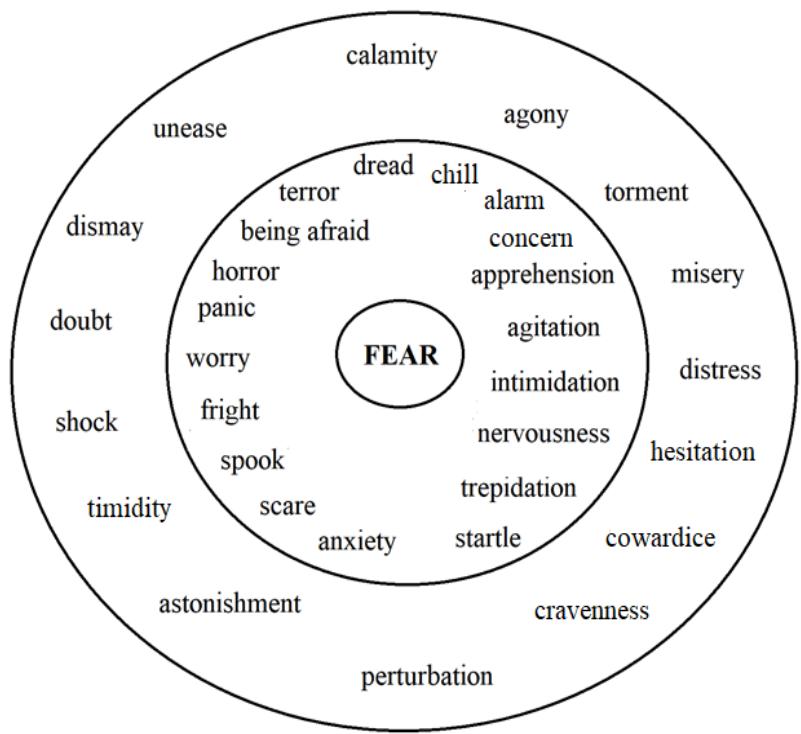 Figure 1: Lexico-semantic field with the dominant "fear"
The emotion in the example above has been intensified by the description of the woman's physical state (she was panting) and metaphors (possessed by some shapeless dread which robbed her of all self-control). Moreover, the emotion has an explicit causality – the woman's fear that Strickland can do them "some great harm." The linguistic expression of the emotional state of fear in the passage may seem somewhat redundant, but such repetition plays a significant role in creating additional overtones. Particularly, the context has helped reveal a new emotional and evaluative overtone – an extremely unpleasant and menacing fear.
Below is one more example of a linguistic representation of another emotional and evaluative overtone of the same emotion – fear:
ii. "Fannie," she said, "is frightened. Terrified. Spooked. Are you, I wonder, the one responsible?" (Bradbury, 1999, p. 137).
In this passage, a former opera singer, Fannie Florianna, who has found out about several mysterious deaths of close friends in her town, is also experiencing different shades of fear, which has been expressed by means of direct nomination:
-
frightened – feeling bad fear, made to be afraid, worried that something bad might happen;
-
terrified – very frightened, impelled by menace;
-
spooked – frightened, frantic, startled into violent activity (Merriam-Webster Dictionary).
All three lexemes also belong to the same LSF with the nucleus "fear." The definition analysis of the word spooked has demonstrated the structure of its meaning which includes additional semes [frantic] and [violent]. The analysis has revealed a new emotional and evaluative overtone – a frantic, violent, menacing fear. Contextually, the emotion has also been intensified by parcellation, creating a more substantial emotional effect:... frightened. Terrified. Spooked.
iii. At the sound of his voice the Director started into a guilty realization of where he was; shot a glance at Bernard, and averting his eyes, blushed darkly; looked at him again with sudden suspicion and, angrily on his dignity, "Don't imagine," he said, "that I'd had any indecorous relation with the girl. Nothing emotional, nothing long-drawn. It was all perfectly healthy and normal." He handed Bernard the permit. "I really don't know why I bored you with this trivial anecdote." Furious with himself for having given away a discreditable secret, he vented his rage on Bernard. The look in his eyes was now frankly malignant (Huxley, 2006, p. 97).
Here, the Director feels different shades of anger because he gives away a "discreditable secret" to Bernard about his visit to the Savage Reservation and an emotional attachment to the woman named Linda, who got lost during their trip to the forbidden territory. The emotion has been expressed by direct nomination:
-
angrily – in a manner born of or expressing anger or strong resentment;
-
furious – extremely angry, intensely violent;
-
rage – violent anger, angry fury;
-
malignant – very angry, dangerous or cruel; showing ill will or hatred, very evil, serious and dangerous (dictionary.com, The Britannica Dictionary).
The definition analysis of the lexemes has demonstrated the structure of their meaning that includes the semes [strong], [extremely], [intensely], and [very] conveying the intensity of the emotion, the semes [violent], [dangerous], and [cruel] conveying the subject's appraisal of the emotional state, and the semes [hatred], [fury], and [resentment] conveying its inner nature. Thus, a new emotional and evaluative overtone has been revealed – a strong, violent anger.
The definition and thesaurus analyses have shown that all the words belong to the same LSF with the nucleus "anger," and have allowed putting the lexical units rage, fury, frenzy, conniption, wrath, tempest, tantrum, madness, delirium, ire, and indignation in the close periphery and irritation, violence, rabidity, fierceness, hostility, frustration, annoyance, malignancy, petulance, hatred, resentment, sullenness, streppiness, discomfort, and distress in the distant periphery. The field is demonstrated in Figure 2.
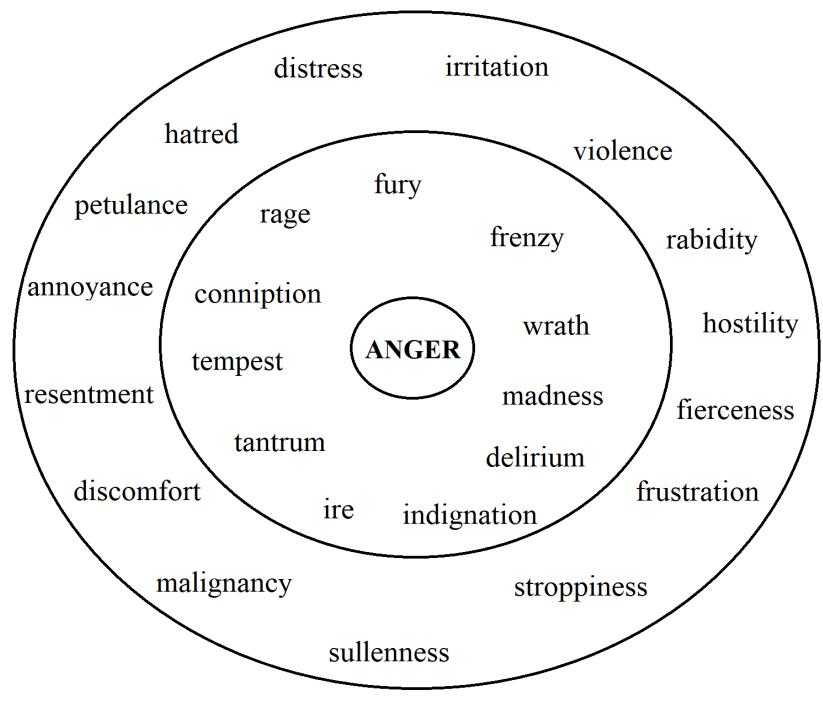 Figure 2: Lexico-semantic field with the dominant "anger"
iv. Just before disappearing from his horizon, she had slipped him Hercules' broom, and he had used it to sweep everything he despised out of his life. A sudden happiness, a feeling of bliss, the joy that came of freedom and a new life – these were the gifts she had left him (Kundera, 2012, p. 116).
Here, the main character, Franz, is going through several emotions that belong to the same emotional cluster of happiness:
-
happiness – the state of being satisfied that something is good or right; the state of feeling great, pleasant contentment;
-
bliss – extreme happiness, great joy, utter contentment;
-
joy – the emotion evoked by well-being and contentment; a state of great happiness, felicity and delight (dictionary.com).
As seen from the definitions, the structure of all three meanings includes the semes [great] and [extreme] conveying the intensity of the emotion, the semes [pleasant] and [satisfied] conveying the subject's appraisal of the emotional state, and the semes [contentment], [felicity], and [delight] conveying its inner nature. Thus, a new emotional and evaluative overtone has been revealed – a great content delight. The overtone has been intensified by the expressed ground of the emotional state of Franz – new opportunities that Sabina, his lover, had brought to his dull life making his existence better even after she had left him. Tremendous and delightful happiness is also caused by the freedom implied in the expression "Hercules' broom." It is a unique author's metaphor that symbolizes hard, gigantic labor (Hercules' labor) on the one hand and a sacral ritual of cleaning and wiping everything bad out for the sake of a new promising beginning (a broom) on the other.
All the words belong to the same LSF with the nucleus "happiness" and with the lexical units felicity, joy, elation, exhilaration, exultation, ecstasy, euphoria, rapture, jubilation, gaiety, merriment, mirth, and gladness in the close periphery and excitement, delight, bliss, ravishment, rejoice, frenzy, delirium, pleasure, contentment, satisfaction, amusement, cheeriness, thrill, nervousness, and hilarity in the distant periphery. The field is demonstrated in Figure 3.
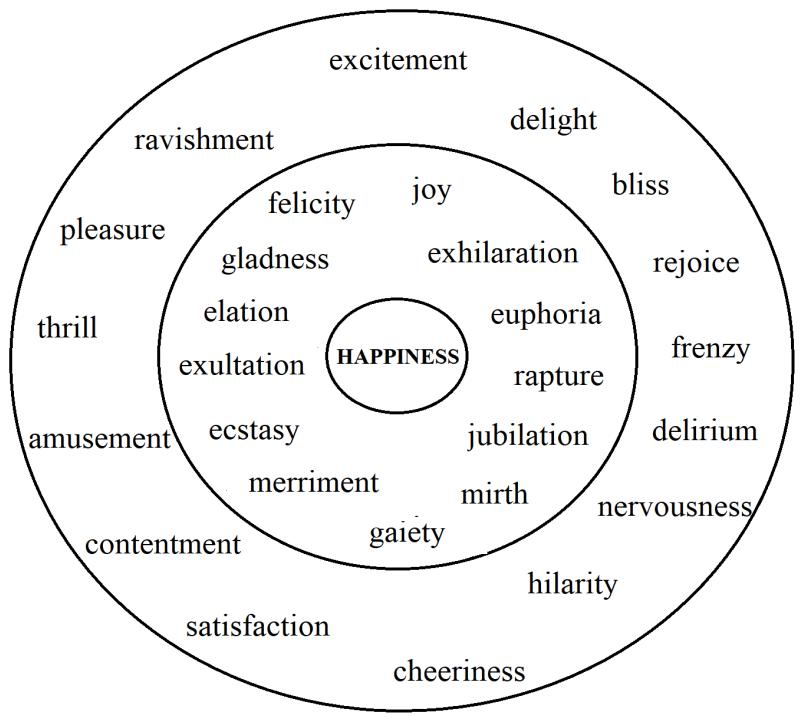 Figure 3: Lexico-semantic field with the dominant "happiness"
v. At home, my father's most vivid quality was a capacity for hating and despising. Those two verbs often went together. He hated and despised certain foods, makes of automobiles, music, manners of speech and modes of dress, radio comedians, and, later on, television personalities, along with the usual assortment of races and classes it was customary to hate and despise in his day (though perhaps not as thoroughly as he did) (Munro, 2010, p. 142).
In this passage, the boy reminiscences about his childhood and his father, who did not want to accept him for the big purple mark on his face. Father's emotional state has been expressed by synonymous nouns "hated" and "despised" that belong to the same emotional cluster but convey different levels of emotional intensity:
-
to hate – to feel extreme dislike, to have a strong aversion;
-
to despise – to look down on with contempt, dislike or strong and deep aversion, to regard as worthless (Merriam-Webster Dictionary).
As seen from the definitions, the structure of both meanings includes the semes [strong] and [deep] conveying the intensity of the emotional state and the semes [dislike], [contempt], and [aversion] conveying its inner nature. The analysis has revealed a new emotional and evaluative overtone – a strong disliking aversion.
The reference to the thesaurus analysis has allowed determining the LSF with the nucleus "hatred" and placing the words abhorrence, despisal, loathing, abomination, detestation, aversion, and dislike in the close periphery and the words enmity, animosity, hostility, resentment, malice, disgust, spite, malignity, bitterness, meanness, contempt, envy, grudge, horror, rancor, and revulsion in the distant periphery. The field is demonstrated in Figure 4.
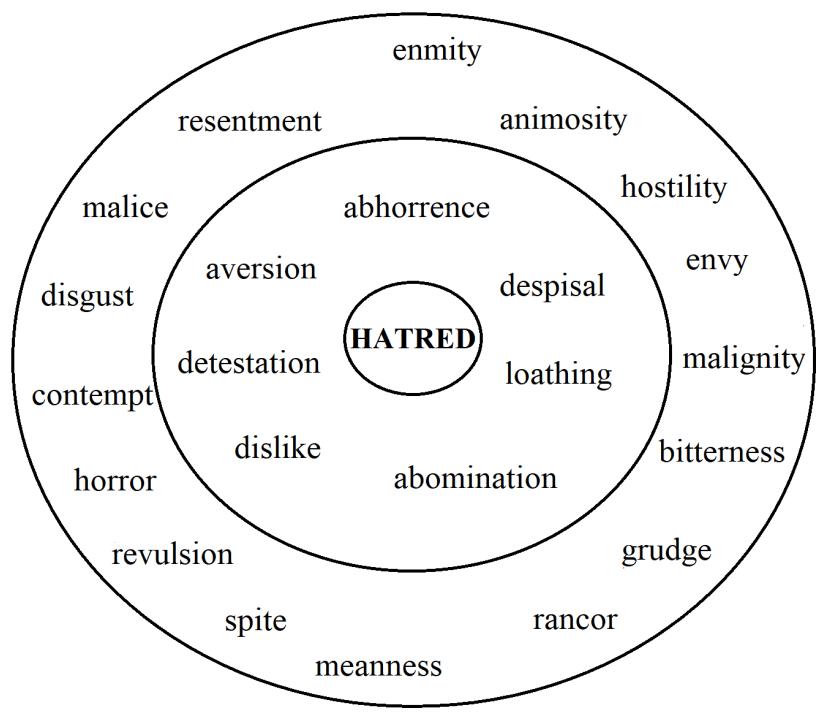 Figure 4: Lexico-semantic field with the dominant "hatred"
The second group provides illustrations of linguistic expression and implication of emotions belonging to different emotional clusters and having either the same or different valence, yet, used in the same context.
vi. It was Françoise's habit, when Eulalie had gone, to make unkind predictions about her. She detested her but she was also afraid of her and believed that when Eulalie was there she had to present a 'good face' (Proust, 2003, p. 109).
In this case, one of the main characters, a family's servant Françoise, simultaneously feels two negative emotions that have been expressed by means of direct nomination:
-
detested – disliked intensely; felt violent antipathy and abhorrence;
-
afraid – feeling strong inner apprehensive disquiet; having a dislike for someone (Merriam-Webster Dictionary).
As seen from the definitions, the structure of both meanings includes the semes [strong], [violent], and [intensely] conveying the intensity of the emotional state and the semes [dislike], [apprehensive], and [abhorrence] conveying its inner nature.
The words belong to different LSFs. More specifically, the verb detested (and its derivative – the noun detestation) is a part of the LSF with the nucleus "hatred" (Fig. 4), whereas the adjective afraid (and the noun equivalent being afraid) belongs to the LSF with the nucleus "fear" (Fig. 1). The thesaurus analysis of both words has demonstrated that the distant periphery of the LSF with the nucleus "hatred" includes the lexeme "horror" that belongs to the close periphery of the LSF with the nucleus "fear." So, the LSFs overlap based on the presence of the word "horror" in both fields. The overlap is presented in Figure 5.
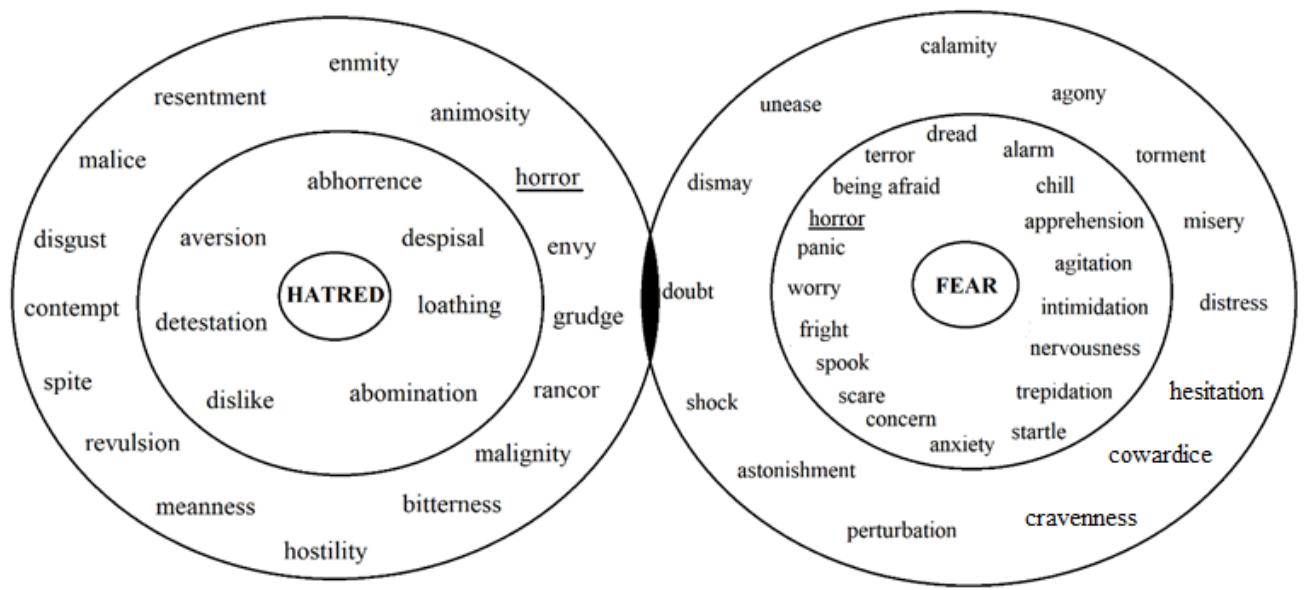 Figure 5: Lexico-semantic fields with the dominants "hatred" and "fear"
Definition and thesaurus analyses have allowed us to reveal a new emotional and evaluative overtone – an intense apprehensive dislike.
vii. On the morning following his arrival, I did everything I could to get out of the house for my morning hike without his knowing where I had gone. Breakfastless, with hysterical haste, I gathered my net, pill boxes, killing jar, and escaped through the window. Once in the forest, I was safe; but still I walked on, my calves quaking, my eyes full of scalding tears, the whole of me twitching with shame and self-disgust, as I visualized my poor friend, with his long pale face and black tie, moping in the hot garden – patting the panting dogs for want of something better to do, and trying hard to justify my absence to himself (Nabokov, 2012, p. 92).
In this example, the author has mixed feelings caused by his escape from a friend due to the desire to spend time alone, enjoying his peculiar hobby, or, rather, obsession with hunting butterflies. Such cruel insensitivity and negative emotions that occur to Nabokov regarding the poor boy whose father had died and the family got ruined and left with no money have been expressed in the passage through direct nomination:
-
shame – a strong and painful emotion caused by consciousness of guilt, regret, or sadness;
-
(self)-disgust – strong marked aversion aroused by something distasteful; annoyance and anger towards something that is not good, appropriate or fair (The Britannica Dictionary).
As seen from the definitions, the structure of both meanings includes the seme [strong] conveying the intensity of the emotion, the semes [painful] and [distasteful] conveying the subject's appraisal of the emotional state, and the semes [guilt], [regret], [sadness], [anger], and [annoyance] conveying its inner nature.
The words belong to different LSFs. More specifically, the lexeme shame is a part of the LSF with the nucleus "embarrassment," and the words shame, humiliation, abashment, abasement, ignominy, mortification, and disgrace in the close periphery, and the words disconcertment, confusion, guilt, odium, awkwardness, discomfort, distress, squirm, nervousness, dispirit, and chill in the distant periphery. The noun self-disgust (a derivative of the noun disgust) belongs to the LSF with the nucleus "disgust" and the words distaste, repulsion, revulsion, repugnance, aversion, revoltedness, grossness, vileness, ickiness, queasiness, squeamishness, deprecation, and dislike in the close periphery, and the words disapproval, hate, loathing, abhorrence, displeasure, antipathy, abomination, averseness, detestation, horror, odium, disgrace, and shame in the distant periphery. The analysis has demonstrated that the distant periphery of the LSF with the nucleus "embarrassment" includes the lexemes that also belong to the distant periphery of the LSF with the nucleus "disgust." In other words, the LSFs of both emotions overlap based on the presence of the lexemes "odium," "disgrace," and "shame" in their fields. The overlap of two LSFs is presented in Figure 6.
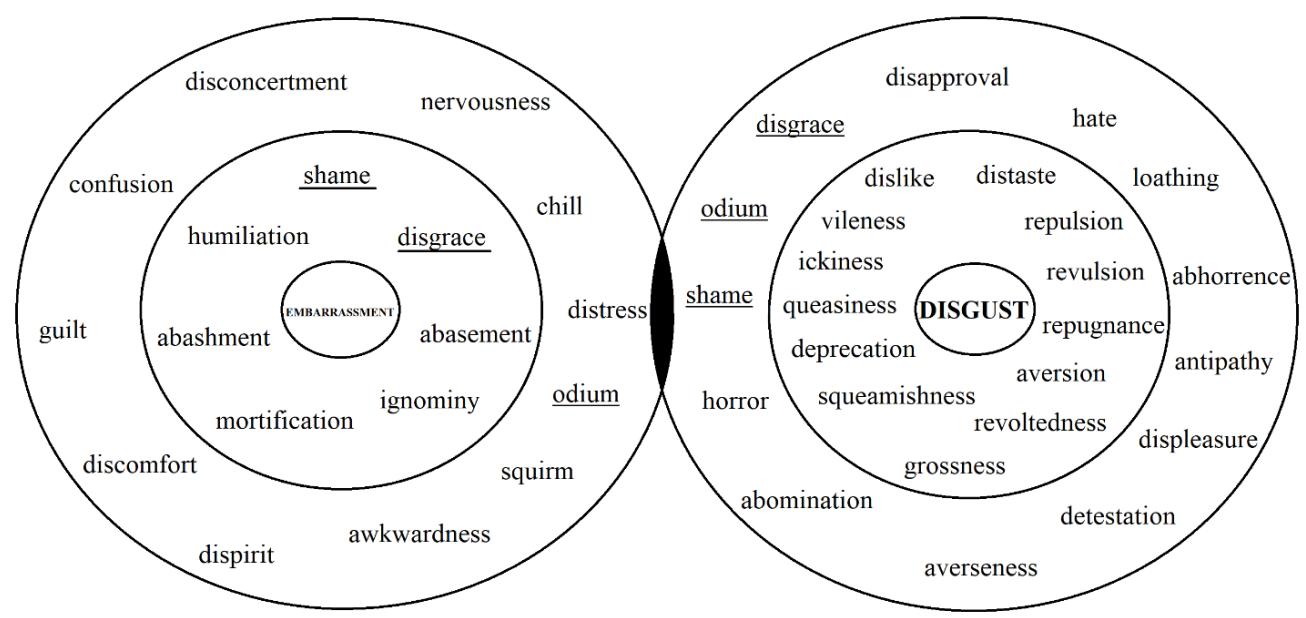 Figure 6: Lexico-semantic fields with the dominants "embarrassment" and "disgust"
Apart from fear and embarrassment, the character also feels sadness, which has been implied in the definition of "shame" and the context (my eyes full of scalding tears). In the process of definition, thesaurus and contextual analyses, a new emotional and evaluative overtone has been discovered – a disgusting saddening embarrassment.
The analysis of examples from fiction has also revealed many cases where positive emotions are experienced along with negative ones.
viii. I was blushing furiously, head down, half-angry and somewhat embarrassed but somehow pleased at all this attention. I had been called Flash and Buck often, but somehow when Crumley did it, it went right by without wounding (Bradbury, 1999, p.82).
In this passage, the main character, a struggling writer, who became a witness to several murders, is talking to Detective Elmo Crumley. The detective is unwilling to listen to the man, emphasizing that everyone around him considers him a "nut" and "fool." Such an attitude makes the writer feel a mixture of emotions that have been expressed by direct nomination:
-
furiously – terribly, extreme in degree, power, or effect;
-
half-angry – showing a certain degree of anger;
-
pleased – experiencing pleasure, feeling some degree of satisfaction (Merriam-Webster Dictionary).
The words "furiously" and "half-angry" belong to the same LSF with the nucleus "anger" (Fig. 2). The lexeme "embarrassed" belongs to the LSF with the nucleus "embarrassment" (Fig. 6). Another emotion the young fellow feels is the satisfaction expressed by the word "pleased." The lexeme pleased and its derivative, the noun pleasure, belong to the LSF with the nucleus "satisfaction" and the lexical units contentment, pleasure, enjoyment, happiness, and joy in the close periphery, and the lexemes delight, amusement, gladness, comfort, excitement, and delirium in the distant periphery.
The analysis has demonstrated that the distant periphery of the LSF with the nucleus "anger" includes the lexemes that also belong to the distant periphery of the LSF with the nucleus "embarrassment." In other words, the LSFs of both emotions overlap based on the presence of such words as "discomfort" and "distress" in their fields. In its turn, the LSF with the nucleus "anger" overlaps with the one with the nucleus "satisfaction" based on the presence of the word "delirium" in both fields. The overlap of all three LSFs is presented in Figure 7.
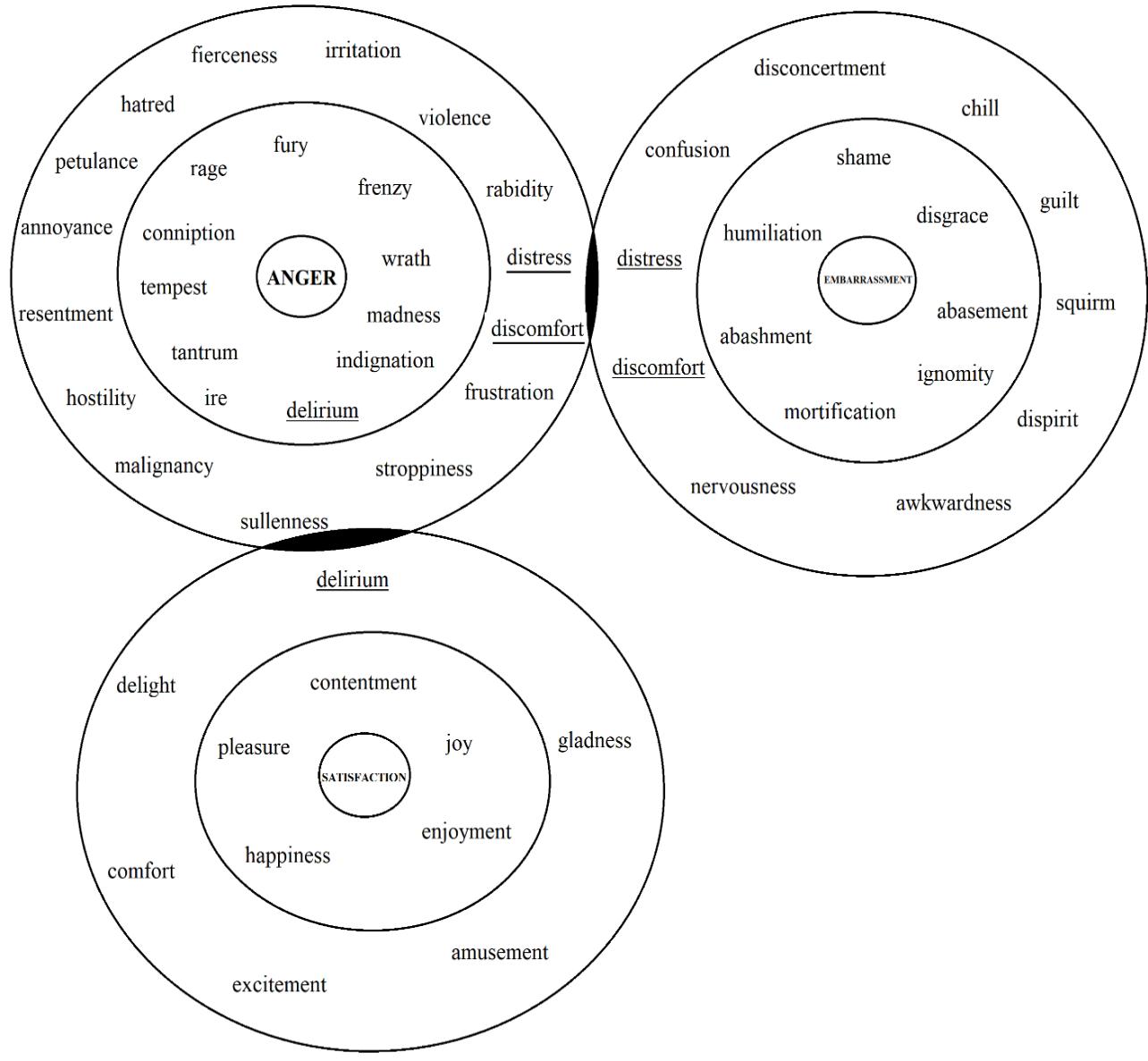 Figure 7: Lexico-semantic fields with the dominants "anger," "embarrassment," and "satisfaction"
The analysis has revealed a new emotional and evaluative overtone – an intense, embarrassing, discomforting, yet pleasing anger. In addition, the emotional and evaluative overtone is implied in the actual semantics of the word, expressing anger (half-angry), and in the word somewhat that both imply approximation and gradation of the emotions experienced. The overtone has been also implied and intensified in the description of the writer's physical state (blushing (developing a rosy color as from embarrassment)).
ix. Lenina alone said nothing. Pale, her blue eyes clouded with an unwonted melancholy, she sat in a corner, cut off from those who surrounded her by an emotion which they did not share. She had come to the party filled with a strange feeling of anxious exultation (Huxley, 2006, p. 173).
In the passage, the girl feels a mixture of positive and negative emotions that have been expressed by direct nomination:
-
exultation – a feeling of triumphant elation or jubilation;
-
anxious – causing or showing fear or nervousness;
-
melancholy – a feeling of pensive sadness, depression of mind or spirit (dictionary.com, Oxford Learner's Dictionary).
The word anxious belongs to the LSF with the nucleus "fear" (Fig. 1), the word exultation – to the LSF with the nucleus "happiness" (Fig. 3), and the word melancholy – to the LSF with the nucleus "sadness," which has been determined in the process of definition and thesaurus analyses. The close periphery of the LSF includes grief, woe, forlornness, gloom, misery, sorrow, downcast, poignancy, upset, melancholy, mourning, anguish, and yearning, and the distant periphery – agony, discouragement, regret, shame, frustration, disappointment, dispiritedness, despondency, distress, despair, and depression.
The analysis has demonstrated that the distant periphery of the LSF with the nucleus "fear" includes the lexeme "distress" that also belongs to the distant periphery of the LSF with the nucleus "sadness" and the lexeme "nervousness" that also belongs to the LSF with the nucleus "happiness." In other words, the LSFs with the nuclei "fear" and "sadness" overlap based on the presence of the word "distress," and the LSFs with the nuclei "fear" and "happiness" overlap based on the presence of the lexemes "nervousness." The overlap is presented in Figure 8.
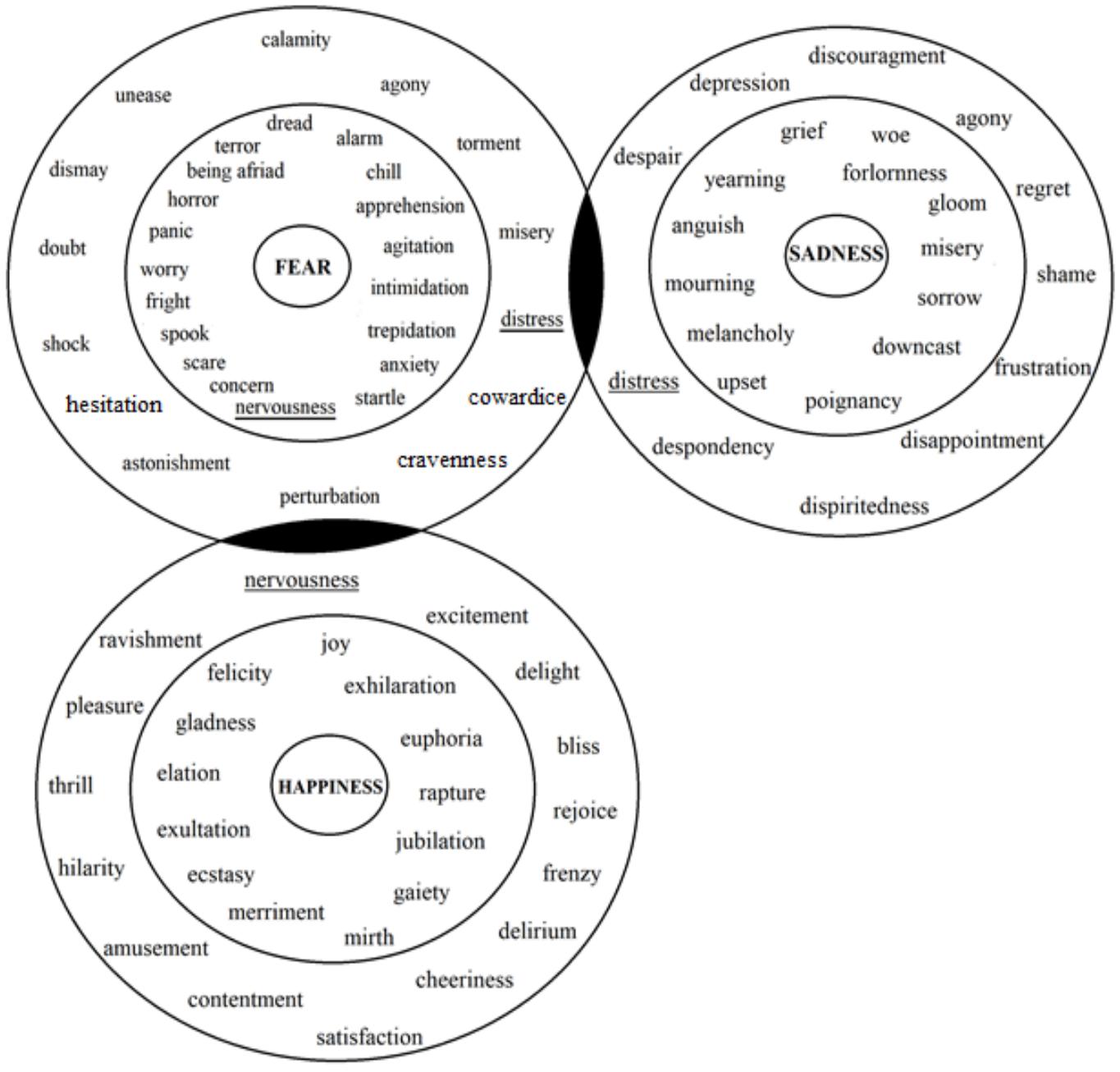 Figure 8: Lexico-semantic fields with the dominants "fear," "sadness," and "happiness"
The analysis has revealed a new emotional and evaluative overtone – a sad, nervous, and distressing happiness. In addition, the overtone has been also implied and intensified in the description of the girl's physical state (pale (light in color from shock or fear), she sat in a corner, cut off from those who surrounded her)).
V. CONCLUSION
This article has investigated the phenomenon of emotions and the unique and complex ensemble they create in their interrelation. Namely, the paper has examined the cases of linguistic representation of emotional and evaluative overtones in English fiction. In the course of definition and thesaurus analyses and the construction of lexico-semantic fields with words expressing emotions, it has been demonstrated that they can move within their own or to the lexico-semantic field of another lexical unit expressing the emotion of the same or opposite valence. In other words, it has been confirmed that lexico-semantic fields with a positive or negative dominant of an emotional state possess the feature of diffusion. Moreover, it has been shown that lexical units representing emotional states can perform both a positive or negative emotion function since it is determined by one's appraisal. The differences in perception and appraisal of emotions are caused by individual experiences that vary from subject to subject and thus help build knowledge about emotion. Finally, it has been proven that the discovery and interpretation of emotional and evaluative overtones heavily depend on the context and the subject's ability to see the contextual parameters that encourage new meanings.
The study has highlighted several areas that could use further research, such as the relation between emotion and appraisal, emotional ambivalence, and overall subjectivity of emotional experience. For further study and a follow-up investigation, the presented lexico-semantic fields can be extended by adding more lexical units representing emotions. In addition, other positive and negative emotions can be selected and analyzed based on their definitions and contextual usage. There is also a vast array of linguistic means and devices that are beyond the scope of the current study but can be considered regarding how they convey emotional and evaluative overtones, including the analysis of emotions expressed and implied on the phonetic, morphological, and syntactical levels. Moreover, the sources of illustrations can be broadened to other types of fiction, including short stories, folk tales, legends, myths, and novellas, or extended beyond literary discourse.
Conflict of Interest
The authors declare no conflict of interest.
Ethical Approval
Not applicable
Data Availability
The datasets used in this study are openly available at [repository link] and the source code is available on GitHub at [GitHub link].
Funding
This work did not receive any external funding.
References
Cite this article
Related Research



Special Issue
Launch a focused special issue to highlight research, emerging trends, and expert insights in your academic field.
