



IntelliPaper
Abstract
We report a rare case of longitudinally extensive transverse myelitis (LETM), a rare but disabling condition defined as a lesion of the spinal cord that extends over four or more vertebrae on MRI, in association with measles. Measles related devastating neurological disorders include primary measles encephalitis, acute post measles encephalitis, subacute sclerosing pan encephalitis (SSPE) and measles inclusion body encephalitis (MIBE). Due to rarity of disease and poor prognosis of LETM in patients, prompt diagnosis and treatment is of critical importance for a positive clinical outcome. We provide a comprehensive perspective of past and current literature in order to aid diagnosis and management of this rare phenomenon.
Explore Digital Article Text
I. OBJECTIVE
Established as a viral disease, highly contagious and acute infectious, Measles is characterized by being a febrile exanthematous disease, caused by viruses of the family Paramyxoviridae, of the genus Morbillivirus, which has eight classes and 24 genotypes and the human being is its only reservoir and source of infection.
The classic clinical condition is associated with fever, coryza, conjunctivitis, photophobia, morbilliform maculopapular rash, with cephalocaudal distribution, that is, it starts on the forehead, around the ears and neck, in the hairline and in the cranio-caudal direction, associated respiratory symptoms, such as dry cough. It presents tropism in the upper airways and can evolve with serious complications such as otitis, laryngitis, diarrhea, in addition to pneumonia and encephalitis, which are the main causes responsible for deaths
LETM is a heterogeneous inflammatory disorder of the spinal cord characterized by acute or subacute development of motor weakness, sensory impairment, and autonomic dysfunction. Etiologies include idiopathic or secondary LETM which can be directly associated with infectious, systemic inflammatory or multifocal central nervous system disease. Despite the known neuro-invasive nature of measles virus the development of LETM is a rare manifestation. Few cases have been reported including the development of LETM at the initial time of presentation or subsequent development of LETM following recovery measles.
Only few cases of post measles mumps rubella vaccine (MMR) are reported. In this report, we present a case with radiographic evidence of longitudinally extensive transverse myelitis in the patient with measles infection.
II. CASE PRESENTATION
A 8 year old male presented to pediatric emergency department, NIMS medical college, Jaipur with history of cough – coryza for 7 days, high grade fever for 7 days, rashes over body for 6 days and limb weakness for 2 days. Morbilliform maculopapular rash developed on day 2 of fever which started from neck area and than gradually involved the whole body. Limb weakness was gradual on onset, progressive and associated with sudden urinary incontinence. The patient denied any history of trauma. Patient had normal development history but he did not receive any vaccination in past.
On presentation, his vitals were the following: temperature 98.1 °F, pulse 74/min, blood pressure 102/64, respiratory rate 24/min and oxygen saturation (SpO2) of 99% on room air.
Neurologic exam on admission showed muscle strength of 0/5 strength in lower extremities and 4/5 strength in upper extremities. Deep tendon reflexes were absent in bilateral lower limbs and planter reflex was absent. He was conscious and oriented on admission. Rashes were in the stage of recovery at the time of presentation. Urinary bladder was distended due to retention of urine.
The remainder of the physical examination was within normal limits.
Brain magnetic resonance imaging (MRI) were negative for acute infarct or hemorrhage. Urgent MRI of the cervical and thoracolumbar spine were done which showed diffuse hyperintense T2 signal from the level of cervicomedullary junction up to lower thoracic vertebra level without any evidence of cord compression.
Cerebrospinal fluid (CSF) analysis showed a high white blood cell (WBC) count of 20 (ref. 0–5 cells/ L) with 15% neutrophils and lymphocyte count of 85%. CSF protein was high at 56 mg/dL (ref.15–45 mg/dL) and glucose was high at 203 mg/dL (ref.40–70 mg/dL). Measles antibody immunoglobulin M (Ab-IgM) and immunoglobulin G (Ab-IgG) were positive in blood and CSF in high titres. However, measles virus RNA in the spinal fluid, measured using the polymerase chain reaction method, was negative.
Bacterial cultures of the spinal fluid showed no growth. Human immunodeficiency Virus (HIV) serology, ANA - IFA were negative. The patient was started on 5 days of IV methylprednisone pulse therapy (30 mg/kg/day) followed by oral steroid therapy along with other supportive treatment. Patient showed significant clinical improvement. He was discharged to an extended care facility for physical therapy and neurorehabilitation after 2 wks of admission. At the time of discharge he had muscle power of 5/5 in upper limbs and 4/5 in lower limbs. On the 1 month follow-up, the patient had further improvement in both his motor and sensory functions. Strength was 5/5 in the upper extremities as well as lower extremities.
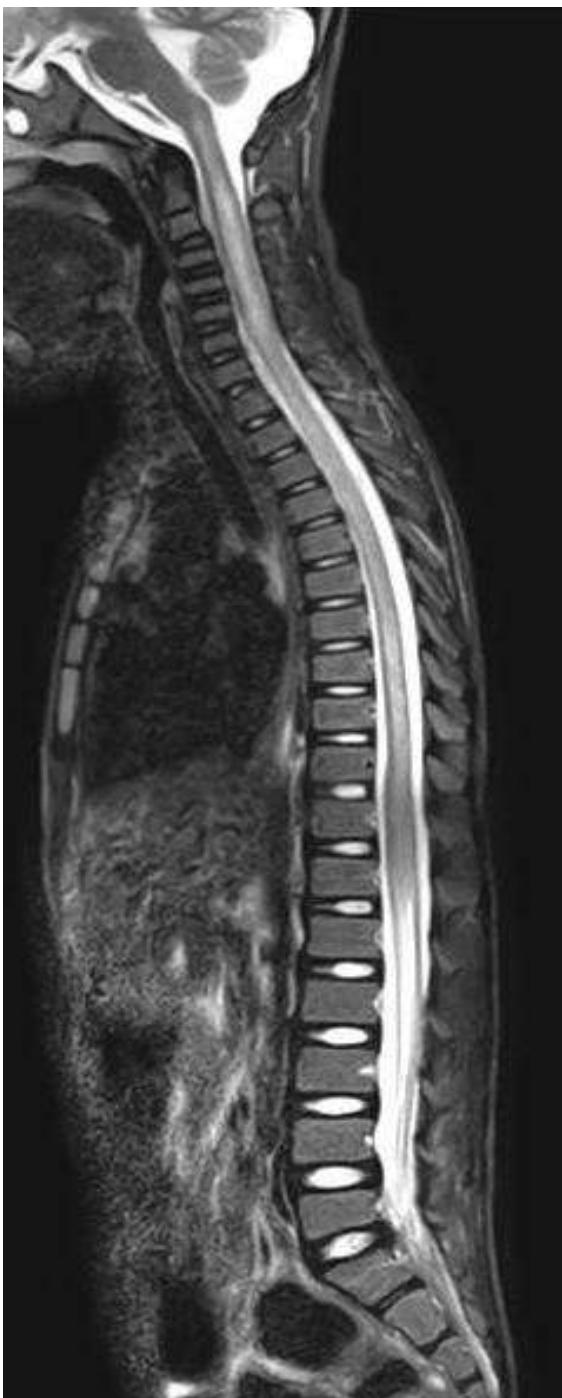
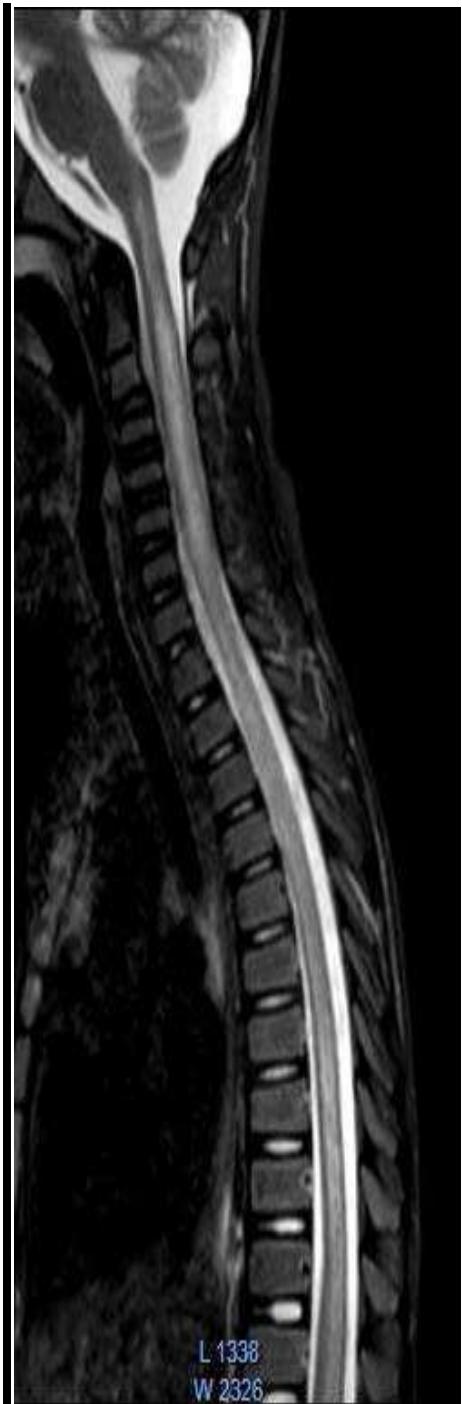
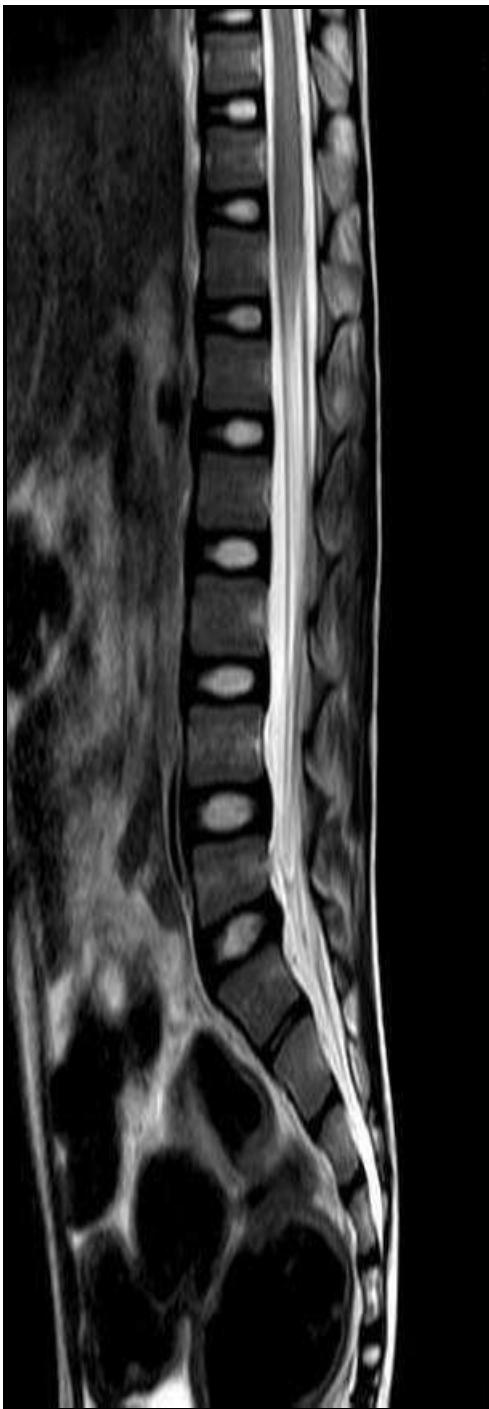 Figure 1,2,3: T2W MRI spine shows T2 high signal extending from cervicomedullary junction up to the conus medullaris
III. DISCUSSION
Measles infection is an uncommon cause of transverse myelitis in immunocompetent patients. The pathogenesis of the nervous complications of measles is unknown. Many observers believe that there are acute inflammatory processes due to the neurotropism of the measles virus. Knebusch et al. also suggested that there was a cellular autoimmune process against the myelin sheath of the central tracts that was more responsible than direct infection of the spinal cord. Early diagnosis of measles related myelitis is based on its temporal relationship to the rash and detection of measles RNA or measles specific antibodies or both in the CSF and blood. Magnetic resonance imaging of the spine may demonstrate T2 hyperintense lesions in the spinal cord with occasional swelling and enhancement.
Virologically confirmed cases of measles transverse myelitis are extremely rare. Analysis of available data reveals that approximately one-half of the patients with post measles myelitis recovered completely, approximately one-fourth were left with residual deficits, and about one-fourth died. Currently, there are no established treatment regimens for transverse myelitis as a complication of measles infection. Some researchers recommend high doses of methylprednisolone for management and use of plasmapheresis in case no response to pulse steroid therapy. Although clinical recovery is variable, many immunocompetent patients improve significantly, though fatal cases have been reported.
IV. CONCLUSION
Measles and its neurological complications are preventable and must be prevented. Methylprednisolone pulse therapy appears to be a safe and effective treatment for children with transverse myelitis secondary to post-measles myelitis. More effective treatments for LETM may be available in the near future but currently this remain neurologically disabling disease.
Conflict of Interest
The authors declare no conflict of interest.
Ethical Approval
Not applicable
Data Availability
The datasets used in this study are openly available at [repository link] and the source code is available on GitHub at [GitHub link].
Funding
This work did not receive any external funding.
References
Cite this article
Related Research




Special Issue
Launch a focused special issue to highlight research, emerging trends, and expert insights in your academic field.
