



IntelliPaper
Abstract
The study investigates resilience and inclusive practices by non-violence education in Cameroon as the focal point. The essence of the study was to investigate the relationship between resilience, inclusion and non-violence within the educational context in Cameroon. It has been reflecting how the victims can navigate the challenge with resilience by non-violence. It emanated from a project on the effects of violence on students learning in Cameroon with the research question on their survival ability of such abuses. The study employed a cross-sectional design with a quantitative approach of data collection and processing. The sample participants comprised (n = 924) students randomly selected from eight secondary schools in one region of Cameroon with four schools chosen from the urban center and four others from the rural centre. These schools were used as the primary source of data collection for the study. The collection of data was undertaken with questionnaires that have been tested and validated through multinational and regional organizations, pilot studies, and different institutions. The structured questionnaires were used to elicit data from the participants. The collected data was analysed using JAMOVI. The study's findings show high levels of violence with both genders suffering equally from the scourge. Furthermore, the male gender in the findings from some of the variables are more subservient and more affected by sexual violence, besides other violence strands such as structural, psychological, environmental and physical violence. These findings therefore introduce diverse probabilities and hypotheses. The subservient of males to sexual violence reduces schools to arenas of illicit sexual activities thereby compromising the learning, social justice and global values for the students. Looking forward, agencies should provide support to educational institutions in their efforts to assist students who are confronted with violence through the implementation of resilience, capacity building and inclusive practices. These practices will help in addressing discrimination among school communities, preventing violence, and cultivating an effective learning environment for all students, irrespective of their background. The advancement of inclusion and resilience signifies a more efficacious approach to addressing school violence and establishing a secure environment for all.
Explore Digital Article Text
I. INTRODUCTION
The essence of this paper was to investigate the relationship between inclusive practices, resilience and non-violence in the educational setting. Education has been identified as a critical factor in addressing inequalities, exclusion, and achieving social cohesion (García-González, 2022). Hence, quality education plays a crucial role in fostering the development of resilient individuals who can navigate challenges, contribute positively to society, and thrive in a complex and interconnected world (Coetzee, 2023). However, the Cameroonian education system, akin to other African countries, grapples with substantial challenges, including gender inequalities, substandard educational quality, and pervasive school violence (Reyes, J. E. 2013; UNICEF, 2016; Brekk, 2023). The pervasive issue of school violence in educational settings has been shown to perpetuate cycles of harm (Kim, E. J., 2023).
Responding to its pervasive nature, the global community convened in September 2015 and adopted 17 Sustainable Development Goals, one of which was dedicated to ensuring access to quality education for all (SDG 4). This initiative aims to foster inclusive and equitable quality education, as well as to promote lifelong learning opportunities for all (UNICEF, 2000). Nevertheless, considerable challenges persist in addressing school violence. Survivors of violence often encounter significant obstacles to accessing and succeeding in education, and consequently, to contributing to school dropout rates (Pochini, 2024). Addressing this issue necessitates the implementation of inclusive practices and the cultivation of resilience capacity building among students within educational settings. The present study will commence with Part One, which will provide a comprehensive overview of the study's background and contextualize the problem. The subsequent section will offer a comprehensive review of the extant literature on the subject. The third section will describe the methodology, followed by the presentation of the findings. The paper will conclude with a discussion.
1.1 Context of the Study
Education has been identified as a critical factor in addressing inequalities, exclusion, and achieving social cohesion (García-González, 2022). It plays a pivotal role in fostering the development of resilient individuals who can navigate challenges, contribute positively to society and thrive in a complex and interconnected world (Coetzee, 2023). However, the nexus of resilience, inclusion, and nonviolence in Cameroon is a complex issue, intricately interwoven with historical and social-structural factors. Cameroon, akin to numerous nations across the African continent, grapples with a myriad of educational challenges that impede the attainment of educational excellence and stifle the development of human capital. This assertion is corroborated by Brekk (2023) and Zickafoose (2024). The Cameroonian education system faces several significant challenges, including gender inequalities, inadequate quality of education, insufficient vocational training, and pervasive school violence (Reyes, 2013; UNICEF, 2016; Brekk, 2023).
Violence against children is a broad category that includes all forms of harm inflicted on individuals under the age of 18. The perpetrators of such violence may include parents, caregivers, peers, intimate partners, or strangers. This violence can occur in a variety of settings, including homes, orphanages, residential care facilities, streets, workplaces, prisons, other detention centers, and schools (Pietro, 2019). Gupta, sees school violence as that which occurs in a school setting, including violence on school property, on the way to or from school, and at school trips and events. It can be physical, sexual violence, Psychological violence, gender-based violence (Gupta, 2023). It may be perpetrated by students, teachers, or other members of the school staff; however, violence by fellow students is the most common (Eaton, 2024). The underlying causes of this violence may vary and include, but are not limited to, factors such as academic underperformance, a history of violence, a hyperactive or impulsive personality, the presence of mental health conditions, witnessing or being a victim of violence, substance use (alcohol, drugs, or tobacco), dysfunctional family dynamics, domestic violence or abuse, access to weapons, the influence of delinquent peers, and economic disadvantage or high crime rates in the community (Tangwe, 2021). However, it is crucial to emphasize that the presence of these factors does not inherently imply that a child will engage in violent behaviour (CDCP, 2016).
The data from the National Crime Victimization Survey (NCVS) yielded insights on nonfatal criminal victimisation experienced by students aged 12–18, as reported by the students themselves. 18 Nonfatal criminal victimisation encompasses theft and violent victimisation, with the later including rape, sexual assault, robbery, aggravated assault and simple assault. In 2022, students aged 12–18 experienced 568,100 victimisations at school. This figure corresponds to a rate of 22 victimisations per 1,000 students enrolled in school (NCSE, 2024). This finding is further corroborated by a study conducted by OCHA (2019), which found that 56.4% of women in union were confronted with at least one of these forms of violence. It is noteworthy that 33% of girls aged 12 to 25 have experienced violence, and 5% of them have experienced sexual violence (OCHA, 2019). This phenomenon of adolescent sexual problems is not confined to a single country (Kim, 2023). A study conducted in Cameroon revealed that more than 87% of students experienced violent victimisation. These actions have been shown to have a significant impact on the learning abilities of students, including emotional responses, aggressive behaviours, and attachment disorders (UNICEF, 2016). These actions tend to demonstrate challenges in problem-solving abilities and a diminished sense of self-worth. Furthermore, these students encounter difficulties in maintaining concentration during educational activities (Wilson, 2021). The consequences of violence and trauma extend to various aspects of students' lives, including social isolation, school dropout, poor academic performance, and mental health challenges (UNICEF, 2016; Pochini, 2024).
In September of 2015, the global community adopted 17 Sustainable Development Goals, one of which was dedicated to ensuring access to quality education for all (SDG4). The United Nations articulated this position and used it to promote inclusive and equitable quality education and lifelong learning opportunities for all (UNICEF, 2000; UNESCO, 2017). In response to this global initiative, the leaders of Cameroon promulgated Law No. 98/004 of the Cameroon National Educational Guidelines in 1998, which expressly prohibits all forms of violence and discrimination within the educational sector. Despite the enactment of this legislation, concerns have been raised regarding the utilisation of educational institutions as a platform for violent indoctrination (Tchombe, 2006). Notwithstanding, Cameroon has contributed to gender equality in its area of intervention focused on transformative, inclusive, and sustainable growth by relying on the country programme document (CPD) 2022-2026 (UNDP, 2024). However, significant challenges persist in addressing school violence. The pervasive issue of school violence in educational settings has been shown to perpetuate cycles of harm (Kim, 2023).
Consequently, survivors of violence frequently encounter substantial obstacles to accessing and succeeding in education, encountering trauma-related challenges that adversely affect their academic performance, socio-emotional well-being and overall development, and contributing to school dropout rates (Pochini, 2024). These experiences impede the realization of the victims' full potential. However, the resilient nature of these individuals enables them to overcome these challenges with the support of family, community, and educational institutions (Wilson, 2021). However, the dearth of inclusive and supportive environments within educational institutions often fails to address the unique needs of survivors, thereby hindering their recovery and reintegration into the learning process (Bindhani, 2024). This failure to provide adequate support for survivors of violence perpetuates individual suffering and engenders systemic inequalities that hinder the achievement of gender equity in education (Norström, 2023). The contemporary educational landscape, which is characterized by diversity, the promotion of resilience and inclusive practices is imperative for the cultivation of a learning environment that is both non-violent and supportive. However, numerous schools and educational institutions grapple with addressing and mitigating incidents of violence, discrimination, and exclusion. These challenges are often rooted in a paucity of comprehensive strategies that effectively integrate resilience-building and inclusivity into the educational experience. Consequently, victims of such incidents require substantial support to overcome the challenges they face. In this context, the concept of resilience is associated with characteristics such as addictiveness and flexibility. The degree to which a society's capacity to adapt is robust, directly correlates with its resilience in the face of disturbances. The dearth of effective non-violence programs and inclusive practices has been demonstrated to impede the academic and social development of students, thereby exerting a detrimental influence on their mental health and well-being. Researchers have explored related topics but the concept of resilience and inclusion, as well as non-violence, remains under-researched in this context. While extant literature has identified school violence as a significant impediment to quality education and positive educational outcomes, there is a paucity of literature addressing how victims of violence can persevere in their education. It is imperative to identify and implement evidence-based interventions that promote resilience, inclusivity, and a culture of non-violence within educational settings. This study will contribute to the existing body of knowledge by offering empirical insights related to the aforementioned concept. This paper investigates the relationship between resilience, inclusivity and non-violence within the educational context. In addressing this central research question, the following sub-question emerged:
How does resilience, inclusive practice, non-violence interconnect within the educational context to impede the students' outcomes in Cameroon?
II. LITERATURE REVIEW
This section explores literatures pertinent to this study to deepen and underscore the relevance of this work.
2.1 Violence and Students' Outcome in Educational Setting
School violence is the occurrence of violence within the school environment, encompassing incidents that transpire within the school premises (Tangwe, 2021), and during school-organized excursions and activities. Perpetrators of such acts may include students, teachers, or other members of the school staff. However, violence perpetrated by fellow students is the most prevalent form of this phenomenon (Gupta, 2023). This phenomenon, characterized by its pervasiveness, has far-reaching consequences that extend to individuals, families, and communities worldwide. The impact on victims is profound, manifesting in academic, social, and behavioural domains. School counselors assume a multifaceted role in addressing this issue, encompassing counseling, consultation and coordination functions. They assist victims, present prevention curriculum and function as a referral source. (McWherter, 2005). The etiology of this phenomenon encompasses a multitude of factors, including but not limited to: substandard academic performance, a personal history of violence, a propensity towards hyperactivity or impulsivity, preexisting mental health conditions, exposure to violence as a witness or victim, substance use (alcohol, drugs or tobacco), dysfunctional family dynamics, domestic violence or abuse, access to weapons, influence from delinquent peers and economic disadvantage or elevated crime rates within the community (Gupta, 2023; Tangwe 2023).
Concurrently, violence in educational settings perpetuates cycles of harm (Kim, 2023). The study by Pochini (2024) indicated that survivors of school violence frequently encounter substantial obstacles to accessing and succeeding in education, experiencing trauma-related challenges that adversely affect their academic performance, social-emotional well-being, and overall development. According to the United Nations International Children's Emergency Fund (UNICEF, 2016), violence has a substantial impact on students' learning abilities, including emotional responses, aggressive behaviours, and attachment disorders. These students often exhibit challenges in problem-solving abilities and a diminished sense of self-worth. Furthermore, they encounter difficulties in maintaining concentration during educational activities (Wilson, 2021). The consequences of violence extend to various aspects of a student's well-being, including physical and psychological trauma, social isolation, school dropout, poor academic performance and mental health challenges (Pochini, 2024).
It has been documented that such experiences can potentially result in the onset of various disorders or syndromes. However, it is important to note that these conditions do not necessarily constitute a disorder in and of itself (McWherter, 2005). When children are under duress, they manifest it in several different ways, including temper tantrums, decreased academic performance, altered interpersonal relationships and/or regression to behaviour from an earlier age (Gfroerer, Flowers & Whitaker, 2004). The ability of resilient victims to overcome these challenges with the support of family, community, and educational institutions has been demonstrated. (Wilson, 2021. (Reyes, 2013). However, the absence of inclusive and supportive environments within educational institutions often results in a failure to address the unique needs of survivors, thereby contributing to discrimination, social injustice and exclusion. This, in turn, hinders their recovery and reintegration into the learning process (Bindhani, 2024).
2.1.1 Resilient Practice in the Education Context
Resilience is the skills, abilities, knowledge, and insight that accumulate over time as people struggle to surmount adversity and meet challenges. It is an ongoing and developing form of energy and skill that can be used in current struggles." (Magudulela, 2017). Conversely, the term "resilience" can also refer to an individual's or an organization's capacity to effectively manage external threats (McWherter, 2005). According to the findings of the United Nations International Children's Emergency Fund (UNICEF, 2016), violence in educational settings exerts a considerable influence on students' learning abilities, encompassing emotional responses, aggressive behaviours, attachment disorders, impaired problem-solving skills, physical and psychological trauma, social isolation, discrimination, and depression (UNICEF, 2016). These factors have the potential to contribute to substandard academic performance and the phenomenon of school dropout (Pochini, 2024). However, survivors of violence often encounter substantial barriers to accessing and succeeding in education (Pochini, 2024; Tangwe, 2021), which limit their opportunities to reach their full potential. Resilient girls and boys can overcome these challenges with the support of family, community, and educational institutions (Reyes, 2013). Within the educational environment, the cultivation of resilience becomes paramount for stakeholders, as it enables the nurturing of the capacity to ensure equitable and suitable learning opportunities and outcomes for all students.
The concept of resilience does not only underpin academic success (Pinkney & Walker, 2019) but also serves as a catalyst for positive change within educational environments. Various structures and agencies, including teachers, students, community leaders, parents, states, economic structures, business organizations, community leaders, and education departments, among others, have played a pivotal role in effecting a shift in the situation at hand (Mason, 2013). In the educational context, research consistently demonstrates that school administrators and teachers play a critical role in the development of resilience in children who have experienced violence. (Hurlington, 2010).
Irrespective of the social environment in which children find themselves (family, school, or community), research indicates the presence of three protective factors: caring relationships, high expectations, and opportunities for meaningful contribution (Zengarini, 2018). Hurlington, proposed seven strategies to foster resilience in students: Affirming relationships entails fostering a comprehensive understanding of students' non-academic environments and individual competencies. This process involves encouraging students to engage with one another, thereby fostering a sense of community and support. Setting ambitious yet attainable expectations is also crucial for nurturing positive relationships. Collaboratively establish the parameters of the learning environment, set high expectations, collaboratively construct pragmatic objectives with individual students, ensure opportunities for substantial engagement, and embrace the cultivation of resilience as a continuous process (Hurlington, 2010). In view of this, Cherry, a psychologist, has proposed ten strategies for enhancing resilience, including finding purpose, believing in oneself, developing a social network, embracing change, maintaining optimism, self-nurturing, developing problem-solving skills, setting goals, taking action, and committing to the gradual development of skills over time (Cherry, 2022).
2.1.2 Resilience and Inclusive Practices
Sustainable Development Goal #4, harps on ensuring inclusive, equitable and quality education and the promotion of lifelong learning opportunities for All," that intends to foster inclusive and equitable educational environments that provide quality teaching and learning opportunities, thereby cultivating a lifelong desire and capacity for learning (UNESCO, 2017). Within educational settings, students from diverse backgrounds, with varied health, physical and emotional challenges, coexist. Inclusive education is predicated on the notion that all students should learn together, which necessitates greater diversity in classrooms and schools (Tangwe, 2023). All students are expected to benefit from the provided education, which should compel teachers and schools to engage in creating a good learning environment for all students (Eikeland & Ohna, 2022). Conversely, the concept of inclusive education signifies the facilitation of transformative teaching, learning experiences and environments that address inequitable and dominant structures within educational setups (Kyriazi, 2023).
Inclusive education is regarded as the most effective strategy for ensuring equitable access to education for all children, thereby facilitating their acquisition of the skills necessary for optimal development (UNICEF, 2016). It emphasizes the enhancement of participation for all learners, the establishment of systems that value all individuals equally and the promotion of equity, compassion, human rights and respect. Key aspects of inclusive education include increased placement in the mainstream classroom, equal opportunities for academic and social achievement, the implementation of inclusive pedagogies, and the creation of inclusive school communities (Kefallinou, Symeonidou, & Meijer, 2020). A considerable number of students encounter challenges in their learning, which may include exposure to violence. Pochini (2024), indicated that survivors of violence frequently encounter substantial impediments to accessing and succeeding in education, experiencing trauma-related challenges that adversely affect their academic performance, social-emotional well-being and overall development. It underscores the need for heightened attention and specialized support for survivors of violence to ensure their access to and success in education (Rawe, 2024).
Inclusive classrooms, characterized by a sense of acceptance, value, and support for all students, with an acknowledgment and celebration of diversity and its integration into the learning experience, are of paramount importance in promoting student success, social and emotional well-being, and the cultivation of a positive school community (Kyriazi, 2023).
The support of family, community and educational institutions is crucial for resilience in survivors of violence (Wilson, 2021; Reyes, 2013). To cultivate resilience and inclusive education, schools should implement the following measures to dowse the challenges. It should foster a supportive classroom culture, cultivate cultural responsiveness and understanding and ensure equitable access to learning opportunities. Furtherance to this, collaboration with families and communities remains primordial in addressing bias and stereotyping. Promoting social and emotional learning is imperative, as well as offering ongoing support, and advocating for inclusion and equity. Noteworthy is that student voice are integral to fostering a conducive learning environment (Kyriazi, 2023).
2.1.3 Resilience, Inclusion, Non-Violence in Educational Establishments
Inclusive practices, resilience, and non-violence are interconnected concepts that promote positive social change and individual well-being. Inclusive practices, therefore, are seen as the proactive approach of ensuring that all individuals, irrespective of their background, abilities, or characteristics, feel valued, respected and included Wilson, 2021. These practices foster the creation of environments where individuals have equal opportunities to participate, contribute, and thrive. (Portobello, 2024). Inclusive practices ensure that children facing complex or vulnerable circumstances, as well as children from diverse cultural and linguistic backgrounds, do not lag in developing essential early learning skills (Tangwe, 2021). In this context, resilience is the skills, abilities, knowledge, and insight that accumulate over time as people struggle to surmount adversity and meet challenges" (Portobello, 2024). Additionally, it is defined as an "ongoing and developing fund of energy and skill that can be used in current struggles" (Magudulela, 2017). Nonviolence is viewed as a philosophy and strategy for achieving social and political change, as well as a way of life that fosters respect for all humanity. Nonviolent strategies may include dialogue, negotiation, and civil disobedience. Inclusive practices, resilience and non-violence are all critical for establishing social justice, promoting the equitable opportunities in learning and enhancing societies that are equitable. Ensuring that children facing complex or vulnerable circumstances, as well as children from diverse cultural and linguistic backgrounds, do not lag in acquiring essential early learning skills is paramount (Eikoh, 2024). Resilience, perceived as the ability to overcome challenges and setbacks (McWherter, 2005; Magudulela, 2017), is a crucial factor in the success of individuals and communities. Non-violence offers a peaceful and efficacious means for achieving social change. A close correlation exists among inclusive practices, resilience and non-violence (Yildirim, Akan & Yalcin, 2016). The implementation of inclusive practices has been demonstrated to foster resilience by engendering a sense of belonging and support among individuals and communities. Conversely, resilience has been demonstrated to play a pivotal role in the sustenance of inclusive practices, particularly in the face of adversity. Non-violence emerges as a potent instrument in promoting both inclusive practices and resilience. The significance of inclusive practices, resilience, and non-violence extends beyond the educational setting, permeating the fabric of society at large. Such processes indicate pro-active and robustness in achieving quality education but in reality, this is complicated and complex.
2.2 Conceptual Framework
This study, sate the gap within the Cameroon context, investigated the relationship between resilience, inclusive practices and nonviolence within the educational context. It proposes actionable strategies to foster a nonviolent and inclusive learning environment for all students. In this regard, the study examined the prevalence of various forms of violence and their impact on learners' cognitive learning outcomes and achievements. It also explored the potential of resilience and inclusive practices to mitigate violence in educational settings and foster a secure learning environment for all students, irrespective of their differences. A distinguishing aspect of this study is its focus on the concept of resilience and inclusive practices in education, a subject that is less extensively documented in the existing literature. This paper aims to contribute to the existing body of knowledge by exploring how survivors of violence can resist the effects of violence and further their education.
Swaen & George (2022), concieve the conceptual framework to be the structural foundation of a study, illustrating the anticipated relationship between its variables, delineating its pertinent objectives for the research process and demonstrating their integration to derive coherent conclusions. In this study, the independent variables are the various forms of violence (sexual violence, psychological violence, physical violence, and property destruction) and their impact on victims (emotional disorders, poor students' performance). These effects are to be mitigated by the mediating variables of self-esteem, motivation and health impairment. The dependent variables encompass inclusive practices implemented by differentiated instruction, collaborative learning and the creation of an effective inclusive learning environment, among others, as well as resilience practices such as affirming supportive learning, building strong relationships with students, and fostering emotional learning. The social background of the students, including their economic situation, parents' education, and school type, must be controlled, as this social background exerts influence on learning and violence, as previously described. The social background of the students, as well as the context stemming from both the school environment and the family background of the students, will be examined. The constructs are the independent or predictor variables, while the dependent or outcome variables are found on the figure above.
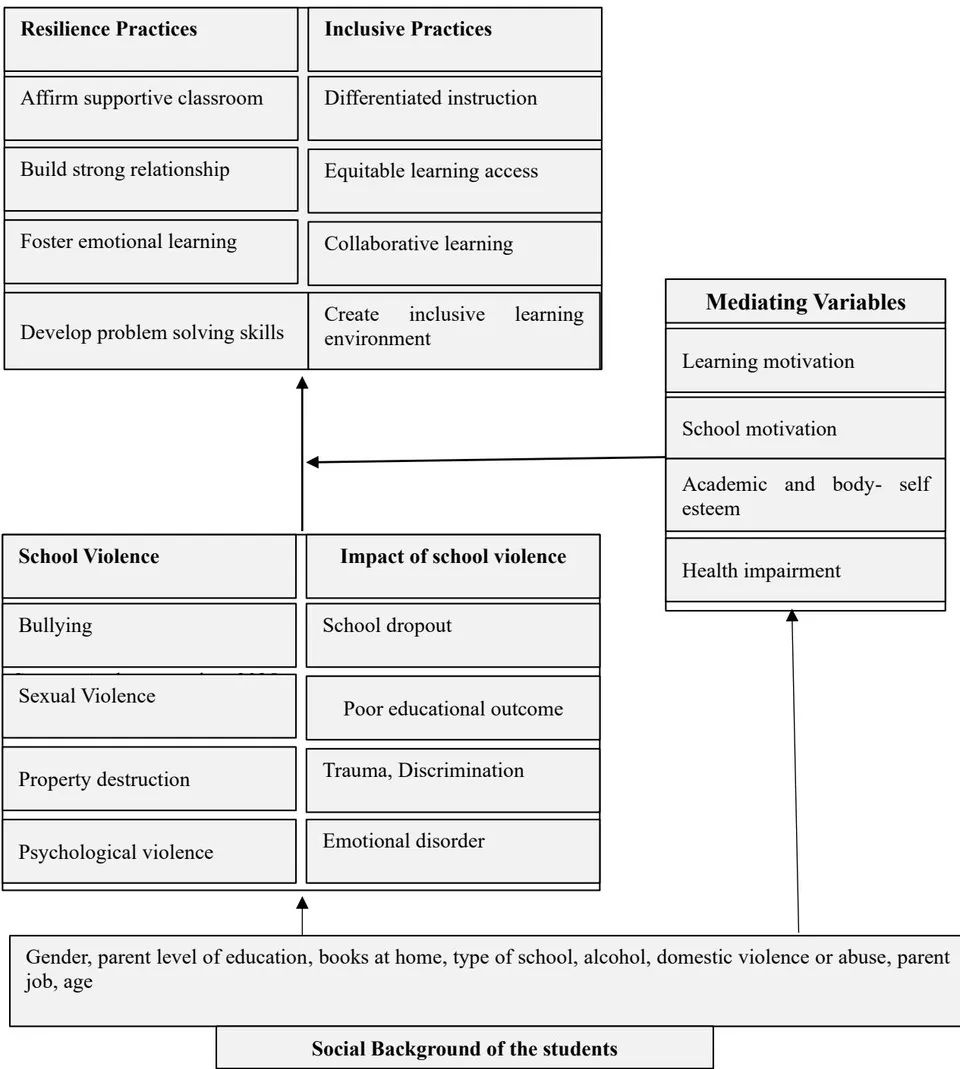
Source: Authors creation, 2025
III. METHODOLOGY AND METHODS
The study was conceived as a cross-sectional design using quantitative methods (Pandey & Pandey, 2015; Kothari, 2004). A sample population of 924 students in grades four to seven was administered questionnaires. The study necessitated the implementation of a written questionnaire to accommodate the ambiguity and complexity of the students' sentiments and to ensure their complete anonymity. The students were informed that they were not required to respond to all questions and that they could withdraw from the study at any time (Devries et al., 2016). The administration of the questionnaires was tailored to align with the developed model. The questionnaire design was adapted from existing scales (Hamburger et al., 2011, p. 84; Heatherton & Polivy, 1991, p. 898). Midgley et al., 2000, pp. 10, 18 & 30: Furlong et al., 2005, p. 142: Stewart et al., 1988, p. 733: Zimet et al., 1988, p. 35) and composed concerning the explained model. These scales were primarily evaluated in different countries of the global North, where their reliability was extensively validated. In addition, the research instruments were standardized through pilot studies. Eight schools were selected for data collection from two districts that included both public and private schools. The respondents were randomly selected, stratified and willing to participate in the study. The questionnaire was initially administered in English due to the fact that the studies were designed to take place in the English-speaking region of Cameroon. However, due to the subsequent political and social unrest in the Anglophone regions, it was necessary to relocate the study to the French-speaking region of Cameroon. Consequently, the questionnaire underwent a multilingual process, including translation into French and subsequent re-translation into English, with meticulous attention to ensure the quality of the translation and the consistency of the research instruments.
From the selected sample, the gender distribution was found to be uneven, with a high ratio of girls corresponding to the number of girls attending the schools selected for data collection. This gender imbalance can be attributed to the fact that the permission for data collection was exclusively granted for schools with low tuition fees and a lower academic prestige. This phenomenon can be attributed to the tendency of families with higher socio-economic status and academic background to enroll their male children in schools with stronger reputations.
{"image_source":{"path":"images/0fc7b7b30120bd93d4a1bf9e7473d8aba00efb463cdd3727a70d519335a35713.jpg"},"content":"","chart_caption":[],"chart_footnote":[]}
This disparity in the sample distribution is reflected in the overall composition of the study sample, with males constituting 43% and females 57% of the total sample. The age distribution exhibited a conspicuous variation in the age range. The proportion of respondents below the age of 15 years was 54, constituting 6.1% of the total. In contrast, respondents between the ages of 15 and 20 years constituted 67.8% of the sample. The remaining respondents, categorized as 20 years and above, numbered 232, constituting 26.1% of the total sample. This finding indicates that the mean age for males is 18.1, while for females, it is 18.0 (See Figure 2 below). Filling them lasted for 40 minutes and the students received consent from their authorities to take part.
{"image_source":{"path":"images/7dea2367dae82515a8caf3578a3dd1eaad5cd0567f990747d4b93f98b498c671.jpg"},"content":"","chart_caption":[{"type":"text","content":"Fig.2: Sample Gender and Age of Respondents"},{"type":"text","content":"Source: Primary data, 2018"}],"chart_footnote":[]}
The scales were adapted from various test instruments utilized by international scientific organizations and educational institutions. As illustrated in table 1, the instruments on the left of the table, measured different types of violence, while the instruments on the right, measured mediating variables and subject grades. These grades were ranked from 1 to 5 to measure learning outcomes. The social background, adapted from the TALIS student questionnaire PISA, (2009), was used to control these variables.
| Types of Violence | Impact of violence | Mediating Learning | Inclusive Practices | Resilience Practice |
| Psychological violence | School dropout (Hamburger, 2011) α = 0.83 | Self-Esteem (Heatherton & Polivy, 1991) α = 0.77 | Differentiated instruction | Affirm supportive classroom |
| Sexual violence | Poor educational outcomes (Zolotor, 2009) α = 0.77 | Motivation (Vallerand, R. T. et al., 1992) α = 0.64 | Equitable learning access | Build strong relationship |
| Physical violence | Trauma, Discrimination (Zimet et al., 1988) α = 0.84 | Health (Stewart et al., 1988) α = 0.83 | Collaborative learning | Foster emotional learning |
| Structural Violence | Emotional disorder (Furlong, 2005) α = 0.85 | Creating inclusive learning environment | Development of problem solving skills |
IV. RESULTS
The findings of this study demonstrated the needs of a significant association between resilience, inclusivity and non-violence within the educational context in Cameroon.
4.1 The Profile of Respondents by Age and Gender
The results indicated a probable discordance between physical and sexual violence, in addition to school quality development. The data set included responses from 924 students, with a reported missing value of 12. The sample
Source: Primary data, 2018 population is predominantly female (57.2%), with 390 students, while 42.8% of the sample is male. The gender composition of the sample is not balanced, as discussed in the preceding chapter. The sample population is primarily from grades 4-7, with the majority of students belonging to the second cycle of secondary school in the 6th and 7th grades, respectively. The mean age of students in grade 4 was 16.5 (median = 17), in grade 5 it was 15.7 (median = 16), in grade 6 it was 18.1 (median = 18), and in grade 7 it was 20 (median = 20). In figure 3 below, we went further to undertake a check on gender per class.
{"image_source":{"path":"images/7877e07ff029e6451e2ce02f7008ecae3fb62b3b5923f4a2e6eb37eff6f57ee2.jpg"},"content":"","chart_caption":[],"chart_footnote":[{"type":"text","content":"Source: Primary data, 2018"}]}
Fig. 3: Gender Distribution by Class In each of the classes from lower to upper secondary schools, the gender distribution of respondents was found to be unevenly distributed. As illustrated in Figure 2, the proportion of females in each class consistently exceeds that of males. The data presented in Table 1 indicates that the gender balance among students in grade 7 differs from the overall sample balance. Specifically, the proportion of female students in grade 7 exceeds the overall sample average.
4.2 The Structure of Violence by Student's Background
Provide dates defining the periods of recruitment and follow-up and the pnmary sources of the potential subjects, The parents' educational attainment was found to be a significant predictor of the students' social background, with lower levels of education often correlating with a lower social status. The analysis reveals that the educational attainment of the mothers is less than or equal to the educational level of their children, with 684 (75%) of mothers having an education level that is less than or equal to their children's educational attainment. The fathers' educational attainment does not vary significantly. Among the fathers, 554 (60.7%) had a maximum education level of ≤8th grade. Consequently, given the students' parents' educational attainment, the quality of education provided by teachers assumes paramount importance.
The prevalence of violence experienced by students was further examined, revealing that approximately 20% of students had been subjected to physical and psychological violence. The prevalence of violence was observed to occur in both school and domestic settings. Furtherance to this, structural violence was reported by more than half of the students, as detailed in figure 4 below.
{"image_source":{"path":"images/5f266c4f251fb9ad92fc8a754e62135864ffc1f7368820a30d7cba803edd9c3b.jpg"},"content":"","chart_caption":[{"type":"text","content":"Fig. 4: Levels of Experienced Violence"}],"chart_footnote":[{"type":"text","content":"Source: Primary data, 2018"}]}
This lends further evidence to the concept that restricted access to quality education, healthcare, and social support systems, in conjunction with the absence of adequate parental supervision, communication and emotional support, can contribute to the development of behavioral problems in children, thereby increasing their propensity to engage in violent behaviours. This phenomenon can engender feelings of frustration and hopelessness, which may ultimately result in aggressive behaviours. Consequently, as the status of parents is a contributing factor to violence, this issue necessitates meticulous consideration, such as teacher-parent collaboration.
4.3 Types of Violence in the Educational Setting
The findings yielded further evidence on the various forms of violence experienced by students. The identified categories of violence encompass sexual violence, psychological violence, and physical violence. The subsequent section is devoted to a comprehensive presentation of these forms of violence.
4.3.1 Sexual Violence
The findings evidenced that both girls and boys reported equal levels of exposure to sexual violence. Among the 885 respondents, 201 students, or 22.7%, indicated that they had been subjected to sexual abuse, characterized by teachers requesting sexual activities in exchange for favourable marks. The mean score on the scale indicated by the students was M = 1.44 (SD = 0.55). It is noteworthy that 24.0% of the students who had experienced sexual violence were affected. Both genders were affected equally, with 201 students, or 22.7% of the reported 885 respondents, indicating that they had experienced sexual abuse at the hands of their teachers, who demanded sexual practices in exchange for marks. These findings underscore the prevalence of sexual victimization as a significant form of violence within the context of the study's sample. Figure 5 provides a comprehensive overview of experiences related to sexual violence.
{"image_source":{"path":"images/697061beb11b4eaa46a120b1c3e380041cb86ff0aa94a33805e0faa4ba9bd2e7.jpg"},"content":"","chart_caption":[{"type":"text","content":"Source, Primary data 2018"},{"type":"text","content":"Note: As sexual harassment is a traumatic experience which should have zero probability; the scale was related to the different levels by using 1 for 1,0; 2 = 1,01 to 2,0; 3 = 2,1 to 3,0; 4 = 3,1 to 4,0 n = 924; as 895 students did respond to the scale = 96,8%."}],"chart_footnote":[]}
Fig. 5: Experienced Sexual Violence
Based on the findings above, sexual violence in educational settings has been demonstrated to engender a multitude of consequences for victims, including trauma, academic struggles, and long-term mental health issues. Conversely, survivors' resilience capacity assists them in coping with the effects of trauma and healing. Nevertheless, it is imperative to acknowledge that resilience alone is inadequate to ensure justice and support are provided to survivors. Ensuring inclusive environments that foster a sense of safety and support for all students, irrespective of their background or identity, is imperative in preventing sexual violence and providing comprehensive support to survivors and ensuring respect for diversity by the students.
4.3.2 Psychological and Physical Violence
The aforementioned findings indicated that 23.9% of the students experienced physical victimization at home, while 23.2% suffered in school. In addition, 18.9% of the students reported experiencing psychological bullying at home, while 23.2% indicated that they had been subjected to this form of mistreatment in the school environment. Moreover, 53.9% of the students perceive their school environment to be hostile. Figure 5 below gives an overview of the different levels of experienced violence by the harmonized scale.
{"image_source":{"path":"images/e84117d7cff9b548c114645666f593c0882b0d712a4ef81875b250c0e46746e6.jpg"},"content":"","chart_caption":[{"type":"text","content":"Comment: Physical and Psychological victimization had a four level measure, 1 = Never, 2 = Once, 3 = Sometimes, 4 = Often."}],"chart_footnote":[{"type":"text","content":"Structural Violence had a three level measure 1 = Not at all, 2 = Sometimes, 3 = Very Often. Sexual Violence had a four measure level, 1 = Never, 2 = Not in the past year but this has happened, 3 = Sometimes, 4 = Many times"}]}
Source: Primary data, 2018
Fig. 5: Summary of Experienced Violence
The results above, shows that the prevalence of violence indicates challenges with the school's inclusive dimension and apparently showing proof of student's survivor instincts apparently based on their ability to be resilient in the face of such challenges. But in spite of this strength of resilience, school results are affected due to a poor school quality and leading to drop outs from school.
4.4 The Impact of Violence in the Educational setting
The primary data demonstrated that violence against children has a detrimental impact on their social interaction and educational outcomes. To facilitate a more profound comprehension of this phenomenon, the ensuing section will elucidate the repercussions of violence on children.
4.4.1 Violence and Learners' Social Interaction
In the context of the learning process, the concept of self-esteem was assessed in relation to three distinct domains: body self-esteem, general self-esteem and academic self-esteem. In the context of body self-esteem, students were invited to provide ratings on items such as "I am pleased with my appearance," ranging from 1 = not at all, to 5 = extremely positive. This yielded a M = 3.48 (SD = 0.15). In the case of general self-esteem, students indicated how they felt in relation to others by answering questions such as "I feel that others respect me," with a M = 3.04 (SD= 1.31). The academic self-esteem of the students was assessed on a scale of 1= not at all, 5= extremely, and they were asked to rate "I feel confident that I understand things," which led to M = 2.78 (SD= 0.13). In the context of learning motivation, students were prompted to indicate their inclination to learn, with a statement such as, "One of my objectives in class is to acquire as much knowledge as possible." The scale was answered with a M = 2.86 (SD= 0.28). In regard to school motivation, students were asked to rate statements regarding their motivation to be or not to be in school. For instance, they were asked to indicate whether they agreed or disagreed with the statement, "I really feel that I am wasting my time in school." The students' responses to this scale revealed a mean M = 2.78 (SD = 0.40). In regard to their health conditions, the students were asked, "For how long has your health limited you from eating, studying, bathing, and dressing?" The students responded with M = 1.50 (SD = 0.65). The statistical analysis revealed that the academic and body self-esteem, as well as their health, indicated challenges. Furthermore, the general self-esteem, learning, and school motivation levels of the students were found to be average.
{"image_source":{"path":"images/3df5b08797ae45c2cb67ef96d99956af8b2a12c42b4095f4bd03bd0c160c7ff0.jpg"},"content":"","chart_caption":[{"type":"text","content":"Grading had five measurement levels, 1 = Fail, 2 = Average, 3 = Fair, 4 = Good, 5 = Very good"}],"chart_footnote":[{"type":"text","content":"Source: Primary data, 2018"}]}
Fig. 6: Summary of Learning Mediators
The findings above, indicated that individuals exposed to violence manifest low self-esteem, which can impede their capacity to recover from adversity. These individuals may engage in risk-taking behaviours as a coping mechanism, thereby exacerbating the problem. In this regard, a paucity of support from educators and policymakers can likely lead to a deficiency in inclusivity and a sense of belonging. To address these issues, educators and policymakers can implement inclusive practices that promote social interaction, resilience and a culture of non-violence.
4.4.2 Violence and Educational Outcomes of Learners
The data on grading indicates that 779 (85.4%) of the 912 students who have experienced violence indicated fail scores in at least one of the important subjects. This finding suggests that there are significant issues with the educational quality, as evidenced by the system's output. These issues are also reflected in the high rate of class repetition. The subject grades that were used to assess school outputs were the French Language, English Language, Mathematics and ICTs. The subjects had five measurement levels to ease the data collection (see fig. 7) {"image_source":{"path":"images/0c567e51318d44c140ec62843197b6e546078297567e15f46f5a2a8fd5c1de03.jpg"},"content":"","chart_caption":[],"chart_footnote":[{"type":"text","content":"Source: Primary data, 2018"}]}
Fig. 7: Grading Levels of Subjects
The dependent variable of class repetition indicated N = 898 and 26 missing data. The data indicates that 26.3% of the students, equivalent to students, accounting for 32.6% of the sample, had repeated their classes twice or more times. The mean number of retakes was 2.06, with a standard deviation of 0.765, as shown in Table 2. Furthermore, 662 students (73.7%) had repeated at least one class. This rate of repetition is notably high in comparison to international standards (Carey & Ernst, 2006), indicating a deficiency in the quality of education in Cameroon.
| Number of repetition | Counts | % of Total |
| No, never | 236 | 26.3% |
| Yes, once | 369 | 41.1% |
| Yes, twice or more | 293 | 32.6% |
The pervasiveness of violence has been shown to have a detrimental effect on the academic performance of learners, potentially leading to their disengagement from educational activities and, ultimately, to the abandonment of their education. To address these challenges, educators and policymakers must prioritize inclusive practices and address the impact of violence on learners. They should also create a safe and supportive learning environment that promotes social interaction, resilience and academic success.
4.4.3 Violence and Cognitive Development
Among the 889 respondents (35 missing), 253 (28.3%) indicated that they never allocate time to reading for leisure. Furthermore, 223 respondents (25.1%) indicated that their daily reading duration was 30 minutes or less, while 118 respondents (13.3%) reported reading for more than 30 minutes but less than 60 minutes per day. Notably, only 147 respondents (16.5%) read for one to two hours daily, with a mean of 2.68 and a standard deviation of 1.46, as illustrated in Figure 8.
{"image_source":{"path":"images/e1c9692fa103ee26cbeba053e15ac4e6702745c560d590d94dd42f67ff14de02.jpg"},"content":"","chart_caption":[{"type":"text","content":"Fig. 8: Extra Reading Enjoyment"}],"chart_footnote":[{"type":"text","content":"Source: Primary data, 2018"}]}
The experience of violence has been shown to impede students' ability to learn, as the social environment can influence their exposure to violence within the educational setting.
Conversely, violence experienced in both domestic and school settings, influenced by one's social milieu, has been shown to adversely impact self-esteem and the motivation to engage in academic pursuits. Notably, violence influenced by social background is associated with significant health impairment. Therefore, it becomes a condition sine-qua-non, to raise societal awareness against violence, fostering a global collaborative effort to eradicate violence and transform schools into nurturing environments devoid of violence.
RQ1 on reported experience of violence, indicates approximately that 20% of the participants have endured physical and psychological violence, more than half have experienced structural violence, and about 23% have suffered sexual violence.
RQ2, which focused on the reported effects of violence on learning outcomes, revealed that violence negatively impacts self-esteem and learning motivation.
RQ3, concerning the impact of violence on learning outcomes, it revealed that the effects were not discernible, despite the significant impact observed on self-esteem and motivation.
V. DISCUSSION
The findings indicated various forms of violence experienced by students, with 23.9% reporting physical victimization at home and 23.2% encountering psychological bullying at school. Furthermore, 18.9% of students indicated experiencing psychological bullying at home, while 23.2% reported facing this form of mistreatment in the school environment. 53.9% of the students perceive their school environment to be hostile. This finding aligns with the study by Eaton (2024), which indicates that students encounter various forms of violence, including physical violence, sexual violence, psychological violence, and structural violence. The study also revealed a high prevalence of sexual violence, with 24.0% of respondents reporting experiences of sexual abuse by teachers, underscoring the necessity for comprehensive prevention and intervention strategies. This finding was further corroborated by Gupta, argues that violence may be perpetrated by students, teachers, or other members of the school staff; however, violence by fellow students is the most common (2023).
Consequently, both girls and boys experience sexual violence at equal level, whereby, among the 885 respondents, 201 students, or 22.7%, indicated that they had been subjected to sexual abuse, characterized by teachers requesting sexual activities in exchange for marks. However, the study by OCHA (2019), demonstrated that 56.4% of girls in union were confronted with at least one of these forms of violence than boys). As it is noteworthy that 33% of women aged 12 to 25 have experienced violence and 5% of them have experienced sexual violence (OCHA, 2019).
Regarding the impact of school violence on students' educational outcomes, the findings revealed that 779 (85.4%) of the 912 students who have experienced violence indicated fail scores in at least one of the important subjects. This finding suggested that there are significant issues with the educational quality, as evidenced by the system's output. These issues are also reflected in the high rate of class repetition. whereby, 369 students, representing 41.1% of the sample, had repeated once. Finally, 2931 students, accounting for 32.6% of the sample, had repeated their classes twice or more times. In this regards, different authors (UNICEF, 2016; Carey & Ernst, 2006; Wilson, 2021; Kim, 2023; Pochini, 2024), have presented significant argumentation on the impact of school violence on the victims educational outcomes, as it was evidenced that the survivors of school violence frequently encounter substantial obstacles to accessing and succeeding in education based on trauma-related challenges that adversely affect their academic performance, social-emotional well-being and overall development. These students often exhibit challenges in problem-solving abilities and a diminished sense of self-worth. Furthermore, they encounter difficulties in maintaining concentration during educational activities.
5.1 Resilience, Inclusion and Non-Violence: Quality Education at the Crossroads
The essence of education that is qualitative (see Tangwe 2021; UNESCO 2005) is resonating at a critical crossroad regarding the triangulation of resilience, inclusion and non-violence (Eikoh, 2024; Portobello, 2024; Magudulela, 2017). The results of this study provided glaring issues linked to the learning and wellbeing of the learners that is apparently truncated due to the prevalence of various strands of violence in school and at home (refer to figure 5 above). In view of such prevalence of violence, the essence of non-violence and inclusion (UNESCO, 2012) becomes eroded, thereby, ushering resilience (Portobello, 2024) as a coping mechanism to navigate the challenges besetting quality of education. It is imperative to mitigate school violence and its repercussions to ensure the realization of educational quality (Coetzee, 2023).
It is further compounded by substandard education, conventional teacher training, and a challenging socioeconomic background. Violating the fundamental rights of learnerstherefore, impede their ability to acquire global educational values including their rights as well as not disrupting barriers as seen by Cymru (2023). Educational agencies are therefore expected to valorize and support educational institutions in their efforts to assist students who are confronted with violence by enabling them to develop resilience and inclusive practices, leaving no one behind. These practices will serve as a pivotal strategy in addressing discrimination among school communities, preventing violence, and cultivating an effective learning environment for all students, irrespective of their background or diversity. The advancement of inclusion and resilience signifies a more efficacious approach to addressing school violence and establishing a secure environment for all. The students are coping due to such resilience but how are they inclusively supported is yet to be effectively reflected. The deontological dispensations of safe schools isstill undergoing deep reflections.
5.2 Implications for Practice
In light of the findings, two areas emerge with significant implications for practice.
Education stakeholders should embrace a holistic approach, fostering pluralistic perspectives to empower them to make informed decisions and engage meaningfully in society. It has to nurture qualities of reflection, reliance, inclusion, tolerance, and reciprocity towards their natural environments, which are fundamental to sustaining life itself and should ensure a systemic approach
Furthermore, it is important to raise societal awareness against violence, fostering a global collaborative effort to eradicate and transform schools into nurturing environments devoid of violence.
5.3 Implications for Research
- Future research should explore the reasons why some parents engage in violence while others do not, the subjective nature of class repetition, and how church leaders guide their congregations in violent strategies. Additionally, the future researchers should propose effective strategies for inclusive practice and resilience capacity building among the students within the educational setting.
Conflict of Interest
The author note that there is no conflict of interest.
Limitations
The study was quantitative and requires different designs and methods to get more insights into this cankerworm of violence. This can be navigated with ethnographic design to ascertain if there is a segment of the community that is very susceptible to violence.
ACKNOWLEDGMENT
I am happy to extend deep appreciation to Brot für die Welt for the bursary that led to the realization of this project.
Footnotes
Conflict of Interest
The authors declare no conflict of interest.
Ethical Approval
Not applicable
Data Availability
The datasets used in this study are openly available at [repository link] and the source code is available on GitHub at [GitHub link].
Funding
This work did not receive any external funding.
References
Cite this article
Related Research


Special Issue
Launch a focused special issue to highlight research, emerging trends, and expert insights in your academic field.