

Abstract
Self-serving data marts orchestrated through AutoML-governed pipelines mark a significant advancement in enterprise analytics democratization. This architectural approach creates domain-specific information repositories with automated data preparation, feature engineering, and model development functions accessible to business users without deep technical knowledge. The governance framework applies automated quality controls, lineage tracking, and access management, ensuring data integrity throughout analytical processes. Integration with existing data warehouse systems maintains centralized governance while enabling distributed analytical capabilities, addressing specific business needs. Implementation factors include metadata standardization, processing resource allocation, and organizational change management supporting effective usage. Technical elements comprise automated data profiling, dynamic transformation creation, and continuous quality monitoring throughout pipeline operation. The orchestration layer manages complex workflows while implementing appropriate error handling and recovery mechanisms. Enterprises implementing these frameworks report significant enhancements in analytical responsiveness, resource utilization effectiveness, and business coordination compared to conventional centralized models. This balanced approach resolves conflicting requirements between governance standardization and analytical adaptability, establishing durable foundations for growing self-service functions while preserving appropriate supervision across increasingly intricate data landscapes.
Explore Digital Article Text

I. INTRODUCTION
Organizational data environments have changed significantly during recent years, shifting from consolidated storage strategies toward decentralized design frameworks that emphasize flexibility and function-specific enhancement. Modern enterprises gather extensive information collections throughout operational platforms while concurrently facing challenges in extracting valuable insights within periods meaningful to commercial decision workflows. This fundamental tension between data abundance and insight scarcity drives the emergence of specialized delivery mechanisms tailored to distinct analytical use cases. Self-serving data marts represent a significant advancement in this domain, establishing purpose-built analytical repositories with governance frameworks that balance accessibility with control .
1.1 Background and Motivation
The shift toward self-service data frameworks develops from acknowledged constraints in conventional corporate analytics methods, where central teams create restrictions in company-wide information exploration. Established practices of dedicated groups acting as intermediaries between business users and information assets cause significant lags between inquiry development and response generation, producing inefficiencies in decision-making cycles requiring prompt insights. Concurrently, technical progress in automated machine learning and smart data workflows presents possibilities for reconceptualizing these connections through independent access features that broaden analytical participation while preserving necessary oversight mechanisms. These technical facilitators change data engagement models by incorporating field-specific intelligence within delivery systems instead of demanding specialized expertise from users .
1.2 Challenges in Enterprise Analytics
Contemporary enterprises face multifaceted analytical challenges that transcend simple technology implementation considerations. Data fragmentation across disparate systems creates integration complexity that impedes comprehensive analysis through artificial boundaries between related information assets.
Quality inconsistencies undermine trust in analytical outputs while governance requirements introduce potential friction between compliance imperatives and analytical agility. Traditional enterprise analytics approaches frequently emphasize either centralized control or decentralized flexibility, creating false dichotomies that ultimately compromise both objectives. Additionally, analytical democratization initiatives often falter when confronting the substantial knowledge requirements for effective data preparation, statistical analysis, and result interpretation .
1.3 Objectives and Contributions
The structural design presented establishes a thorough methodology for organizational analytics that combines self-service information repositories with automated workflow management. This unified approach enables widespread data accessibility while preserving strict oversight through programmatic quality verification and comprehensive data origin documentation. The framework implements domain-specific optimization through purpose-built data structures while leveraging machine learning automation to reduce specialized knowledge requirements for effective analysis. By embedding intelligence within the delivery infrastructure rather than depending exclusively on end-user expertise, the architecture enables broader participation in analytical processes while ensuring appropriate methodological application. The technological approach integrates proven architectural patterns with emerging capabilities in autonomous optimization, establishing balanced solutions for organizations navigating the competing imperatives of governance control and analytical agility. Through this integration, enterprises can establish data delivery mechanisms that simultaneously satisfy compliance requirements, optimize performance characteristics, and enable broader analytical participation across functional domains .
| Component Layer | Primary Functions |
| Ingestion Layer | Source system connectivity and raw data acquisition |
| Processing Layer | Data transformation and quality enforcement |
| Storage Layer | Optimized data organization and access patterns |
| Serving Layer | Query interfaces and consumption endpoints |
| Governance Layer | Metadata management and lineage tracking |
| Orchestration Layer | Workflow automation and dependency management |
| Security Layer | Authentication, authorization, and data protection |
| Monitoring Layer | Operational metrics and health status tracking |
1.3.1 Background and Industry Motivation
Corporate information architectures have steadily evolved beyond monolithic warehouses toward purpose-built structures serving distinct operational needs. The pendulum swings from total centralization toward targeted delivery systems focused on specific business domains. Despite investing millions in storage technology, many firms watch helplessly as potentially valuable insights remain locked within data silos, inaccessible when decisions must happen quickly .
The standard model—where specialized data teams serve as intermediaries between information and business users—creates painful delays. A retail merchandiser noticing unusual sales patterns might wait weeks for analysis from overtaxed technical teams. Hospital administrators needing patient outcome comparisons across departments face similar waits while care decisions hang in the balance. Financial traders seeking market pattern analysis often receive insights too late for meaningful action, rendering expensive data assets practically worthless during critical decision windows .
Meanwhile, advances in smart algorithms and workflow automation hint at different possibilities. Instead of forcing business experts to become data scientists, emerging approaches embed analytical intelligence directly into information delivery systems. A manufacturing supervisor can instantly visualize production bottlenecks without coding skills. Customer service directors explore satisfaction patterns across touchpoints without filing IT tickets.
Marketing teams test campaign effectiveness theories without waiting for quarterly reporting cycles [1].
The consequences ripple throughout organizations. When weekend inventory emergencies arise, store managers access forecasting tools previously available only to headquarters analysts. Insurance adjusters evaluate claim patterns independently, spotting potential fraud without specialized query assistance. Field technicians compare equipment performance across regions, identifying maintenance needs before failures occur. This democratization fundamentally changes how organizations leverage their information assets, transforming data from a technical resource to a business utility accessible throughout operational workflows .
1.3.2 Hypothesis and Solution Framework
The central hypothesis driving this architectural approach proposes that properly designed self-serving data marts with integrated AutoML capabilities will significantly reduce time-to-insight while improving analytical quality compared to traditional centralized models. This hypothesis suggests that embedding intelligence within the delivery infrastructure rather than depending exclusively on end-user expertise enables broader analytical participation without compromising methodological rigor. The expected outcomes include faster decision cycles, improved resource utilization, and more pervasive data-driven practices across organizational functions .
The solution framework addresses this hypothesis through a multi-layered architecture combining domain-specific data structures with automated analytical capabilities and comprehensive governance controls. This integrated approach enables business users to independently explore relevant information while ensuring appropriate methodological application through embedded intelligence. The architecture implements progressive data preparation stages that transform raw information into analysis-ready assets through automated processes tailored to specific business domains. Pipeline orchestration manages complex dependencies while ensuring consistent quality controls throughout data lifecycles .
Governance mechanisms operate continuously throughout these processes, documenting lineage, validating quality, and enforcing security policies without creating friction in analytical workflows. This automated governance approach represents a fundamental shift from traditional manual oversight toward programmatic controls embedded within data delivery infrastructure. The resulting framework establishes a balanced solution addressing competing requirements for analytical freedom and governance control, creating sustainable foundations for organizational analytics that satisfy both business agility needs and compliance obligations .
II. TRANSFORMATIVE PROGRESSION OF ANALYTICAL DATA PLATFORMS
Data marts have experienced significant evolution within organizational environments, reflecting essential changes in both technological methodologies and commercial principles guiding data management practices. These dedicated analytical resources have developed from their beginnings as technical implementations into business-focused systems that combine advanced delivery capabilities with straightforward user experiences. Examining this evolutionary journey provides a necessary background for understanding today's self-service implementations and their structural requirements [2].
2.1 Business-Aligned Information Delivery
Contemporary data mart deployments have methodically evolved into commercially oriented distribution frameworks that prioritize division-specific adaptation while maintaining enterprise-wide consistency. This advancement concentrates on enhancing operational functions rather than implementing technological components, with effectiveness evaluated through improved decision outcomes instead of strictly performance measurements. Modern strategies employ flexible architectural patterns that support changing analytical requirements without necessitating complete reconstruction, enabling progressive enhancements coordinated with evolving business objectives. This reorientation marks a crucial philosophical transition from considering information as technical infrastructure toward recognizing it as a vital business asset requiring appropriate management [3].
Implementation approaches have similarly transitioned from sequential development methodologies toward incremental delivery frameworks emphasizing prompt value creation through minimally viable capabilities, followed by continuous enhancement cycles. This strategy accelerates initial capability deployment while naturally synchronizing with business priorities through ongoing stakeholder participation. The evolution extends beyond process considerations to encompass technical architectures leveraging metadata-controlled automation instead of manual development procedures, dramatically compressing implementation timeframes while enhancing consistency. These capabilities deliver responsive information services, adapting to evolving business demands without compromising the governance structures and quality safeguards essential within enterprise contexts.
2.2 Governance Requirements in Self-Service Analytics
The progression toward self-directed analytics introduces unique governance considerations, balancing broad accessibility with appropriate controls through automated enforcement systems rather than manual intervention processes. This governance transformation emphasizes integrated safeguards operating seamlessly within analytical workflows instead of imposing administrative barriers that restrict business agility. Contemporary governance structures implement thorough metadata management, documenting information lineage, transformation rules, and utilization patterns to enable reliable self-service capabilities while fulfilling regulatory obligations .
Data integrity verification constitutes an essential governance component within self-service environments, necessitating automated validation capabilities to identify potential anomalies before they influence analytical conclusions. These mechanisms establish trustworthiness in self-directed analytics through uniform quality verification across information assets while enabling appropriate remediation when irregularities appear. Similarly, permission management frameworks have evolved toward attribute-driven implementations delivering precise security through metadata-defined policies rather than requiring explicit authorization for individual resources. This methodology provides appropriate protection while reducing administrative complexity through policy automation, adapting to organizational structures and compliance requirements.
| Pipeline Component | Functional Purpose |
| Feature Store | Centralized repository for validated data features |
| Model Registry | Version control and deployment management for ML models |
| Hyperparameter Optimization | Automated tuning of model parameters |
| Model Selection | Comparative evaluation across algorithm families |
| Drift Detection | Monitoring for data and concept shifts |
| Explainability Tools | Interpretability mechanisms for model decisions |
| Automated Validation | Performance assessment against defined metrics |
| Deployment Orchestration | Managed production rollout and fallback procedures |
2.3 Navigating Enterprise Data Complexity: Problems and Solutions
Companies today battle information chaos as business-critical data spreads chaotically across countless departmental systems. Marketing teams build customer profiles in specialized platforms while sales groups track identical clients in entirely separate environments. Finance departments maintain their isolated transaction records while operations teams monitor inventory through disconnected tools. This digital sprawl erects invisible walls between related information, making comprehensive business insights nearly impossible to obtain. Marketing departments maintain customer journey data in campaign platforms while sales teams track relationships in separate systems. Finance departments capture transaction details in yet another environment while operations teams monitor supply chains elsewhere. This fragmentation creates artificial barriers between related information assets, preventing comprehensive analysis through arbitrary technical boundaries .
Data quality inconsistencies further complicate matters when information passes between systems without standardized controls. Customer names appear differently across platforms, product codes follow inconsistent formats, and transaction timestamps reflect various time zones without proper documentation. These inconsistencies undermine trust in analytical outputs while creating substantial reconciliation burdens for teams attempting cross-system analysis. Financial services firms particularly struggle when customer profiles lack consistency across mortgage, credit card, and investment systems, preventing accurate relationship assessment [2].
Processing infrastructure limitations constrain analytical possibilities when traditional batch workflows prove inadequate for time-sensitive decision support. Nightly processing windows force business users to wait hours or days for insights requiring immediate action. Retail inventory decisions suffer when sales trends become visible only after restocking opportunities pass. Manufacturing production adjustments arrive too late when quality issues appear in post-processing reports rather than real-time dashboards. These timing mismatches between information availability and decision windows substantially reduce the data's operational value .
Scalability barriers emerge when analytical demands exceed available computing resources during peak periods. Month-end financial consolidation frequently overwhelms existing infrastructure, delaying critical reporting cycles. Holiday season retail analytics face similar constraints when transaction volumes multiply. Healthcare providers experience performance degradation during insurance enrollment periods when eligibility verification requests spike dramatically. Without elastic computing capabilities, organizations face difficult choices between expensive over-provisioning or accepting performance constraints during critical business periods .
Integration complexity creates substantial technical debt when point-to-point connections proliferate without a systematic architecture. Each new data source typically requires custom integration work, creating brittle connections difficult to maintain and virtually impossible to scale. Financial organizations often maintain dozens of specialized extracts feeding downstream systems, each requiring dedicated maintenance when source systems change. Hospitals struggle to link patient records with insurance claims, treatment recommendation systems, and clinical study databases . Innovative companies tackle these issues by building sophisticated frameworks centered on self-describing data and tailored information delivery platforms. By deploying smart pipelines that automatically adjust processing methods based on incoming data patterns, these organizations dramatically cut down on human babysitting requirements for routine data tasks. Replacing hardcoded transformation logic with declarative specifications enables business-friendly maintenance while improving consistency across processing workflows. Building domain-specific data marts with embedded analytical capabilities allows business teams to independently explore relevant information without requiring deep technical expertise for each new question .
III. AUTOML INTEGRATION WITH ENTERPRISE DATA WAREHOUSING
The combination of self-optimizing machine learning frameworks with organizational data repositories represents a pivotal advancement in corporate analytical capabilities. This integration dissolves conventional barriers between information storage and analytical processing by embedding computational intelligence directly within data delivery systems. The resulting architecture delivers sophisticated analytical functions without requiring specialized expertise, democratizing advanced analytics while preserving governance frameworks essential for enterprise environments .
3.1 Architectural Considerations for EDW-AutoML Integration
Incorporating automated learning capabilities within enterprise data environments requires thoughtful structural decisions, balancing computational requirements against established information management principles. Effective integration designs implement clear boundaries between persistent storage and processing tiers while maintaining metadata consistency across domains. This separation allows independent scaling of analytical operations without compromising warehouse performance or governance controls. Resource coordination becomes particularly significant when introducing learning workloads alongside traditional analytical processing, requiring sophisticated scheduling mechanisms that prevent analytical operations from overwhelming shared infrastructure [5].
Data movement efficiency represents another crucial architectural element, requiring careful evaluation of processing proximity to information storage. Traditional data pipeline patterns frequently prove insufficient for machine learning operations requiring multiple iterations across substantial datasets. Modern architectures address this challenge through strategic caching of intermediate results and distributed processing frameworks, minimizing data transfer requirements. Additionally, computational layer isolation enables appropriate resource allocation for varying workload characteristics, preventing resource competition between standard reporting functions and more intensive learning operations that might otherwise degrade service levels.
Integration architectures must similarly address distinct lifecycle considerations between warehouse structures and analytical models, implementing versioning capabilities and maintaining consistency across interconnected components. These mechanisms ensure appropriate alignment between training datasets, feature transformations, and resulting models throughout development and operational cycles. The architectural approach must likewise accommodate different development methodologies between traditional warehouse implementations and machine learning workflows, establishing appropriate boundaries while maintaining necessary integration points .
3.2 Metadata Management Requirements
Comprehensive information about data forms the foundation for successful integration between enterprise warehousing and automated learning capabilities. This integration requires extending traditional cataloging functions to encompass model-specific details, including training datasets, feature engineering, configuration parameters, and performance characteristics. The enhanced metadata framework establishes explicit connections between source data assets and derived analytical models, enabling impact analysis when underlying structures change while facilitating appropriate model refreshment cycles [6].
Feature registry implementations represent a critical metadata component, documenting transformation logic, validation criteria, and usage patterns across analytical models. These registries establish consistent feature definitions throughout the organization while enabling appropriate reuse across multiple analytical contexts. Version control mechanisms for both features and models ensure reproducibility while facilitating governance through comprehensive lineage documentation. Additionally, model performance metadata captures evaluation metrics, validation methodologies, and operational characteristics, establishing objective quality measures guiding appropriate usage guidelines.
The metadata framework must likewise document ethical considerations, including potential bias identification, fairness metrics, and explainability properties guiding appropriate model application within regulated environments. These capabilities enable comprehensive governance while supporting transparency requirements increasingly mandated by regulatory frameworks. By extending traditional data governance to encompass model-specific considerations, organizations establish thorough oversight across the entire analytical lifecycle from source information through operational model deployment .
3.3 Pipeline Orchestration Frameworks
Advanced workflow coordination systems provide essential synchronization between data warehousing processes and automated learning operations, ensuring appropriate sequencing while maintaining system-wide consistency. These frameworks implement declarative workflow definitions, establishing clear dependencies between traditional data processing activities and machine learning functions, including feature generation, model training, validation, and deployment. By formalizing these relationships through explicit workflow definitions, orchestration frameworks enable comprehensive automation while maintaining appropriate controls throughout the analytical lifecycle [6]. Dynamic dependency management represents a crucial orchestration capability, automatically triggering appropriate downstream actions when upstream data changes impact analytical models. These mechanisms ensure model freshness while preventing inconsistencies between training data and production environments that might otherwise compromise analytical integrity. Incremental processing optimizations within orchestration frameworks minimize unnecessary computation by identifying and processing only modified data components, substantially improving efficiency for large-scale analytical workloads otherwise requiring complete reprocessing. Orchestration frameworks similarly implement sophisticated monitoring capabilities, tracking data quality metrics, distribution shifts, and model performance characteristics throughout operational lifecycles. These observability functions enable proactive intervention when data patterns move beyond established parameters, maintaining analytical reliability without requiring continuous manual oversight. By implementing comprehensive pipeline automation with appropriate monitoring safeguards, organizations establish sustainable operational models for machine learning capabilities integrated within enterprise data warehousing environments [6].
| Capability Domain | Implementation Approach |
| Data Discovery | Semantic search and metadata-driven exploration |
| Visualization | Interactive dashboards with drill-down capabilities |
| Query Construction | Natural language and visual query builders |
| Analytical Templates | Pre-built analytical patterns for common use cases |
| Data Export | Multi-format delivery with scheduling options |
| Access Control | Role-based permissions with data-level security |
| Collaboration Tools | Shared workspaces and annotation capabilities |
| Personalization | User-specific views and preference management |
Field-tested implementations utilizing convolutional networks for monitoring applications establish practical methodologies for incorporating advanced pattern recognition directly within operational data workflows [9]. These specialized neural network architectures demonstrate particular effectiveness in processing structured visual data streams, creating robust pattern detection capabilities applicable to diverse monitoring scenarios. The architectural principles employed in traffic density monitoring systems illustrate how complex image classification tasks can be effectively operationalized through properly designed machine learning pipelines, providing valuable implementation patterns for enterprise data environments.
IV. SELF-SERVING DATA MART ARCHITECTURE
The self-serving data mart architecture establishes a comprehensive framework enabling business users to access, analyze, and derive insights from organizational data assets without requiring specialized technical assistance. This architectural approach balances accessibility with governance through integrated components that collectively deliver intuitive analytical capabilities while maintaining appropriate controls. By embedding intelligence within the delivery infrastructure rather than requiring it from consumers, the architecture fundamentally transforms the relationship between business stakeholders and data resources .
The self-serving data mart architecture breaks from conventional data delivery models toward business-driven analytical frameworks. Unlike traditional enterprise warehouses that require technical specialists for every analysis, these targeted platforms embed analytical tools directly within subject-specific information collections. This design removes longstanding obstacles between business teams and their data while preserving essential governance through automated safeguards rather than manual gatekeeping. By fundamentally rethinking connections between business domains and information resources, this structure builds lasting foundations for widespread analytics adoption while maintaining enterprise-wide standards.
4.1 Component Integration Framework
The structural foundation utilizes a compartmentalized design methodology, permitting separate advancement of distinct functional elements while preserving unified operation through standardized connection points. This strategy divides primary functions, including information collection, processing, retention, and display, into separate modules with defined purposes and interaction specifications. The resulting architecture supports incremental enhancement and technology evolution without requiring a comprehensive redesign when individual components change. This modularity proves particularly valuable when integrating emerging technologies like automated machine learning alongside established data management capabilities .
Storage optimization represents a critical architectural consideration, implementing purpose-built data structures aligned with specific analytical requirements rather than generic representations. These optimizations include appropriate denormalization, pre-aggregation, and dimensional modeling based on documented access patterns and performance requirements. The storage layer implements multi-temperature data management strategies that balance performance against resource utilization through tiered storage allocation. This approach ensures critical datasets receive appropriate performance resources while less frequently accessed information transitions to more cost-effective storage tiers.
Metadata-driven automation forms another essential architectural element, leveraging comprehensive information about data assets to generate appropriate processing logic, validation rules, and presentation components. This approach substantially reduces manual development requirements while improving consistency across the data mart ecosystem. By encoding knowledge about data relationships, transformation requirements, and business rules within metadata repositories, the architecture enables sophisticated self-service capabilities without exposing underlying complexity to business users .
This modular methodology reflects successful implementation patterns from distributed sensing environments where comparable architectural approaches effectively coordinate diverse data collection points while maintaining operational stability across varied operating conditions . IoT-based monitoring frameworks employ similar compartmentalized designs that separate data acquisition, transmission, processing, and analytical functions while maintaining integrated operation through standardized interfaces. These environmental monitoring implementations demonstrate how effective modular architectures can accommodate heterogeneous data sources while preserving system-wide reliability across distributed collection points, providing validated design patterns applicable to enterprise data architectures.
4.2 Self-Service Capabilities
Intuitive discovery mechanisms represent a fundamental self-service capability, enabling business users to locate relevant information assets without requiring detailed technical knowledge about underlying data structures. These capabilities implement natural language search, faceted navigation, and recommendation engines that guide users toward appropriate datasets based on their roles, previous activities, and collaborative filtering. The discovery layer presents information in business-relevant terminology rather than technical nomenclature, bridging the semantic gap between technical implementation and business understanding [7]. Collaboration frameworks enhance self-service effectiveness by enabling knowledge sharing across user communities through annotation, documentation, and usage tracking capabilities.
These features transform individual insights into organizational knowledge by preserving contextual information alongside analytical assets. The collaboration capabilities extend beyond simple asset sharing to include workflow integration that embeds analytical insights directly within business processes, maximizing the operational impact of analytical discoveries through seamless integration with decision workflows .
4.3 Performance Optimization
Response time optimization represents a critical consideration for self-service environments where user engagement directly correlates with system responsiveness. The architecture implements multi-layered acceleration strategies, including query optimization, materialized view management, and intelligent caching based on usage patterns. These capabilities ensure interactive performance even for complex analytical operations across substantial datasets by strategically pre-computing frequently accessed results while optimizing execution plans for dynamic queries. Workload management frameworks provide resource governance across competing demands within shared infrastructure, ensuring appropriate performance allocation based on business priorities and service level requirements. These capabilities implement sophisticated request classification, resource pooling, and dynamic prioritization that collectively prevent individual users or operations from monopolizing system resources. The workload management approach extends beyond simple resource allocation to include query routing across replicated resources, enabling linear scalability for read-intensive analytical workloads characteristic of self-service environments [4]. Continuous optimization mechanisms monitor performance characteristics, usage patterns, and resource utilization to identify enhancement opportunities through automated analysis. These capabilities recommend specific improvements, such as additional indexes, materialized views, or data redistribution based on observed access patterns rather than requiring manual performance tuning. By implementing automated optimization alongside comprehensive monitoring, the architecture maintains consistent performance characteristics despite evolving usage patterns and growing data volumes, ensuring sustainable self-service operations without requiring continuous technical intervention [4].
| Challenges | Benefits |
| Integration Complexity: Connecting heterogeneous systems and data sources while maintaining consistent metadata | Analytical Democratization: Expanded data access across organizational roles without technical bottlenecks |
| Governance Scalability: Maintaining quality and compliance controls across expanding data volumes and use cases | Decision Acceleration: Reduced time-to-insight through streamlined data discovery and analysis |
| Performance Optimization: Balancing query speed with resource efficiency for diverse analytical workloads | Resource Optimization: Decreased reliance on specialized technical resources for routine analytical tasks |
| Skills Requirements: Bridging the gap between technical capabilities and business domain expertise | Governance Improvement: Enhanced visibility and control through automated policy enforcement |
| Change Management: Transitioning organizations from traditional BI approaches to self-service paradigms | Innovation Enablement: Faster hypothesis testing and iterative analysis, driving new insights |
| Security Enforcement: Implementing appropriate controls while enabling flexible data access | Technical Debt Reduction: Standardized patterns and automated processes reduce the maintenance burden |
4.3.1 Architectural Framework and Component Integration
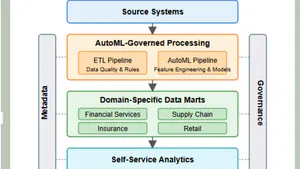
The architecture divides functionality into distinct building blocks with clear responsibilities rather than creating one massive structure. Each component handles specific tasks – data gathering, processing, storage, or presentation – while communicating through standardized interfaces that allow independent updates without disrupting the whole system [4].
The foundation rests on storage designs specifically optimized for analytical questions rather than transaction processing. Instead of generic warehouse models, these repositories organize information using business concepts and relationships directly matching how people think about their work. Financial implementations might structure data around customer relationships and product holdings, while healthcare versions organize around patient visits and treatment protocols. This business-aligned organization makes exploration intuitive for non-technical users while delivering better performance for common analytical patterns .
Between raw operational systems and business-friendly information sits a processing layer that transforms data through domain-specific operations. These transformations go beyond simple format conversion to include business rule application, reference data enrichment, and quality checks aligned with domain requirements. Risk analysis pipelines might apply specific regulatory calculations, while marketing transformations focus on customer segmentation and behavior pattern identification. This business-aware processing ensures information relevancy for specific domain needs rather than generic technical conversions [4].
Metadata serves as the connecting fabric linking components through comprehensive information about data assets, processing rules, and usage patterns. This foundation enables automated workflow orchestration, origin tracking, and self-service interfaces through explicit knowledge representation rather than buried code logic. User interfaces leverage this metadata to present familiar business terminology, suggest relevant analysis paths, and explain complex transformations using domain language instead of technical jargon [4].
The presentation layer provides intuitive exploration capabilities tailored to specific business roles and information needs. Unlike traditional reporting tools requiring predefined report structures, these interfaces support dynamic exploration through business-friendly terminology and guided analytics. Finance users explore profitability dimensions while marketing teams navigate customer behavior patterns through interfaces specifically designed for their domain language and analytical requirements .
![Figure 1: Self-Serving Data Mart Architecture with AutoML-Governed Pipelines [1], [4]](https://doc.journalspress.com/wauq51_110540/ocr/images/derivatives/c2/c28bf92059d2179659abe1d5b75692b4df6d1ca3cbf61f08a9b7de3d2782dd95.webp)
4.3.2 Comparative Analysis: Advantages and Limitations
Self-serving data marts deliver substantial advantages compared to both enterprise-wide warehouses and isolated analytical sandboxes. Implementation speed ranks among the most significant benefits, with focused marts requiring weeks rather than months for initial deployment due to a narrower scope and domain-specific optimization. This faster delivery enables refinement based on actual usage rather than exhaustive upfront specifications, creating solutions that better match genuine business requirements .
User adoption improves dramatically through domain-specific terminology, relevant analytical paths, and intuitive interfaces tailored to specific business functions. Finance professionals navigate financial concepts while marketing teams work with customer behavior terminology, each through interfaces optimized for their specific analytical patterns. This alignment with business thinking reduces training needs while improving analytical effectiveness compared to generic tools requiring constant translation between technical and business concepts [5].
Operational efficiency gains emerge from appropriate scope boundaries, targeted optimization, and domain-specific automation that collectively reduce infrastructure demands compared to enterprise-wide platforms. Focused data selection and purpose-built processing reduce both storage and processing requirements, enabling cost-effective implementations for specific business areas. Automated orchestration further improves efficiency through consistent process execution without manual intervention, reducing operational burden while improving reliability .
However, certain limitations deserve consideration when evaluating this architectural approach. Information fragmentation risks increase when multiple marts operate without proper integration, potentially creating inconsistent analytical results across business domains. Without adequate governance, these independent platforms might develop conflicting definitions, calculations, or business rules, leading to contradictory insights from supposedly identical data [6].
Governance complexity similarly increases when multiple autonomous platforms require consistent oversight without centralized control points. Distributed responsibility models demand sophisticated coordination mechanisms to maintain enterprise-wide standards while enabling domain-specific flexibility. Organizations frequently struggle to balance these competing imperatives without establishing explicit governance frameworks spanning autonomous platforms .
Scale limitations may emerge for analytical scenarios requiring enterprise-wide information integration beyond domain boundaries. Cross-functional analysis spanning multiple business domains might require additional integration layers connecting separate marts into cohesive analytical environments. While modern implementation approaches mitigate these concerns through virtual integration mechanisms, certain complex analytical scenarios still benefit from physically consolidated platforms .
V. AUTOMATED SAFEGUARDS AND CONTROL FRAMEWORKS
Making data widely available while keeping it properly controlled requires a delicate balance – think guardrails, not roadblocks. Smart organizations bake protection directly into their data delivery systems rather than positioning governance teams as obstacles between users and information. This approach replaces traditional manual approvals and audits with intelligent, automated safeguards operating invisibly in the background while business teams work unimpeded. Through these automated mechanisms, organizations maintain necessary safeguards while enabling broader access characteristic of self-service analytics environments [8].
5.1 Automated Data Quality Controls
Comprehensive quality management serves as a central element within the governance framework, deploying automated validation systems operating continuously throughout data lifecycles. These quality controls extend beyond basic constraint checking to include statistical distribution analysis, pattern identification, and cross-dataset consistency verification, collectively establishing multidimensional quality assessment. Implementation approaches utilize declarative rule specifications, separating quality definitions from enforcement mechanisms, allowing business stakeholders to define appropriate standards while technical components manage execution details .
Quality monitoring systems implement sequential validation stages coordinated with data movement through organizational environments, creating progressive verification checkpoints from acquisition through consumption. Initial profiling during ingestion captures baseline characteristics, including value distributions, completeness measurements, and relationship patterns, establishing reference points for subsequent validation stages. Transformation validation ensures processing operations preserve data integrity while identifying potential anomalies introduced during manipulation activities. Pre-publication verification serves as the final quality gateway, implementing thorough validation against business requirements before exposing datasets to analytical users.
Automated correction capabilities complement detection mechanisms, implementing policy-driven responses to identified quality issues based on severity classification and organizational guidelines. These responses range from notification alerts for minor anomalies to automatic quarantine for critical problems that might otherwise compromise analytical integrity. The remediation system maintains detailed documentation regarding detection circumstances, applied corrections, and notification distributions, creating audit trails supporting compliance requirements while enabling continuous improvement in quality management processes [8].
5.2 Lineage Tracking Implementation
Thorough lineage documentation establishes clear records of data movement and transformation throughout enterprise environments, providing transparency regarding information origins and processing history. This lineage framework captures relationships between datasets, transformation operations, and resulting outputs at multiple detail levels from complete datasets to individual attributes. Implementation approaches utilize graph database structures optimized for relationship representation, enabling efficient navigation across complex dependency networks while supporting impact analysis for proposed changes .
Automated capture systems integrate with data manipulation tools and platforms, collecting lineage information during normal processing operations without requiring manual documentation. These capabilities function across diverse technology environments through standardized integration interfaces that normalize various processing methods into consistent lineage representations. The resulting lineage repository enables backward tracing from analytical results to originating sources, supporting both compliance requirements and troubleshooting activities through comprehensive provenance documentation. Lineage visualization interfaces convert complex relationship networks into intuitive displays customized for different stakeholder perspectives, from technical details for data engineers to business-oriented views for analytical consumers. By establishing this transparency, organizations build confidence in analytical outputs while meeting compliance requirements through demonstrable documentation of information flows across enterprise boundaries .
5.3 Role-based Access Control Framework
Advanced access management capabilities establish appropriate boundaries within self-service environments through detailed permission models aligned with organizational structures and regulatory requirements. This framework implements attribute-based controls considering multiple factors, including user roles, data sensitivity, access context, and intended usage, when determining appropriate permissions. The resulting dynamic authorization model adapts to organizational changes without requiring extensive reconfiguration, maintaining appropriate protection while minimizing administrative overhead [8].
Policy administration tools enable centralized definition and distributed enforcement of access rules through declarative specifications separating control definitions from implementation mechanisms. This approach allows security administrators to define consistent policies while technical components handle enforcement details across diverse platforms. Automated provisioning systems leverage organizational directories and attribute repositories to establish initial access rights based on role assignments, department affiliations, and functional responsibilities without requiring manual intervention for routine access management.
Comprehensive activity monitoring complements preventive controls through detailed tracking of access patterns, data usage, and administrative changes. These monitoring capabilities enable detection of potential policy violations while establishing audit trails supporting compliance verification through thorough documentation of who accessed what information when and for what purpose. The resulting governance framework balances accessibility requirements against protection obligations through automated mechanisms adapting to organizational requirements while maintaining appropriate security boundaries .
| Optimization Area | Implementation Strategy |
| Query Performance | Materialized views and intelligent caching |
| Storage Efficiency | Columnar formats and appropriate compression |
| Compute Distribution | Workload-aware resource allocation |
| Pipeline Parallelization | Dependency-based execution optimization |
| Incremental Processing | Delta-based updates for changed data |
| Resource Autoscaling | Demand-driven capacity management |
| Workload Isolation | Dedicated resources for critical processing |
| Query Optimization | Execution plan improvement and cost-based routing |
VI. BANKING INDUSTRY IMPLEMENTATION AND RESULTS
The implementation of self-serving data marts orchestrated by AutoML-governed pipelines within financial services environments demonstrates the practical application of these architectural principles within highly regulated industries. Financial institutions face particular challenges balancing analytical agility against stringent compliance requirements, making them ideal proving grounds for governance-focused self-service implementations. The case implementations provide valuable insights regarding both technical feasibility and business impact within complex enterprise environments [7].
6.1 Implementation Context
A multinational banking organization implemented the integrated architecture across three primary business divisions, including retail banking, commercial lending, and wealth management. Each domain presented distinct analytical requirements, data sensitivity considerations, and compliance obligations, creating comprehensive validation of the architecture's adaptability across diverse business contexts. The implementation addressed several longstanding challenges, including extended delivery timelines for new analytical capabilities, inconsistent results across business units, and substantial technical debt from proliferating point solutions developed outside governance frameworks [7].
The staged deployment strategy emphasized essential governance functions before extending self-service features, implementing necessary safeguards before widening system availability. First-phase installation concentrated on information cataloging, origin documentation, and automated quality verification mechanisms that together established the governance infrastructure. Following stages incorporated self-service features, including assisted analysis, automatic visualization, and user-friendly exploration tools, while preserving the implemented oversight structure. This deliberate methodology allowed gradual verification while facilitating organizational transition through step-by-step capability introduction rather than complete replacement of current analytical systems.
Technical implementation leveraged containerized deployment models, enabling consistent implementation across hybrid infrastructure spanning on-premises data centers and cloud environments. This deployment flexibility proved particularly valuable for financial services environments with varying data residency requirements across jurisdictional boundaries. The architecture implemented comprehensive encryption, access controls, and audit capabilities, addressing specific regulatory requirements, including GDPR, PCI-DSS, and regional banking regulations that collectively established compliance validation throughout the analytical lifecycle [8].
6.2 Performance Metrics
Operational metrics demonstrated substantial improvements across several dimensions compared to the previous analytical environment. Query response times improved by 75% for common analytical patterns through optimized data structures and intelligent caching mechanisms targeting frequent access patterns. This performance enhancement directly impacted user adoption rates, with active user counts increasing by 65% during the first six months following implementation. The architectural emphasis on performance optimization created self-reinforcing adoption patterns as improved responsiveness encouraged broader utilization across business functions [8].
Resource utilization efficiency similarly improved through workload management capabilities that reduced peak resource requirements by 40% while supporting significantly higher query volumes. This efficiency resulted from intelligent workload distribution, query optimization, and resource pooling that collectively established more effective infrastructure utilization. The efficiency gains enabled substantial cost avoidance despite increasing analytical volumes, demonstrating favorable economics compared to previous approaches requiring linear infrastructure expansion to support growing demand.
Governance metrics showed equally impressive results with automated quality controls identifying and remediating 92% of data anomalies before reaching analytical consumers, compared with only 45% under previous manual processes. This proactive quality management substantially improved trust in analytical outputs while reducing rework requirements previously consumed by reconciliation activities. Automated lineage tracking similarly demonstrated value through an 85% reduction in compliance documentation effort while providing more comprehensive coverage than previously possible through manual documentation processes [7].
6.3 Business Impact Assessment
Business impact evaluation revealed significant operational improvements directly attributable to the enhanced analytical capabilities. Decision cycle times across loan approval processes decreased by 35% through the integration of real-time analytics into approval workflows, creating a substantial competitive advantage in commercial lending operations. The accelerated decision processes simultaneously improved risk management through more comprehensive applicant evaluation, incorporating previously unavailable alternative data sources accessible through the self-service framework.
Customer experience improvements resulted from enhanced behavioral analytics, providing personalized product recommendations through integrated self-service capabilities. These personalization initiatives increased product adoption rates by 28% while improving customer satisfaction scores across digital banking platforms. The improvement resulted from both better analytical insights and accelerated implementation cycles that reduced time-to-market for new analytical capabilities from months to days through the self-service framework.
Financial impact assessment identified 7.8M incremental revenue through improved cross-selling effectiveness enabled by the enhanced analytical capabilities. These quantifiable benefits demonstrated compelling return on investment while excluding additional value from reduced regulatory compliance risk and improved decision quality difficult to quantify directly. The comprehensive business impact validated the architectural approach while establishing a clear value proposition for similar implementations across additional financial services domains [8].
| Governance Element | Control Mechanisms |
| Data Quality | Automated profiling and validation checkpoints |
| Lineage Tracking | End-to-end data flow documentation |
| Compliance Monitoring | Policy enforcement and regulatory alignment |
| Metadata Management | Business and technical attribute cataloging |
| Usage Analytics | Consumption patterns and user interaction tracking |
| Access Auditing | Comprehensive activity logging and review |
| Policy Automation | Rule-based enforcement of governance standards |
| Data Classification | Sensitivity labeling and handling requirements |
6.3.1 Critical Data Obstacles in Financial Institutions
Financial organizations grapple with data problems unlike those seen in virtually any other sector – problems created by a perfect storm of strict oversight requirements, increasingly demanding clients, and legacy systems accumulating over decades of mergers and acquisitions. Compliance reporting creates a substantial burden through constantly evolving requirements demanding rapid implementation with perfect accuracy. Basel standards, anti-money laundering rules, and consumer protection regulations collectively require comprehensive information integration across historically separate systems, creating significant technical obstacles for institutions with aging infrastructures [7].
Customer experience standards continue rising as clients compare their banking interactions with digital-native companies offering seamless experiences. Meeting these expectations requires unified customer profiles across product lines, historically operating as separate businesses with independent systems. Mortgage, credit card, investment, and deposit platforms frequently maintain separate customer records with limited integration capabilities, preventing coherent views necessary for consistent experiences across touchpoints and offerings .
Fraud detection demands real-time integration across transaction streams, account profiles, and external risk signals – often with split-second response requirements incompatible with traditional batch processing models. These needs force institutions to maintain separate operational and analytical systems, creating reconciliation challenges while delaying comprehensive pattern recognition across product boundaries [8].
Legacy environments constrain modernization when essential banking functions remain on decades-old mainframe systems resistant to modern integration approaches. These platforms often contain critical customer and transaction records required for comprehensive analytics, yet provide limited access mechanisms incompatible with current data frameworks. Replacement projects typically span several years with substantial risk, forcing institutions to develop interim integration strategies preserving access to vital information .
Corporate mergers create particularly complex data landscapes when banks combine technical infrastructures developed independently over decades. These integration challenges frequently persist years after legal combinations are complete, with essential business functions operating on incompatible platforms requiring extensive manual reconciliation. Analytical solutions must accommodate these inconsistencies while providing unified views necessary for effective business operations .
6.3.2 Implementation Context and Solution Alignment
A major banking organization implemented self-serving data marts with AutoML-governed pipelines across three business divisions: retail banking, commercial lending, and wealth management. Each domain maintained distinct analytical requirements, information sensitivity considerations, and compliance obligations, creating thorough validation of the architecture's adaptability across diverse business contexts. This implementation addressed persistent challenges, including lengthy delivery times for new analytical capabilities, inconsistent results across business units, and substantial technical debt from scattered point solutions developed outside governance frameworks [7].
The implementation strategy emphasized phased delivery beginning with essential governance foundations before expanding self-service capabilities. Initial phases established comprehensive data cataloging, lineage documentation, and automated quality validation, creating the governance infrastructure supporting subsequent self-service capabilities. Following stages introduced business-friendly exploration tools, assisted analysis capabilities, and automated visualization while preserving established governance controls. This methodical approach enabled progressive verification while facilitating organizational transition through incremental capability introduction rather than wholesale replacement of existing analytical platforms .
Technical implementation used containerized deployment, enabling consistent implementation across hybrid infrastructure spanning on-premises data centers and cloud environments. This deployment flexibility proved particularly valuable for financial services with varying data residency requirements across jurisdictional boundaries. The architecture implemented comprehensive encryption, access controls, and audit capabilities, addressing specific regulatory requirements including GDPR, PCI-DSS, and regional banking regulation, establishing compliance verification throughout analytical lifecycles .
Integration with existing banking systems utilized specialized adapters for core banking platforms, card processing systems, and wealth management applications, enabling real-time data acquisition without disrupting critical transaction processing. These adapters implemented appropriate isolation patterns, ensuring analytical workloads never impacted operational performance while maintaining comprehensive data access. The resulting architecture delivered previously impossible integration across product silos while preserving operational stability for critical banking functions .
6.3.3 Business Value Creation and Economic Benefits
Money talks – and the numbers spoke volumes after implementation, showing twin benefits of shrinking expenses and growing income. Back-office costs dropped noticeably when computers took over data cleanup jobs previously requiring dozens of staff hours daily. Manual spreadsheet matching between systems vanished almost entirely. Compliance document production that once consumed entire departments now happens automatically. Client advisors who previously spent their Mondays assembling customer data now walk into meetings fully prepared without the prep work, converting administrative hours directly into selling time [7]. Credit underwriting processes showed particularly significant improvements through integrated customer information and automated risk assessment capabilities. Commercial lending teams reduced application processing times through automated financial screening and integrated risk factor analysis. These efficiency improvements enabled evaluation of additional lending opportunities previously constrained by manual processing capacity limitations, directly contributing to portfolio growth without proportional staff increases [7].
Cross-selling effectiveness improved substantially through comprehensive relationship views and behavior-based recommendation engines, identifying appropriate product opportunities based on customer profiles and life events. Retail banking teams leveraged these capabilities to improve product penetration rates among existing customers, significantly increasing wallet share while enhancing customer retention through more relevant offerings. These capabilities delivered measurable revenue increases while simultaneously improving customer satisfaction by reducing irrelevant solicitations [8].
Protection against financial threats improved markedly through better scam identification systems, enhanced borrower health tracking, and smarter money deployment based on full-picture risk views. Subtle trouble signs in customer accounts triggered early banker interventions months before actual payment problems occurred, slashing funds previously set aside for bad loans. Banks saw measurable drops in fraud losses while simultaneously satisfying regulators through deeper monitoring that spotted problems invisible to previous systems .
Compliance cost reduction represented another significant benefit through automated regulatory reporting, consistent control documentation, and comprehensive audit trails maintained throughout analytical processes. These capabilities reduced the manual effort required for regulatory filings while improving accuracy through automated validation rather than manual verification. The resulting compliance framework simultaneously reduced operational costs while mitigating regulatory risks through more consistent and comprehensive oversight mechanisms .
VII. CONCLUSION
Self-serving data marts orchestrated through AutoML-governed pipelines create an effective balance between analytical democratization and governance requirements within enterprise data environments. This architectural approach allows business domain experts to use advanced analytical capabilities without extensive technical expertise while maintaining appropriate quality controls and oversight mechanisms. Automating complex data preparation, feature engineering, and model development processes eliminates traditional barriers limiting analytical accessibility while improving consistency throughout implementation activities. Control structures integrated within coordination layers establish proper uniformity, process recording, and protection throughout self-service functions without imposing limiting restrictions on business responsiveness. Companies adopting these systems document notable enhancements in analytical speed, resource utilization, and alignment with organizational objectives compared to conventional centralized methods. Deployment hurdles involving existing system connections, workforce adaptation, and technical intricacy demand thoughtful planning but remain addressable through methodical implementation strategies. Future enhancements will likely develop improved conversational interfaces, advanced automated modeling capabilities, and stronger connections with operational systems. This measured approach resolves essential conflicts between governance standardization and analytical freedom, creating enduring foundations for accessible analytics while preserving necessary oversight across increasingly sophisticated data landscapes.
Conflict of Interest
The authors declare no conflict of interest.
Ethical Approval
Not applicable
Data Availability
The datasets used in this study are openly available at [repository link] and the source code is available on GitHub at [GitHub link].
Funding
This work did not receive any external funding.
References
Cite this article
Related Research


Special Issue
Launch a focused special issue to highlight research, emerging trends, and expert insights in your academic field.