

IntelliPaper
Abstract
The massive interactions on social mediaplat forms had created a luxury of computer-mediated communication (CMC) languages in recent times, especially on the X (formerly Twitter) Platform. Resources required in extracting and analyzing these enormous expressions whether for public perception, market trends, or social dynamics are incredibly huge and can also be complex to handle. The comparative investigation of the CMC based on the accuracy of the interpreted sentiments is expressed within the Google Natural Language Processing(NLP) API model. The results of experts’ analysis with that of the Google NLP model using sizable data of CMC from X were compared. The X comments on the declaration of the state of emergency by the Nigeria President-Bola Ahmed Tinubu- in Rivers State on the 18th of March 2025 as posted by its handlers were the subjects of analysis. Identification and categorization of sentiment polarity whether positive, negative, or neutral were carried out by the model. Indices such as linguistic variations, context-dependent sentiment, sarcasm, and irony were used in order to understand the influence on the accuracy and reliability of sentiment analysis results of the tool. The outcome of this paper reveals the remarkable strengths and weaknesses of an Google NLP model in analyzing sentiment present in the CMC in social media platforms.
Explore Digital Article Text
I. BACKGROUND TO THE STUDY
The Natural Language Processing (NLP) model which is one of the techniques of Artificial Intelligence (AI) plays a key role in understanding public sentiments expression through digital communication platforms such as social media platforms (Manganari, 2021) and it has in a major way revolutionized the integration of sentiment analysis processes. Despite the achievement that has been recorded as a result of these integrations there are issues and challenges that call for passionate resolution when dealing with sentiment analysis of computer mediated communication expressions. Some of these issues are enumerated as follows;
The challenge of hidden linguistic meaning and interpretation. The computer mediated communication expressions are flexible and can have a wider coverage of various kinds of uses which include content specific expression, slangs, abbreviations and emojis (Manganari, 2021). However, the structure of the traditional models for sentiment analysis is a former one, hence, it is difficult to accurately bring out the meaning of various slangs and other informal expressions of computer mediated communication on the X platform. In addition to this, there is rapid evolution in language trends on social media platforms which contributed to the difficulty of adequate or accurate analysis of various emerging phrases, abbreviations, acronyms and cultural references (Manganari, 2021). All these require a powerful NLP model for their analysis.
Similarly, there is difficulty in figurative expressions and cultural variations. The credibility of Natural Language Processing models to interpret sarcasms, nuance and figurative expressions adequately and accurately for sentiment analysis of computer mediated communication raised a lot of dust in times of its reliability. Just like there are cultural variations in the real world, so also there is cultural variation and tone in the social media space (Rodgers and Rousseau, 2022).
This paper aims at exploring and exposing the effectiveness of Natural Language Processing in sentiment analysis of social media expressions particularly from X (formerly Twitter) in order to alienate the difficulties witnessed in computer mediated communication environments with an emphasis on adequate and accurate interpretation, representation and analyses of sentiment expressed in text and emojis. The objectives of this research are in two folds:
To underscore, how interpreting sentiment analysis of social media in CMC can be effective in this fast and ever-changing world using Natural Language Processing.
To compare the results of manual methods of sentiment analysis with that of the Natural Language Processing models thereby showcasing the effectiveness of sentiment analysis of a CMC executed by Natural Language Processing on social media expressions.
II. SENTIMENT ANALYSIS AND EMOTION DETECTION ON X PLATFORM
Sentiment analysis is a way of representing the emotions, sentiments, and attitudes of people towards entities from textual data (Mäntylä et al, 2018). Liu (2012), Balahur and Turchi (2014) observed that the extraction and identification of information from source materials using Natural Language Processing (NLP), computational linguistic and text analysis can be described as the very essence of sentiment analysis over the past few years. Drawing out people's opinion and feelings from text is the main purpose of sentiment analysis which is applicable to every facet of life because the opinions of individuals form a major influence of human activities and behaviour (Cui et al, 2023). Rahman et al, (2018) proposed various methods of extracting emotions from textual data which include keywords, classification, and the use of proverbs, matches and short form.
The knowledge and the application of sentiment analysis are not restricted into computer science premises any longer, but it finds its usability in all areas of life especially in the business world and in the contemporary society (Cui et al, 2023). In the digital world today, choices are made based on views and perceptions, this is because of the beliefs and the reality of the world system (Zhang and Liu, 2016). Pang and Lee (2008), noted that there was a rush and widespread awareness of sentiment analysis in the early 2000 because of factors which include the rise of Machine Learning, Natural Language Processing, and the readily available access to large datasets. Anushree et al (2022), expressed that sentiment analysis is a way of an automatic deduction of feeling from textual expressions.
There is massive data that is being generated on the internet through the social media platforms every minute (Ahmad et al. 2020) and it is important that these data are processed as quickly as possible to understand their sentiment polarity. Sentiment analysis should not only be carried out on whatever data that is available on the social media platforms but to also determine the emotional state of the writers and these as really affected the way business are conducted in the recent times (Bhardwaj et al. 2015). The emotional state of what is being said or the review that is being made about product of services or on social media handles are not only being expressed by textual data but sometimes they use pictures, video, or GIF to express their feelings (Munezero et al. 2014).
Nandwani and Verma (2021) highlighted five basic steps of processing sentiment analysis from textual data found on online communication platforms and on social media platforms as depicted in Figure 1. The first step is the input (dataset collection), which includes but not in any particular order international survey of emotion and antecedent reactions (ISEAR), standard sentiment Treebank (SST) and SemEval. Second Step is what is known as the pre-processing of textual data (Nandwani and Verma, 2021). This pre-processing can also be referred to as the organization of datasets into relevant classes using the pre-processing methods that best suitable for the purpose (Abdi et al. 2019).

The third step of course is known as feature extraction which makes use of the method known as bag of words and the N-gram method (Abdi et al. 2019; Chaffar and Inkpen 2011). Another method that is also applicable at this stage is known as time frequency inverse document frequency. All that is aimed at this step is to enable the Machine to perform a deep learning algorithm. Nandwani and Verma (2021), noted that the fourth step is to carry out the techniques for sentiment analysis and emotion detection. Two techniques are implemented at this stage. The first is sentiment analysis techniques much of which is discussed in the subsequent sub session and the second is emotion detection technique. These two techniques utilize Lexicon based approach (Rabeya et al. 2017), deep learning technique (Jain et al. 2023) and transfer learning approach (Zhang et al. 2012) among others. The fifth and the last according to Nandwani and Verma, (2021) is the model assessment where indices such as F1 score, recall and accuracy are being used to evaluate the results of various models.
2.1 The Challenges of Sentiment Analysis
Liu (2012) reiterates that the task of sentimental analysis can be challenging not only for NLP Model but especially for human beings because what the writer of a text means may be different from the meaning the reader or the computer gives. These difficulties may arise from text such as abbreviations, slangs, sarcasm, wordplay, puns and even the tone of the Voice. The results of sentiment analysis should not and cannot be relied on blindly (Kontopoulosetal, 2013). He further outlined five major factors that makes the results of sentiment analysis not to be absolutely accurate even though so many benefits can be derived from it yet there are still some traces of inaccuracy in the results produced.
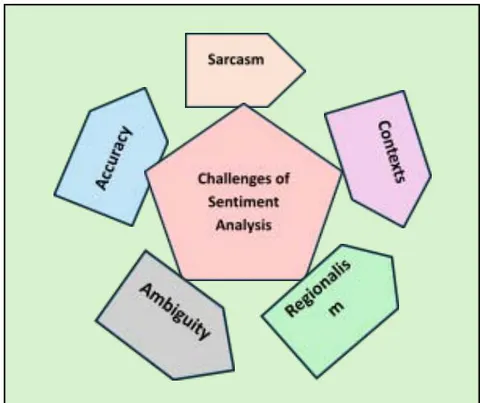
The first challenge is sarcasm which is a situation whereby a word can be used on both extremes of either being a positive or a negative one. The second is the context; this implies that a word can have a negative meaning and can also have positive meaning based on the context in which it is being used. That is, the meaning of the sentiment is not based on a word in isolation but in the context or the environment in which the words are used. The third is the ambiguity which means sentences that are made are difficult to be placed on either side of the analysis. This also includes abbreviations and all other misspelled words that are written either intentionally or unintentionally, either to shorten their length or save time in writing them. Writing letters 'y' and 'u' in stead of 'You' pose a challenge to determining the reward sentiment and emotions attached to these kinds of expressions (Balahur and Turchi 2014). The fourth one is known as comparative difficulty in which the algorithm may find it difficult to pick side on the statement that is made to bring out accurate results. The last factor is the regional variation which means that the meaning attached to words in a particular region may be different from meaning attached to the same words in another region, therefore, this can be confusing and produce wrong results (Carr, 2021).
2.3 An Overview of Computer-Mediated Communication and Emotions
Several research paperwork has been done to investigate and determine the effectiveness (Huang et al. 2008) of emoticons in computer mediated communication on different communication platforms, for instance, an investigation was carried out by Wei, (2012) in order to determine how users of Facebook use emojis and stickers to demonstrate their emotions in place of face-to-face communication.
Additional work was done by researchers to investigate how the users of instant messaging (Garrison et al. (2011) and Short Message Service (SMS) enhance their expressions using emoticons (Amaghlobeli, 2012). These and several research works have proven that the use of emoticons of computer mediated communication has a way to greatly and positively influence the users and the recipient of messages that are decorated with emojis and stickers (Jibril and Abdullah, 2013; Kaye et al, 2016). They continue to argue that emoticons can also be understood and analyzed to determine the sentiment polarities being expressed by their writers. Emoticons, which started technically by using a combination of key characters to express different facial expressions that represent the very mood of the writer, have evolved over the years (Datar and Kosamkar, 2016).
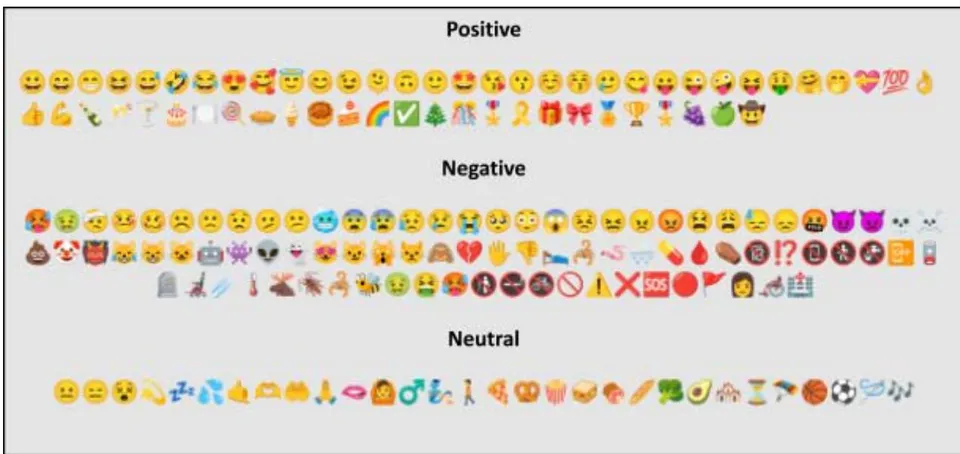
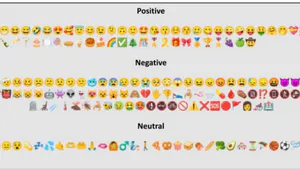
Figure 3 is the representation of commonly used emojis. It comprises of positive, negative and neutral emojis as obtained from https://unicode.org/emoji/charts/full-emoji-list.html. It is noted that emojis does not consist of facial expressions only but everyday items and actions. Although emojis are specifically meant for digital communications especially on the social media platforms, they are also being used by various cultures notwithstanding the various meanings that are attached to the same emoji. History has it that the first emoticon was designed by Carnegie Mellon in the year 1982 (Tang and Hew, 2019) and it is now being referred to by other terms such as graphic icon or graphicons. The features of positive emojis represent happiness, approval or excitement. For instance 😊 (Face with Tears of Joy), and 👍 (Thumbs Up) Negative emojis have sadness, anger, frustration or disapproval as its features. An example of this includes 😊 (Angry Face) and ❤️ (Broken Heart) among others. Neutral emojis on the other end don't have any positive or negative emotion but depends on the context in which they are used. 😊 (Thinking Face), 🔥 (Folded Hands) are some of the examples of such as shown in Figure3 (Wang et al, 2014). Stickers are generally regarded as a larger image and advanced form of emojis (Tang and Hew, 2019). Different research work and paper presented these non-textual data using different summarizing names such as emoticons, emojis, graphicons (Wang et al, 2014) and even smileys (Tang and Hew, 2019). One of the reasons why different researchers come up with different representations is because, for instance, Microsoft apps tend to convert to smileys and sometimes emojis (Amaghlobeli, 2012). But the purpose of this research work is that all these terms will be used as computer-mediated communication because they are all forms of non-textual symbols and smiley.
2.5 Natural Language Processing as a Subset of Artificial Intelligence Ant its Percularities
Oluwalade (2024) noted that sentiment analysis, a subset of natural language processing (NLP), is an increasingly important apparatus for analyzing huge volumes of text data across various platforms. This model which extracts and quantifies data as opinions, emotions, and attitudes expressed in text. Liu (2012), observed that since the use of Artificial Intelligence has become a prominent way in which communication and interaction with technology is possible, there have been several techniques that are being used to implement Artificial Intelligence. Figure 4 shows different types of techniques and models that are subset of artificial intelligence and its branch of Natural Language Processing which is being used for sentiment analysis. It also highlighted a standard categorization with specific examples for each of them, and also gives the description of their basics principles (Gou et al, 2020).
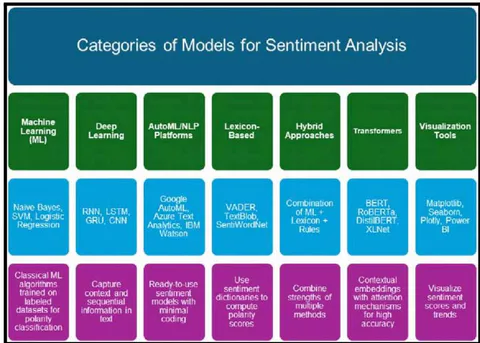
- Machine Learning (ML): Naïve Bayes, SVM (Support Vector Machine), Logistic Regression are some of the examples of Machine Language model (Sharifani, et al, 2022). These are essentially the machine learning algorithms that are trained on labeled datasets. In other words, Text and emojis are already being pre-classified as positive, neutral or negative to carry out sentiment polarity classification. This technique relies on statistical approach patterns learned from the pre loaded dataset (Sharifani et al, 2022). Alloghani (2022) and Gou et al (2020) classified the Machine Learning into Supervised learning, Unsupervised learning, and Reinforced Learning.
Deep Learning: The examples of this include but not limited to CNN (Convolutional Neural Network), RNN (Recurrent Neural Network), LSTM (Long Short-Term Memory), GRU (Gated Recurrent Unit), (Shiri et al, 2023). Deep learning models can be described as an offshoot of machine learning techniques or model that uses multiple layers of the neural networks. They are specifically useful at absorbing sequential and context information from text and also from emojis. This is particularly essential for understanding nuanced tones of sentiment polarity (Shiri et al, 2023).
AutoML/NLP Platforms: The examples of this include Google AutoML, Azure Text Analytics and IBM Watson (Opara et al, 2022). These platforms can be described as ready-to-use models and services that provide pre-built sentiment analysis mechanisms. The platforms provides the users an avenue to implement sentiment analysis with no or very minimal coding. In most cases, the model leverage on high-level ML/DL fundamental techniques without requiring anyone to build models before it can be used (Opara et al, 2022).
Lexicon-Based: VADER, Text Blob and SentiWordNet are some of examples of Lexicon Based technique (Aljedaani et al, 2022). These models adopt the use of sentiment dictionaries. In other words, it is a lexicons model that contain lists of words that are linked with particular sentiment polarity which are in most cases produce numerical equivalent scores showing the severity of the polarity in the sentiment. The sentiment scores are calculated by evaluating the occurrence and gravity of these words within the textual data (Aljedaani et al, 2022).
Hybrid Approaches: This is the combination of ML + Lexicon + Rules (Razali et al, 2023). These models combines the attributes of two or more models together. The machine learning models, lexicon-based models, and some contents or concept specific rules are modeled together in order to achieve better precision and effectiveness in sentiment analysis. Specifically, a rule might be given in the model code to override a lexicon score in a pre-defined contexts (Razali et al, 2023). Leeway (2024) noted that machine learning enhanced sentiment analysis models produce better results when incorporated with the Natural Language Processing model. This is so because, having loaded and trained the model with so many datasets, the model can design sentiment that is embedded in a new set of words. In addition to that, they are also able to interpret sarcasms and different words with similar meaning.
Transformers: Examples of these includes XLNet, BERT, RoBERTa, and DistilBERT (Rajapaksha et al, 2021). Transformers are sort of deep learning in principles of operation which produced an improved outstanding performance for Natural Language Processing. Transformers make use of attention architecture to accept data input sequences simultaneously, which permits them to pick contextual footprints for a higher degree of correctness in sentiment polarities (Rajapaksha et al, 2021).
Visualization Tools: Examples of these include but not limited to Power BI, Matplotlib, Seaborn, Plotly (Sial et al, 2021). These are especially known as software libraries and media through which sentiment polarities, scores, trends, and patterns are displayed as they are being analyzed. They are useful when it comes to in showcasing the analysis in a tangible, presentable and graphical style. This makes the interpretation easier for any given dataset for sentiment analysis (Sial et al, 2021).
III. METHODOLOGY AND RAW DATA FEATURES
Figure 5 provides an overview of the methodology which was an hybrid approach to sentiment (polarity) analysis that combines both human and Google (NLP) models. At the beginning was the input where the process begins with the identification of raw data and harvesting them from the X platform. Data Selection was the next on the line. It was based on the features from the linguistic variations which was as a result of diverse forms of language and styles contained in the data. This was done with the aim of ensuring a comprehensive and representative dataset for analysis. There are two paths or steps depicted in Figure 6. Step One was the Google NLP Analysis. This path begins with the Google Cloud which was the sentiment analysis automation that leverages on Google's cloud infrastructure, providing a window to a robust computing resources and refined pre-built NLP tasks. Within the Google Cloud lies huge Pre-trained Dataset, enabling it to understand language patterns, grammar, and sentiment cues without having to be trained from the scratch for the specific task.
Next in the flow was NLP Model which was the core of the automated sentiment analysis. Google's NLP model processes the selected data, applying NLP algorithms to identify and classify the sentiment polarities and their respective scores. Last on the path of the flow was Google NLP Analysis Results. This represent the sentiment classifications generated by the Google NLP model.
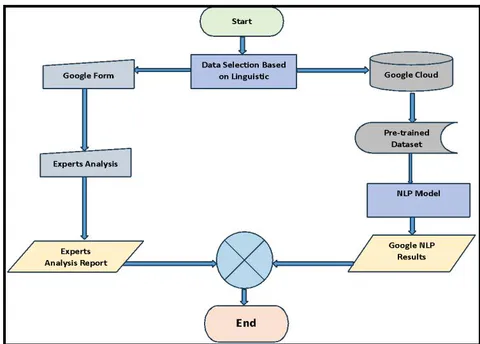
Figure 5 also depicted Step Two as the Human Experts Analysis. Twenty (20) experts from the department of Linguistic and African Languages, University of Ibadan, Nigeria were involved in the research. This compromise of lecturers at various academic cadre with years of experience in their field of chosen career. What was done was to a prepare a Google Form through which the data were analyzed and scored by experts. The form was created and its link was shared with experts for onward contribution and analysis. The rating on the Google form was ranged between 1 and 10 for each expression. After creating the Google Form a group of Experts Analysis was created.
The linguists experts were meticulously and carefully reviewed the sorted data to determine their sentiment scores. The human understanding was leveraged upon to handle context, sarcasm, idioms, and subtle linguistic cues that might be challenging for automated models. To close that path was the Expert output. The output of the human experts' analysis was converted to excel spreadsheet for further work. Finally, the End converges both paths, that is, which is an integration and comparison of results.
3.1 Algorithm for Data Analysis
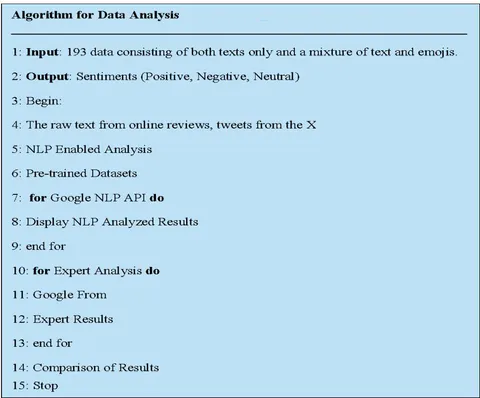
Figure 6 shows the algorithm used to execute this research on the data were extracted and gathered from the X social media platform. The method of primary data collection for this paper was done by direct scrapping or extraction of comments on the post of the Nigeria President -Bola Ahmed Tinubu- on the state of emergency declared in Rivers State of Nigeria on the of March, 2025.
The declaration was prompted by a deepening political crisis, escalating violence, and security concerns, legislative clashes, attempted impeachment and the continued face off between former Governor Nyeson Wike and his successor Governor Siminalayi Fubara in the State. This was the primary source of data which was unbiased and reliable. In addition, the sentiment polarities of experts were collected through questionnaires using the Google form. Expressions that were used as specimens for this research work were coiled out from the X platform on the said date. The textual data contents or expressions were taken directly from the platform without any form of editing.
3.2 Google Nlp Model of Sentiment Analysis On X Data
In this research, it's imperative to determine the accuracy and the efficacy of NLP model for sentiment analysis of a computer mediated communication. It juxtaposes the results of Expert analysis without NLP based sentiment analysis using the same set of data that were carefully selected out from the X Platform. The presented by the algorithm (Figure 6) outputs were in three polarities of sentiment -positive, negative and neutral. First, NLP based sentiment results were obtained, then, human analysis. Observations were made to note any discrepancies in the result as well for an appropriate comparative analysis. The reports of analysis for Google NLP API were under four tabs namely entity, sentiment, moderation and categories in Figure 7. The entities are various subject matters that have attributes in the content which includes persons, places, objects, events among others. The sentiment analysis is given in Floating point and designated by diverse colors to indicate their polarities or sentiment. Moderation gives the analysis of the level of toxic derogatory terms such as sexually inclined words, insults, firearms and weapons. The categorization is where the content is being grouped into various categories such as politics, campaign, entertainment, news, law and government among others.
Figure 7: Google NLP Model Output Tabs
| Entities | Sentiment | Moderation | Categories |
IV. OUTLINE OF THE RAW DATA
Data used for this research was obtained from the X social media platform, formerly called Twitter, but now known as the 'X'. The choice for X was because of easy access to tweets from several millions of tweets that are generated on the platform on daily basis. This research work being a qualitative exercise in nature, the data used were collected within 18 days ( of March to of April 2025) with a total sum of 193 tweets responses on the post on the X about reaction to the broadcast of Nigeria President, Bola Ahmed Tinubu, declaring State of emergency in Rives State, Nigeria. The post published at 8:15pm was viewed by about 634000 X users, liked by 429, reposted by 243 and saved by 78 X users as at 5 of April 2025.
4.1 Textual Data and Emojis
Table 1 was the linguistics categorization distribution of X comments showing the number of time each category appears and their respective percentage. By calculation comments with Emojis only was 5.32% of the total count. Most of the expressions were done without using emojis; however, about 9 responses were done using only as indicated. From Table 1, there were 16 types of different linguistic categorization discovered in the X comments and of course relevant to this research.
| S/N | Category | Count | Percentage (%) |
| 1 | Slang Only | 10 | 5.91 |
| 2 | Sarcasm | 12 | 7.10 |
| 3 | Slang and Abbreviation | 10 | 5.91 |
| 4 | Political statement | 10 | 5.91 |
| 5 | Emojis only | 9 | 5.32 |
| 6 | Irony | 11 | 6.51 |
| 7 | Emojis and Slang | 14 | 8.28 |
| 8 | Abbreviations Comments | 7 | 4.14 |
| 9 | Irony, Sarcasm, and Slang | 8 | 4.73 |
| 10 | Slang + Pidgin | 9 | 5.32 |
| 11 | Insult | 16 | 9.46 |
| 12 | Abuse, Threat or Curse | 14 | 8.28 |
| 13 | News headline | 6 | 3.55 |
| 14 | Formal critiques | 8 | 4.73 |
| 15 | Hashtag activism | 18 | 10.65 |
| 16 | Rhetorical statement | 7 | 4.14 |
| Total | 169 | 100 |
4.2 Ratings and Scores
From Table 2, the ratings on Google NLP Cloud for sentiment analysis is between -1 and +1, minus one (-1) indicates negative sentiment, 0.25 and -0.25 indicate neutral polarity while the extreme towards +1 indicates positive sentiment. The positive sentiment was highlighted by green colour, yellow signifies neutral sentiment, while the red color is used to represent a negative sentiment polarity. Their respective ranges are also indicated. 0.25 to 1.0 is the range for positive sentiment, -0.25 to '0.25 is designated for neutral sentiment polarity and -1.0 to -0.25 is negative sentiment polarity as shown in Table 2.
| Models | Negative | Neutral | Positive |
| Google NLP | -1.0 to -0.25 | 0.25 to -0.25 | 0.25 to 1.0 |
| Human Expert | -1.0 to -0.41 | -4.42 to -0.72 | 1.0 to -0.41 |
The experts rating was done on the Google Form and it was rated between 1 and 10 so as to obtain the finest rating from the experts. The ratings towards 1 were negative and ratings towards 10 are positive.
4.3 Findings from the X Expression using Google Nlp and Experts Models
Out of the 193 tweets on the post, 24 which is 12.43% were in JPEG format. JPEG formats were not useful for this research because they were neither text nor emojis. Therefore, 87.56% of the total 193, that is, 169 which were either fully text-based data or a mixture of text and emojis became useful for the experiment. From the analysis 169, the negative polarity is 90.74% and the rest were either negative polarity or neutral polarity. Table 3 shows the various forms of CMC used for this research such as Sarcasm, Slang and Abbreviation, News Headline, Emojis, Irony, Emojis and Slang, Irony, Slang and their Google NLP and Experts results. Each of this data was entered into Google NLP Model separately for clarity purpose.
| S/N | Linguistic categorization | X comments | Google NLP Score | Google Polarity | Experts Scores | Experts Polarity |
| 1 | News headline | It is illegal and unconstitutional to suspend or remove a democratically elected Governor. | -0.672 | Negative | 0.56 | Neutral |
| 2 | Insult | A terrible human being sent from the deepest part of hell. | -0.880 | Negative | 0.42 | Neutral |
| 3 | Slang + insult | Terrible president and clueless one at that. | -0.930 | Negative | 0.33 | Negative |
| 4 | Insult | Shame on the presidency! | -0.948 | Negative | 0.45 | Neutral |
| 5 | Insult | For doing the bidding of Nyesom Wike. | -0.815 | Negative | 0.45 | Neutral |
| 6 | Rhetorical statement | Wow, what a decision Mr President, Posterity will remember. | -0.888 | Positive | 0.53 | Neutral |
| 7 | Abuse | Fooolish declaration. | -0.834 | Negative | 0.38 | Negative |
| 8 | Abbreviation + punctuation | ENKR..... | -0015. | Neutral | 0.49 | Neutral |
| 9 | ...Emojis | okan yin o ni bale ☐ ☐. | 0.202 | Neutral | 0.49 | Neutral |
| 10 | Sarcasm | I just love this our father, very wise decision. | 0.938 | Positive | 0.53 | |
| 11 | Emojis with text | ☐ ☐ ☐ ☐ ☐ ☐ ☐ Red flags everywhere! | -0.895 | Negative | 0.43 | Neutral |
| 12 | Abbreviation | SMH at this move. | -0.885 | Negative | 0.49 | |
| 13 | Slang + curse | An absolute idi0t. | -0.116 | Neutral | 0.41 | Neutral |
| 14 | Irony | Well done, sir. | 0.938 | Positive | 0.41 | |
| 15 | Pigin+ slang | Dis one no be emergency, na political wahala. | -0.906 | Negative | 0.51 | Neutral |
The overall sentiment polarity from the Google NLP was displayed to be -0.275 on the model which is negative. It was observed that the analysis was done per statement especially where there are two or more clauses. They were first broken down into various parts and analyzed separately. The overall result was the average of the various parts. Examples of these are rows 4 and 5, rows 8 and 9, rows 11 and 12, rows 13 and 14 in Table 3. That is, rows 5 and 6 were made together as a single comment by the writer on X but because of full stop (.) present in between the expressions, it was seen as two separate comments by Google NLP model. The same was the case with rows 8 and 9. Obviously this was a weakness on the Google NLP model. Using evaluation experts rating to appraise the outcome of each X comment clears all forms of uncertainty. With that done, the level of performance of Google NLP model on various aspects of CMC for sentiment analysis tasks was registered.
Table 4 depicts the top 5 most used emojis present in the users' comments to Presidential Address on the X. The meaning of each emoji obtained from https://unicode.org/emoji/charts/full-emoji-list.html. 😊: Implies mockery/sarcasm, using the crazy face for irony and fire emojis for emphasis (e.g., "Ride on sir 😊). 😊: Clearly expresses anger, as shown in examples like "Tyrant 😊." 😊: conveys insults, combining a dismissive downward pointer with intense "fire" (e.g., "Fvcky'all 👍"). 🏠: directly symbolizes warnings, representing the idiom "red flags" (e.g., "Red flags").: indicates political theatrics, reflecting exasperation or disbelief at perceived drama (e.g., "APC's drama").
| Emojis And Example | Meaning | Number Of Occurrences |
| ☐☐ – (e.g. "Ride on sir ☐☐☐☐☐"). | Mockery/sarcasm | 7 |
| ☐☐ –(e.g. "Tyrant ☐☐"). | Anger | 5 |
| ☐☐ –(e.g., "Fvcky'all☐☐☐") | Insults | 4 |
| ☐☐ –(e.g., "Red flags ☐☐☐☐") | Warnings | 3 |
| ☐☐ –e.g., "APC's drama ☐☐") | Political theatrics | 1 |
Findings from this research work reveals that emojis (Table 4) play an important role and add additional meaning for sentiment analysis using Google NLP model. Whether used in conjunction with text (8.28%) or they are used without text (5.32%) the meaning of sentiment attached to each emojis remain the same but can only be different based on regional biases and the context in which they are used. Emoticons as observed in this research work are not usually subjected to sarcasm or ironical usage since a positive emojis remains positive whether the circumstance around the usage is positive or not.
4.4 Interpretation of Findings
Figure 8 was the comparison of scores of the same X data but different models: Google NLP Score and Expert Score. The sentiment polarities are Positive (green), Negative (red), and "Neutral" (yellow). From Figure 8, Google NLP Percentage Score had 20.83% Positive, 58.33% Negative and 20.83% Neutral. Hence, Google NLP model was predominantly negative inclined, making up over half of the analyzed data. Positive and neutral sentiments are equally distributed and significantly lower than the negative sentiment.
Expert Percentage Score was 5% Positive, 10% Negative and 85% Neutral. There was a contrast when comparing with Google NLP, the expert analysis shows a strong prevalence of neutral sentiment, accounting for 85%. Negative sentiment is much lower at 10%, and positive sentiment is the lowest at 5% (Figure 8).
{"image_source":{"path":"images/74a9bddcc81faa310883f7b2268e354016ddd42f47a9aef8a005bcae3e858e51.jpg"},"content":"","chart_caption":[{"type":"text","content":"Figure 8: Comparison of Percentage Distribution of Google NLP model and Expert Scores"}],"chart_footnote":[]}
Therefore, the following were the explanations or the meaning of the findings:
Sentence Complexity: The major difference occurs because of the Google model was not able to handle linguistic variations of informal words or expressions properly especially when the meaning of such sentences is embedded in more than one sentence.
Discrepancy in Dominant Sentiment: The most striking difference is the dominant sentiment. Google NLP identifies Negative as the primary sentiment, while the Expert Score overwhelmingly identifies Neutral as the primary sentiment.
Neutral Sentiment: There is a major difference in the perception of neutral sentiment. Google NLP assigns a low percentage (20.83%) to neutral, whereas experts assign a very high percentage (85%). This suggests that Google NLP must have classified content as positive or negative that experts considered neutral.
Negative Sentiment: Google NLP registers a significantly higher percentage of negative sentiment (58.33%) compared to the expert score (10%). This further supports the idea that Google NLP possibly classified content as negative or that experts are politically biased.
Positive Sentiment: Both sources show a relatively low percentage of positive sentiment, but Google NLP's positive score (20.83%) is notably higher than the expert's (%).
Short and Formal Expressions: Google NLP model excel very well when her expressions are short and most importantly when they in a formal way. Example of such include expressions which are political comments and formal as indicated on Figure 8.
The bar chart highlights a substantial divergence between the Google NLP model's sentiment analysis and that of human experts. The Google NLP model seems to be more inclined to score sentiments as either positive or, more predominantly, negative. On the other hand, the experts model appears to score a huge proportion of the data as neutral. This can only suggest that there is potential differences in how each system rate or scope sentiment, particularly regarding what constitutes a neutral tone of X expression.
V. SUMMARY AND RECOMMENDATIONS
This research work highlighted that the use of NLP in sentiment analysis cannot be overemphasized as it can handle several millions of data within a very few seconds which will ordinarily take human analysts several days or months to capture. The speed and volume of data analysis that can be handled by an NLP model to extract sentiment polarity from computer mediated communications should not be traded for accuracy of various data that is being analyzed for human consumption. Large chunk of data analyzed which is not reliable and accurate cannot compensate for the few data that can be analyzed by human beings which is accurate and reliable. The use of NLP in analyzing sentiment polarities can be categorized as an emerging phenomenon at the present stage which still need more fine tuning and thorough overhauling so that it can produce results that is perfect for human utilization as though they were produced by human beings in the first place.
This research has highlighted the relevance and importance of NLP in data analysis and presentation in sentiment analysis of CMC data in a manner that is useful, accurate and reliable for businesses and policy making. It has also contributed to the application of various NLP techniques and models that are being used for sentiment classification and extraction of opinion. It has equally spelt out the need for careful, separate and human interpretation of findings generated by NLP to eliminate limitations and external factors that can limit or reduce the accuracy of NLP generated results.
The exploration of NLP enabled sentiment analysis which helped to understand the emotional feeling and subjective behaviour of persons as expressed in written forms has been able to contribute the following to the body of knowledge in Data Science and would therefore recommend the following:
The results and performance of NPL should be evaluated properly to avoid misleading conclusions and should be given the benefit of doubts. NLP models should be trained continuously to detect nuance whether in the business world, political arena and religious settings to provide a more accurate analysis that is also reliable
The datasets for various analyses should be specific and related to the area of analysis and should be updated to accommodate various trending changes that produce the best result.
The interpretation of various findings from textual data must be within the context of the analysis to be carried out and taking account of limitations that are present within the data and the models used for the analysis.
Conflict of Interest
The authors declare no conflict of interest.
Ethical Approval
Not applicable
Data Availability
The datasets used in this study are openly available at [repository link] and the source code is available on GitHub at [GitHub link].
Funding
This work did not receive any external funding.
References
Cite this article
Related Research

Special Issue
Launch a focused special issue to highlight research, emerging trends, and expert insights in your academic field.