

Abstract
Introduction: As healthcare sectors are complex, it's difficult to handle the process involved in the management. The cost of healthcare is increasing so it is important to increase efficiency as well. Assessing appointment schedules and Turnaround time will help to analyze the workflow of the MRI department and optimize the processes.
Methods: The methods used were cross-sectional, prospective, descriptive, quantitative analysis, and qualitative methods. The patients for the study were selected through random sampling techniques and in-person data gathering was performed.
Results:Data was collected, and charted on an Excel tracker sheet, and in-depth analysis was performed. The tracker sheet included various study parameters like Registration Time, Waiting before changing, Changing Time, Waiting before Case history, Case History, Waiting before the scan, and MRI Scan Time. The data analysis included the average turnaround time for MRI i.e. from registration to scan was 1 hour 14 minutes.
Discussion: The reasons that were causing the delay in the MRI department were enumerated. Reasons like carrying any metal object in the department, first preference for emergency patients, nature of the examination, and movement of the patient during the scan were studied in depth.
Application: This study provides the pattern that was supposed to be followed for scheduling patient's appointments in the MRI department and to optimize the turnaround time for the patient. The possible reasons causing a delay in the process of the MRI department by observing the current practices in the MRI department including the infrastructure, and staffing.
Explore Digital Article Text
I. INTRODUCTION
An MRI (Magnetic Resonance Imaging): One of the most common scanning techniques that are used in health care is Radiology and the Radio-diagnosis modality is Magnetic Resonance Imaging. MRI scanning is utilized in the staging of disease, medical diagnosis, and follow-up of cases without radiation exposure to the body. The received information is processed through the computer and an image is produced. The image obtained gives a detailed resolution that can detect changes that are minute and small changes in the body structure can be identified. MRI with contract plays an important role in enhancing image resolution. Contrast agents like Gadolinium are used in some of the procedures to enhance image accuracy .
Preparation and procedure for an MRI scan:
The patient is instructed to remove all metallic objects from the body before proceeding with the MRI scan. As the patient lies in the close atmosphere in the MRI machine, the patient is expected to be still for accuracy. The patient is informed to breathe normally and stay calm and relaxed. Throughout the process of scanning, a continuous interaction is kept with the MRI technician. The patients are informed that throughout the scan there will be loud, repetitive clicking noises. In some cases, contrast injection might be needed to enhance the images. The scanning time for an MRI varies as per the body parts involved .
History of MRI:
Nuclear Magnetic Resonance (NMR) is the spinning atom effect, which was first noticed in the late 1930s. Dr. Raymond Damadian 1971 discovered that MRI is beneficial for the diagnosis in the medical field. The whole-body MRI scanning was built and in the year 1977 was named Indomitable .
Location:
- Reports are collected on the Ground floor (from the reports section).
Manpower allocation:
Layout:
The layout of the hospital includes:
1. MRI machine room- 2
2. Console room-2
3. Consultant radiologist room- 2
4. Nursing Station
5. Changing room
6. Bed
7. Sofa
Machine:
There are 2 MRI machines (Magnetom Spectra) along with 2 console rooms.
The machine is 3 Tesla with automatic protocol.
SYNGO software is used for processing.
| Sr. No. | Personnel | No. of Personnel | Shift Timings |
| 1 | Consultant Radiologists | 2 | 8:00 AM-4:00 PM, 9:00 AM-5:00PM |
| 2 | Resident duty doctors | 4 (2-2) | 8:00 AM-6:00 PM, 12:00 PM-8:00 PM |
| 3 | Nurses | 3 | 8:00 AM-4:00 PM, 10:00 AM-6:00 PM, 2:00 PM-10:00 PM |
| 4 | MRI Technicians | 7 (3-3-1) | 8:00 AM-4:00 PM, 2:00 PM-10:00 PM, 11:00 PM-7:00 AM |
| 5 | Health care Assistants | 3 | 7:00 AM-3:00 PM,11:00 AM-7:00 PM,1:00 PM-9:00 PM |
| 6 | Office attender | 1 | 9:00 AM- 6:00 PM |
Appointment is scheduled according to the slots available in the EHIS (Enterprise Healthcare Information System).
Medium of appointment scheduling:
At the nursing station of the MRI department.
At the radiology reception of the imaging department.
3. Through call centers.
There are fixed slots for EHC and IPD patients i.e. from 5:00 P.M.-7:00 P.M.
By 10:30 AM EHC slots are confirmed or released for other patients.
Receptionists make two calls to the OPD appointment patients one day prior at 9:00 AM and 1:00 PM to confirm their visit for the MRI scan.
Reports:
Reports are dispatched to the patient the next day of the scan after 5 pm on the ground floor at the dispatch counter.
Cases are diagnosed by the radiologist and they give the notations of impressions and confirmed diagnosis on Dictaphone which is further typed and reviewed by them.
CD is also given along with the reports.
IPD patient reports: The morning patient gets the reports on the system by the end of the day.
For evening patients, a provisional report is updated on the system the by end of the day.
II. AIMS AND OBJECTIVE
Aim:
Study of appointment Scheduling pattern of the MRI department
Analysis to optimize Turn Around Time.
Objectives:
To study the appointment scheduling pattern of the MRI department and further analyze it.
To study the Turn Around Time (TAT) of the MRI department.
To study the reasons for the delay in the MRI department.
To study the infrastructure and physical facility of the MRI department.
To study the staffing pattern of the MRI department.
III. REVIEW OF LITERATURE
The Article proposes two approaches namely Online and Offline for scheduling the appointment, depending upon the availability of a batch of patients waiting for it. The author also discusses the benefits and cons of each of the alternatives. A comparison of this alternative is to provide insights into work efficiency and effectiveness. It also describes the work distribution and equity and optimization of resources. This also provides input on work discrimination power .
The author of the article demonstrates the functionality of types of stages in the scheduling process. He bifurcates the scheduling process into two categories of systems.
- Single Stage, where the patient queues for a single level of the process.
2. Multistage
The study included data from 904 outpatients. He concluded based on the study that lack of education and low awareness regarding the instruction process were the key reasons . Based on the study conducted to analyze the importance of turnaround time in radiology, it was been observed by the authors that, "Routine MRI studies are performed on weekends and the report is interpreted on a weekday . With the available data that is analyzed, the conclusions can be drawn by optimized MRI results saving the time of 5 minutes 28 seconds per patient . Improving the turnaround time is the objective to make the MRI process more efficient and effective. The author states that having a planned operation with the use of new technology by implementing interoperability within the departments can reduce the turnaround time for the patient . After conducting the study on appointment patterns for patient scheduling, it is observed that continuous improvement of the performance of the diagnostic services and be enhanced by minimizing the cancellation probability. By summating all the capacity of the clinic and by increasing the clinic's overall performance, it can be compared with only a 5% cancellation probability . After conducting the study for the scheduling process of patients for tests, the results show that multi-appointment scheduling problems are becoming increasingly popular. Multi-appointment scheduling problems in hospitals are currently gaining progressively more momentum in the academic literature . As Lin states, "To summarize, this article addresses the following questions for a multiphase and multi-server queueing system with stochastic factors to optimize the (weighted average) objectives of patient waiting time, resource over time, and waiting room congestion" . Hans Lugnegård, product manager for Sectra's Diagnostic Imaging Suite said "Achieving quick report turnaround times requires an efficient RIS/PACS solution with closely integrated tools, such as speech, intelligent display protocols, 3D visualization, and other clinical applications," . The importance of the MRI scan has increased in the healthcare and medical departments. How powerful a magnetic field along with strong radio waves helps to take clear and detailed pictures of the human body organ. This supports the detection of any abnormalities in the organs and thus saving the life . The article discusses the advancement of MRI implementation in medical studies. Concepts such as MRI scanning for Lungs have now become possible and have helped doctors in the treatment of many diseases. FDA clearing 7T MRI system has added an advantage for detailed neurological diagnosis . Using MRI scan scheduling effectively to reduce process time is the main objective to attain efficiency. Many factors like the sudden and randomly arriving emergency patients, and reasonable slaking time slots provide better performance. It is important to reserve the slot time for these emergency cases and revise the turnaround time. Setting an appropriate time for every individual scan becomes crucial in managing the time . In the radiology department, quick attendance and delivery of reports always improve the patient's psychological suffering in a place where emotional and physical torture has occurred . By understanding the patient turnaround time which is directly propositional to the quality of services rendered to minimize the turnaround time . Most of the patients demand efficiency and timeliness in service delivery of medical care because of manual entry of appointment schedule and the situation is irritating due to long waiting hours at the health care services set-up. There is a need for an integrated healthcare system that will provide efficient care for the benefit of patients. By offering an online appointment system, the system can be improved to provide access to health care services . The model followed: Patient service times are determined and the slot times are considered that be equal to appointment slot allocation. Accordingly, the nature of the problem is combinative, which is used. Given the combinatorial nature of this problem, they use a lateral thinking approach to solve it. This work very much improves by providing a united optimization framework for general problems and by developing algorithms to solve them efficiently . There are tangible quality elements such as patient waiting times and waiting room congestion. A well-designed and properly structured appointment schedule will minimize the waiting times for the patients. Online appointments and scheduling when incorporated can minimize patient dissatisfaction due to long waiting times . The appointment schedule will have gaps when it is underutilized as of the doctor's time . Patient satisfaction is enhanced with the initiation of treatment . Various studies define waiting time and access time in various manners and ways . Argues that sufficient staff makes sure that patients are not rescheduled or booked for later dates due to the staff taking offs and duty leaves. This is another factor that contributes to the long waiting time .
IV. METHODOLOGY
a) Place of study: Kokilaben Dhirubhai Ambani Hospital, Mumbai
b) Population: Patients scheduled for an MRI scan appointment.
c) Unit of study: The study included 167 waiting patients who were scheduled for an MRI Scan and the MRI department of the tertiary care hospital. Patients were selected for the study through Random sampling.
d) Variables:
Patient footfall (expected inflow)
Type of scan
Scan time
e) Parameters of the study:
Registration Time
Waiting before changing
Changing Time
Waiting before Case history
Case History
Waiting before the scan
Scan Time.
f) Data collection: The data for the study was collected through observation and EHIS.
g) Method: Observation, cross-sectional, prospective, Quantitative method, and Qualitative methods were used.
h) Tools used:
Microsoft Excel
Enterprise Healthcare Information System (EHIS) i.e. the HMIS of the hospital was used for reference, under the supervision of the management of the MRI department.
i) Reliability of data: In-person data gathering.
j) Period of study: The study was done for 23 days i.e. from 4th June to 26th June 2019.
Analysis:
A. Data Collection
B. Data Presentation and Data Analysis
- Data collection: The project was conducted in the MRI department of a tertiary care hospital located in Mumbai city. The duration of the study was from 4th June to 26th June 2019 for a period of 23 days. The turnaround time was calculated for MRI procedures by random sampling. The study included 167 patients from the MRI department, were Outpatient Department, the Inpatient Department, Accident and Emergency, Executive Health Checkups, and Walk-in patients. A tracker sheet was devised for recording the time taken by each patient at different points in the process.
Process:
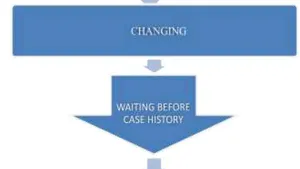
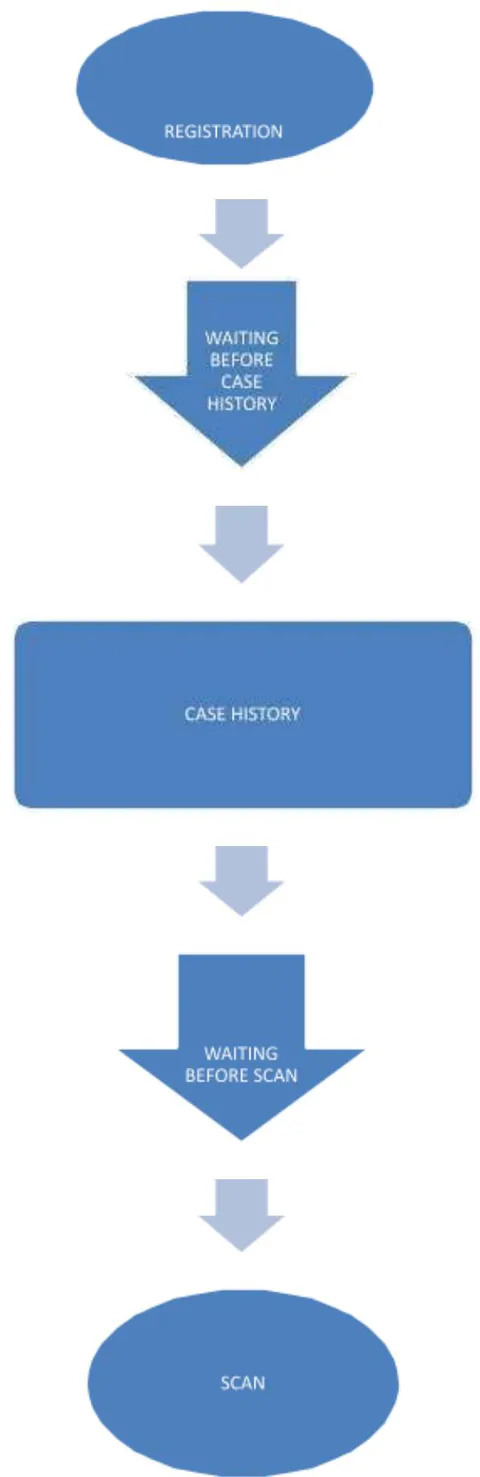
The data were collected at different stages i.e. the time required at different stages was noted:
When the patient was registered
When the history was documented
When the patient is asked to change
When the scan is performed.
The waiting time was noted at different points (before history, before the change, before the scan)
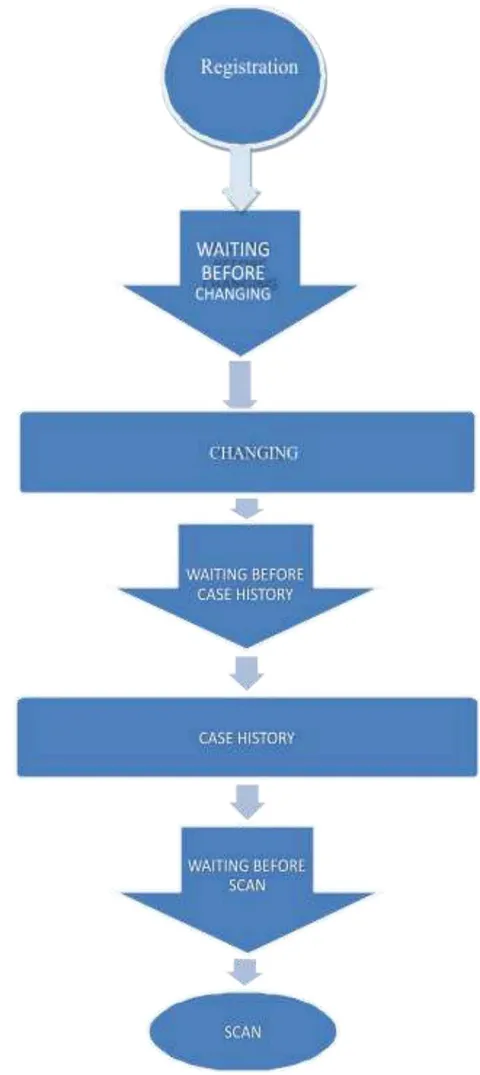
Process Flow for in-Patient Department and Accident and Emergency.
Process Average Time Taken in Minutes Registration Time 0:01 Waiting before changing 0:02 Changing Time 0:03 Waiting before Case history 0:03 Case History 0:03 Waiting before scan 0:09 Scan Time 0:53 Total time 1:17
{"image_source":{"path":"images/751188963df6b991ef8402a3c9c4d3a30b0d09cf666348273e51816a4ec7bcb8.jpg"},"content":"","chart_caption":[],"chart_footnote":[]}
Figure no. 4: Average Waiting Time at Different Points for MRI OPD
| Process | Average Waiting Time Taken in Minutes |
| Waiting before changing | 0:02 |
| Waiting before Case history | 0:03 |
| Waiting before scan | 0:09 |
| Total waiting time | 0:14 |
| Process | Average Waiting Time Taken in Minutes |
| Waiting before changing | 0:02 |
| Waiting before Case history | 0:03 |
| Waiting before scan | 0:09 |
| Total waiting time | 0:14 |
Data Interpretation: The above graph shows that the average waiting time for MRI OPD patients is the highest before the scan i.e. 9 minutes and the shortest is before changing i.e. 2 minutes and the total waiting time is 14 minutes.
{"image_source":{"path":"images/d0058e9b308077b05e67751aca018c8bcfd8b063c5fdd408af625168109e3de9.jpg"},"content":"","chart_caption":[{"type":"text","content":"Average Time taken in minutes"}],"chart_footnote":[]}
Data Interpretation: The above graph shows the average total time required to complete the whole process for MRI IPD patients from registration to scan completion i.e. Turnaround time is 1 hour 9 minutes.
{"image_source":{"path":"images/983dddbf6ebe28c0669336fcd42bac372af4165fa38636a0a7013a80045402e2.jpg"},"content":"","chart_caption":[{"type":"text","content":"Average Time taken in minutes"}],"chart_footnote":[]}
Figure no. 6: Average Time Taken for MRI IPD Scan Table 5: Average Time Taken for MRI IPD Scan
| Process | Average Time Taken in Minutes |
| Registration Time | 0:01 |
| Waiting before changing | 0:00 |
| Changing Time | 0:00 |
| Waiting before Case history | 0:02 |
| Case History | 0:02 |
| Waiting before scan | 0:09 |
| Scan Time | 0:54 |
| Total time | 1:09 |
Data Interpretation: The above graph shows the average total time required to complete the whole process for MRI IPD patients from registration to scan completion i.e. Turnaround time is 1 hour 9 minutes.
{"image_source":{"path":"images/5fb30416dc9e4f3cf59e5d406f47b60d3088bac68c944455be30d0495a0e1a0b.jpg"},"content":"","chart_caption":[],"chart_footnote":[]}
Figure no. 7: Average Waiting Time at Different Points for MRI IPD Table 6: Average Waiting Time at Different Points for MRI IPD
| Process | Average Waiting Time taken in minutes |
| Waiting before changing | 0:00 |
| Waiting before Case history | 0:02 |
| Waiting before scan | 0:09 |
| Total waiting time | 0:11 |
Data Interpretation: The above graph shows that the average waiting time for MRI IPD patients is the highest before the scan i.e. 9 minutes and the shortest is before changing as IPD patients need not change before the scanning. The total waiting time for MRI IPD patients is 11 minutes.
{"image_source":{"path":"images/d9074dad747afb420eafd29dec33685ee1b86ba46949a8133312313455f81609.jpg"},"content":"","chart_caption":[{"type":"text","content":"Figure no. 8: Average Time Taken for MRI A & E scan"}],"chart_footnote":[]}
| Process | Average Time taken in minutes |
| Registration Time | 0:01 |
| Waiting before changing | 0:00 |
| Changing Time | 0:00 |
| Waiting before Case history | 0:02 |
| Case History | 0:02 |
| Waiting before scan | 0:03 |
| Scan Time | 0:38 |
| Total time | 0:48 |
{"image_source":{"path":"images/a2faf2d6b247731997a81f9f6dcddb0100c31460279db63b0d15cab4b9bb5f10.jpg"},"content":"","chart_caption":[],"chart_footnote":[]}
Figure no. 9: Average Waiting time at Different Points for MRI A & E Table 8: Average Waiting Time at Different Points for MRI A & E
| Process | Average Waiting Time Taken in Minutes |
| Waiting before changing | 0:00 |
| Waiting before Case history | 0:02 |
| Waiting before scan | 0:03 |
| Total waiting time | 0:06 |
Data Interpretation: The above graph shows that the average waiting time for MRI A&E patients is highest before the scan i.e. 3 minutes and the shortest is before changing as A&E patients need not change before the scanning. The total waiting time for MRI IPD patients is 6 minutes.
{"image_source":{"path":"images/7833977fd5a1993185b071be5b43f65a2b163cb28d63af6e94427c7b14e3830f.jpg"},"content":"","chart_caption":[{"type":"text","content":"Figure no. 10: Average Time Taken for MRI Walk-in Scan"}],"chart_footnote":[]}
| Process | Average Time Taken in Minutes |
| Registration Time | 0:01 |
| Waiting before changing | 0:03 |
| Changing Time | 0:02 |
| Waiting before Case history | 0:03 |
| Case History | 0:02 |
| Waiting before scan | 0:07 |
| Scan Time | 0:48 |
| Total time | 1:09 |
{"image_source":{"path":"images/f55bc85dcff5f468e2b97e652262735700d4e16fe4cd43068e41c7a34d2bbac1.jpg"},"content":"","chart_caption":[{"type":"text","content":"Data Interpretation: The above graph shows the average total time required to complete the whole process of MRI Walk-in patients from registration to scan completion i.e. Turnaround time is 1 hour 9 minutes."},{"type":"text","content":"Figure no. 11: Average Waiting Time at Different Points for MRI Walk-in"}],"chart_footnote":[]}
| Process | Average Waiting Time taken in minutes |
| Waiting before changing | 0:03 |
| Waiting before Case history | 0:03 |
| Waiting before scan | 0:07 |
| Total waiting time | 0:14 |
Data Interpretation: The above graph shows that the average waiting time for MRI Walk-in patients is the highest before the scan i.e. 7 minutes and the shortest is before changing i.e. 3 minutes and the total waiting time is 14 minutes.
{"image_source":{"path":"images/3d70306626459302e8ffa5a2afbcafe7f6313804ddec5d8afe62e9242dec9b32.jpg"},"content":"","chart_caption":[{"type":"text","content":"Figure no. 12: Average Time Taken for MRI EHC"}],"chart_footnote":[]}
| Process | Average Time taken in minutes |
| Registration Time | 0:01 |
| Waiting before changing | 0:00 |
| Changing Time | 0:00 |
| Waiting before Case history | 0:03 |
| Case History | 0:03 |
| Waiting before scan | 0:06 |
| Scan Time | 0:42 |
| Total time | 0:58 |
Data Interpretation: The above graph shows the average total time required to complete the whole process for MRI EHC patients from registration to scan completion i.e. Turnaround time is 58 minutes.
{"image_source":{"path":"images/322c980285d16f272d85e516d0d9be8d23aced4592fe3fadd085f07585e6378f.jpg"},"content":"","chart_caption":[{"type":"text","content":"Figure no. 13: Average Waiting Time at Different Points for MRI EHC"}],"chart_footnote":[]}
| Process | Average Waiting Time Taken in Minutes |
| Waiting before changing | 0:00 |
| Waiting before Case history | 0:03 |
| Waiting before scan | 0:06 |
| Total waiting time | 0:09 |
{"image_source":{"path":"images/d9bde9522f5a5c5423a53dd8817a042bff0c27b6832d0e52fc2c66c8503e7300.jpg"},"content":"","chart_caption":[{"type":"text","content":"Figure no. 14: Average of Total Time Distribution (in minutes)"}],"chart_footnote":[]}
Data Interpretation: The above pie chart represents the average total time distribution in minutes. Delays mostly occur because of the long waiting time before the scan due to improper appointment scheduling.
{"image_source":{"path":"images/ef59f9a76ccf27e729b833ebfa690f5c19a070e9d7f75a30706124c374b624d1.jpg"},"content":"","chart_caption":[{"type":"text","content":"Figure no. 15: Number of Patients in Each Category"}],"chart_footnote":[]}
Data Interpretation: The above pie chart shows that the maximum number of patients are from the OPD followed by IPD then Walk-in then A&E and the minimum number of patients are from the EHC.
V. DISCUSSION
The average time taken by an OPD patient at every stage to complete all the processes i.e. from registration to MRI scanning. Knowing this average time for this entire process can be considered as an important factor while scheduling an appointment for an OPD patient and giving the slots accordingly.
The average waiting time is taken by an OPD patient before changing clothes, before case history, and before the scan. By knowing this we can check for places where there is more waiting and the reasons for this waiting so that the delays can be avoided or minimized. This will improve patient satisfaction.
The average time taken by an IPD patient at every stage to complete all the processes i.e. from registration to MRI scanning. Knowing this average time for this entire process can be considered as an important factor while scheduling an appointment for an IPD patient and giving the slots accordingly.
The average waiting time is taken by an IPD patient before changing clothes, before case history, and before the scan. By knowing this we can check for places where there is more waiting and the reasons for this waiting so that the delays can be avoided or minimized. This will improve patient satisfaction. IPD patients are not required to change clothes as they are already in hospital clothes and hence changing time is eliminated.
The average time is taken by an A&E patient at every stage to complete all the processes i.e. from registration to MRI scanning. Knowing this average time for this entire process can be considered as an important factor while scheduling an appointment for an A&E patient and giving the slots accordingly.
The average waiting time is taken by an A&E patient before changing clothes, before case history, and before the scan. By knowing this we can check for places where there is more waiting and the reasons for this waiting so that the delays can be avoided or minimized. This will improve patient satisfaction. A&E patients are not required to change clothes as they are already in hospital clothes and hence changing time is eliminated.
The average time taken by a Walk-in patient at every stage to complete the process i.e. from registration to MRI scanning. Knowing this average time for this entire process can be considered as an important factor while scheduling an appointment for a Walk-in patient and giving the slots accordingly.
The average waiting time is taken by a Walk-in patient before changing clothes, before case history, and before the scan. By knowing this we can check for places where there is more waiting and the reasons for this waiting so that the delays can be avoided or minimized. This will improve patient satisfaction.
The average time taken by an EHC patient at every stage to complete the process i.e. from registration to MRI scanning. Knowing this average time for this entire process can be considered as an important factor while scheduling an appointment for an EHC patient and giving the slots accordingly.
The average waiting time is taken by an EHC patient before changing clothes, before case history, and before the scan. By knowing this we can check for places where there is more waiting and the reasons for this waiting so that the delays can be avoided or minimized. This will improve patient satisfaction. EHC patients are not required to change clothes as they are already in hospital clothes and hence changing time is eliminated.
The pie chart helps us to understand the average total time distribution in minutes at every stage in the process including all categories of patients.
This gave an average turnaround time for all categories of patients.
The number of patients categorically. We understood the appointment scheduling for each category, the maximum time delays for each category and further what can be done to make processes lean category-wise using recommendations that follow.
Challenges:
The data collection from department MRI had to be specific and the turnaround time had to be measured appropriately. This required proper knowledge and awareness regarding the data collection and data analysis. There are sequences of events that require proper coordination. The challenge was to ascertain the job role of each and proper monitoring of the same.
The duration was very less and short. The data needed to be refined as per the requirements. There were delays mostly in the daytime only and not during the night timings. So data collected was not very significant at night times.
Limitations:
This study was conducted in a single department and one unit of the hospital.
The study was conducted for 6 months duration.
No other department or unit is involved in the data collection.
VI. CONCLUSION
A. The average turnaround time for MRI (from registration to scan) is 1 hour 14 minutes.
B. The following are the reasons leading to the delay in the turnaround time in the MRI department of a tertiary care hospital:
If the patient carries any metal object in the department, they have to remove it before entering the scan room, which takes time.
When the emergency patient arrives, they give the first preference. The appointment patients are made to wait for a long time as it causes delays in the entire procedure.
Longer waiting times may also be experienced where the nature of the examination requires immediate additional workup such as in the case of contrast studies.
The appointment patient arrives late.
IPD patient is transferred late to the MRI department.
Last-minute adjustments due to the cancellation of the appointment patient.
VII. RECOMMENDATIONS
OPD patients are to be communicated 20 minutes before their appointment time to complete the billing, changing, and case history process and avoid delay in the scan.
Confirmation calls are to be performed by the nurses if the appointment patient does not reach 20 minutes early so that an alternate patient (IPD/EHC/A&E) can be scheduled in case of cancellation.
One of the MRI rooms has been dedicated to OPD patients and another one to IPD, EHC, and A&E patients.
As IPD, EHC, and A&E patients are already present in the hospital, they can be called 20-30 minutes before the completion of the previous scan (considering the Porter availability) to maintain a continuous flow of patients and minimize waiting time for the next patient.
1 porter can be assigned specifically to the MRI department.
Considering 1 hour slot for 1 patient, on 2 MRI machines approximately 26-28 patients can be done per day. So by avoiding the delays, 2-4 patients can be increased each day.
Conflict of interest: NIL
Source of funding: NIL
Ethical clearance: Not applicable and not required. (As these do not involve any of the patient's information directly, ethical clearance is not needed).
Conflict of Interest
The authors declare no conflict of interest.
Ethical Approval
Not applicable
Data Availability
The datasets used in this study are openly available at [repository link] and the source code is available on GitHub at [GitHub link].
Funding
This work did not receive any external funding.
References
Cite this article
Related Research


Special Issue
Launch a focused special issue to highlight research, emerging trends, and expert insights in your academic field.