



IntelliPaper
Abstract
The understanding of the Universe depends on the key factors which are the Hubble Flow, the Doppler effect, and redshift. Hubble constant is an approximation value of a very short interval in 1-2 Mpc of universe-scale. The Supreme Theory of Everything indicates this constant varies permanently and confirms that there is no need to search for the Hubble constant. The Hubble constant doesn’t find anywhere. So, I would like to call Hubble constant the Hubble Flow. Contemporary cosmology can observe more than 14000 Mpc of distance from Earth. Astronomers have the beautiful possibility to observe Hubble Flow, which opens the mystery of the Universe. We need to find its physical basis. We don't know also the age of the Universe as a consequence of the flawed Hubble constant. In this paper, the possibility to use the open hysteresis instead of the Hubble constant is presented.
Explore Digital Article Text
I. INTRODUCTION
Since the beginning of the 1900s, we have transformed our view of the Universe. We learned that our galaxy is just one of many, that galaxies are racing away from each other, and that the universe's expansion is accelerating. These discoveries depended on an important finding made by Henrietta Leavitt, an American astronomer. [1] In 1929, Edwin Hubble announced that almost all galaxies appeared to be moving away from us. [2][3][4][5] The velocity of a galaxy could be expressed mathematically as
(1) Where v is the galaxy's radial outward velocity, d is the galaxy's distance from Earth, and H is the constant of proportionality called the Hubble constant. [6]
Today some theories have indeed become very complicated, and some have been too simple. But the fundamental ideas aren't that complex. Does the Hubble constant have this very simple relationship? And is the calculation of the age of the Universe so easy? The exact value of the Hubble constant is still somewhat uncertain but is generally believed to be around 65 kilometers per second for every megaparsec in the distance. [6][7]
The Hubble law is in functional studies. [8-12] The first measurement of from WMAP, in 2003, was . Further results from WMAP were slightly lower: 73 in 2007, 72 in 2009, and 70 in 2011. No problem, though: the error for the SHoES and WMAP measurements still overlapped in the 72-to-73 range. The most recent result from SHoES at that time showed a Hubble constant of , and WMAP's final result showed a Hubble constant of . [8]
Indeed, one method's results would begin to trend toward the other's as methodology and technology improved-perhaps as soon as the first data were released from the Planck Space Observatory, the European Space Agency's successor to WMAP. That release came in 2014: . The error ranges no longer overlapped—not even close. [10] The proportionality between recession velocity and distance in the Hubble Law is called the Hubble constant (it looks like the Planck constant [13]), or more appropriately the Hubble parameter we have a history of revising it. In recent years the value of the Hubble parameters has been considerably refined, and the current value given by the WMAO mission is 71 km/s per second. Measurements using a variety of techniques find the Hubble constant to be about 70 to 76 kilometers per second for every megaparsec of distance (Mpc, about 3.26 million light-years). So, an object one Mpc away will move away from us at 70-76 km/s, an object two Mpc will move away at 140-152 km/s, and so on. [1][14]
The fact that the Hubble expansion rate of the Universe changes over time teaches us that the expansion of the Universe isn't a constant phenomenon. In fact, by measuring how that rate changes over time, we can learn what our Universe is made from: this was precisely how was first discovered dark energy. [15] [16]
Entitling his paper "Sorry, Astronomy Fans, The Hubble Constant Isn't A Constant At All Starts With A Bang," Ethan Siegel wrote that if you measure the slope of that line, you get a value, colloquially known as the Hubble constant, still, it isn't a constant at all, as it changes over time. Here's the science behind why. [17] Astronomers have reached a fundamental impasse in their understanding of the Universe: they cannot agree on how fast it is flying apart. And unless a reasonable explanation can be found for their differing estimates, they may be forced to completely rethink their ideas about time and space. Only new physics can now account for the cosmic conundrum they have uncovered, many believe. [18]
"Over the decades, these surprises have included the discovery of dark matter – believed to be made up of as yet undetected particles – whose extra gravitational pull explains why galaxies do not fly apart. In addition, astronomers have also discovered the existence of dark energy, which is accelerating the rate at which the cosmos is expanding. [18]
"Those two discoveries were remarkable enough," adds Riess who won his Nobel for his involvement in the discovery of dark energy. "But now we are facing the fact there may be a third phenomenon that we had overlooked – though we haven't got a clue yet what it might be." [18]
"Changing the Hubble constant from 67.4 to 73.5 would mean it must have been flying apart faster than previously supposed and so must be younger than its currently accepted age of 13.8bn years," says Mortlock. [18]
A Kavli Institute for Theoretical Physics workshop in July 2019 directed attention to the Hubble constant discrepancy. New results showed that it does not appear to depend on the use of any one method, team, or source. Proposed solutions focused on the pre-recombination era. [19]
This paper is a summary review of a KITP-UCSB workshop convened to bring together both experimental and theoretical researchers in the field to review and assess the current state of affairs and identify promising next steps for the resolution of this issue. [20][21]
The model is well established from decades of research and its Hubble constant prediction is supported by Planck's results, however, measurements indicate the universe is expanding faster than expected. This conflict has been growing more perplexing in recent years. [1][22]
"The Hubble constant discrepancy has been increasing, raising the possibility that we may be missing something interesting in our understanding of the universe," said SHoES team lead Adam Riess at the Johns Hopkins University and Space Telescope Science Institute in Baltimore. [22]
So, either something is wrong with our various measurement techniques or something is wrong with our theoretical model of how the universe evolves. [1][23]
If you measure the slope of that line, you get a value, colloquially known as the Hubble constant. But it isn't a constant at all, as it changes over time. Hubble measurements suggest a faster expansion rate in the modern universe than expected, based on how the universe appeared more than 13 billion years ago. These measurements of the early Universe come from the European Space Agency's Planck satellite. This discrepancy has been identified in scientific papers over the last several years, still, it has been unclear whether differences in measurement techniques are to blame or whether the difference could result from unlucky measurements. [24]
These most precise Hubble measurements to date bolster the idea that new physics may be needed to explain the mismatch. [24]
"This mismatch has been growing and has now reached a point that is impossible to dismiss as a fluke. This disparity could not plausibly occur just by chance." [1][25][26]
Cosmologists have been struggling to understand an apparent tension in their measurements of the present-day expansion rate of the Universe, known as the Hubble constant. [27][28][29]
One alternative to the Hubble recession law is the tired-light hypothesis proposed initially by Zwicky. [30][31] Despite periodic re-examination of the concept, tired light has not been supported by observational tests and remains a fringe topic in astrophysics. [32] {"image_source":{"path":"images/42c91e73c9530e9b9f89ea880f9edd68b15c857e07be233debad972969d7a9e4.jpg"},"content":"","chart_caption":[{"type":"text","content":"Measurement of the Hubble constant then and now"}],"chart_footnote":[]}
Figure 1: "How Far We've Come" [33] in the study of the Hubble constant
We've come a long way in our understanding of the Universe. While Hubble is given credit for the initial discovery of the distance-redshift relation, later astronomers continued to take measurements of the distance of galaxies and their redshifts.
You can see this in the upper right of the Figure above, which plots a more modern graph of the relation. Hubble's original data spans the small red square in the lower-left corner of the Figure. Then in 1998, Purlmutter, Schmidt, and Riess used observations of very distant galaxies to show that the Universe was not just expanding but accelerating. [33].
The recent study strengthens the case that new theories may be needed to explain the forces that have shaped the cosmos. [24].
Either way, the Hubble constant puzzle indicates something is missing from our picture of the universe. [1][24] And that was all it short review is about recent scientific research on the Hubble constant.
considered its results for different levels, from quantum mechanics to cosmological phenomena. It was proved to be correct and rational. [35][37-43].
II. NEW SOLUTION FOR HUBBLE PROBLEM
2.1 Hubble Flow
Hubble's law must yield a great deal of much more information about the Universe. But it conflicts with the observations and research above talked. This contradiction is not just in minor details but is very fundamental. Hubble's law couldn't be formulated perfectly because the Hubble constant (H) is a linear relationship between the distance and velocity of the receding celestial object on a small scale (1-2 Mpc). The Hubble law was almost valid in nearby galaxies (700 Mpc) (Figure 2a and Figure 2b). But it is not constant for distant galaxies lying more than 700 Mpc. Today we can observe 14260 Mpc or 46.5 Gly in radius [34]. I introduce that the diameter of the whole Universe is approximately 60000 Mpc, which equals 195.7 billion light years. [35] Of course, at that time Hubble law was a revolutionary scientific discovery. At that time, it was. Even now, not only Hubble's law (same as Einstein's photoelectric effect [13]) but many phenomena haven't been explained by classical physics because they are not linear, but cyclical. As seen today, Hubble's law cannot be accurately determined without the apparent hysteresis of magnetism. Because of this, we carefully handle the 100-year-old theory of Hubble from another point of view in this chapter.
Does the problem of Hubble's constant direct us to new physics? Or require a new consideration of an old unsolved law? Both versions maybe. I think that the reason for Hubble's problem is the unsolved old physical phenomenon of hysteresis, which has been a struggle for scientists. At first, I solved the problem to open hysteresis, then used it for solving the Hubble problem, and finally
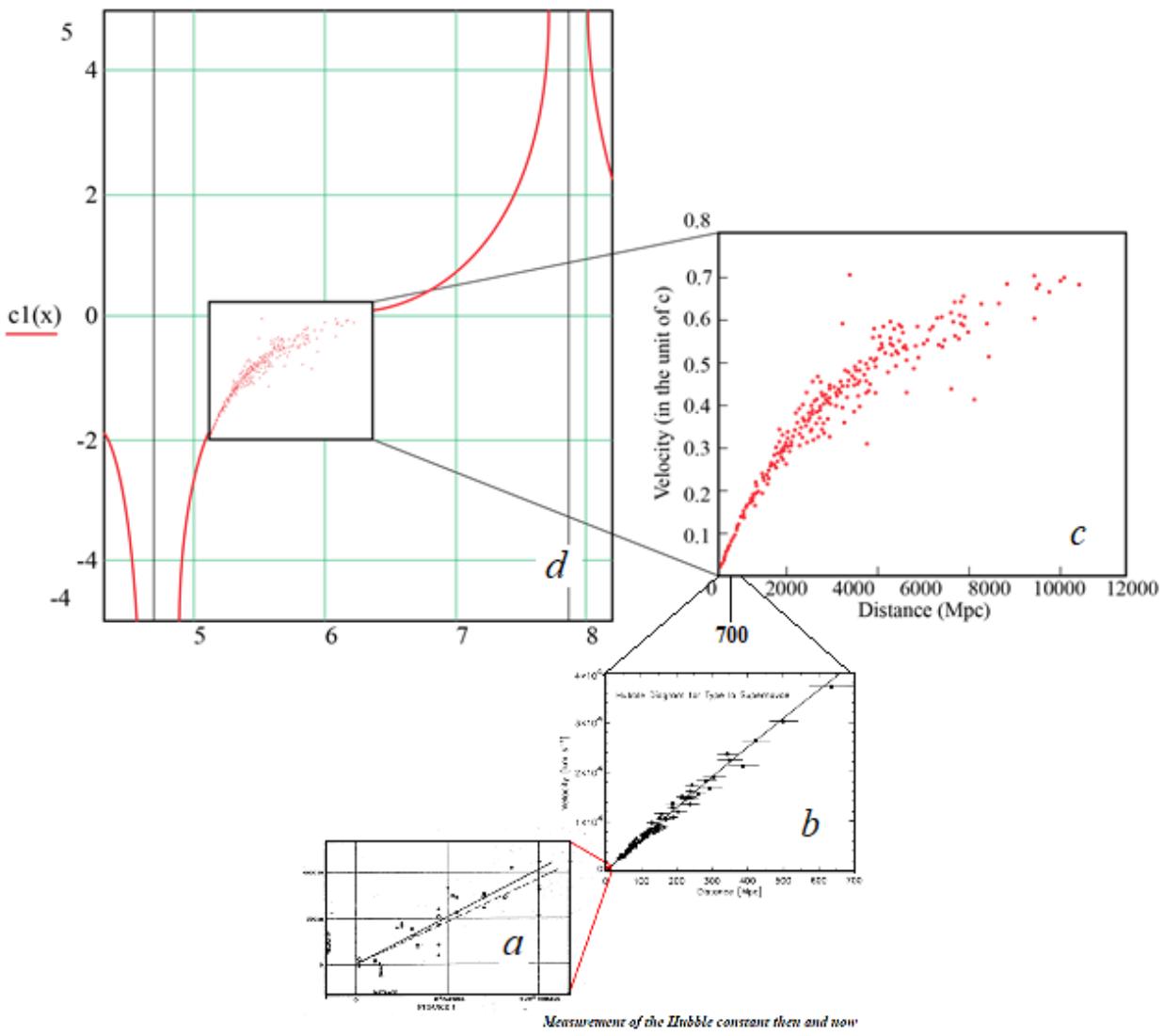 Figure 2: How Far We've Gone Now in Universe-Scale
Figure 2 is processed from Figure 1 by Brain Koberlein [33] and from a paper by Ulaanbaatar T., [35] The horizontal axis is not scaled in Figure 2d because of the circle scale but it says a lot.
The Hubble constant is seemingly different in Figure 2c [36] and Figure 2d [35]. For this reason, we called it the Hubble Flow [35].
In this paper, I wouldn't like to copy and insert the formula extraction of the open hysteresis published [41][42] and examples to use it.
The Hubble Flow is described by the following formula of the open hysteresis of the electromagnetism [13][35](Figure 2d):
Where x is the distance unit in a circular scale.
According to the Supreme Theory of Everything, the graph of Hubble Flow shown in red in Figure 2d shows only the whole structure of the Universe.
2.2 Structure of the Universe
The understanding of the universe depends on the key factor "Hubble flow". The curve in Figure 2d is a quarter of a full illustration in the Universe-scale.
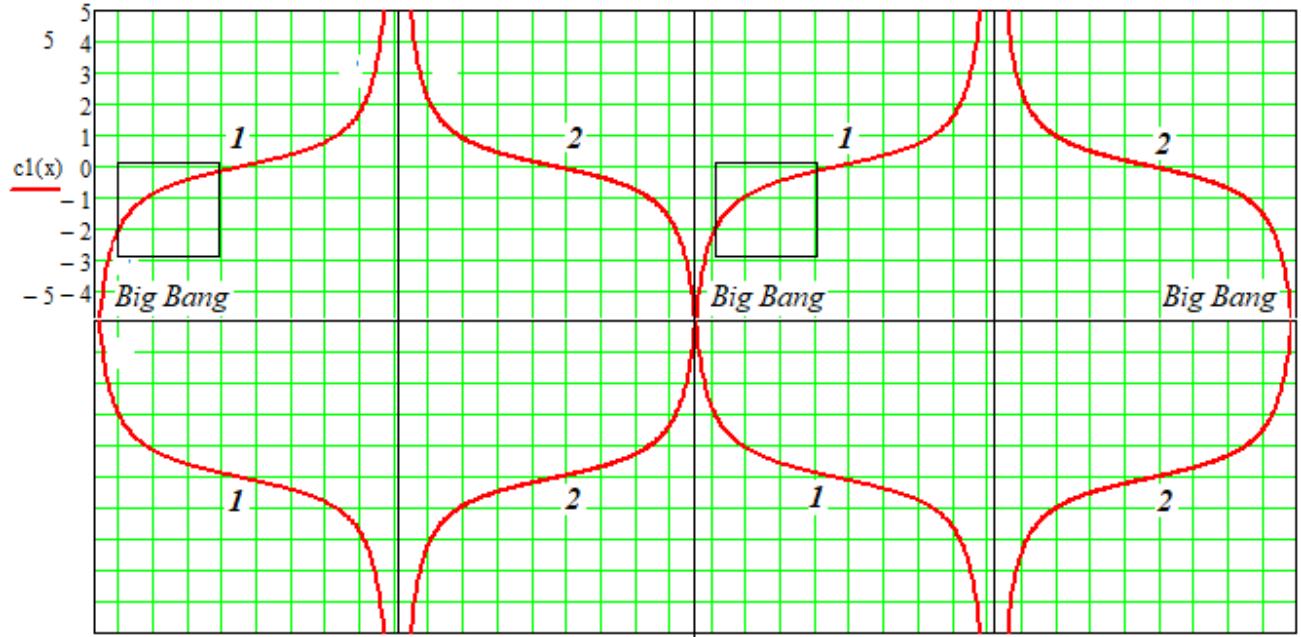 Figure 3: Universe structure as a geometric rotation form (1 denotes Big Expansion: Accelerating-Slowing-Accelerating, 2 represents Big Crunch: Intensive Slowing-Slowing-Intensive Slowing)
It is the large-scale structure of the universe. And parallel universes have the same designs I think .
2.3 The Age of the Universe is Flawed
According to the Hubble law
Where is the dimensionless scale factor for the expanding Universe, is the scale factor set = 1 at present.
The scale factor R for a given observed object in the expanding Universe relative to at present may be implied from the z parameter expression of the redshift. [9] The Hubble parameter has the dimensions of inverse time, so a Hubble time may be obtained by inverting the present value of the Hubble parameter. [46]
It is seemingly so uncomplicated. Unfortunately, cannot be constant. Consequently, the age of the Universe is changed.
The title of Ethan Siegel's article is "If The Universe Is 13.8 Billion Years Old, How Can We See 46 Billion Light Years Away?". [47]
III. CONCLUSION
We summarize that:
-
We cannot find any constant of Hubble anywhere. It changes by the angle of a circle.
-
We can call the Hubble Constant the Hubble Flow, which is the result of the open hysteresis of everything.
-
The cause for the Hubble flow is the circular structure of the Universe.
-
The presently accepted age of the Universe is not 13.8 Billion years. More research is needed to determine the exact age of the universe.
Conflict of Interest
The authors declare no conflict of interest.
Ethical Approval
Not applicable
Data Availability
The datasets used in this study are openly available at [repository link] and the source code is available on GitHub at [GitHub link].
Funding
This work did not receive any external funding.
References
Cite this article
Related Research




Special Issue
Launch a focused special issue to highlight research, emerging trends, and expert insights in your academic field.
