




IntelliPaper
Abstract
This work aimed to understand the resignifications of living in the productions of singular subjectivities of Being a Woman in the landless workers camp on the Ipanema farm in Iperó/SP. For this, in the theoretical part, there was a discussion on the production of subjectivities, from a post-structuralist perspective, and the segmentarities of this production based on desire, rhizome and territory, observing in these elements the possibilities of escape and singularities amid the productions of capitalistic subjectivities. The data presented in this study were collected through narrative interviews. The analysis of the narratives produced about the act of living during the camp times on the Ipanema farm demonstrated aspects of a resignification of practices that involve the very production of meanings of the act of living. Amidst these resignifications, women were produced, through breaks in the lines of flight of the struggle for land, but keeping to the stratifications and delimitations of the roles that accompany Being a Woman
Explore Digital Article Text
I. INITIAL CONSIDERATIONS
In the early morning hours of May 16, 1992, around three thousand landless workers occupied a part of the Ipanema farm in Iperó/SP, a space that since 1589 (when iron ore was found in the
Araçoiaba hill) has been the object of exploration, first from the Portuguese crown and, later, the federal government, through the activities of the Ministry of Agriculture. This space is known as the Ipanema farm, in reference to the name of the São João de Ipanema steel mill, which operated there from 1808 to 1895. In 1937 the area was transferred to the Ministry of Agriculture, functioning as a large test farm until its deactivation in 1990 (ICMBio, 2017). The result of the use of this space was the degradation of the area, a reality found and experienced by the families of the camp installed there.
Thus, the Ipanema farm, no longer explored in the late 1980s, was used as a living space for families organized by the Landless Rural Workers Movement (Movimento dos Trabalhadores Rurais Sem Terra - MST), in a process marked by actions such as occupation, encampment and the canvas shack (Sigaud, 2009). Through these actions, the MST, as the main social movement in Latin America, draws the attention of the State and society to the problems generated by the lack of distribution and access to land (Carter, 2009; Hollender, 2015). Even so, the organization of the MST (Zioli et al., 2021) and the representation of social movements in the field are subjects little discussed in studies in Administration (Misoczky, Flores, Silva, 2008; Misoczky, Flores, 2020), where the hegemonic perspective and managerialism dominate the area's production (Carrieri, Perdigão, Aguiar, 2014; Barros, Carrieri, 2015).
Thus, analyzing the practices that produce the MST as an organization is to break with the definitions of organizations shaped by a managerial-functional-formal perspective, opening up to the multiplicity of ways of understanding organizations as social movements and of struggles for a dignified life. Multiplicities involving the actions described by Sigaud (2009) – occupation, camp and canvas shack, and which are taken to build this study, as it deals, as Figueiredo and Pinto (2014) point out, with a moment of transition, capable of break with an old reality of life, allowing access to land to those who never had it, who were always the "never-included" (Gaigner, Kuyven, 2019).
However, this rupture is accompanied by suffering that, in the description of Sigaud (2009), makes the residents of canvas shacks deserving of the reward represented by land ownership. Suffering, marked by the difficulties that accompany the production of life in the camps, are signs of the absence of the productions of the social machine. These productions, which involve both mechanical and organic aspects and which comprise machinic dimensions of subjectivation, follow through stratifications, segmentarities of a capitalistic order that produces human relations and their unconscious representations, which include living, as well as possession and work on land (Guattari, Rolnik, 1996).
There is also no way to understand the MST without looking at gender relations, especially noting the condition of women in this movement. Since the 1980s, the MST has increasingly sought the participation of women, with the condition of establishing gender equality, making many women, in the movement, militant subjects, with rights and duties, with active participation in the conducting, not only of the movement, but mainly of the encampments and land tenure. It is recorded that within the MST, many men were arrested or had to flee and it was women who were the resistance and in charge of the maintenance of the shacks, constituting the main agents of access to land and guarantee of housing for the family. Thus, thinking about Being a Woman in camps and settlements is a critical exercise in the reflection on power, equality, access to land, guarantee of housing, etc (Silva, 2004).
Thus, this article follows the paths of resignification of living, possession and work on land, in the camp of landless workers who, since 1992, on the Ipanema farm in Iperó/SP, have moved from the marginalization of housing in the city to the precariousness of canvas shacks on the farm. Looking at the resignifications present in the memories of the women who are in this camp is to follow the movements of existential refrains and the production of a multiplicity of subjectivation modes, which escape the strata, reorganize, crystallize and delimit new existential territories, which can produce both singular and capitalistic subjectivities (Guattari, 2006).
Amidst this production of refrains that delimit existential territories (Guattari, 2006), new meanings of "home", "dwelling", "land ownership" and "housework" are being built. But, these new ways of perceiving house, housing, land ownership and the activities that are carried out there create a territorialization of Being a Woman, an issue that led to the development of this study, with the aim of understanding the resignifications of living in the productions of singular subjectivities of Being a Woman in the camp of landless workers on the Ipanema farm in Iperó/SP. The data presented were produced as part of a general cartography constituted in this territory, which is the settlement on the Ipanema farm. In the process of undertaking this cartography, Being a Woman became evident, as well as the resignifications of living, land ownership, housework and family care.
This article is organized into five parts, starting with these initial considerations, followed by the presentation of theoretical discussions by Deleuze and Guattari on subjectivities, desire, rhizome and machine. In the third part of this work, the methodological procedures followed for the construction of this analysis are described. In the fourth part, the results of the cartographic study are presented, as well as the analyzes developed from the theoretical constructions presented. Finally, the final considerations of the study are pointed out.
II. PRODUCTION OF SUBJECTIVITIES AND SEGMENTARITIES
For Guattari (2006), talking about subjectivity is dealing with its form of production, endowed with individual, collective and institutional instances, fleeing from the understanding of subjectivity produced by ideological determinations, but opening up to the plurality that constitutes it. Thus, subjectivations, as processes of production of meanings, act in a state of nothingness or inertia and also of a non-human subject (Guattari, 2006; Guattari, Rolnik, 1996). When the author deals with the state of the non-human subject, the reference he is building is of a machine state, that is, an impossibility of limiting technical objects to the composition of its materiality, because there are elements that escape its materiality and constitute machinic dimensions of subjectivation.
The term machine, for Guattari (2006), is placed as an opposition to the term structure, because while the structure repeats the same, machines repeat the difference (Watson, 2009). This difference refers to a way of perceiving life, without needing to substantiate other aspects to produce meaning, being, therefore, particularities and singularities of each individual, moment, object, perception (Deleuze, 2018; Stagoll, 2010). For Colebrook (2002), when emphasizing the difference, Deleuze turns to the individuality of each subject, the potential of the paths not taken, the updated potentialities, in this way, life is perceived as a constant production process.
Machines, for Guattari, are not limited to their mechanical aspects or to the organisms that they are connected to, but are linked to the production of a relationship between individuals and society (May, 2005). Such connections, for Deleuze and Guattari (2004), form circuits that are not independent, but production, "production of productions, actions and reactions, production of records, distributions and reference points; productions of consumption, voluptuousness, anguish and pain" (Deleuze, Guattari, 2004: 9).
What connects, moves and characterizes machines, for Deleuze and Guattari (2004), is desire, which produces, registers and consumes in the same process and at the same time. Desire is understood by everything that precedes the opposition between the representation of the subject and the production of the object (Guattari, 2009). In this way, desire is what overflows from us, it is the flow, the "will to produce, to assert its uniqueness, the power to be" (Dosse, 2010: 167). Thus, desire is not the lack of something, but the production of connections (May, 2005), acting in the productive process of life and producing us as organisms (Colebrook, 2002).
Thus, by opening the unconscious to the machinic dimensions of subjectivation, Guattari (2006) extrapolates the individual-society opposition founded by classical understanding, by also considering the presence of material and immaterial, human and non human elements. According to Dosse (2010: 166), Guattari sought to "anchor the search for the unconscious in its social, collective fabric". Understanding the unconscious as multiple strata of subjectivation placed on top of each other is why Guattari (2006) highlights its opening in a schizo unconscious, facing current praxis. "Unconscious of Flow and abstract machines, more than unconscious of structure and language" (Guattari, 2006: 23). Fleeing from the reductions of the unconscious, the author deals with the machinic dimensions of subjectivity, in which both the semiotic productions of psychological subjectivity, as well as the social, technological, information and communication machines, act on human subjectivity.
Thus, when opening the concept of the unconscious, Guattari (2006) highlights the existence of a machinic unconscious, which acts through signs, symbols, indexes and icons produced by it (Watson, 2009). Therefore, the machinic unconscious makes itself heard, it does not need an interpreter, but it is also not always alive, repressed, sometimes it is visibly dead, exhausted, needing to be reconstructed from scratch (Guattari, 1985). Guattari's machinic unconscious (1985; 2006) combats the perception of a psychologized unconscious that needs to be "accessed", bringing a perspective of the unconscious as an open territory to receive social and economic interactions. Which does not have human subjectivity as central, but as an element of a diversity of sign flows, social flows and material flows (Guattari, 1985).
Even though Guattari (1985) understands that intersubjective and interpersonal logical relationships are essential, they are not the only relationships that participate in the production of the machinic unconscious, as everything is found in the unconscious (faces, animality, landscape, systems of abstract entities). In this way, the machinic unconscious is in a constant process of evolution in history, being able to both follow the past, hide in the imagination, open to the now, and choose what to be. Opening itself this way to a future, to possibilities not yet realized, to the will of power, the pure intensities of that will (Deleuze, 2018) that Machado (2009) describes as a will that wants power in its intense form, being the statement of difference itself.
However, Guattari (2009) adds the organizing effect of capitalism on our desires, producing us as a living body. By taming the flows of desire, capitalism promotes its continuity, by smothering the flows and resistance that can compromise its hegemony. In this sense, Guattari describes us as desiring machines, having desire as fuel, being organized as a body in constant production process, which lives the tension between desire and its organization (Lawley, 2005). This tension described by Lawley (2005) is reflected in suffering, because as a body we suffer from being organized, because this organization, as highlighted by Buchanan (2000), exorcises desire, by reflecting to Deleuze and Guattari (2004) everything that could end with the existence of capitalism.
For Guattari (1985: 20), capitalism does not only exist as an exploiter of the labor force, but it also "manipulates to its advantage the relations of production, insinuating itself in the desiring economy of the exploited". It promotes the organization of flows, acting through desiring machines and producing us as organisms. However, this organization denies other forms of organization, denying what Deleuze and Guattari (2015) highlight as the Body without Organs (BwO), which is a full body, that is, with an unlimited flow of uncontrollable desire (Lawley, 2005). A body that is constantly open to the will of power (Deleuze, 2018), because it is an anti-production, an imageless and unproductive body, where any process of production of desire can be registered (Deleuze, Guattari, 2004).
The BwO represents for Deleuze and Guattari (2004) the possibilities of following lines of flight, escaping from the impositions of strata, following the direction of potency, following a multiplicity that the authors treat as rhizomatics, in reference to the rhizome (from botany) while random, proliferating, not centralized (Deleuze, Guattari, 2017a; Colebrook, 2002). Colman (2010) points out that the rhizome for the authors can be understood as any network of things, which in contact with each other generates new affects, concepts, bodies, thoughts, producing a rhizomatic network that maps the forces that act on the bodies (moving or immobilizing). In this sense, the rhizome is movement, free, acting on the plane of immanence, without dimensions, producing a multiplicity that is not subordinate to the one (Deleuze, Guattari, 2017c). Thus, it portrays the multiplicity that constitutes polyphonic subjectivities, or the different modes of subjectivation (Guattari, 2006).
For Deleuze and Guattari (2017c) the rhizome is constituted by a complex of lines, segmentarity and escape. Segmentality lines can be of the flexible type, which are the result of multiplicities, or the hard type, which are produced by direct binarization machines, but both types are loaded with stratifications, definitions, categorizations. The lines of flight move, on the other hand, tracing ruptures in these segmentarities, metamorphosing the multiplicity that makes up the rhizomes (Deleuze, Guattari, 2015; 2017a). The machinic productions that define the flows of desires operate along lines of segmentarity, categorizing and guiding the production of machinic subjectivities. These categories are produced by the action of power and knowledge relations, which, according to Deleuze (2013), operate in stratifications, which produce lines of segmentarity, which organize flows, but which can also be broken by lines of flight.
Thus, Deleuze and Guattari (2017a) emphasize that the movements that constitute the rhizome are produced by the movements of breaking the lines of segmentarity by the lines of flight, which can be reorganized into other lines of segmentarity. In this sense, the authors point to the existence of microfascisms ready to be solidified, as the lines of flight can close into lines of hard segmentarity, stratifying desires. Observing these stratifications described by the authors, one can see what Guattari treats as the productions of an integrated world capitalism, which instead of acting through processes of singularization, promotes processes of individuation, which organizes men in individualizing patterns, killing power (Guattari, Rolnik, 1996).
Amidst the movements and flows of desires that reorganize these lines, assemblages are constituted, which are established in forms of arrangement, processes of organization and assembly, creating territories and ways of functioning (Livesey, 2010). Because it is constituted through desire, assemblages for Deleuze and Guattari (2017c: 83) do not occur from a "natural or spontaneous determination", but are constantly arranged and are constantly assembling. Understood by the authors as any and all set of singularities and traits that are extracted from the flow (of the movement operated by desire), being selected, organized and stratified, as the assemblages occur in the strata and from there initially extract a territory, where it will take place and present itself as an invention.
When Deleuze and Guattari (2017c) deal with the territory or territoriality that involves assemblages, it does not refer to geographic territory, but to psychosocial territories that, composed of a variety of categories of decoded fragments, gain property value, creating assemblages, such as "my house", "my friend", "my job", "my neighborhood". Thus, agency is not the subject's action in a given situation or place, but the complexity of the subject's productions that involve material, immaterial, social, human and non-human elements. To understand the production of subjectivations, it is important to realize that through machinic assemblages (content assemblages) there is the production of subjectivations by desire that, operating in the strata, give new meanings to the fragments.
These new meanings are called refrains, which are territorial, territorializing and reterritorializing, and are manifested by expressing the tension that involves the events (Deleuze, 2008; Deleuze, Guattari, 2017b; 2017c). The movements of territorialization, deterritorialization and reterritorialization produced by the refrain, by the territory, produce subjectivations, which may be singular, following the movements and territories created by lines of flight, bringing new rhythms and movements for the production of refrains, existences that move towards the potency. As they can produce refrains of delimitation of existing territories (Guattari, 2006), they crystallize existential agencies, reterritorializing in abstract machines produced by a capitalistic order (Guattari, 2013). They kill and replace the flows of desire with an industrial order that ignores differences and reproduces generalities.
III. METHODOLOGICAL PROCEDURES
This research is one of the reliefs observed during the cartography developed on the Ipanema farm. For this work, we followed the paths of resignifications of living, land ownership and housework, in the productions of singular subjectivities of Being a woman in the landless workers' camp, established in 1992, on the Ipanema farm in Iperó/SP. The action of cartography has gone beyond the records of maps of spatial landscapes, an activity specific to geography (Sanz, Wyttenbach, 2011), involving forms such as social cartography and its political and social engagement in the production of territories (Gomes, 2017). But psychosocial landscapes are also mapped (Rolnik, 2016), and it was through these landscapes that it follows, following, producing and being produced amidst the loss and formation of meanings.
Producing research in the form of cartography is not following ready-made packages, as Barreto (2018) describes it as a theoretical-methodological proposal, as it guides the researcher not only at the time of data collection and analysis. Thus, both the theoretical guidelines and the tools used for the development of this cartography, emerged in the course of the process. Data collection took place between April 2019 and February 2020, when the research had to be interrupted due to the Covid-19 pandemic. During this period, data were collected through narrative interviews (Flick, 2004) that ranged from one to two hours. To preserve the anonymity of the participants, they will be presented in this work by pseudonyms, using the work "Seara Vermelha" by Jorge Amado (1946), which places his characters in the midst of the climatic problems of drought in the northeastern hinterland, of ownership of land and relations of power and exploitation. Problems that are also present in the memories produced by the participants of this cartography. For this work, six (6) interviews will be presented during this cartography; all six research participants are residents of area 1 of the Ipanema settlement and were at the beginning of the occupation in 1992. Dinah (1) came from Campinas/SP with her two daughters, a few weeks after her husband. Lurdes (2) and her husband came from the city of Sumaré/SP; first her husband went to the camp and a few weeks later she went with her young daughters. Ernestina (3) and her daughter Noca (4) came from the city of São Paulo/SP; unlike the other women, she waited for her daughters to finish the school year so they all moved to the camp, where her husband had already built the shack. Joana (5) lived in the city of Piracicaba/SP, with her husband and daughter, and after her husband built the shack, they came to the camp. Zefa (6) went to the camp in the first weeks of occupation, accompanying her husband and taking a newborn child.
After the visits, the interviews were transcribed and the narratives analyzed from the conceptualizations of desire, rhizome and territory that involves the production of subjectivities for Deleuze and Guattari. This allowed us to visualize the elements that make up the participants' memories and that are part of the productions that constitute their existence.
IV. RETERRITORIALIZING LIVING IN CANVAS SHACKS
The discussions held here are divided into two topics. The first shows the act of living highlighted by the women who live in the settlement, especially in the first moments of arrival at the Ipanema farm. The second topic showed that in this act of living, appropriating the land, taking care of the family, the forms of working with the land and domestic work were still being established. These segmentations emerge as the acts of living, working, building the shack, caring for the family, being a woman are presented.
4.1 Producing housing in shacks
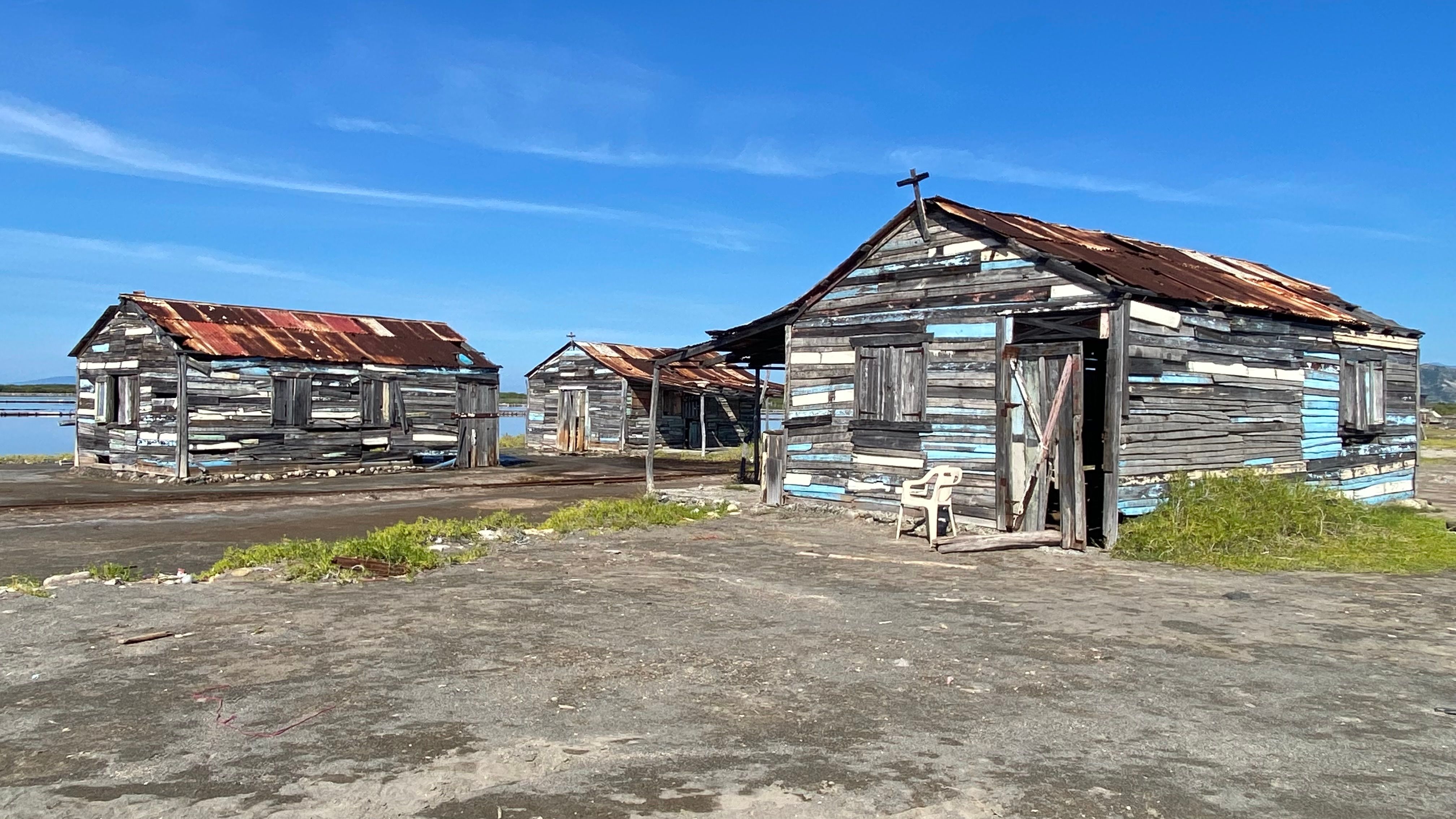
The narratives about the camp years go through a description of the canvas shacks, which were housing for the families camped for four years. In addition to the women 's reports about the shacks, Ernestina and Noca also showed some photographs of the family that show what their internal and external appearance was like. The biggest highlight was the adaptations carried out by the campers, who were directing this cartography towards the production of questions regarding the meanings of what housing is or what "home" is. This directed cartographic attention to the difference constructed by the memories of these subjects who, fleeing from ready-made packages, standardized models and stratified knowledge, produce new agencies, new ways of living, new territories (Deleuze, Guattari, 2017c) to call "home" or "house".
In this way, the production of life, which follows the movements of the flow of desire, as Colebrook (2002) puts it, is not limited to what is seen, but questions itself about the possibilities that may exist in the future, the becoming, the potentials, the paths not taken. Therefore, producing life through the struggle for land is diving into the unknown, which is the camp in a new space, producing the house under canvas shacks (Sigaud, 2009), and thus producing life from the difference or potency (Deleuze, 2018). Opening up to other productions, work on the land, but also to the absence of stratified elements produced as necessary for the production of life, such as running water, electricity, basic sanitation.
When talking about the period in camp, the first reference that the women interviewed make is living in shacks. What was also part of the constructions we carried at the beginning of this cartography, that camping is moving away from urbanity, putting oneself under the protection of a tent, without amenities such as electricity, running water, in contact with nature. However, this sense of camping exists as something temporary, a momentary living, just days, an escape from urban hustle, and the search for contact with nature, but which will end when it is necessary to resort to the elements of urban life to work, both domestic and professional. It is from this construction of the camp that we receive the reports produced by the participants of this cartography, clashing with the perception that life is not produced in the long term in a camp.
In this process of production of life, it was necessary to leave the life produced in the city, to open up to a new way of living in the countryside, as a landless worker, living in a camp, carrying out activities, as components of everyday domestic life, in canvas shacks. Zefa points out that they lived in the shacks for about four years, "we spent four and a half years under a shack, a canvas shack". Zefa also commented that after this time, around 1990, families began to spread out across the farm, dividing themselves by the places where their future lots would be.
Thus, hearing about the shacks, their appearance and adjustments made by the families opened up new sensations, in the midst of an apparently known landscape, of the dwelling of landless workers in the camps, but which was being rediscovered by the contrast with the dwellings in the city, that even the simplest ones are still constructions in wood or masonry. About the appearance of the shacks, Dinah describes her impressions the night she arrived at the camp with her two young daughters.
On the day I arrived, I'm glad I arrived at night and very tired, because the shack was, it wasn't very high, and then João Paulo (her husband's pseudonym) had covered it with coconut leaves, I think to make it fresher and then put the canvas on top and there was a little piece of leaf hanging. And it wasn't very big either, it was tiny because it was just him and the boys, right, after we arrived it got bigger; those things that you kept seeing were a:: a platform with a mattress on top. (Dinah).
Something that caught the attention of Dinah's description was the detail that her husband included in the construction of the shack. The construction of the shacks only with the canvas made it inefficient to protect against the wind and the cold, and also during the day it was not the best place to protect against the sun. By including other elements in the construction of the shacks, such as coconut leaves, the campers produced their living conditions, creating breaks in the lines of segmentarity, creating lines of escape from the stratified uses by the social machine (Deleuze, Guattari, 2017a).
We understand that needing to produce one's existence living in canvas shacks, fighting for the right to access better living conditions, is to force previous living conditions on the subjects, making it difficult and hindering the path that leads to a revolution. Thus, living with the whole family in a small shack, sleeping in a bed that, in Dinah's description, was "a platform with a mattress on top", the subjects act with cunning to overcome, even minimally, the difficulties that come with the fight. Following the multiplicity that constitutes the field of immanence, the subject produces new knowledge, such as the use of other materials for the construction of shacks.
Understanding that the production of life living in canvas shacks portrays the struggle for the right to access better living conditions is not to ignore all the obstacles and difficulties that mark this path of a revolution in the conditions of production of life. Thus, by introducing other elements and materials in the construction of housing in the camp, these subjects produce other refrains, which set new rhythms throughout the territory. Deterritorializing from the old senses, and reterritorializing from new materials and space, following the multiplicity that constitutes the field of immanence and seeking to overcome, even if minimally, the difficulties that accompany the struggle for land. In addition to coconut leaves, Dinah presents the use of another material in the construction of shacks.
We lived in an aluminum shack that gave people shocks when it thundered and you were leaning against the wall (laughs) [...] It's (made of) this milk carton, you know, these, these materials, you know? So the shacks were made of that, some, right, there were some that were still made of canvas, but it was more resistant, they were more cute, only when it was thundering that it wasn't. (Dinah).
Producing new agencies in the construction of housing in the camp reveals the inefficiency of the canvas shack in fulfilling its housing role. This finding was recurrent in the reports of the participants, showing that, given the adversities of life in the camp, the shack represented a major problem for the safety of families. Thus, driven by this need, the subjects produced adaptations and new uses for materials, such as those used in the manufacture of milk cartons (Tetra Pak packaging or carton packaging). Thus, the aluminum shack in Dinah's description was built with "those milk cartons, it was like a milk carton, it was huge, right, those big rolls that made the houses" (Noca). It caught our attention, as this is not a material often associated with the construction of shacks. Its origin was also not specified by the participants, but not everyone had access to this material, as highlighted in Dinah's speech, who points out that some shacks were still made with canvas.
Adapting the shacks guaranteed greater durability and resistance to the houses, also ensuring the comfort of the residents, "the house that used to be like that was cooler, it wasn't like those black canvas houses, you know" (Noca). Even solving the heat problem during the day, the canvas house was still inefficient to protect residents from heavy rains and winds. The arrival of storms increased the problems and concerns of the campers. Joana says that "the wind took the shacks of many people", because during the rains "that wind would come in and then you see that whirlpool, and then it would enter the shack and as it was black plastic, the shack would burst, wow." In her description, Joana draws attention to the noise of the wind and rain in the shacks, "a lot of noise, no one could hear (anything else)" reinforcing the discomfort of having the shack as a home.
Listening to the narrative about the storms and the destruction of the shacks makes us think about the desperate situation these people found themselves in, far from the protection guaranteed by a house made of brick or wood, totally subject to the action of time, powerless in the face of this situation. To produce life in the camp was to produce refrains with the difficulties of wind and cold, lack of drinking water, hunger, malnutrition of children and diseases. Thus, reterritorializing the house in the shacks is to produce other meanings for domestic work, for childcare and for the fight for the right to produce life in the countryside.
The women's narratives about the canvas shacks gave us a melancholy condition, because even before starting to carry out research with landless workers, we already knew, from hearing about, the housing conditions of the MST camps. Even so, when approaching these people, it was not possible to remain indifferent to these reports or the sadness they produced. Unlike city dwellings which, despite being simple, were wooden or masonry constructions, with electricity, running water and sanitation, the shacks barely protected from the wind, rain, cold and sun. When talking about living in the camp, Dinah describes the shacks as low, "it wasn't too high", the family shack had been covered with coconut leaf, "I think to be cooler and then (he) put the canvas over and then there were those little pieces of leaf hanging". During the day, the shacks were very inefficient in protecting the residents from the heat of the sun, so, by adapting their construction, inserting other elements, the residents of the camp produce their living conditions, similarly to the rhizomatic effect expressed by Deleuze and Guattari (2017a). Along with these new housing conditions come new forms of work, especially domestic work that was a task for women and which we highlight in the next topic.
4.2. Women's work and life in shacks
When Joana tells about life at the camp, she points out that "it was not easy at first, we drank water like mine water, water without filtering, without knowing anything, it was like that, we drank water without filtering" (Joana). In her highlight of the difficulties, Joana points out the type of water that was consumed by the camp's residents. This water was also used to do domestic activities such as cooking, washing clothes and dishes, elements that make up the productions of the social machine about what women's work is.
The women's reports, the memories of their times in the camp are full of elements that constitute the strata of being a woman, the constructions of meanings that relate household chores and childcare as the "role" of women. Thus, life in the camp was produced by these lines of segmentation that place women in charge of taking care of their children and the house (shack). The men, in turn, took care of the work in the fields, preparing the land, planting, harvesting and selling the products. While women directly experienced the restrictions imposed by this new way of producing life, as in Lurdes' description they were "the ones who stayed at home the most", men needed to go out to "try to get a donation, to sell things, in a rush, and the women stayed here".
Such restrictions increased the effort made to carry out chores, as Joana puts it, when she says that tasks such as washing clothes were carried out in the mine, "I used to wash clothes like that, in the mine". Drawing our attention to the fact that the emphasis of your report is not on the difficulties imposed by the social machine, which in its stratifications delimits and imposes what is the role of women, but that the difficulties faced by women in the camp were in the absence of amenities as washing machine and running water. Even though such amenities do not nullify the lines of hard segmentarity that define domestic work as a woman's "role", they facilitate the development of this work, making it less uncomfortable or less painful. Thus, if life in the camp demanded even more from women to do chores, this requirement exists through the reproduction of refrains of delimitation of existential territories of Being a Woman.
Aspects related to the roles imposed on women in the MST is a subject that has been discussed by other researchers, such as Santos (2019), Silva (2003) and Gonçalves (2009), who highlight the dichotomy existing in the history of the MST, which, at the same time that it struggles for a fairer and more egalitarian society, it reproduces the oppression of defining what it means to be a woman. It is in this sense that Silva (2004: 280) highlights in his study domestic tasks as belonging to women, producing the house as "a gender boundary". Thus, even with the questioning of the MST leaders about the little participation of women in representational work, the author emphasizes that "it is important to think that, if the house belongs to women, the rest seems to belong to men", this sexual division of works provides women with "commissions" in the organization of the camp, such as health and education, while production and finances are run by men (Silva, 2004: 280).
Amid the constant production of meanings of what it is to be a woman, mother, wife, worker, and the exclusion of elements from urban life and the inclusion of other elements that directly interfere in the execution of "female tasks", subjectivities of these women in the camp were produced. A subjectivity produced by women who renounced the products of a social, oppressive, generalist machine (Guattari, 1985), which ignores their difference as a woman, but which produces amenities, facilitators and normalizers of this defining segmentarity (Deleuze, Guattari, 2017a) line of the woman's role. Thus, it is understood that refrigerator, gas stove, washing machine, running water, electricity, are presented as elements that would offset the oppression of the definition of Being a Woman as economically active, but which is also responsible for the house and children.
In the initial period of the camp, at "two in the morning, I used to scream: the police are coming, (we were) the fools who picked up their children and walked to the street, even at the gate, wasn't it? We had to walk, son crying" (Lurdes). The responsibility for caring for their children made these women live with insecurity and fear of police action, in addition to their task of taking care of the house and children and the demands that accompany the struggle for land. They had to prepare for possible police action, but at the same time, be concerned about the needs of their children, given the hunger and cold that accompanied life in the camp. In this sense, the description made by Lurdes emphasizes that women heard their children "screaming because of hunger and cold, who saw their children crying because of hunger", increasing their demands and concerns in caring for their children.
But, how to take care of the house and children when there is no food? Depending on donations, the campers divided the food among the families; in these divisions the young children who needed milk were the most affected. Ernestina's account of the camp brings food as something that was not constant in their lives.
[...] sometimes there was something to eat, sometimes there wasn't. I remember that my oldest girl, for breakfast, she would grind some corn, right, and make hominy, then cook to eat, right, that's what we had to eat. And we received a lot of donations, right, we lived on donations, because as I was here, no one could go out to work, right, we had to stay here. (Ernestina)
Food donations were what guaranteed the little that the camp's residents had to eat, however the donations decreased over time, increasing the difficulties of the families. With the planting that started right at the beginning of the camp, the residents were also able to count on other foods. When production was sufficient, it ended up not guaranteeing a variety of food in the families' meals, which Ernestina highlights when describing a situation that occurred when the camp harvested the planted corn. Thus, the paths of escape lines for the campers were built, in their search for a change in living conditions through access to land, which also followed many lines of segmentarity, through strata that accentuated the difficulties of production of subjectivities, mostly women.
In Ernestina's speech, the issue of work also drew attention, as in the struggle for settlement on the Ipanema Farm there was no possibility of going out in search of work outside the occupied lands. Even the exits from the camp were controlled by the organizers, and the whole family was not allowed to leave, guaranteeing the possibility of returning to the camp if prevented by the police. Thus, the production of new meanings or subjectivations (Guattari, 2006; Guattari, Rolnik, 1996) occurs through assemblages that are essentially territorial (Deleuze, Guattari, 2017c).
The production of meanings for these workers was deterritorialized from other forms and working conditions, which required the search for new territories, thereby producing new meanings and agencies. In this way, they reterritorialize in working the land and the family and in selling their production, new assemblages, which are in constant movement through this territory, characterizing the refrain for Deleuze and Guattari (2017b; 2017c), which is a constant development of becomings, of becoming a woman, becoming a woman-mother, becoming a woman-worker without land, becoming a woman-camper of the MST.
Thus, more than the difficulties initially faced, the participants in this cartography reinforce the feeling of belonging and unity of the group, the unity that occurs in the face of life's difficulties and that day after day shaped their experiences and productions of life and the present experienced. For Ernestina, the beginning of the camp was also a good time, as there was more unity between people: "it was a very good time in the camp, because people were more united, right". Likewise, Dinah highlights the union and proximity of the families in the camp, which could have continued if they had opted for the settlement in the form of an agri village.
So the people were very united there, very close, right, I think that after the settlement left, this was one of the things that people felt the most, right, because then each one went to their lot and the people ended up taking care of their life, people distanced themselves a lot. So I think that was one thing, a negative point, when the settlement and the agri village issue came up, people didn't want it because they heard some negative agri-village stories and it turned out that suddenly no one wanted to stay in the agri-village, each one preferred to stay on the individual lot. But I think that in agri-villages we have some more benefits, right, but anyway we're settled like this. (Dinah)
Therefore, when the reports point out new ways of living the daily life, of producing and consuming what is imposed on them, it is not something that was in the past, isolated and inaccessible, but something that accompanies them, that produces them as subjects that has the fight as a constant aspect of the present. For the interviewees, the fight was not an aspect that was lost in the past or forgotten when relations with the city hall and with the administration of FLONA Ipanema (National Forest of Ipanema) were pacified, or when the lots were divided. The struggle is still daily for the maintenance of work in the field and the sale of products. In their daily struggle, the residents use, in their own way, what is imposed daily by the hegemonic forces, producing collective assemblages of enunciation from the struggle. Thus, it is possible to infer that the memories present in the production of subjectivities of the participants allow the construction of their existence, ignoring the machinic capitalistic productions. It is from movements of flight, breaking with the capitalistic stratifications, that these women produce the cycles of being a worker, of being a rural dweller, of Being a Woman.
V. FINAL CONSIDERATIONS
Continuing through the reinterpretation of the act of living in the productions of the subjectivities of the residents of the Ipanema settlement in Iperó/SP led to the encounter of the elements: canvas shacks, hunger, food, housework and family. The production of these elements in the participants' memory was loaded with other elements that shape life in the city, placed as elements of comparison in these narratives, highlighting the breadth of the difficulties faced. Thus, looking at living is to perceive the movements produced by the subjects, the flows of desire, the desire for life, which was and is ignored by the social machine.
But, the dynamism of the flows and movements produced by desire cannot be erased, these flows of desire struggle to free themselves from the limitations and impositions of paths, producing a rhizomatic multiplicity. These movements produced by the flow of desire design multiple ways to produce life, which prevents us from understanding the subject as the one who passively accommodates and accepts the impositions. But to understand the subject from the understanding of the rhizomatic multiplicities produced by the flows of desire, is to understand the subject as the one who can break the segmentarities, opening up to the power and to the multiple possibilities of production of life. In the situation mapped in this article, we found in the memories produced by the women the productions of life as landless workers, as campers with canvas shacks as housing, needing to reinvent the meanings of domestic work.
However, in the situation of women in the camp, this multiplicity did not distance itself from the regime of abstract machines produced by a capitalistic order, delimiting the roles and unconscious representations of Being a Woman. Thus, we find in the participants' memories a reterritorialization of the suffering of Being a Woman. They began to accumulate other obligations, and must find, despite the exhaustion of domestic work, the insecurity and limitations of lack of food, reasons to continue fighting for the land. A fight that can guarantee them a space to live and work, but that will not transform the delimiting strata of their condition as a woman.
Looking at these memories produced in times of struggle makes us question the production of industrial subjectivities, which naturalize roles and which remain firm even with the production of other existential territories. In the end, we understand the importance of looking at the questionings of the capitalist order and its productions, to understand to what extent it interferes in the productions of our unconscious representations.
Conflict of Interest
The authors declare no conflict of interest.
Ethical Approval
Not applicable
Data Availability
The datasets used in this study are openly available at [repository link] and the source code is available on GitHub at [GitHub link].
Funding
This work did not receive any external funding.
References
Cite this article
Related Research




Special Issue
Launch a focused special issue to highlight research, emerging trends, and expert insights in your academic field.
