


IntelliPaper
Abstract
The use of arts to communicate and express values is seen in the cultural life across many African societies; they are symbolic and identify the people by narrating their customs, traditions and history. These arts are featured in the celebration of many festivals and some contribute to the level of reconciling people and resolving conflict. One popular festival in Ghana that is noted for using the arts as a symbolic role in resolving conflicts is the Apoo Festival, which is celebrated by the people of Techiman in the Brong Ahafo Region of Ghana. This study sought to investigate into these arts and how they are used as a symbolical aid during the Apoo Festival in resolving conflicts .Non-participant observation, personal interview, and focus group discussions guided the collection of data from 51 participants consisting of traditional authorities, traditional priests, elderly respondents, and the youth. The findings concludes that the use of arts as a symbolic element in aiding the Apoo Festival to project the message of peace to the community is indispensable.
Explore Digital Article Text
I. INTRODUCTION
Art is used in cultural events such as festivals, which are normally held at frequent intervals, often in one place. The arts used include the visual arts, verbal arts and the performing arts. Art and culture are connected and complement each other. They are closely linked and cut across cultures of different people. The use arts in festival celebration play significant roles, including; social, religious, economic, and others, in the lives of the people.
Due to this significance, several discussions and studies have been conducted on festivals. In his thesis, "the religious and philosophical perception of communal meal 'otor' as a strategy for conflict resolution: a case study of Worawora in Ghana," Otu (2013) focused on how this communal meal aided in resolving conflict in Worowora. Aside Otu, other writers have written on festivals, but not necessarily tackled some artistic elements in those festivals that could be used to manage conflicts. Although arts play a pivotal role in the celebration of the Apoo festival of the people of Techiman, studies of the literature on the festival reveals that the artistic aspects of the festival have not been adequately and extensively treated by scholars and less attention has been given to the artistic elements of the Apoo festival. The rich heritage of oral records that is passed onto generations is gradually losing certain components in the festival and very soon the realization of the artistic roles and essence of the festival will die off. But with all these, not much is said specifically about the artistic elements in the Apoo festival of Techiman and how they are translated as a tool for managing conflict. This gap is what this paper tries to bridge by going into details and reflecting on the subject of arts (artistic elements) as an integral part of the Apoo festival.
II. BACKGROUND OF THE TECHIMAN PEOPLE AND ORIGIN OF THE APOO FESTIVAL
The Apoo Festival is an annual festival held in Western part of Ghana, specifically in Techiman. This occurs for a week within the months of April and March. According to Nana Baffuor Asare Twi Brempong ll, the Adontenhene of Techiman Traditional Area, the festival is celebrated to ritually cleanse the people from social evils and unite the community through other traditional cultural activities associated with the festival. The word 'apoo' is derived from the Akan root word 'po,' which means 'to reject.' The festival is strongly associated with the Bono movement (including the communities of Nwoase, Wenchi Nsawkwa) predominantly in Techiman.
According to oral traditions, the eleven day annual Apoo festival of the Techiman people originated from the peoples resentment against the harsh system of rule in the early Bono Manso State implemented by the paramount chief of the sate, Ohene Ameyaw Kwakye I (1712–1740). Nana Baffour Asare narrates that the Rich and powerful Ohene Ameyaw Kwakye I was so fearful and autocratic that his subjects could not exercise their democratic rights to express their opinion about his bad governance. The only person with an opinion was the Okyeame (chief's spokesman) whose thoughts and wishes were absolute. He was the king's only medium of contact to his subjects. The king's two princes capitalized on their father's position and looked down on the people with disrespect.
Selfish, ostentatious and extravagant Ohene Ameyaw Kwakye I ruled with iron hands, he exploited his people to build "Sika Putu" a small shed for the storage of gold nuggets.
The Techiman people, filled with apathy, began to die from a psychological illness called "Sipe" a stressed induced sickness. This was because they were compelled to keep mute over the harsh system of governance by Ohene Ameyaw Kwakye I and his sons. The cause of the "Sipe" epidemic was relayed through consultations with various shrines including; Ntoa, Kontwematwefo, Atiatwefo and Segudo.
To remedy the situation, these shrines advised the people to voice all grievances against the king and other leaders without any penalty. Out of fear, the people disguised themselves with animal skins feathers, masks, smocks, wood ash, charcoal and other paraphernalia as they sang proverbially to dispose their innate feelings. Fortunately enough, people went unpunished in the first grievancevoicing out performance, hence, from another term for the Apoo which Rattary in his book, Asante p.153 identified as Attensie which means to speak harshly to, insult or abuse. the occurrence of this festival each year to repudiate troubles and evils in the Techiman Traditional Area.
Again, in the Akan language, "Po" means to discard, throw away or reject and therefore "Apoo" literally means rejection of what is bad or evil. The Apoo, therefore, reminds leaders to change for the better. This festival is also a means to lampoon the occupants and the traditional leadership vocally to remove the bitterness and misfortune the citizens have for the state and renew peace and harmony among the citizenry through songs.
III. HISTORY AND ARTISTIC BACKGROUND OF TECHIMAN (FROM BONO-MANSO TO TECHIMAN)
Techiman Traditional Area is located within the Bono East Region of Ghana. It shares common boundaries with Wenchi Traditional Area to the North and West, Mo Traditional Area to the North-East, Nkoranza Traditional Area to the South and East, and Offinso Traditional Area (in the Ashanti Region) to the South. Techiman hitherto known as Bono Manso was the home to Akan people, and centre for Akan culture and traditions.
Bono Manso also spelled Bono Mansu, was one of the earliest towns of Bonoman, established by Bonohene (king of Bono) Nana Asaman and Bonohemaa (Queen of Bono) Ameyaa Kesse in the 11th century after migrating from the Amowi cave. Nana Asaman was the head of the Ayoko/Çyoko abusua. Bono is denoted as pioneer, therefore Bono Manso means "place of the pioneers" or "on the place/state of Bono". Bono Manso was the capital of the centralized Bono state/Bonoman of West Africa. It was situated on the northern boundary/forest savanna transition of the Akan world and was an important political, economic, and religious settlement. It grew into a large multi-ethnic merchant center which developed during the periods of transcontinental sub-
Saharan trade. Bono Manso and its surrounding villages were positioned along trade routes that was initially linked to the Inland Niger Delta cities of Djenne, Timbuktu and Gao.
Muslim Dyula/Mande/Wangara merchants from the Malian Empire and Soninke traders traveled to Bono Manso with textiles, salt, and brass which they exchanged for gold, kola, and slaves. This exposure helped the Bono people to participate in long-exchange networks in around the 13 century to 17 century with Sudanic merchants over much of West Africa.
Bonohene Akumfi Ameyaw 1 introduced Fontomfrom and Atumpan drums from North Africa in the period of 1320s. The earliest brass casting at Bono Manso was likely in the 14th to 15th centuries which included; bells, gold weights and jewellery. Bonohene Obunumankoma (1363–1431) played a pioneering role in establishing gold weight (abrambo) and scales/balances(nsennea), and introduced gold dust as a currency. Later, when European merchants arrived in Gold Coast in 1471, one of their objectives was to cut the Muslim/Mande middlemen out of the gold trade by procuring gold materials directly from the Akan goldfield traders, by establishing trading outposts along the Coast or Atlantic coastal settlements.
Bonohene Afena Yaw (1495–1564) is credited with, and whom the Afena swords (courier swords) were created in his name. Bonohene Akumfi Ameyaw II(1649–1659) is credited with introducing the double decker umbrella known as Bidabiakyi/Bitebiso. In fact, all the Bonohenes and Bonohemaas played an important role for Bono Manso, and Bonoman as well as Akan. Their achievements and legacies were unmatched, which contributed to the success of Bono Manso. Bonohene Kwakye Ameyaw was installed in 1712, he was known for erecting the Golden Wall. He was very affluent, and was compared to Mansa Musa of the Mali empire in terms of wealth. This earned him the appellations/epithet; "Kwakye adeæ a εfε, yεde sika na εyε" which literally means Kwakye's wall is beautiful but it was made with gold. "Ameyaw odi sika atomprada". During the period of 1690s, some asylum seekers from
Amakom fled from the attacks of Asantehene Osei Tutu l due to chieftain dispute. They were Adu, Adu Donyina and Baffo Pim. However, Adu stayed at Kodie while Adu Donyina later died at Soaduro/Swedru. Baffo Pim, the nephew of Adu Donyina and his people however continued the journey and sought refuge in an area within the confines of Bono Manso. Upon arrival at the final destination in early 1721, Baffo Pim met some three old men who were the hunters of Bonohene, Kwakye Ameyaw. Their names were Sene Diamin, Dasi and Ampofo with their sister Duoduwaa Amane. It was from these old men that Nkoranza got its name, Nkora in Twi language is shortened from "Nkokora" which means "old men" whilst "nsa" stands for mmiensa(three). Nkoransa therefore means "three old men". Baffo Pim requested the three old men to appeal to the Bonohene to enable him stay at the village (Nkoranza/Akora San). The three old men also conveyed the message to Forikromhene, Kesse Basahyia, the Benkumhene to the Bonohene Kwakye Ameyaw. The request was granted. Baffo Pim used to attend to the royal court of Bono Manso to pay homage to Bonohene. During a New Year festival at Bono Manso in 1722, all the chiefs and other subordinates under Bonohene except Baffo Pim, had gone to pay homage to the king as traditions demanded. Baffo Pim was not able to reach Bono Manso at the expected time. His delay prompted one of the princes called Boyemprisi, Nkyeraahene, who rode a horse to find out what was happening, as the Bonohene was about to rise. When he met Baffo Pim on the road, misunderstanding ensued, Boyemprisi slapped Baffo Pim in the presence of his people. Bonohene heard of the incident, which he consoled on behalf of his son, and placated Bafo Pim. However Baffo Pim harbored the pain.
History indicates that on one event, the Bonohene Kwakye Ameyaw sent a gift of gold dust (worth £1000 at that time) to the Asantehene, Opoku Ware 1 via an emissary, Baffoe Pim. However, Baffo Pim swapped the gold dust for guns and gunpowder at the coast, to Asantehene Opoku Ware. When Opoku Ware received the gift being the guns and gun powder, he and his elders interpreted the gift as an invitation to war. Opoku
Ware waged a war on Bono Manso, resulting in its defeat in 1723. This defeat affected all the Bono states/cities/towns, disintegrating it into fragments. since Bonohene was the head. Baffo Pim was made the chief of Nkoranza and much of the territory of Bono Manso fell into Nkoranza.
3.1 Bono Manso was known for its industrial artistic refinement
Following the 1723 war, the Bono intelligentsia consisting of goldsmiths, craftsmen, weavers, carvers, musicians etc were taken to Kumase to teach the Asantes, including the Asantehene and his court, their arts and technology. After the conquest, some of the Bono Manso inhabitants fled to northern Togoland settling between Borada and Ahamansu –Papase; others went as far north as Kpembi in eastern Gonja and are called Mbong-Wule by the Gonjas. While others moved to Manso near Bekwai and form part of the Amansi state. Some too sought refuge in Gyaman while others moved to the founding town of Abease. Others went in different directions. Bonohene Kwakye Ameyaw and some of the royals fled to Amoma now in Kintampo for refuge and later moved to Buoyem while the heir apparent were taken to Kumasi.
The rest of the war survivors fled to the nearby town of Techiman, and revived it. Techiman also spelled Takyiman succeeded Bono Manso in 1740 as a vassal to Asante. Takyiman had been established by Nana Takyi Firi, a royal of Bono Manso and a son of Taa Takyiwaa. So after years of chaos, Ameyaw Gyamfi, a prince of Bono royal lineage and Ameyaa Adiyaa, a princess who had lived in hiding for years near Forikrom, returned and ruled as Takyimanhene and Takyimanhemaa in 1748. Most of the Fantes had fled to the Coast and still more left upon Gyamfi's arrival. Robbed of its craftsmen, singers, drummers etc, Takyiman became a backwater. Yet they did their best to revive the glorious heydays of renaissance and prosperity and this has translated into the present as Techiman is known as the "food basket of Ghana" due to its historical trading impact.
IV. METHODOLOGY
The study sought to give an account of the celebration of the Apoo festival of Techiman, to identify and investigate the categories and roles of art in the festive celebration specifically emphasizing on its significance to the symbolic reference of conflict resolution. Due to the anthropological nature of the study which describes and discusses the artistic expressions of Apoo festival and its symbolic significance in conflict management, the research question was strategically answered by the qualitative research approach. This research method allowed the researcher to discover the in-depth motivation of celebrating Apoo festival, identify the categories of art that play a role in the festival especially in the symbolical commemoration of conflict resolution. The search for authentic, adequate and related literature esoteric to the study took the researcher to a number of public and private libraries in the country. It becomes a challenge when most libraries in the country have no records of authentic documented information on the topic of study. Therefore the researcher visited selected institutions including the Ashanti Library and the Manhyia Archives which basically houses classified documents of history with limited public assess. The Chiefs, Elders, the Traditional council Registrar, Traditional Priest and Priestesses and Queen mothers' in the Techiman Traditional area constituted the target population of the study since they are directly connected to the Apoo festival. The target population was 105. It consisted of 30 chiefs, 15 traditional priests and priestesses, 25 queen mothers in the traditional area 5 people from the traditional council and 30 elders and senior citizens who were involved and familiar with the festival. However, due to limited time and schedule constraints, the population accessible for sampling and study was 26 which comprised of 15 chiefs, 2 queen mothers, 2 traditional priest, 1 traditional council registrar, 6 elders and senior citizens Interview and observation were tools used to collect data on the historical details and significance of the Apoo festival celebration from the respondents. The respondents preferred interview over questionnaires due to interesting reasons including; The need to be comfortable in expressing themselves better without any restrictions than to answering questionnaires.
Most of the respondents were not literally inclined making them not eligible to answer questionnaires.
Some of the questions needed to be probed further for clarification in order to get the right information.
As a measure not to deviate from the purpose the study, an interview guide was prepared by the researcher to serve as a checklist which contained twenty-five questions which sought to find out from respondents how the Apoo festival was celebrated; the activities involved in the celebration and the category of arts implored in the festival, the link contributing to conflict resolution. The criteria that the researcher used to select respondents for the interview were:
The respondents' involvement with the festival being recent and not outdated.
The respondents should be knowledgeable about the festival celebration and the activities involved.
Variety of incidence and activities relevant to the study in the celebration of Apoo festival were observed and photographed by the researcher to help him collect, document and appreciate information for future studies and reference. observation was a major tool because it enabled the researcher to gain knowledge and attain firsthand information of the Apoo festival celebration.
Primary data was collected from the field through interviews and observation covering the history of Apoo, the origin of the Techiman people, the category of the arts that plays a role in the festive celebration, the processes and activities involved in Apoo Festival. This information was collected through resource people who make up the population of study including; traditional priests, chiefs, queen mothers, senior citizens and elders in the Techiman traditional area. Primary data constituted all the formation that were gathered and used directly to answer the research questions.
Secondary data was basically gathered from libraries and other literary sources including; textbooks, journals, periodicals, internet among others. Copies of the interview guides were given out to the respondents and with the option to come out with a date and time to enable the researcher come and conduct the interview. Data gathered for this study was mainly by the researcher himself. Data gathered from the study field and resource people were analyzed, synthesized, discussed, translated and conclusions were drawn. The descriptive method of qualitative research was employed in analyzing the data.
V. CHRONICLES OF THE APOO FESTIVAL
Information from the interviewees revealed that the celebration of Apoo festival is divided into three ceremonial parts:
Pre-Apoo
During Apoo
Post Apoo
5.1 Pre-Apoo
The celebration of the Apoo festival is heralded in by the declaration of "Adamuasi", thus a month-long ban on drumming, and any other forms of noise making. This is the time for the gods, spirits, the people and the state to be consecrated through rituals. Hence, during the celebration of the Apoo festival, all funerals to be held are suspended until the festival ends. Again, during this period, people are prohibited from publicly drumming, singing and dancing until the "spirits" of the Apoo festival are brought from the Royal Mausoleum by the Omanhene and his sub-chiefs in the traditional area especially the Bamuhene (Chief of the Royal Mausoleum and custodian of the Ancestors). People who violate these traditional norms are sanctioned and punished severely according to the dogmatic settings of the land after the festival. Preliminary activities before the main celebration of the Apoo festival is the responsibility of the chief Priest and Adontenhene (chief or Army general in the frontflanks during wartimes) of the Techiman Traditional Area. Such activities were categorized as a major spiritual aspect of the festival. This ritual starts from Fofie (ritual Friday). The Obaapanin of ABamu (queen mother of ABamu) and a group of women go to River Aponkosu to collect Hyire (white clay or kaolin). The kaolin fetched is used to paint the walls of the shrine. When the kaolin is brought home the Paramount chief is summoned to observe it and after that offers the people refreshment and money. Once the koalin is brought home it marks the beginning of the sacred days Adamu (forty days). In the olden days kaolin was used to paint the house to beautify it as visitors were expected to be returning home for the celebration. The paramount chief places a ban on all forms of noise making including funerals during the forty days before the celebration of Apoo festival.
The next day is for the removal of stumps (Nnunsintuo) by the chief priest, Taa Mensah Bosomfoo. That night the chief Priest and his priests surveys all the routes in the town where the various chiefs will be passing during the celebration to remove and destroy all charms supposed to have been put in place to harm innocent people both the celebrants and visitors in town who will come to witness the celebration and also to pave the way for smooth festival celebration (figure1.1, The chief priest performing nnisintuo rituals, Source: Photograph by researcher). On the last Thursday of the forty days, all the chiefs, the queen mothers and the priests meet at the Adontenhene's palace. The chief priest and the Adontenhene mix about 77 different kinds of herbs (figure1.1 traditional herbs in a pot, source: photograph by researcher) for all the chiefs and queen mothers of the land to drink and bath. The philosophy behind the drinking and bathing of these concoctions is serve the purpose of fortifying them to make them physically and spiritually strong. After bathing the chiefs, queen mothers and the priests try their strength by wrestling amongst themselves [figure1.2, Chiefs trying their strength in wrestling form (mock fighting) Source: Photograph by researcher]. All start from the last 'Sacred Friday' which is called 'Adamu Fiada' in the Celebration week. It is that same Friday night that the chief priest and all the chiefs including the queen mothers go to the Bamu (sacred forest/groove) for some rites, clandestine for public consumption to thank the ancestors and ask for a successful celebration (Figure 1.3, the chief priest leading the chiefs to the Bamu/ sacred forest to preform rituals marking the start of the Apoo festival). According to the chief priest, In the sacred forest libation is offered and two rams are slaughtered as oblation to the gods. The first one is brought by Bamuhene (the custodian of the mausoleum) and the other one from the Paramount chief. Other rituals are performed in the sacred forest not disclosed. The traditional entourage usually return after performing all the rituals in the forest around 2:00 am with singing and dancing to mark the beginning of Apoo festival celebration. The Apoo festival celebration officially begins from the entrance of the Sacred Forest after the the ritual section.
5.2 During the Celebration of Apoo Festival
Apoo festival is regarded as an art of democracy as it is happening in modern governance, Nana Gyasi a traditional elder of the town affirms this by saying that indeed the Apoo is an epitome of a "Cultural Democracy" to the extend that even children are involved by also participating in speaking out their grievances. This democracy therefore gives community members the opportunity to express themselves, air their views or share their opinion about the attitude and behaviour of the chiefs, leaders and individuals within the community in through drumming, singing and dancing in a proverbial and jovial manner.
According to the interviewees, eleven (11) days are set aside for both the night and day Apoo festival celebration. Findings from the interviews and observation revealed that Apoo festival celebration is divided into two celebrations; Night Apoo festival celebration and Daylight Apoo festival Celebration.
5.3 Night Apoo Festival Celebration
After the preliminary rituals, drumming and dancing in the night is initiated. This is the time people learn how to drum and compose songs for the day light section of the Apoo. These rituals open the door to the singing of the Apoo songs which also help to complete the cycle for the festival. Normally, it begins at dawn on Saturday. The Bamuhene with his people start the Apoo from the Sacred Forest through to the Paramount chief's palace. During this period no one is expected to celebrate Apoo in the day time, so during the day everyone engage in their routine daily chores. The night Apoo is performed in all the communities for four (4) days, starting from the Friday to Monday evening. During the night celebration, people play drums, dance and sing in the various communities, across houses. The relevance of the night celebration is a grace period the celebrants rehearse and train community members both young and old, the art of drumming, rattling and traditional songs.
5.4 Daylight Apoo Festival Celebration
According to the queens interviewed, Monday evening marks the end of Night section of the Apoo Celebration. The duration of the day Apoo celebration session lasts from Tuesday to Sunday. Aponkotwie marks the beginning of the day session of the Apoo celebrations which involves the chief priest and acolytes in the traditional area to making sure the entire community is safe spiritually for peaceful celebration. This is event involves ritual performances after visiting the royal mausoleum for the Apoo celebration. Before the celebration, the shrines of the various resident deities according to Komfo kwame (Ta kesse, Ta Amoah, Ta Kwasi and Ta Mensah, Ta Toa, Ta Toa, Ta Kojo, Ta Kofi, Ta Kuntum, Kum Aduasia, Ati Akosua, Obo Kyerewa, Asubonten) are paraded through the principal streets to the forefront of the entire chiefs who will be waiting with drinks or eggs for the chief priest to offer prayers of blessings and protection for their families. The significance of this ritual ceremony is to check after the Nnunsintuo (removal of stumps) that the roads are clear to receive invited guests and visitors and also to appeal to the ancestral spirits for safe grounds to carry out the Apoo festival celebration peacefully.
After the shrines of the deities are paraded, there is a semi-durbar at the forecourt of the chief priest's palace. Each chief presents Schnapps for prayers to be said for them, their families and the entire community.
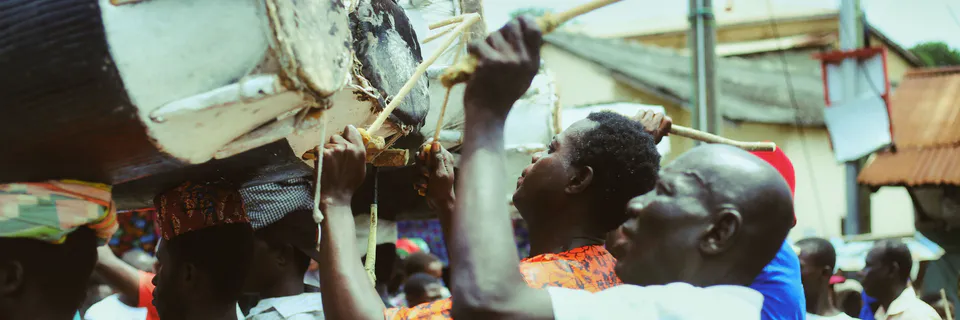
During this period, individual communities' chiefs, elders and community members perform at the Apoo festival celebration by singing and dancing with fancy dresses, some in masks of different disguise themes (figure 1.4, Section of Communities singing and dancing in the celebration of Apoo festival, source: photograph by the researcher). Opanin Kyere Kese, an elder narrates that in the olden days, chiefs and elders were not obligated to travel all the way from their communities to the Omanhene's (paramount chief) Palace to perform the Apoo but currently, to grace the festival in a grand style, chiefs are summoned with their subjects to pay their allegiance to the Omanhene. When it get to the turn of a chief, all the community members escort the chief with different kinds of Apoo themed costumes, predominantly smocks, singing of Apoo proverbial songs. Dancing begin from the high street of Techiman to the end of the high street before moving to the royal palace of the Omanhene. As the festive troops parade, amid singing and dancing along the principal street, and they can detour and enter any chief's house with greetings. The two chiefs will then dance together, embrace each other and offer celebrants drinks before seeking for permission to continue the celebration on the principal streets. This continues till they get to the Omanhene's palace. The Omanhene also has a special day for his Apoo festival which is also the climax of the celebration. usually, Fridays climax the celebration. Since the Omanhene is the head of all the sub-chiefs in the traditional area, all the sub-chiefs come to the royal palace to celebrate the festival with him. During that time the divisional chiefs and the celebrants also get opportunity to tell the Omanhene his wrong doings through singing and drumming. The following, Sunday all the traditional priests and priestesses in the traditional area perform the Akom Dance (fetish Dance). During the Apoo, the chiefs dress in smocks or similar clothes that would allow free movement in dancing. However, the chiefs and their community members process through the principal streets with ceremonial umbrellas on them, holding 'bodua' (whisk) and playing 'firikyiwa' (castanet) accompanied with singing of Apoo songs, drumming and dancing. The community meet at Abamu palace (the Chief Priest's Palace) to perform their Apoo through drumming, singing and dancing. The principal deities of the land; 'Taa Mensah', 'Tano' and 'Twumpro' are carried out to the Paramount Chief's Palace with drumming and singing, a mist these activities, the Chief Priest gives revelations and prophesies.
5.5 Post- Celebration of Apoo Festival
After the celebration of the Apoo festival, the traditional authority including the Chief Priest and his team members perform some rites to send the Apoo to the sacred river, Tano to climax the festival celebration for that year. It is believed that all the wrong doings including immoral acts and conflicts which escalated between community members expressed through ceremonial Apoo songs have been buried into the river to let peace, unity and blessing from the Supreme Being and ancestors prevail in the traditional area.
5.6 The Categories of Art Featured in the Apoo Festival
The prevalence of the Arts in the celebration of the Apoo festival of the people of Techiman traditional area, is inevitable and thus; channels a symbolic role in culturally identifying the people of Techiman. Based on observations, it can be argued that art forms an integral part of the Apoo festival and the festival will make lesser impact without the arts. These arts featured in the Apoo festival can be categorized into; visual arts and performing arts. Due to limited time and space, a few of the arts from each category were selected for study.
5.7 Visual Arts in the Apoo Festival
Based on the historical background of the people of Techiman, it can be stated that they are recognized for their aesthetic impact in celebration of the Apoo festival. They have a great sense of beauty and this reflects in their culture and traditions. The visual arts identified in the Apoo festival were textiles, sculpture and body arts.
VI. TEXTILES (COSTUME)= FUGU OR BATAKARI (SMOCK)
The Apoo festival is popular for exhibiting colourful and fantastic smock costumes. The paramount chief and the divisional chiefs distinguish themselves with respective smocks throughout the celebration. During the Apoo, smock is usually combined with 'atwakoto' trousers and kufi caps (figure 1.5: celebrants in smock during the Apoo, source: photograph by the researcher). Smocks as costumes are used during the Apoo festival to show identity, social classification and aesthetics. The origin of the smock is consistent among the various northern tribes who are identified with it, since none of the tribe claims ownership of its heritage however, Northern tradition maintains that the Smock fabric was introduced into the region by the Moshie tribe from Ouagadougou. They were believed to have come into contact through trade to the North from the Upper Volta in exchange of woven pieces for kola nuts, millet, yam, rice, guinea fowl and other foodstuffs. The Bono people also came into contact with the Northerners through trading since Bono was at its peak of renaissance in the arts and commence. It is therefore possible that the Bono people adopted the smock fashion from the Northern tribes due to the rich cultural significance it portrays.
The smocks during this celebration has a unisex appeal and even women were observed wearing smocks to celebrate the Apoo (this was certain especially from the women who formed the lampooning band thus, they sang most of the Apoo songs). Also, To express disguise and anonymity, some of the celebrants put on tattered and dirty smocks to make themselves undetectable and invisible to the general public. Some of the celebrants also interchange the attire for the opposite sex dresses (cross dressing).
For instance, males wear female attire such as 'kaba' and slit with wig to hide their identity.
Smock is a woven fabric widely used by men and women in Ghana especially the northern part of the country. It sometimes covers the upper part of the wearer or better still from the shoulders of the wearer to the knee. To distinguish the traditional leaders and the traditional priests from the other celebrants, the costume for the above mentioned groups have amulets and charms fixed on them. These amulets and charms are believed to drive away evil spirits and therefore protect the wearer from physical and spiritual attacks.
6.1 Sculpture
Major sculpture works featured in the celebration of the Apoo festival includes; linguist staffs, stools, statues, umbrella tops, drums, dawuro (gong), masks and castanets. The sculptures used in the Apoo perform specific symbolic functions and not intentionally recruited for aesthetic purposes. A few major featured sculpture will be discussed below;.
that one head cannot go to counsel, and that it is improper for one person to make decisions for a an entire society. This implies that there cannot be progress in families and for that matter societies where there is no unity when everything is left on the shoulders of only one person. Therefore, families and people living in societies must live together in peace and unity and fight for a common goal in order for their communities to develop, since disunity and conflicts among families and groups hinder development and progress. (figure 1.6, linguist staff signifying unity, source) Through the Apoo festival, the staff reminds the people to remove all resentments and become one with the leaders and also advice the leaders that they cannot reign on their own without the support of their people, thus, a call for unity and reconciliation.
6.2 Spokesman's Staff
Okai–Anti (2010) explains that the spokesman's staff is the official insignia of the Okyeame (spokesman) and the symbol of his status as spokesperson, counsellor and advisor to the chief. The staff is a large heavy stick, rod, or pole with a carved figure(s) used as a symbol of authority in ceremonies. It is basically made up of wood and sprayed with black, gold or bronze paint. The Okyeame serves as a mediator between the chief and his subjects. During the initial stages of the Apoo celebration including; the Friday night procession of the paramount chief and his sub-chiefs to the Bamu for the Apoo, the ritual performances in the Adontenhene's palace and also in the durbar grounds, they are accompanied with the spokesmen and elders. There are several spokesmen staffs paraded during the Apoo festival. They have different symbols which serve as totems to represent the philosophies of the clan or family the chiefs originate from.
6.3 Tikoro Nko Agyina Staff (Three heads carved together)
This staff 'Tikoronkoagyina', is a three dimensional sculpture piece made up of three human heads carved together with each facing a different direction at the top. The symbol on the staff represents unity. This is further explained by Opanin Kyere that this particular staff reminds us
6.4 Mask
Masks have been used since the inception of the celebration of Apoo festival in the Techiman traditional area. It may be conjectured that the first celebrants used masks out of fear of being identified and victimized by the authorities. This has been maintained till the current days that people still do wear masks during the Apoo Festival not because of they are afraid but for the nostalgic historical relevance of disguise, protection and for fun during the celebration. (figure 1.7 celebrants wearing different masks, source: photograph by researcher) The cultural significance of the use of masks in the Apoo festival serves as a means of visual narrative telling celebrants and observers alike of the history of the evolution of cultural democracy through the means of artistic expressions.
VII. PERFORMING ARTS
7.1 Music
Music is featured throughout the celebration of Apoo Festival. It plays a vital role in the celebration of the Apoo festival. The element of music in the celebration is as old the conception of the festival. Apoo songs are more than ceremonial peripherals to the Apoo festival; they are indeed primary variables of foundational built to the festival celebration, thus without the element of music in the festival, it will have no meaning at all but will be just a mere event. The songs are dynamic forces which continue to give freedom through artistic-expressions; a form of democratic right to the people of the Techiman traditional area. During the preliminary stages to the main celebration of the Apoo Festival, individual celebrants as well as groups meet secretly to learn and rehearse songs for the celebration. These songs are basically composed of provocative lyrics in a form of chastisement of their leaders and neighbours. These songs are proverbial but insulting to those who are guilty of bad behaviour for them to change for the better. These songs give celebrants the opportunity to openly voice out their issues without the fear of stigmatization or intimidation by leaders affected by the words of the songs. People who are convicted by the words of the songs accept their faults and correct their imperfections for peace and unity to prevail. Obaa Panin Akua, an elderly woman and a member of the singing group who sings during the Apoo explains that, an important and interesting factor about the festival is that when leaders or elders are ridiculed through the Apoo songs, whether the lyrics of the songs are factual or fictional, singers cannot be prosecuted, either in the traditional court or by the law court. Consequently, the singers of the Apoo songs of protest are not to be blamed for the content of their songs; they are only reporting what they feel and think. For instance, lyrics of these songs were recorded during the festival celebration:
Song 1
"Asuoba gyae bebirebe yioooo "Gentleman desist from that bad behaviour. Na wo yenaa nyεooo All these behaviour you have Wo yenaa nye adwaman nti wo yenaa nyεoo put up is not good therefore stop it". Kofi ee, gyae bebirebeee wo yenaa nyεoo"
Song 2
The god, Ta Kese, says if we have anything to speak, let us speak it, For by so doing we are removing misfortune from the nation.
Your head is very large, And we are taking the victory out of your hands, O King, you are a fool. We are taking the victory out of your hands O King, you are impotent. We are taking the victory out of your hands. They know nothing about guns, The Ashanti know nothing about guns. Had they known about guns Would they have let the white man seize King Prempeh and Ya Akyaa (1) without firing a gun?
Song 3
We are casting stones at Ati Akosua (a god) The leopard Gya, the King's child, We are casting stones at him. How much more shall we cast stones At the child of the bush cat? (From this song it would appear that even the gods come in for some of the general abuse.)
It was believed that, songs sang at Apoo removed the feelings of guilt and resentments through the art of insults and criticisms and according to Obaapanin Akua, the individual soul became purified. From her explanation, it can be argued people were "reborn" with clear mind and new strength after the feelings of guilt and resentment were removed. The songs therefore conveyed moral lessons to the people not to hate one another but always try to resolve all differences and live in peace,unity and harmony.
7.2 The significance and Functions of the Arts in Apoo Festival
Based on the findings the significance of Apoo festival celebration can be classified into: the moral messages from the forms of arts and the significance of the forms of art in the Apoo festival celebration to the people of Techiman Traditional Area.
7.3 Projection of Moral Messages in the Forms of Art in the Apoo Festival
Findings from observations revealed that some art forms featured in the Apoo Festival specifically linguist staff tops contained some moral messages for instance the staff with 'Two heads carved together' communicated to people that indeed "two heads are better than one". This teaches the people in the Techiman traditional area that one head cannot resonate to counsel alone, thus it is improper for one person to take decisions for a whole family or society. This implies that there cannot be progress in families and for that matter societies where there is no unity and everything is left on the shoulders of only one person. Therefore, families and people living in societies must live together in peace and unity so as to fight for a common goal to bring progress to the community, since disunity and conflicts in the society obstructs development. This is urging the people to do away with every difference and come together and think about ways and means of developing their community.
The moral massages the masks carry is deep and meditative on a spiritual level of contemplation as Komfo Kwame puts it, that masks originally serves as a medium of communication to channel cryptic messages from the spiritual world to the physical world, meaning the wielder of the masks communicating the information by mimicking the the spirit or deity that the mask represents. So when people wear the masks to insult the authority, it is taken as a divine reprehension by the gods. Again, Okomfo Kwame further reveals that the mask is a symbol of societal constabulary since the spirits that these masks represents function as spiritual guides and law enforcers of the affiliated community and in this case, Techiman. So the Authorities taking criticism from the masked performers reminds them of their commitment and vows to their deities to protect the people and uphold the standards of the society entrusted to them. The masked performers who are generally the people also gain an assurance from the moral code of the masks that they should trust in the cultural democracy given to them by the spirits whose masks and symbols they bear.
7.4 Significance of the Forms of Art in Apoo Festival to the Celebrants
The respondents not only indicated the moral message in the artistic expressions involved in Apoo festival but they also acknowledged the importance of the art forms in the festival to the celebrants. The people voiced out their differences through both performing and visual arts displayed during the festival celebration. Taking a critical look at the arts identified and discussed above which are used during the celebration of Apoofestival, for instance, the spokesperson's staff-three heads are better than one (one cannot go to council), the proverbial songs which are sung throughout the celebration to repudiate both leaders and the citizenry and many others reconcile people or manage conflict in the traditional area. The display of these art forms as sacramental speak to the celebrants and the observers about forgiveness, reconciliation, unity, mutual respect, not living or taking decision alone as a leader rather involving all in decision making for peace and tranquility to prevail in order for better development.
The findings revealed that displays arts such as textiles, sculpture and body art, music, dance, drama, speech, and drumming in the Apoo Festival are used as communication tools to allow people to avoid wrong doings, evil deed and social vices and rather promote peace and unity.
7.5 The Functions of the Arts in Apoo Festival
Based on the interviews and personal observation made, during the festival celebration so far, brings an in-dept revelation on the role of the arts in Apoo festival to be clearly indispensable in terms of political, social, economic, medicinal, psychological, aesthetic and spiritual benefits to the people of Techiman Traditional Area.
7.6 Political Functions of the Apoo Festival
Findings made from the observation revealed that, arts are used to glorify the traditional authorities thus the chiefs and the queen mothers in the traditional area celebrated the Apoo during the day using royal regalia including linguist staff, smocks etc to indicate their positions and ranks in the community. Not only are their position revealed but also their identity as chiefs are revealed using the art forms for instance, the Paramount chief's regalia in the form of a spokesman's staff of a hand holding an egg, makes him unique among the other chiefs during the festive celebration of Apoo. Also, traditional authorities wear Ahenema (royal) sandals with special smocks at the durbar ground to distinguish themselves from other celebrants.
7.7 Social Functions
The Apoo festival itself is a social capital to the people of Techiman due to the fact the arts in the celebration give the people rich information about their past, present and assurance of a brighter future. As people come together, the norms of the community are taught through the various arts displayed during the celebration. Performing arts such as music, songs, drumming and dancing build a positive relationship among the celebrants and the observers alike. During festival celebration, new friendships are made and others also renew their friendship in a form of reunions. The Apoo festival bring people from all angles of the diaspora together for a common purpose of the celebration of peace and unity.
7.8 Economic Functions of the Arts in Apoo Festival
Even though Techiman is noted popularly for its market and economic activities thus, attributed as the "the basket mouth of Ghana", the Apoo festival is one of the main activities that promotes the towns economic development. It was observed that during the celebration of the festival, that trading activities were boasted. Selling and buying of artifacts such as masks, castanets, smocks, miniature sculpture and many others were in high demand creating job opportunities for the youth.
7.9 Aesthetic Functions
Apoo festival encompasses both visual and performing arts. There are varieties of arts displayed during this festive celebration. Among such arts are ceramics, textiles, filmmaking, drawing, painting, sculpture, printmaking, graphic design, crafts, photography, body art and many others. All these arts are displayed in grand style which are appealing to the eyes and attracts many foreigners who are fascinated by the colourful display of art and culture exhibited during the festival.
7.10 The Indispensable Factor Of Art In The Apoo Festival
Findings revealed that, arts are inextricably woven into of the fabric of the festival. Meaning, the arts and the festival are intertwined which projects that the arts are used as a vehicle to carry the Apoo festival celebration from the beginning to the end of the festive celebration. Brempong (2009) further explains and support this assertion by saying that, without the arts there is no Apoo and that the festival will be meaningless without the arts. The festive celebration of Apoo itself is an art, therefore, the festival cannot be separated from the arts.
The Apoo festival is a platform that displays both visual and performing arts such as music (traditional songs), dance, verbal art, textiles, sculpture and many others out into the streets in the traditional area. Based on observation of the Apoo, it can be argued that the arts pervade and transverse the entire festival from the beginning to the end of its celebration. It is the arts that gives identity to the festival. The popularity of the Apoo festival celebration is attributed to the artistic expressions such the singing of the proverbial Apoo songs, the costume, and the beats of the drums etc, give identity to the festival.
VIII. CONCLUSIONS
The art forms, identified by the findings in this study promotes the Apoo festival; therefore, without the arts the celebration will have no meaning at all. It is evidently clear that the arts are important in the Apoo festival and they cannot be separated from the occasion, because without the arts, the Apoo festival will not achieve its main objectives. The arts have been critically examined and it can be argued they serve as agents of renewed peace reminding the people of to remain united. The art forms used by the people of Techiman during the celebration of Apoo offer an enlightenment to their culture, and hence of their thought processes, attitudes, beliefs and values. Ammah (1982) as cited by Nortey (2009:234-253) supports this by explaining that close studies revealed that behind the glee and enthusiasm, the visual and performing arts in festivals are the mirror reflecting the traditions and beliefs and the religious concept of the people. The art forms such as visual and performing arts displayed during the Apoo festival celebration serve as a channel of identity to the people of Techiman, therefore making a positive turning point for the community. Nortey (2009:234-253) agrees to this by saying that people attached some importance to festivals all over Africa as a major turning point in their lives. The researcher agrees with Nortey that the celebration of Apoo is a major turning point of the people, especially from their bad behaviors. Despite the vibrant charm of the Apoo Festival, there is one question that needs to be asked, answers offered and implementations initiated, will the heritage of the festival stand the test of time where technology and the religious revolution of self-centeredness diminishing the significance of cultural impact?
The Researcher believes that the younger generations in the traditional area must be motivated to develop keen interest in the celebration of Apoo festival because of the peace, unity and love it promotes among the people in the traditional area. This is achievable when custodians of the land carefully educate the youth of the community on the philosophies behind the celebration of the festival via the media. For instance, air time could be sought by the traditional authorities from the Frequency Modulation (FM) stations for the teachings on the festival. seminars can also be organized in the various schools and colleges in the community on the Sociocultural significance of the Apoo festival.
Conflict of Interest
The authors declare no conflict of interest.
Ethical Approval
Not applicable
Data Availability
The datasets used in this study are openly available at [repository link] and the source code is available on GitHub at [GitHub link].
Funding
This work did not receive any external funding.
References
Cite this article
Related Research


Special Issue
Launch a focused special issue to highlight research, emerging trends, and expert insights in your academic field.