




IntelliPaper
Abstract
This study aimed to assess the community's perception of the impact of a university, and to contribute to the consolidation of mechanisms that aim to assess the perception of the impact of the university community. To this end, 30 interviews were carried out with community Leaders from different segments of society. The themes involved in the interviews were guided by a conceptual model that considers three types of impact: socioeconomic, scientific-technological and cultural and image of the region. The model also addresses the idea of outputs and inputs of a university. The exits are products and services that universities generate for the community, and the inputs are the demands that a university has from the community. The answers were systematized searching evolving to identify the positive, negative impacts and aspects that the university sees it as the university's mission. The positive impact highlighted the following aspects: existence of projects, impact on the economy, education available formal status and image of the region associated with the university's positive actions. The negative impact is related to the connection made to the presence of university with an increase in drug use, loud noise, and disturbance of the peace in addition to the increase in the cost of living and the negative image of the region associated with the facts negative events that occurred at the university. Finally, they highlighted as a mission, the absence of the university in the community, the difficulty of the institution in inserting itself in the local context, the difficulty of carrying out projects, little effectiveness of the means of university communication and little effectiveness of university participation university in municipal bodies and councils.
Explore Digital Article Text
I. INTRODUCTION
The universities relate to the local community in the region where they are located (Silva, 2006). This relationship occurs through various possibilities, such as jobs generated by the institution, a rise in the number of local youth access to higher education, or projects carried out by the university (Georgen, 1998; Jain, George, & Maltarich, 2009; Leten, Landoni, & Looy, 2014).
In the face of the various ways that a university can impact the community, studies have been conducted to identify how this impact occurs (Harrison & Turok, 2017). However, there is a slight evaluation of how communities perceive this impact. It is also worth noting that although there are works that evaluate the impact of a university on the local community, there is no consensus on the types of impact that a university provides for its community. However, the literature review by Curi Filho & Wood Jr (2021) identified that the impact generated by a university in its community can be grouped into three types: socioeconomic impact, scientific-technological impact, and impact on the image of culture and the region.
Considering that identifying how a university impacts its community is a recurring concern of the managers of these institutions and given the questions about what these impacts are, this study seeks to address this gap by evaluating how the impact of a university is perceived by its community. To this end, this work evaluates the responses of 30 interviews with community Leaders from two cities in the interior of Brazil, where academic units of a public university are located.
The interview script was organized considering the idea that the university-community relationship has outputs and inputs. The outputs are the products and services that a university provides to the community, and inputs refer to the demands that the institution benefits from society. The inputs and the outputs were considered for socioeconomic impact, scientific-technological impact, and impact on the image of culture and the region.
This work comprises seven sections, with the first being this introduction. The second provides a brief literature review of the three types of impact mentioned. The third section is dedicated to presenting the methodology. The fourth and fifth sections present the results and analyses, respectively. Following that, there are the final considerations and references.
II. THEORETICAL REVIEW
2.1 Socioeconomic Impact of Universities
The first group comprises the works of Mcnicoll, Kelly, & March (2008), Kureski & Rolim (2009), and Tarocco et al. (2014), in which analyses of the socioeconomic impact of universities are conducted using a quantitative methodology called input-output. This methodology used a mathematical model to evaluate university expenditures by comparing them with data from the economy of the studied region. Still, from a quantitative perspective, Bessete (2003) suggests calculating the return on investment for each university project, Ohme (2003) argues that one way to analyze the impact is by comparing university data with local economic data.
The second group is composed of the works of Steinaker (2005), Taylor & Cox (2006), Kureski & Rolim (2009), Huggins & Johnston (2009), and Lendel (2010). These works emphasize that the analysis of the socioeconomic impact of a university should be carried out using a mixed methodology. The authors highlight the importance of understanding the diversity of the outputs and inputs that there are in the relationship between the university and the local community. Thus, for these authors, in addition to collecting and analyzing quantitative data, it is necessary to analyze variables such as human capital produced by the university, the production of new knowledge, and new technologies.
Table 1 presents the themes that will guide the various interviews regarding the socioeconomic impact.
Table 1: Topics to be covered in the interview to identify the perception of the socioeconomic impact
| Nature of the Relationship | Means of Impact | Topics to be Covered in Interviews |
| Outputs | Employment creation | Social participation of the university.Perception about if the local people working at the university.Perception if there are local companies that have a relationship with the university.Knowledge about university projects.Demand from the university community for public services.Perception of the local population if there are businesses and economic activities directly related to the university's target audience. |
| Financial expenditure | ||
| Extension course projects | ||
| Other activities | ||
| Inputs | Direct business with the university | |
| Demand for public services |
2.2 Scientific and Technological Impact
Just like for the socioeconomic impact, this section presents two sets of works.
The first set of articles includes the works of Thorpe et al. (2011), Bertero et al. (2013), Musselin (2013), Kieser, Nicolai, and Seidl (2015). They discuss the need for research to approach studies of practical relevance. In this sense, these works suggest that the measurement of research results should be considered, in addition to elements such as the number of publications, the context in which the research was conducted, and its practical relevance. Martin (1998), Barnes, Pashby, & Gibbons (2002), Alcadipani (2011), Pettigrew (2011), and Gomes (2014) also criticize that research results are measured by unidimensional metrics.
The second set of articles comprises works that present studies on the relationship between the university and local businesses. Etzkowitz & Leydesdorff (2000), Sutz (2000), Leydesdorff & Meyer (2003), Johnson (2008), Fernandes et al. (2010), and Gomes & Pereira (2015) examine the university-industry-government relationship, called the Triple Helix. Looy et al. (2006) and Garcia et al. (2014) consider that the presence of the university is critical to local development, especially in a knowledge-based economy. According to Fisher, Atkinson-Grosjean, and House (2001), the university's approach to the community should come from research that results developing marketable technologies.
The ideas of the articles in this section are summarized in Table 2, which presents the themes covered in the interview related to how the population perceives scientific and technological impact.
Table 2: Topics to be covered in the interview to identify the perception of the scientific and technological
| Nature of the relationship | Means of impact | Topics to be covered in interviews |
| Outputs | Intellectual capital | Knowledge about the participation of interns and graduates in organizations.The university's involvement in the local workforce.knowledge about the involvement of the university in public and social organizations.Knowledge about the projects (extension, research, or service provision) of the university.The university's communication with the community (website, project dissemination, etc.)Knowledge about the university's projects with local companies.Knowledge about municipal laws and policies that the university has contributed to the drafting of or that involve the university in some way. |
| Public policies | ||
| Research projects | ||
| Projects with local companies | ||
| Inputs | Demand for public policies |
2.3 Impact on the Region's Culture and Image
The third type of impact presented is the impact on the culture and image of the region. In this section, the articles are grouped into three types.
In the first group of articles are Santos (2003) and Perry & May (2006). These authors highlight that the university must address communication problems to participate in local culture.
In the second group of articles are Guetzkow (2002), Langem & Garcia (2009), Doval, Bondrea, and Negulescu (2011), and Popescu & Corbos (2012). These authors evaluate the impact of a university through the organization of artistic and cultural events. According to the authors, the impact of these events can be analyzed, for example, based on the jobs generated. Alternatively, it can be analyzed based on the self-reflection and self-awareness that a cultural event can provide to a population. Popescu &
Corbos (2012) emphasize that cities are socioeconomically structured around large events organized by a university in the region.
The third group of articles highlights the importance of the university in the implementation of local public policies. In this group are the works of Arbo & Benneworth (2007), Alshuwaikhat & Abubakar (2008), Jain & Paint (2009), and Jorge et al. (2015). The authors consider that when a city or community wants to implement a public policy, the university can contribute. Thus, for example, a university can contribute to an innovation policy or focus on sustainability.
Table 3 presents the themes approached of the interview script to identify what Leaders think about the impact of the university on the culture and image of the region.
Table 3: Topics to be covered in the interview to identify the perception of the region's culture and image Source: Author adapted from Curi Filho & Wood Jr (2021)
| Nature of the Relationship | Means of Impact | Topics to be Covered in Interviews |
| Outputs | Region promotion through university initiatives | University communication channels.Relationship with events and projects development of the university.Knowledge about university Projects.Understanding the involvement of the university in public and social organizations. |
| Regional image stemming from university initiatives. | ||
| Cultural and social events promoted by the university | ||
| University contribution to developing public policies. | ||
| Inputs | Demands for public policies. |
III. METHODOLOGY
In front of the objective of evaluating the community's perception of the impact of the university in its region, interviews were collected and analyzed with leaders from two small cities, located in the interior of the state of Minas Gerais, Brazil. In this region, there are 11 academic units of a Brazilian federal university. It is a public university and students don't pay by course. In total, the university has approximately, 12000 undergraduate students, 1100 postgraduate students (masters and doctorates), 870 technical administrative staff, and 820 professors from various fields of knowledge.
Considering that the objective was to identify the perception of the community through interviews with Community Leaders from various segments of society, it was decided to conduct qualitative analyses (Cresweel, 2010), focusing on the analysis of the content of the answers.
3.1 Sampling and Data Collection
Based on the guidelines of Adler and Adler (2012), it was initially planned to conduct 30 interviews. This number would rise if, after 30 interviewees, response patterns appeared to be different, which was not necessary (Glaser and Strauss, 1967; Fontanella et al., 2011). Responses showed similarity around the twenty-second interview, although 30 interviews were conducted.
One concern of the research was to conduct interviews with a wide diversity of societal segments. Thus, interviewees were selected considering the proposal of Mainardes (2010), which suggests that the University has 21 stakeholders.
Leaders were sought from formally organized institutions such as associations and unions. Therefore, aiming for a sample that represented the community's diversity, the following were interviewed: nine Leaders from Neighborhood Associations, six Union Leaders, five Political Leaders, two Leaders from Commercial and Industrial Associations, two Leaders from Professional Associations, two Leaders from Educational and Social Institutions, two police force Leaders, one Religious Leader, and one local journalist. In total, It was realized 30 interviews, with 13 leaders from city A and 17 from city B.
The data collection was conducted through semi-structured interviews conducted in person by the author. The interviews lasted between 15 and 45 minutes and took place for one year, from April 2017 to March 2018. The protocol was standardized for all interviewees. However, throughout each interview, some questions relevant to those moments were inserted, always seeking a more in-depth contribution regarding the perception of impact.
3.2 Data Analysis
The data was analyzed based on the content of answers and reaching interpretations of meaning (Creswell, 2010; Spradley, 1979). The interviews were transcribed, and after transcription, the author analyzed the records, as suggested by Fontanella (2011). The intention was to search to identify elements that could contribute to the evaluation of the interviewees' perceptions about the impact of the university,
Thus, a response that emphasized positive elements related to the university's presence in the community was classified as "Positive Impact"; responses that emphasized negative elements were classified as "Negative Impact"; and responses that did not emphasize negative or positive elements were considered as "Omission". These three codes were subdivided into 14 subcodes that allowed for a better understanding of the interviewees' perception of the impact. Table 4 shows the codes and subcodes.
Table 4: Codes and subcodes The University Beyond its Walls_ Expectations of Community Leaders
| Code | Subcodes |
| Positive Impact | Formal education available |
| Economic elements | |
| Improvement in workforce qualification | |
| Social elements and project developments for society | |
| Cultural elements and the region's image | |
| Negative Impact | Drugs, vandalism, and disturbance. |
| Problems arising from the city's population rise. | |
| Omission | Low community engagement |
| Difficulty in carrying out projects | |
| Percentage of local students | |
| Integration into the local context | |
| No interference in the qualification of the local workforce. | |
| Participation in entities, councils, and related organizations | |
| The media channels of the university fail to reach the community. |
IV. INTERVIEW RESULTS
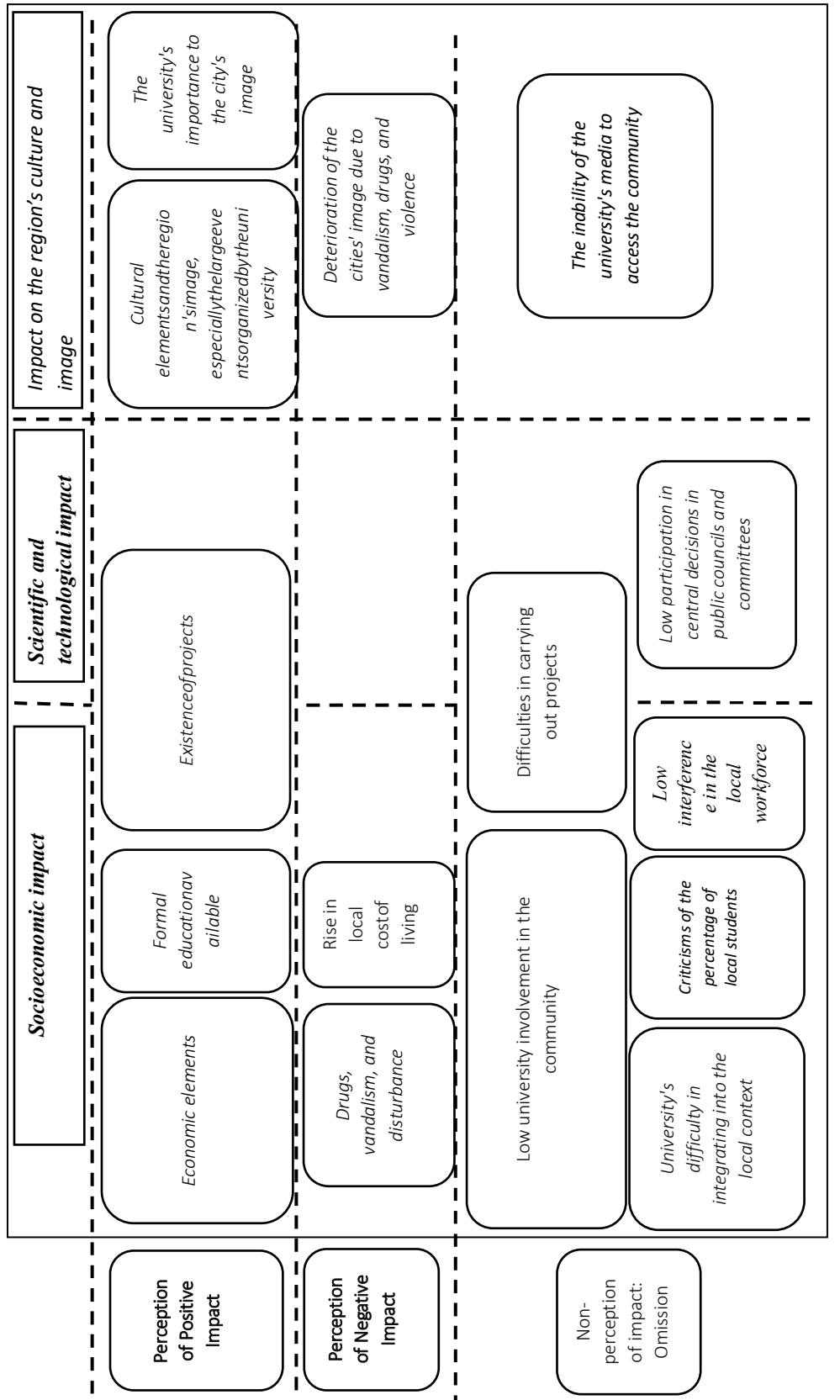
The interviews were organized based on the relationship between positive, negative, and omission impacts, and the types of impact: socioeconomic, scientific-technological, and the image and culture of the region. Thus, Figure 1 introduces a summary of how the perception of the impact of the analyzed university can be viewed schematically. The sizes of the diagrams qualitatively represent the difference in the number of occurrences of each response.
 Figure 1: Schematic representation of the perception of the impact of University A
Table 5 presents the number of respondents and responses associated with each code and subcode used in the systematization of the answers.
Table 5: Number of responses and respondents for each subcode
| Code | Subcodes | The number of interviewees mentioned the subcode. | Number of responses related to each subcode |
| Positive Impact | Formal education available | 17 | 27 |
| Economic elements | 28 | 41 | |
| Improvement in workforce qualification | 8 | 8 | |
| Social elements and project developments for society | 27 | 48 | |
| Cultural elements and the region's image | 17 | 29 | |
| Total number of responses classified as positive impact on the university | 153 | ||
| Negative impact | Drugs, vandalism, and disturbance. | 15 | 19 |
| Problems arising from the city's population rise. | 9 | 15 | |
| Total number of responses classified as negative impact on the university. | 34 | ||
| Omission | Low community engagement | 25 | 65 |
| Difficulty in carrying out projects | 22 | 41 | |
| Percentage of local students | 13 | 17 | |
| Integration into the local context | 17 | 31 | |
| No interference in the qualification of the local workforce. | 14 | 16 | |
| Participation in entities, councils, and related organizations | 14 | 17 | |
| The media channels of the university fail to reach the community. | 21 | 31 | |
| The total number of responses classified as Omission | 218 | ||
V. ANALYSIS OF THE INTERVIEWS
To analyze the community's perception of the university's impact on the local community, it organized this section considering the three types of impacts presented in the theoretical review.
5.1 Socioeconomic Impact of Universities
i) The community recognizes the economic impact of the university
Regarding the socioeconomic impact, it can be observed that the Leaders interviewed perceive this form of impact. After all, all respondents emphasized the economic importance of the university. However, this perception is much greater about economic elements than about social elements. This perception corroborates with the significant concern of the literature in studying the economic impact of universities.
ii) The
Although the economic impact is emphasized, for the interviewees, the university fails to integrate into the community or demonstrate its social participation. As shown earlier, the code "Omission" was the most frequent. The responses suggest that the university has difficulty engaging with the community and understanding the social and historical context of the region. Even in the training of the local workforce, many interviewees pointed out that they don't see the importance of university. There is also criticism regarding the percentage of local students, which, according to the interviewees, is excessively low.
Despite many projects being mentioned in the interviews and their existence being considered positive by the university, the responses from the interviewees make it clear that the projects have a slight impact and reach small segments of the population.
iii) Drugs, disturbance of peace, and raised cost of living are related to the presence of the university
Within the Type of Socioeconomic Impact, responses were identified that were classified as a negative impact, namely: Drugs, vandalism, and disturbance; Problems arising from population rise. From the perspective of public services, it is noteworthy that the demands are related to the population rise resulting from the establishment or growth of the university. This rise also leads to real estate speculation and a general rise in the cost of living. This situation was described in many responses from the interviewees.
5.2 Scientific and Technological Impact
i) The community does not recognize the existence of research projects and faces difficulties in establishing partnerships with the university
Thus as projects to the community (They are called extension projects in Brazil), research projects are not perceived by the community. The analysis of the responses suggests that research projects do not generate perceptible results for the population. Even projects focused on local demands have limited insertion into small parts of the population. In this sense, various studies in the literature questioning the metrics of how to evaluate research projects corroborate with the fact that the population does not see themselves benefiting from the results of the university's research projects.
ii) The
Between 2014 and 2017, the units of applied social sciences, engineering, and three health areas provided around 2,400 interns and over 600 graduates. However, the existence of this number of interns and graduates, as well as research projects with local companies do not seem to contribute to a perception of the rising intellectual capital of the city.
Although some interviewees had emphasized the importance of the university for the intellectual capital of the city, there were contradictory responses that already indicate that the community does not perceive a positive impact of the university on the intellectual capital of the city, especially in, especially in the training of a local workforce. The responses suggest that this intellectual capital is only found in big companies presents in the region.
iii) Perception is that the university's participation in councils and public bodies is ineffective.
The evaluation of the responses highlights that many of the Leaders are aware of the university's participation in councils and public bodies. However, they also emphasize that this participation is not very effective, as university representatives frequently miss meetings, and when they are present, they contribute slightly to the decision-making discussions. In this sense, the interviewees emphasize that the university should control who represents it and whether these representatives are indeed contributing to the debate.
5.3 Impact on the Region's Culture and Image
i) Large events organized by the university are recognized by the population, but communication channels are ineffective
All interviewees are familiar with some projects or events in the city. In this regard, the two major events organized by the university contribute to these responses. Community-oriented projects, with a narrower scope, were also mentioned as a possibility for collaboration of the university in the culture of cities A and B.
Although the two major events organized by the university were mentioned by all interviewees, many of them highlighted the lack of effectiveness of the university's communication channels. The need to publicize the university's actions passes through across the three types of impacts but is most emphasized in the analysis impact on the region's culture and image.
ii) The interviewees recognize that the university affects the region's image, both positively and negatively.
The university, located in cities A and B, has academic units older than the university itself. In this regard, many of the interviewed leaders emphasized that the city's image is positively affected by the existence of these units.
These units participate in rankings and reports associated with the names of cities A and B. However, it is worth noting that the interviewees also highlight that events at parties and disturbances organized by students negatively impact the city's image.
In the literature, studies analyzing the impact of universities on the culture and image of the region highlight precisely the ability of units to disseminate the city's name through their actions and public appearances.
VI. CONCLUSIONS
The purpose of this paper is to show an evaluation of how the impact of a university is perceived by its local community. To this end, 30 interviews were conducted with community Leaders from various segments of society. The interviews were organized in such a way that it was possible to understand how the interviewees perceive the socioeconomic impact, scientific-technological impact, and impact on the region's culture and image of two cities, 12km away.
The interview script followed guiding themes for each type of mentioned impact. Therefore, considering the university's outputs and inputs expected for each type of impact, themes to be addressed in the interviews were defined. The responses were analyzed to identify the community's perception regarding the positive impact, negative impact, and elements that the community sees as omissions of the university.
The answers highlight the following positive impacts: the existence of projects; the impact on the local economy, especially local business; availability of formal education in the region; and positive news of the region associated with successful university initiatives. The answers that highlighted the negative impact are related to drug consumption, vandalism, disturbance of the peace, and increased cost of living resulting from population growth, particularly related to real estate speculation. Finally, negative situations associated with issues related to the university were also highlighted, such as the death of young people due to overdose. Additionally, there are several elements identified as omissions of the university. Responses indicated that the university: is absent from the community, struggles to understand the local context, faces organizational and bureaucratic hurdles that hinder project implementation, has a low percentage of students from cities A and B regions, fails to noticeably contribute to local workforce qualification, participates ineffectively in public bodies and councils, and has communication channels that fail to reach the entire population.
Considering the three forms of impact presented in the literature, it can be highlighted that from the perspective of socioeconomic impact, the community perceives the economic impact, but the perception of social impact falls short of community expectations. There is also emphasis on the rise in the cost of living, which the population considers to be a result of the existence and expansion of the university. From the perspective of scientific-technological impact, it is possible to highlight that: the community has difficulty identifying the impact of research projects; the community does not perceive the participation of graduates and interns in the region's daily life; and the community evaluates the university's participation in public bodies as unconstructive. From the perspective of impact on the culture and image of the region, the following elements stand out: the importance of the region's major events for the culture and economy of the cities; and the region's image is associated with the university, whether positively or negatively.
Although there are studies in the literature that analyze the impact of universities, there is no consolidated methodology on this topic. There is also no consensus on how the perception of the community about the impact of a university should be evaluated. Therefore, this work contributes to advancing methodologies for evaluating the impact of a university in a local community, especially by addressing the gap regarding studies that evaluate the perception of the community about the impact of the university in its local community.
The practical nature of this work can be seen in the management decisions that the university can make to expand the positive perception of its presence. Similarly to the work that has been carried out, other institutions may evaluate the perception of impact in their respective communities.
This work is limited by diversity and number of interviewees. Therefore, it is possible to complement the work realized through interviews with different kinds of leaders. It is also possible to carry out quantitative research to confirm the elements found in qualitative research. Finally, it is emphasized that evaluating other universities can also contribute to university evaluations, considering that community perceptions may be similar - which, in this case, can contribute to more comprehensive solutions.
Conflict of Interest
The authors declare no conflict of interest.
Ethical Approval
Not applicable
Data Availability
The datasets used in this study are openly available at [repository link] and the source code is available on GitHub at [GitHub link].
Funding
This work did not receive any external funding.
References
Cite this article
Related Research



Special Issue
Launch a focused special issue to highlight research, emerging trends, and expert insights in your academic field.
