




IntelliPaper
Abstract
The present work deals with the use of the mandacaru cactus as an adsorbent material for the process of adsorption of the methylene blue dye present in wastewater, since this is an agricultural material of little applicability, used mainly in animal feed. In this sense, the mandacaru cactus was previously treated and applied in the process of removing this dye, evaluating the effects of the initial concentration of the pollutant, dosage of the adsorbent and adsorbent/adsorbate contact time. Furthermore, the adsorption mechanism was further studied by applying the pseudo-first and pseudo-second order models to the data obtained from the contact time parameter. The entire process was evaluated using UV-vis spectrophotometry as an analysis technique. The results obtained showed a maximum adsorption capacity of 36.18 mg/g, with a removal rate greater than 90%, presenting a mostly chemical process.
Explore Digital Article Text
I. INTRODUCTION
Only 2.5% of all water on the planet can be considered good for consumption. However, due to a series of factors, this value becomes even lower. In this sense, environmental contamination has been debated around the world, since the integrity of ecosystems, aquatic life, soil fertility and aquatic resources are being negatively impacted due to the release of wastewater containing different contaminants, mainly synthetic dyes. [1]
Dyes are organic compounds widely used in a wide variety of industries, such as textile, plastic, paper, rubber, wood, medicine, food and cosmetics sectors, with the aim of coloring their products. [2] Its annual global production is estimated at approximately 800,000 tons [3], where between of this value is discarded into the environment as colored waste material. [2] The disposal of these materials causes high toxicity, carcinogenic potential, risk of poisoning the ecosystem, drinking water and human health. [3]
Several dyes are characterized by very striking colors, high resilience to deterioration and great resistance to chemical, photochemical and biological processes.
[4] Methylene blue, with molecular formula C16H18ClN3S and 319.86 g/mol molecular weight [5] is a cationic dye with an organic structure that has great applicability in wool, cotton, silk and acrylic production industries. Disposal of this pollutant in water suitable for consumption generates negative impacts on humans, such as vomiting, increased heart rate, tissue necrosis, among others. [6]
Several methods can remove dyes present in wastewater, such as methylene blue, contributing to improving the drinking water crisis and protecting the environment and ecosystem. [7] In this context, many processes exist and can be divided into physical, physicochemical, chemical and biological methods. [8] Among them, adsorption, a physicochemical process, is considered an efficient method for removing dyes in wastewater due to its characteristics, such as flexibility, easy operation, low cost, high efficiency and selectivity, mechanical stability, and character. non-destructive. [9]
Adsorption consists of a phenomenon in which ions, molecules or atoms, the adsorbate, adhere to the surface of a solid material, known as adsorbent material. This process can occur in a liquid or gaseous medium. [10] The nature of the adsorbent and the adsorbate, the temperature of the medium and the presence of other substances interfere in the interaction between the adsorbent and the adsorbate, affecting the adsorption process. [11] There are several materials used as adsorbents for capturing methylene blue in wastewater. Among them, activated carbon has been the most used adsorbent due to its characteristics such as high efficiency, high surface area and strong surface reactivity, [12] which guarantees high adsorption capacity for organic pollutants, [10] such as methylene blue. However, due to the high costs for its synthesis and regeneration, [10, 11] low-cost adsorbents have been developed to remove methylene blue dye.
Adsorbent materials obtained from biomass can be considered an alternative to conventional adsorbents for capturing methylene blue, since they are widely available, cheap, generally do not require any prior treatment and have high efficiency. [6] Recently, Oladoye et al. [13] published a review work that emphasizes the importance of capturing methylene blue from wastewater due to its high toxicity. In this work, the author presents adsorption technology, among others, highlighting the use of different biomass-based adsorbent materials, due to their high efficiency and low cost, showing what they can or cannot receive treatment before being used as an adsorbent material. However, none of the works presented in the review suggest the use of the mandacaru cactus.
The mandacaru cactus, scientifically named "Cereus jamacaru", is a species whose rigid trunk is approximately 60 cm long and can reach up to 10 meters in height.
[14]It is a typical plant from the Brazilian Caatinga, with a production of 13 tons of dry matter per hectare that is very poorly valued, being mainly used as animal feed[15], due to its composition. Despite gaining timid attention in the development of artisanal food products[16], other applicability, such as the adsorption of pollutants, can be studied. In this regard, only one study using this biomass was found for the process of removing the basic fuchsin dye, indicating that much remains to be explored. Therefore, the present work proposes to study the adsorption process of methylene blue dye using the mandacaru cactus as an adsorbent material. For this, the parameters initial dye concentration, adsorbent dosage, and contact time were evaluated. Furthermore, the adsorption mechanism was studied using pseudo first and pseudo second order models.
II. MATERIAL AND METHODS
2.1 Materials
The adsorbate used in this work was methylene blue (Dinâmica Química Contemporânea LTDA). All solutions used in the experiments were obtained by diluting a previously prepared stock solution with a concentration of 1000 mg/L. The selected adsorbent was the mandacaru cactus (Cereus Jamacaru). This was collected in the interior of the city of Acauã, in the state of Piauí, Brazil, washed, ground in a conventional blender and separated with a paper filter. Then, the filtrate was washed repeatedly with distilled water to remove dirt particles. Subsequently, the sample was kept in contact with a 50% ethanol solution for 3 h, in order to separate extractives present in the sample. [15] Finally, the solid was dried in an oven at 100 °C for 2 hours and stored until further use.
2.2 Methods
2.2.1 Effect of initial concentration
To evaluate the effect of the initial concentration of the adsorbent, a fixed amount of 100 mg of the mandacaru cactus previously treated was placed in 250 mL Erlenmeyer flasks containing 20 mL of a methylene blue solution with varying initial concentrations, at room temperature. After 24 h, to ensure system balance, the solutions were analyzed in a digital spectrophotometer, UV/VIS ESPEC-UV-5100 from Tecnal, at a wavelength of 664 nm. [5, 17] Experiments were performed in triplicate. The amount adsorbed at equilibrium, qe (mg/g), was calculated using equation 1 and the percentage removal of the dye was determined using equation 2:
Where Co and Ce are the initial and equilibrium concentrations of the methylene blue solution, respectively (mg/L); V is the volume of the solution (L) and m is the mass of the adsorbent (g). [18]
2.2.2 Effect of Adsorbent Dosage
To investigate the influence of the adsorbent dosage, 20 mL of methylene blue solution 5 mg L was added to 250 mL Erlenmeyer flasks. Then, 50, 100 or 200 mg of the adsorbent were included in each bottle. The process was carried out in triplicate and at room temperature. After 24 h, the solutions were analyzed in the spectrophotometer, according to the effect of the initial concentration. The amount adsorbed at equilibrium, qe (mg/g), was calculated using equation 1 and the percentage of removal, using equation 2.
2.2.3 Effect of the contact time
To evaluate the contact time, a fixed amount of 100 mg of adsorbent was placed in 250 mL Erlenmeyer flasks containing 20 mL of methylene blue solution of 5 mg/L, at room temperature. After predetermined times, an aliquot of this solution was removed and, according to the effect of initial concentration, it was analyzed. The experiments were carried out in triplicate and the amount adsorbed at time t, qt (mg/g), was calculated using equation 3. [18]
2.2.4 Adsorption kinetics study
Kinetic studies were analyzed based on the results obtained from the studies of the effect of contact time, using the pseudo-first order (equation 4) and pseudo-second order models (equation 5).
Where is the pseudo-first order adsorption rate constant ( ), is the pseudo-second order adsorption constant ( ), qe is the amount adsorbed at equilibrium (mg/g) and qt is the amount adsorbed at time t (mg/g). [1]
III. RESULTS AND DISCUSSION
3.1 Effect of Initial Concentration
The effect of the initial concentration for the adsorption process of the methylene blue dye using the mandacaru cactus as an adsorbent material can be seen in Figure 1.
{"image_source":{"path":"images/bae46cb5d3bad536efa8f9e92f10c3f31530c30a7fa722da1aafb21607af9082.jpg"},"content":"","chart_caption":[{"type":"text","content":"Figure 1: Effect of initial methylene blue concentration using mandacaru cactus as adsorbent (dosage = 100 mg, V = 20 mL, room temperature, t = 24 h)"}],"chart_footnote":[]}
It can be seen that the adsorbed amount, qe, increases from 0.23 to 36.18 mg/g when the initial dye concentration increases from 1 to 200 mg/L. This occurs due to the mass transfer resistance of the methylene blue molecules to the mandacaru cactus, which is overcome by the driving force with the increase in the initial concentration of the adsorbed, increasing the amount adsorbed. [19] On the other hand, the removal percentage decreased from 100 to 91.12% when the initial adsorbate concentration increased from 1 to 200 mg/L. This happens because the presence of a higher concentration of dye in solution causes less surface availability of the adsorbent, or of active sites present on the adsorbent, available to interact with the dye in question. [20]
3.2 Effect of Adsorbent Dosage
The adsorption process of methylene blue dye using the mandacaru cactus as adsorbent material was also evaluated by the adsorbent dosage parameter. The response to the effect of this parameter can be seen in Figure 2.
{"image_source":{"path":"images/21892cbadbf1a439ab2759215db40f8363e185e1d236c49214629cfd691c5fd3.jpg"},"content":"","chart_caption":[{"type":"text","content":"Figure 2: Effect of adsorbent dosage on the adsorption of methylene blue using mandacaru cactus as adsorbent ("},{"type":"equationinline","content":"C\{0} = 5 \, mg/L"},{"type":"text","content":", V = 20 mL, room temperature, t = 24 h"}],"chart_footnote":[]}
It is observed that, when the mass of the adsorbent increases from 50 to 200 mg, the amount adsorbed at equilibrium (qe) reduces from 1.65 to 0.51 mg/g while the removal percentage (R%) of the dye at solution increases from 81.01 to 100%. According to the literature, [21] the reduction in qe may be related to the decrease in the amount of adsorbate adsorbed per unit weight of adsorbent, causing a reduction in the active sites used. As for the increase in R%, this is related to the existence of a greater quantity of active sites in the mandacaru cactus to be used in the dye adsorption process in the solution.
3.3 Effect of the Contact Time
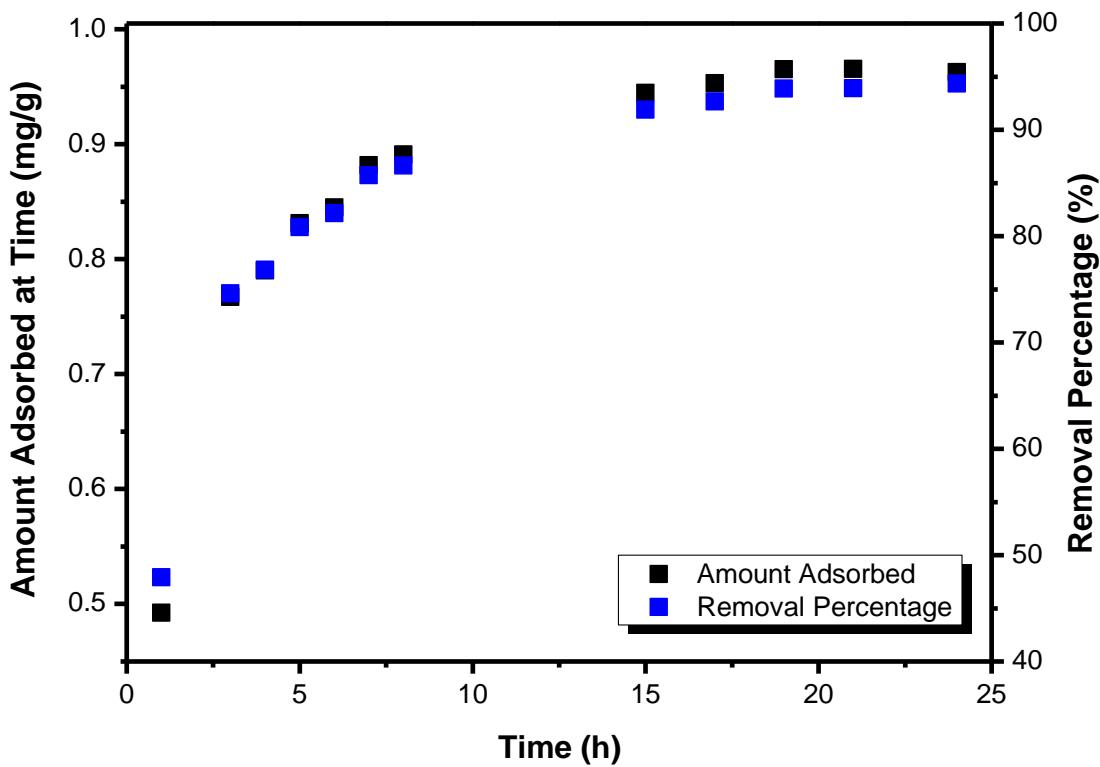
The adsorption process of the methylene blue dye using the mandacaru cactus was evaluated over a period of 24 hours, using 100 mg of adsorbent material. The amount adsorbed at time t (qt) calculated by equation 3 and the percentage of removal (equation 4) can be seen in Figure 3.
{"image_source":{"path":"images/38e820d551a4d5086de3586cce406c8af17c8359c7b7398d7169b9f01ea1b0f8.jpg"},"content":"","chart_caption":[{"type":"text","content":"Figure 3: Effect of the contact time on the methylene blue adsorption using mandacaru cactus as adsorbent ("},{"type":"equationinline","content":"C\{0} = 5 \, mg/L"},{"type":"text","content":", V = 20 mL, room temperature, dosage = 100 mg)"}],"chart_footnote":[]}
It can be observed that, with the increase in contact time, both qt and R% increase, reaching values of 0.96 mg/g and 94.34%, respectively. The adsorption process reached equilibrium around 19 hours. But, it can be seen that in just one hour of contact between the adsorbent and the solution, these values already reach 50% of the final result.
According to literature, the time required to reach equilibrium in an adsorption process depends on the type of adsorbent, as well as the number of active adsorption sites that are available.
3.4 Adsorption Kinetics
The adsorption kinetics data were obtained by applying the Pseudo-First Order (equation 4) and Pseudo-Second Order (equation 5) models to the values observed in Figure 3, with the purpose of investigating the adsorption mechanisms. The results are shown in Figure 4 and Table 1.
{"image_source":{"path":"images/9164bef19d15da9101485b2a63279e31390f3ad1b3af6379f9ee1c44a91d1765.jpg"},"content":"","chart_caption":[{"type":"text","content":"Figure 4: Adsorption kinetic and fitting models for adsorption of methylene blue using mandacaru cactus as adsorbent material"}],"chart_footnote":[]}
Table 1: Kinetic parameters for the methylene blue adsorption on mandacaru cactus
| Pseudo-First Order | Pseudo-Second Order | ||||
| qe(mg/g) | k1(h-1) | R2 | qe(mg/g) | k2(g mg-1h-1) | R2 |
| 0.926 | 0.587 | 0.885 | 1.001 | 0.946 | 0.995 |
The value found using the Pseudo-Second Order kinetic model was higher than the value obtained by the Pseudo-First Order kinetic model. This result suggests that the Pseudo-Second Order model is the most suitable for studying the adsorption of methylene blue dye when using the mandacaru cactus as adsorbent material. Therefore, chemisorption, which involves chemical reactions, appears to be the limiting step for this process. [22] This result is in agreement with the literature, which presents some studies that demonstrate that the adsorption of methylene blue tends to obey the Pseudo-Second Order kinetic model. [23-25].
IV. CONCLUSION
In this work, the mandacaru cactus was used as an adsorbent material for the adsorption process of the methylene blue dye present in wastewater. For this, it was previously treated and the effects of initial adsorbate concentration, adsorbent dosage and contact time were evaluated using UV-vis spectrophotometry as an analysis technique. The results obtained showed a maximum adsorbed amount of 36.18 mg/g when the initial concentration of 200 mg/g of the dye was used, presenting a removal rate greater than 90%. Regarding the kinetic study, the adsorption of the selected dye reached equilibrium in approximately 19 hours and the Pseudo-Second Order model was the one that best fit the experimental results, indicating that chemisorption is the majority. These results suggest that the mandacaru cactus can be considered a promising adsorbent, since it is commonly found in northeastern Brazil, is cheap, easy to prepare and has proven to be an efficient adsorbent material in removing methylene blue dye.
Conflict of Interest
The authors declare no conflict of interest.
Ethical Approval
Not applicable
Data Availability
The datasets used in this study are openly available at [repository link] and the source code is available on GitHub at [GitHub link].
Funding
This work did not receive any external funding.
References
Cite this article
Related Research



Special Issue
Launch a focused special issue to highlight research, emerging trends, and expert insights in your academic field.
