




IntelliPaper
Abstract
In South Africa, the role of language is crucial in transforming higher education because it not only affects academic access and success, but also affirms diversity. This means that the implementation of multilingual policies at South African universities constitutes a paradigm shift from the prejudiced methods of the old apartheid regime. Central to the University of South Africa’s 2030 strategic plan is the need to transform teaching and learning as well as research and community engagement in order for the university to operate/ function effectively as a leading Open Distance e-Learning (ODeL) institution. Besides the decolonisation of the curriculum, the transformation of teaching and learning requires a review of how most students learn. In various South African legislative reports on language issues, a common problem is that language continues to be a barrier to access and success in higher education. The purpose of this research paper therefore is to map the practices that the university has initiated to overcome the language barrier by creating a space for the previously marginalised indigenous languages to be used in teaching and learning. The study utilises a qualitative approach in examining the processes, and challenges of implementing the initiatives to assist students in their learning. It is hoped that the recommendations made will promote collaborative programmes among institutions of higher learning in developing and strengthening the use of multiple languages in teaching and learning. The current study does not examine the impact of these initiatives on the success and pass rate of students, so further research on this subject is needed.
Explore Digital Article Text
I. BACKGROUND
From the time it became apparent at the University of South Africa (Unisa) that language attitudes may influence learning, the Senate Language Committee commissioned the strategic project called Survey of Language Attitudes (SLA) (2013 - 2016) to investigate the language attitudes and preferences of Unisa students. One of the objectives of the project was to make recommendations for the implementation of an informed, successful language policy at Unisa. Some of the recommendations which emerged from the findings of the qualitative research project on the language attitudes and language preferences of Unisa students were the following:
-
Languages should be developed for academic purposes and a parallel medium of instruction should be encouraged where possible.
-
A phase-in approach to language policy implementation should be used.
-
African languages should be used to facilitate and support learning.
-
Examination question papers should be translated into various African languages wherever possible.
The Survey of Language Attitudes (SLA) (2013 - 2016) project served as a platform that informed the implementation of the 2016 Unisa Language Policy. The project's recommendations resulted in the introduction of a Language Unit as a 5-year strategic project in October 2018 called Transformation: building capacity for South African languages. The Language Unit is responsible for monitoring the implementation of the university's language policy and ensures that all academic departments play an important role in the achievement of multilingual education and the development of African languages. The definitive goal of the Unisa Language Policy (2016) is to utilise a mother-tongue-based multilingual education system to cater for all South African students. The implementation plan of the 2016 Unisa Language Policy was adopted in 2017.
The next section outlines the research problem and aim, followed by an overview of the promotion of multilingualism in teaching and learning at selected South African universities.
II. THE RESEARCH PROBLEM AND AIM
The transformation of teaching and learning requires a consideration of how most students learn, paying particular attention to the way the language medium facilitates or hinders their access to subject content, and their degree of success. Various South African legislative reports on language issues identify the common problem of language acting as a barrier to effective learning in higher education for the following reasons:
(a) Indigenous official languages have structurally not been afforded the official status to function as academic and scientific languages, and
(b) most students are not proficient in English, presently the dominant language of teaching and learning in higher education.
The purpose of this research paper, therefore, is to map the practices that the university has initiated to address the issue of the language barrier by creating a space for the previously marginalised indigenous languages to be used in teaching and learning. This study seeks to demonstrate how Unisa provides support to its students, for most of whom English is not the first language or mother tongue, to enable academic access and success.
III. LITERATURE REVIEW
The review of literature focuses first on multilingualism in teaching and learning at selected South African universities. Second, it considers the functional approach to translation, as translation is a method used to make texts accessible to the new target group.
Since South Africa became a democracy in 1994, many academic institutions in South Africa have been faced with the challenge of how to develop and use indigenous languages in academia as Section 29(2) of the Constitution of the Republic of South Africa (1996) mentions the right to education in the language of the individual's choice. Based on case studies at the University of KwaZulu-Natal (UKZN), Ndimande-Hlongwa, Balfour, Mkhize and Engelbrecht (2010) and Kamwendo, Hlongwa and Mkhize (2013) address a significant issue, which is the Language of Learning and Teaching (LoLT) in higher education. These scholars highlight the impact of mother tongue / home language instruction on students' performance and success. They state explicitly in their research articles that the University of KwaZulu-Natal does not intend to discard English, but favours its use concurrently with isiZulu, thus endorsing a bilingual mode of teaching. Academics are not compelled to acquire isiZulu, but they are encouraged to learn it so that they can make informed decisions based on the nature of the discipline and consider the involvement of communities in the discipline.
Tshongolo (2022) in his Ph.D study about enhancing epistemological access using bilingual material in teacher education states that language continues to be an obstacle to most students who are second or third language speakers of English in South African universities. He proposes that a flexible approach for academic success be adopted. He believes that this imperative can be achieved by promoting mother-tongue bilingual education. His research was based on first-year teacher education students at a university in the Eastern Cape, and examined how beneficial it would be for students whose first language is isiXhosa to access study material and assessments in isiXhosa in a higher education institution. The study further explored the potential benefits of training teachers in the language medium in which they will teach (isiXhosa), instead of training them in English. In cases where a bilingual mode of instruction was promoted (English-isiXhosa), student throughput improved as students were taught in a language they fully understood. The researcher recommends that development and strengthening of multilingual education awareness projects should be endorsed as there are still many who have not yet grasped the relevance of mother-tongue-based multilingual education. Institutions such as PanSALB should educate people about the basic human right to receive tuition and academic training in a language of one's choice as articulated in Section 29 of the Constitution of the Republic of South Africa (1996).
The example of the University of KwaZulu-Natal where English and isiZulu are used as languages of teaching and learning in some domains serves as evidence that indigenous languages of South Africa can be developed as formal academic languages. Since the subject of Language of Learning and Teaching (LoLT) in higher education is topical in South Africa, and some institutions of higher learning are battling with the implementation of the language policy, the research on language issues at the University of KwaZulu-Natal provides useful guidelines on language planning in higher education. Additionally, the study by Tshongolo on the use of English and isiXhosa in a university in the Eastern Cape confirms that mother-tongue-based multilingual education enhances student performance. Institutions of higher learning that plan to introduce multiple languages in teaching and learning, can learn /gain insight and guidance from the research of these scholars.
Hlatshwayo and Siziba (2013) conducted a survey of students' perceptions of multilingual education at North-West University (NWU). The researchers wanted to establish how South African university students conceptualise multilingual education and what they expect from it. The survey was conducted at the North-West University (NWU) Mafikeng campus where a sample of 500 questionnaires was distributed to students who were first-year undergraduates during Academic Literacy lectures. The research concluded that the use of multilingualism in higher learning contributes to the learner's conceptual and pedagogical development as well as his/her communicative abilities. The researchers suggest that each province in South Africa, depending on the linguistic needs of its learners / students, should design a language policy suitable for its learners / students. For example, the North-West Province (the home of the above-mentioned university) could have Setswana, English and Afrikaans in its policy. Setswana and Afrikaans are the primary languages in this province, and the North-West University Mafikeng campus utilises these languages in addition to English for business communication. The researchers believe that the use of the students' home language as a Language of Learning and Teaching (LoLT) would improve their performance and efficiency.
Kaschula (2019) gives an overview of practices in promoting multilingualism in some South African universities. For example, at the University of Cape Town, an isiXhosa- and Afrikaans language course is compulsory for the MB ChB programme and other Health Sciences professional training programmes. The University of Limpopo offers a fully bilingual Bachelor's degree in Sesotho sa Leboa and English in Contemporary English and Multilingual Studies. The University of Stellenbosch has developed glossaries that comprise three languages (English-Afrikaans-IsiXhosa) for disciplines such as Law, Psychology, Social Work and Sociology. Rhodes University offers isiXhosa vocation-specific courses in Pharmacy, Law, Journalism and Education. Kaschula emphasises the importance of language in the Africanisation of the curriculum. The use of multiple languages by higher education institutions is a response to the call made by Neville Alexander (2003) in his work The African renaissance and the use of African languages in higher education. He says that it is impossible to even think of an African renaissance without the development and intellectualisation of African languages. His basic proposal is:
[U]ntil and unless we are able to use the indigenous languages of South Africa as languages of tuition at tertiary level our educational system will continue to be skewed in favour of an English-knowing elite (Alexander 2003: 23).
He suggests that South African universities can adopt ‘a step-by-step development and implementation plan’ to develop specific languages, and the decision to begin using those languages for specific functions will remain the responsibility of that institution. (Alexander 2003: 30).
The succeeding paragraphs deliberate on the functional approach to translation as Unisa translates tutorial texts to make them accessible to students who are second- or third-language speakers of English. It was in the late 1970s and early 1980s when Reiss and Vermeer formulated the functional approach to translation, terming it skopos theory because it is the skopos, that is, the purpose or scope of the translated text that determines the translation process (Shuttleworth & Cowie 1997:156). The intended recipient of the target text is an important factor in any translation process. The recipients of the target text have their own culture-specific world knowledge, as well as their own expectations and communicative requirements. The translator is expected to produce a target text which conforms to the requirements of the translation skopos. The function of the translated texts is informative as the texts provide knowledge, and the language used is formal. Following in Vermeer's footsteps, Nord (1992) moved away from the equivalence-based approach to translation. She adopted Vermeer's approach that texts should be translated according to a skopos. However, by introducing the concept of loyalty, Nord adapted the functionalist theory to what she considered to be the requirements of the translation task. 'Loyalty' can be defined as embodying the commitment of the translator both to the source and the target situation as well as their responsibility both to the initiator of the source text and the target recipient (Moropa 2005).
The translations discussed in the paper represent language for special purposes (LSP) since the university has adopted a multilingual approach to produce translated tutorial letters that can assist students who are not proficient in English to access specialised subject fields in their preferred language. Language for Special Purposes refers to language that is normally very formal in register with a highly specialised vocabulary (i.e. vocabulary used by experts in a particular field, e.g. chemistry, physics, computer science, agriculture, accounting, economics, law, etc.). Language for Special Purposes texts are restricted and precise and typically feature, amongst others, an abundance of specialised terms. Crystal (2010:400) makes the following points about the language of science:
-
The large technical vocabulary is undoubtedly its most characteristic feature reflecting the specialised subject matter of scientific domains of enquiry.
-
Everyday words are too vague for many scientific purposes, so new ones have to be invented.
Language for Special Purposes' phrases and terms are chiefly aimed at serving the communication needs of specialists. By contrast, Language for General Purposes (LGP) is ‘general’ in the sense that it is in common usage. The initiator of the translation (the academic / lecturer in this context) wishes the target text to serve a specific purpose or function when it is received by recipients, i.e. the students who are not first-language speakers of the original / source language.
This section concludes by referring to the Language Policy Framework for Public Higher Institutions (2020) which is a revision of the Language Policy for Higher Education (2002). The revised language policy seeks to address the issues raised in relation to ensuring the development and strengthening of a multilingual environment in which all official languages are developed and used as languages of scholarship, research, teaching and learning. The language policy states that higher education should consider all indigenous languages as sources of knowledge that can inform learning of the different disciplines. Higher education institutions should nurture an environment where multilingualism is not seen as a problem but as a resource to facilitate cognitive development, epistemic access, inclusiveness, transformation, social cohesion and respect for all languages. Therefore, conditions must be created for the development and strengthening of indigenous languages as languages of meaningful academic discourse.
IV. METHODOLOGY
This paper employs a qualitative approach in examining the processes and challenges of implementing the initiatives to assist students in their learning. The data sources are reports of institutional, language-related strategic projects, college reports on language policy implementation, multilingual resources developed by colleges, and language policy reports previously authored and presented by the researcher who obtained ethical clearance from the university to access Unisa data.
V. DISCUSSION
The initiatives that are discussed in the study are the following:
(i) Developing multilingual glossaries
(ii) Digitalising multilingual glossaries
(iii) Translating examination question papers (EQPs)
(iv) Translating tutorial letters
(v) Offering modules in more than one official South African language.
5.1 Developing multilingual glossaries
Prior to the dawn of a democratic South Africa, Unisa built its language capacity around English and Afrikaans. In compliance with the Language Policy for Higher Education (2002), the University adopted a language policy in 2006 and revised it in 2010 and 2016. Two African languages were introduced; isiZulu and Sepedi. Multilingual glossaries were developed in these languages in addition to English and Afrikaans. As the 2016 language policy committed to promote all official languages, colleges began to expand the glossaries by adding the other official languages. For example, the College of Agriculture and Environmental Studies developed a multilingual glossary of action words (verbs) in assessment. Initially the glossary of over 40 assessment verbs with definitions was developed in four languages by the college. The Language Unit as a body that monitors the implementation of the language policy, collaborated with the College of Agriculture and Environmental Studies to broaden the scope of the glossary by adding the other seven official South African languages. The Senate Language Committee approved the glossary of assessment terms in eleven languages in March 2021. The multilingual glossary is available for use by students and staff in colleges. Figure 1 below presents a sample of assessment verbs with their definitions in five official South African languages: English, Afrikaans, isiNdebele, isiXhosa and isiZulu. The definitions are meant to improve the students' understanding of the concepts in his/her preferred language.
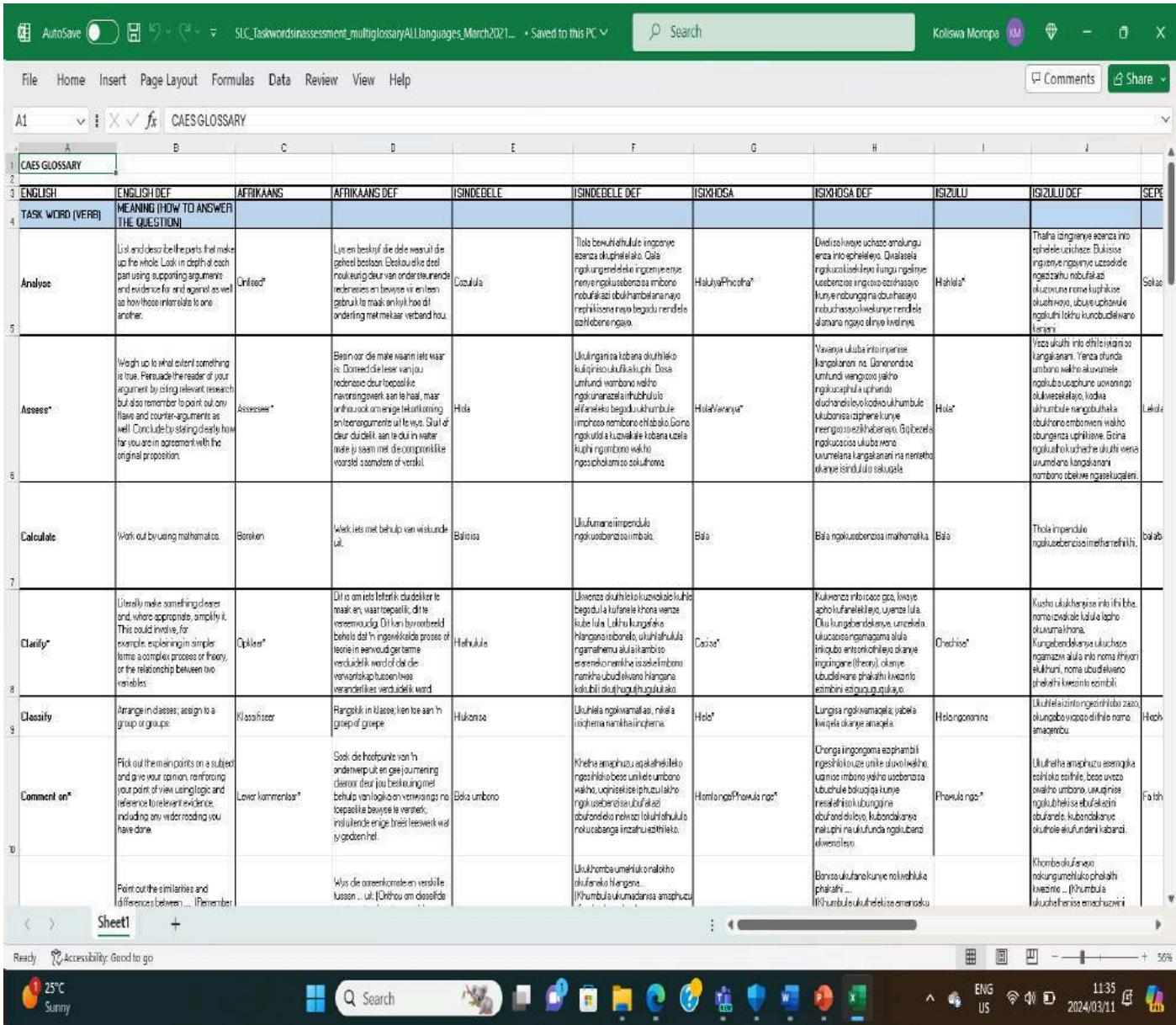
Figure 1: Multilingual glossary of assessment terms in five South African languages
These glossaries are paper based in MS, PDF or Excel format and are appended to the study guide or tutorial letter. Some are uploaded on the university teaching and learning platform called myUnisa under ‘Additional resources’. A detailed exposition of institutional multilingual glossaries was carried out by Shoba and Moropa (2023) in an article entitled Multilingual glossaries for teaching and learning: an initiative at the University of South Africa. The university emphasises the importance of multilingualism in higher education by promoting the digitalisation of the glossaries, hence the following discussion.
5.2 Digitalisation of multilingual glossaries
The Department of Geography within the College of Agriculture and Environmental Studies pioneered the digitalisation of multilingual glossaries. The Unisa Academy of African Languages and Science (AALS) was a strategic project that was conceptualised in 2009. From 2013-2018 the project focussed on research and development of language technology for four South African languages. In 2021 a computational linguist in the Academy of African Languages and Science project worked with the Department of Geography on a new version of Terminator for displaying and interacting with geography glossaries. Terms as well as their definitions are in four languages: English, isiZulu, Sesotho sa Leboa / Sepedi and Afrikaans. The multilingual glossary comprises a list of terms with definitions and cross-references covering a variety of terms used in geography, the environmental field and geographical information systems (GIS). The selection of terms is based on the undergraduate modules offered by the Department of Geography at the University of
South Africa (Unisa). The glossary aims to provide support to the students in their learning in a multilingual context.
In the introduction to the user guide, it is stated that the glossary will not only be of value to Unisa students, but also to lecturers and students at other universities, schoolteachers and learners, and a wide variety of stakeholders in civil society and industry. Figure 2 shows the front page of the user guide.
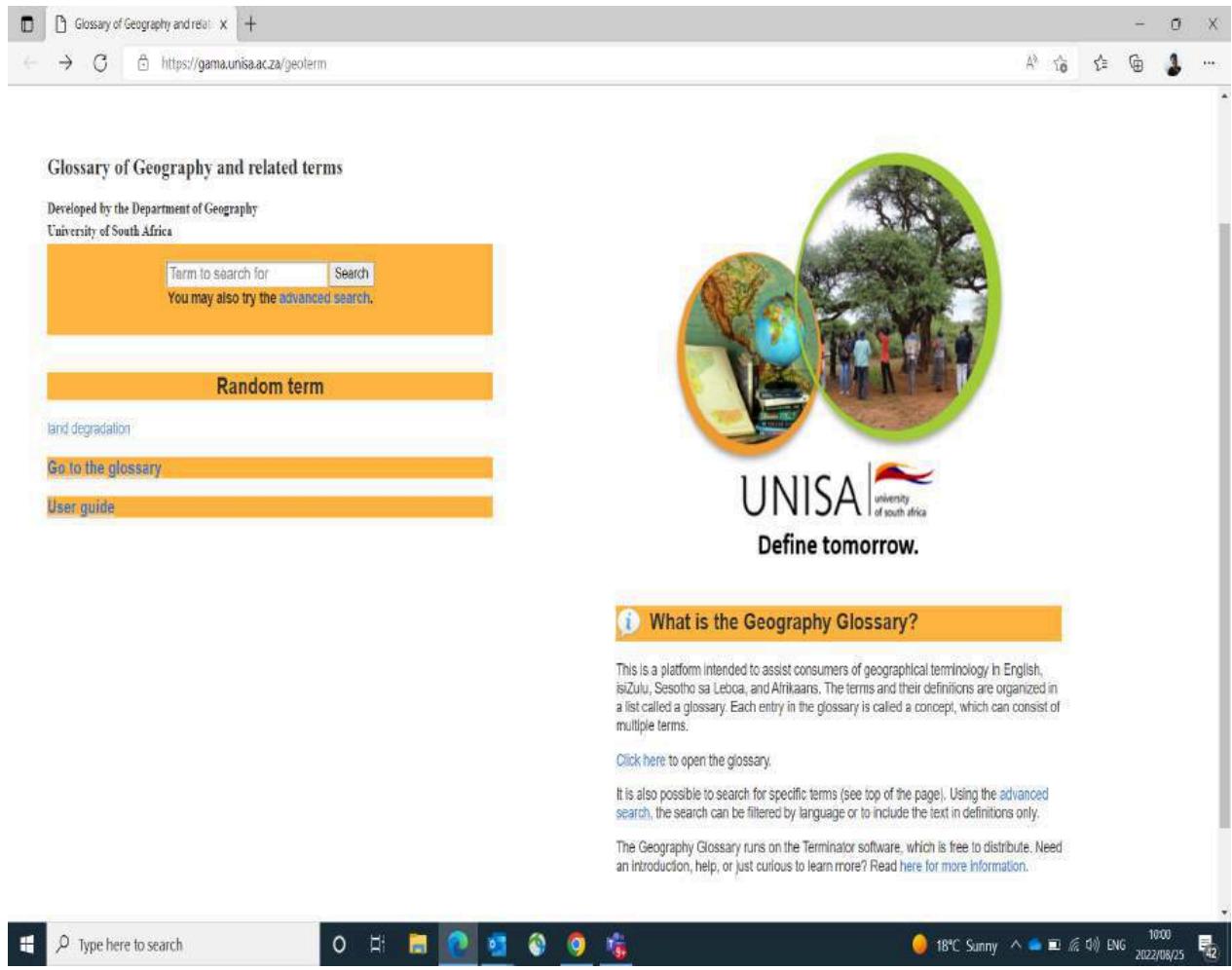
Figure 2: Front page of user guide: https://gama.unisa.ac.za/geoterm
In using the platform, users are encouraged to provide feedback. This can take the form of comments or suggestions and a text box in which to write the feedback statement is provided. The Department of Geography intends to expand the glossary in the future to include more indigenous South African languages. This approach in developing glossaries is based on the Unisa
Language Policy 2016 which adopts a phase-in approach to advancing the indigenous languages.
5.3 Translation of examination question papers (EQPs)
The university Senate took a decision at its first sitting during the first quarter of 2018 to translate Unisa examination question papers (EQPs) from English into all official South African languages, in line with the institution's 2016 language policy. The translation of examination question papers from English into official South African languages is a process that requires systematic procedures to provide a product that is acceptable to Unisa as a client and students as the end-users. The next paragraphs outline the translation procedures that the university adopted.
For a successful implementation, Senate appointed the Senate Language Committee chaired by the Vice Principal (VP): Teaching and Learning, Community Engagement and Student Support to manage the process. It was agreed that a staggered approach be followed starting with the first year, i.e. National Qualifications Framework (NQF) Level 5 in ‘at risk’ modules. At risk modules are modules with a low pass rate. The purpose of the translated examination question papers was to provide the student with access to the examination question paper in his / her preferred language to enhance comprehension of the concepts in the various disciplines. Students were still required to answer the examination questions in English. Translation proper was faced with several challenges, for example, human resource capacity and the submission dates. Based on the output norms, the Directorate of Language Services responsible for translating and editing in the university, estimated that, with the available capacity, it would take about 19 weeks to complete the translations of approximately 45 examination question papers into ten languages. After deliberating on the matter it was agreed that due to time constraints and limited capacity the examination question papers be translated into isiZulu, Sesotho sa Leboa/ Sepedi and isiNdebele and Tshivenda. The compromise was reached to mitigate further risks that could hamper the actual translation phase.
To ensure the success and sustainability of the project it was recommended that a dedicated group of staff should be assigned to the project, for example one supervisor with the necessary authority to manage the entire process, one administrative manager with two assistants to manage allocation of examination question papers. The language practitioners should sign a declaration of secrecy before they were allowed to handle examination question papers.
The tasks of the administrative staff included:
-
receiving declarations of secrecy from all translators/quality assurers
-
liaison with examiners, translators and quality assurers
-
keeping track of receipt and allocation of original examination question papers
-
keeping track of allocation and receipt of edited versions of the examination question papers
-
keeping track of allocation and receipt of translated versions
-
keeping track of allocation and receipt of quality assured versions
-
keeping record of word counts of the various source texts
-
checking whether texts have been translated in full, etc.
In the first cycle, the university had 39 examination question papers for ‘at risk’ modules across colleges. The college domains encompass education, economic and management sciences, accounting sciences, human sciences, law, agriculture and environmental studies, science, engineering and technology, as well as the sub-disciplines within these colleges.
The institutional Language Unit trained language practitioners before the translation proper stage to equip the team with pre-translation skills. The pre-translation activities included the importance of a translation brief, text analysis, terminology search, translation procedures/methods and practical exercises translating specialised texts.
They were made aware of the existing resources in the different languages such as the multilingual glossaries developed by the Unisa Directorate of Language Services, Pan South African Language Board (PanSALB) orthography and spelling rules for all official languages as well as multilingual terminology lists published by the national Department of Sport, Arts and Culture. Collaboration with subject specialists was crucial during the translation process. If there was no glossary, the examiner was advised to extract key terms from the tutorial material for the language practitioners to translate. The language practitioners were instructed to keep a record of all the new terms that they created. The newly created terms would be submitted at a later stage to linguistic structures such as PanSALB, in accordance with the national policies and rules of terminology verification.
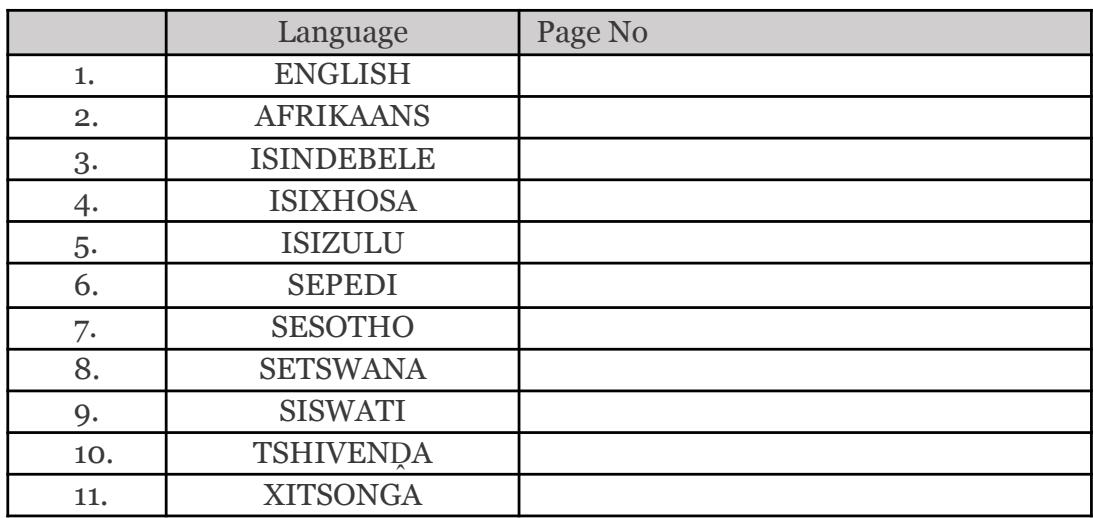
{"code_caption":[],"code_content":[{"type":"text","content":"This paper includes copies of the examination question paper in all the South African Official Languages.\n\nALL EXAMINATION QUESTIONS MUST BE ANSWERED IN ENGLISH\n\nTHE EXAMINATION QUESTIONS ARE PROVIDED IN ALL THE SOUTH AFRICAN OFFICIAL LANGUAGES FOR STUDENT SUPPORT\n\nThe first examination question in this pack is in English, and thereafter the papers in the various languages are presented in alphabetical order and can be found on the pages as indicated in the following table of contents."}],"code_language":"txt"}
Figure 3: below provides an example of the cover page of a translated examination question paper Figure 3: Cover page of an examination question paper
| Language | Page No | |
| 1. | ENGLISH | |
| 2. | AFRIKAANS | |
| 3. | ISINDEBELE | |
| 4. | ISIXHOSA | |
| 5. | ISIZULU | |
| 6. | SEPEDI | |
| 7. | SESOTHO | |
| 8. | SETSWANA | |
| 9. | SISWATI | |
| 10. | TSHIVENDA | |
| 11. | XITSONGA |
In practice, the word ‘all’ (with reference to languages) is replaced by the number of languages in which the question paper is translated. The translation of exam question papers for the October/November 2019 examination period was completed at the beginning of August 2019. The examination question papers for the 39 modules were translated successfully from English into four indigenous languages; Sepedi, isiZulu, Tshivenda and isiNdebele. This means that the examination question paper was in five languages. Due to the time constraints, it was impossible to have the examination question papers translated into 10 official languages. (See Appendix A for a list of some modules from the various colleges whose exam question papers were translated.)
Table 1 below is an illustration of the number of languages in which the exam question papers were translated for the May/June 2020 Semester 1 examination period. For example, out of the four examination question papers from the College of Agriculture and Environmental Studies, three EQPs were translated into eight languages and one into nine languages. In the College of Economic and Management Sciences, three examination question papers were translated into ten languages and two were translated into nine languages. The pattern differs from college to college and there was a significant increase in the number of languages of translation as compared to the October / November 2019 examination.
Table 1: Translated EQPs for May/June 2020; Total translations = 368
| COLLEGES | NUMBER OF EXAM QUESTION PAPERS TRANSLATED INTO: | |||
| 7 languages | 8 languages | 9 languages | 10 languages | |
| Agriculture & Environmental Sciences: (4 papers) | 3 | 1 | ||
| Economic & Management Sciences: (5 papers) | 2 | 3 | ||
| Law: (5 papers) | 1 | 4 | ||
| Science, Engineering & Technology: (2 papers) | 1 | 1 | ||
| Human Sciences: (13 papers) | 1 | 1 | 4 | 7 |
| Education: (11 papers) | 1 | 4 | 1 | 5 |
4.4 Translation of tutorial letters
Similarly to the translation process used for the examination question papers, the translation of tutorial letters requires collaboration and coordination between the academics and the language professionals to ensure a successful outcome. The only distinction is that it is not necessary for the tutorial letters to be password protected, although the translators still maintain confidentiality. The academic provides a translation brief indicating the language/s of translation, due date, delivery mode and any other relevant information. The translator requires resources such as specialised dictionaries, parallel texts and multilingual terminology lists or glossaries to handle the actual translation.
The purpose of Tutorial letter 101 is to equip students with the fundamental concepts, standards and principles of the subject field. As an example, the author has used Tutorial letter 101: Introductory Financial Accounting (FAC1501), taken from the College of Accounting Sciences for the 2022 academic year. Table 2 below shows the total number of words of each of the translations of the Tutorial letter which was translated into five languages: isiXhosa, isiNdebele, isiZulu, Tshivenda and Xitsonga.
Table 2: No. of words per translation of FAC 1501 Tutorial letter 101
| Source text | Target text and language | No. of words |
| Tutorial letter 101 / 3/2022Introductory Financial Accounting (FAC1501) | 3 241 words | |
| Isikhokelo sokufunda 101 – Intshayelelo ngoCwangciso lwezeMali (isiXhosa) | 2 559 words | |
| Incwadi yokufundisa 101 – Introductory Financial Accounting (isiNdebele)– | 2 587 words | |
| Incwadi yokufundisa 101 – Isethulo Sokubalisisa Izimali (isiZulu) | 2 420 words | |
| Incwadzi Yekufundzisa 101 – Singeniso Kutekuphatfwa Kwetimali (siSwati) | 2 767 words | |
| Luńwalo lwa Thuthoriała 101 Muhasho wa Financial Accounting (Tshivenda) | 4013 words | |
| Papiladyondzo 101 Ndzawulo ya Financial Accounting (Xitsonga) | 3735 words |
The difference in the number of words of the translated texts is attributed to the morphological structure of each language. Some languages are conjunctively written while others are disjunctively written. A very important feature of the South African indigenous languages is that any word that stands in a particular relationship to the noun has a concord which is derived from the noun class prefix to indicate the concordial system. The noun prefix is very important because all words which may stand in a special relation to a substantive are brought into agreement with it by the class concord. There are several concords such as subject concord, object concord, adjectival concord, possessive concord, relative concord etc. In some of the indigenous languages the concords are written together with the noun while in others the concords are separated from the noun (Moropa 2005).
To conclude the section on translation activities, it is worth mentioning that the Language Unit developed a translation framework that emphasises quality assurance. Initially, it was for the translation of examination question papers, but now it is utilised in all translation services and products managed by the Language Unit. The translation process for the core process of translating is based on ISO 17100: 2015, a quality standard published by the International Standard Organisation. The quality standard specifies the requirements for all aspects of the translation process that impact quality and the delivery of translation products. The Language Unit continuously recruits language practitioners from academic and support departments within the institution. It conducts training workshops to build a team of competent language practitioners (translators, quality assurers and proof-readers) for all official South African languages within the institution. The topics dealt with during the workshops include the following:
-
Translator competence (knowledge) – ability to choose the most suitable word among alternatives; ability to make decisions; ability to produce a functional target text.
-
Translation proficiency (skill) – ability to produce a good quality target text; ability to translate to the required standard.
-
Self-revision / self-check: accuracy, linguistic correctness and readability.
-
Bilingual peer review: Source text versus target text – seeking accuracy and consistency (terminology, register, style).
-
Monolingual peer-revision accuracy.
According to Van de Poel, Carstens and Linnegar (2012), translators are essential mediators in the communication process between author and reader (or speaker and listener in the case of interpretation) because they make texts accessible to new groups of readers / listeners who would not otherwise be able to understand the original versions. In other words, texts would not be accessible to the new target audience without the translator's/ interpreter's intervention.
5.5 Teaching a module in more than one language
Regarding the Language of Learning and Teaching (LoLT), the Unisa 2016 Language Policy; Section 4.2.3 states that:
Where there is capacity, a selected number of modules and programmes will progressively be offered in more than one official South African language in order to support relevant national policies.
The plan for teaching a module in more than one language according to the 2017 language policy implementation plan is presented in Figure 4 below.
| Actions | Performance Measure | Targets/Milestones | Accountable | Type of evidence | |||||
| 2017 | 2018 | 2019 | 2020 | 2021 | |||||
| 1.2.1 | Determine learning programmes that can use an additional two or more other official South African languages | Senate approved list of multilingual learning programmes | • | One new learning programme identified in Colleges where applicable | One new learning programme identified in Colleges where applicable | One new learning programme identified in Colleges where applicable | One new learning programme identified in Colleges where applicable | Executive Deans | |
| 1.2.2 | Develop study material for identified learning programmes in other official South African Languages | Modules developed according to the FTA that incorporate multilingualism | Number of modules | Number of modules | Number of modules | Number of modules | |||
| 1.2.3 | Offer modules/learning programmes developed in 1.2.2 | Offer identified module | |||||||
| 1.2.4 | Audit of existing resources in the identified learning programmes in 1.2.1 | By end of year | By end of year | By end of year | By end of year | By end of year | LU Executive Deans | ||
Figure 4: 2017-2021 plan for teaching a module in more than one language
Regarding this initiative, an example is drawn from one department in the College of Human Sciences: the Department of Religious Studies and Arabic within the College of Human Sciences. The first-year module RST1501 is offered in English and isiZulu. The Tutorial letter 101 comprising assignment questions is available in English and isiZulu. The students are allowed to submit the non-venue-based examination portfolio in either English, Afrikaans or isiZulu. This instruction is presented in Figure 5 below.
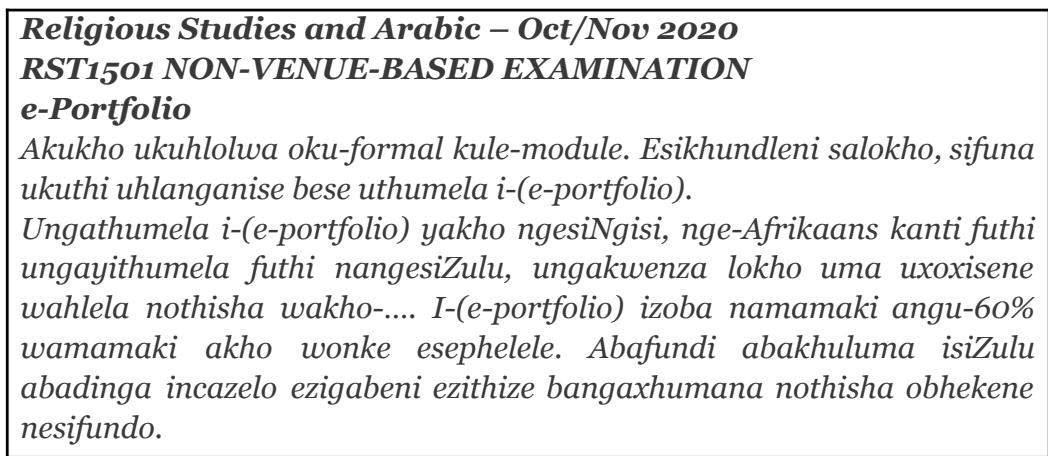
Figure 5: Non-venue-based examination instruction in isiZulu
The lecturer created a discussion forum on myUnisa in Nguni languages where students discuss topics related to the module. The four languages listed in Figure 6 below: re isiXhosa, isiZulu, isiNdebele and siSwati. These languages belong to a group of languages called Nguni, and the speaker of any of the mentioned languages would participate in the multilingual discussion forum.
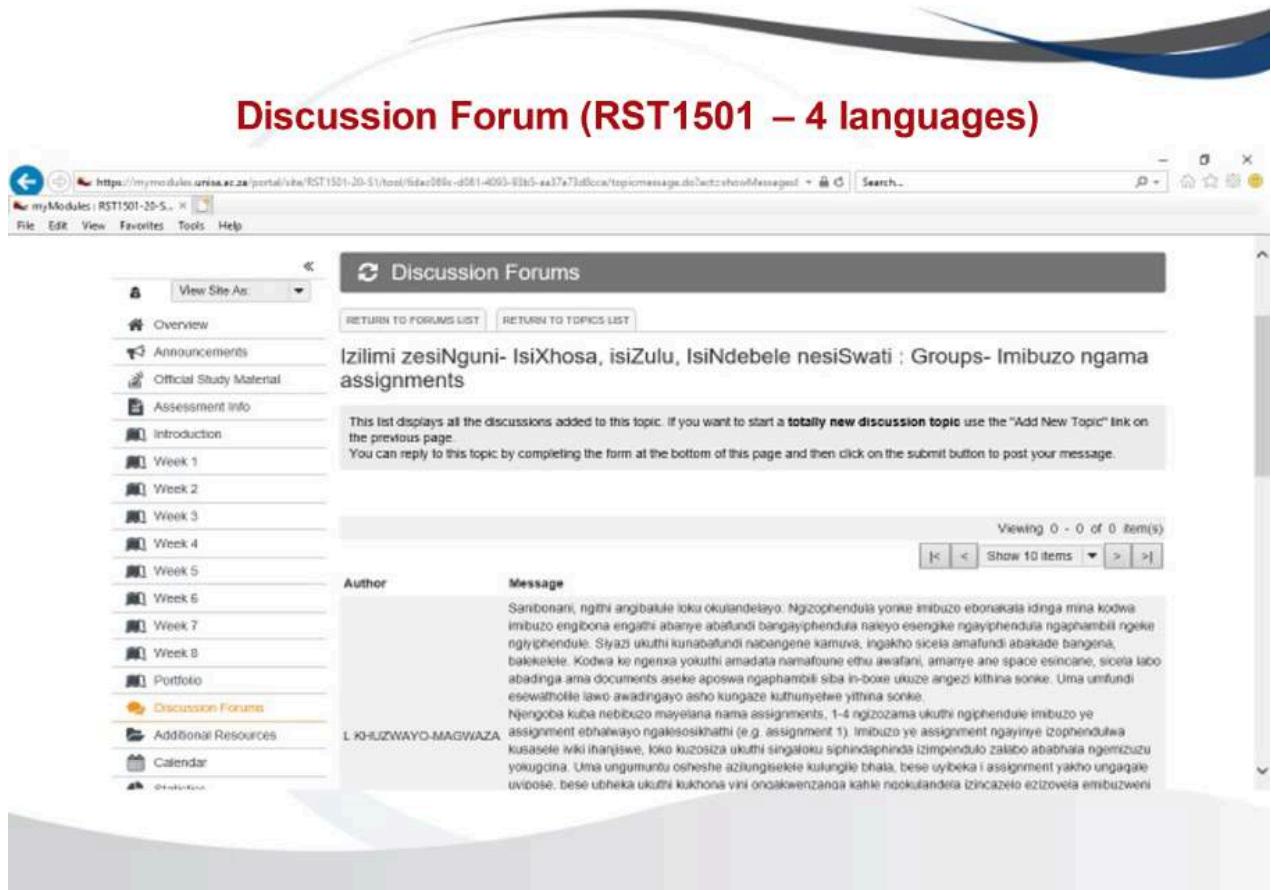
Figure 6: RST 1501 discussion forum in four Nguni languages
Utilisation of Multiple Languages in Teaching and Learning: Mapping Initiatives at the University of South Africa (Unisa)
It is the role of the lecturer to initiate the teaching in isiZulu. If the lecturer is proficient in any of the indigenous languages and is willing to pilot teaching in another language in addition to English, it is possible to teach in more than one language.
VI. CONCLUSION
This study demonstrates how the University of South Africa supports its students in their learning, using multiple languages. The university began by producing multilingual glossaries for the various disciplines as far back as 2009. It started by introducing two indigenous languages in addition to English and Afrikaans, and in its 2016 language policy, it committed to advancing all the official indigenous languages of the country. In 2021, it initiated the digitalisation of the multilingual glossaries, which was pioneered by the Department of Geography within the College of Agriculture and Environmental Studies. In the October/November 2019 examination period, the translated examination question papers to support first-year students in assessment were introduced specifically for modules with a low pass rate, that is the ‘at risk’ modules. The translated examination question papers were representative of the colleges in the institution (see Appendix A). This initiative was hindered by Covid 19 in 2020, as the university was obliged to move from venue-based examinations to online assessments. The current online assessment platform permits only one exam question paper to be uploaded. To address this issue, the university must develop an online platform that will enable the student to select a different language of choice besides English. Assisting students in their learning by translating tutorial material into indigenous languages is an ongoing process, however human resource capacity and submission dates remain a challenge as some languages have less translators than others. The university has demonstrated its commitment to advancing multilingualism as it implemented strategic projects on language attitudes and language transformation.
The University of South Africa offers eleven official South African languages: English,
Afrikaans, Sepedi, Sesotho, Setswana, siSwati, Tshivenda, Xitsonga, isiNdebele, isiXhosa and isiZulu. Additionally, it has a Department of Linguistics and Modern Languages which offers Translation and Interpreting Studies at Honours level. The nature of the Honours programme is such that students who have completed their studies should not only be competent translators/interpreters but should also be eminently well-equipped for a career in any profession in which language plays a central role, e.g. editing, terminology and lexicography. The University of South Africa as a centre of scholarship should be a crucial constituent in the advancement of the indigenous languages. As the university is in the process of implementing its 2023 language policy, which is a revised version of the 2016 one, it should consider developing collaborative projects with other institutions to develop language resources to enhance the use of multiple languages in teaching and learning and research in higher education. Collaboration between linguists, terminologists and computational linguists should be strengthened to develop online terminology banks for both students and staff. The digitalisation of multilingual glossaries should be accelerated in the implementation plan of the 2023 language policy. The university should take the lead in the training of language teachers, interpreters, translators and other language professionals. It remains the responsibility of the Department of Higher Education to support the Departments of African languages nationwide in terms of funding, infrastructure and personnel as they are the primary drivers of scholarship in these languages.
LIST OF SOURCES
- Alexander, N. 2003. The African renaissance and the use of African languages in tertiary education. The Estate of Neville Edward Alexander. Crystal, D. 2010. The Cambridge encyclopaedia of language. 3rd edition. New York: Cambridge University Press.
Names of modules with translated EQPs: October/November 2019
| Module name | Code |
| Mercantile Law | CLA1501 |
| Economics | ECS1500 |
| Economics 1A | ECS1501a |
| Elementary Quantitative Measures | QMI1500 |
| Decision Sciences | DSC1520 |
| Forms of Business Enterprise | FBE2604 |
| Theories of Social Change | SOC2601 |
| Management 1A | MNG1502 |
| Art and Handwork | PRS1034 |
| Child Development | EDT101G |
| Guidance, Counselling and Life Skills Development | EDT102H |
| Emergent Mathematics | EMA1501 |
| Emergent Literacy | EML1501 |
| Health Education | HEC101V |
| Early Childhood Teaching | PRS101Y |
| Health in Early Childhood Education A | PRS1023 |
| Statistics | STA1510 |
| General Chemistry | CHE1501 |
| Drawing | DRW1501 |
| The Learning Child | ETH102L |
| Religious Studies and Arabic | RST1501 |
Conflict of Interest
The authors declare no conflict of interest.
Ethical Approval
Not applicable
Data Availability
The datasets used in this study are openly available at [repository link] and the source code is available on GitHub at [GitHub link].
Funding
This work did not receive any external funding.
References
Cite this article
Related Research



Special Issue
Launch a focused special issue to highlight research, emerging trends, and expert insights in your academic field.
