



IntelliPaper
Abstract
Human rights are rights of a person simply just because they are a human and are inherited by birth. Human rights are inalienable, indivisible and interdependent. To violate human rights of a person simply means to treat that person as not a human being and when respected means that the dignity of all human beings be respected. Although human rights are universally declared and they are protected by international courts and organizations, there are countries globally who are in conflict of granting human rights to their citizens with the clash of cultural relativism. My research is on one country among them which is Qatar and the research work is done on how rights of women in Qatar are exploited, diving deep into the historical context, to understand the legal and social status of women in Qatar, to understand the reforms which have been provided to them in the past years. The ultimate goal to study is to see that human rights of every person is protected and promoted everywhere. Even though there have been several reforms and initiatives taken by the Qatari government, there have still been cases reported by human rights watch and many such international organizations. Laws in Qatar still continue to discriminate against women and lesbian, gay, bisexual, and transgender (LGBT) individuals. Women continued to face discrimination in law and practice. Under the guardianship system, women needed a male guardian’s permission to marry, study abroad on government scholarships, work in many government jobs, travel abroad if aged under 25, and access reproductive healthcare, Women remained inadequately protected in law against domestic violence (Amnesty International, 2024). The supreme political leadership represented by His Highness the Emir and Crown Prince plays an encouraging role in supporting women to achieve equal rights, and improve and enhance women’s position and role in society (Ashghal, n.d.). She has supported the Qatar Institution for Sciences, Education and Society Development that was established in 1996. It is a special institution that first established The Qatar Academy under the chairmanship of Sheikha Al Misnad (Ashghal, n.d.) Her Highness has also shown her interest in helping girls with special needs, by establishing the ’Al Shafallah‘ center, headed by Sheikha Ghalia Bint Mohamed Al Thani (Ashghal, n.d.)
Explore Digital Article Text
I. OBJECTIVES OF THE RESEARCH
The research aims to understand the recent reforms in Qatar, whether these reforms are implemented in practice and to what extent they align with the international human rights regulations. It aims to deeply analyse the reforms, identify the gaps and assess policy reforms. My research aims to understand what rights women currently have and what they are fighting for and to understand how traditional gender roles affect women's ability to be independent.
1.1 Research Questions
How do male guardianship laws in Qatar reflect a clash between modern legal reforms and traditional norms?
How effective is the recent Qatari government in enhancing women's legal and human rights? What are the limitations posed by Qatar's reservations to international human rights treaties on the realization of gender equality?
1.2 Hypothesis
Qatar's diplomatic efforts to appear progressive on the global stage have led to limited but symbolic reforms in women's rights, without fully addressing systemic gender discrimination even International pressure and global partnerships (e.g., with the UN) influence Qatar's public stance on women's rights but have limited impact on changing internal legal and cultural frameworks.
II. METHODOLOGY
The research employs a qualitative methodology, collecting a range of primary and secondary sources to analyse women's rights in Qatar and how it is navigating the crossroads of cultural norms and universal human rights in gulf diplomacy, looking at it through the lens of the debate between cultural relativism and universalism. Primary sources include official statements, policy documents, official speeches as well as reports by international organizations such as the United Nations, Amnesty International as well as Qatari government releases. Secondary sources encompass academic journals, think tank publications, media reports. This method allows for a comprehensive and inclusive understanding of the rights of women in Qatar. My research study incorporates discourse analysis as to how cultural relativism in Qatar justify the restrictions on women rights and universalism ought for reforms and justified rules. To have diverse and inclusive viewpoints, my research study incorporates reports from international organizations, Qatari scholars and global activists.
2.1 Sampling Strategy
We will use purposive sampling to pick reports and cases that are directly connected to how cultural practices and gender policies intersect. We will focus on materials created from 2015 to 2025 to make sure the information is both relevant and up-to-date.
2.2 Data Analysis
The qualitative data we collect will be analyzed using thematic coding. We will group and compare key themes to find patterns and differences in how Qatar handles traditional values alongside its diplomatic objectives. We may use software like NVivo or do the coding manually, depending on how much data we have.
2.3 Ethical Considerations
Since this study uses publicly available data and secondary sources, there will be no direct contact with people. Still, we will be careful and respectful when interpreting the content, especially when looking at personal stories shared by women.
2.4 Justification of the Study
This topic is important because it shows how women's rights are affected not just by laws, but also by culture, family expectations, and politics. It also helps explain how countries like Qatar can appear modern in some ways while still being very traditional in others. Understanding this helps us see the bigger picture of women's rights in the Middle East and beyond.
2.5 Limitations of the Study
2.5.1 Limited Field Work
My research study does not include interviews, surveys or direct face to face interaction with the people in the region. The personal experiences, ground realities and local voices in the region could have added more depth to my research findings.
2.5.2 Dependence on Secondary Sources
As my research study relies on policy reports, official documents, news articles, government statements, they might carry certain biases and provide only official narratives.
2.5.3 Language and Translation Limitations
Important sources for example the local and regional ones which might not be available in Hindi or English which limits access to wider range of viewpoints and might also influence the diversity of perspectives in the analysis.
III. REVIEW OF LITERATURE
3.1 Human Rights Watch. (2021). "Everything a Woman has to do in Qatar is Tied to a Man" - Discrimination against Women in Qatar. Human Rights Watch
This report highlights the legal constraints that were faced by women in Qatar. This report has highlighted gender-based discrimination and the working of women under male guardianship laws which has put restrictions on the basic rights of women in general. The report has provided insights of reality on ground and has helped me in portraying those ground realities faced by women in general and how their human rights are curtailed which further insists that reforms are needed to protect and preserve the basic human rights of women in Qatar. This report provides an insightful and a broader framework on how cultural systems intersect to shape women's lived experiences in the Gulf region.
3.2 Human Rights Watch. "Qatar." World Report 2023: Events of 2022. Human Rights Watch, 2023
This report has further investigated that even in 2023 the male guardianship system still continues the discriminatory practices which have also covered the LGBT individuals as well. The report has very well highlighted how the cultural norms intersect with women's freedom and how cultural relativism justifies practices that contradict universal human rights standards. This report is helpful in providing me an insight into the debate between cultural relativism and advocacy for universal human rights.
3.3 Public Works Authority (Ashghal). (n.d.). Women in Qatar. Ashghal. Retrieved October 25, 2025
This report by a Qatari think tank is an important and valuable insight which presents an official
narrative on women rights and empowerment. This report while specifying on the discrimination and inequality faced by women in Qatar has provided the vision 2030 and more government initiatives to bring on reforms for unjust laws and discriminatory practices. It reveals a complex interplay between modern narratives and existing patriarchal structures in Qatari society.
3.4 Musawah. (2019). Musawah Thematic Report on Qatar (CEDAW73). Retrieved October 25, 2025
This thematic report provides a critique of Qatar government's compliance with CEDAW. It reveals the legally unjust provisions in family laws, marriage customs, divorce regulations.
Musawah, which is a global reform movement dives into reforms according to Quranic principles which objects to the injustices done in the name of cultural relativism. It provides a bridge between local cultural realities and international advocacy and what efforts can be made to protect human rights. This provides reforms in women's rights in Qatar from a Muslim feminist lens.
IV. INTRODUCTION
In 539 B.C., the armies of Cyrus the Great, the first king of ancient Persia, conquered the city of Babylon. But it was his next actions that marked a major advance for Man. He freed slaves, declared that all people had the right to choose their own religion, and established racial equality. These and other decrees were recorded on a baked clay cylinder in the Akkadian language with cuneiform script. Known today as the Cyrus Cylinder, this ancient record has now been recognized as the world's first charter of human rights (British Museum, n.d.). It is translated into all six official languages of the United Nations and its provisions parallel the first four articles of the Universal Declaration of Human Rights (UN, 2020).
Documents asserting individual rights, such as Magna Carta (1215), the Petition of Right (1628), the US Constitution (1787), the French Declaration of the Rights of Man and of the Citizen (1789), and the US Bill of Rights (1791) are written precursors to many of today's human rights documents (Donnelly, 2013). Human Rights are those basic standards without which people cannot live in dignity. The basic rights and freedom to which all humans are entitled often include the right to life and liberty, freedom of thought and expression and equality before law (UDHR, 1948). Human rights are protected and promoted by International law. They are internationally recognized, enforced by the United nations, international courts and other specialized organizations (Alston & Goodman, 2013). There are no remedies against the violation of human rights.
On the basis of UDHR, 1948, there are following classifications:
Civil and Political rights Economic Rights, Social and Cultural rights Solidarity rights
Rights are something people demand or desires for their self-Development. Rights are those basic standards without which people cannot live in dignity (United Nations, 1948).
Hobhouse says, "Rights are what we may expect from others, and others from us and all genuine rights are conditions of social welfare" (Hobhouse 1911). To violate someone's human right is to treat that person as though she or he were not a human being (Donnelly, 2013). These are basically few natural rights which cannot be denied, but at the same time not guaranteed by Statutory Law (Freeman, 2017). It is the obligation of the state to promote and protect human rights. Human rights are the same for everyone regardless of their caste, class, race, sex, gender, nationality, origin. Though Human Rights have a universal figure, its scope and periphery differ because of the different socio-economic and political structure of various countries (Donnelly, 2007). One such case study is that of Qatar where women are denied basic rights because the country is navigating its crossroads with cultural norms and universality of global rights.

Source: Qatar, UN join forces for women empowerment.(2024).
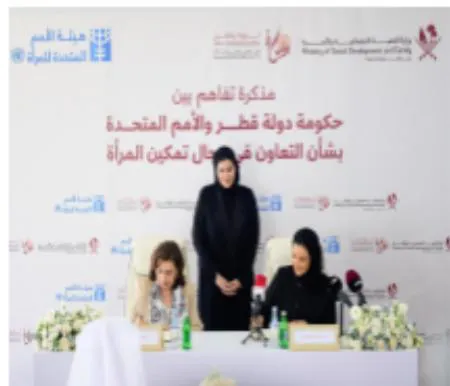
Source: (2015a). Qatar Flag.
Many women in the Middle East are not free to go where they want. In some countries, women need their husband's permission to get a passport, or to travel with her own children, even leaving their homes requires a man's consent. A Human rights watch report says, "Everything a woman has to do in Qatar is tied to a man" (Human Rights Watch, 2021).
Women in Qatar have broken barriers and achieved significant progress, including in education where there are now more female than male graduates, and as doctors, lawyers, and entrepreneurs in one of the world's richest states per capita. Yet they continue to face deep discrimination in almost all aspects of their lives (Human Rights Watch, 2021). Women in Qatar face systematic discrimination. To avail their basic rights like right to education, government scholarships & even for some reproductive healthcare as well, women are dependent upon their fathers, brothers, grandfathers (Human Rights Watch, 2021; Human Rights Watch, 2024). This depicts that men are the heads of households and also the guardians of women. All of this has led Qatari women to leave their home country and flee to other countries to avail benefits which has resulted in refugee crises around the world as well.
4.1 Universal Values vs Cultural Relativism
Cultural relativity is an undeniable fact; moral rules and social institutions evidence an astonishing cultural and historical variability. The doctrine of cultural relativism holds that at least some such variations cannot legitimately be criticized by outsiders (Donnelly, 1984). Radical universalism says that culture is irrelevant to the validity of moral rights or rules, which are universally valid. The body of the continuum defined by these typical end points, that is those positions involving varying mixes of relativism and universalism can be roughly divided into what we can call strong cultural relativism and weak cultural relativism (Donnelly, 1984). Many in developing countries argue that some human rights are simply not relevant to their societies, for instance, to political pluralism, the right to paid vacations and, inevitably, the rights of women. It is not just that some societies claim they are simply unable to provide certain rights to all their citizens, but rather that they see the "universal" conception of human rights as little more than an attempt to impose alien Western values on them (Mutua, 2002). "Human Rights might turn out to be a Trojan horse, surreptitiously introduced into other civilizations, which will then be obliged to accept those ways of living, thinking and feeling for which Human Rights is the proper solution in cases of conflict" (An-Na'im, 1992, p. 14). Universalists argue that all peoples have a shared and common humanity which means there can be some universal values. In human rights, universalists believe that all humans have the same inalienable rights simply because of their humanity. Therefore, all humans are entitled to the same rights and freedoms, regardless of age, sex, gender or any other distinguishing characteristic (Donnelly, 2013). Relativism is a critical theory that argues nothing is universal among humans and that all values are created by culture. Because there is no universal culture, there can be no universal values. As a result, each culture determines its own values and its own idea of justice (Renteln, 1990). Relativists believe it is impossible to impose a universal set of human rights on all cultures because each culture creates its own set of morals and ideas of right and wrong. Instead, human rights are relative to the cultures that created them and other cultures are entitled to their own morality (Renteln, 1990). The theory of Cultural relativism leads to the idea that the main social unit is community, not individual (Renteln, 1990).
4.2 Historical Context
Qatar obtained independence in 1971 from its status as a British protectorate. The country has a mixed legal system incorporating both civil law and Islamic law. Shari'ah is one of the sources of Qatari legislation, and is applied to aspects of family law, inheritance, and certain criminal acts (Musawah, 2019). Political leadership in Qatar under Sheikha Moza bint Nasser in the 1990s had played an encouraging role in supporting women in providing equal rights to them. She had led the establishment of Qatar institution for sciences, education and society development in 1996. Under her leadership, women had achieved educational excellence and also contributed their part extensively in arts, law, public policy etc. Globally, women started to have a good impact, a Qatari women member of the UN child rights committee was elevated to a senior position in 2001. Women got the right to vote in 1997. In 1998 respectively, women started to grow in the banking and investment sector, a joint venture between Qatari ladies and Qatar international bank started which was also managed by a woman, In line Qatari business women forum was established in 2000.
The Qatar Red Crescent Society was the first to establish a Women's Section in 1982, before more associations joined and set up women's branches in addition to the country's Social Development Center. Qatari women work in these communities both as employees and as volunteers (Ashghal, n.d.). Qatari women have contributed to the health sector since the late 1960s through their involvement in nursing and study in nursing schools. The proportion of Qatari nurses exceeds of nurses working within the Supreme Council of Health (Ashghal, n.d.). Her Highness Sheikha Moza had paid great attention to highlighting the prominent role of Qatari women and encouraging them to move forward with social responsibilities and participation in public life (Ashghal, n.d.).
4.3 Ambivalent Chauvinism in Qatar
Since Qatar is a Sunni monarchy with Sharia law as its main source of legislation, Qatari women's present day mobility needs to be viewed in the context of the established patterns in Islamic gender relations. While historically the level of human mobility was high for Muslims, tribal order and strict interpretation of the Qur'an resulted in a rigid spatial organization (Hidemitsu 2003, Golkowska, 2017). Women in Qatar face legal and structural constraints leaving them easily vulnerable to violence and hindering equal status in areas like nationality, guardianship and family law (Qatar Centre for Peace & Democracy, n.d.).
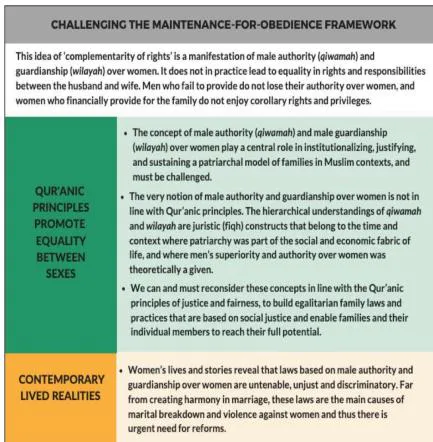
Musawah the global movement for equality and justice in the Muslim family contends that the very notion of male authority and guardianship over women is not in line with Quranic principles. The hierarchical understanding of qiwahah and wailayah are juristic constructs shaped by gender ideology of classical muslim scholars in the context of norms and practices prevalent in their times (Qatar Centre for Peace & Democracy, n.d.)
A study reveals that there was inequality persisting in Qatar during the gulf cooperation council crisis (2017-2021). As of 25 April 2018, Qatari citizens living in the blockading countries have experienced 643 human rights violations regarding family reunification (Abu-Ras et al., 2022). The interaction between law, tradition, family life, and well-being is complex and multidimensional. Gendered citizenship is fundamental to this interplay, While citizenship contributes to positive psychological well-being, engagement, and interpersonal interactions, gender-based citizenship places women at a disadvantage and makes them more vulnerable to psychological distress (Abu-Ras et al., 2022).
A women's rights activist Aisha-al-Qahtani escaped from Doha because of an oppressive and abusive life she had to face in Qatar, she escaped a country where a local woman under 25 required the male guardian's permission to board a flight restricting the right to travel (Al Arabiya English, 2020). The reason she chose to do so from another Gulf country as Qatar remains the only state within the Gulf Cooperation Council to require females under the age of 25 to obtain a male guardian's permission to travel (Al Arabiya English, 2020). Qatar remains the only GCC country with male guardianship laws for female travel after Saudi Arabia lifted restrictions in 2019. According to the Qatari Ministry of Interior's website, single women under 25 years of age require a male guardian's consent to travel outside the country, Qatari men can also apply to the courts to prohibit their wives from traveling, Al-Qahtani vowed that she plans
Women's Rights in Qatar:
on "starting a revolution" in Qatar to get more women to speak out for their rights, adding that she had both the time and energy to do so (Al Arabiya English, 2020), "But why do I have to go through this escape plan and Prison Break-like story just to leave? Just to, you know, travel? Just, my freedom of movement?" she added (Al Arabiya English, 2020).
4.4 Women's Rights in Qatar, A 2023 Human Rights Watch Report
The Human Rights Watch report in 2023 published a report highlighting that women in Qatar are bound by male guardianship laws and they restrict women's ability to make autonomous decisions. All their basic rights like right to education, applying for scholarships, travelling abroad, seeking healthcare facilities. Unmarried women are restricted to travel without their guardian's permission and women who are married may have their travel restricted by the men they are married to, and even their female relatives' travel can be restricted. Unmarried women who are victims of sexual violence and rape cases and when they report it and if authorities don't believe in them, they are subjected to torture and severe punishment in charge of adultery. The family law in Qatar restricts and forbids husbands from hurting their wives physically as well as morally but there are no provisions for victims of domestic violence and prosecuting their abusers.
The 2016 Mental Health Law allows for involuntary hospitalization, that is detention, including by male guardians or other Qatari authorities for three months, which is renewable, with no role given to the judiciary to review such detention (Human Rights Watch, 2023).
Qatar's penal code punishes consensual sexual relations between males above sixteen with up to seven years imprisonment (Article 285). It provides penalties between one- and three-years' imprisonment (Article 296) for any male who "instigates" or "entices" another male to "commit an act of sodomy or immorality." A penalty of 10 years' imprisonment (Article 288) is imposed on anyone who engages in consensual sexual relations with a person above sixteen, outside marriage, which could apply to consensual same-sex relations between women, men, or heterosexual partners (Human Rights Watch, 2023). Preventive Security Department Forces in Qatar arbitrarily arrest lesbian, gay, bisexual, and transgender (LGBT) people and subject them to ill-treatment in detention. Security forces pick people off the streets and in public places based solely on their gender expression, and unlawfully search their phones in detention (Human Rights Watch, 2023).
4.5 Qatari Government Support for Women's Rights
- The Qatari government established the supreme council for family affairs in 1998 to focus on women's issues (Qatar Supreme Council for Family Affairs, 1998).
- The council led by Sheikh Mouza bint Naseer-al-Misnad, advocates for reforms in women's rights. (Al-Misnad, 2002).
- Legislative changes include raising the marriage age from 15 to 16 (Qatar Legal Code, 2003).
- Women can now divorce without losing custody of their children and are eligible for three years of alimony after divorce (Family Law Reform Act, 2006).
- The government provides free education for citizens aged 6 to 16, contributing to a high literacy rate (Ministry of Education, 2010).
- Women are provided more education opportunities where more women attend Qatar's university college of law in comparison to men (Qatar University Report, 2015).
- Women are provided good career opportunities in business and finance after graduation (Qatar Development Report, 2016).
- Qatar's labor law enacted in 2004 promotes equality in the workplace (Labor Law No. 14, 2004).
- Women receive equal wages for similar work and have access to promotion and training opportunities (Qatar Ministry of Labor, 2018).
- There are still some employment restrictions in hazardous or morally harmful jobs (International Labour Organization, 2020).
- Qatar joined the convention on the elimination of all forms of discrimination against women (CEDAW) in 2009 (United Nations Treaty Collection, 2009).
V. CONCLUSION
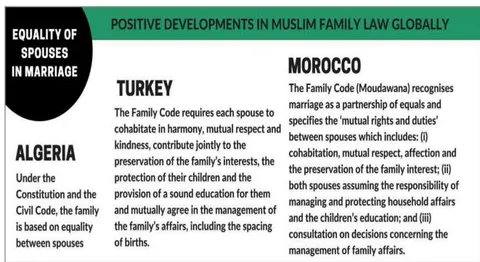
With its upcoming role as host of the WSSD2, Qatar is well placed to demonstrate alignment between domestic priorities and global social commitments (Qatar Centre for Peace & Democracy, n.d.). Originally launched in 2008 and most recently updated in 2024, the 2030 Vision "for a country in which there is economic and social justice for all", is underpinned by a Human and Social Development dimensions, Recognising its people as the "nation's most valuable resource", the national strategy outlines essential investments in healthcare and workforce development sectors whilst including a gendered-responsive objective to foster and enhance female participation in economic life, The empowerment of women is also reverberated within the second social dimension, along with the provision of safeguards for vulnerable groups (Qatar Centre for Peace & Democracy, n.d.). The CEDAW committee should ensure men and women the same right to enter marriage, including repealing discriminatory laws, regulations and practices requiring for a guardian's consent or approval, eliminating all provisions that refer to disobedience of women as a grounds by which she risks losing her right to financial maintenance, Consider family codes in other muslim contexts such as morocco, algeria, turkey as examples for reforming QFL to promote equality in the muslim household (Musawah, 2019). Education can provide the necessary changes.
Education based on equal citizenship is one way to address the region's political and social realities. Furthermore, the curriculum must be updated to include discussions of national identity, women's participation in and contribution to government and politics, and the transmission of democratic and just values to future generations. This resocialization process would enable educators and parents to contribute to gender equality, social justice, and the advancement of human rights (Abu-Ras et al., 2022). Qatar is home to a wide range of civil-society organizations that support vulnerable people and cultural outlets for its many different nationalities. These organizations can also actively assess and address current human rights concerns and increase women's civic involvement locally and nationally (Abu-Ras et al., 2022).
Conflict of Interest
The authors declare no conflict of interest.
Ethical Approval
Not applicable
Data Availability
The datasets used in this study are openly available at [repository link] and the source code is available on GitHub at [GitHub link].
Funding
This work did not receive any external funding.
Cite this article
Related Research


Special Issue
Launch a focused special issue to highlight research, emerging trends, and expert insights in your academic field.