






IntelliPaper
Abstract
Carrot is a valued exotic vegetable in Ghana, mostly used in combination with other vegetables in preparing soups, stews, salads and drinks. Demand for carrots therefore, remains high especially in urban centres. A major constraint to carrot production is poor soil fertility. Carrot farmers generally experience high production costs as a result of inorganic fertilizer application. The use of legumes such as cowpea for nitrogen fixation leading to soil fertility enhancement provides a viable alternative for sustainable crop production. This chapter is an output of research that examined the contribution and improvement of cowpea-based Biological Nitrogen Fixation (BNF) in carrot production in the Ashanti Mampong Municipality in the Ashanti Region of Ghana to propel carrot production to sustainable levels. Carrot production is a widespread economic activity within the Municipality which supplies other urban centres such as Kumasi within the Ashanti Region of Ghana. The study highlights salient carrot production and handling practices which are expected to provide some relevant information to farmers, agricultural-service providers and other actors along the carrot value chain.
Explore Digital Article Text
I. INTRODUCTION
Vegetable production is an important crop sub-sector of Ghana's agriculture with a great potential for both local and international markets. Carrot is a valued exotic vegetable in Ghana, mostly used in combination with other vegetables in preparing soups, stews, salads and drinks [1]. One of the constraints to carrot production is poor soil fertility. The nutrient status of the soils is usually depleted when farmers engage in practices such as continues cropping and diminutive mineral and organic fertilizer use [2].
Cowpea is a major component of the cropping systems of the drier parts of the tropics, particularly sub-Saharan Africa. It is mainly grown in mixtures with other crops and a great diversity of crop mixtures has been reported. Because of its soil improvement ability (fixing nitrogen into the soil), it has the beneficial effects on subsequent crops in the rotation and also on the crops grown in association with it. In any cropping system research, it is useful to understand how the components which make up the cropping system interact. Cropping cowpea generally improves soil fertility through nitrogen fixation and addition of soil organic matter. It compensates for the loss of nitrogen absorbed by cereals and has a positive impact on soil properties. The use of legumes such as cowpea for nitrogen fixation leading to soil fertility enhancement provides a viable alternative for sustainable crop production . This is due to its unique capacity to fix atmospheric nitrogen and good performance even in poor soils . The common practice of integrating legumes into cropping systems include crop rotation, simultaneous intercropping, improved fallows, green manuring, and alley cropping .
This chapter is an output of research that examined the contribution and improvement of cowpea-based biological nitrogen fixation (BNF) in carrot production in the Ashanti Mampong Municipality in the Ashanti Region of Ghana to propel carrot production to sustainable levels. The study highlights salient carrot production and handling practices which are expected to provide some relevant information to farmers, agricultural-service providers and other actors along the carrot value chain. Such pieces of information can be updated as new research information and recommendations are generated in future studies.
II. AGRONOMY AND CROPPING PRACTICES AGRONOMY AND CROPPING PRACTICES
2.1 Land preparation
Carrots give highest production on well drained, light sandy soils as well as deep, loose, loamy soils with pH between 6 - 6.5. For effective BNF, cowpeas are grown on well-drained sandy loams. Since organic manure releases both major and minor nutrients, carrot and vegetable farmers are advised to use any available manure including cowpea residuals for effective growth and yield. The land should be cleared of debris, ploughed, and leveled before planting. The biomass or stubble should be incorporated into the soil to decompose. After the incorporation of the biomass or stubble, the land should be cleared of weeds, raked, loosened and leveled after it is thoroughly watered. For soils with poor structure, high run-off and low water infiltration, the physical properties can be improved markedly and cowpea yields increased if the land is ploughed. Zero tillage (for example using Roundup spray prior to planting) may be used only where drainage is good. Beds should be of uniform size of 3 m and raised at 1.5 cm wide and 2 cm long for the sowing of carrots (Plate 1).
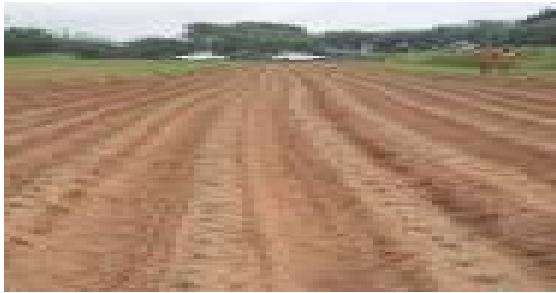 a: Seed bed of cowpea
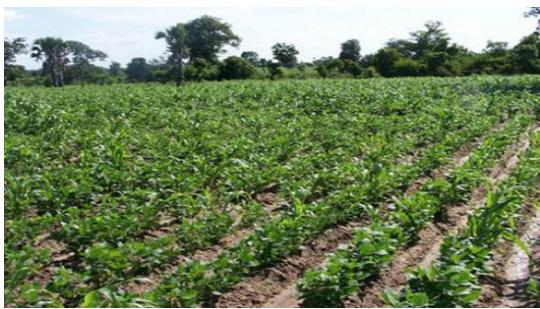 b: Vegetative stage of cowpea Plate 1: Photographs of cowpea fields at different management stages
III. PLANTING OF COWPEA
Generally, for early maturing cowpea varieties, planting at the beginning of the rains is advised so that the sensitive stages of the crop could avoid the peak activity of insect pests (Plate 2). Soronko variety (80-85 days) should be planted at 60 cm x 20 cm, while the Asetenapa variety (70-75 days) should be 50 cm x 20 cm. After harvesting the cowpea, the cowpea residue should be incorporated into the soil to decompose before sowing of carrot seed. Application of fresh leguminous organic matter to the soil during cultivation is detrimental to carrot root development [8]. The seeds should be planted inch deep and thinned out to 3 inches apart within rows and 9 inches apart between rows. About 3 lbs of seeds is required to plant 1 acre. Heavy rains should be avoided during planting as it can result in heavy loss of seeds and seedlings.
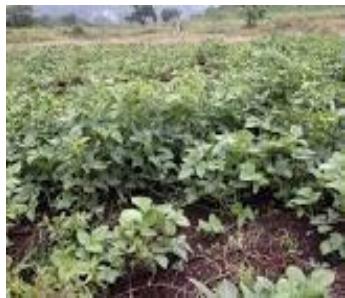 a: Podding stage
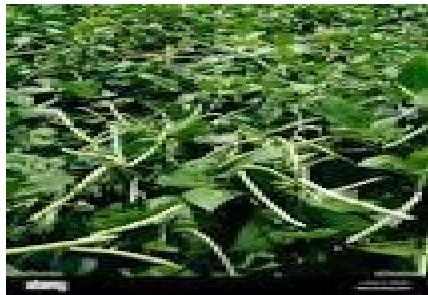 b: immature pods stage
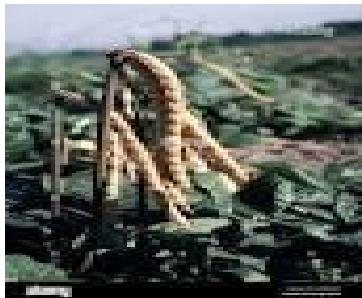 c: mature pods stage Plate 2: Photographs of carrot fields at different developmental stages
IV. WEED CONTROL
Weeding should be done by the second week after germination, although this depends on the types of weeds present and how well the land was prepared. If a pre-emergence herbicide (e.g. Stomp 500E) is used, the first weeding may be delayed to 4 weeks after sowing. It is important to complete weeding by the end of the week when the crop is establishing ground cover. Weeds should be controlled manually when needed and should be done twice manually with a hoe. Loosening of the soil (forking) should be done periodically to enhance water percolation and air circulation and also to aid carrot root development.
V. FERTILIZER AND PESTICIDE APPLICATION
Generally, cowpea varieties especially Asetenapa and Soronko combine effectively with 60 kg N/ha in amending the soil for optimum carrot yield (Table 1). Carrot root forking and cracking is generally low in cowpea amended plots as these plots record minimal cracked and forked carrot roots compared with non-amended plots. The 60 kg N/ha fertilizer application rate gives significant performance in plant height, number of leaves per plant, dry matter accumulation, low nematodes ratings and carrot root length. Cymethoate 2.5EC (Cymethoate + Dimethoate) should be applied at 40 ml per 15 litres of water using a Knapsack sprayer at 30, 40 and 50 DAS to control pest in Asetenapa, and at 35, 45, 55 and 65 DAS for Soronko. The last spraying should be applied to control post flowering pests.
VI. CARROT YIELD
Generally, the soil amendment using cowpea varieties leads to higher carrot yield. Soil physical composition is of special significance for carrot yield. In the soil amendment studies in Asante Mampong, it was observed that increased carrot yield and other yield components such as root length, root diameter and root weight in treated plots, and improved soil chemical and physical properties are influenced by the application of organic matter (Plate 3). Application of Mucuna pruriens green manure, chicken manure, and their combinations as well as the combination of Mucuna pruriens and NPK fertilizer significantly improves soil physical conditions, particularly total porosity and gravimetric moisture content and reduced bulk density . Resource-poor farmers can therefore benefit from the cowpea grain as well as higher carrots yields to increase their household incomes.
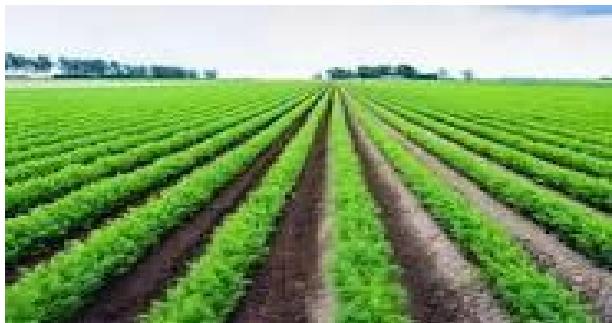 a: Vegetative growth stage
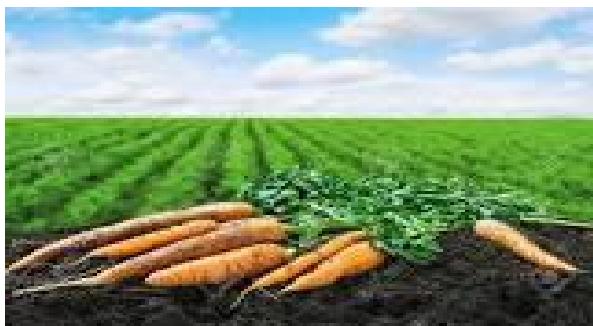 b: Fresh tubers after harvest Plate 3: Photographs of carrot field at different stages of growth
VII. YIELD AND YIELD COMPONENTS OF PRECEDING CROPS (COWPEA)
In the soil amendment studies in Asante Mampong, it was also observed that Soronko and Asetenapa had similar number of pods per plant, number of seeds per pod, and hundred seed weight. This could be due to similarity in the number of branches and plant height between the cowpea varieties. The two varieties also had similar growth patterns, and although Soronko is medium maturing, it did not significantly produce higher yield components than Asetenapa (an early maturing variety) as it usually occurs. In terms of total grain yield however, Soronko had higher grain yield (793.0 kg/ha) than Asetenapa (365.8 kg/ha). Soronko's performance could be attributed to the high nodulation and high DM accumulated (Table 1).
Table 1: Dry matter accumulation, nodulation, yield and yield components of Soronko and Asetenapa as preceding crops
| Preceding crops | ||
| Soronko | Asetenapa | |
| Dry biomass at 50 DAS (g/m2) | 0.67 | 0.51 |
| Dry biomass at harvest (t/ha) | 2.819 | 1.476 |
| No. of effective nodule/plant | 176 | 55 |
| No. of non-effective nodules/plant | 3 | 2 |
| Dry weight of effective nodules | 1.2 | 0.6 |
| No. of pods per plant | 11.00 | 9.67 |
| No. of seeds per plant | 15.00 | 12.00 |
| 100 seed weight | 12.07 | 11.43 |
| Grain yield (kg/ha) | 793.0 | 365.8 |
VIII. EFFECT OF SOIL AMENDMENT ON NUMBER OF ROOTS FORKED, CRACKED AND NEMATODES INFESTATION
The number of forked carrot roots did not show any significant differences in both carrot seasons (Table 2). Root forking and cracking were generally low and this could largely be attributed to the improved soil conditions due to the cowpea amendment. [8], reported that organic soil amendments contribute macro and micro nutrients and also improve the soil structure for effective microbial activities and crop growth, increase the water holding capacity, porosity and decrease bulk density. [9] in a research conducted on growth and yield response of carrot (Daucus carota L.) to different rates of soil amendments and spacing in Ashanti Mampong, reported that amendments improve soil conditions such as moisture content, soil structure, texture and reduces soil compaction which normally causes forking of carrot roots. There was minimal cracking among the carrot roots which could be due to the application of inorganic fertilizer as affirmed by , that well decomposed organic matter minimizes carrot root cracking. It could also be attributed to the soil amendment which probably improved the chemical and physical conditions of the soil for crop growth. Forking is a known problem in carrot production and if the organic matter is well decomposed forking will be reduced . Thorough working into the soil promotes effective decomposition leading to less cracking of carrot roots . However, nematode rating record showed significant differences with the non-amended plots, while carrots grown on the cowpea crop varieties showed no significant differences. This confirms that cowpea can be used to suppress the growth of nematodes . The meloidogyne incognita species were suppressed by the cultivation of cowpea . This confirms that cowpea can be used to suppress the growth of nematodes . Rotating carrot with cereals alongside the application of organic manure minimizes the impact of nematodes . The amendment also helps reduce the incidence of nematodes. Organic amendments procedures can also be practiced to control nematodes . Certain lines of cowpea can also suppress the populations of the nematode Scutellonema cavenessi .
Table 2: Number of forked and cracked roots and nematodes infestation as influenced by preceding crops in Ghana
| No. of forked roots | No. of cracked roots | Nematodes Ratings | ||||
| 2020 | 2021 | 2020 | 2021 | 2020 | 2021 | |
| Variety | ||||||
| Soronko | 0.07 | 0.07 | 0.00 | 0.20 | 0.07 | 0.60 |
| Asetenapa | 0.07 | 0.07 | 0.13 | 0.07 | 0.00 | 0.13 |
| Obatanpa | 0.20 | 0.00 | 0.27 | 0.07 | 0.80 | 0.13 |
| Mean | 0.11 | 0.04 | 0.13 | 0.11 | 0.29 | 0.29 |
IX. HARVESTING
Matured, dried pods of cowpea should be harvested promptly, as delayed harvesting encourages weevil infestation in the field and seed shattering. In harvesting carrot, the mature plant is lifted gently by hand where the soil is loose. The soil should be loosened when it is heavy. This can be done using a spading fork and the roots lifted gently so that they do not break. In manual harvesting, hand tools such as hoes, spades, pick axes, sickles and crowbars (for loosening of soil) are used. Tractor-operated carrot harvester or animal drawn implement may also be used for harvesting carrots.
 Plate 4: Fresh tubers after harvest
X. CONCLUSION
Cowpea used to amend the soil generally improves soil conditions leading to increased carrot productivity. Soil physical composition is of special significance for carrot yield. The application of organic and inorganic fertilizers promotes plant nutrient availability for crop growth, yield and yield components. There is also minimal root forking and cracking which could be due to the application of inorganic fertilizer as affirmed by who reported that well decomposed organic matter minimizes carrot root cracking. Soil amendment improves the chemical and physical conditions of the soil for crop growth. The use of leguminous crop residues to amend soil has the potential of sustaining soil organic matter for increased yields of succeeding crops .
Competing Interests
Authors have declared that no competing interests exist.
Conflict of Interest
The authors declare no conflict of interest.
Ethical Approval
Not applicable
Data Availability
The datasets used in this study are openly available at [repository link] and the source code is available on GitHub at [GitHub link].
Funding
This work did not receive any external funding.
References
Cite this article
Related Research



Special Issue
Launch a focused special issue to highlight research, emerging trends, and expert insights in your academic field.
