


IntelliPaper
Abstract
Feynman (1956) called the double slit experiment "… contains the only mystery. We cannot make the mystery go away by ‘explaining’ how it works". The photons are described by probability wave functions. The wave functions collapse to photons when landed on detector. However, the collapse of the wave function leads to the inconsistent/incomplete of the quantum mechanics (Penrose, 2022). In this article, we confirm that the diaphragm does not change the nature of the light passing through it. Then we perform multi experiments to show that, before and after passing through the diaphragm, the light is photons, not waves. It is photons that produce the interference pattern, we refer to it as “PhotoWave Phenomena”. We show for the first time the novel phenomena, new mysteries: (1) a same single produces the non-diffraction pattern near the diaphragm, which gradually evolves to the orthogonal diffraction patterns; (2) a curve-single slit produces the non-diffraction pattern near the diaphragm, which gradually evolves to Hourglass-shape patterns; (3) a double slit produces the non-interference patterns near the diaphragm, which gradually evolves to the orthogonal interference patterns; (4) a non-parallel-double-slits produces the non-wave patterns near the diaphragm, which gradually evolves to the hybrid patterns; (5) a curved-double slit produces Arc-interference pattern near the diaphragm and Point-symmetry interference patterns near/on the detector; (6) Non-parallel-curve-double slit produces Butterfly-shape interference patterns; (7) simple differences in the shapes of slits lead to the profound differences in the pattern evolutions and in the final patterns, we referred to which as “Optical-Butterfly phenomena”. We referred to above novel phenomena as PhotoWave phenomena. The PhotoWave phenomena support Penrose’s statement. To explain completely/consistently PhotoWave phenomena is a challenge. PhotoWave experiments provide the comprehensive phenomena for further developing theoretical model to study the nature of the light, the complementarity principle, and the light wave theories.
Explore Digital Article Text
1. Introduction
2. Four Zones and Postulates
3. PhotoWave phenomena: single slit to cross-single slit to curve-single slit
4. PhotoWave phenomena: double slit to non-parallel double slit
5. PhotoWave phenomena: Double slit to curved double slit
6. PhotoWave phenomena: double slit to non-parallel curve double slit
7. Summary and conclusion
I. INTRODUCTION
Historically, the study of the nature of light reached basically two concepts: wave and particle.
(1) Light is waves only: In 1690, C. Huygens established the wave theory of light [1].
(2) Light is particles only: In 1704, Newton established corpuscles theory [2].
(3) Light is waves only: In 1801, Young's double slit experiment [3] and Arago experiment [4] revived Huygens' wave theory.
(4) Light is Photons: In 1905, Einstein quantized light as photons to interpret "Photoelectric effect" [5].
(5) Wave-Particle duality: In 1927, to coordinate particle concept and wave concept of light, Bohr proposed the complementarity principle that stating that the wave and particle phenomena cannot be observed simultaneously
[6]. Until 1951, wave-particle duality of the light still puzzled Einstein, he wrote "All these 50 years of conscious brooding have brought me no nearer to the answer to the question: What are light quanta?" [7].
(6) Mystery of double slit: In 1956, Feynman called the double slit experiment "a phenomenon [...] has in it the heart of quantum mechanics. In reality, it contains the only mystery. We cannot make the mystery go away by 'explaining' how it works" [8].
(7) Light is Probability waves: a photon is described by a probability wave function which collapses to photon when one measures it [9].
(8) Penrose's Statement: In 2022, R. Penrose in an interview stated: "this is not something that people normally even recognize as a problem I mean they do but they shove it under the carpet which is known as the collapse of the wave function. Now you see current quantum mechanics strictly speaking is an inconsistent theory that is rather brutal way of saying what Einstein and Schrodinger and even Dirac said that quantum mechanics is incomplete" [10].
Three standard explanations of the normal double slit experiments are: (1) The classical optical wave; (2) The electromagnetic (EM) wave; (3) The probability wave function description.
In this article, we show (1) several novel phenomena which are new mysteries; (2) the nature and characteristics of the patterns of the parallel-double slit, non-parallel-double slit, curved-double slit, and non-parallel-curve double slit are distance-dependent, angle-dependence, curvature-dependence, respectively. Novel experiments show that the light is Photons not only in Photoelectric effect, but in the classical wave experiments. Namely the light is photons, not waves, before and after passing through the double-slit. It is Photons that produce the non-wave patterns near diaphragms and wave patterns near/on the screen. We referred to it as "PhotoWave Phenomena" [11,12]. Thus, no need to introduce both the wave-particle duality and the collapse of wave functions to interpret photons in measurement.
PhotoWave phenomena support Penrose's statement.
Let us summarize the evolution of the understand of the nature of the light (Table 1): (1) Light is waves only; to (2) light is both waves and photons; to (3) light is photons only [12].
| Light is Waves only | Wave-Particle duality | Light is Photons only | |
| Wave pattern | Light as waves produces wave pattern | Light as waves produces wave pattern: Wave function collapsing on detector | Light as Photons produces wave patterns: PhotoWave phenomena |
| Photon effect | Light as Photons produces Photoelectric effect | Light as Photons produces Photoelectric effect |
PhotoWave phenomena challenge the wave nature of the light, wave-particle duality, Bohr's complementarity principle, and the wave function collapse. It is a challenge to consistently interpretate the PhotoWave phenomena We provide novel experiments/PhotoWave phenomena for further theoretical development.
II. FOUR ZONES AND POSTULATES
2.1. Four Zones
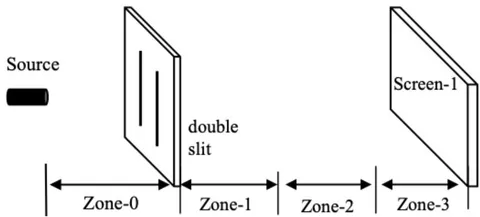
Let us divide the space between the source and screen into four Zones (Figure 2.1) [13].
2.2. Postulates
The wave-description of double-slit experiment is: the light is waves, before and after passing through the double-slit. In this article, we experimentally show: the light is photons, before and after passing through the double slit [14], we refer to it as the photon-description of double-slit experiment.
Combining above two descriptions, we propose:
Postulate-1: the diaphragm, e.g., slide of double slit, does not change the nature of the light passing through it. Postulate-1 can be applied to quantum particles as well, such as electrons, etc.
Let us apply Postulate-1 to two descriptions of the double slit experiments:
Wave-description: the light is waves in the double slit experiments. Utilizing four Zones, the standard interpretation of Young's double-slit experiment can be rewritten as:
(1) the light is waves in Zone-o, i.e., before passing through the diaphragm, the light is waves.
(2) the light is waves in Zone-1, Zone-2 and Zone-3, i.e., after passing through the diaphragm and before landing on the detector, the light is waves.
(3) the light is photons measured on the detector.
The concept of the collapse of wave functions is necessary to explain the light landing on detector as particles.
Photon-description: the light is photons in the double slit experiments. It is photons that produce both the non interference patterns and interference patterns, we referred to it as "PhotonWave Phenomenon". Utilizing four Zones and Postulate-1, Photon-description states the following:
(1) the light is Photons in Zone-0, i.e., before passing through the diaphragm, the light is Photons. (2) the light is Photons in Zone-1, Zone-2 and Zone-3, i.e., after passing through the diaphragm and before landing on the detector, the light is Photons.
(3) the light is Photons on the detector.
The concept of the collapse of wave functions is no longer needed, which support Penrose's statement. Postulate-1 can be rewritten as: In Zone-0 and in Zone-1/Zone-2/Zone-3, the light has the same nature, as well the quantum particles.
Example-1: if we experimentally show that the light is photons in Zone-0, then the light is photons in Zone-1/Zone 2/Zone-3 as well.
Example-2: if we experimentally show that the light is photons in Zone-1, then the light is photons in Zone-0/Zone 2/Zone-3 as well.
Photon-description indicates that each fringe of the interference pattern on a detector is formed independently and partially. We have experimentally confirmed this indication .
We experimentally confirm "PhotonWave Phenomenon" in the article. However, we need to theoretically interpret the phenomenon of photons producing the wave patterns, the "PhotonWave Phenomenon".
Postulate-2 on convex lens
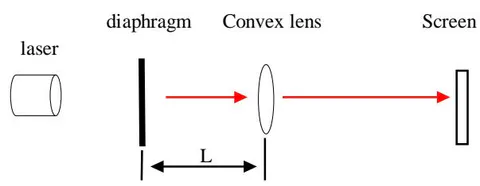
To study the details of the pattern evolution, we utilize the convex lens by placing the lens at different positions between the diaphragm and detector, so the light patterns arriving at the input surface of the lens are different. For the experiments, the original image is that when the light just comes out the diaphragm. The input image is the pattern arriving at the input surface of the lens placed a distance away. Both the original image and the input image are different. To utilize the convex lens to study the evolution of patterns, we propose Postulate-2 of Lens. Postulate-2 contain three sub-Postulates:
Postulate-2.1: the convex lens enlarges the input image that arrives at the input surface; Postulate-2.2: The convex lens breaks/stops the evolution of the patterns;
Postulate-2.3: The convex lens does not change the nature of the input pattern.
Experiments in this article confirm Postulate-2.
Next, we show the universal phenomena that, the nature and the characteristics of the patterns depend on distance from the diaphragm, e.g., of the double slit/cross double slit. Namely in Zone-1, Zone-2 and Zone-3, the patterns are Particle patterns, Transition patterns and Interference patterns, respectively, i.e., in Zone-1 and Zone-2, the light is photons, and thus, in Zone-3, the light is photons that form the interference patterns. In the same classical wave experiment, the non-interference patterns evolve to the interference patterns, which is a mystery.
2.3. Experimental Setup
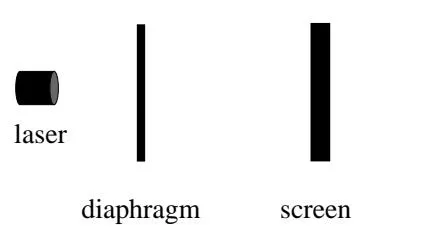
Experimental setup: Figure 2.2 shows Experimental setup without lens. Figure 2.3 shows Experimental setup with lens. For Experiments in this article, we utilize Experimental setup of Figure 2.2 and Figure 2.3.
III. PHOTOWAVE PHENOMENA: SINGLE SLIT TO CROSS-SINGLE SLIT TO CURVE-SINGLE SLIT
In Section 3, we show the novel phenomenon of non-diffraction pattern evolving to diffraction patterns and then, show that the phenomenon is universal.
3.1. Single slit to cross-single slit to Curve-single slit
The single slit is one of the fundamental experiments in classical optics. We extend the single slit to the cross-single slit, and to the curve-single slit/cross-curve-single slit (Figure 3.1).

3.2. Single slit/cross single slit and pattern evolutions
The double slit has been extended to the cross double slits that have much more variations. We extend the single slit to the cross single slits. Then perform the single slit/cross-single slit experiments:
Experiment-3.1: Single slit experiment:
Experiment-3.2: Single slit cross tilt single slit
Experiment-3.3: Single slit orthogonally cross single slit
Experiment-3.4: Single slit crossing two double slit
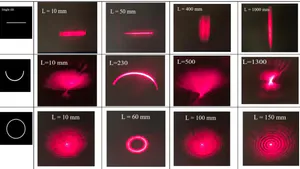
Experiment-3.5: Single slit crossing ring By Experimental setup (Figure 2.3), Experiment-3.1 to Experiment-3.5 show: (1) the phenomenon of the non diffraction patterns evolving to the diffraction patterns; (2) the phenomenon of the pattern evolution is universal. The evolutions of non-diffracting pattern to the diffraction patterns of Experiment-3.1 to Experiment-3.5 are summarized in Table 2.
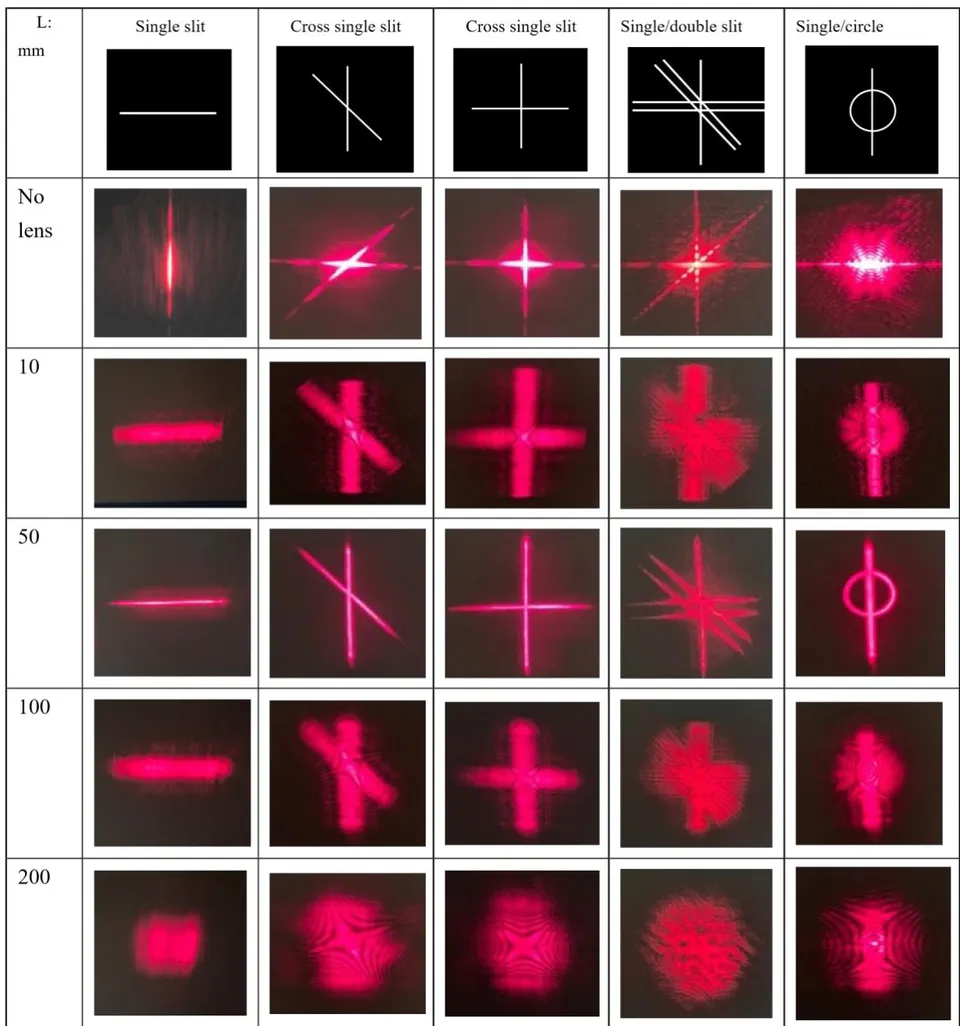
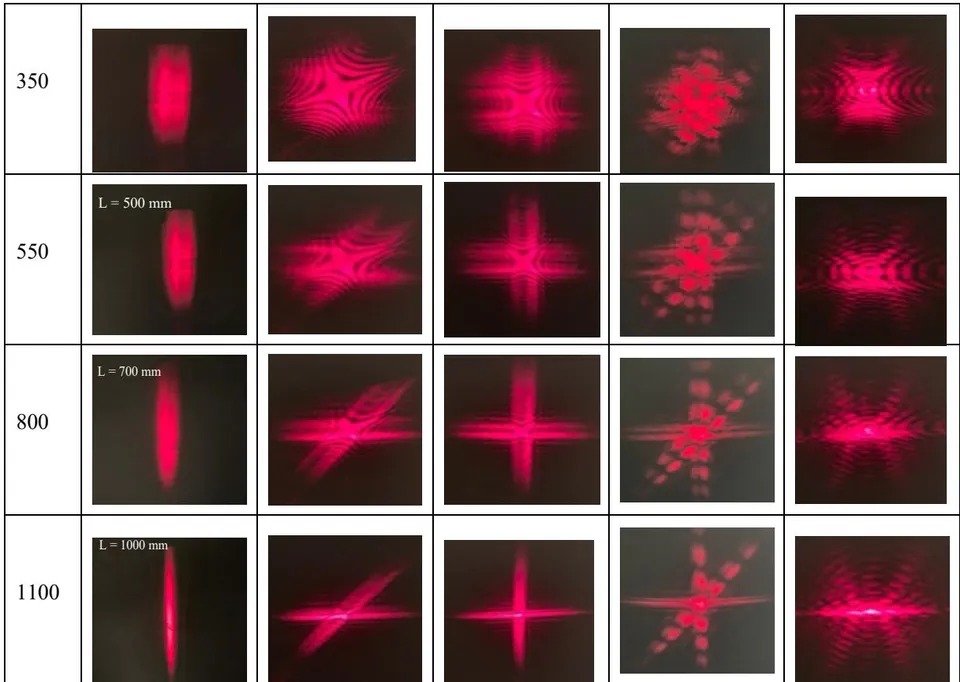
Observation: for all of Experiments
At L = 10 mm, the patterns are Pre-particle patterns
At L = 50 mm, the patterns are Particle patterns
At L = 100 to 800 mm, the patterns are Transition patterns
At L = 1100 and larger, the patterns are Diffraction and/or Interference patterns
Note: the evolution is gradually taking place, there is no clear cut between Particle patterns and Transition patterns, and between Transition patterns and the Diffraction patterns.
3.4. Curve-single slit and pattern evolution
We extend the single slit to the curve-single slits.
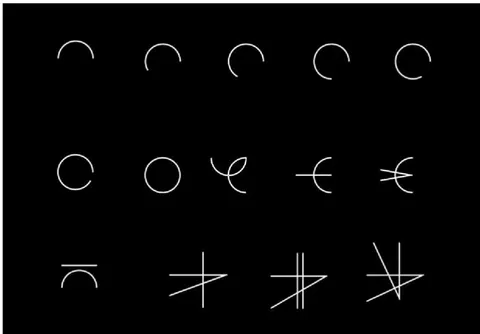
Experiment-3.6: Curve-single slit experiment Utilizing Experimental setup of Figure 2.2, Figure 3.3 shows that the curve-single slit produces Hourglass-shape diffraction pattern.
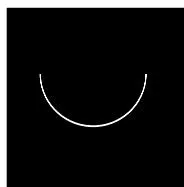
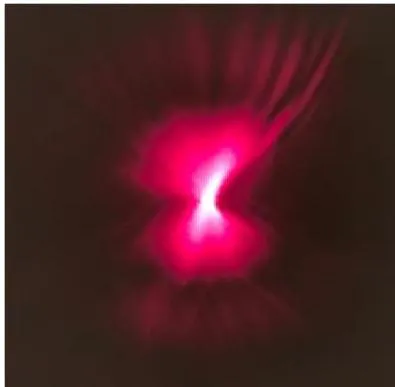
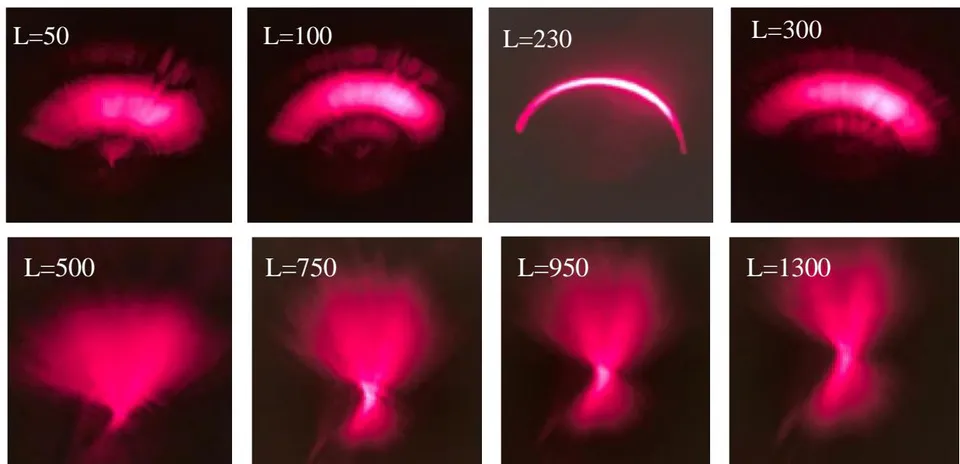
Observation: Figure 3.4 shows the pattern evolution of the curve-single slit. At L=50 - 100 mm, we observe Pre particle patterns. At L = 230 mm, it is the typical Particle pattern. At L = 300 - 750 mm, we have Transition patterns. At L >300 mm, it is the pattern of the curve- single slit, referred to it as Hourglass-shape pattern.
3.5. Ring and pattern evolution
We extend the curve-single slit to the ring.
Experiment-3.7: (Figure 3.5 and 3.6):
Utilizing Experimental setup of Figure 2.2, Figure 3.5 shows that a ring produces the ring-shape interference patterns.
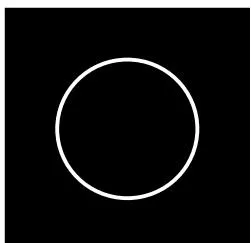
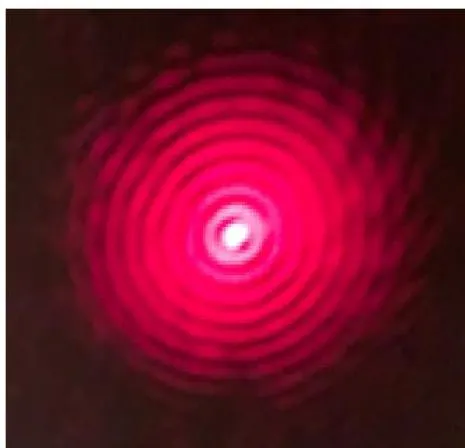
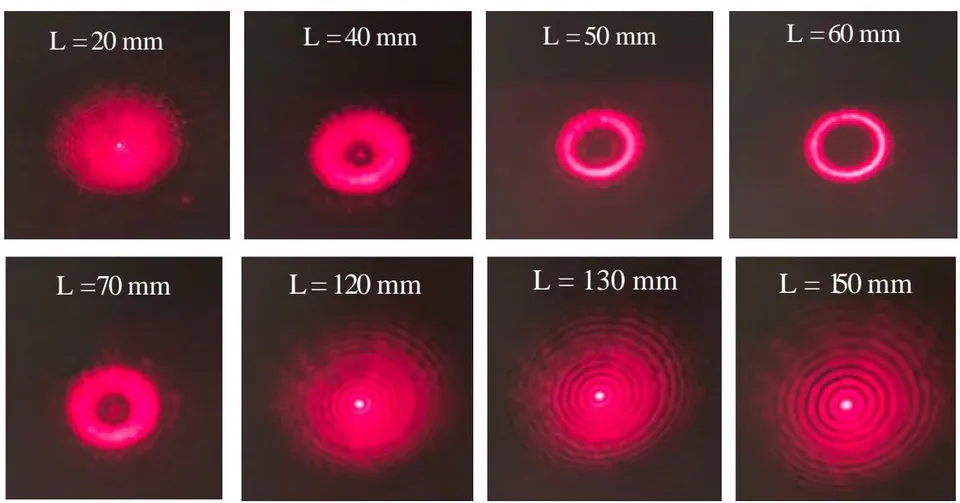
Observation: When L = 60 mm, the pattern is the typical Particle pattern that is the image of the ring. Approximately, from L = 20 mm to L = 40 mm, the patterns are Pre-Particle patterns. At L >130, the photons produce Ring-shape Interference pattern.
Conclusion: Ring-shape Interference pattern has two characteristics:
3.6. Discussion
In Section 3, we show for the first time the novel PhotoWave phenomena/mystery:
(3) The light is photons, not wave. It is photons that produce both the non-diffraction and diffraction patterns in the same experiment;
(4) PhotoWave phenomena are universal.
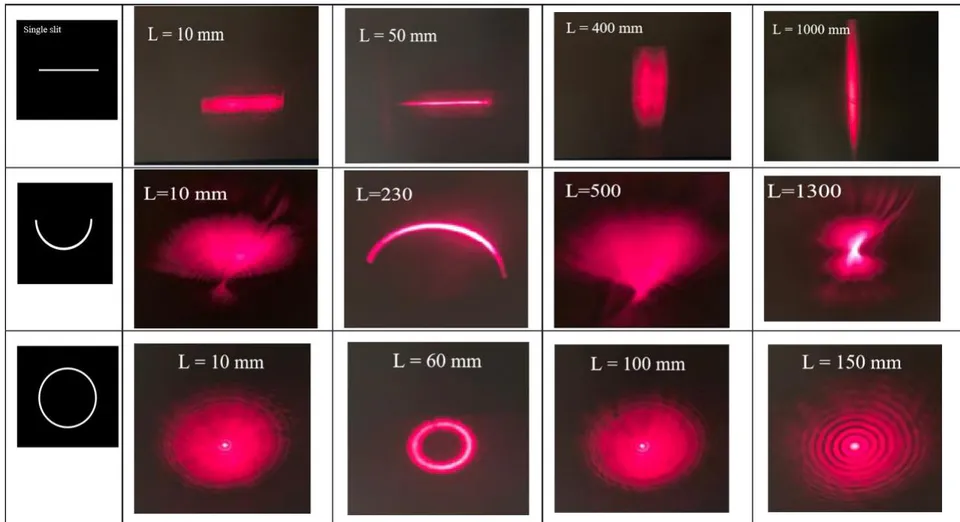
The patterns of the single slit, curve-single slit and ring are profoundly different (Table 3):
(1) a straight-line single slit produces the normal diffraction pattern;
(2) a curve-single slit produces Hourglass-shape pattern;
(3) a ring produces Ring-shape interference pattern with a spot at the center.
(4) A change in the shape of single slit alter the pattern evolution and the final pattern on the detector at larger distance.
Next let us compare both the pattern evolution and the final pattern on the detector (Table 3).
Conclusion:
Simple differences in the shapes of slits lead to the profound differences in the pattern evolutions and in the final patterns. The consistent and complete physical/mathematical interpretation is a challenge.
IV. PHOTOWAVE PHENOMENA: DOUBLE SLIT TO NON-PARALLEL DOUBLE SLIT
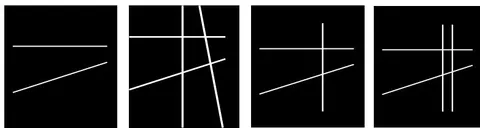
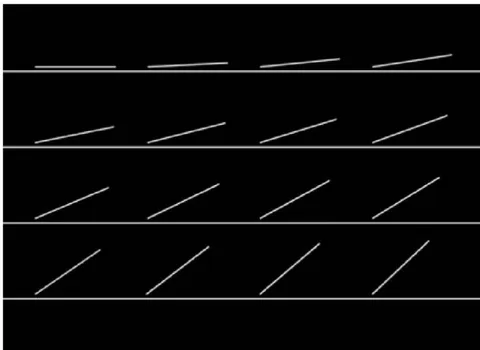
The double slit is one of the fundamental experiments in classical optics, where the two slits are parallel. We extend the parallel double slit to the non-parallel double slit and cross-non-parallel double slit (Figure 4.1). Non-parallel double slit of different angles (Figure 4.2) are utilized to show the angle dependence of pattern
4.1. Non-parallel double slit: Hybrid pattern
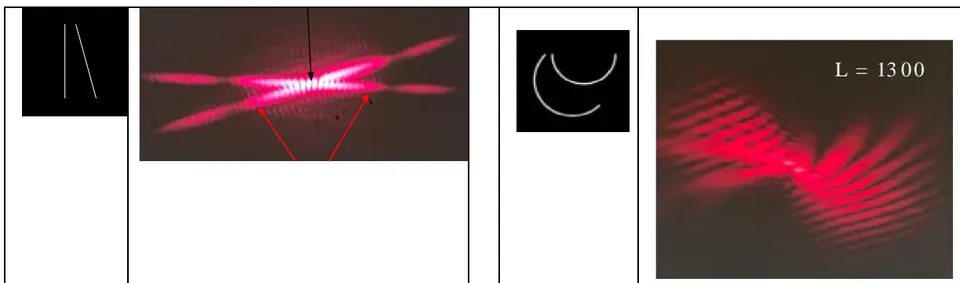
We show for the first time the patterns of the non-parallel-double-slits: two non-parallel single slits produce Interference + Diffraction hybrid pattern, referred to it as the hybrid patterns.
Experiment-4.1.
The laser with beam-diameter 3 mm aims at the non-parallel-double-slits, as shown by the red circle in Figure 4.3. We set the distance between the diaphragm and the screen 1400 mm. The narrow-ends of two slit is 0.3 mm. As an example, the angle between two slits is . Utilizing Experimental setup of Figure 2.2, Figure 4.3 shows that the non-parallel double slit produces the hybrid pattern
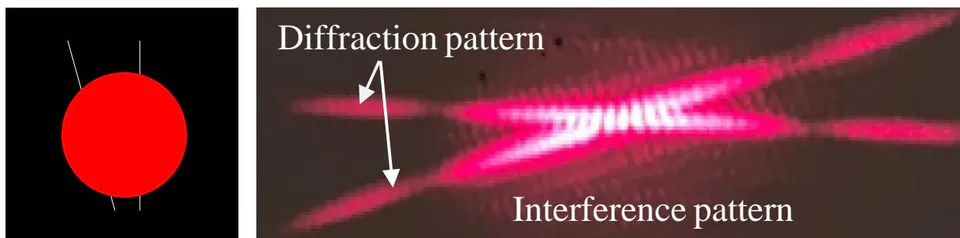
Observation: Figure 4.3 shows the non-parallel-double-slit and its novel pattern, i.e., the interference pattern embeds in the two diffraction patterns; we referred to the pattern as the Interference pattern + diffraction hybrid pattern or "Hybrid pattern". Two non-parallel slits produce two diffraction patterns respectively as they were independent single slit. While two slits produce the embedded interference pattern as they are a double slit.
Note: We show for the first time the mysterious phenomenon that the interference pattern embeds in the two diffraction patterns.
4.2. Pattern evolution: Photon producing patterns
Now, study the pattern-evolution of the non-parallel double slit.
Experiment-4.2
Experimental setup: Figure 2.3. The angle between two slits is .
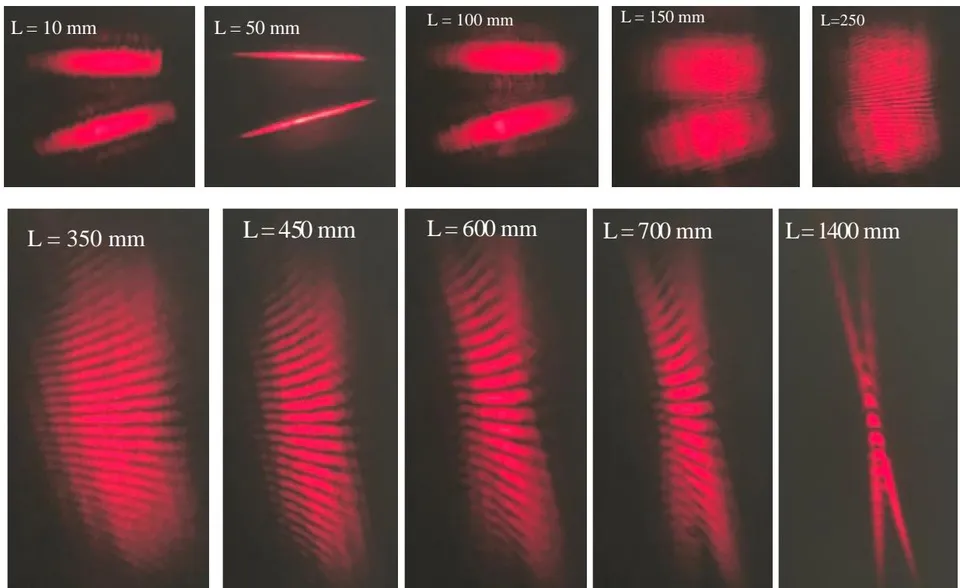
Observation: Figure 4.4 shows the pattern evolution. The patterns are the Particle patterns, at L = 10-100 mm. At L = 150-700 mm, we call the patterns Transition patterns. At L >300 mm, the patterns are the Interference.
4.3. Angle-dependence of patterns
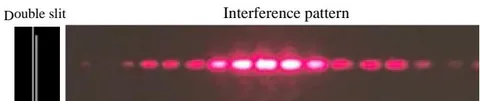
Next, we show the phenomena: when the angle between two slits increases from the to and beyond, the interference pattern evolves to the partial interference + diffraction hybrid patterns and, finally, evolve to the crossing diffraction patterns. In the non-parallel-double slit experiments, the nature and the characteristics of the patterns depend not only on the distance from the diaphragm, but also on the angle between two slits.
Experimental setup: The laser with beam-diameter 3 mm aims at the non-parallel-double-slits, as shown by the red circle in Figure 4.3. The all distances between the bottom-ends of each tilt short slit and the horizontal long slits are 0.3 mm. Then, utilizing Experimental setup of Figure 2.2 and the diaphragm containing 16 double-slits with different angles: (Figure 4.2), we show the angle-dependence of the patterns of the non-parallel double-slit experiments.
Experiment-4.3: between two slits
Experiment-4.4: between two slits
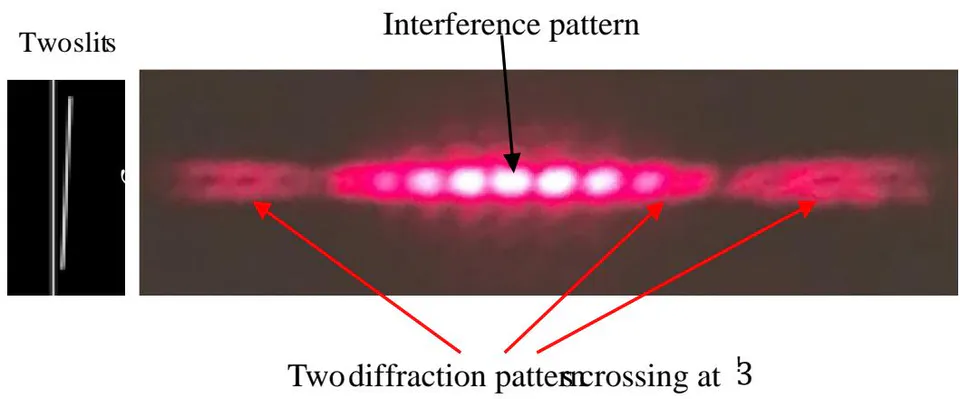
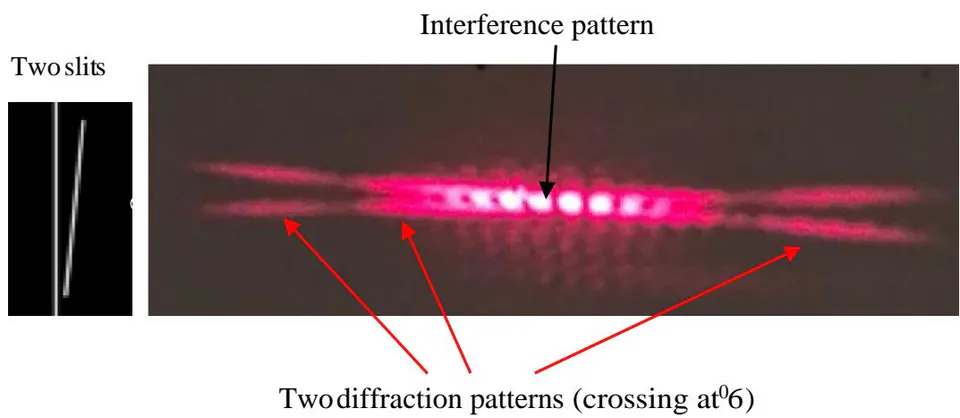
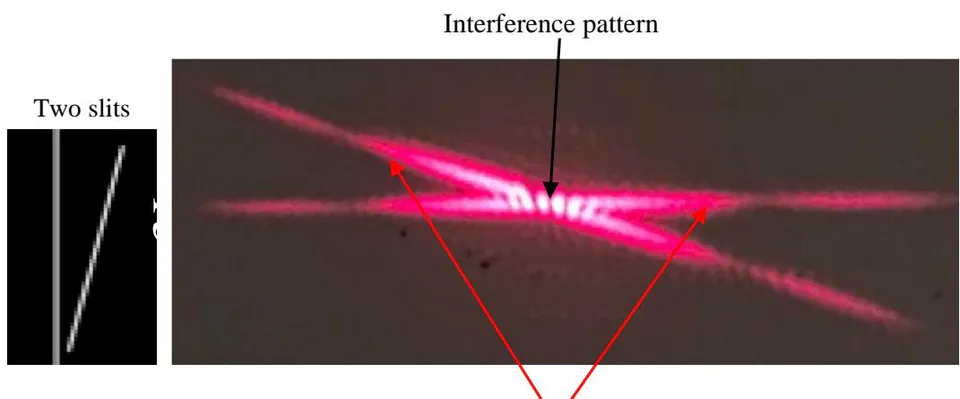
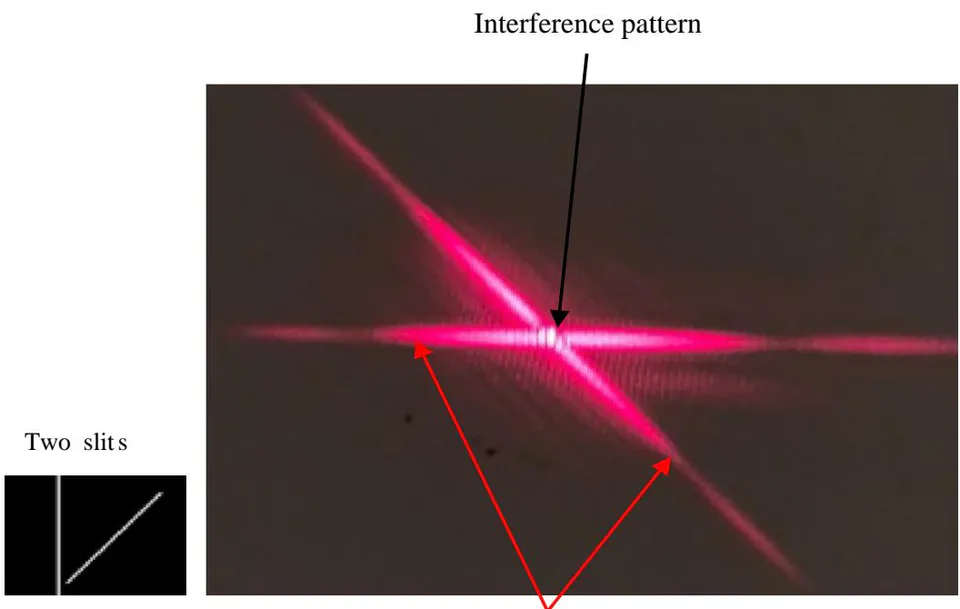
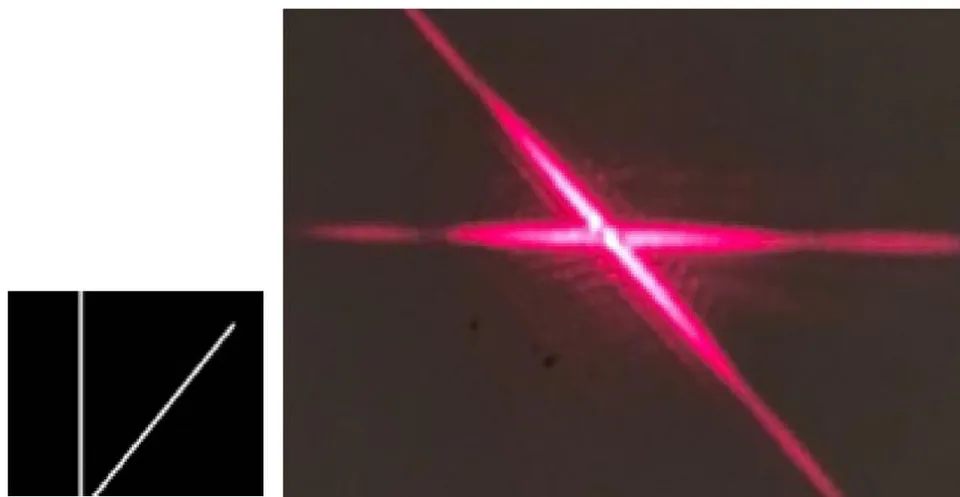
Observation: There is no hybrid pattern at .
We show that when the angle between two slits is , the pattern is the interference pattern; increase the angle between the two slits, the patterns are the hybrid pattern; at , the pattern becomes the diffraction pattern. For certain angles, the non-parallel double slit produce the pattern that contains two diffraction patterns and the partial interference pattern embedded in the diffraction patterns, referred to it as the Interference + diffraction hybrid patterns or the hybrid patterns. The hybrid patterns depend on the angle between two slits.
4.4. Discussion
The hybrid pattern shows that the light is photons, not wave, and it is photons that produce the hybrid patterns, PhotoWave phenomena.
It is a challenge for the existing wave theories to interpret the hybrid pattern and thus, we suggest that the hybrid pattern indicates the interaction between photons.
The optical theory, EM theory and quantum probability theory cannot predict/explain this hybrid pattern and thus, are inconsistent/incomplete. A new theory is demanded.
V. PHOTOWAVE PHENOMENA: DOUBLE SLIT TO CURVED DOUBLE SLIT [20]
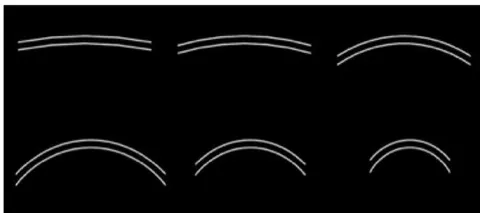
Now we extend the double slit to the curve-double slit and to the cross-curve-double slit (Figure 5.1). Then we study the pattern evolution of the curve-double slit, and the curvature-dependence of the patterns (Figure 5.2).

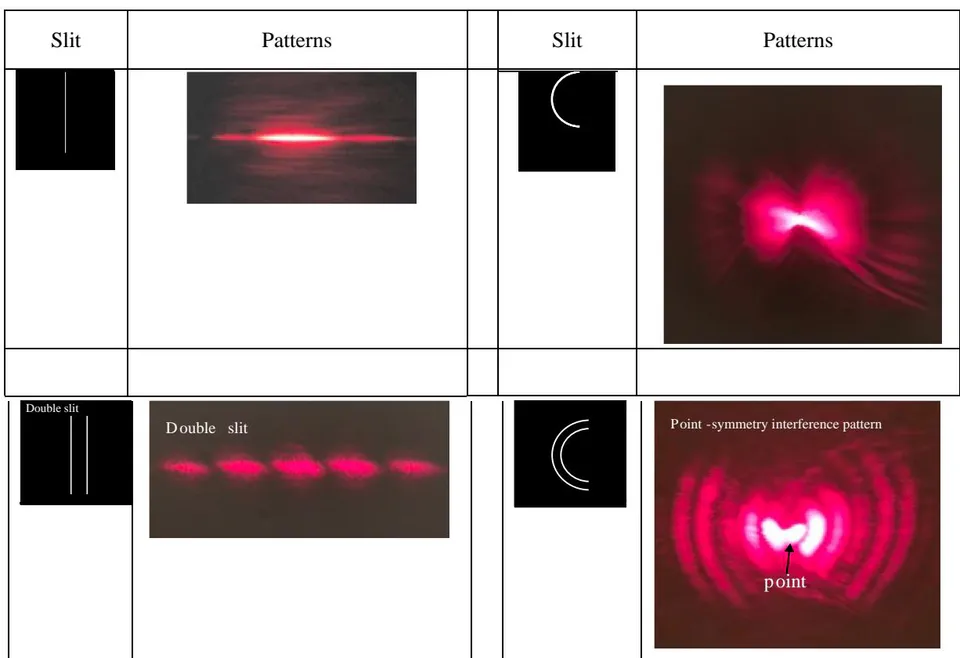
5.1. Curve-double slit: Arc-Shape and Point-Symmetry Interference Pattern
Cross double slit-1 Cross double slit-2 Ring
Experiment-5.1: Arc-shaped interference pattern and Point-symmetry interference pattern
Experimental setup: Utilizing Experimental setup of Figure 2.2, Figure 5.3 shows the curve-double slit and its Arc interference pattern and Point-symmetry interference pattern
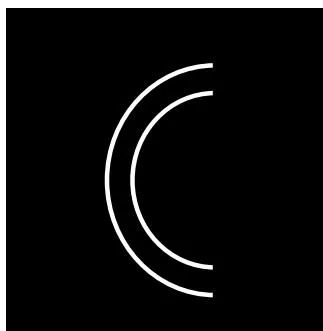
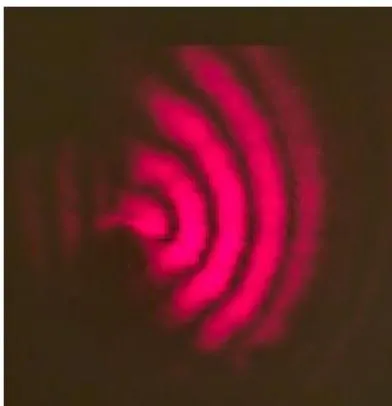
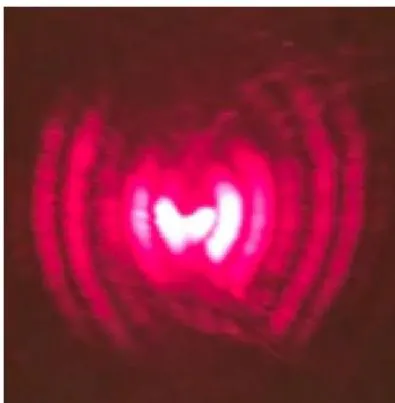
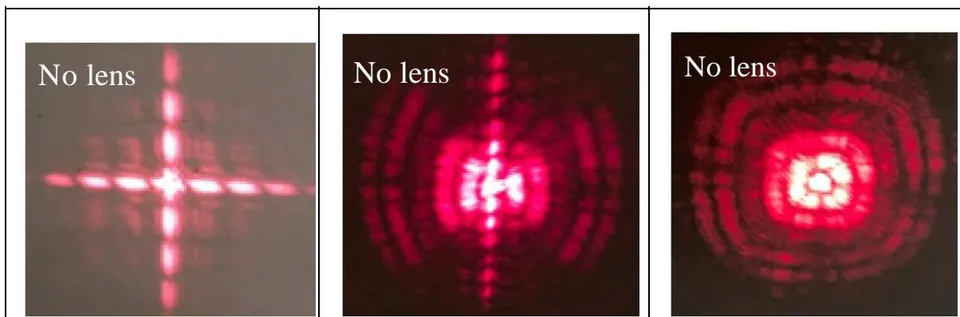
Observation: we observe Arc-shaped interference pattern near the curved-double slit and Point-symmetry interference pattern at detector (Figure 5.3).
5.2. Pattern Evolution: Photon producing Arc-shape and Point-symmetry interference patterns
To study the pattern evolution, we use Experimental setup in Figure 2.3: The lens is placed at different positions "L mm".
Experiment-5.2.
Experimental setup: Figure 2.3.
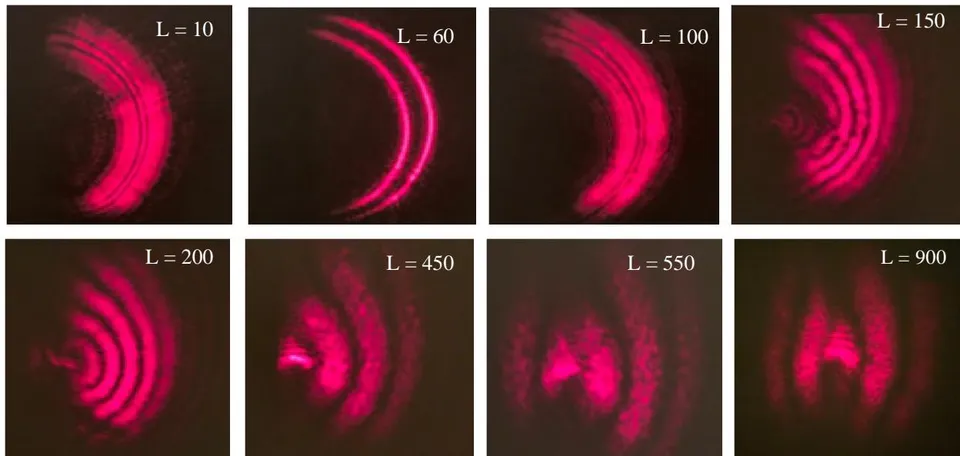
Observation (Figure 5.4): we observe for the first time the following pattern and its evolution: L = 10 mm, Pre-particle pattern; L = 60 mm, Particle pattern; L = 100 - 150 mm, Transition pattern-1; L = 200 mm, Arc-shaped interference-pattern; L = 350 - 550 mm, Transition pattern-2; L = 900 mm and larger, Point-Symmetry-interference-pattern
Conclusion: the light is photons, not waves.
Note: the evolution gradually takes place, there is no clear cut: (1) between Pre-Particle patterns and Particle patterns; (2) between Particle patterns and Transition patterns-1; (3) between Transition patterns-1 and Arc interference-patterns; (4) between Arc-interference-patterns and Transition patterns-2; and (5) between Transition patterns-2 and Point-Symmetry-interference-patterns.
5.3. Curvature-dependence of Pattern
Experiment-5.3: Utilizing Experimental setup (Figure 2.2), Figure 5.5 shows the curvature-dependence of the patterns of the curved-double slit.
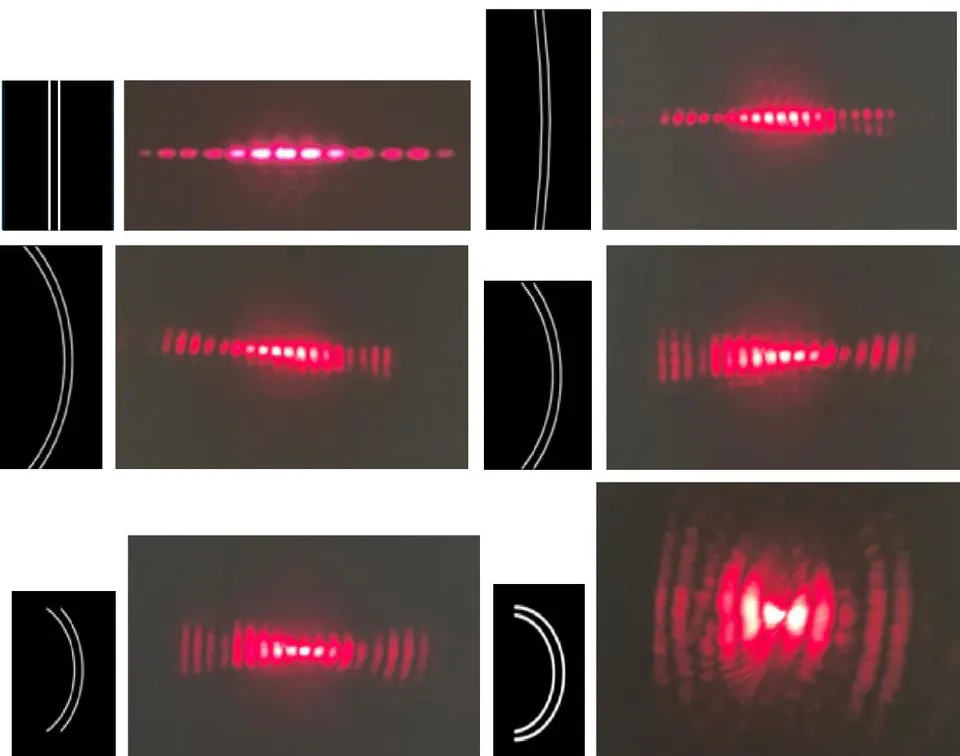
Observation: Figure 5.5 shows the curvature-dependence of the patterns of the curved double slit experiments.
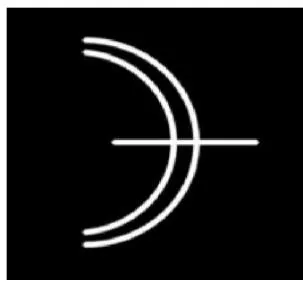
5.4. Single-slit crossing curve-double-slit
5.4.1. Single slit crossing curve-double slit
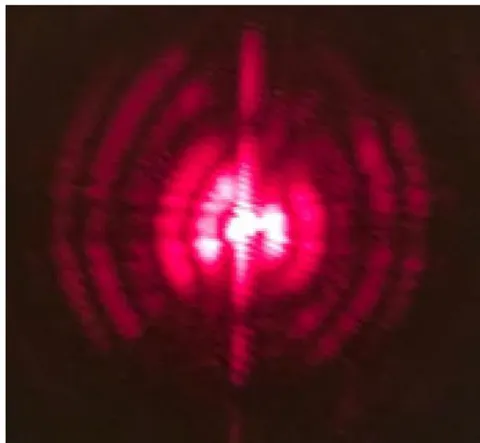
Experiment-5.4: single slit crossing curve-double slit
Experimental setup: Utilizing Experimental setup of Figure 2.2, Figure 5.6 shows that a Single slit crossing curve double slit produces a pattern of a diffraction pattern crossing a Point-symmetry interference patter at detector.
Experiment-5.5: Pattern evolution of Single slit crossing curve-double slit Experimental setup: Figure 2.3.
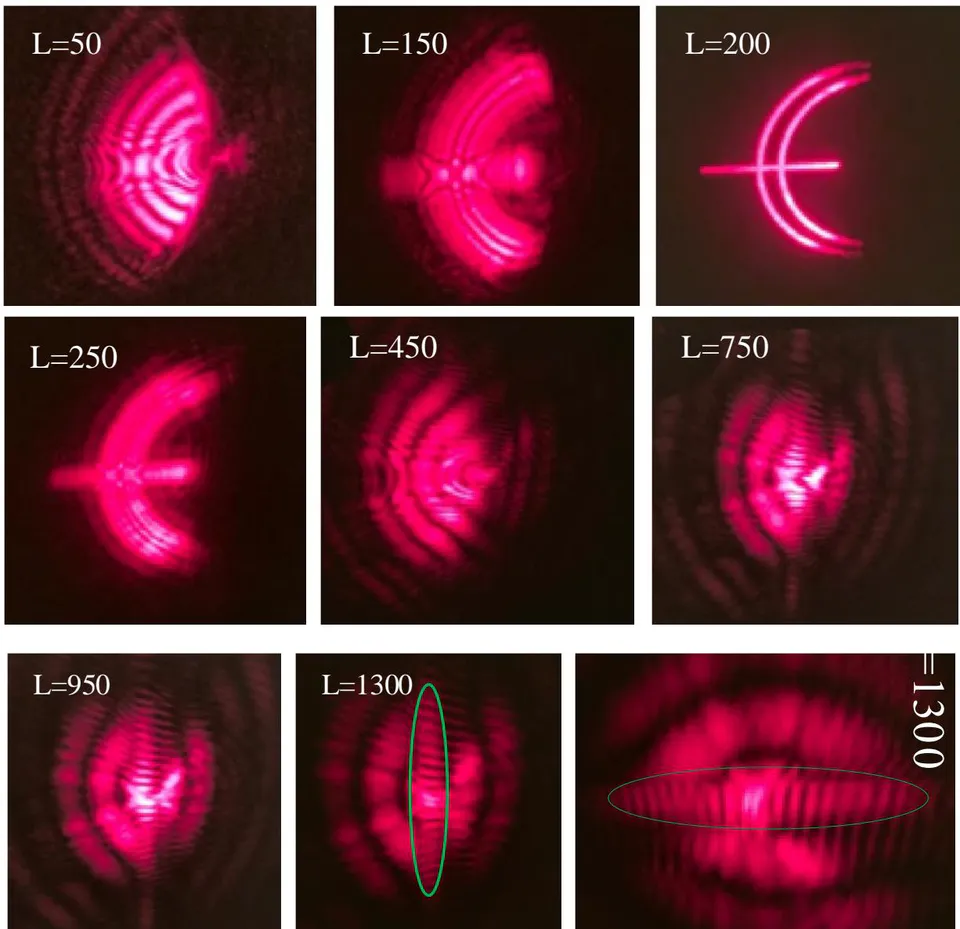
Observation (Figure 5.7): we observe Arc-shape interference pattern at L = 50 mm, Transition pattern at L = 150 mm, Particle pattern at L = 200 mm, Transition pattern at L = 250 mm, Arc-shape interference pattern at L = 450 mm, Point-symmetry interference pattern at L = 750-1300 mm.
Note: as shown by the green oval at L = 1300 mm, the single slit produces an interference pattern, but a diffraction pattern. The right of Figure 5.7 shows the enlarged interference pattern due to single slit.
5.5. Double slit crossing curve-double slit
5.5.1. Double slit crossing curve-double slit
Experiment-5.6: double slit crossing curve-double slit
Experimental setup: Fig. 2.2
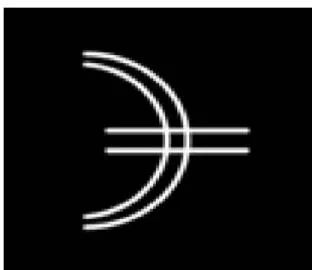
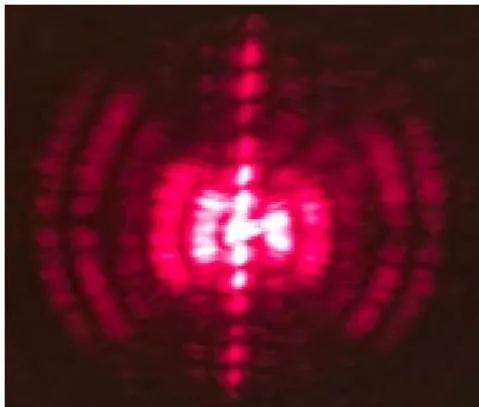
Observation (Fig. 5.8): the right is the vertical interference pattern crossing the Point-symmetry interference pattern.
5.5.2. Pattern evolution
Experiment-5.7:
Experimental setup: Fig. 2.3.
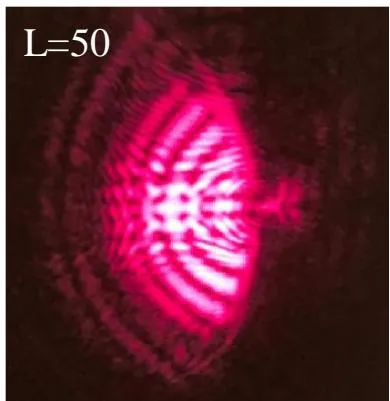
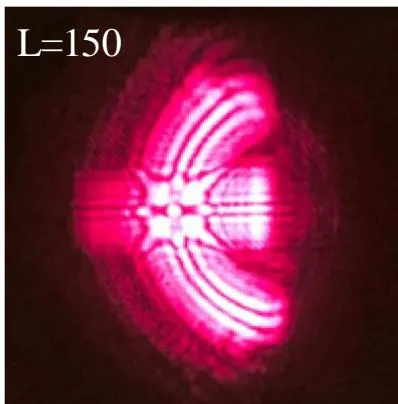
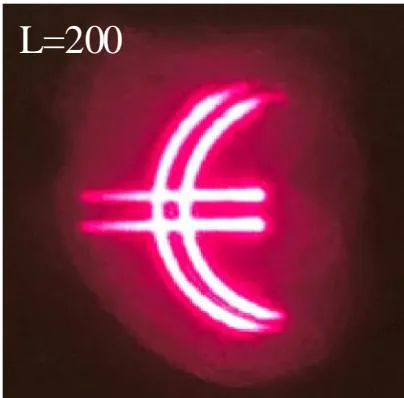
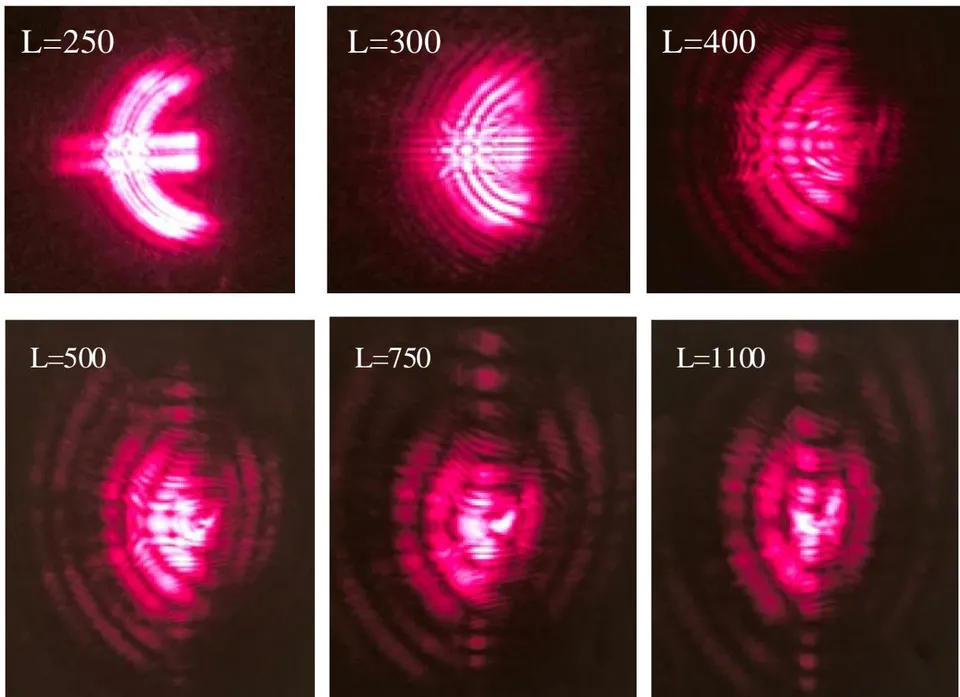
Observation (Fig. 5.9): we observe Arc-shape interference pattern at L = 100-150 mm, Particle pattern at L = 200 mm, Transition pattern at L = 250 mm, Arc-shape interference pattern at L = 300 mm, interference pattern crossing Point-symmetry interference pattern at L = 500-1100 mm.
5.6. Curve-double slit crossing curve-double slit
5.6.1. Curve-double slit crossing curve-double slit
Experiment-5.8: curve-double slit crossing curve-double slit (Figure 5.10)
Experimental setup: Fig. 2.2
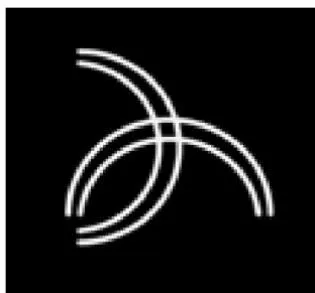
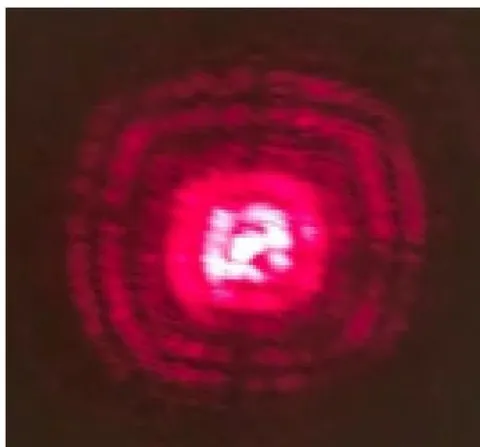
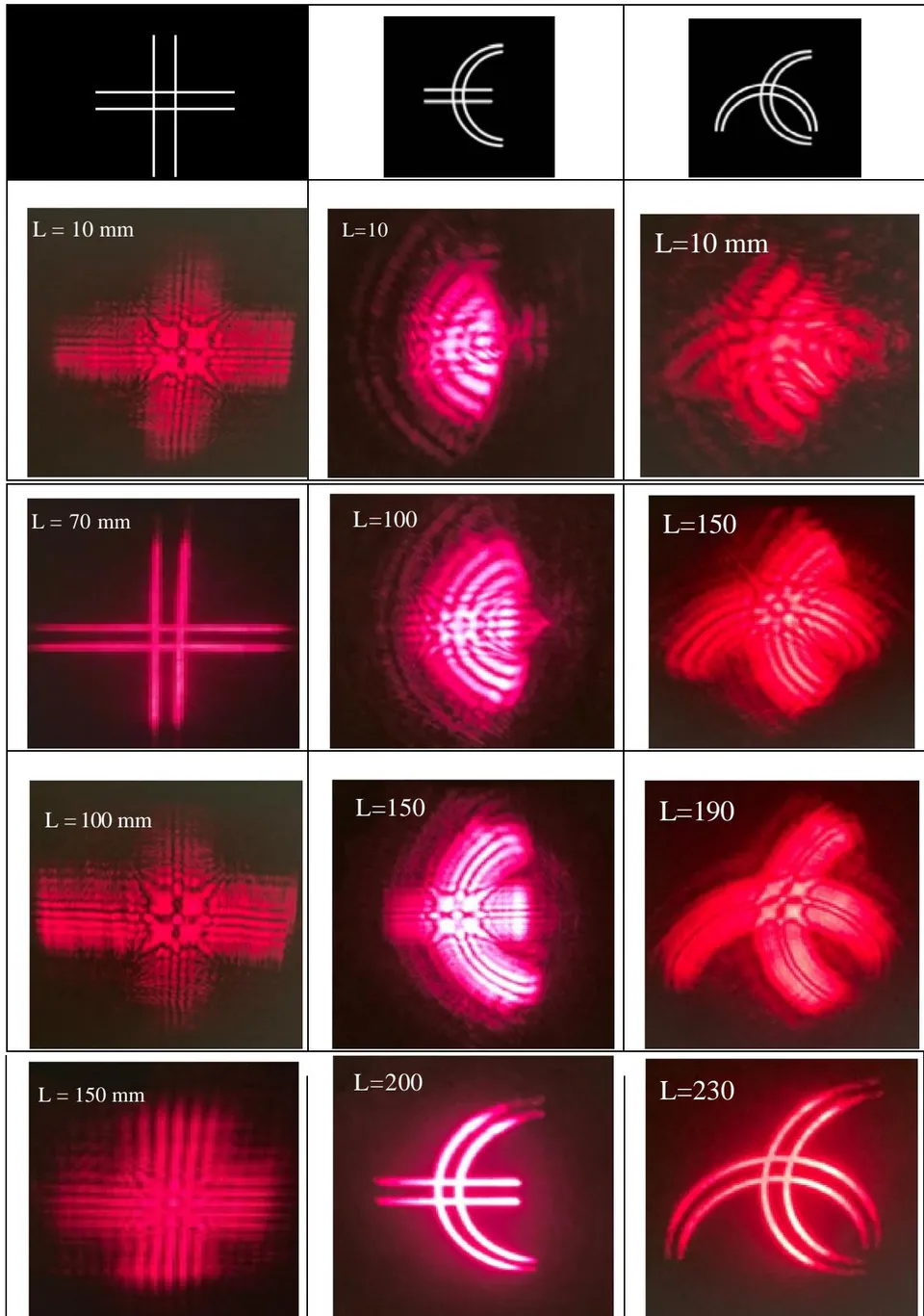
Observation (Fig. 5.10): the right is the interference pattern, we referred to it as Square-shape interference pattern.
Experiment-5.9: curve-double slit crossing curve-double slit
Experimental setup: Fig. 2.3
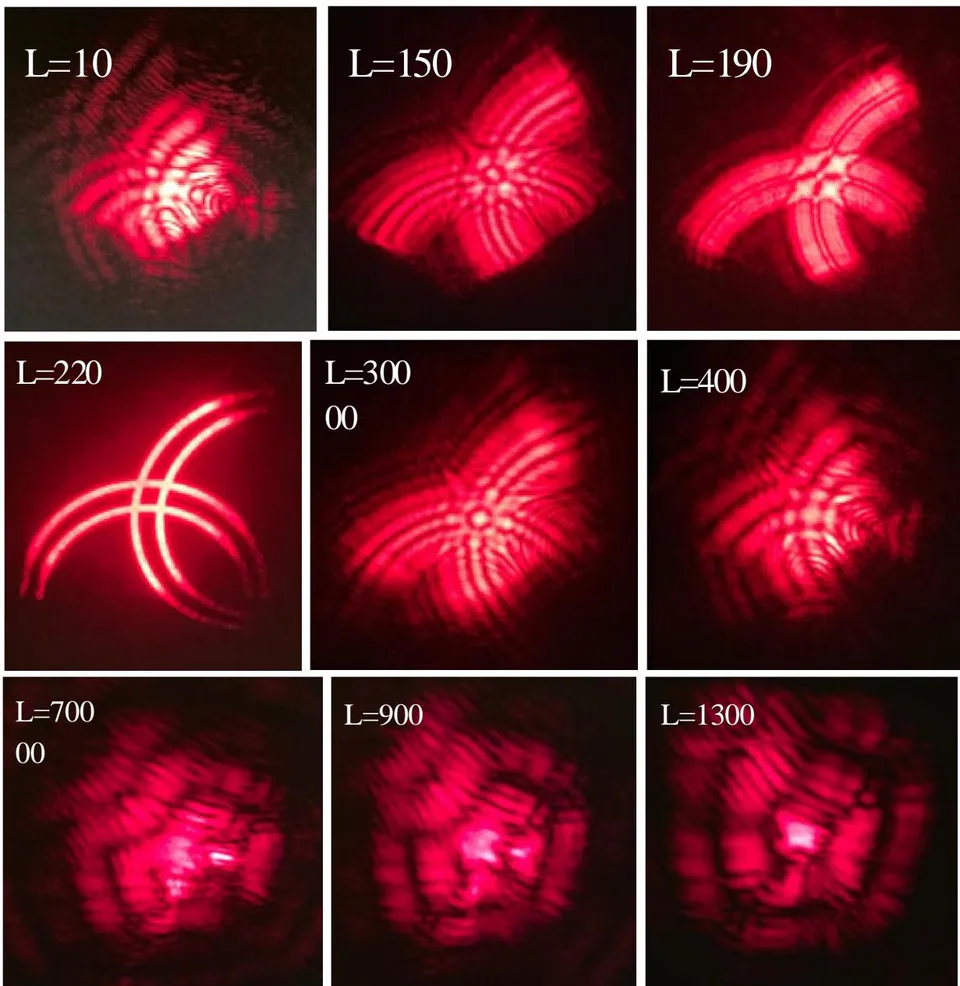
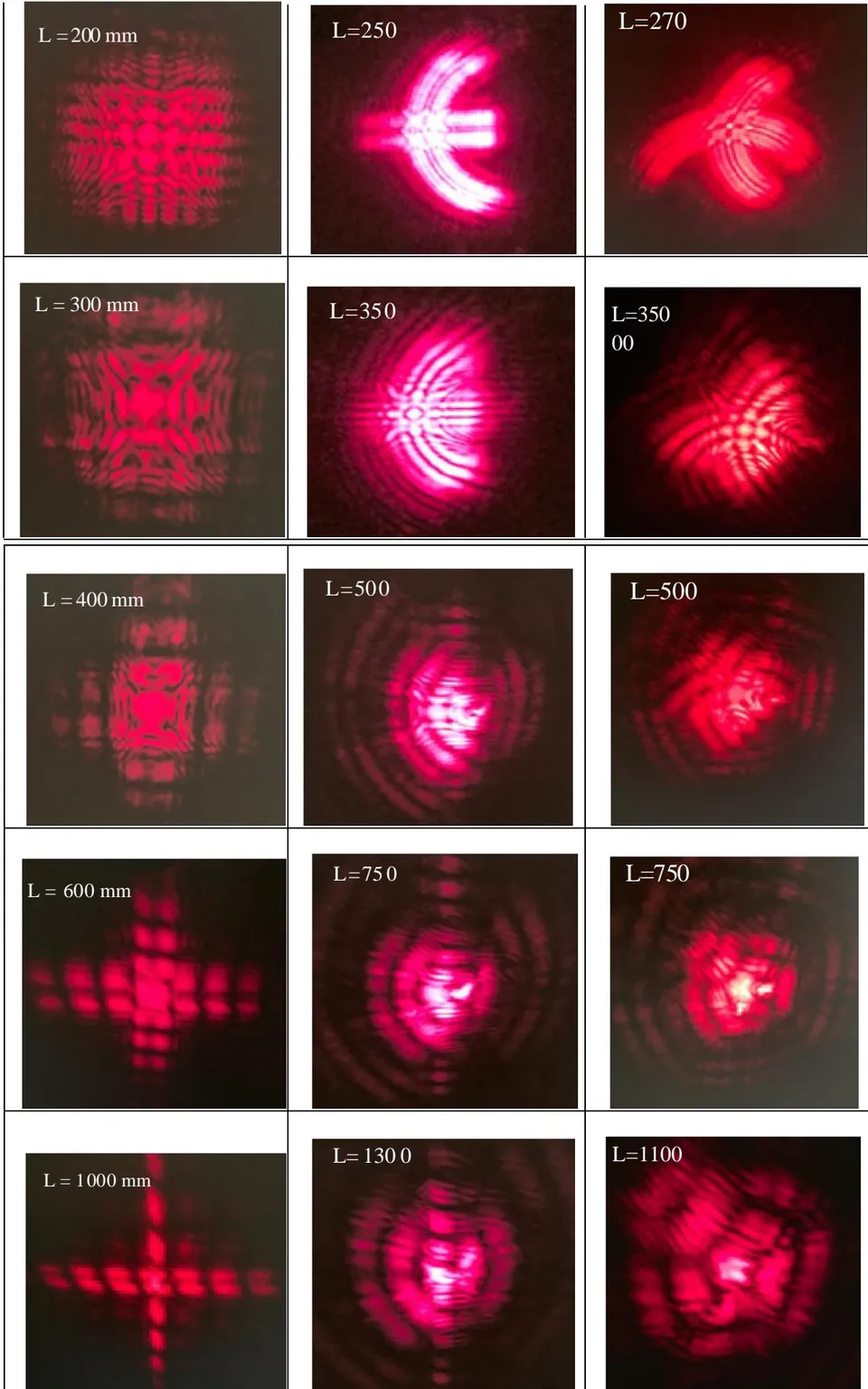
Observation (Figure 5.11): Patterns at L=10-190 mm are Pre-particle patterns. At L=220 mm, it is the typical Particle pattern. At L=300-700 mm, patterns are Transition patterns. At L>900 mm, pattern become the interference patterns, referred to it as Square-shape interference patterns.
5.7. Discussion
By preforming the curve-double slit experiments, we show Arc-shape interference-pattern and Point-Symmetry interference-patterns. For Curve-double slit crossing curve-double slit experiments, we observe Square-shape interference pattern.
Cross-double slit has two straight double slit; double- slit-crossing-curve-double-slit has one straight double-slit and one curve-double-slit; curve-double-slit-crossing- curve-double-slit has two curve-double -slit. Next let us Cross double slit-1 Cross double slit-2 Ring compare both the pattern evolution and the final pattern on the detector.
Table 4: Comparison of cross-double slit, double slit crossing curve-double slit and curve-double slit crossing curve-double slit
VI. PHOTOWAVE PHENOMENA: DOUBLE SLIT TO NON-PARALLEL-CURVE-DOUBLE SLIT
6.1. Non-parallel-curve-double slit: Butterfly-shape interference pattern
Now we extend the non-parallel-double-slit or curve-double-slit to the non-parallel-curve-double-slit (top of Figure 6.1) and then, study its pattern evolution (Figure 6.2), and the curvature-dependence of the patterns (Table 4).
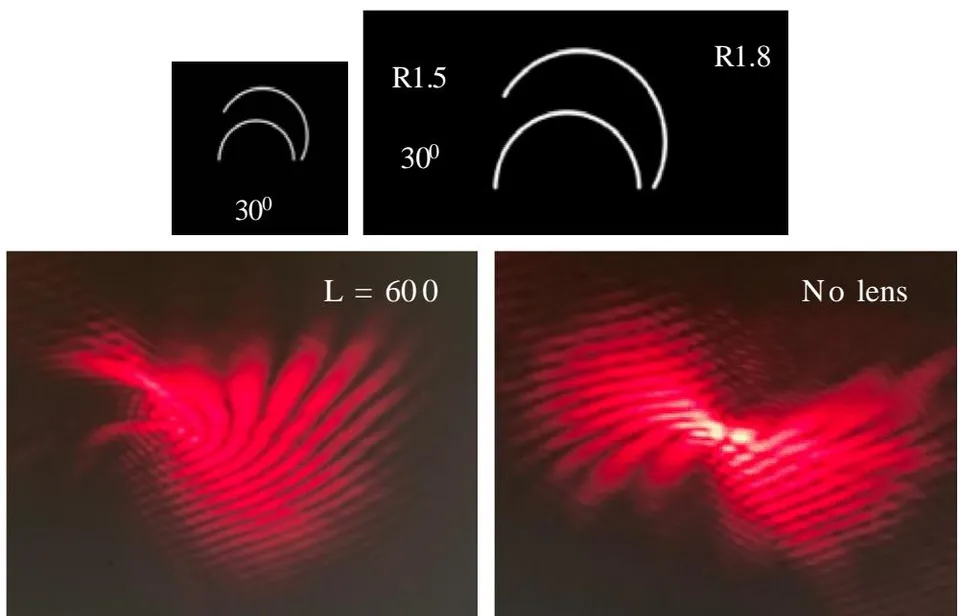
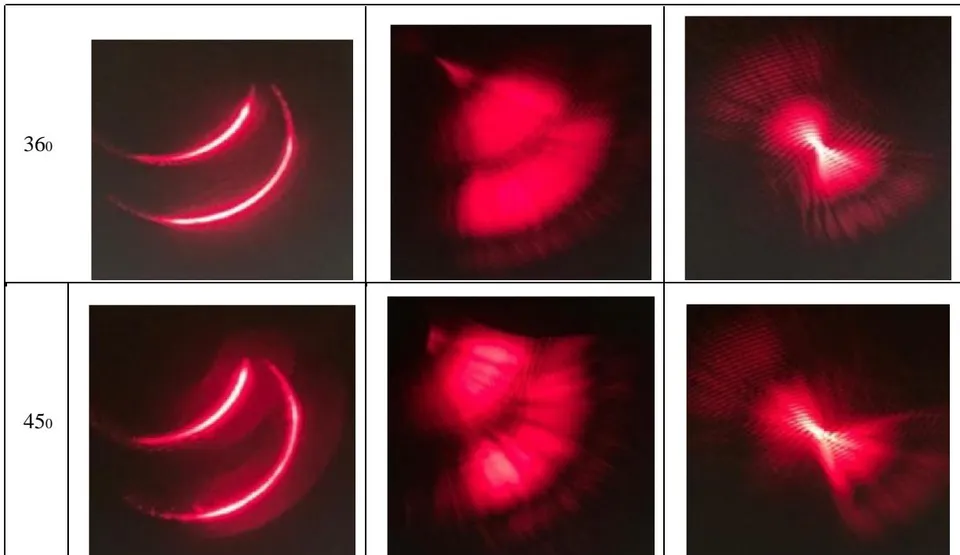
Observation: Figure at L = 600 mm shows a "Resting-Butterfly-shape interference pattern" or "close-wing Butterfly" pattern. The right of Figure 6.1 shows a "Flying-Butterfly-shape interference patterns" or "open-wing Butterfly" pattern.
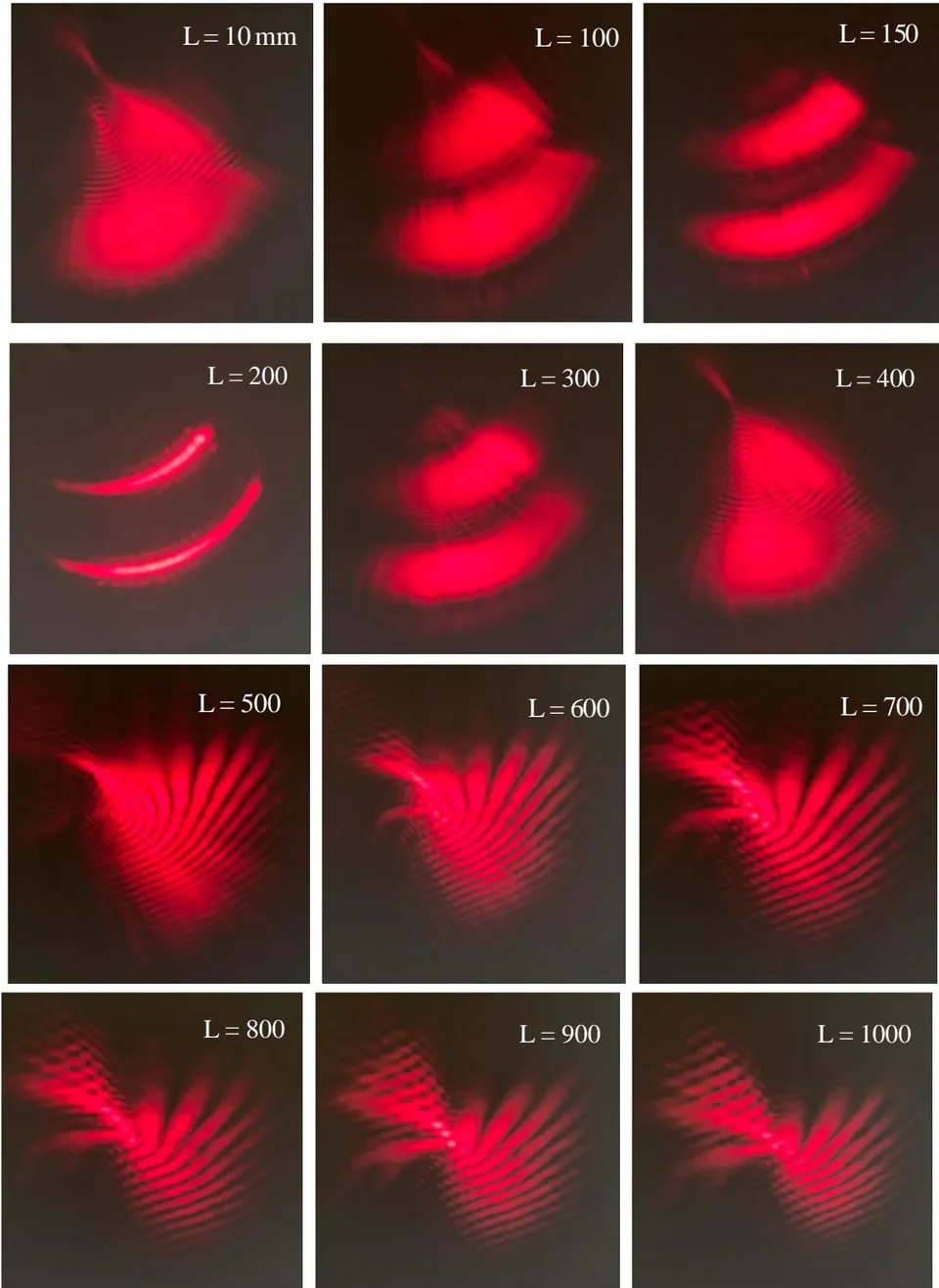
Observation (Fig. 6.2):
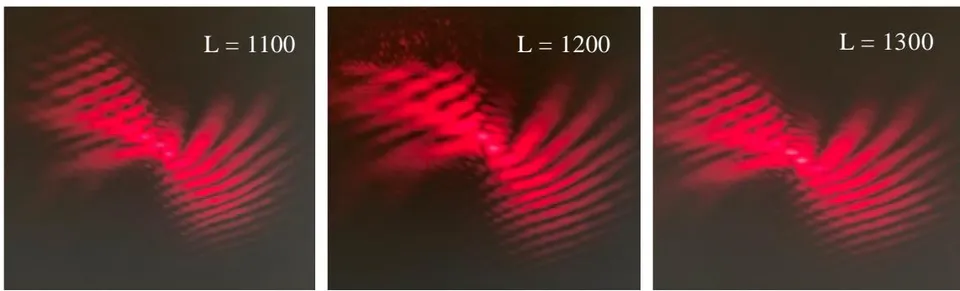
Figures at L = 10-100 mm shows Pre-particle patterns; at L = 150-200 mm, showing Particle pattern, the image of the non-parallel curved double slit; at L = 300 - 400 mm, showing Transition patterns; at L = 500-600 mm, showing Resting-Butterfly-shape interference pattern; at L = 700 - 1000 mm, showing Transition patterns; at L = 1100-1300 mm, showing Flying-Butterfly-shape interference patterns.
We refer to the patterns at L = 500-600 mm as a "Resting-Butterfly-shape interference pattern" or "close wing Butterfly" pattern; while the pattern at L = 1300 mm as a "Flying-Butterfly-shape interference patterns" or "open wing Butterfly" pattern.
Note: the patterns gradually evolve, so there is no clear cut between patterns.
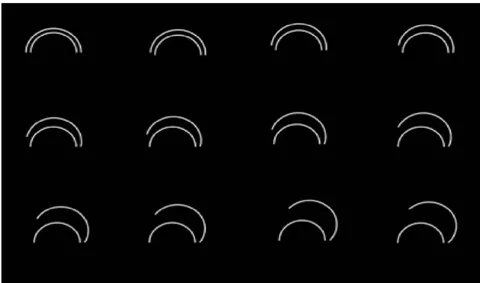
6.3. Angle-Dependence of Butterfly Patterns
Now let us study the Angle-Dependence of Butterfly Patterns (Fig. 6.3).
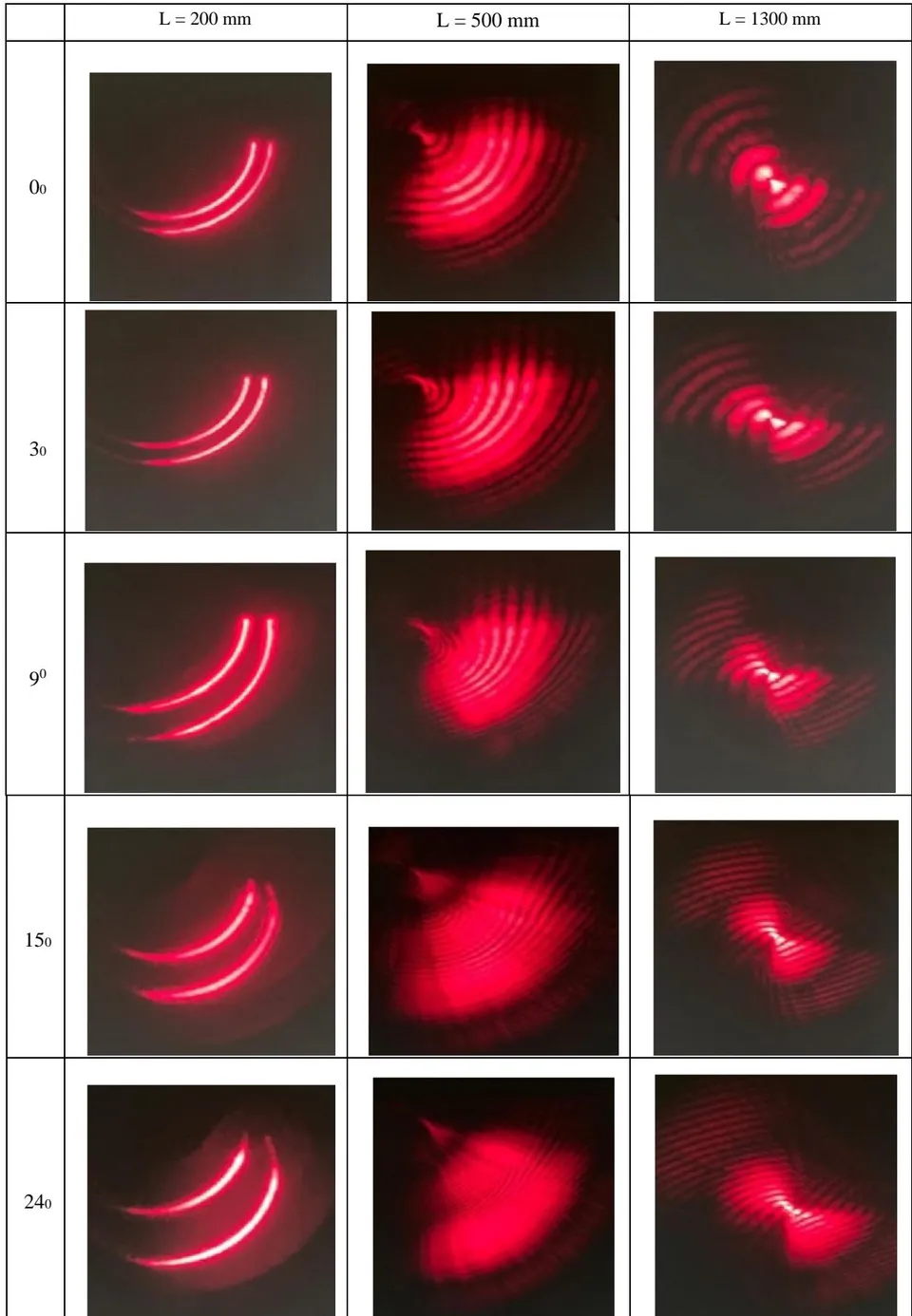
6.4. Discussion
We proposed and performed the non-parallel-curve-double slit experiments, which show both the non diffraction/non-interference patterns (such as Pre-particle patterns, Particle patterns, Transition patterns), and the Butterfly-shape interference patterns.
The coexistence of the non-diffraction/non-interference patterns and Butterfly-shape interference patterns in the same experiment indicates that it is photons that produce both the non-diffraction/non-interference patterns, and the Butterfly-shape interference patterns, referred to it as Photo-Wave experiments/phenomena. To completely and consistently interpret PhotoWave phenomena is a challenge.
VII. SUMMARY AND CONCLUSION
We experimentally show, for the first time:
(a) the classical experiments, e.g., the single slit, cross single slit, double slit, cross double slit, single slit crossing double slit experiments;
(b) the novel experiments, e.g., curve-single slit, ring, the non-parallel-double slit, curve-double slit, and nonparallel-curve-double slit experiments;
It is not necessary to introduce the concept of "collapse of the wave function" in PhotonWave phenomena; which supporting Penrose's statement.
PhotonWave phenomena shown in this article include:
*) Non-wave patterns in traditional wave experiments
*) Non-wave patterns evolve to wave patterns in same Experiment; Coexistence of wave pattern and non-wave pattern in same experiment
) Hourglass shape patterns) Ring-shape interference patterns
*) Interference pattern embedded in diffraction pattern, refer to it as Hybrid patterns
*) Angle-dependence of hybrid patterns
*) Arc interference pattern and Point-symmetry interference pattern in same experiment;
) Curvature-dependence of Arc interference pattern and Point-symmetry interference pattern) Butterfly-shape interference patterns
Theory:
No need of the concept of collapse of wave function to explain the double slit experiment;
No need of wave-particle duality to explain both Photoelectric Effect and PhotoWave Phenomena. It is a challenge to consistently/completely explain PhotoWave Phenomena shown in Section 3-6. A consistent/complete theory of quantum optics/physical optics is demanded.
Simple differences in the shapes of slits lead to the profound differences in the final patterns (Table 6) and in the 1 pattern evolutions. We refer to the phenomena as Optical Butterfly Effect, which shows the sensitive dependence on initial shapes. Optical Butterfly Effect is an analogy of "Chaos Butterfly Effect".
Now we interpret the mechanism of producing the "Hybrid pattern" of the non-parallel-double slit.
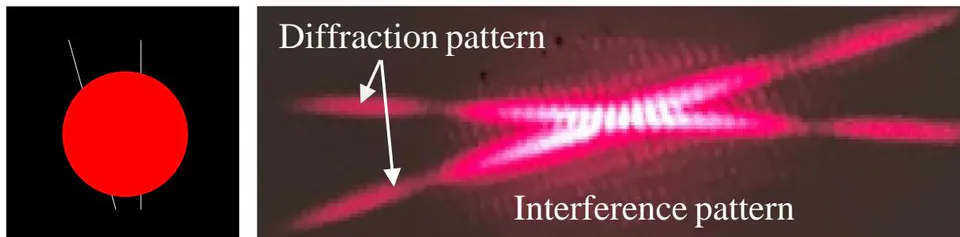
A1.1. Treating non-parallel double slit as two independent single slits: tilt Slit-1 and vertical Slit-2 First, let us consider a non-parallel double slit as two independent single slits as show in Figure A1.
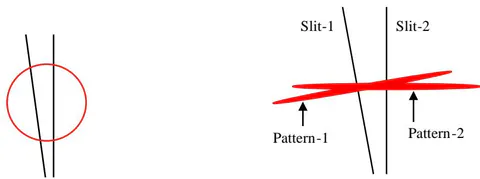
The red circle indicates the spot of the laser beam on the non-parallel-double slit. If the tilt Slit-1 and the vertical Slit-2 were two independent single slits, then Slit-1 would produce the diffraction Pattern-1; while Slit-2 would produce the diffraction Pattern-2. Pattern-1 and Pattern-2 are perpendicular to Slit-1 and Slit-2 respectively.
Pattern-1 and Pattern-2 (Figure A1) are part of the Hybrid pattern (Figure 4,3).
Obviously, Pattern-1 and Pattern-2 in Figure A1 are different from the Hybrid pattern in Figure 4,3, which indicate that Slit-1 and Slit-2 cannot be considered only as two independent single slits.
2. Treating
We have shown that in a traditional double slit experiment, the light propagates as photons, and it is the photons that produce the interference pattern , the PhotoWave phenomenon.
To interpret the Hybrid pattern of a non-parallel-double slit, let us utilize the PhotoWave concept and introduce multi "auxiliary lines" as sub-Slits.
Since the dimension of a photon is Zero, we can divide the tilt Slit-1 into large number of small segments denoted as single Slit-1-1, such that, for each photon, each single Slit-1-1 can be considered as a slit paralleling to the vertical Slit-2. Namely each single Slit-1-1 and Slit-2 can be considered as a parallel double slit.
The large number of small single Slit-1-1 are represented by red "auxiliary lines" (Figure A2). Therefore, some of photons passing through the Slit-1-1/Slit-2-double-slit produce the interference Pattern-1-1, and some of photons passing through Slit-2 produce the diffraction Pattern-2 (Figure A2). Both the interference Pattern-1-1 and Pattern-2 are perpendicular to both Slit-1-1 and Slit-2 and thus, Pattern-1-1 and Pattern-2 are overlap, or, Pattern-1-1 embeds in Pattern-2.
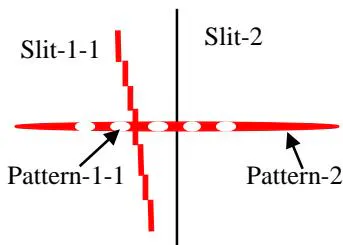
Slit-2 producing diffraction Pattern-2
Pattern-1-1 and Pattern-2 (Figure A2) are part of the Hybrid pattern (Figure 3).
Obviously, Pattern-1-1 and Pattern-2 in Figure A2 are different from the Hybrid pattern in Figure 3, which indicate that "Treating tilt Slit-1 as multi-small Slit-1-1 and vertical Slit-2 as single slit" is incomplete.
A1.3. Treating tilt Slit-1 as both single Slit-1 and multi-small Slit-1-1, and Slit-2 as single slit
Slit-1 still acts as a whole single slit and thus produces the diffraction Pattern-1 (Figure A3); while Slit-1-1/Slit 2-double-slit produces the interference Pattern-1-1; Slit-2 produces diffraction Pattern-2.Pattern-1 perpendiculars
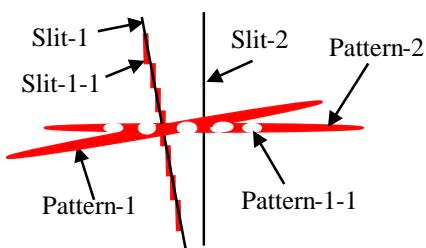
Figure A3: Slit-1-1/Slit-2-double-slit producing interference Pattern-1-1; Slit-1 producing Pattern-1; Slit-2 producing diffraction Pattern-2
Pattern-1-1, Pattern-1 and Pattern-2 (Figure A3) are part of the Hybrid pattern (Figure 4.3). Obviously, Pattern-1-1, Pattern-1 and Pattern-2 in Figure A3 are different from the Hybrid pattern in Figure 4.3, which indicate that "Treating tilt Slit-1 as both single Slit-1 and multi-small Slit-1-1 and Slit-2 as single slit" is still incomplete.
A1.4. Treating Slit-2 as multi-small Slit-2-1 and tilt Slit-1 as single slit
We have shown above that photons passing through the single Slit-1 produce the diffraction Pattern-1, and, combining with Slit-2, produces the interference Pattern-1-1.
Following the same concept/method, we can divide the Slit-2 into large number of small segments denoted as single Slit-2-1, such that, for each photon, each Slit-2-1 can be considered as a slit paralleling to Slit-1. Namely each pair of single Slit-2-1 and Slit-1 can be considered as a parallel double slit.
The large number of small single Slit-2-1 (Figure A4) are represented by red "auxiliary lines". Therefore, some of photons passing through Slit-2-1/Slit-1-double-slit produce the interference Pattern-2-1, and some of photons passing through Slit-1 produce the diffraction Pattern-1 (Figure A4). Both the interference Pattern 2-1 and Pattern-1 are perpendicular to Slit-1 and thus, Pattern-2-1 and Pattern-1 are overlap, or, Pattern-2-1 embeds in Pattern-1.
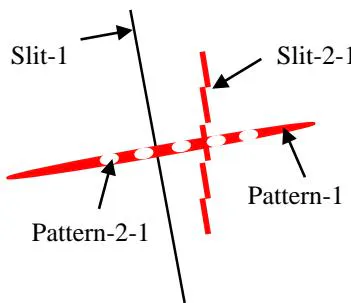
Pattern-2-1 and Pattern-1 (Figure A4) are part of the Hybrid pattern (Figure 3).
Obviously, Pattern-1 and Pattern-2-1 in Figure A4 are different from the Hybrid pattern in Figure 4.3, which indicate that "Treating slit-2 as multi-small Slit-2-1 and tilt Slit-1 as single slit" is still incomplete.
A1.5. Treating Slit-1 as single Slit-1 and Slit-2 as both a single Slit-2 and multi-small Slit-2-1
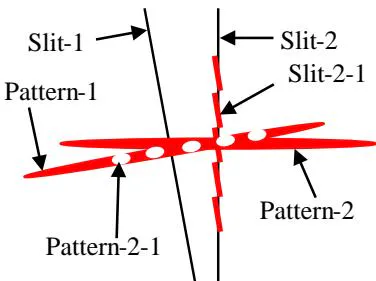
Slit-1 produces diffraction Pattern-1
Slit-1 acts as a whole single slit and produces the diffraction Pattern-1; while Slit-2-1 and Slit-1 form a double slit and thus produce the interference Pattern-2-1; Slit-2 produces the diffraction Pattern-2 (Figure A5). Both Pattern-1 and Pattern-2-1 perpendicular to Slit-1 and thus, Pattern-2-1 and Pattern-1 are overlap, or, Pattern-2-1 embedded in Pattern-1.
Pattern-2, Pattern-2-1 and Pattern-1 (Figure A5) are part of the Hybrid pattern (Figure 4.3). Obviously, Pattern-1, Pattern-2 and Pattern-2-1 in Figure A5 are different from the Hybrid pattern in Figure 4.3, which indicate that "Treating Slit-1 as single Slit-1 and Slit-2 as both a single Slit-2 and multi-small Slit-2-1" is still incomplete.
A1.6. Treating Slit-1 as both a single Slit-1 and multi-small Slit-1-1 and Treating Slit-2 as both a single Slit-2 and multi-small slit-2-1 In Figure A6, we keep auxiliary line Slit-1-1 and auxiliary line Slit-2-1, in addition to Slit-1 and Slit-2. Then we have the Hybrid pattern which is the same as that in Figure 4.3.
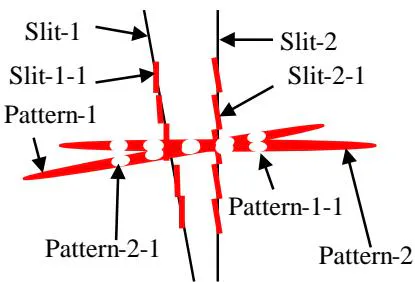
Slit-1-1/Slit-2 produce interference Pattern-1-1; Slit-1 produces diffraction Pattern-1
Now, let us delete the auxiliary line Slit-1-1, the auxiliary line Slit-2-1, Slit-1 and Slit-2 in Figure A6, we finally show the Hybrid pattern (Figure A7), which is the same as that in Figure 4.3. Pattern-1
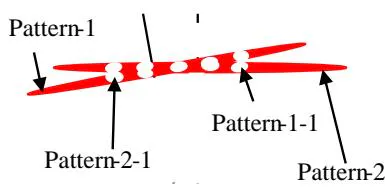
The combination of Slit-1 and Slit-2 produces the interference Pattern-1-1 and the interference Pattern-2-1. Slit-1 produces the diffraction Pattern-1. Slit-2 produces the diffraction Pattern-2.
A2. Math Description
In this Section, we mathematically describe the "Hybrid pattern" of the non-parallel-double slit. The interference Pattern-1-1 and Pattern-2-1 can be mathematically described by either the classical formulars P or modified formular [19] {"image_source":{"path":"images/15ab0abe629eeee2d5024861c9ed65573fec91b53e564ee5054e6f14c836f4cf.jpg"},"content":"","chart_caption":[],"chart_footnote":[]}
or modified formular [19] {"image_source":{"path":"images/05399151a011485594d7ae69b52d4fae9cb7e749e28e202c371d0c7daf541748.jpg"},"content":"","chart_caption":[],"chart_footnote":[]}
A3. Conclusion
By utilizing the PhotoWave concept and the auxiliary lines Slit-1-1 and the auxiliary lines Slit-2-1 in the non parallel double slit experiment, we interpret the mechanism of how the Hybrid pattern is produced. Based on the interpretation, we propose the math description of the Hybrid pattern.
Conflict of Interest
The authors declare no conflict of interest.
Ethical Approval
Not applicable
Data Availability
The datasets used in this study are openly available at [repository link] and the source code is available on GitHub at [GitHub link].
Funding
This work did not receive any external funding.
References
Cite this article
Related Research


Special Issue
Launch a focused special issue to highlight research, emerging trends, and expert insights in your academic field.