


Abstract
The rapid integration of artificial intelligence into organizational decision-making has fundamentally altered how value is created, risks are managed, and authority is exercised within modern enterprises. Yet, while AI systems increasingly influence high-stakes outcomes, the governance mechanisms that oversee them have not evolved at the same pace. A critical vulnerability has emerged: executives and board members are frequently tasked with governing AI systems they do not sufficiently understand. This article argues that AI governance without executive AI literacy represents a structural governance failure rather than a technical shortcoming. The article examines how low levels of AI literacy among executives undermine strategic alignment, weaken risk oversight, and expose organizations to ethical, regulatory, and reputational harm. It demonstrates why traditional corporate governance and enterprise risk management frameworks are ill-suited to address AI-specific risks, including algorithmic bias, data misuse, opacity, and cascading system failures. Rather than positioning AI literacy as optional or advisory, the article reframes it as a fiduciary and governance imperative essential to informed oversight and responsible decision-making. To address this challenge, the article presents an integrated AI governance approach centered on executive literacy and structured around technical understanding, strategic oversight, ethical accountability, and regulatory compliance, supported by continuous learning and adaptive governance. The article concludes that organizations that embed AI literacy at the executive level are better positioned to realize AI’s benefits while mitigating its risks, whereas those that fail to do so face growing governance, performance, and legitimacy deficits in the AI era.
Explore Digital Article Text
Introduction: The Governance Challenge of the AI Era
Artificial intelligence is reshaping industries at a pace that outstrips most leadership teams' capacity to adapt, creating a widening capability gap for organizations without strong digital and AI competencies [1]. As AI systems increasingly drive critical business decisions—from hiring and credit allocation to healthcare diagnostics and criminal justice risk assessment—the governance challenge has become acute: boards of directors and executive leadership are responsible for overseeing technologies they do not adequately understand [2], [3]. This literacy gap represents one of the most significant governance challenges of the digital age, with consequences that extend far beyond individual organizations, affecting market stability, social equity, and public trust in corporate institutions.
The integration of AI into corporate operations has fundamentally altered the risk landscape. Unlike traditional operational risks that boards have historically overseen, AI-specific risks—including algorithmic bias, model opacity, emergent behaviors, and systemic discrimination—often fall outside conventional enterprise risk management frameworks [1], [4]. These risks materialize in ways that are difficult to predict, challenging to detect, and potentially catastrophic in their impact. Yet research indicates that while 63% of leaders deem monitoring AI systems crucial, most are unsure how to do so, with 60% requiring monthly human overrides of AI decisions [5]. This uncertainty at the leadership level creates a governance vacuum where AI systems operate with insufficient oversight, inadequate accountability mechanisms, and limited strategic alignment with organizational values and objectives.
The consequences of this governance vacuum are increasingly visible. High-profile incidents—including Amazon's abandonment of a hiring algorithm that discriminated against female applicants [6], ProPublica's exposure of racial bias in recidivism risk scoring systems [6], and widespread facial recognition failures that disproportionately misidentify individuals with darker skin tones [7], [8]—demonstrate that governance failures are not hypothetical risks but documented realities. These incidents share a common root cause: insufficient executive understanding of AI systems' capabilities, limitations, and potential for harm, coupled with inadequate governance structures to ensure responsible development and deployment [9], [10].
This paper argues that AI governance without executive AI literacy is not merely suboptimal—it represents a fundamental breach of directors' fiduciary duties in the modern corporate context. Drawing on legal scholarship regarding directors' duty of care, duty of loyalty, and duty of oversight (Caremark duties) [11], [12], [13], we demonstrate that the absence of AI literacy at the executive level creates material risks that boards are obligated to understand and manage. The paper synthesizes empirical evidence from governance failures, legal analysis of fiduciary obligations, and emerging best practices to propose an integrated framework for AI governance centered on executive literacy development. This literacy gap represents one of the most significant governance challenges of the digital age, with consequences extending far beyond individual organizations to affect market stability, social equity, and public trust in corporate institutions. When executives lack fundamental understanding of how AI systems operate, what data they require, what biases they may encode, and what risks they create, the governance function becomes ceremonial rather than substantive.
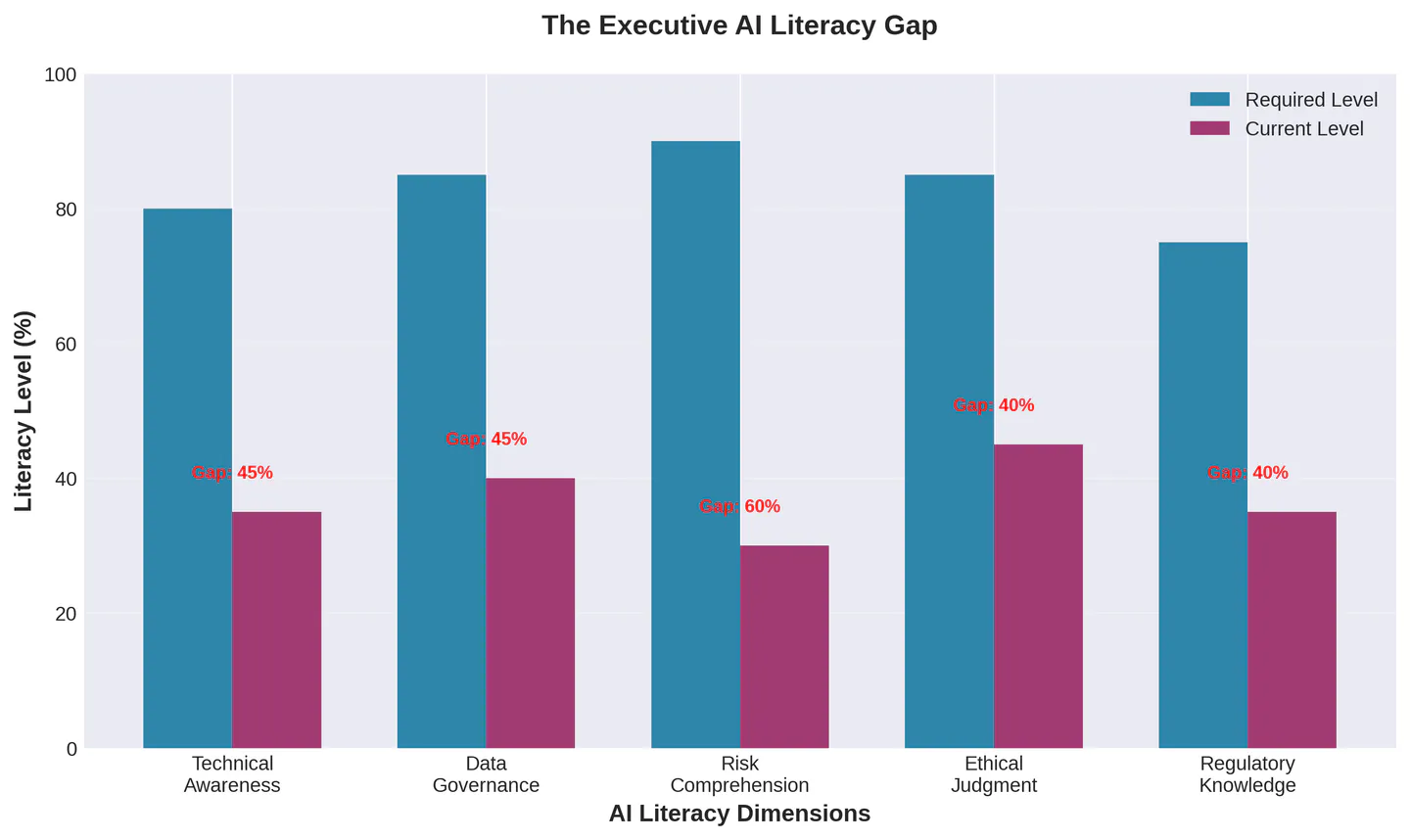
The Executive AI Literacy Gap
Understanding Executive AI Literacy
Executive AI literacy encompasses the knowledge, skills, and competencies required for board members and senior leaders to effectively govern AI systems within their organizations. It extends beyond technical proficiency to include strategic understanding of AI's capabilities and limitations, awareness of AI-specific risks and ethical considerations, and the ability to establish appropriate oversight mechanisms [14], [15]. Critically, executive AI literacy is not about transforming directors into data scientists or machine learning engineers; rather, it involves developing sufficient understanding to ask informed questions, challenge assumptions, evaluate risk-benefit tradeoffs, and ensure alignment between AI initiatives and organizational strategy and values [16], [17].
Core Dimensions of Executive AI Literacy
Executive AI literacy comprises several interconnected dimensions. Technical comprehension involves understanding fundamental AI concepts—including machine learning, neural networks, training data, model validation, and algorithmic decision-making—at a level sufficient to grasp how AI systems function and where vulnerabilities may arise [18], [19]. This does not require coding ability but does necessitate familiarity with concepts such as bias in training data, model interpretability, and the distinction between correlation and causation in algorithmic predictions. Risk awareness constitutes a second critical dimension, encompassing recognition of AI-specific risks that differ from traditional operational risks. These include algorithmic bias and discrimination, privacy violations through data misuse, security vulnerabilities in AI systems, model drift and performance degradation over time, and emergent behaviors in complex AI systems [20], [21]. Executives must understand that AI risks are often probabilistic rather than deterministic, may manifest in unexpected ways, and can create cascading effects across interconnected systems [22].
Ethical and social implications represent a third dimension, requiring executives to recognize AI's potential impacts on stakeholders, communities, and society. This includes understanding how algorithmic decisions can perpetuate or amplify existing inequities, recognizing the importance of fairness and transparency in AI systems, and appreciating the reputational and legal consequences of AI-related harms [23], [24]. Research indicates that ethical AI governance requires a "human-first" approach that prioritizes stakeholder welfare and societal values alongside business objectives [25]. Governance and oversight capabilities form the fourth dimension, encompassing the ability to establish appropriate organizational structures, policies, and processes for AI governance. This includes knowing when to establish AI ethics committees, how to integrate AI oversight into existing board committees, what questions to ask of technical teams, and how to ensure accountability for AI-related decisions [26], [27]. Effective governance requires executives to understand their fiduciary obligations regarding AI oversight and to implement mechanisms that translate ethical principles into operational practices [28].
| Dimension | Description | Priority |
|---|---|---|
| Technical Awareness | Understanding AI/ML fundamentals, capabilities, and limitations | High |
| Data Governance | Comprehending data quality, privacy, and security requirements | Critical |
| Risk Comprehension | Identifying AI-specific risks and failure modes | Critical |
| Ethical Judgment | Recognizing bias, fairness, and accountability issues | High |
| Regulatory Knowledge | Understanding compliance obligations and legal frameworks | High |
Core Dimensions of Executive AI Literacy
The Distinction Between AI Literacy and AI Expertise
A critical distinction exists between AI literacy and AI expertise. AI expertise—possessed by data scientists, machine learning engineers, and AI researchers—involves deep technical knowledge of algorithms, statistical methods, and computational systems [29]. AI literacy, by contrast, focuses on strategic understanding and governance capability rather than technical implementation [30]. This distinction is important because it clarifies that effective AI governance does not require boards to possess technical expertise equivalent to their AI development teams; rather, it requires sufficient literacy to exercise informed oversight, challenge technical recommendations, and ensure alignment with organizational objectives and values [31].
The analogy to financial literacy is instructive. Board members are not expected to be accountants or financial analysts, but they are expected to understand financial statements, recognize red flags, ask probing questions about financial risks, and ensure appropriate controls are in place [32]. Similarly, AI literacy enables directors to understand the strategic implications of AI systems, recognize governance gaps, question assumptions about algorithmic fairness and accuracy, and ensure that appropriate oversight mechanisms exist [33], [34].
Why Executive AI Literacy Matters
The importance of executive AI literacy stems from several factors. First, AI systems increasingly drive decisions with significant consequences for individuals, organizations, and society, making effective oversight essential [35]. Second, AI-specific risks differ qualitatively from traditional operational risks and require specialized knowledge to identify and manage [36]. Third, the opacity of many AI systems—particularly deep learning models—makes it difficult for non-experts to understand how decisions are made, creating information asymmetries that can undermine accountability [37], [38]. Fourth, the rapid pace of AI development means that governance frameworks must evolve continuously, requiring executives to maintain a current understanding of emerging risks and best practices [39].
Research demonstrates that organizations with higher levels of executive AI literacy exhibit better governance outcomes, including more robust risk management practices, greater transparency in algorithmic decision-making, and stronger alignment between AI initiatives and organizational values [40]. Conversely, low executive AI literacy correlates with governance failures, including inadequate oversight of AI development, insufficient attention to bias and fairness concerns, and reactive rather than proactive risk management [41], [42]. The next section examines empirical evidence of this literacy gap in practice.
The Executive Literacy Gap in Practice
Despite the critical importance of executive AI literacy, substantial evidence indicates a significant gap between the AI governance responsibilities boards face and their capacity to fulfill these responsibilities effectively. This section documents the literacy gap through empirical findings, survey data, and observed governance practices.
Empirical Evidence of the Literacy Gap
Research consistently indicates that most organizations lack adequate AI literacy among their executives. A study examining AI governance practices found that although 63% of leaders consider monitoring AI systems crucial, most are unsure how to conduct such monitoring effectively; 60% report the need for monthly human overrides of AI decisions [5]. This uncertainty reflects a fundamental knowledge gap: executives recognize the importance of oversight but lack the literacy to implement it effectively.
The literacy gap manifests in several ways. First, many boards lack members with AI or technology backgrounds, creating a knowledge deficit at the governance level [43]. Second, even when technical expertise exists on boards, it is often concentrated in one or two individuals rather than distributed across the board, limiting collective oversight capacity [44]. Third, board education on AI topics is often superficial, focusing on high-level concepts rather than developing the deeper understanding necessary for effective governance [45].
Survey data reveals that most companies are not AI-ready due to immature data governance practices, exposing organizations to costly failures without proper oversight [1]. This immaturity extends to board-level understanding: many directors lack familiarity with fundamental AI concepts such as training data bias, model validation, algorithmic fairness metrics, and the distinction between explainable and "black box" AI systems [46]. Without this foundational knowledge, boards struggle to ask informed questions, evaluate technical recommendations, or recognize warning signs of potential governance failures.
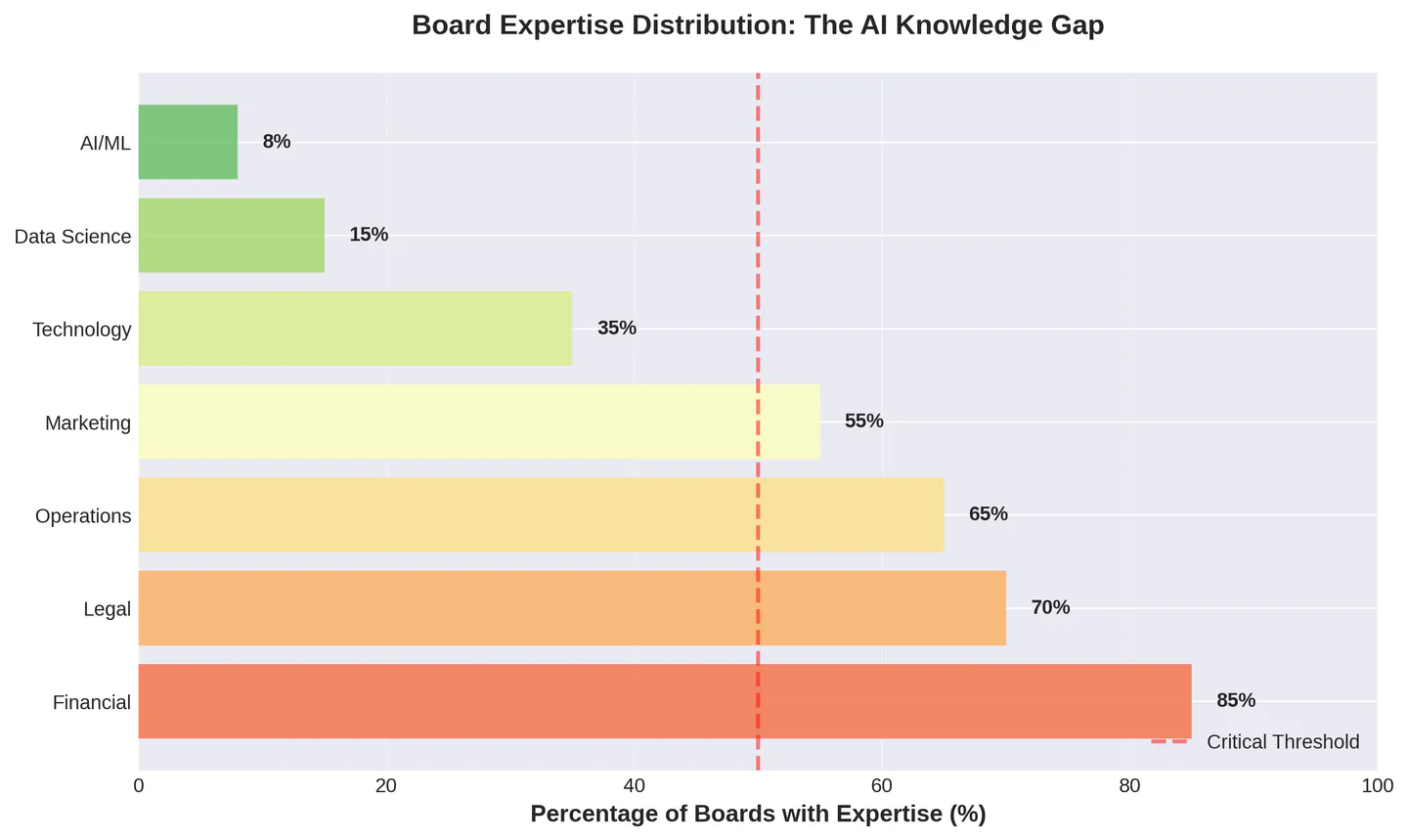
Board Expertise Distribution
This composition creates a structural vulnerability: boards are equipped to oversee traditional business risks but lack the foundational knowledge to evaluate AI-specific risks such as algorithmic bias, model drift, data poisoning, or adversarial attacks. The knowledge asymmetry between boards and technical teams becomes particularly problematic when management has incentives to downplay risks or overstate AI capabilities.
Manifestations of the Literacy Gap
The executive literacy gap manifests in observable governance deficiencies. One common manifestation is over-reliance on technical teams without adequate board-level challenge or oversight [47]. When executives lack AI literacy, they may defer entirely to data science teams' recommendations without questioning assumptions, evaluating alternatives, or considering broader implications. This creates a governance vacuum where technical considerations dominate strategic and ethical concerns [48].
A second manifestation is inadequate risk identification and assessment. Research indicates that AI-specific risks—including algorithmic bias, model drift, adversarial attacks, and emergent behaviors—often fall outside traditional enterprise risk management frameworks [4], [49]. Without executive AI literacy, boards may fail to recognize these risks or may underestimate their materiality, leading to insufficient risk mitigation efforts [50].
A third manifestation is reactive rather than proactive governance. Organizations with low executive AI literacy tend to address AI governance issues only after problems arise—such as public exposure of algorithmic bias or regulatory scrutiny—rather than establishing robust governance frameworks proactively [51], [52]. This reactive approach increases the likelihood of governance failures and their associated costs.
A fourth manifestation is insufficient integration of AI governance into corporate structures. Effective AI governance requires embedding oversight mechanisms into existing board committees, establishing clear accountability for AI-related decisions, and integrating AI considerations into strategic planning and risk management processes [53], [54]. However, organizations with low executive AI literacy often treat AI governance as a separate, technical concern rather than integrating it into core governance structures [55].
Barriers to Developing Executive AI Literacy
Several factors contribute to the persistence of the executive literacy gap. Rapid technological change means that AI capabilities evolve faster than board education programs can adapt, creating a moving target for literacy development [56]. Complexity and technical jargon can make AI concepts intimidating for non-technical executives, discouraging engagement and learning [57]. Time constraints limit directors' ability to develop deep understanding of AI topics alongside their other governance responsibilities [58]. Organizational culture can also impede literacy development. In some organizations, technical expertise is siloed within IT or data science departments, with limited communication to executive leadership [59]. In others, a culture of technological optimism may discourage critical questioning of AI initiatives, viewing skepticism as resistance to innovation [60]. Additionally, lack of standardized frameworks for executive AI education means that literacy development efforts are often ad hoc and inconsistent [61]. The consequences of this literacy gap extend beyond individual organizations. When boards lack AI literacy, they cannot effectively fulfill their fiduciary duties regarding AI oversight, creating legal and regulatory risks [62]. They cannot ensure that AI systems align with organizational values and stakeholder interests, creating reputational risks [63]. And they cannot identify and mitigate AI-specific risks proactively, creating operational and strategic risks [64]. The next section examines documented governance failures that illustrate these consequences.
Governance Failures Arising from Low AI Literacy
The consequences of inadequate executive AI literacy are not theoretical—they manifest in documented governance failures with significant organizational and societal impacts. These failures share common patterns: insufficient board-level questioning, inadequate risk assessment processes, reactive rather than proactive governance, and accountability gaps when systems cause harm.
| Incident | Failure Type | Governance Gap | Severity |
|---|---|---|---|
| Amazon Hiring Algorithm (2018) | Gender bias in resume screening | Inadequate bias testing oversight | High |
| COMPAS Recidivism (2016) | Racial bias in risk assessment | Lack of algorithmic accountability | High |
| Facial Recognition Bias (2019) | Misidentification of minorities | Insufficient validation protocols | High |
| Healthcare AI (2020) | Racial bias in care allocation | Absent clinical governance | Critical |
| Credit Scoring (2021) | Discriminatory lending practices | Weak model governance | High |
Major AI Governance Failures and Root Causes
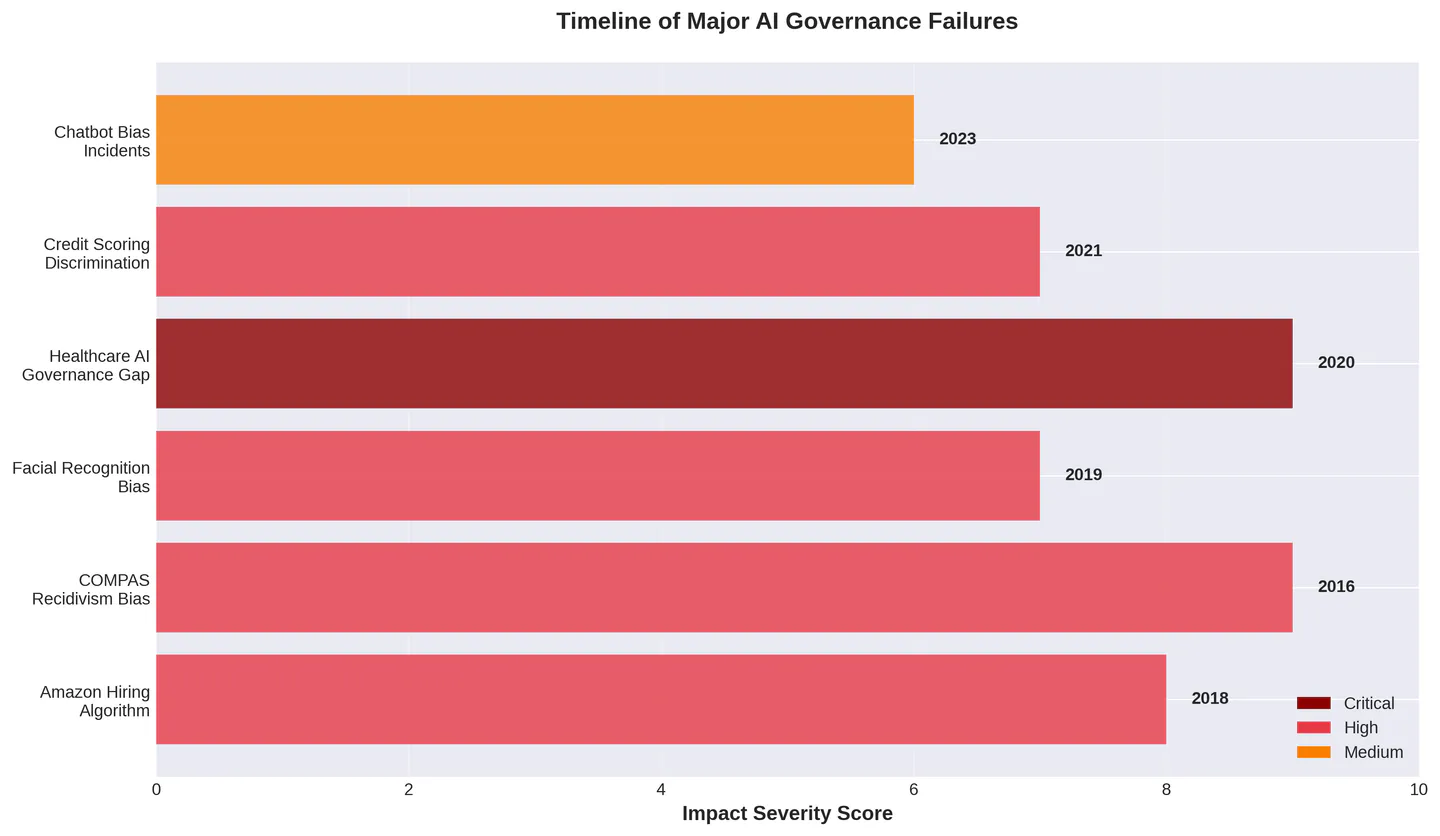
Timeline of Major AI Governance Failures
High-Profile Algorithmic Bias Incidents
Several high-profile incidents illustrate governance failures arising from insufficient executive AI literacy. Amazon's hiring algorithm provides a paradigmatic example. In 2018, Amazon abandoned an AI-powered recruiting tool after internal review revealed it systematically discriminated against female applicants [6]. The algorithm, trained on historical hiring data that reflected existing gender imbalances in technical roles, learned to penalize resumes containing words associated with women, such as "women's" in "women's chess club captain." This incident reveals multiple governance failures: inadequate oversight of training data quality, insufficient attention to fairness testing, and lack of board-level awareness of algorithmic bias risks until the problem became public.
Recidivism risk scoring systems present another well-documented case. ProPublica's investigation of Northpointe's COMPAS system—used in criminal justice to assess defendants' likelihood of reoffending—revealed significant racial bias, with the algorithm falsely flagging Black defendants as high-risk at nearly twice the rate of white defendants [6], [19]. Despite the system's widespread use in consequential decisions affecting individuals' liberty, governance oversight was minimal, with insufficient attention to fairness metrics, validation across demographic groups, or transparency in algorithmic decision-making. The root cause was not merely technical but governance-related: decision-makers lacked the AI literacy to recognize the need for rigorous bias testing and ongoing monitoring.
Facial recognition systems have exhibited systematic bias across multiple implementations. Research documented in the Gender Shades audit exposed significant gender and skin-type performance disparities in commercial facial analysis systems from IBM, Microsoft, and Megvii (Face++), with error rates for darker-skinned females substantially higher than for lighter-skinned males [7]. Following public disclosure, targeted companies reduced accuracy disparities within seven months, demonstrating that the technical capability to mitigate bias existed but was not prioritized until external pressure forced action [7]. This pattern—where bias mitigation occurs only after public exposure—indicates governance failure at the oversight level.
Healthcare AI Governance Failures
The healthcare sector has experienced particularly concerning governance failures. Research identifies a "governance vacuum" in medical device AI, where systemic bias, flawed proxy variables, and emergent risks to patient safety persist unaddressed due to inadequate regulatory frameworks and insufficient institutional readiness [65], [66]. These failures are structural rather than incidental, rooted in the absence of equity-centered design and inadequate board-level understanding of AI's potential for harm in clinical contexts.
Specific examples include clinical algorithms that exhibit worse performance for Black patients compared to white patients, often because the algorithms fail to model the cumulative impacts of racism-related stress and other social determinants of health [67]. The governance failure here is not merely technical—it reflects insufficient executive understanding of how algorithmic design choices can perpetuate health inequities and inadequate oversight mechanisms to ensure fairness across patient populations.
Workplace Discrimination and Hiring Bias
Beyond Amazon's case, workplace AI systems have exhibited systematic bias in multiple contexts. Studies document cases of hiring discrimination in which algorithms trained on historical data perpetuate existing biases, screening out qualified candidates based on protected characteristics [68]. Experiments with AI systems revealed that they reinforce social stereotypes and struggle with nuanced, subjective situations, with specific bias cases including facial recognition and caste-based discrimination [69].
The root causes of these failures consistently trace to governance deficiencies. Organizations deployed AI systems without adequate fairness testing, diverse representation in development teams, ongoing monitoring for bias, or board-level oversight to ensure accountability [70], [71]. These are not technical failures but governance failures—failures of oversight, accountability, and informed decision-making at the executive level.
Governance Structure Failures
Some governance failures involve the structures intended to provide oversight. Google's Advanced Technology External Advisory Council (ATEAC) dissolved rapidly in 2019 due to public backlash over controversial appointments and a lack of civil society representation [19]. The council's failure revealed the fragility of symbolic ethics structures built on corporate image management rather than substantive governance and legitimacy. Similarly, the NYC algorithm task force's 2019 report was widely criticized as weak, and Access Now resigned from the Partnership on AI, citing diminished civil society influence [6]. These structural failures indicate that establishing governance bodies is insufficient without a genuine commitment to informed oversight and stakeholder engagement.
Root Causes: The Literacy-Governance Connection
Analysis of these failures reveals consistent patterns linking low executive AI literacy to governance breakdowns. First, inadequate risk identification: boards without AI literacy fail to recognize algorithmic bias, fairness concerns, and other AI-specific risks as material governance issues requiring oversight [72]. Second, insufficient questioning and challenge: executives lacking AI literacy cannot effectively challenge technical teams' assumptions, evaluate alternative approaches, or identify gaps in proposed AI governance frameworks [73]. Third, reactive rather than proactive oversight: without understanding AI risks, boards address governance issues only after problems become public, missing opportunities for prevention [74].
Fourth, lack of accountability mechanisms: organizations with low executive AI literacy often lack clear accountability for AI-related decisions, with responsibility diffused across technical teams without board-level ownership [75]. Fifth, inadequate stakeholder consideration: boards without AI literacy may fail to consider how algorithmic decisions affect diverse stakeholders, particularly marginalized communities disproportionately harmed by biased systems [76], [77]. These patterns demonstrate that governance failures are not random but systematically linked to the executive literacy gap.
Strategic Misalignment and Technology-Driven Decision-Making
Beyond specific governance failures, low executive AI literacy creates a more insidious problem: strategic misalignment where technology capabilities drive organizational decisions rather than strategic objectives and values guiding technology deployment. This section examines how the literacy gap enables technology-driven decision-making and its consequences.
The Inversion of Strategic Priorities
In organizations with low executive AI literacy, a problematic inversion often occurs: instead of strategic objectives determining which AI capabilities to develop and deploy, available AI capabilities determine strategic direction [78]. This inversion happens because executives lacking AI literacy cannot effectively evaluate whether proposed AI initiatives align with organizational strategy, serve stakeholder interests, or create sustainable value [79]. Instead, they defer to technical teams' enthusiasm for AI applications, approving projects based on technological novelty rather than strategic fit.
Research indicates that competitive pressure drives CEOs to embrace AI innovation aggressively, often without adequate consideration of risks or alignment with organizational values [80]. When boards lack AI literacy, they cannot provide an effective counterbalance to this pressure, failing to ask critical questions about whether AI deployment serves strategic objectives or merely follows technological trends [81]. The result is strategic drift, where organizations pursue AI initiatives because competitors are doing so rather than because these initiatives create a genuine strategic advantage.
The "Black Box" Problem and Accountability Erosion
The opacity of many AI systems—particularly deep learning models—creates what researchers term the "black box" problem: algorithmic decisions are difficult or impossible to explain, even for technical experts [82], [83]. This opacity becomes particularly problematic when executives lack AI literacy. Without understanding how AI systems make decisions, boards cannot effectively evaluate whether these decisions align with organizational values, serve stakeholder interests, or comply with legal and ethical standards [84].
Research indicates that without explainable AI frameworks, corporate boards and shareholders may be forced to rely on opaque models, weakening accountability and increasing reputational risk [85]. The literacy gap exacerbates this problem: executives who do not understand the distinction between interpretable and black-box models cannot insist on explainability where it matters most—in high-stakes decisions affecting individuals' opportunities, rights, and welfare [86]. The result is erosion of accountability, where algorithmic decisions are treated as technical outputs rather than organizational choices requiring justification and oversight.
Misalignment with Organizational Values
AI systems encode values through their design choices, training data, optimization objectives, and deployment contexts [87]. When executives lack AI literacy, they cannot ensure that these encoded values align with stated organizational values and stakeholder commitments [88]. This misalignment manifests in several ways.
First, optimization for narrow metrics without consideration of broader impacts. AI systems optimize for specified objectives—such as maximizing engagement, minimizing processing time, or predicting outcomes with highest accuracy—but these narrow objectives may conflict with broader organizational values such as fairness, transparency, or stakeholder welfare [89]. Without executive AI literacy, boards cannot recognize these conflicts or insist on multi-objective optimization that balances competing values.
Second, insufficient attention to fairness and equity. Research demonstrates that AI systems can perpetuate or amplify existing inequities when fairness is not explicitly designed into systems [90], [91]. However, fairness is not a default outcome but requires deliberate design choices, ongoing monitoring, and willingness to accept tradeoffs between accuracy and equity [92]. Executives lacking AI literacy may not recognize the need for these interventions or may accept technical teams' assurances that systems are "objective" without understanding that algorithmic objectivity does not guarantee fairness.
Third, a disconnect between AI governance and corporate governance. Effective AI governance requires integration with broader corporate governance structures, ensuring that AI-related decisions are subject to the same oversight, accountability, and stakeholder consideration as other strategic decisions [93], [94]. However, organizations with low executive AI literacy often treat AI governance as a separate, technical domain rather than integrating it into core governance processes [95]. This separation creates strategic misalignment, in which AI initiatives proceed without adequate consideration of their implications for organizational strategy, reputation, and stakeholder relationships.
The Innovation-Risk Imbalance
Low executive AI literacy creates an imbalance between enthusiasm for innovation and risk awareness. Technical teams naturally focus on AI's potential benefits—efficiency gains, predictive capabilities, automation opportunities—while being less attuned to governance risks, ethical implications, and potential for harm [96]. In organizations with strong executive AI literacy, boards provide a counterbalance, ensuring that innovation proceeds with appropriate risk management and stakeholder consideration [97]. However, when boards lack AI literacy, this counterbalance is absent, creating an imbalance in innovation risk where enthusiasm for AI capabilities overwhelms attention to governance concerns [98].
This imbalance is particularly problematic because AI risks are often probabilistic, emergent, and difficult to predict [99]. Unlike traditional operational risks that can be managed through established frameworks, AI risks may manifest in unexpected ways, affect stakeholders not initially considered, and create cascading effects across interconnected systems [100]. Managing these risks requires informed oversight that anticipates potential harms, insists on robust testing and monitoring, and ensures accountability for algorithmic decisions [11]. Without executive AI literacy, this oversight is likely to persist, leaving organizations vulnerable to governance failures that could have been prevented through informed leadership.
Why Traditional Governance and Risk Frameworks Fall Short
Conventional corporate governance and enterprise risk management frameworks were designed for a pre-AI era and prove inadequate for AI-specific challenges. Traditional governance assumes relatively static risks that can be identified, assessed, and controlled through established processes. AI systems, by contrast, present dynamic, adaptive, and cascading risks that evolve as systems learn from new data and interact with changing environments.
| Traditional Approach | AI Reality | Required Adaptation |
|---|---|---|
| Static Risk Assessment | AI risks evolve continuously | Dynamic monitoring required |
| Checklist Compliance | AI requires contextual judgment | Adaptive governance needed |
| Siloed Oversight | AI impacts span functions | Integrated governance essential |
| Reactive Controls | AI failures cascade rapidly | Proactive risk mitigation critical |
| Annual Reviews | AI systems drift over time | Continuous oversight necessary |
Limitations of Traditional Governance Frameworks for AI
Limitations of Traditional Enterprise Risk Management
Traditional enterprise risk management (ERM) frameworks were developed for operational, financial, strategic, and compliance risks that differ qualitatively from AI-specific risks. Several characteristics of AI risks challenge conventional ERM approaches.
First, probabilistic and emergent nature. Traditional risks are often deterministic or follow predictable patterns, enabling risk assessment through historical data and established methodologies. AI risks, by contrast, are probabilistic—they may or may not materialize depending on complex interactions between algorithms, data, deployment contexts, and user behaviors—and emergent, arising from system interactions that were not anticipated during design [4]. This probabilistic and emergent nature makes AI risks difficult to assess using traditional risk matrices and scoring systems.
Second, opacity and interpretability challenges. Traditional risks can typically be understood through established analytical frameworks and explained to non-experts [15]. AI risks, particularly those involving complex machine learning models, may be difficult to understand even for technical experts due to model opacity. This opacity challenges traditional risk governance, which assumes that risks can be identified, assessed, and communicated clearly to decision-makers.
Third, rapid evolution and continuous learning. Traditional risks are relatively stable, changing gradually over time [7]. AI systems, particularly those employing continuous learning, evolve constantly as they process new data, potentially developing behaviors and risks that were not present at deployment. This dynamic nature requires ongoing monitoring and adaptive governance that traditional ERM frameworks, designed for more stable risk environments, do not adequately address.
Fourth, sociotechnical complexity. AI risks arise not merely from technical systems but from interactions between algorithms, data, organizational processes, human decision-makers, and social contexts. Traditional ERM frameworks tend to treat risks as discrete, manageable entities, whereas AI risks are deeply embedded in sociotechnical systems requiring holistic governance approaches [68].
Inadequacy of Compliance-Focused Approaches
Many organizations approach AI governance primarily through compliance frameworks, focusing on regulatory and industry standards. While compliance is necessary, it is insufficient for effective AI governance for several reasons.
First, regulatory lag. AI technology evolves faster than regulatory frameworks, creating gaps that leave emerging risks unaddressed by existing regulations. Compliance-focused governance may address known regulatory requirements but may miss novel risks that have not yet been codified in law. Research indicates that regulatory fragmentation creates compliance challenges for AI governance frameworks, with different jurisdictions imposing inconsistent requirements [88].
Second, minimum standards versus best practices. Compliance frameworks establish minimum acceptable standards, but effective AI governance requires going beyond compliance to implement best practices that address ethical considerations, stakeholder interests, and organizational values. Organizations that view AI governance solely through a compliance lens may meet legal requirements while failing to address broader governance concerns [16].
Third, a reactive rather than a proactive orientation. Compliance frameworks are inherently reactive, responding to identified problems through regulation. Effective AI governance requires proactive identification of potential risks and harms before they materialize, and the anticipation of how AI systems might fail or cause unintended consequences [11]. This proactive orientation requires executive AI literacy, enabling boards to ask forward-looking questions rather than merely checking compliance boxes.
The Fiduciary Duty Gap
Traditional corporate governance frameworks emphasize directors' fiduciary duties—duty of care, duty of loyalty, and duty of oversight—but these duties were developed in contexts that did not anticipate AI-specific governance challenges. Several gaps exist between traditional fiduciary duty frameworks and AI governance requirements.
First, information asymmetry. The duty of care requires directors to be informed about material risks and to make decisions on an informed basis. However, the technical complexity and opacity of AI systems create information asymmetries that make it difficult for directors to become adequately informed without specialized AI literacy [22]. Traditional approaches to fulfilling the duty of care—such as reviewing management reports and consulting experts—may be insufficient when directors lack the requisite literacy to ask probing questions or critically evaluate expert recommendations.
Second, oversight of novel risks. The duty of oversight (Caremark duties) requires directors to establish information and reporting systems to monitor legal compliance and material risks. However, AI-specific risks—including algorithmic bias, model drift, adversarial attacks, and emergent behaviors—may not be captured by traditional reporting systems designed for conventional operational risks [12]. Without executive AI literacy, boards may not recognize the need for AI-specific monitoring and reporting mechanisms.
Third, stakeholder consideration. While fiduciary duties traditionally focus on shareholder interests, effective AI governance requires consideration of broader stakeholder impacts, particularly for marginalized communities disproportionately affected by algorithmic bias. Traditional fiduciary duty frameworks provide limited guidance on balancing shareholder interests with stakeholder welfare in AI governance contexts [28].
The Need for AI-Specific Governance Frameworks
The limitations of traditional governance and risk frameworks necessitate AI-specific governance approaches that address the unique characteristics of AI risks. Research consistently emphasizes the need for governance frameworks that integrate technical, ethical, legal, and organizational dimensions. These frameworks must address bias mitigation, transparency, data governance, accountability mechanisms, and ongoing monitoring in ways that traditional frameworks do not. Critically, AI-specific governance frameworks must be grounded in executive AI literacy. Without board-level understanding of AI risks, capabilities, and limitations, even well-designed governance frameworks will be ineffectively implemented [33]. The next section examines how AI governance should be understood as a core fiduciary responsibility requiring executive literacy.
AI Governance as a Fiduciary Responsibility
Directors' fiduciary duties—the duty of care and the duty of loyalty—require informed decision-making and oversight. When AI systems create material risks or drive significant business decisions, directors cannot fulfill their duty of care without adequate AI literacy. The Caremark doctrine establishes that directors must implement reasonable information and reporting systems to monitor corporate operations and compliance. For organizations deploying AI at scale, this duty necessarily encompasses AI-specific governance mechanisms. Emerging legal and regulatory frameworks reinforce this interpretation. The EU AI Act, the proposed U.S. Algorithmic Accountability Act, and various sector-specific regulations increasingly impose explicit governance obligations on organizations deploying high-risk AI systems. Directors who lack the literacy to understand these obligations or oversee compliance face potential personal liability [67].
The Duty of Care and AI Oversight
Directors' duty of care requires them to act on an informed basis, with the care that an ordinarily prudent person would reasonably be expected to exercise in a similar situation. This duty encompasses the obligation to become informed about material risks facing the organization and to make decisions based on adequate information. In the context of AI governance, the duty of care requires directors to understand AI-specific risks, to establish appropriate oversight mechanisms, and to ensure that AI-related decisions are made on an informed basis [36].
Delaware law—the dominant corporate law jurisdiction in the United States—mandates that a board's duty of care includes ensuring information and reporting systems exist to provide timely, accurate data for compliance with law and business performance. Negligent failure to establish such systems may violate the duty of care, whereas deliberate disregard may breach the duty of loyalty based on bad faith. In the context of AI governance, this standard requires boards to establish monitoring and reporting systems specifically designed to identify AI-specific risks, including algorithmic bias, model performance degradation, and compliance with emerging AI regulations.
The duty of care is not satisfied by passive receipt of management reports; it requires active engagement, informed questioning, and critical evaluation of information provided. In the AI context, this means directors must possess sufficient AI literacy to ask probing questions about algorithmic fairness, to challenge assumptions about model accuracy and reliability, and to evaluate whether proposed AI governance mechanisms are adequate [39]. Without this literacy, directors cannot fulfill their duty of care regarding AI oversight.
The Duty of Loyalty and Algorithmic Fairness
The duty of loyalty requires directors to act in good faith and in the best interests of the corporation and its shareholders. This duty prohibits self-dealing and requires directors to prioritize corporate interests over personal interests. In the AI governance context, the duty of loyalty extends to ensuring that AI systems serve organizational interests and stakeholder welfare rather than narrow technical objectives or short-term efficiency gains that may create long-term risks [55].
Research indicates that algorithmic bias and discrimination create material risks to organizational reputation, regulatory compliance, and stakeholder relationships. Directors who fail to address these risks—either through ignorance or deliberate disregard—may breach their duty of loyalty by exposing the organization to preventable harms. The duty of loyalty thus requires directors to ensure that AI systems are designed and deployed with attention to fairness, that bias testing and mitigation are conducted rigorously, and that stakeholder impacts are considered in AI-related decisions [46].
The Duty of Oversight (Caremark Duties)
The duty of oversight, established in the landmark Caremark decision and refined in subsequent cases, requires directors to implement reasonable information and reporting systems to monitor legal compliance and material risks. Failure to establish such systems, or conscious disregard of red flags indicating problems, can constitute a breach of fiduciary duty [19].
The Caremark standard has traditionally been difficult to satisfy, requiring plaintiffs to demonstrate that directors utterly failed to implement oversight systems or consciously disregarded known risks. However, recent cases suggest courts are increasingly willing to hold directors accountable for oversight failures, particularly in contexts involving significant regulatory risks or reputational harms. In the AI context, the duty of oversight requires boards to establish AI-specific monitoring systems, to ensure regular reporting on AI risks and incidents, and to respond appropriately to warning signs of governance failures [12].
Critically, the oversight duty cannot be fulfilled without executive AI literacy. Directors cannot establish appropriate monitoring systems if they do not understand what should be monitored. They cannot recognize red flags if they lack the literacy to interpret information about algorithmic performance, bias metrics, or model validation. And they cannot respond appropriately to AI-related risks if they do not understand the potential consequences of governance failures [55].
Regulatory Compliance and Director Liability
Emerging AI regulations create additional compliance obligations that implicate directors' fiduciary duties. The European Union's AI Act, proposed U.S. federal AI legislation, and state-level AI regulations impose requirements for transparency, fairness testing, risk assessment, and accountability in AI systems. Directors have a fiduciary obligation to ensure organizational compliance with these regulations, and failure to do so can result in regulatory sanctions, legal liability, and reputational damage [17].
Research indicates that directors' risk management oversight obligations have expanded significantly in recent decades, particularly in regulated industries. The Dodd-Frank Act, for example, imposed structural reforms on boards of directors at large financial institutions, requiring enhanced risk oversight. While these reforms addressed financial risk management, they established a precedent for regulatory intervention in board oversight obligations when systemic risks are at stake. AI governance presents analogous systemic risks—including discrimination, privacy violations, and threats to democratic processes—that may justify similar regulatory expectations for board oversight [62].
Director liability for AI governance failures remains an evolving area of law, but several liability theories are emerging. Negligent oversight claims may arise when boards fail to establish adequate AI governance systems. Breach of duty of care claims may arise when directors approve AI deployments without adequate information regarding the associated risks. Breach-of-duty-of-loyalty claims may arise when directors consciously disregard known AI risks. While successful claims remain rare due to the business judgment rule's protections, the increasing materiality of AI risks and growing regulatory attention suggest that director liability for AI governance failures will become more common [16].
The Literacy Imperative
The fiduciary duty analysis establishes that effective AI governance is not optional but obligatory for corporate boards. However, fulfilling these fiduciary obligations requires executive AI literacy. Directors cannot establish appropriate oversight systems without understanding what AI-specific risks require monitoring. They cannot make informed decisions about AI deployments without the literacy to critically evaluate technical recommendations. And they cannot recognize and respond to warning signs of governance failures without understanding how AI systems can fail and cause harm [69].
This creates what we term the "literacy imperative": in the modern corporate context, where AI systems increasingly drive consequential decisions, executive AI literacy is not merely beneficial but necessary for fulfilling fiduciary duties. Boards that lack AI literacy cannot adequately discharge their duty of care, duty of loyalty, or duty of oversight regarding AI governance [17]. The next section examines how this literacy gap creates material risks that boards are obligated to address.
Risk Materiality in Low Executive AI Literacy Environments
The materiality of AI-related risks increases substantially in low-literacy governance environments. When boards cannot identify, assess, or prioritize AI risks, the likelihood and potential impact of adverse events both increase. This creates a compound effect: not only are risks more likely to materialize, but organizational responses are slower and less effective when incidents occur.
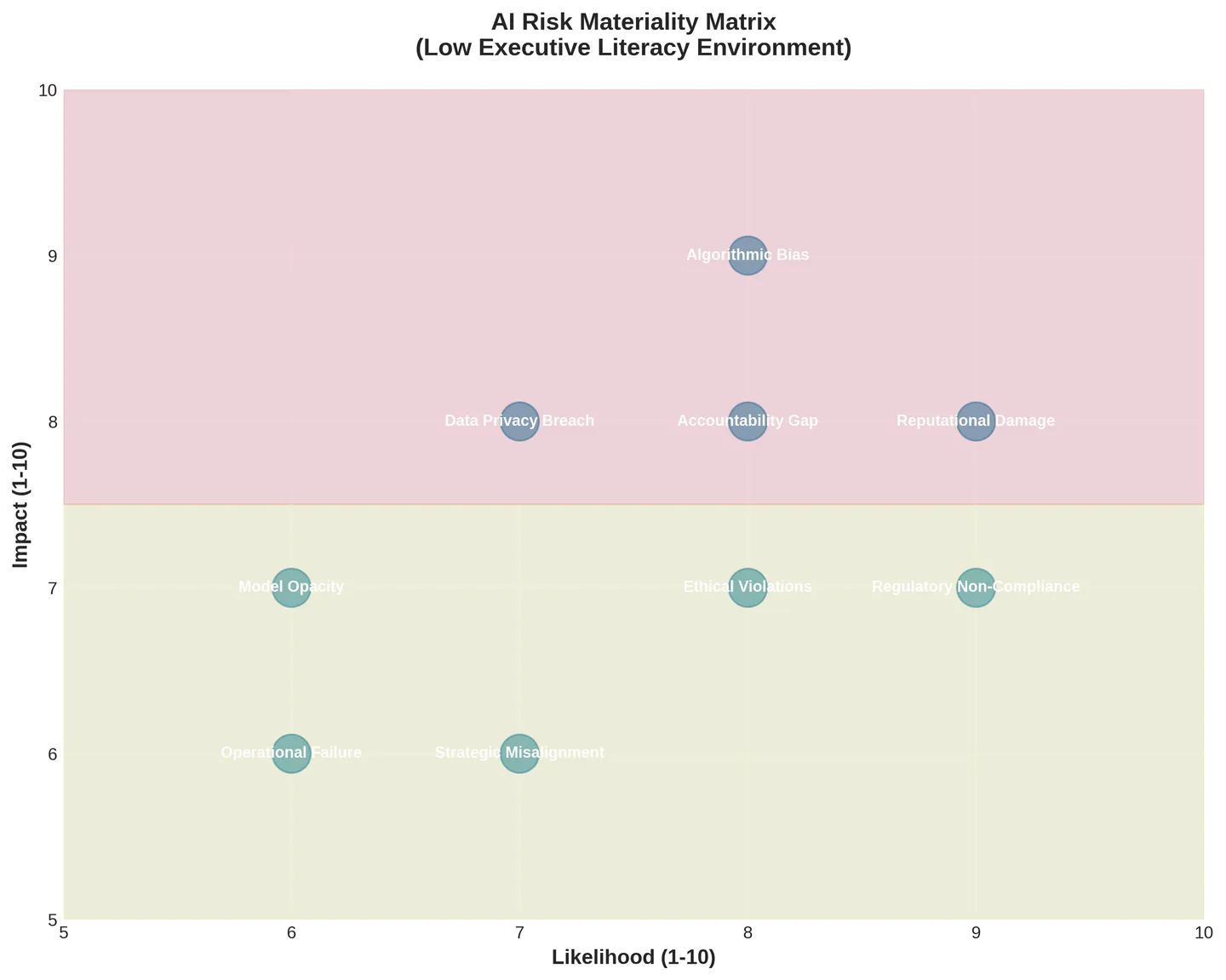
AI Risk Materiality Matrix
Key risk categories amplified by low executive literacy include algorithmic bias and discrimination, data privacy breaches, regulatory non-compliance, model opacity and unexplainability, accountability gaps, strategic misalignment, reputational damage, operational failures, and ethical violations. Each of these risks becomes more likely and more severe when governance oversight is inadequate.
Reputational Risks
Reputational damage from AI governance failures can be severe and long-lasting. High-profile incidents of algorithmic bias—such as Amazon's discriminatory hiring algorithm, biased recidivism scoring systems, and facial recognition failures—generate significant negative publicity, erode stakeholder trust, and damage brand value. Research indicates that reputational risks from AI failures are particularly acute because they implicate organizational values and social responsibility, not merely technical competence [73].
The materiality of reputational risks is amplified by several factors. First, social media amplification means that AI governance failures can rapidly become public knowledge, generating widespread criticism and stakeholder backlash. Second, stakeholder expectations for responsible AI are rising, with consumers, employees, investors, and civil society increasingly demanding that organizations deploy AI ethically and transparently. Third, competitive dynamics mean that organizations perceived as leaders in responsible AI gain a competitive advantage, while those associated with governance failures face market disadvantages [16].
Low executive AI literacy exacerbates reputational risks because boards that lack such literacy cannot proactively identify and mitigate potential sources of reputational harm. They may approve AI deployments without adequate consideration of how algorithmic decisions will be perceived by stakeholders, particularly marginalized communities disproportionately affected by bias. And they may respond inadequately to AI-related controversies, lacking the understanding to communicate effectively about governance failures and remediation efforts [79].
Regulatory and Legal Risks
Regulatory risks from AI governance failures are increasing as jurisdictions worldwide implement AI-specific regulations. The European Union's AI Act establishes comprehensive requirements for high-risk AI systems, including transparency obligations, fairness testing, human oversight, and accountability mechanisms. U.S. federal agencies are developing AI governance guidelines, and several states have enacted AI-specific legislation. Organizations that fail to comply with these regulations face substantial penalties, including fines, operational restrictions, and legal liability [82].
Legal risks extend beyond regulatory compliance to include civil liability for harms caused by AI systems. Individuals harmed by algorithmic bias may bring discrimination claims under civil rights laws. Consumers harmed by AI-driven decisions may bring product liability or consumer protection claims. Shareholders may bring derivative suits against directors for breaches of fiduciary duty arising from failures in AI governance. While the legal landscape continues to evolve, the trend is toward greater accountability for AI-related harms [16].
Low executive AI literacy increases regulatory and legal risks because boards that lack AI literacy cannot ensure organizational compliance with AI regulations. They may not recognize when AI systems fall within regulatory scope, may not understand compliance requirements, and may not establish adequate compliance monitoring systems [18]. This creates exposure to regulatory sanctions and legal liability that could be avoided through informed governance [89].
Operational Risks
AI systems create operational risks when they fail to perform as expected, produce erroneous outputs, or exhibit unintended behaviors. These risks include model drift, where AI performance degrades over time as data distributions change; adversarial attacks, where malicious actors manipulate AI systems to produce desired outputs; data quality issues, where poor training data leads to unreliable predictions; and integration failures, where AI systems interact poorly with existing organizational processes [93].
The materiality of operational risks depends on the criticality of AI systems to organizational functions. When AI drives high-stakes decisions—such as credit allocation, healthcare diagnostics, or safety-critical systems—operational failures can have severe consequences. Research indicates that operational risks associated with AI are often underestimated because organizations focus on AI's potential benefits while paying insufficient attention to failure modes [15].
Low executive AI literacy exacerbates operational risks because boards that lack such literacy cannot ensure adequate testing, validation, and monitoring of AI systems. They may approve AI deployments without understanding the systems' limitations, fail to insist on robust contingency planning for AI failures, and fail to establish appropriate mechanisms for human oversight. This creates vulnerability to operational disruptions that could be prevented through informed governance [98].
Strategic Risks
Strategic risks arise when AI initiatives fail to create expected value, divert resources from more productive investments, or create strategic vulnerabilities. These risks include misalignment with organizational strategy, where AI projects are pursued for technological novelty rather than strategic fit; opportunity costs, where resources invested in unsuccessful AI initiatives could have been deployed more productively; competitive disadvantage, where competitors develop superior AI capabilities or more effective AI governance; and strategic lock-in, where organizations become dependent on AI systems that prove difficult to modify or replace [20].
The materiality of strategic risks is particularly high in industries where AI is becoming a source of competitive advantage. Organizations that deploy AI effectively can achieve significant efficiency gains, improved decision-making, and enhanced customer experiences. Conversely, organizations that deploy AI poorly—or that fail to deploy AI when competitors do so successfully—may face strategic disadvantage [4].
Low executive AI literacy increases strategic risks because boards lacking literacy cannot effectively evaluate AI initiatives' strategic merit. They may approve AI projects based on technical enthusiasm rather than strategic analysis, may fail to ensure alignment between AI capabilities and organizational objectives, and may not recognize when AI investments are failing to create expected value. This creates a strategic vulnerability that could be avoided through informed governance [20].
Quantifying Risk Materiality
While precise quantification of AI governance risks is challenging, several indicators suggest their materiality. Financial impacts of AI governance failures can be substantial, including regulatory fines (potentially reaching millions or tens of millions of dollars under emerging AI regulations), litigation costs and settlements, remediation expenses, and lost business due to reputational damage. Operational impacts include system failures, service disruptions, and the need to rebuild or replace AI systems that are biased or unreliable. Strategic impacts include competitive disadvantage, missed opportunities, and erosion of stakeholder trust [10].
Research indicates that organizations with robust AI governance practices experience better outcomes across these dimensions, suggesting that governance investments create material value. Conversely, organizations with weak AI governance face elevated risks that can materialize in costly failures. The materiality of these risks indicates that AI governance is not a peripheral concern but a core governance responsibility that requires board-level attention and executive AI literacy [13].
An Integrated AI Governance Framework Centered on Executive Literacy
Effective AI governance requires an integrated framework grounded in executive literacy. This framework must encompass five core pillars: technical competence for informed questioning and oversight; strategic oversight and alignment with organizational objectives; ethical governance and stakeholder accountability; regulatory compliance and auditability; and continuous learning and adaptive governance mechanisms.
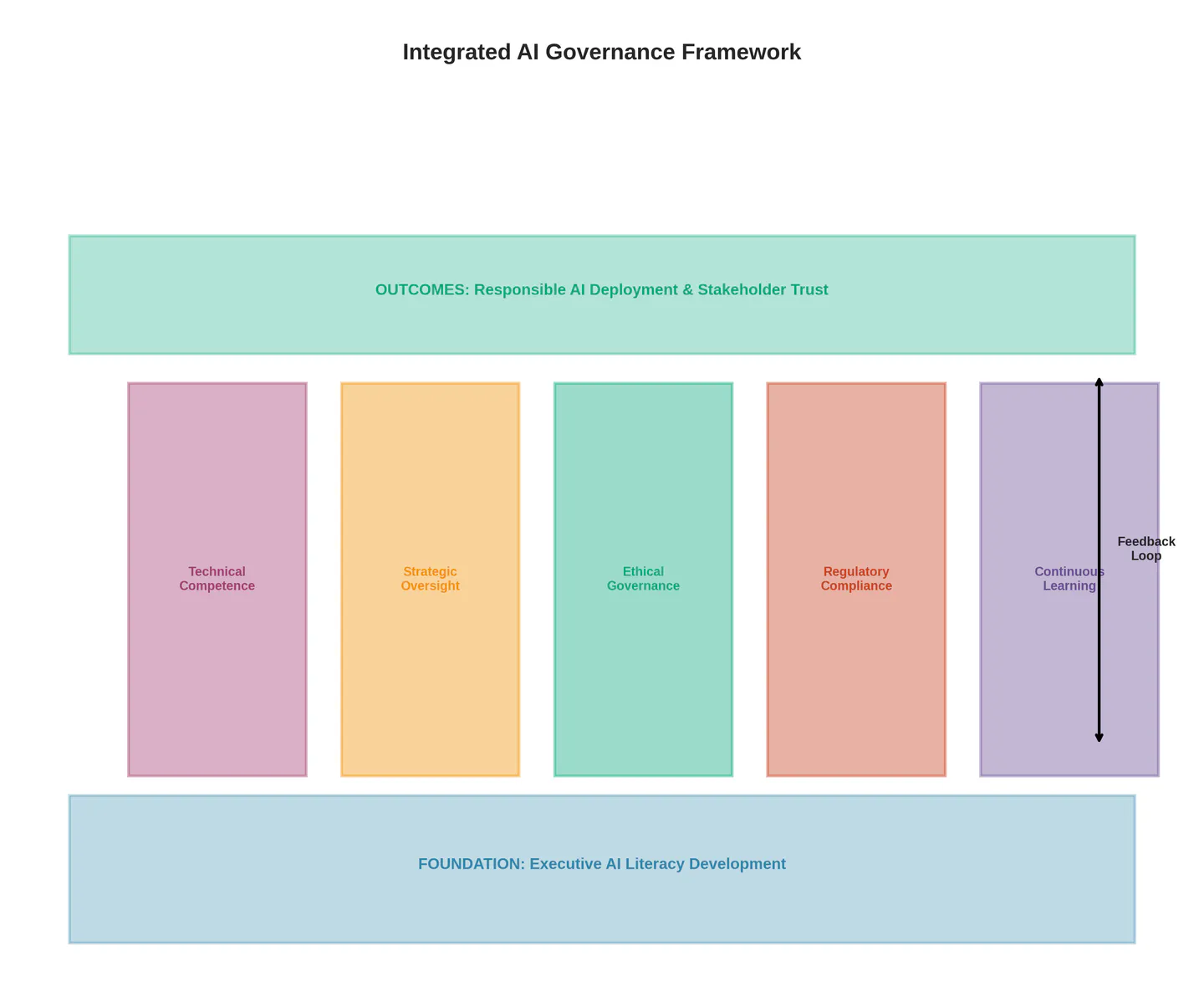
Integrated AI Governance Framework
| Component | Description | Layer |
|---|---|---|
| Board Education | Structured AI literacy programs for directors | Foundational |
| AI Oversight Committee | Board-level committee for AI governance | Structural |
| Risk Assessment Protocol | AI-specific risk identification and evaluation | Operational |
| Ethics Review Board | Independent review of AI ethical implications | Operational |
| Compliance Monitoring | Continuous regulatory compliance tracking | Operational |
| Stakeholder Engagement | Mechanisms for affected party input | Operational |
| Audit and Assurance | Independent algorithmic auditing | Control |
| Incident Response | Protocols for AI failure management | Control |
Components of the Integrated AI Governance Framework
Framework Principles
The proposed framework rests on several foundational principles. Executive literacy as a prerequisite: Effective AI governance requires that board members and senior executives possess sufficient AI literacy to exercise informed oversight. This literacy is not optional; it is foundational to all other governance mechanisms. Integration with corporate governance: AI governance should not be treated as a separate, technical domain but integrated into existing corporate governance structures, including board committees, risk management processes, and strategic planning [17].
Multi-layered oversight: Effective AI governance requires oversight at multiple organizational levels, from technical teams conducting day-to-day AI development to board committees providing strategic oversight. Stakeholder-centered approach: AI governance should prioritize stakeholder welfare and societal impacts alongside business objectives, recognizing that algorithmic decisions affect diverse communities. Continuous learning and adaptation: Given AI's rapid evolution, governance frameworks must be adaptive, with ongoing learning and refinement as new risks and best practices emerge [22].
Transparency and accountability: AI governance requires clear accountability for AI-related decisions, transparent communication about AI systems' capabilities and limitations, and mechanisms for stakeholders to understand and challenge algorithmic decisions. Proactive risk management: Rather than reacting to governance failures after they occur, effective AI governance requires proactive identification and mitigation of potential risks [4].
Organizational Structures
The framework proposes several organizational structures to support AI governance:
Board-level AI oversight committee: Organizations should establish a board-level committee with explicit responsibility for AI governance, either as a standalone committee or as a function within an existing committee (e.g., risk, audit, or technology). This committee should include members with AI literacy and should meet regularly to review AI initiatives, assess AI-specific risks, and ensure alignment with organizational strategy and values [20].
Executive AI ethics committee: At the management level, organizations should establish an AI ethics committee comprising subject matter experts, ethics specialists, and representatives from affected business units. This committee should advise on AI strategies and use cases, review proposed AI deployments for ethical implications, and provide guidance on bias mitigation and fairness testing [22].
AI governance office: Organizations with substantial AI deployments should consider establishing a dedicated AI governance office to develop and implement AI policies, conduct AI risk assessments, provide AI literacy training, and monitor AI systems for compliance and performance. This office should report to senior leadership and provide regular updates to the board oversight committee [31].
Cross-functional AI governance teams: Effective AI governance requires collaboration across technical, legal, compliance, risk management, and business functions. Organizations should establish cross-functional teams responsible for specific AI governance activities, such as bias testing, model validation, and incident response [23].
Governance Processes
The framework encompasses several key governance processes:
AI literacy development programs: Organizations should implement comprehensive programs for board members and senior executives that cover fundamental AI concepts, AI-specific risks, ethical considerations, and governance best practices. These programs should be ongoing rather than one-time training, reflecting AI's rapid evolution [36].
AI risk assessment and classification: Organizations should develop processes to assess and classify AI systems based on their risk levels, considering factors such as decision stakes, potential for bias, data sensitivity, and regulatory requirements. High-risk AI systems should be subject to enhanced governance requirements, including rigorous testing, ongoing monitoring, and board-level oversight.
Fairness and bias testing protocols: Organizations should establish standardized protocols for testing AI systems for bias across relevant demographic groups and for implementing bias mitigation strategies. These protocols should be applied throughout the AI lifecycle, from development through deployment and ongoing operation.
Model validation and monitoring: Organizations should implement robust processes to validate AI models prior to deployment and to continuously monitor their performance. This includes tracking accuracy metrics, fairness indicators, data quality, and model drift, with escalation procedures when performance degrades or bias is detected.
AI incident response and remediation: Organizations should establish clear procedures for responding to AI-related incidents, including algorithmic bias discoveries, model failures, and regulatory violations. These procedures should specify roles and responsibilities, escalation paths, communication protocols, and remediation requirements.
Stakeholder engagement and transparency: Organizations should develop processes to engage with stakeholders affected by AI systems, communicate transparently about AI capabilities and limitations, and provide mechanisms for stakeholders to understand and challenge algorithmic decisions.
Governance Capabilities
The framework requires developing several organizational capabilities:
Technical expertise: Organizations need sufficient technical expertise to develop, deploy, and maintain AI systems responsibly. This includes data scientists, machine learning engineers, and AI ethics specialists with expertise in fairness, transparency, and accountability.
Ethical reasoning: Organizations need the capability to ethically reason about AI systems' societal impacts, including the ability to identify potential harms, evaluate trade-offs between competing values, and design AI systems that reflect organizational values.
Risk management: Organizations require enhanced AI-specific risk management capabilities, including the ability to identify AI-related risks, assess their materiality, implement mitigation strategies, and monitor risk evolution over time [2].
Regulatory compliance: Organizations need the capability to track emerging AI regulations, assess their applicability to organizational AI systems, implement compliance requirements, and demonstrate compliance to regulators [51].
Communication and transparency: Organizations need the capability to communicate effectively about AI systems to diverse audiences, including board members, employees, customers, regulators, and the public [22].
Framework Implementation Pathway
Implementing the framework requires a phased approach:
Phase 1: Assessment and planning (Months 1-3): Assess current AI governance maturity, identify gaps relative to the framework, develop implementation roadmap, and secure board and executive commitment.
Phase 2: Literacy development (Months 3-6): Implement AI literacy programs for board members and senior executives, establish baseline understanding of AI concepts and governance requirements.
Phase 3: Structure and process development (Months 6-12): Establish governance structures (committees, governance office), develop governance processes (risk assessment, bias testing, monitoring), and implement initial governance capabilities.
Phase 4: Integration and operationalization (Months 12-18): Integrate AI governance into existing corporate governance structures, operationalize governance processes across AI initiatives, and establish ongoing monitoring and reporting [26].
Phase 5: Continuous improvement (Ongoing): Refine governance framework based on experience, adapt to emerging risks and regulations, and maintain executive AI literacy through ongoing education [57].
Implementing Executive-Level AI Governance
Implementing effective AI governance centered on executive literacy requires a phased approach. Organizations should begin with board education and literacy development, establishing a baseline understanding across all directors. This foundation enables subsequent steps: creating appropriate governance structures (AI oversight committees, ethics boards, governance offices), embedding AI considerations into existing risk and compliance processes, developing AI-specific policies and standards, and establishing measurement and continuous improvement mechanisms.
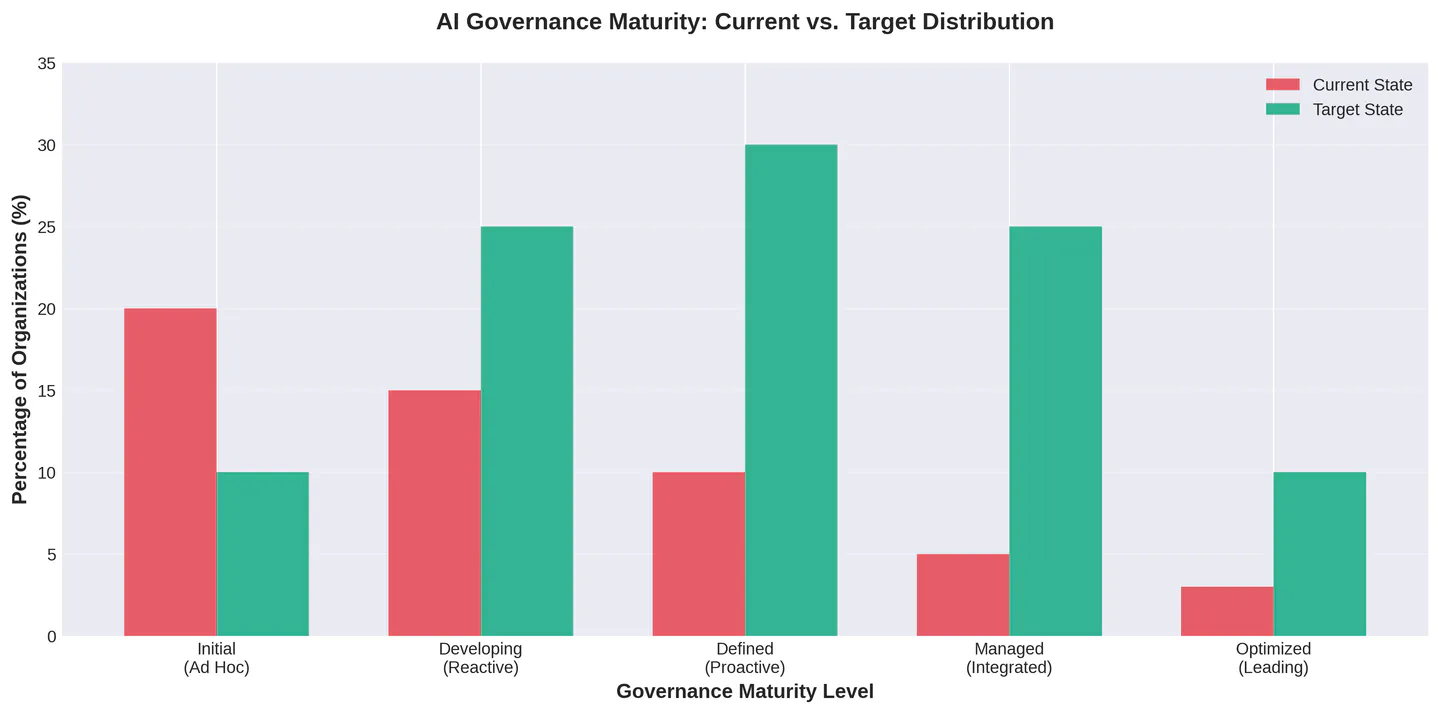
AI Governance Maturity Model
Implementation Roadmap
| Phase | Key Activities |
|---|---|
| Phase 1: Foundation (0-6 months) | Board education, gap assessment, governance charter |
| Phase 2: Structure (6-12 months) | Oversight committee, ethics board, policy framework |
| Phase 3: Integration (12-18 months) | Embed in ERM, compliance protocols, audit processes |
| Phase 4: Optimization (18-24 months) | Continuous learning, maturity assessment, refinement |
| Phase 5: Leadership (24+ months) | Industry leadership, stakeholder engagement, innovation |
Phased Implementation Roadmap
Building Executive AI Literacy
Developing executive AI literacy requires structured, ongoing education tailored to the needs and constraints of board members and senior executives. Curriculum design should cover fundamental AI concepts (machine learning, neural networks, training data, model validation), AI-specific risks (algorithmic bias, model opacity, adversarial attacks, emergent behaviors), ethical considerations (fairness, transparency, accountability, stakeholder impacts), and governance best practices (oversight structures, risk management, regulatory compliance) [55].
Delivery methods should accommodate executives' time constraints and learning preferences. Options include board education sessions (2-4 hours quarterly), executive workshops (half- or full day), online learning modules (self-paced, 30-60 minutes each), site visits to AI development teams, and engagement with external experts. Research indicates that experiential learning—such as reviewing actual AI systems, analyzing case studies of governance failures, and participating in bias testing exercises—is particularly effective for developing executive AI literacy [61].
Ongoing education is essential given AI's rapid evolution. Organizations should establish regular touchpoints to keep board members informed about emerging AI risks, new regulations, and evolving best practices. This might include quarterly briefings on AI governance topics, annual comprehensive reviews of organizational AI initiatives, and ad hoc updates when significant AI-related incidents or regulatory developments occur [23].
Establishing Governance Structures
Implementing effective governance structures requires careful consideration of organizational context, AI maturity, and existing governance arrangements. The board committee structure should be tailored to the organization’s needs. Options include establishing a standalone AI governance committee, adding AI oversight to an existing technology or risk committee, or distributing AI governance responsibilities across multiple committees (e.g., risk committee for AI risk oversight, audit committee for AI compliance, nominating committee for AI expertise in board composition) [26], [65].
Committee composition should balance AI expertise with broader governance experience. At least one committee member should possess a substantial AI or technology background, but the committee should not be dominated by technical experts at the expense of governance, risk management, and stakeholder representation perspectives. Organizations should consider recruiting board members with expertise in AI or providing intensive AI training to existing members [67].
Management-level structures should ensure clear accountability for AI governance. The executive AI ethics committee should include senior leaders from relevant functions (technology, legal, compliance, risk, business units) and should have authority to review and approve high-risk AI deployments. If established, the AI governance office should have sufficient resources and organizational stature to influence AI development practices across the organization [29].
Developing Governance Processes
Implementing governance processes requires balancing rigor with practicality, ensuring that governance requirements enhance rather than impede responsible AI development. Risk assessment processes should classify AI systems based on decision stakes, potential for harm, data sensitivity, and regulatory requirements, with proportionate governance requirements for different risk levels. High-risk systems should undergo rigorous review, including fairness testing, stakeholder impact assessment, and board-level approval [21].
Bias testing protocols should be standardized and applied consistently across AI initiatives. This includes defining relevant demographic groups for fairness analysis, selecting appropriate fairness metrics (while recognizing that different metrics may conflict), establishing acceptable performance thresholds, and documenting test results and mitigation efforts. Organizations should recognize that eliminating bias entirely may be impossible and should focus on understanding, measuring, and mitigating bias to acceptable levels [23].
Monitoring and reporting processes should provide board-level visibility into AI governance. Regular reports should cover AI initiatives in development and deployment, AI-specific risk indicators (e.g., bias metrics, model performance, incident reports), compliance with AI governance policies, and emerging AI risks and regulatory developments. Reporting should be designed for non-technical audiences, using clear language and visualizations to communicate complex information effectively [75].
Integrating AI Governance with Corporate Governance
Effective AI governance requires integration with existing corporate governance structures rather than operating as a separate domain. Strategic planning integration means that AI initiatives should be evaluated using the same strategic criteria as other investments, with explicit consideration of strategic fit, resource requirements, risk-return tradeoffs, and alignment with organizational values. Board strategy discussions should include AI's role in competitive positioning and long-term value creation [27].
Risk management integration entails incorporating AI-specific risks into enterprise risk management frameworks, with appropriate risk assessment, mitigation, and monitoring processes. AI risks should be reported alongside other material risks in board risk committee meetings and in external risk disclosures [79].
Compliance integration entails incorporating AI compliance requirements into existing compliance programs, with clear accountability for ensuring adherence to AI-specific regulations. Compliance monitoring should include AI systems, and compliance reporting should cover AI-related regulatory obligations [21].
Overcoming Implementation Challenges
Organizations implementing AI governance frameworks face several common challenges. Resource constraints can limit governance investments. Organizations should prioritize governance efforts based on AI risk exposure, focusing resources on the highest-risk systems and most material governance gaps [82]. Governance processes should be designed for efficiency, avoiding unnecessary bureaucracy while ensuring adequate oversight.
Cultural resistance may arise from technical teams who view governance as an impediment to innovation or from executives who perceive AI governance as a technical rather than a strategic concern. Overcoming this resistance requires clear communication about governance's purpose (enabling responsible innovation rather than blocking it), executive sponsorship that demonstrates leadership commitment, and the involvement of technical teams in governance design to ensure practicality [85].
Complexity and uncertainty regarding AI risks and best practices can create implementation paralysis. Organizations should adopt iterative approaches, implement initial governance frameworks, and refine them based on experience [26]. They should engage with industry peers, participate in AI governance initiatives, and learn from others' experiences [87].
Maintaining momentum over time can be challenging as initial enthusiasm wanes. Organizations should establish governance as an ongoing practice rather than a one-time project, with regular touchpoints, continuous improvement processes, and accountability for governance outcomes.
Implications for Organizations, Regulators, and Society
The implications of the AI governance literacy gap extend across multiple stakeholder groups. For organizations, inadequate governance creates competitive disadvantages, regulatory risks, reputational vulnerabilities, and potential legal liabilities. Organizations with strong AI governance capabilities will increasingly differentiate themselves through stakeholder trust, regulatory compliance, and operational resilience.
Implications for Organizations
For organizations deploying AI systems, the analysis establishes several imperatives. AI governance is a fiduciary responsibility, not merely a best practice or technical concern [29]. Boards that fail to establish adequate AI governance—including developing executive AI literacy—may breach their fiduciary duties, creating legal liability and reputational risk [90]. Organizations should treat AI governance with the same seriousness as financial governance, compliance, and other core governance functions [29].
Executive AI literacy is foundational to effective governance. Organizations cannot govern AI systems effectively without board-level understanding of AI capabilities, limitations, and risks [17]. Investing in executive AI literacy should be a priority, with ongoing education programs ensuring that board members maintain their current understanding as AI evolves [93].
Proactive governance prevents costly failures. The documented governance failures examined in this paper demonstrate that reactive approaches—addressing AI governance only after problems arise—are costly and damaging [24]. Organizations should proactively implement robust AI governance frameworks before deploying high-risk AI systems and before regulatory or public pressure compels action.
Stakeholder trust is a strategic asset. Organizations that demonstrate responsible AI governance build stakeholder trust, creating competitive advantage and resilience [96]. Conversely, organizations associated with AI governance failures face reputational damage that can persist long after technical issues are resolved [27]. Stakeholder-centered AI governance is not merely ethical but strategically valuable.
Implications for Regulators
For regulators developing AI governance requirements, the analysis suggests several considerations. Literacy requirements may be appropriate. Given that executive AI literacy is foundational to effective governance, regulators might consider requiring board members of organizations deploying high-risk AI systems to demonstrate a minimum level of AI literacy [99]. This could parallel requirements in regulated industries for board members to possess relevant expertise (e.g., financial expertise for audit committee members).
Governance process requirements should be specific. General requirements for "responsible AI" or "ethical AI" may be insufficient without specific guidance on governance structures, processes, and capabilities [30]. Regulators should consider establishing detailed requirements for AI risk assessment, bias testing, monitoring, and incident response, like those in other risk domains.
Regulatory frameworks should be adaptive. Given AI's rapid evolution, regulatory frameworks should be designed for adaptability, with mechanisms for updating requirements as technology and risks evolve [14]. Principles-based regulation combined with specific technical standards may provide an appropriate balance between flexibility and clarity [80].
Enforcement should address governance failures. Regulatory enforcement should focus not only on technical compliance but on governance processes and board oversight. Enforcement actions that hold boards accountable for governance failures may be more effective in driving responsible AI practices than actions focused solely on technical violations [78].
Implications for Industry Practices
For industry associations and standard-setting bodies, the analysis suggests several opportunities. Standardized AI literacy curricula could be developed for board members and executives, providing a consistent baseline education across organizations [7]. Industry associations could offer certification programs or continuing education in AI governance [80].
Governance frameworks and best practices could be codified and disseminated, reducing the need for each organization to develop its own governance approaches [309]. Industry-specific guidance could address sector-specific AI risks and governance requirements [50].
Peer learning and collaboration could be facilitated through industry forums, working groups, and information-sharing on AI governance challenges and solutions [41]. Organizations could learn from others' experiences, both successes and failures, accelerating governance maturity across industries [12].
Implications for Society
For society, the analysis has several implications. Algorithmic accountability requires informed oversight. The documented governance failures demonstrate that technical expertise alone is insufficient to ensure responsible AI; informed board-level oversight is essential [33]. Societal demands for algorithmic accountability should include expectations for executive AI literacy and robust governance [31].
Equity and fairness require proactive governance. Algorithmic bias disproportionately harms marginalized communities, perpetuating and amplifying existing inequities [15], [316]. Addressing these harms requires proactive governance that prioritizes fairness and stakeholder welfare, which, in turn, requires executive AI literacy to recognize and mitigate bias [31].
Democratic governance of AI requires informed participation. As AI systems increasingly affect consequential decisions in employment, credit, healthcare, criminal justice, and other domains, democratic governance requires that decision-makers—including corporate boards, regulators, and policymakers—possess sufficient AI literacy to make informed choices [18]. Investing in AI literacy across decision-making institutions is essential for democratic governance of AI [3].
Trust in AI systems depends on governance. Public trust in AI systems—essential for realizing AI's potential benefits—depends on demonstrable commitment to responsible governance [20]. Organizations that invest in AI governance, including executive literacy development, help build societal trust in AI [31].
The Path Forward
The path forward requires coordinated action across multiple stakeholders. Organizations must prioritize AI governance and executive literacy development, recognizing these as fiduciary responsibilities rather than optional investments [22]. Regulators must develop clear, enforceable AI governance requirements that address both technical and governance dimensions [32]. Industry associations must facilitate knowledge sharing and develop standardized governance frameworks and literacy programs [32]. Educational institutions must develop AI literacy programs tailored to executive audiences [25]. Civil society must continue to hold organizations accountable for failures in AI governance and advocate for responsible AI practices [15].
The governance challenge posed by AI without executive literacy is significant but not insurmountable. The frameworks, processes, and capabilities outlined in this paper provide a roadmap for organizations to develop effective AI governance grounded in executive literacy. Implementing these approaches requires commitment, resources, and sustained effort, but the alternative—continued governance failures with their attendant harms—is unacceptable. The time for action is now.
The Imperative for Action
The governance challenge posed by AI without executive literacy is urgent. AI systems are being deployed at scale across industries, driving decisions with significant consequences for individuals, organizations, and society. The documented governance failures examined in this paper demonstrate that inadequate oversight enables algorithmic bias, accountability breakdowns, and organizational harm. The costs of these failures—measured in reputational damage, regulatory sanctions, legal liability, and human harm—are substantial and growing [35], [60]. Yet the path forward is clear. Organizations that invest in executive AI literacy, establish robust governance structures and processes, and integrate AI oversight into corporate governance can govern AI systems responsibly [31]. The frameworks and recommendations presented in this paper provide actionable guidance for organizations at all stages of AI maturity [36]. What is required is commitment: recognition that AI governance is a fiduciary responsibility, not an optional investment; that executive AI literacy is foundational to effective governance; and that the time for action is now. The governance challenge of the AI era is significant but not insurmountable. By closing the executive AI literacy gap, organizations can fulfill their fiduciary responsibilities, protect stakeholder interests, and realize the potential benefits of AI while mitigating its risks. The alternative—continued governance failures with their attendant harms—is unacceptable. The imperative for action is clear: organizations must prioritize AI governance and executive literacy development as core governance responsibilities. The future of responsible AI depends on it.
Conclusion: Closing the AI Governance Literacy Gap
AI governance without executive literacy is no longer sustainable. The evidence presented in this paper demonstrates that the literacy gap creates systematic governance failures with material consequences for organizations and stakeholders. As AI systems become more powerful and more deeply embedded in organizational decision-making, the governance challenge will only intensify. Executive AI literacy must be reframed from a technical nicety to a fiduciary imperative. Directors and senior executives have a duty to understand the technologies they oversee sufficiently to exercise informed judgment. This does not require technical expertise, but it does require structured education, ongoing learning, and organizational commitment to developing governance capability. The path forward requires action from multiple stakeholders: boards must prioritize literacy development and governance capability building; executives must champion AI governance as a strategic priority; regulators must establish clear expectations and accountability mechanisms; and professional organizations must develop standards, certifications, and educational resources to support the development of governance capabilities. Organizations that invest in executive AI literacy and robust governance frameworks will be better positioned to realize AI's benefits while managing its risks. Those that fail to close the literacy gap face increasing regulatory scrutiny, reputational damage, and potential legal liability. The cost of inaction—for organizations, stakeholders, and society—is simply too high to ignore.
Conflict of Interest
The authors declare no conflict of interest.
Ethical Approval
Not applicable
Data Availability
The datasets used in this study are openly available at [repository link] and the source code is available on GitHub at [GitHub link].
Funding
This work did not receive any external funding.
References
Cite this article
Related Research

Special Issue
Launch a focused special issue to highlight research, emerging trends, and expert insights in your academic field.