


IntelliPaper
Abstract
In most African societies, there are oral artists; prominent among the are folk singers and composers, ‘griots’ (praise singers in kings’ courts), oral poets and dirge singers. Categories of oral artistsinclude professionals, free-lance and occasional poets.The most outstanding oralartists are the praise-singers at the various traditional courts.Niyàgákừừ’s performance falls under the professional type because he isa renowned xylophonist who playsduring the ‘Kàkubé’ Festival celebrated in Nandom and funerals that he attends.
Explore Digital Article Text
I. INTRODUCTION
In most African societies, there are oral artists; prominent among them are folk singers and composers, 'griots' (praise singers in kings' courts), oral poets and dirge singers. Categories of oral artists include professionals, free-lance and occasional poets. The most outstanding oral artists are the praise-singers at the various traditional courts. Niyàgákùr's performance falls under the professional type because he is a renowned xylophonist who plays during the 'Kàkubé' Festival celebrated in Nandom and funerals that he attends. The purpose of this study is to delineate poetic intricacies closely associated with only "lògyìl" xylophone musical texts. It must be emphasised that the xylophone musical scope is very wide and a single study cannot underscore all the details on xylophone music. Even lògyìl music has its own varieties apart from major varieties of xylophone music such as "bè-làŋnì" and "dàgáár"/"dɛgáár".
1.1 The Dàgàrà Xylophone
The xylophone (known as 'gyìl' in Dàgàrà) is mostly played in northwestern Ghana by the Dàgáábà and Sìsààlá people whose territory also extends into Burkina Faso. In certain areas, the instrument is considered as sacred and played only for funerals. However, in modern times, xylophones are used for various musical occasions such as weddings and religious ceremonies. Generally, it is a symbol of unity during gatherings to entertain the public. Xylophone making is considered sacred and for generations the art of making them had been known to very few families. The knowledge of production and playing has been passed from father to son by way of initiation. Therefore, in ritual ceremonies specific xylophone texts are played that are not to be used for ordinary occasions.
Our modern xylophone is a complex assembly of various natural and industrial materials. Redwood is used in constructing the frame as this is insect resistant. Cowhide and other forms of skin are cut into stripes and used in tying the frame or wooden structure together. Some are also used to decorate the frame. A number of gourds which resonate the pitched bars are hung below attached to the frame. When it is suspended, it serves as a resonator for tuning. The scale it is tuned to, traditionally, is pentatonic that is, nasal pentatonic. Here is a description on how the gyil is made in systematic order:
The bars of gyìlé are made from a strong red wood of the ('lìgá') tree and joined first to one another and then suspended above a wooden frame, which is held together by cowhide. Hollowed calabash gourds act as resonators for the bars, with gourds ranging in sizes that correspond to the size and pitch of the bars. Thus, the largest bars are resonated by the largest gourds. These gourds act as sound amplifiers, and also provide a characteristic of the Dagara sound ideal, the buzzed timbre. In order to create this buzzed timbre, holes are cut in the circumference of the roundest part of the gourds, then covered with spider egg casings.
(Strumpf 1970, cited in Lawrence, 2006, p.19)
The construction of a Dàgàrà xylophone can be illustrated as follows:
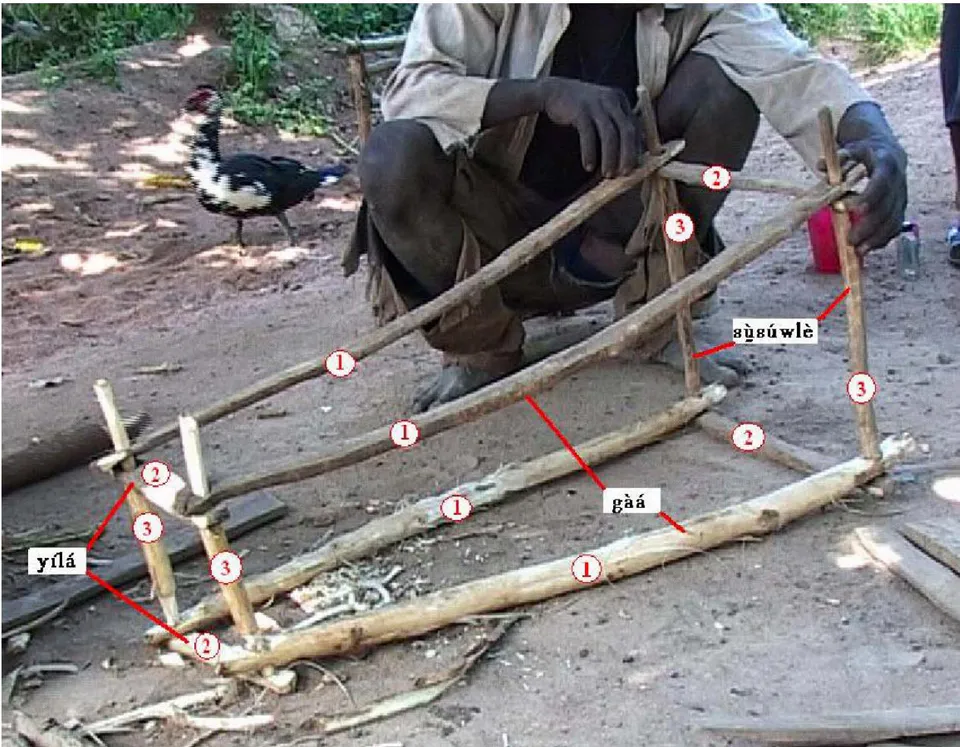
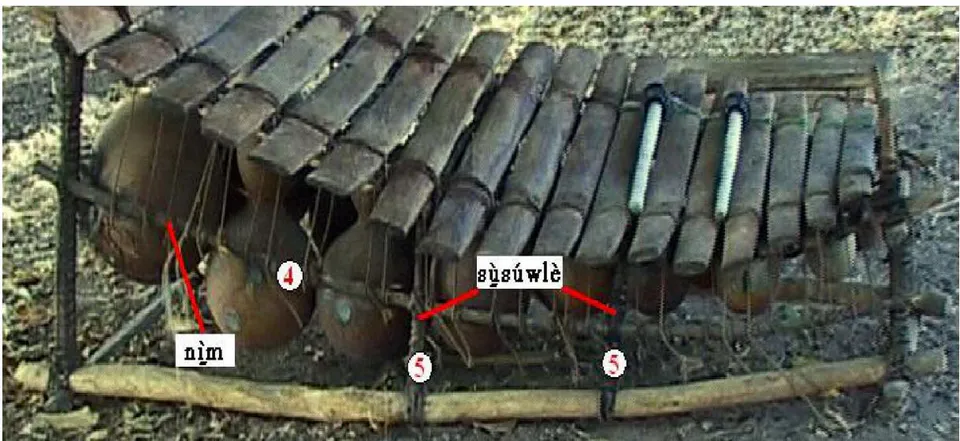
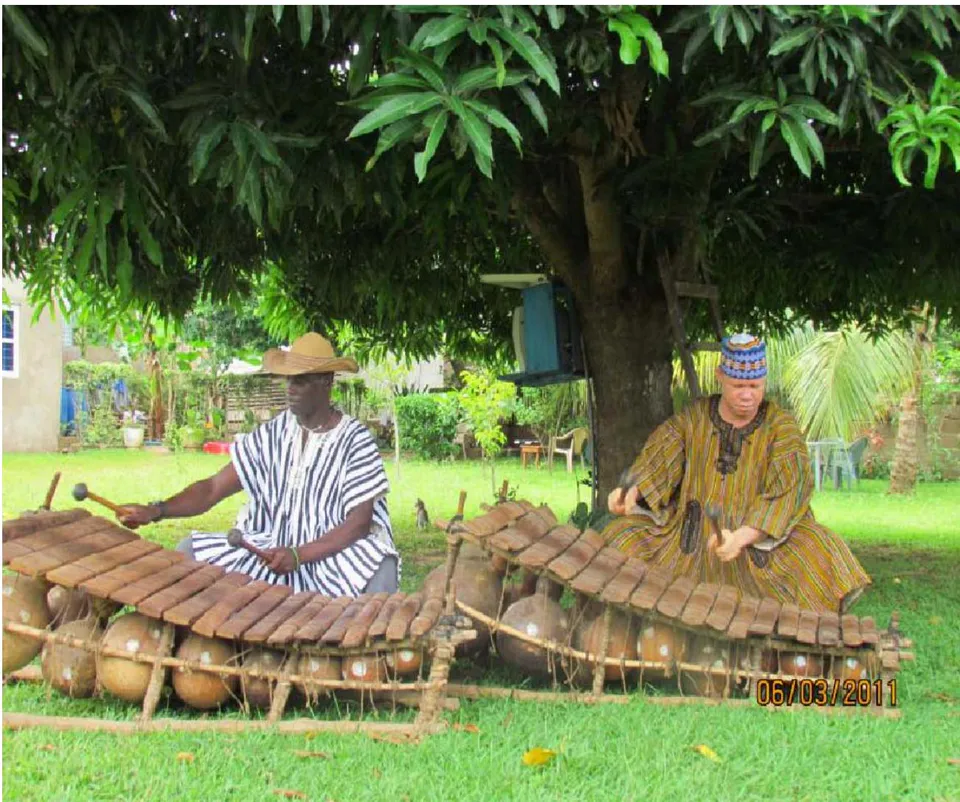
Photo 3: Two master xylophonists with "Gyil-dàá" (Male gyil) on the right and "Gyil-pog" (Female gyil) on the left.
Kuutiero's (2006) research on the poetic values of the Dàgàrà dirge corroborates Lawrence's exposition on the nature of the Dàgàrà xylophone. Kuutiero emphasizes that the boards function as the keys on which notes are struck while the gourds are the resonators. Some mallet-heads made of latex (known in Dàgàrà as 'gyìl-bié) are wound round the ends of a moulded piece of rounded wood which is thick enough to make a firm hold in the hand. Bodomo and Mora (2007, p.88) have also exemplified the structure of the xylophone through their apt description of this indigenous musical instrument of the Dàgàrà and the Dàgáábà. "The rapid striking of the keys by a performer with the gyìl-bié usually gives rise to the mellifluous melody that emanates from the xylophone" (Kuutiero, 2006, p.108). Xylophone makers are skilful in their art and are often highly regarded among the Dàgàrà. "Xylophone makers are themselves very good xylophonists but of course, it is not every xylophonist that is a xylophone maker. Xylophone making is a skill one acquires through training. The mastery of this skill will usually draw customers to the maker" (Kuutiero, 2006, p.108). Among the Dàgàrà, xylophone experts are likened to good poets. They are known as 'gɔbr' (plural of 'gɔba') that is, distinctive performers of high calibre who are noted for their exquisite performances at funerals. A 'gɔba' (sing. of 'gɔbr') acquires his skills through many years of apprenticeship in learning how to play the xylophone very skilfully as required by their mentors. This is because the art of communication with the xylophone is a specialized one and the mentee must know all about the xylophone as is often the case of accomplished xylophonists some of whom are also xylophone makers. A master xylophonist from Fielmuo-Hiinéteng, East of north-western Ghana was properly trained by his paternal uncle and he eventually became an expert player (i.e. a 'gōba'). He points out that "the purification ceremony of a new gyìl also offers the opportunity for non-initiate gyìl players to eat the gyìl-tii (gyìl medicine), a ritual ceremony that confirms their induction as gōba (the recognized official title of a gyìl-ηwièrè)" (Woma, 2012, p. 40).
Here is a brief narrative on the development of the Dagara xylophone.
Oral history of the Dagara people trace the musical origins of the gyil to some mythical inhabitants of the forest called kontombili (dwarfs). According to a legend, a Dagara hunter (nabagle) was on a hunting expedition when he heard the kontombili playing the gyil. Drawn to the beautiful sound of the gyil, the hunter consulted the kontombile (singular for drawf) to learn the art of making the instrument and all the knowledge associated with the performance techniques of the gyil. Initially, the kontombile was hesitant but later on taught the hunter how the gyil was made and all the mysteries and taboos associated with the instrument. There are details about cultural taboos associated with the gyil. After learning the art and knowledge of making and playing the gyil, the hunter with the help of his fellow hunters, used their magical powers to kill the kontombile and took the gyil to their people, claiming that God gave it to them as the musical instrument of the Dagara people. Even these days, it is believed that the kontombili are still attracted to the sound of the gyil, but also harbour animosity toward humans (Vercelli, 2006 cited in Woma, 2012, p.39).
The sociocultural significance of the gyil is represented by Woma in the following submission.
Drawing from its mysterious history, the name "gyil" in Dagara translates as "gather." When the hunters brought the instrument to the community, the people were so baffled with its amazing sound that they began gathering around to listen to its wonderful music. As the hunters began playing the instrument, they told the gathered crowd to dance to the music. In amazement, the men started jumping and leaping high in the air while the women danced gently and gracefully to this "sweet" music. According to Woma (also a master xylophonist) this story was narrated to him by Ziem Tibo (his gyil mentor) during his "gyil-tii dib", that is (final initiation rites for a xylophonist). Binε (a vigorous dance to the gyil music) is gender specific as men jump and leap in their version of the dance called vaafu (leaping) while women dance gracefully in much coordinated dance-steps to gyil music. As the name "gyil" implies, anytime there is gyil music celebration in Dagara community, everyone gathers around the performance space to hear the music or join the performance celebration. In funeral performance, it is still the practice for mourners and dirge singers to gather around the gyile (plural) at funeral rituals to sing their dirges and dance to the music. The legend of the gyil has always been part of the ritual of gyil making; therefore, makers of the instrument believe that a newly made gyil should be purified to cleanse both the bad spirits in the wood that constitutes the instrument as well as the magical spirits of the kontombile that gyil makers believe hover around a newly made gyil (Woma, 2012, pp. 39-40).
In line with Dàgàrà tradition, the xylophone is played mostly by men as a solo or pair instrument. Two people often sit and face each other, a short distance apart. The lead player decides the kind of musical text that should be played and the support player then joins him with a more repetitive accompanying tune (Kuutiero, 2006, p.110, Woma, 2012, pp.43-44). The xylophone is a percussion instrument when it is properly tuned and can be played with other percussions together. There are two types of Dàgàrà xylophone: the 'lógyìl' (plural is 'lógyulé') used for 'lòbrì' musical texts and the 'dàgá-gyìl' (plural is 'dàgá-gyulé') used for 'dàgáár' and 'bě-làŋní' musical texts. The standard 18-key dàgá-gyìl is used for funerals and for 'bēwáá' (a vigorous dance for entertainment). The dàgá-gyìl is "widely regarded as the eldest of all xylophones" (Mensah 1982, p. 142) as posited by a Ghanaian musicologist. However, Woma has given a comprehensive exposition on the Dàgàrà xylophone and its ensemble as well as how it is used for performances.
In a duet performance, the music is typically divided into two parts: melody and bass. The gyil-daa usually plays the lead role while the gyil-pog plays the support part, sometimes with one hand playing a repetitive baseline with little improvisation while the other hand provides a timeline called kpagru with the back end of the mallet. Gyil kpagru is an important component of this highly rhythmic music. For gyil players, kpagru is the foundation of upon which the music enjoys its rhythmic flow and density. Just as the bell serves to keep rhythm and timing in most West African music, kpagru serves the same purpose for gyil music and, without it, the music loses its rhythmic power and musical taste.
played for both male and female. A particular musical text being played determines whether a man or a woman has died. One is able to determine the context of every text wherever one is (Bérisée, 2011).
(Woma, 2012, pp. 43-44)
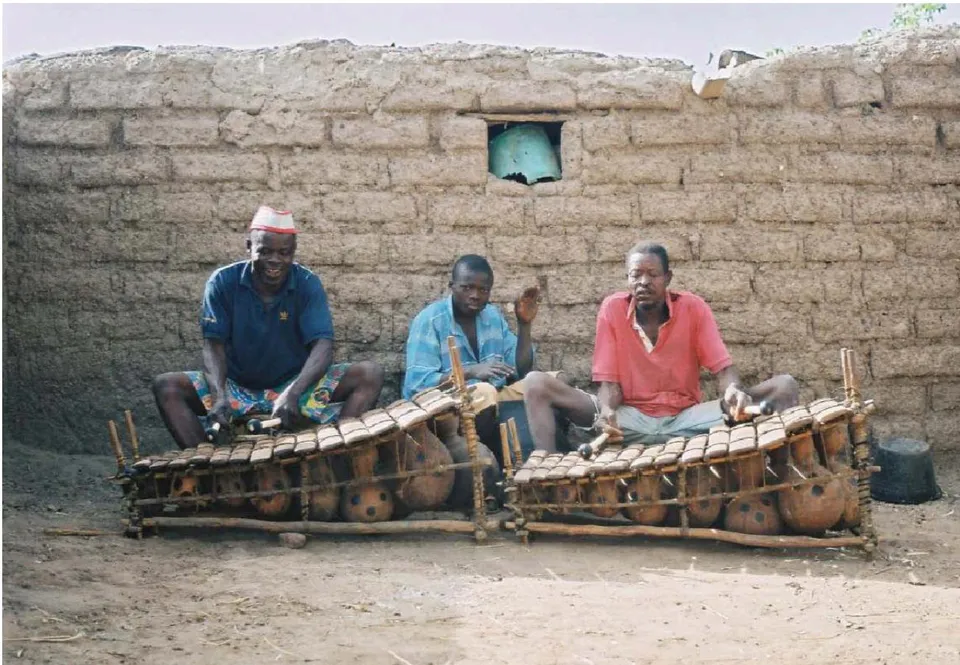
The 14-key lógyìl is traditionally used in 'bàgrbùně' (a dance performed during traditional religious rites) and also to announce the death of anybody among the Dàgàrà of Nandom and those of Burkina Faso. The lógyulé are used when communicating with the spirits and ancestors and are believed to be imbued with spiritual power. The lógyulé are used to sound lòbrì musical texts. Lòbrì musical texts are original Dàgàrà texts that have always been used until the Dàgàrà learnt 'dàgáár' musical texts from other related cultures. A clear distinction can be drawn between 'lòbrì' and 'dàgáár' musical texts on one hand and 'lòbrì' and 'bě-làŋní' on the other. Lógyìl music can be performed for both entertainment and funerals. On funeral occasions, selected musical texts are
1.2 Poetic Elements and Oral Traditions
Finnegan (2012, pp. 145-146) states that elegiac poetry is a common form of expression in Africa. It comes in many different forms but usually less elaborate than panegyric poetry. Elegaic poetry tends to be performed by non-professionals, mostly women rather than state officials. However, among the Dàgàrà people, men are the most dominant elegiac poets in terms of performance during funerals. Elegaic poetry falls under 'lyric' poetry and cannot be treated as a distinctive genre. Obvious instances of elegiac poetry are those poems or songs performed at funeral or memorial rites, e.g. Islamic funeral songs sung by Hausa mallam or the complex Akan funeral dirges chanted by women soloists, to the simple laments with leader and chorus such as those sung among the Limba and the Dàgàrà of the northwestern Ghana.
The occasions for these laments differ from people to people. Often dirges are sung round the corpse or round the house in which the corpse lies while it is being prepared for burial. Among the Akan, the Dàgàrà of Nandom and the Dàgáábà of northwestern Ghana in general, this is followed by a period of public mourning, during which the corpse lies in state and dirges are sung. The actual burial is often accompanied by elegies performed by dirge-singers among the Dàgàrà people. However, Nketia (1955, p.15) posits that it is not practised among the Akan. In the traditions of the Dàgàrà and the Limba, all burials are normally accompanied by performance from the dirge-singers especially panegyric of the dead. Elegiac Features of the Dagara Dirge are illustrated as follows:
| Source Language (Dagara) | Translation |
| ǐ sãà bag-bieó sób hàp nyinε lòór? | Where will my unfortunate father seek refuge? |
| Kũŭ yel ke ε ti íh ἡminε? | What does death want us to do? |
| Kũŭ vuơn ti na a pîn, pîn tûl. | Death has baffled and caused us irreparable havoc. |
The rhetorical questions above are lamentations that the cantor conveys to his ancestor on the fate of an unfortunate person bogged down with persistent deaths. The state of despondency is portrayed in this expression: Kūū yel ke ε ti ih ηminε? (What does death want us to do?) The same dirge singer maintained his rhetorical questions to arouse the emotions of sympathisers.
| Source Language (Dagara) | Translation |
| Ti gbáálε nyine to anv? | To whom should we grope in our misery? |
| U naa ti nyog ni a dɔɔ ε kyε tu nyine lóór? | Where would death have passed after 'He' had captured the man? |
The dirge singer's language above depicts the bravery of the deceased: "U naa ti nyog ni a doo e kyε tu nyinε lòór". This implies that if death were human and had confronted the deceased (man) there could have been no way to pass without being defeated. In this performance, the image of bravery and physical strength demonstrate how bellicose the deceased was but unfortunately, it was rather death (Kūū) that accosted him. The rhetorical question emphasises the helplessness of mankind before death as terminator.
The following lines by a ninety-year-old dirge singer accentuate the grievous nature of sorrow caused by death:
| Source Language (Dagara) | Translation |
| Ni nàŋ nir nèm wèe! | I am forlorn without any relative! |
| Ni nàŋ nir nèm wèe! | I am forlorn without any relative! |
| Ni nàŋ nir nèm wèe! | I am forlorn without any relative! |
| Ni nàŋ nir nèm wèe! | I am forlorn without any relative! |
The dirge singer in the above text conveyed her deepest sorrow as she declared to the world: Ni nàn nir nèm wèe! (I am forlorn without any relative!) to emphasise that she was a lonely and miserable person. The contextual interpretation of the term 'forlorn' in the mourning tone of the cantor (in the Dagara funeral context) depicts either total loss of her entire family or most of her family members which has caused her to grapple with loneliness in her abode. The phrase, Ni nàŋ foregrounds sorrow and sadness that have engulfed the cantor in her old age. Thus, she keeps on repeating the expression: Ni nàŋ nir nem wεε! The idiophonic expression, "wεε" indicates overwhelming sorrow.
The xylophonist like any poet, gains inspiration through some powerful emotions (influenced by a Muse) and this could result into the composition of a fresh song. The xylophonist then waits for a special occasion to launch his new song. Preferably, a funeral celebration which attracts sympathisers from far and wide. A case in point is the late Bérgyiré, one of the accomplished xylophonists of Nandom-Puffiong. He was not only a 'gōba' but also a xylophone maker and repairer who was prolific in composing sensational musical texts. Some of most popular ones include:
Xylophone Text No. 1:
| Source Language (Dàgàrà) | Translation |
| "Bièbiè nir mì tī wà kùb bér ékyé zǐh". | An avowed enemy employs diabolic, mysterious and wicked means in eliminating his opponents. |
Xylophone Text No. 2:
| Source Language (Dàgàrà) | Translation |
| 'Dɔndəmè kùb fù fàà ná bàn yān". | Even if enemies conspire against you and kill you, you have already surpassed them in knowledge and wisdom. |
Xylophone Text No. 3:
| Source Language (Dàgàrà) | Translation |
| "Fùr sáá kyén zié zà"; | You can choose wherever you want to go; |
| dɔndəmɛ kyããnà bé à bé | enemies will still abound. |
Xylophone Text No. 4:
| Source Language (Dàgàrà) | Translation |
| "Bìbì běrwoné nyɔg dɔpàn (gbãá) nì zùrùr". | It is a stubborn child who dares to hold a cobra by the tail. |
Xylophone Text No. 5:
| Source Language (Dàgàrà) | Translation |
| "Vurbààlè běl ù nà gùr ékyé pór Bérgyiré; | Vurbààlè members stared at him in awe and named him "Mysterious-Prodigy"; |
| dōndomè běl ù nà káã ù lüebì zàã purí". | enemies gloated and scorned him as a petty fellow. |
Xylophone Text No. 6:
| Source Language (Dàgàrà) | Translation |
| "A nǚbě bèl ně nà těr á,". | Those who gossip about you are the same people |
| bèl mingà něbě bōbr kě bě kùb" | who conspire to kill you. |
II. The Dàgàrà People and their Xylophone Musical Texts
The Dàgàrà are a group of people in the Upper West Region of north-western Ghana. The main area of settlement is Nandom and Burkina Faso. However, some of them are reported to have settled in present day Ivory Coast as well. In Ghana, the Dàgàrà form the greater part of the population of Diocese of Wa and their relatives in the Diocese of Diebougou of Burkina Faso. (Bekye, 1991, pp. 93-94) The Dàgàrà originated from the Mole-Dagbani peoples of the Lake Chad region. They are part of the MABIA-speaking (Gur) group of West Africa. They have always maintained and sustained their traditional, social, political and religious systems of organisation.
With reference to previous researchers on the Dagara people, Naciele Hien (2019) argues that Dagara people, the Mossi and the Gourmatché can be traced to the Dagomba ethnic group. Delafosse was the first scholar to make such claim and was corroborated by Hébert and others such as Nurukyor who concluded that "the results of our own inquiries confirm the hypothesis established by Fr Hébert. Indeed, all the Dagara from Haute-Volta (Burkina Faso) agree that they migrated from Northern Ghana" (Mukassa, 1986 cited in Naciele-Hien (2019, pp. 32-33). This assumption hinged on the Dagara migratory movement from Tamale to Northern Ghana and Southern Burkina which occurred during the time of Dagombas' empire and their territory expansion through tribal wars, invasions and conquests. The geographical location of the Dagara in Burkina and Ghana would have been seen as a result of migration. Colonial boundaries first moved the ancestors of the Dagara from Tamale to the north-western part of Ghana. While some remained in Ghana, others migrated to the South-western region of Burkina Faso by the end of the 18th Century (Mukassa, 1986 cited in Naciele Hien, 2019, p.33). The latest corroboration is by Kuba & Lentz (2020, pp.3-4). However, Gbaane-Dabire rather gives other reasons on the historical migration of the Dagara community. He posits that the Dagara geographical mobility is motivated by search for fertile lands and fear of the great empires and invaders such as the Ashanti, the Dagomba, the Djermas as well as the colonial powers. He points out that the Dagara had always loved their freedom and want to enjoy their independence wherever they are (Dabire, 1983 cited in Naciele-Hien, 2019, p. 33).
Before the advent of Christianity and Islam, the Dàgàrà people held strong spiritual beliefs in a popular cosmological figure known as "Konton"; a kind of omnipotent deity in Dàgàrà traditional practices ("sàākumv"). Tradition is regarded by the Dagara as a community-owned knowledge of cultural practices, customs, religious beliefs, taboos and other social virtues. Thus, the Dàgàrà people strongly believe that knowledge of their cultural history, religion and rituals emanated from "Konton" (pl. Kontomè"). Naaeke posits that the Kontomè are the brainchildren behind the discovery of many aspects of Dagara culture such as art, music, magic, hunting and medicine. In fact, Dàgàrà gyìl players usually trace the origin and invention of their instrument to the Konton who is believed to have given this specialized knowledge to a Dàgàrà hunter (nàbáglè) to use as their traditional instrument for funerals and entertainment (Naaeke, 2000, p.36 cited in Woma, 2012, pp.14-15).
Some of the traditions of the Dàgàrà people include farming, sacrifices to almighty God, marriage, dowry, initiation rites, inheritance, nomenclature, art and craft. All these originated from their ancestors. The Dàgàrà have always settled in villages according to patrilineal clans such as Bèkuònè, Dikpièllè, Kusiéllé, Gbāānè, Nābèglè, Bībìlélé, Bèrwuölè, Mètuollè and Zágè. Apart from these patrilineal clans there are also matrilineal clans. Some of them include Sòmdà, Kpòdà, Mèdà, Sòmè, Dàbúré, Kàmbúré and Híén.
In accordance with Dàgàrà tradition, lòbrì musical texts are the first type of xylophone music played when a person dies. In an interview with Bérisée (2011) he described the lógyìl as "an instrument of sorrow" because of its typical role of arousing sympathy and mourning on funeral occasions. Lòbrì rhythms are often soft in nature and are played in a particular way to portray the situation of bereavement and the attendant mourning that accompanies the selected musical texts.
Example of Lóbrí Musical Text:
| Source Language (Dàgàrà) | Translation |
| Gàndáá tàm-migr ká kpélé kpélé. | The bow-string of a man of valor has broken inots and piece. |
According to Dàgàrà tradition, 'dàgáár' music is often played before 'bè-làŋnì' music during funeral occasions. Dàgáár musical texts are similar to 'bè-làŋnì' musical texts. They are critical and satirical in nature depending on the cause of the death of a person in Dàgàrà society. The above text is a lamentation on the elder who was a man of valour to the household and has suddenly passed on. The term gàndáá shows the social stature and power he wielded in his society before he died.
Example of Dàgáár Musical Text
| Source Language (Dàgàrà) | Translation |
| Fifth kàbr bě nyùìré i, fifih ŋměa nà. | Driver-ants are getting burnt but they do not smell so are driver-ants. |
The above text means that nothing can change somebody's negative attitude towards another. This kind of music text is often directed against the enemies of the dead. In other words, the enemies of the dead are incurably bad and should never boast of their nefarious activities.
'Bé-làŋni music does not only arouse great sympathy in mourners but they induce people to dance on funeral occasions of elderly people in Dàgàrà society.
Example of Bé-làŋnì Musical Text
| Source Language (Dàgàrà) | Translation |
| Nìnfàà gběé nãã í wégr., nìnfàà gběé nãã í lìrgé | If the poor person's legs were long beams, the poor man's legs would have been used in roofing traditional Dàgàrà homes. |
The above musical text is based on oppression that poor people experience in Dàgàrà homes. The satire is directed against all oppressors of poor and weak people in society. Metaphor and symbolism are the useful literary features. These are seen in the words "nìnfàà gbèè" (poor person's legs) compared indirectly to straight beams ("wègr") often used in the roofing of traditional Dàgàrà houses.
Lôbri musical texts are intended basically to arouse sympathy and praise the deceased's background. However, 'dàgáár' texts are meant to induce mourning during a funeral and to warn and admonish the bereaved family. They are equally critical and satirical in nature depending on the possible cause of the death.
Example of Dàgáár Musical Text
| Source Language (Dàgàrà) | Translation |
| Bíkpíeb sìgr nà bè fáá è. dé à ù núrú mhìlì tàně | They have seized the orphan's honey and used his hands to smear them with dirt. |
While lôbrí musical texts are intended to praise the deceased's background, Dàgáár musical texts are meant to induce mourning during a funeral and to warn and admonish the bereaved family.
III. THEORETICAL FRAMEWORK
Magoulick (2012) identified and emphasised the dynamics of folklore and ethnography in Performance with reference to her fieldwork. She points out that the dynamics have shifted from mere collection and categorisation of folklore to synthesis and understanding of peoples and their creations in their own terms. This gave birth to the Performance Theory. Performance Theory aims at rendering texts skilfully artful so that the aesthetic values can be delineated according to the comprehension of language, speech patterns and figures of sound inherent in the texts. Literary aesthetics can be seen to be more effective and understandable through the manifestation of rhythm, repetition, patterns of speech and pauses in texts. Therefore, there are performances which require thorough application of these techniques to render the texts enjoyable and meaningful (Kyiileyang, 2017, pp.63-64).
Performance is an indispensable part of Oral Poetry. Much of Oral Poetry is directly associated with rhythmic movement. Every culture has recognised conventions for its forms of poetic expression. Some of these relate to the occasion, the audience, performer or purpose. The most fundamental of these conventions are those pertaining to the verbal style of the piece or genre. The simplest, most fundamental and most widespread feature of poetry is rhythmic structure. Words and music are closely associated with rhythmic movements of the body. There is no doubt that the prosodic system is the feature which most immediately gives form to a poem. (Finnegan, 1977, pp.89-92; Finnegan, 2012, p.236).
Expressive culture is very significant to oral performances such as the singing of traditional songs of any ethnic group, the citing of a proverb in the right context, the narration of folktales as well as the playing of the Dagara xylophone. This study is undergirded by Richard Bauman's Performance Theory. He corroborates Magoulick on the wave of change which characterized the collection and analysis folkloric materials in the 1960s and 1970s. Bauman (2012) notes that there was a general shift of perspective among ethnographically oriented folklorists in the latter part of the twentieth century. Initially, folklore was regarded as "an aggregate of things" (Ben-Amos, 1972 cited in Bauman, 2012, p. 97). However, the wave of change shifted that line of thought and folklore was then regarded as a "communicative process" (Ben-Amos, 1972 cited in Bauman, 2012, p. 97). Several factors accounted for the new motivation towards folkloric materials. First, Malinowski's (1923) research experience revealed a certain focus of emphasis in dealing with elements of folklore. He argued that "context of situation" was "an essential frame of reference for the comprehension of 'narrative speech as... a mode of social action' " (Bauman, 2012, p. 97). Another scholar, Milton Singer underscored the "conception of cultural performances as scheduled, bounded, crafted, heightened and participatory occasions in which culture" is displayed "for the reflexive contemplation of members and outsiders" (Singer, 1958 cited in Bauman, 2012, p. 97) It is relevant to note too that Roman Jakobson's model of a communicative event enabled scholars to begin "comprehending the multiple functionality of verbal expression and the place of poetic language among those multiple functions" (Jakobson, 1960 cited in Bauman, 2012, p.97). Additionally, Jacobs' (1959 cited in Bauman, 2012, p. 97) conception of style gives relevance of the "aesthetic design" of folklore forms in use. This contributes to the understanding of compositional and performative aspects of cultural expression. Moreover, Parry and Lord's Theory of Oral-Formulaic Composition as a means of comprehending the radical integration of cultural tradition gave some recognition to the significance of individual creativity in the act of singing, performing and composing during discourse (Lord, 1960, cited in Bauman, 2012, p. 97). It is also important to emphasise that the conception of performance was shaped by two mutually agreeable schools of thought: one was literary and the other was anthropological. Kenneth Burke argues that literature is some kind of "equipment for living" (Burke, 1968, 1969, cited in Bauman, 2012, p. 98). However, Bauman and Sherzer, 1989, cited in Bauman, 2012, p.98) claim that "the task of the ethnographer of speaking... is to identify and analyse the dynamic internalationships among elements that go to make up performance".
From the discussion so far, it is important to note that the line of inquiry that developed out of those efforts made by earlier scholars proved to be durable and productive intellectual enterprise for folkloric studies and linguistic anthropology and other disciplines (Bauman, 2012, p.99). It is in line with these theoretical tenets that this research explores the poetic significance of Dagara xylophone performance using the poetic elements embedded in the musical texts. The interpretation of these elements will reveal the level of literary quality and effectiveness of these poetic elements embedded in "logyil" (a portable 14 wooden-key xylophone) musical texts. In fact, Dagara xylophone musical performance enables the xylophonist to display virtuosic skill and communicative competence and by that, the performer elicits the participative engagement of co-participants such as the dirge-singers and other sympathisers who gather round the xylophonist to witness his skill and the language that emanates from the performance. The audience and other participants have the license to "regard the act of display with heightened intensity and inviting them to evaluate how skillfully and effectively" the xylophonist tries to accomplish his social responsibility towards the audience and spectators (Bauman, 2012, p.99).
IV. METHODOLOGY AND RATIONALE OF THE STUDY
Niyágákūū's "lógyil" (xylophone) performance is the main basis of this study. One hundred and four (104) portions (out of the five hundred and fourteen (514) lines of the translated oral text) were selected for discussion and analysis in order to bring out the literary significance of the various poetic elements. The whole text (translated version) was divided into two major parts of a total of five hundred and fourteen lines (514). Lines were purposively chosen wherever literary features were identified in the whole text. Raw data was gathered in 2005 at Nandom, based on the funeral celebration of an elderly woman of Segge's House, North-East of Nandom. The rationale of this study lies in the fact that Dàgàrà oratory, as part of their oral tradition, still deserves more exploration in determining the cultural relevance of xylophone performance. The performance was audio-recorded using a mobile phone and translated from Dàgàrà into English based on Peter Newmark's Translation Theory with emphasis on semantic and communicative perspectives. Semantic translation takes into account the aesthetic value (that is, the beautiful and natural sounds) of the Source Language (SL) text, compromising on denotative meaning so that no assonance, word-play or repetition becomes an obstacle in the completed version. It may translate less important cultural words by culturally neutral third or functional terms but not by cultural equivalents. However, Communicative translation attempts to render the exact contextual meaning of the original in such a way that both content and language are readily acceptable and comprehensible to the readership (Newmark, 2001, p. 46). This study investigates the nature of Dàgàrà oratory and examines the poetic elements and their literary significance in Dàgàrà oral traditions especially oral poetry using Niyágákūū's lógyil performance as a source of reference. It was anticipated that these literary features will not only embellish the performance skills of the xylophonist but also reveal the aesthetic qualities of Dàgàrà xylophone performance as the performer played and verbally expressed the musical texts he had chosen successively.
V. LITERATURE REVIEW
Persuasive communication is used in various aspects of human life in both traditional and contemporary Africa. In the absence of writing and the modern use of electronic gadgets, speaking constitutes the single most important mode of interaction. In the African world, speech is considered to be free, which is quite distinct from the trickster's monopoly. For instance, despite his greed and selfishness, Ananse, the Akan trickster, did not make speech the monopoly of one man. Similarly, the Dogon people in Mali trace the origin of speech to the fox. The Fang of Gabon, trace human speech to the parrot which first brought to man, the ability to speak. However, in Akan mythology of the various lineages, the parrot is paramount in human speech. The eloquence associated with one of the eight lineages follows from their being saved centuries ago by the noise of a parrot. The timely noise by the parrot saved the lineage from extinction. Therefore, that lineage's emblem, depicts the essence of eloquence. The Akan say, "The mouth is used to protect the head." Speech, judiciously used, can save lives.
Among several ethnic groups in Africa, sermons, funerals, marriage ceremonies, and even public donations provide fitting opportunities for speakers to assert oratorical skills. Among the Akan, a public donation or drink gift is not merely presented. It is accompanied by a brief speech, often replete with proverbs, idiomatic expressions and other rhetorical devices. The speaker's widow's mite may be compared with that of the housefly: "A poor fellow I am, not rich enough to lavish presents; yet even where the housefly had nothing to give, it scraped its offer from its bare limbs." A flowery acceptance speech is also expected from the recipient or his orator. Generally speaking, rhetoric pervades most verbal interactions. A beggar in Burundi may petition a patron for a new pair of shoes in poetic style, referring to his ragged shoe held together by a safety pin (Finnegan 1970, p.450).
The power of the spoken word is well recognized in African societies. Being the embodiment of acoustic energy, the spoken word has an immediate impact, the capacity to make or break. According to a Yoruba proverb, "Speech is an egg: when dropped, it shatters." The Akan of Ghana say, "When the mouth slips, it is more suicidal than the foot." In everyday life, those endowed with the power of effective speech are held in high social esteem, due to the facility with which they bring stressful situations under control through persuasion. Despite the importance of good speaking in Africa, most cultures do not organize formal training in the art, since it comes naturally with exposure to traditional speech. Children often attend forums for debate and acquire speaking skills, customary lore, and genealogies by listening to elders. Skills in oratory also come with certain social and political positions. Several traditional offices require exquisite skills in the exercise of duties. Positions like chieftaincy, headship of lineages, and membership of juries require considerable rhetorical skills in conflict management. Chiefs, prior to their installation, go into several weeks of seclusion where their attention is drawn to certain formal norms of communication. Even so, most chiefs and elders acquire rhetorical abilities on the job.
Rhetoric in many African communities is male-dominated. In certain cultures, women are forbidden to express themselves in public. Among the Akan, the virtues of ideal womanhood include abstinence from speaking within the public domain. Women are believed to be repositories of wisdom and knowledge. Yet, society has considerably restrained woman's speech. The chief's palace, where most public debates are done, is not always open to women. They are prohibited from entering the premises when they are in their menses. According to the Akan, "The hen knows that day has broken, yet it looks to the cock to announce it." Even so, current trends point to a gradual recognition of women in speaking roles. Not only are women chiefs occasionally found but there are a few instances where male chiefs have appointed women as their orators ("akyeame"), on the basis of their excellent speech skills.
The prospect of incorporating African xylophone has remained relatively untouched though the African drum ensembles have flourished throughout the academic world. The Dàgàrà xylophone ('gyìl') in particular has had little exposure to audiences outside the African continent. This is because the gyìl has had few written transcriptions transmitted almost exclusively through oral tradition. The transmission of the repertoire to western audiences has suffered as a result of few 'gyìl' players residing outside of Ghana to transfer this information. (Vercelli, 2006, p.13) Bodomo and Mora (2007) have carried out thorough research on the spoken and sung texts of the Dagaaba in Jirapa Traditional Areas as well as the city of Accra where Dàgáábà communities are found. They have carefully noted that "music-making among the Dàgáábà, like other peoples of the region, is an intrinsic part of social life. Certain types of music and repertories of song may be associated with particular occasions, cults, cooperative work groups and organized labour, age groups, and rites of passage" (Bodomo and Mora, 2007, p.85). Listening examples include 'bèwáá' dance music (referred to by Dàgááre speakers as 'báwáá'), xylophone duets, sung folktales (known in Dàgááre as 'sénséllè'), spoken folktales (known in Dàgàrà as "suólù") and women's praise songs referred to in Dàgááre as "ánléé" and in Dàgàrà as "ányéé".
Work by Wiggins and Kobom (1992) is designed for use in primary music education and does not give an accurate representation of the performance of the literature by completely ignoring the rest of the gyil ensemble. Transcriptions by Naranjo (1998) apply the traditional repertoire of the gyil to the western marimba and give a brief cultural reference, but do not explain the transcriptions' adaptations. Kofi and Neely (1997) look briefly at the rhythms found in 'bēwáá', but their attention is focused on the drum patterns and do not give any gyil transcriptions or reference the musical culture. An extreme amount of physical dexterity and independence is required to coordinate both hands of the gyil players. Strumph discusses the nature of learning independence in his Ghanaian xylophone studies and gives a step-by-step approach to learning basic polyrhythms commonly found in the gyil repertoire. (Wiggins and Kobom 1992, Kofi and Neely 1997, Strumph 1970, also cited in Vercelli, 2006, p.14)
Hartigan studied this music under Ewe master drummer Abraham Adzenyah and applied the gyil's rhythmic elements first to Ewe drums then to the western drum kit, showing how this repertoire can be beneficial to non-mallet players. However, he does not give any gyil transcriptions or ensemble suggestions. Details are needed in the analysis of the transcription process to include the significant meanings behind what is played on the gyil. In Birifor funeral music, the melody has actual text that is understood by the natives of the traditional area. Sometimes, the xylophone text may simply identify the gender of the deceased. However, more often, complex messages and proverbs are performed. Goody mentioned the musical implications of the gyil, but a musical analysis of the funeral was not included in his tome. Likewise, Malidome paints a beautiful literary picture of his grandfather's Dàgàrà funeral, including mention of Dàgàrà mythology and the gyil, but does not go into musical specifics. (Hartigan 1986, Goody 1962, Malidome 1994 also cited in Vercelli, 2006, p.15). From the above studies, there is a gap that deserves adequate attention. The focus is directed towards lógyil performance in order to explore its cultural significance with reference to the poetic elements which are essential aesthetic features in Dàgàrà lógyil performance.
6.1 Structure of the Oratory
VI. ANALYSIS OF THE LOGYIL PERFORMANCE
Panegyric and rhetorical expressions are the most outstanding features in Dàgàrà Oral literature particularly in the singing of dirges. In Africa, the elderly are accorded great reverence particularly when they die and leave their children as well as their grandchildren whom they cherish and often give advice. The death of this woman can be viewed in similar circumstances. The subject of the performance is the lamentation of the death of an elder in the Dàgàrà paternal household. In order to facilitate understanding of the performance, the oratory is divided into two main parts: Part 1A is made up of 43 lines whilst 1B has only 18 lines. Part 2 is the longest with 453 lines. Therefore, the whole oratory is made up of 514 lines. Idiomatic proverbs, repetition, parallelism and elliptical expressions constitute the main features of Niyágákūū's performance.
It is significant to point out that idiomatic proverbs, repetition, parallelism, elliptical values, panegyric and rhetoric are the most outstanding features in Dagara Oral literature particularly in the singing of dirges. The attainment of coherence in the following performance can be seen in the effective use of repetition and parallelism. By this suitable device, the various parts of the oratory are held together by a common subject and focus.
6.2 Features of Repetition in the Performance
Part 1(A) of the above oratory is rich in various literary features such as repetition of words and parallelism. Lines 1, 9, 15, 16, 17, 19 and 22 are closely related in theme. These are illustrated as follows:
| Source Language (Dàgàrà) | Translation |
| Line 1: Bìkpiéb bè tèr sāà ni mā bè mī tòùr. | The orphan who has no parents is often insulted by people |
| Line 9: Nà pág kúlé mā-yágá puɔ, àáá hǔr! | Better hurry up and go to your many mothers, áá hǔr! |
| Line 15: Û' mā nìbè bàár, v sāà nìbè bàár, óéi! | All his maternal and paternal relatives are dying out, óéi! |
| Line 16: £ nì-yágá bè yàár báárù, óéi! | Large families can easily be wiped out, óéi! |
| Line 17: £ nì-yágá bè yàár báárù, óéi! | Large families can easily be wiped out, óéi! |
| Line 19: Û' mā nìbè bàár; v sāà nìbè bàár, áá! | All his maternal and paternal relatives are dying out, áá! |
| Lines 22: Fù sāà nìbè bàár; fù mā nib£ bàár;bè tòùr fù sìè. | You are termed a witch when all paternal and maternal relatives are dead. |
Line 1 emphasises the persecution of the orphan whilst Line 9 deals with the supposed joy the deceased is rest assured in the land of the dead. Literally, the word 'báárù' in Lines 15, 16, 17, 19 and 22 means 'finished' but semantically, it actually refers to the total loss of paternal and maternal relatives experienced by any unfortunate person. A complete orphan is open to all kinds of abuse, discrimination and suspicion as suggested by the diction of the above oratory. Orphans are often beaten, insulted and suspected as the cause of the death of their relatives. The recurrence of "È nì-yágá bè yàár báárù, ôéi!" (Large families can easily be wiped out, ôéi!) in Lines 16 and 17 is an important parallel feature that underscores the idea of decimation of a large family that once was a source of pride. Herein lies its literary significance.
Line 23 points to the idea of misery and loneliness and the same idea is reiterated in Lines 24 and 25. Their illustrations are as follows:
| Source Language (Dàgàrà) | Translation |
| Line 23: Kpieri nibè wà wéré lùgé, áá! | Once living with people and now embracing forked beams áá! |
| Line 24: Kpieri nibè wà wéré lùgé, óéi! | Once living with people and now embracing forked beams, óéi! |
| Line 25: Bè sœrè nibè nǐ sœrɛ zumε áá | They are counting people and you are counting insults, áá! |
In lines 23 and 24, the term 'wéré lùgé' (embracing the beams) depicts a deeper sign of misery and bereavement that an orphan experiences as a result of the death of loved ones. The use of such terms induces sympathy and mourning. The idea of counting is closely linked with the bereavement referred to in the earlier lines. In most African societies, the number of relatives one has matters a lot as one can always count them in pride to show that there are many protectors around in times of tribulation. In other words, there is bound to be support and co-operation when relatives are around.
Apart from property itself, children are a source of wealth in the African society. These children live in a family home which needs to be favourable for proper training. Lines 67-71 portray the unfortunate situation of an empty home where the children are destined to suffer as a result of the devastation of the family because of death. This is exemplified as follows:
| Source Language (Dàgàrà) | Translation |
| Line 67: À bìr-bààrá bíé; à áá! | Last child who sucked his mother's breast áá! |
| Line 68: À bìr-bààrá bíé; à pog-bààrá bíé áá! | Last child who sucked his mother's breast; child of the last wife áá! |
| Line 69: À yirkpèè yirkpèè bùbùr bèlè niè nébè | The children of a large house are even doing their utmost. |
| Line 70: Yirkpèè yirkpèè yírzág bè viélè i, áá! | A large but empty house is not good at all! |
| Line 71: Yirkpèè yirkpèè yírzág bè viélè i, áá! | A large but empty house is not good at all! |
The effectiveness of repetition through such words as "bìr-bààrá bíé", "pɔg-bààrá bíé", "yirkpèe", "yìrzág" and "bě viělě i" reiterates the predicament of orphans wallowing in misery after the demise of relatives. They are completely devastated. This devastation is further emphasised in Lines 72, 74-88 as follows:
| Source Language (Dàgàrà) | Translation |
| Line 72: Nìyágá, nìyágá, nìyágá nìr, áá! | Somebody with so many relatives, áá! |
| Line 74: Tèr nibè èkyè lèb wà bɔbr nibè, áá! | One had many relatives and now one is yearning for them again, áá! |
| Line 75: Tèr nibè èkyè lèb wà bɔbr nibè, áá! | One had many relatives and now one is yearning for them again, áá! |
| Line 76: Bikpéb bè tèr mã é! | An orphan who has no mother! |
| Line 77: Nùbàál bè tèr sãà é! | A miserable person without a father! |
| Line 78: Víè bèr kè kyéré | Often passed by people with no show of concern |
Loneliness and poverty then become unwelcome companions in the home. Thus, an empty house is a misfortune and the situation is aggravated when the elders die out. Thus, a home without elders often lacks a good and experienced director who is cherished as a role model. The loss of relatives increases poverty and renders the world a 'chilly' (an unfavourable) place for people to live in as seen in the following words Line 119: "ǐágr ërè nì à téŋzù ká (Cold is pervading in this world). Thus, a lonely relative is a symbol of pity and condolence. This is reinforced by 'wéré lùgé' as depicted in the counting of relatives. If one has only beams to contend with at home, then one certainly is forlorn. Beams are not human neither are they sensitive therefore beams are not suitable companions and cannot express feelings of sympathy. That is how the orator chooses to present a subtle but terrible image of the misery of the orphan. The image of the orphan is that of a forelorn child.
6.3 Features of Parallelism in the Performance
A close look at the oratory reveals that there are clear instances of parallelism in Part 1 (A) of the performance. The Lines referred to are 1 and 2, 4 and 5, 9 and 10, 16 and 17, 23 and 24, 25 and 26, 28, 29 and 30, 34 and 35, 39 and 40 and 42 and 43. Similarly, in Part 1 (B) parallelism can be seen in Lines 44 and 45, 51 and 52, 54 and 55, 57 and 58 as well as 59, 60 and 61.
Lines 1-4 delineate the fact that an orphan is lonely and miserable. Moreover, such a child is open to abuse in many ways such as beatings, insults and humiliation. The idea of abuse and suffering of the orphan is further developed in Lines 18-22 where the main focus is still centred on the misery and the humiliation of the orphan. Lines 23-26 are perfect examples of parallelism:
| Source Language (Dàgàrà) | Translation |
| Line 23 Kpèrì nìbè wà wéré lùgé, áá! | Living people suddenly embracing forked roofing beams áá! (expression of sorrow) |
| Line 24 Kpèrì nìbè wà wéré lùgé, oei! | Once living with people and now embracing forked beams oei! |
| Line 25 Bè sœrè nìbè nǐ sœrè zumè áá! | They count people you count insults (expression of disgust) |
This reiterates the fact that they are counting people and you are counting insults, aa!
| Line 26 Bè sœrè nübè nĩ sœrɛ lùgé őéi | They count people you count forked roofing beams, őéi. (expression of sorrow) |
This reiterates the fact that they are counting people and you are counting insults, aa! The effectiveness of the above repetition can be viewed in the light of the magnitude of the suffering, humiliation and solitariness of the orphan. Another interesting repetition which occurs in
Lines 27-30 indicates the real plight of the orphan. These Lines stress the lamentation and misery of the sons and daughters of the deceased woman as indicated by words such as 'àà!' and 'ǒéi!' This focus is further developed in Lines 36-38 in Part 1 as follows:
| Source Language (Dàgàrà) | Translation |
| Line 36: À bíé kóné téngàn puɔ áá! | A child weeping on the shrine of the earth, áá! |
| Line 37: À bìbǔr kóné dì-záglà puɔ, mã wóéi! | The children are weeping in an empty home, oh mother! |
| Line 38: À pɔg-yàbě mã bùdébr mã, mà wóéi! | Mother of many daughters, mother of many sons, oh mother! |
and Lines 64-65 of Part 2.
| Source Language (Dàgàrà) | Translation |
| Line 64. À bıkpiéb nà bẻ tèr sãà nì mã nù bẻ pɔbr | An orphan who has no parents is often beaten up |
| Line 65. À bıkpiéb nà bẻ tèr sãà nì mã nù bẻ mì tvùr | An orphan who has no parents is often insulted |
The unity and coherence of the themes of misery, loneliness and humiliation can never be overemphasized in the logical development of ideas. These run through the whole performance particularly in Part 2 of the oratory. There are more than fifty instances of parallelism in the Part 2 of the performance. Prominent among these are Lines 1-4, 18-22, 23-25, 27-32, 36-38, 43-44, 47-48, 51-52, 64-65, 67-68, 69-71, 74-75, 79-80, 86-87, 89-92, 96-97, 98-99, 117-118, 125-129, 130-131, 168-169, 201-211, 226-227, 251-270,
274-275, 277-278, 282-283, 286-287, 289-290, 295-296, 297-298, 299-303, 311-317, 321-323, 326-327, 330-331, 332-335, 336-337, 341-344, 346-351, 360-370, 371-380, 382-383 and 388-392.
Lines 18-22 are an admonition of doing good and being wary in the present world. They indicate another perfect example of parallelism. Look us look at the following illustrations:
| Source Language (Dàgàrà) | Translation |
| Line 18: Nǐ ìrè vùlá à téŋzú! | People of the world, endeavour to do good! |
| Line 19: Nǐ ìrè vùlá à téŋzú! | People of the world, endeavour to do good! |
| Line 20: Nǐ mààl kyéré à téŋzú! | Be wary about 'walking' in the world! |
| Line 21: Nìbéén bè nù bé à téŋzú é | The world is not made up of only one person |
| Line 22: Nìbéén bè tuɔ à téŋzú é | One person cannot control the whole world |
The orator is also particular about the welfare of the youth in this turbulent world as testified by Lines 27-32 and 36-38. Lines 43-44 clearly emphasise the mortal nature and the vulnerability of human beings. Lines 67-68 draw a tender relationship between a child and the mother as follows:
| Source Language (Dàgàrà) | Translation |
| Line 67: À bùr-báárà búé; à pòg-bààrá búé áá! | Last child who sucked his mother's breast; child of the last wife, áá! |
| Line 68: À bùr-báárà búé; à pòg-bààrá búé áá! | Last child who sucked his mother's breast; child of the last wife, áá! |
The absence of the elderly in the home of an orphan child is a serious blow as there is no one to teach, guide and admonish the miserable children who are open to persecution and wrong things prevalent in the world. Lines 74-75 reiterate the lamentation of the orphan because of the desire of getting closer to the parents who unfortunately are no more.
| Source Language (Dàgàrà) | Translation |
| Line 74: Tèr nìbè yágá èkyè lèb wà bɔbr nìbè, áá! | Had people many and then come looking for people, áá! (expression of sorrow) |
| Line 75: Tèr nìbè yágá èkyè lèb wà bɔbr nìbè, áá! | Had people many and then come looking for people, áá! |
Both expressions emphasise the fact that one had many relatives and now one is yearning for them again. Disregard, neglect and relegation to the background are the lot suffered by orphans; not only those of the deceased woman but all orphans in the Dàgàrà society as depicted by Lines 85-88 of the oratory.
| Source Language (Dàgàrà) | Translation |
| Line 85: Lièbì báál bè tèr sãá ı | Has become so miserable without a father! |
| Line 86: Víè bèr kè kyéré! | Often passed by people who show no concern! |
| Line 87: Víè bèr kè kyéré | Often passed by people who show no concern! |
| Line 88: Ê nà bè tèr sãá | Because he has no father!" |
Lines 90-92 equally portray another perfect example of parallelism in the performance to emphasise the effectiveness of the metaphor. The orator is critical about the attitude of the Dàgàrà towards one another. Dàgàrà are viewed as insensitive as they cause severe pain to others especially their fellow tribesmen/woman. This criticism is a painful truth.
| Source Language (Dàgàrà) | Translation |
| Line 90: Dàgàrà nà wà lèb nàn tèbr nìbè à | Dàgàrà have turned into scorpions and they are stinging others |
| Line: 91 Dàgàrà nà wà lèb nàn tèbr nìbè à | Dàgàrà have turned into scorpions and they are stinging others |
| Line 92: Dàgàrà nà wà lèb nàn tèbr nìbè à | Dàgàrà have turned into scorpions and they are stinging others |
| Line 201: Yèbr wà zèb táár à yǐr puo à,... | When blood brothers fight among themselves,... |
| Line 202: À yìn à gègèrà zié | It originates from the hypocrite. |
The recurrence of the above parallel feature is a critical analysis of the xylophonist about the Dàgàrà people. This bitter attitude towards the Dàgàrà is developed progressively in the course of the performance. Lines 201-211 expose the nefarious activities of the hypocrite ("gègèrà") who moves from home to home destroying peaceful families by sowing seeds of discord among them. This information is not directly related to the occasion of mourning and celebrating the prosperous life of the deceased woman. However, it is general admonition about human relationship and the need to foster cordial relationship among people in a common society. The mouth can be a symbol of unity and a terrible tool of destruction. This is how the literary significance of the above parallel features is drawn from this oratory.
This emanates from the hypocrite who knocks heads together
| Source Language (Dàgàrà) | Translation |
| Line 203: Pog nì sìr wà zèb táár,... | When a husband quarrels with his wife,... |
| Line 204: À yìn à gègèrà zié | This emanates from the hypocrite who knocks heads together. |
| Line 205: Bié nì mã wà zèb táár,... | When a child quarrels with his mother,... |
| Line 206: À yìn à gègèrà zié | This emanates from the hypocrite who knocks heads together. |
| Line 207: Bié nì sãá wà zèb táár,... | When a child quarrels with his father,... |
| Line 208: À yìn à gègèrà zié | This emanates from the hypocrite who knocks heads together |
| Line 209: Nǐ pãá bèl nyè lè à! | Imagine how things have turned out! |
| Line 210:Yéntàbè wà zèb táár à yìr puɔ à,... | When brothers' wives quarrel among themselves,... |
| Line 211: À yìn à gègèrà zié | This emanates from the hypocrite who knocks heads together |
It is equally important to look closely at Lines 225-232 as further evidence of the destructive attitude of the hypocrite.
| Source Language (Dàgàrà) | Translation |
| Line 225: Gègèrà nì ànú? | Who is the hypocrite? |
| Line 226: Úl è nà bàng à fù yìr bé-bà zié. | He is the one who knows the ins and outs of your household. |
| Line 227: Ũl è nà nonè fù yìr yél-kpòlé à | He is the one who likes talking about worthless things of your household |
| Line 228: Yélkpòlé zɔ tì mànùr | Running round spreading worthless ideas |
| Line 229: Ũl è nù bè buǒlè gègěrà. | He is the one they call a hypocrite. |
| Line 230: Ũ nà bè tér nìr à héè! | Because he has no relative hei! (expression of pity) |
| Line 231: Tú tíér kè ù niéna mì tér nìr ú? | Do we always think that such a person even has relatives? |
| Line 232: Ũ tòmé nì à ŋ yòn! | He is concerned about his own nefarious activities |
6.4 Ellipsis in the Performance
Ellipsis is a very important feature in Dàgàrà oral literature and it is given serious attention in this oratory in various instances of the performance. It occurs forty-six times in different ways in the course of the performance. The following Lines portray some aspects of ellipsis as in Lines 12, 14, 49, 53, 103, 107, 109, 117, 121, 123, 133, 147, 160, 165, 172, 184, 185, 191, 194, 196, 197, 199, 200, 201, 203, 205, 207, 210, 215, 216, 217, 233, 235, 241, 243, 248, 279, 280, 288, 354, 360, 363, 369, 390, 427 and 428. There are only two instances of ellipsis in Part 1 (A) and forty-four in Part 2 of the performance. Most of the situations of ellipsis can easily be filled in by the reader or audience in relation to the subject matter being exposed in the course of the performance. It is interesting to note that these elliptical situations are open to several perspectives of interpretation. However, the filling-in must be cautiously done in relation to the particular perspective in which an idea is being developed by the orator. It is a common feature in the singing of dirges among the Dàgàrà and most of them use it effectively on funeral occasions to the admiration of their audience and sympathisers present at the performance. Once again, it is significant to point out that idiomatic proverbs, repetition, parallelism, elliptical values, panegyric and rhetoric are the most outstanding features in Dàgàrà Oral literature particularly in the singing of dirges. Most of them can be found in this performance.
Line 12 of Part 1(A) is a suitable introduction to the subject matter of death particularly the one that occurs in a prominent Dagara home.
| Source Language (Dàgàrà) | Translation |
| Line 12: Dàŋni dáár yır-kpèè kūûsàn,... | In the olden days, on the occasion of a funeral in a prominent house,... |
Line 14 of Part 1(A) makes reference to the unfortunate person who is bedeviled by misfortune in life. There is a lot to say about such a person in many ways. However, the orator stops short of his words. This serves as real food for thought for the audience. When an unfortunate person is exposed in one way or the other, it is
Source Language (Dàgàrà) likely to arouse commiseration and many other unspeakable things.
Translation
| Line 14: À zùfáá sòb fù nà dè wúl à,... | The unfortunate person that you have exposed,..." |
Line 49 of Part 2 of the oratory reveals the Supreme Being as the greatest of all who deserves all the praise in the world. He is short of words in describing God hence the significance of the ellipsis.
| Source Language (Dàgàrà) | Translation |
| Line 49: Gàndáá pvóbú èn dé à,... | As for the worship of the Supreme Being,... |
How can we find the power to praise him? He is greater than all his creation. The Lord is awesome in his greatness; His power is overwhelming. Though you do your best to praise him, he is greater than you can ever express. Though you honour him tirelessly and with all your strength, You still cannot praise him enough. (Sir. 43:28-30)
| Source Language (Dàgàrà) | Translation |
| Line 53: Àlè bè ß gàn zànúr à,... | But for Western Education,... |
| Line 54: Fù náã bàn nì à zàh kpèlènkpèlèn? | Would you have known all these things?is an automatic follow-up to |
Both Lines are connected with formal education and the consequences it produces for the diligent in society. Thus, the significance of formal education can never be overemphasised as seen in the subsequent Lines: 54-57.
6.5 Metaphorical Expression and Rhetorical Questions in the Performance
The following lines are significant because of their metaphorical values. Line 42 is a clear proverb and a stronger form of the admonition began earlier on. The deceased is described as "tén yágrà" (clay of the earth) in Line 43 to depict not only the malleable and vulnerable nature of human life but also the inevitable end that awaits all mortals. The metaphorical image can also be seen in Lines 89-92 where the Dagara are likened to scorpions. "Dàgàrà nà wà lèb nàn tèbr nìbè à. (Dàgàrà have turned into scorpions and they are stinging others.) This parallelism graphically portrays and judges the character of the Dàgàrà as seen by the orator.
Rhetorical values are also important in the performance as depicted in the following lines: 10, 12, 15, 16, 17, 40, 54, 55, 66, 95, 134, 135, 136, 137, 138, 139, 140, 163, 170, 171, 180, 181, 188, 224, 225, 231, 234, 306, 319, 320, 397, 398, 399, 415, 426, 429, 430 and 431. Among the Dàgàrà, relatives who pass away from home are either taken to their original homes for the funeral celebration and subsequent burial or they are buried wherever they have died and the second celebration sent to the traditional home for final mourning and other rites. Dirge singers comment on such situations in the course of their performance. In the oratory, there is clear reference to the deceased woman who died in Kumasi (South of Ghana) and was buried outside her home town—Nandom. As a result, both maternal and paternal relatives at home did not see her before she was buried. This explains why the orator poses the following questions in Lines 134-140.
| Source Language (Dàgàrà) | Translation |
| Line 134: Mã nìbè nyǒn ná à? | Did maternal relatives see her? |
| Line 135: Sãà nìbè nyǒn ná à? | Did paternal relatives see her? |
| Line 136: Mã nìbè nyǒn ná à? | Did maternal relatives see her? |
| Line 137: Bè záh yır bùrè nyǒn ná à? | Did people of different background see her? |
| Line 138: Ũ nà wè à mɔ-kpěè pvo à? | When she perished in the wilderness Down South? |
| Line 139: Bè nyè bè ùrùná bīt? | Did they see them bury her or? |
| Line 140: Bè lòb nà bèr bīt bè ïhn ηmin? | Did they throw her away or what did they do?" |
In Lines 170-171, the orator laments over this predicament which befalls the orphan.
| Source Language (Dàgàrà) | Translation |
| Line 170: Nır-béén mì kpuèrì yìr ñ? | Is it proper for a lone person to dwell in the house? |
| Line 171: Nır-béén mì kpuèrì yìr ñ? | Is it proper for a lone person to dwell in a house? |
Moreover, lonely people are often persecuted and accused of several things including being responsible for the death of their relatives. Such accusations are difficult to refute by the miserable orphan hence the significance of the following words.
| Source Language (Dàgàrà) | Translation |
| Line 180: Fù kù sào à sùè kè ë būnú? | Who are you to deny that you are a witch? |
| Line 181: Fù nìbè ïhn ñmín mò? | Even your relatives, where are they? |
The following words also make reference to the hypocrite who is noted for destruction of peaceful relationships.
| Source Language (Dàgàrà) | Translation |
| Line 224: Nı tiër kè à gègèrá nı ànù? | Who do you think is the hypocrite? |
| Line 225: Gègèrà nı ànù? | Who is the hypocrite? |
| Line 226: Ũlè nà bàn à fù yìr bébà zié | He is the one who knows the ins and outs of your household |
| Line 227: Ũl è nà nonè à fù yìr yél-kpólé à | He is the one who likes talking about worthless things of your household |
| Line 228: Yél-kpólé zo tì mànú | Fond of running round spreading worthless ideas |
| Line 229: Ũlè nù bè buolè gègèrá | He is the one they call a hypocrite |
| Line 230: Ũ nà bè tèr nìr à hèè! | Because he has no relative hei! |
| Line 231: Tı tièr kè ű niè nà mǐ tèr nìr ù? | Do we always think that such a person even has relatives? |
| Line 232: Ũ tòmé nì à ű yón! | He is only concerned about himself! |
Subsequent Lines (226-232) give further exposition on the nefarious activities of the hypocrite as follows:
The focus of this oratory is not only on the deceased woman, but it also gives the performer (xylophonist) the opportunity to explore other thematic concerns about human life such as the activities about talebearers who meddle in other people's affairs and cause trouble and pain to others. The performer thus admonishes people to be wary about talebearers. It is in this way that the poetic elements do not only reflect the aesthetic skills employed by the performer in this oratory but also exemplify the painful realities about life among the Dàgàrà people as he sees it.
6.6 Rythm in the Performance
In many African societies, it is common practice to praise the dead as it is generally considered unkind to condemn and speak evil of them. This is also manifested in the oratory. The deceased is praised repeatedly as the reputable wife of a great farmer in several ways as in the following Lines: 259-262; 265-270; 299-303. These lines produce a regular rhythm which reiterates certain panegyric features in the performance.
| Source Language (Dàgàrà) | Translation |
| Line 259: Kùkúr gàndáá pog! | A great farmer's wife! |
| Line 260: Kùkúr gàndáá pog; wà yǐr wè | Great farmer's wife, come to the house |
| Line 261: Kuɔrà gàndáá pog! | A great farmer's wife! |
| Line 262: Kùkúr gàndáá pog! | A great farmer's wife!" |
| Line 265: Kuɔrà gàndáá pog! | A great farmer's wife! |
| Line 266: Tãm-migr gàndáá pog! | Great archer's wife! |
| Line 267: Tãm-migr gàndáá pog! | Great archer's wife! |
| Line 269: Kuɔrà gàndáá bie | A great farmer's son! |
| Line 270: ε náálùr gàndáá pɔg! | A great and wealthy man's wife!" |
| Line 299: À kuɔrà gàndáá pɔg! | A great farmer's wife! |
| Line 300: Kuɔrà gàndáá bíé! | Great farmer's child! |
| Line 301: Gàndáá pɔg! | Great person's wife! |
| Line 302: Tãm-migr gàndáá bíé! | Brave archer's child! |
| Line 303: À zãá-dém tèbrù gàndáá! | Great archer of yesteryear!" |
VII. DISCUSSION OF RESULTS ON 'L'OGYIL' PERFORMANCE
As indicated at the beginning of this study, expressive culture is very significant to oral performances in the singing of traditional songs of any ethnic group, the citing of a proverb in the right context, the narration of folktales and in the playing of the Dàgàrà xylophone. Using Richard Bauman's Performance Theory as the basis of this study, it is important to illustrate various instances where data supports the tenets of the theory. First, there is enough evidence on "context of situation" as "an essential frame of reference for the comprehension of 'narrative speech as... a mode of social action' " (Bauman, 2012, p. 97). This is because Niyagakuu's performance was contextualised as his utterances were based on a real funeral situation. Therefore, his narrative was in the right context and Bauman cites Malinowski (1923) to corroborate this fact. The social action was obviously the funeral celebrated at Segru, Nandom, Northeast. Singer (1958) underscored the "conception of cultural performances as scheduled, bounded, crafted, heightened and participatory occasions in which culture" is displayed "for the reflexive contemplation of members and outsiders" (Bauman, 2012, p. 97). The choice of words as in the oratory, represents a deep reflection about the traditions of the Dàgàrà people of north-western Ghana. Data used for the analysis reveals the highly poetic nature of the oratory. For instance, the following lines are typically poetic and represent the skilful nature of the logyil performance captured in the analysis. The ethnography of speaking on a special occasion is clearly demonstrated here.
| Source Language (Dàgàrà) | Translation |
| Line 15: Ũ mã nìbě bàár, v sãà nìbě bàár, ǒéi! | All his maternal and paternal relatives are dying out, ǒéi! |
| Line 16: ɛ nì-yágá bě yàár báárù, ǒéi! | Large families can easily be wiped out, ǒéi! |
| Line 17: ɛ nì-yágá bě yàár báárù, ǒéi! | Large families can easily be wiped out, ǒéi! |
| Line 19: Ũ mã nìbě bàár; v sãà nìbě bàár, áá! | All his maternal and paternal relatives are dying out, áá! |
| Line 67: À bìr-bààrá bíé; à áá! | Last child who sucked his mother's breast áá! |
| Line 68: À bìr-bààrá bíé; à pog-bààrá bíé áá! | Last child who sucked his mother's breast; child of the last wife áá! |
| Line 69: À yirkpèè yirkpèè bùbìr bělè niè nébè | The children of a large house are even doing their utmost. |
| Line 70: Yirkpèè yirkpèè yírzág bè vièlè i, áá! | A large but empty house is not good at all! |
| Line 71: Yirkpèè yirkpèè yírzág bè vièlè i, áá! | A large but empty house is not good at all! |
It is in this light that Roman Jakobson's model of a communicative event underscores the significance of verbal expression and the place of poetic language among multiple functions (Bauman, 2012, p.97). The verbal expression helps the audience to appreciate the performance and comprehend the circumstances of its delivery. Additionally, conception of style gives relevance of the aesthetic patterns of folklore items. This contributes to the understanding of compositional and performative aspects of cultural expression. Data to support this is as follows:
The effectiveness of repetition through such words as "bìr-bààrá bie", "pog-bààrá bie", "yirkpèe", "yírzág" and "bě viělě i" exposes the predicament of orphans wallowing in misery after the demise of relatives. Parry and Lord's Theory of Oral-Formulaic Composition as a means of comprehending the radical integration of cultural tradition gave some recognition to the significance of individual creativity in the act of singing, performing and composing during discourse (Lord, 1960, cited in Bauman, 2012, p. 97). This is also demonstrated in the oratory. Bauman and Sherzer, 1989 (cited in Bauman, 2012, p.98) claim that "the task of the ethnographer of speaking... is to identify and analyse the dynamic inter-relationships among elements that go to make up performance". In fact, several poetic elements render this xylophone performance integrative and interdependent. Repetition of words and ideas abound in the oratory, parallel features which emphasise the literary significance of repetition, ellipsis and rhythm are great aesthetic features which captivate the attention of the reader as they portray the virtuosic skills of the master xylophonist.
Words captured in the performance which are highly lyrical include the following in this extract:
| Source Language (Dàgàrà) | Translation |
| Line 76: Bikpíeb bě těr mã é! | An orphan who has no mother! |
| Line 77: Nùbàál bě těr sãà é! | A miserable person without a father! |
| Line 78: Víè běr kě kyéré | Often passed by people with no show of concern |
Loneliness and poverty are persistent and unwelcome companions in the home. An empty house is a devastating misfortune. The situation is aggravated when all elders pass away. Thus, a home without elders often lacks a mentor and an experienced director who is cherished as a role model. As the loss of relatives persists and increases poverty, it renders the world a 'chilly' (an unfavourable) place for people to live in as shown in Line 119: "īágr irè nì à téŋzù ká (Cold is pervading in this world). Thus, a lonely relative is a symbol of pity and condolence. This forlorn situation is reinforced by the words 'wéré lùgé' as depicted in the counting of relatives. Thus, if one has only beams (hard wood) to contend with at home, then one certainly is truly forlorn. Beams are not human neither are they sensitive. Therefore, they cannot be suitable companions at the traditional Dàgàrà home as they cannot express feelings of sympathy. That is how the orator chooses to present a subtle but terrible situation of the orphan. The image of an orphan being a completely forlorn child does not only portray a miserable situation but a disgusting one.
A dejected child will not be able to grow and integrate properly in society as he is likely to view his cultural environment as negligent and unsympathetic. It is in this way that the focus on the orphan is significant in this performance.
Initially, the xylophonist expressed the forlorn nature of the orphan through the lamentation and misery of the sons and daughters of the deceased woman in such words as 'àà!' and 'wóéi!'
| Source Language (Dàgàrà) | Translation |
| Line 36: À bié kóné téngàn puɔ áá! | A child weeping on the shrine of the earth, áá! |
| Line 37: À bìbǐr kóné dī-záglà puɔ, mã wóéi! | The children are weeping in an empty home, oh mother! |
| Line 38: À pɔg-yàbè mã bùdébr mã, mà wóéi! | Mother of many daughters, mother of many sons, oh mother! |
Moreover, the recurrence of the parallel feature below is a critical analysis of the xylophonist about the Dàgàrà people. This bitter attitude towards the Dàgàrà is developed progressively in the course of the performance. Lines 201-211 expose the nefarious activities of the hypocrite ("gègèrà") who moves from home to home destroying peaceful families by sowing seeds of discord among them. Though this information is not directly related to the occasion of mourning, and the celebration of the prosperous life of the deceased woman, it is general admonition about human relationship and the need to foster cordial relationship among people in society. The orator is critical about the attitude of the Dàgàrà towards one another. Dàgàrà are viewed as insensitive as they cause severe pain to others especially their fellow tribesmen. This criticism tends to be is a painful truth not only of the Dàgàrà people but could also be a common phenomenon in other ethnic groups. The mouth can be a symbol of unity and a terrible tool of destruction. The ethnography of speaking on a special occasion shows the real context in which words are uttered. This is how the literary significance of the parallel features is drawn from this oratory.
| Source Language (Dàgàrà) | Translation |
| Line 90: Dàgàrà nà wà lèb nàn tèbr nìbè à. | Dàgàrà have turned into scorpions and they are stinging others. |
| Line: 91 Dàgàrà nà wà lèb nàn tèbr nìbè à. | Dàgàrà have turned into scorpions and they are stinging others. |
| Line 92: Dàgàrà nà wà lèb nàn tèbr nìbè à. | Dàgàrà have turned into scorpions and they are stinging others. |
| Line 12: Dàŋni dáár yır-kpèè kūüsàn,... | In the olden days, on the occasion of a funeral in a prominent house,... |
| Line 14: À zǔfáá sób fú nà dè wúl à,... | The unfortunate person that you have exposed,... |
Ellipsis is a very important feature in Dàgàrà expressive culture and it is given serious attention in various instances of the performance. It occurs forty-six times in different ways in the course of the performance. It is interesting to note that these elliptical situations are open to several perspectives of interpretation. However, the completion of these elliptical features must be cautiously done in relation to the particular perspective in which an idea is being developed by the orator. It is a common feature in the singing of dirges among the Dàgàrà and most of them use it effectively on funeral occasions to the admiration of other sympathisers present at the performance. As performers sometimes sound proverbial, sympathisers are often left in suspense as to what is meant by the cantor. Some things are better left unsaid in order to keep people reflecting over nuggets of wisdom expressed on a particular occasion.
The performance does not only focus on the deceased woman, but it also gives the xylophonist the opportunity to explore other thematic concerns about human life such as the activities of talebearers who meddle in other people's affairs and cause trouble and pain to others. The performer thus admonishes people to be wary about talebearers. Therefore, the poetic elements do not only reflect the aesthetic skills employed by the performer in this oratory but also exemplify the painful realities about life among the Dàgàrà people he has observed. The illustration is as follows.
| Source Language (Dàgàrà) | Translation |
| Line 226: Ûlè nà bàn à fù yìr bébà zúé | He is the one who knows the ins and outs of your household |
| Line 227: Ûl è nà nonè à fù yìr yél-kpólé à | He is the one who likes talking about worthless things of your household |
| Line 228: Yél-kpólé zo tı mànúr | Fond of running round spreading worthless ideas |
| Line 229: Ûlè nù bè buolè gègèrá | He is the one they call a hypocrite |
The rhythm that the xylophonist generated in the cause of his performance also marked the dexterity and the virtuosic skills he has as a master xylophonist. There are several instances that this has been portrayed especially in relation to panegyric expression.
| Source Language (Dàgàrà) | Translation |
| Line 259: Kùkúr gàndáá pog! | A great farmer's wife! |
| Line 260: Kùkúr gàndáá pog; wà yìr wè | Great farmer's wife, come to the house |
| Line 261: Kuɔrà gàndáá pog! | A great farmer's wife! |
| Line 262: Kùkúr gàndáá pog! | A great farmer's wife!" |
| Line 265: Kuɔrà gàndáá pog! | A great farmer's wife! |
| Line 266: Tãm-migr gàndáá pog! | Great archer's wife! |
| Line 267: Tãm-migr gàndáá pog! | Great archer's wife! |
| Line 269: Kuɔrà gàndáá bie | A great farmer's son! |
| Line 270: ε náálù gàndáá pog! | A great and wealthy man's wife!" |
| Line 299: À kuɔrà gàndáá pog! | A great farmer's wife! |
| Line 300: Kuɔrà gàndáá bie! | Great farmer's child! |
| Line 301: Gàndáá pog! | Great person's wife! |
| Line 302: Tãm-migr gàndáá bie! | Brave archer's child! |
| Line 303: À zãá-dém tèbrù gàndáá! | Great archer of yesteryear!" |
VIII. CONCLUSION ON THE STUDY
From the above critical examination, it is important to reiterate that Dàgàrà oral poetry equally forms another significant part of African oral literature. This research is basically an examination of lògyìl texts to help expose the nature of this kind of music and the various poetic elements and images that emanate from it. Niyágákūū's performance reveals images of metaphor and euphemistic representation of Dàgàrà traditional values in various ways. The texts chosen for the study were contextualised as they were derived from a funeral performance done by Niyágákūū's, one of the renowned Dàgàrà xylophonists from Nandom-Kuselle. The performance was made in May 2005 at Nandom-Sègrò during the funeral of an elderly woman of Sèggè's House. The 'lògyìl' performance reveals the significance of metaphor, repetition, parallelism, ellipsis, assonance and other forms of literary aesthetics in Dàgàrà oral poetry.
Panegyric and rhetorical expressions are among the most outstanding features in Dàgàrà Oral Traditions particularly in the singing of dirges. The subject of Niyágákūū's lógyìl performance is the lamentation of the death of an elder in the Dàgàrà paternal household. In this study, idiomatic proverbs, repetition, rhythm, parallelism and elliptical expressions form the most dominant aesthetic features which have greatly enhanced Niyágákūū's performance. Therefore, as one of the "Gōbr" (i.e. master xylophonists) in Nandom, one can say that Niyágákūū's lógyìl performance is one of most elaborate expositions of several significant literary features of lógyìl music. The above research is not an exhaustive investigation on the characteristics and literary features found in lógyìl music. Future researchers will find it academically rewarding to investigate other master xylophonists to determine similarities and differences in the performance of 'lógyìl' music and even 'dègáár' and 'bèlàŋni' music.
Conflict of Interest
The authors declare no conflict of interest.
Ethical Approval
Not applicable
Data Availability
The datasets used in this study are openly available at [repository link] and the source code is available on GitHub at [GitHub link].
Funding
This work did not receive any external funding.
References
Cite this article
Related Research

Special Issue
Launch a focused special issue to highlight research, emerging trends, and expert insights in your academic field.