
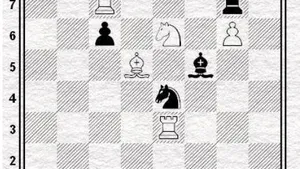


IntelliPaper
Abstract
The practice of the game of chess leads to the development of skills related to memory, logic, concentration, rigor, strategy and the capacity for abstraction. In addition to the benefits observed on learning citizenship, by respecting the rules and others. Solving chess problems is an interesting variation for realizing intellectual development. The common way is to present problems on the chessboard or through diagrams. Here, we present a new method of solving chess problems based on a purely mathematical solution. Concretely, it is a question of solving a chess problem thanks to the solution of equations and the mathematical analysis. Thus with basic knowledge of mathematics, generally of the secondary level, we can proceed to the resolution with a minimum of knowledge of chess, given that the resolution is done from the algebraic notation of the said problem. Here we advance definitions, properties and theorems.
Also we present here an example of a chess problem solved by the method.
Explore Digital Article Text
I. INTRODUCTION
The resolution method that we have developed essentially concerns the didactics of mathematics. This is a new multidisciplinary practical field for teachers and students to test their abilities in mathematical problem solving, manipulation of data displayed on tables programmed by these same students in a simplistic way (Excel for example) and of course the patience and rigor specific to both disciplines. However, we believe that it would be wise to expose - briefly – some other aspects related to algorithms within the framework of game theory. The problem be comes difficult in the case of an nxn board.
For advocates of Chess in Education (CIE), chess offers a powerful tool to build a conceptual understanding of math in children. While the Internet is awash in clever programs that gamify the teaching of early math, chess provides an immediate, direct, and tactile offline tool for teachers. [1]
The game of chess belongs to a set of games sharing common properties, called combinatorial games, of which here are the two main properties: "There is no random intervention. No dice are rolled and no cards are drawn. "These are full-information games. To choose his move, each player has all the information about the game to make his decision. This excludes for example the game of naval battle, where the board of the adversary is hidden". These two properties make it possible to eliminate any luck factor, so that in the presence of two players playing perfectly, the result of the game is known in advance. In education, the use of traditional games and especially chess is recommended. Indeed, on the cognitive level, the game chess "promotes the learning of logic and the development of the spirit of analysis and synthesis, or memory", essential skills for the student to solve a problem. [2]
Problems and modeling: A chess problem, also called a chess composition, is a puzzle set by the composer using chess pieces on a chessboard, which presents the solver with a particular task. For instance, a position may be given with the instruction that White is to move first, and checkmate Black in n moves against any possible defence. A chess problem fundamentally differs from chess play in that the latter involves a struggle between Black and White, whereas the former involves a competition between the composer and the solver. Most positions which occur in a chess problem are 'unrealistic' in the sense that they are very unlikely to occur in chess play. There is a good deal of specialized jargon used in connection with chess problems. There are various different types of chess problems: Direct mates, Help mates, Self mates, Reflex mates, Series mates, Studies, Retrograde analysis problems, Shortest proof games, Construction tasks. There are other types of chess problem which do not fall into any of the above categories. Some of these are really coded mathematical problems, expressed using the geometry and pieces of the chessboard. Famous such problems are the Knight's tour and The Queen puzzle.
Knight's tour problem: The object of the puzzle is to find a sequence of moves that allow the knight to visit every square on the board exactly once. It is a direct mathematical problem, related to the Hamiltonian path problem in graph theory. It appeared for the first time in arabic manuscripts in the 9th century and was very popular among mathematicians from the 18th century due to all possible different solutions. Euler presented a very famous solution in the Berlin Academy of Science in 1759 based on the premise "divide and conquer." [3]
8 queens problem: The problem initially posed by K.F. Gauss in 1842, proposed by Max Bezzel in Germany in 1848 is as follows: is it possible to place 8 queens on a chessboard without any queen threatening another? Gauss himself found 72 solutions to this problem, but there are 92, if you ignore the natural symmetries of the chessboard. The correct solution was found in 1972 with the help of computers and backtracking; 92 solutions were found in total where 12 of them are linear independent (Ramirez, 2004). It is rather the generalization to an nxn chessboard that poses a problem when n is very large. [4]
These problems are usually solved by a classic technique called backtracking in computer science. Backtracking is a resolution process that is particularly suitable for this type of problem. We can describe the course of a game by a graph whose vertices are the different states of the game and the arcs represent the transitions from one state to another. In the special case where it is impossible to return to a past state in the game timeline, the graph has no cycles and is therefore a tree. The maximum number of alternatives to pass from one state to another of the game fixes the arity of the tree and the beginning of the game is logically the root of the tree. Such a tree is called a decision tree. Backtracking designates a way of traversing such a tree and this traversal is often implicit. [5]
Chess solving software: Many programs have also sprung up to verify the correctness of a chess problem. This type of program is very specific, because contrary to a game program, it must analyze all the possible moves, since a problem which would have other solutions than those wanted by the author would be demolished.
What is meant by "solving the game of chess"? Every chess player has one day faced with a problem of the type "White plays and checkmates in n moves". For such a problem, regardless of Black's responses, White manages to checkmate in n moves or less. The problem is correctly analyzed once all Black answers are taken into account. As the human player progresses, he can study positions of more and more complex, but the length of analyzes required means that the problems rarely exceed 5 or 6 moves. The computer then comes to support the human player in its analysis, and for endgame positions, it can then be determined whether, assuming a perfect game, one of the two players is in a position to win, or if the game will end in a draw.[6]
Chess problems take many different forms. The most common form is given by the specification of a position on the chessboard, the specification of the state of play and a statement of the solution condition. Note that this is an extremely general form and can cause many different kinds of problems.
In this article we wish to present a new method of solving chess problems different from current methods at the theoretical level and complementary to them on the level of general interest.
At the theoretical level, it seems that the subject "solving chess problems in a purely mathematical way: using the solution of equations and mathematical analysis" is not well present in the literature proper to these kinds of topics. In contrast, solving chess problems in a computer context is based on tree algorithms, which are good for the machine. Our method is based on new mathematical functions defining the movements of the pieces and their properties. Thus, we have avoided the theory of graphs present in the other methods, which makes it possible to solve compound chess problems by hand, taking into account the theoretical development carried out, thanks to the resolution of equations and the analysis through a dashboard that can be programmed using simple tools.
This way makes it possible to exploit the properties of chess in the learning of mathematics. A path that might be interesting to explore.
Perspective: Theoretical development reveals hidden links with physics. Indeed, within the complexity of chess lies a network of algorithms, models and structures that can be mathematically explored.
The interaction between moves, positions and strategies in chess can be interpreted as a dynamical system, similar to the behavior of particles in physical systems. This connection has opened new avenues for understanding chess problems and designing new methods for solving them. [7]
Here we present the theoretical development specific to our method of resolution.
II. A MATHEMATICAL CHESS PROBLEM
Note: we denote: K=King, Q=Queen, R=Rook, N=Knight, B=Bishop, P=Pawn.
Without a chess board or diagram available, solve the following chess problem: "Find mate in two moves from the following position: (White: Ke1; Rh1; Ng3; Nf5; e2; h3) and (Black: Kg2; f3).
This problem is simple, and established composers or solvers may find it easy to solve (blindly). But for a beginner who finds it difficult to solve a problem laid out on a chess board or in the form of a diagram, mentally analyzing the initial position, it is not easy to think of all the eventualities from the initial position, provided in algebraic notation. However, a mathematical formalization of some rules of the chess game allows the transfer from the chessboard (3D) or diagram (2D) to a digital scoreboard, supporting mathematical analysis. So, with a modest knowledge of chess, we can try to solve chess problems using basic math (usually secondary school).
To do this, we introduce functions for moving chess pieces and controlling chessboard squares. Programming in Excel (or other) allows us to perform repetitive calculations and draw up control tables. Thanks to a mathematical analysis including the resolution of algebraic equations, one manages to solve certain chess problems composed for this purpose, using the usual mathematical tools; such as classical logic or solving equations and systems of equations, for example.
III. DEFINITIONS AND NOTATIONS
3.1 Geometric representation of the position
We project the chessboard on a suitable finite plane provided with an orthonormal coordinate system of unit one and of origin . We thus define any square M of the chessboard by its strictly positive integer Cartesian coordinates in the Plane
The pieces (or figures) are represented by capital letters. These same letters can also represent the squares on which the corresponding pieces are located, if there is no cause for any confusion. Each letter actually represents a type of piece (unique to Orthodox chess) that acts as test functions when it comes to checking the value of a given move, for example.
We will denote A a white piece and a black piece of the same nature. We denote by A a square occupied by a piece A.
a) Algebraic writing of the position of the diagram
The following example illustrates a position given in algebraic notation and how to relate it to a mathematical plane.
Whites: Kf8; R1e3; Bd5; Ne6; R2ç7; g6. Blacks: Kd8; Ne4; Bf5; Rg7; ç6.
{"image_source":{"path":"images/f8935551368706917060d724da8571d29214b8c2ad8c30677718188dc6304895.jpg"},"content":"","chart_caption":[],"chart_footnote":[]} {"image_source":{"path":"images/569b323a0d7724481d769045d459ae8c6bca3bce9069640669e63eb2248baf9f.jpg"},"content":"","chart_caption":[{"type":"text","content":"Fig. 1: Position diagram"},{"type":"text","content":"Fig. 2: Representation in Plan (8)"}],"chart_footnote":[]}
b) Writing in Cartesian coordinates
Consider that the letters from a to h correspond respectively to integers from 1 to 8.
Fig. 3: From letters to numbers
| a | b | c | d | e | f | g | h |
| 1 | 2 | 3 | 4 | 5 | 6 | 7 | 8 |
We replace the letters corresponding to the columns by the numbers to have the x-axis. The y-axis are the line numbers.
We thus obtain, for each piece and square, a representation in Cartesian coordinates.
WHITE: K(^{6}_{8}); R_{1(^{5}_{3}); B(^{4}_{5}); N(^{5}_{6}); R_{2(^{3}_{7}); P(^{7}_{6})}
Note: The transfer of the pieces to our plane is done from the algebraic notation of the position. The diagram is therefore not necessary to deal with the problem!
3.2 Lines and circles
For some, the movement of the pieces was posed in an arbitrary way by the "inventor" of Chess. Perhaps this proposal is not entirely sound!
In our benchmark, the pieces seem to follow a certain geometric logic.
Explanations:
{"image_source":{"path":"images/4d5b446b996c74798d278b165509ecc6e91f586b3486e207f26d5b3bb85495c5.jpg"},"content":"","chart_caption":[{"type":"text","content":"Fig. 4: The Rook moves on the horizontal and vertical squares"}],"chart_footnote":[]} {"image_source":{"path":"images/12f7b56e26d86c90af54ad148a9771135ef025509a3448e6333c64127d5a8029.jpg"},"content":"","chart_caption":[],"chart_footnote":[]}
{"image_source":{"path":"images/5f78a65b8234915100175458557e444d1bdd8599077508cbbd816fef99774cd7.jpg"},"content":"","chart_caption":[{"type":"text","content":"Fig. 5: The Bishop moves on the diagonal squares."}],"chart_footnote":[]} {"image_source":{"path":"images/8269e1133da4805540eb61b7088b3158e81b8b83c24a258233507bff660c856f.jpg"},"content":"","chart_caption":[{"type":"text","content":"Fig. 6: The Queen moves on the horizontal, vertical and diagonal squares. It possesses both the qualities of the Rook and those of the Bishop."},{"type":"text","content":"Fig. 7: The pawn plays on the adjacent vertical square and takes on the 2 adjacent diagonal squares above for a white pawn and below for a black pawn."}],"chart_footnote":[]}
{"image_source":{"path":"images/2374488a2dd24f5099009dfac0fe812f8f68bd294ebbf928ba0d5f1cf0c9b35c.jpg"},"content":"","chart_caption":[],"chart_footnote":[]} {"image_source":{"path":"images/f7b76ce9ac1cc5ebc63af6ed9140ea564c9075b651c1af89045f95eaaf86ac05.jpg"},"content":"","chart_caption":[{"type":"text","content":"Fig. 8: The arrival points of the pawn belong respectively to the circles of origin the starting point and of radii 1 and "},{"type":"equation_inline","content":""},{"type":"text","content":"."}],"chart_footnote":[]}
{"image_source":{"path":"images/2f00ea854d89326f37561051ea2bbe55d00ce5801283a8ffa51d61abb8a004c2.jpg"},"content":"","chart_caption":[{"type":"text","content":"Fig. 9: The King moves on adjacent horizontal, vertical and diagonal squares. The arrival points of the King belong respectively to the circles of origin the starting point and of radii 1 and "},{"type":"equation_inline","content":""},{"type":"text","content":"."},{"type":"text","content":"Fig. 10: The end points of the Knight belong to the circle of origin the starting point and of radius "},{"type":"equation_inline","content":""},{"type":"text","content":"."}],"chart_footnote":[]}
Here we distinguish two families: that of straight lines (Queen, Bishop and Rook) and that of circles (King, Knight and Pawn). In this order the chess pieces seem to represent a good part of the reality of the old wars.
3.3 Squares and Neighborhoods
Let us denote by the set of usual pieces of orthodox chess
Let and
With:
K = King; P = Pawn; K = Knight; B = Bishop; R = Rook and Q = Queen, white pieces and and , black pieces.
Denote by the set of squares on a chessboard. L and ,
We denote by the set of adjacent squares called here neighboring to square M. .
is said Immediate neighborhood of .
Fig. 11: Neighborhood of M
| NW | N | NE |
| W | M | E |
| SW | S | SE |
3.4 Pieces and Control Functions
a. Movement Control
Definition: a piece A controls an M square if A can reach M after the next move.
For each type of piece of and any square M of , we define P,N, B, R,Q and K as applications of in Z, indicative of the possibility or not of the existence of a given piece on a given square after play of the next move.
These notations can also represent two-variable functions of in Z defined by:
Knight:
Bishop: B(M) =
Queen:
King:
Pawn:
Such as m = 1 (Vertical/horizontal movement) or m = 2 (diagonal movement), And y > 0 (if white pawn) or y < 0 (if black pawn);
With, for each square M of and each piece A of :
b. Neighborhood control
The restrictions of the control applications on allow to test the controllability of the M square and its immediate neighborhood (its adjacent L squares) by a piece of . They are
9 defined by:
Knight:
Bishop: B(L) = (X + )2 - (Y + )2
Rook:
Queen:
King:
Pawn: , such as:
(if white pawn) or (if black pawn).
With, for each square M of and each piece A of :
- et where and ;
et parameters of the set linked to the neighboring cells of M and are defined in the following table:
Fig. 12: Neighboring squares of M parameters
| L | M | N | NW | W | SW | S | SE | E | NE |
| 0 | 0 | -1 | -1 | -1 | 0 | 1 | 1 | 1 | |
| 0 | 1 | 1 | 0 | -1 | -1 | -1 | 0 | 1 |
IV. PROPERTIES
Suppose the trait is white.
Either and generally white pieces of .
In what follows we will deal with the concepts within the strict framework of orthodox chess and we will assume that: et .
1. Check the King
In a given position of a chess problem, the Black King is put on failure by one (or more) piece A ( , ) if and only if ( ).
2. Control of the royal neighborhood
In a given position of a chess problem, a square L adjacent to that of the Black King is controlled by one (or more) piece A ( ) if and only if A(L) = o ( ).
3. Self-locking
a. Definition
Let and . Let's ask: Where and . In a given position of a chess problem, Black King is blocked by if and only if it exists such that .
b. Lemma
In a given position of a chess problem, Black King K' is blocked by A' if and only if .
4. Small castling
For castling to be possible, it is necessary and sufficient that all of the following conditions be verified:
a) The King and the Rook must be on their original primitive (game) spaces. We must therefore necessarily have K(5; 1) and R(8; 1) for whites and K'(5; 8) and R'(8; 8) when it comes to castling blacks.
b) The spaces B(6; 1) and N(7; 1) for white castling and B'(6; 8) and N'(7;8) in the case of black castling must not be controlled or blocked.
c) The King is not in check and must not have moved before.
d) The execution of castling produces the following condition: K(7; 1) and R(6; 1) for whites and K'(7;8) and R'(6;8) for blacks.
5. Large castling
For Large castling to be possible, it is necessary and sufficient that all of the following conditions be verified:
a. The King and the Rook must be on their original primitive (game) squares. We must therefore necessarily have K(5; 1) and R(1; 1) for whites and K'(5; 8) and R'(1; 8) when it comes to castling blacks.
b. The spaces , and for the white castling and
Q'(4; 8), B'(3; 8), N'(2; 8) in the case of the black castling, must not be controlled or blocked.
c. The King is not in a state of check and must not have moved before. d. Large castling produces the following condition: and for whites and and for blacks.
III. INITIALIZATION AND CONTROL TABLES
The results needed to deal with a problem are gathered in tables (non-exhaustive list) that help us determine the squares checked and the pieces involved, carry out tests and build a checkmate plan.
These tables expose the following data:
Table (A): Initialization/pieces coordinates
Table (B): The movement indicators applied to the cells of the opposing Kings Table (C): Control of the Black King's neighborhood by white pieces
Table (D): Possible blockages of the Black King
Table (E): Coordinates of neighboring cells and satisfaction of the rules Note: We use the symbol to denote a correct result at the level of the application but which contradicts the rules of the game. For example, a pawn cannot retreat; a Rook cannot ensure its own defense against the opposing King on the ground one of its neighboring squares... etc.
VI. APPLICATION (PROBLEM)
Solve the following chess problem, using its algebraic notation only:
Position A: White: Ke1; Rh1; Ng3; Nf5; e2; h3 and Blacks: Kg2; f3. White mate in 2 moves.
4.1 Reformulation
Initialization
a) Redefine the pieces as moving objects, located by their Cartesian coordinates, and the squares as points in a suitable discrete plane;
b) Draw up the control tables using a calculation program (Excel for example);
c) Check whether one or the other of the Kings is in a state of failure;
d) Define a resolution plan;
To analyze
e) Study the possible movements of blacks;
f) Deduce a first move (the most satisfactory) for White;
g) Play* the White move (the key) and mathematically define the new position;
h) After analyzing the possibilities of Black, play the black move and define the new position;
i) Find the checkmate from this position.
- play = in the control table, replace the old coordinates of the square on which the piece concerned is located with the new ones.
4. 2 Solution
Note: To avoid repetitive manual work in the sense of formulas, you can use a simplistic program such as Excel to perform the calculations, knowing that the tables are reusable for each new position (new move). This should lighten the work, but also serve as a guide for mathematical analysis.
a. Initial
In what follows we consider the following notations:
Whites: R(5; 1); T(8; 1); C1(6; 5); C2(7; 3); P1(5; 2); P2(8; 3),
Blacks: R'(7; 2); P'(6; 3).
b. Satisfaction
According to (B), , so the black king is not in a state of failure and like , the white king is not either, in the state of the initial position of the problem.
c. Resolution strategy
To solve a chess problem such as a straight checkmate in 2 moves, one starts by studying the possibilities of Black; the King's escape spaces and the possible movements of the pieces. However, the escape squares are the squares adjacent to the Black King. We therefore calculate the movement and control indicators for each white piece applied to the squares adjacent to the Black King. If the indicative specific to a piece is zero for a square then the latter is controlled by said piece.
| BLANCS | NOIRS | ||||||||
| B | R | T | C1 | C2 | P1 | P2 | |||
| x | 5 | 8 | 6 | 7 | 5 | 8 | 7 | 6 | x |
| y | 1 | 1 | 5 | 3 | 2 | 3 | 2 | 3 | y |
| x | 2 | -1 | 1 | 0 | 2 | -1 | -2 | -1 | |
| Y | 1 | 1 | -3 | -1 | 0 | -1 | -1 | -2 | |
| 12 | -1 | 5 | -4 | 2 | -2 | -1 | |||
| BLANCS | NOIRS | ||||||||
| B | R | T | C1 | C2 | P1 | P2 | |||
| x | 5 | 8 | 6 | 7 | 5 | 8 | 7 | 6 | x |
| y | 1 | 1 | 5 | 3 | 2 | 3 | 2 | 3 | y |
| x | 2 | -1 | 1 | 0 | 2 | -1 | -2 | -1 | |
| Y | 1 | 1 | -3 | -1 | 0 | -1 | -1 | -2 | |
| 12 | -1 | 5 | -4 | 2 | -2 | -1 | |||
Fig. 13: Tables A and B
| L | R(L) | T(L) | C1(L) | C2(L) | P1(L) | P2(L) | NC | PC | ||
| N | 42 | -2 | 0 | -5 | 3 | -1 | 0 | 1 | 1 | C1 |
| NW | 12 | -4 | -1 | -4 | 0 | 2 | -1 | 1 | 1 | P1 |
| W | 0 | -2 | 4 | -3 | -1 | 3 | -1 | 0 | 1 | R |
| SW | 0 | 0 | 11 | 0 | 6 | -1 | -1 | 3 | R, T, C2 | |
| S | 6 | 0 | 12 | -1 | 3 | 3 | 0 | -1 | 1 | T |
| SE | 56 | 15 | 0 | 8 | 2 | 1 | -1 | 1 | C2 | |
| E | 72 | 0 | 8 | -3 | 7 | -1 | 1 | 0 | 1 | T |
| NE | 132 | 0 | 3 | -4 | 8 | -2 | 1 | 1 | 1 | T |
Fig. 14: Table C Fig. 15: Table E
| L | x_L | y_L | Y+β_L_P1 |
| N | 7 | 3 | 1 |
| NW | 6 | 3 | 1 |
| W | 6 | 2 | 0 |
| SW | 6 | 1 | -1 |
| S | 7 | 1 | -1 |
| SE | 8 | 1 | -1 |
| E | 8 | 2 | 0 |
| NE | 8 | 3 | 1 |
If and , then , that is 8=6. Which is absurd.
If and , then , from where . However, according to Table (A): . Which means that . This possibility is excluded since the white Rook cannot access a square occupied by a white pawn.
If and , then and 1 = 3. Which is absurd.
√ The last case gives us and . So .
We replace in (A2) the coordinates of the Rook by and we obtain the following tables:
| BLANCS | NOIRS | |||||||
| B | R | T | C1 | C2 | P2 | |||
| x | 5 | 6 | 6 | 7 | 8 | 6 | 0 | x |
| y | 1 | 1 | 5 | 3 | 3 | 3 | 0 | y |
| x | 1 | 0 | 0 | -1 | -2 | -1 | 5 | |
| Y | 2 | 2 | -2 | 0 | 0 | -2 | 1 | |
| 12 | 0 | -1 | -4 | ##### | ##### | |||
| BLANCS | NOIRS | |||||||
| B | R | T | C1 | C2 | P2 | |||
| x | 5 | 6 | 6 | 7 | 8 | 6 | 0 | x |
| y | 1 | 1 | 5 | 3 | 3 | 3 | 0 | y |
| x | 1 | 0 | 0 | -1 | -2 | -1 | 5 | |
| Y | 2 | 2 | -2 | 0 | 0 | -2 | 1 | |
| 12 | 0 | -1 | -4 | ##### | ##### | |||
Fig. 19: Tables A3 and B3 Fig. 20: Table C3 Note: Like
, we have From (B3), . The
| L | R(L) | T(L) | C1(L) | C2(L) | P2(L) | NC | PC | |
| N | 72 | 0 | -4 | -3 | 3 | 1 | 1 | T |
| NW | 56 | -3 | -3 | 0 | 8 | 1 | 1 | C2 |
| W | 6 | -2 | 0 | -1 | 7 | 0 | 1 | C1 |
| SW | 0 | -1 | 5 | 0 | 8 | -1 | 2 | R, C2 |
| S | 0 | 0 | 4 | -3 | 3 | -1 | 2 | R, T |
| SE | 12 | 1 | 5 | -4 | -1 | 0 | inc | |
| E | 42 | 2 | 0 | -5 | -1 | 0 | 1 | C1 |
| NE | 132 | 3 | -3 | -4 | 0 | 1 | 1 | P2 |
Black King is therefore in a state of failure by the Rook, but he still has an escape space (the SE space according to (C3). The Rook move is therefore not the right one. Note, however, that ans one of the conditions for white castling is fulfilled and the Rook after having played his last move ( ) does indeed occupy the finish square after performing a small white castling. What motivates us to play the small castling rather than the Rook. In Table (A3), we change the coordinates of the White King to have . Fig. 21: Tables A4 and B4
| B | R | T | C1 | C2 | P1 | P2 | |||
| x | 7 | 6 | 6 | 7 | 0 | 8 | 6 | 0 | x |
| y | 1 | 1 | 5 | 3 | 0 | 3 | 3 | 0 | y |
| x | -1 | 0 | 0 | -1 | 6 | -2 | 1 | 7 | |
| Y | 2 | 2 | -2 | 0 | 3 | 0 | -2 | 1 | |
| 12 | 0 | -1 | -4 | ∅ | ### | ### | |||
| L | R(L) | T(L) | C1(L) | C2(L) | P2(L) | NC | PC | ||
| N | 72 | 0 | -4 | -3 | 3 | 0 | 1 | 1 | T |
| NW | 132 | -3 | -3 | 0 | 8 | -1 | 1 | 1 | C2 |
| W | 42 | -2 | 0 | -1 | 7 | -1 | 0 | 1 | C1 |
| SW | 12 | -1 | 5 | 0 | 8 | -1 | -1 | 1 | C2 |
| S | 0 | 0 | 4 | -3 | 3 | 0 | -1 | 2 | R,T |
| SE | 0 | 1 | 5 | -4 | 1 | -1 | 1 | R | |
| E | 6 | 2 | 0 | -5 | -1 | 1 | 0 | 1 | C1 |
| NE | 56 | 3 | -3 | -4 | 0 | 1 | 1 | 1 | P2 |
Fig. 22: Table C4
It can be seen from (C4) that all of the black king's escape cells are under white control, since: .
Since the Black King is in a check state according to (B4), it is concluded that he is checkmate.
By following the development of the position of the pieces involved in the checkmate, we manage to present the result in its digital form and then the chess form:
#2 Math Solution (6+2)
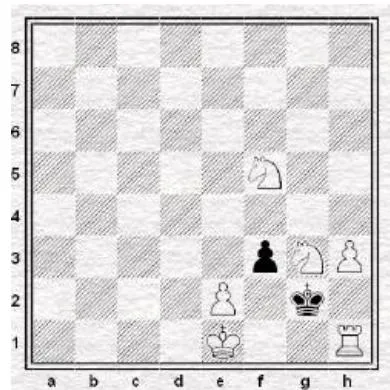
The application example shows us that it is quite possible to solve chess problems with the help of equations and analysis using properties and theorems. This brings closer the two disciplines Chess and Mathematics and opens the way to new ideas around a composition of problems oriented towards education.
VII. CONCLUSION
So there are other ways to value chess problems. The fact of exploring the other possibilities should increase the presence, in various forms, of Chess in particular the resolution of the problems. Certainly some fun and useful combinations come out of it.
What can we think about the diversification of published problem genres?
A mathematics teacher who seeks, in special sessions, to offer a playful challenge to his students may find no better than to give them chess problems to solve using mathematical tools. But first he will have to teach them a method, which should be done quickly and without hassle, then compose himself problems or seek out them from the composers who indicate under their compositions the terms: "math solution". These will have to respect certain rules (which will have to be defined) and certainly the level of the target audience; A one-move problem being easier than a two-moves one. For the student it is a fun session solving puzzles and proving his ability to use mathematical analysis with the appropriate tools and for the teacher it is a question of testing at fair value certain technical and moral skills in its students.
The link between the two disciplines gives rise to connections whose result can be in favor of the promotion of the chess problem and the human cognitive values it must convey.
Conflict of Interest
The authors declare no conflict of interest.
Ethical Approval
Not applicable
Data Availability
The datasets used in this study are openly available at [repository link] and the source code is available on GitHub at [GitHub link].
Funding
This work did not receive any external funding.
References
Cite this article
Related Research

Special Issue
Launch a focused special issue to highlight research, emerging trends, and expert insights in your academic field.