




IntelliPaper
Abstract
This work evaluates the impact of climate-induced damage to wheat production in Kashkadarya (Uzbekistan), was conducted in April and June of 2023, and examines the effectiveness of various management strategies to mitigate these risks. Based on a survey of 120 wheat growers, this study applies parametric and non-parametric econometric techniques to assess the production risks associated with extreme weather events and the role of innovative management strategies in reducing crop damage. The findings highlight the significant adverse effects of severe weather events, such as thunderstorms, windstorms, and hailstorms, on wheat yield, and demonstrate that the adoption of strategies like those for watercourse availability, shelterbelt plantation, and adjustments to irrigation schedules can significantly reduce wheat losses. This study underscores the importance of financial and technical support for farmers to adopt such strategies and suggests further research to explore effective adaptation measures to protect crops from weather shocks. By integrating empirical data with sophisticated econometric models, this study offers a comprehensive view on the adaptation processes necessary for sustaining agricultural productivity in the face of climatic uncertainties. In addition, this work serves as a call to action for policymakers, researchers, and practitioners to prioritize climate-smart agriculture practices to safeguard food security in rural Kashkadarya, Uzbekistan, and similar agro-ecological zones.
Explore Digital Article Text
I. INTRODUCTION
Natural disasters and extreme weather conditions have a direct impact on crop production and food security, posing a challenge for limited arable land to meet the growing food demand, especially under unpredictable weather conditions[1]. Uncertain factors like rainfall, wind, and pest attacks are expected to become more frequent in the future, potentially leading to significant crop yield losses and food shortages. Climate risks to agriculture encompass production, marketing, financial, environmental, and human factors, with drought in rivers and seas also affecting crop production[2]. The Aral Sea tragedy, impacting millions in Central Asia and causing environmental damage, poses a major global disaster. Uzbekistan, due to its geographical characteristics and limited adaptability, is highly vulnerable to these challenges, facing agricultural risks from heavy rains, floods, winds, cyclones, and droughts[3]. Recent events, including severe floods and unseasonal rainfall, have caused significant damage to agriculture in Uzbekistan, threatening its ability to meet the food demands of its growing population[4].
Wheat is the main cereal crop and food staple in Uzbekistan. In 2023, it was grown on nearly 8734 thousand hectares and it contributed of the country's gross domestic production and of the value-added in agriculture. Uzbekistan is one of the highest wheat-consuming countries in Central Asia. According to an estimate, the per capita wheat consumption in Uzbekistan is per year and wheat flour contributes of the daily caloric intake. A decline in wheat production was reported over the period between 2018 and 2019. Particularly the decline was from 26.67 million tons in 2017 to 25.49 million tons in 2018. Recently, according to surveys from local farmers, during the first quarter of 2019, stormy weather such as heavy rains, windstorms, and hailstorms caused significant losses to the standing wheat crop (about 27 percent) in the Kashkadarya province of Uzbekistan. Reportedly climate change will aggravate the losses and the gap between actual and potential wheat yield will continue to increase unless Uzbekistan implements timely adaptations of innovative technology and management strategies to mitigate its vulnerability[5].
II. LITERATURE REVIEW
Climate change is causing serious issues in global food production and security, particularly in resource-poor countries heavily reliant on agriculture. There is evidence of climate change's destructive impact on farming worldwide, including reduced cereal production in Russia [6], Kazakhstan[7], United States[6], Malaysia[8], and Australia[9] due to heatwaves and droughts, as well as crop damage in China from strong winds and heavy rain[10]. Resource-poor countries, especially in Africa, are suffering more from extreme weather events, such as crop lodging caused by fluctuating rainfalls and winds. This situation is expected to worsen, putting African health and livelihoods at risk [11],[12]. Additionally, it is predicted that unexpected crop yield losses will occur due to extreme weather events like heavy rain, high winds, and heatwaves. Uzbekistan, in Central Asia, is particularly vulnerable to climate change due to its history of severe climate-related events, including droughts, floods, and storms, which have had a devastating impact on agriculture. Recent extreme storms have also affected Uzbekistan's agriculture, and these weather shocks are expected to intensify in the future. However, no studies have focused on how crops are vulnerable to windstorms, thunderstorms, and hailstorms in Uzbekistan.
Organizations view climate change as a driving force for creating innovative technologies and management strategies to address vulnerability. Cleantech industries are encouraged to adapt efficient technology, such as renewable energy sources, to mitigate climate-induced risks. Studies emphasize the importance of environmental management strategies, like those proposed for the Alberta oil industry, to ensure long-term survival and sustainability[13]. Enhanced enforcement of environmental regulations is deemed crucial for industry competitiveness and sustainability. Despite advancements in cleantech, there is a recognized need for further application of technology and management strategies in agriculture to counteract the adverse effects of climate change[14].
Both the industrial and agricultural sectors are investing in innovative technologies to address climate change threats. Agricultural advancements include the integration of renewable energy sources like photovoltaic greenhouses and water pumps , alongside a focus on information technology to reduce production risks. Uzbekistan's agriculture is highly vulnerable to weather shocks due to a lack of technological and financial resources. Adopting smart management strategies, including physical measures like irrigation and non-physical ones such as crop insurance, can effectively reduce crop vulnerability to weather anomalies with minimal financial investment , .
Implementation of innovative management strategies is important to reduce the adverse impacts of weather shocks on crop production. This issue requires increased attention in resource-poor countries such as Uzbekistan. Most of the previous literature focused on the impacts of droughts and rainfalls on crop damage and the adaptation of basic farm management practices. However, crop vulnerability due to windstorms, thunderstorms, and hailstorms and adaptation of physical and non-physical management strategies to mitigate the weather-induced crop damages have not been empirically studied in Uzbekistan. Given this literature gap, a dedicated effort has been made in this study to collect the existing information from farmers of Uzbekistan on extreme weather events and crop yield, in order to provide a better understanding of the climate-induced vulnerability of farms and the innovative management strategies to mitigate the risk. To develop a more comprehensive framework, the study focuses on seven key objectives: 1) to determine extreme weather events and wheat yields, 2) to estimate the spatial differences of wheat yield with the occurrence of storms, 3) impact estimation of storms on wheat yield, 4) to evaluate innovative management strategies to mitigate risk, 5) to evaluate causal impacts of storms on yield damages, 6) to estimate the causal impacts of innovative management strategies to mitigate vulnerability and 7) to analyze determinants of innovative management strategies. The findings of this study provide an outlet for policymakers to design effective adaptation measures to better protect crops from weather shocks. We end the article by suggesting a potential avenue for future study.
Managing risks for wheat crops under extreme weather conditions requires a blend of strategies to safeguard against adverse events. Key risk mitigation models specific to wheat cultivation include drought-resistant varieties, precision agriculture, early warning systems, crop insurance, water management, crop rotation, soil conservation, remote sensing technology, innovative irrigation, and capacity building. Growing wheat that can withstand water scarcity, using real-time weather data to optimize farming practices, forecasting adverse weather to take timely actions, insuring crops to cover losses from extreme weather events, employing practices like drip irrigation for efficient water usage, rotating crops to enhance overall farm resilience, implementing methods to prevent erosion and enhance soil health, using technology to monitor crop health in real-time, adopting efficient irrigation techniques, and educating farmers in climate-smart practices to build resilience are all crucial steps. Integrating these models offers a holistic approach to protecting wheat crops from extreme weather, fostering sustainable and resilient agriculture.
The study emphasizes the need for innovative management strategies to counter the impact of weather shocks on crop production, especially in resource-demanding countries like Uzbekistan. This study addresses the gap by examining the vulnerability of crops to windstorms, thunderstorms, hailstorms, as well as to drought conditions. Through information collected from Uzbekistan farmers, the study aims to understand climate-induced farm vulnerability and propose effective management strategies. The key objectives include assessing storm impacts on wheat yields, estimating spatial differences in wheat yield during storms, estimate storm impact on wheat yield, evaluate innovative risk mitigation, examine the cause-and-effect of storms on yield damages, gauge the impact of innovative strategies on vulnerability, and analyze factors influencing management strategies. The findings aim to guide policymakers in developing adaptation measures for crop protection, suggesting potential avenues for future research.
The study examines the impact of storms on wheat yield, proposing that both severe and mild storms, as well as dry weather negatively affect it. Innovative management strategies, like watercourse maintenance and adjusting irrigation, are suggested to mitigate damages. Non-physical measures such as crop insurance may have varied effects. Factors like farmers' education and access to weather forecasts influence the adoption of these strategies, while family size may hinder adoption.
III. METHODOLOGY
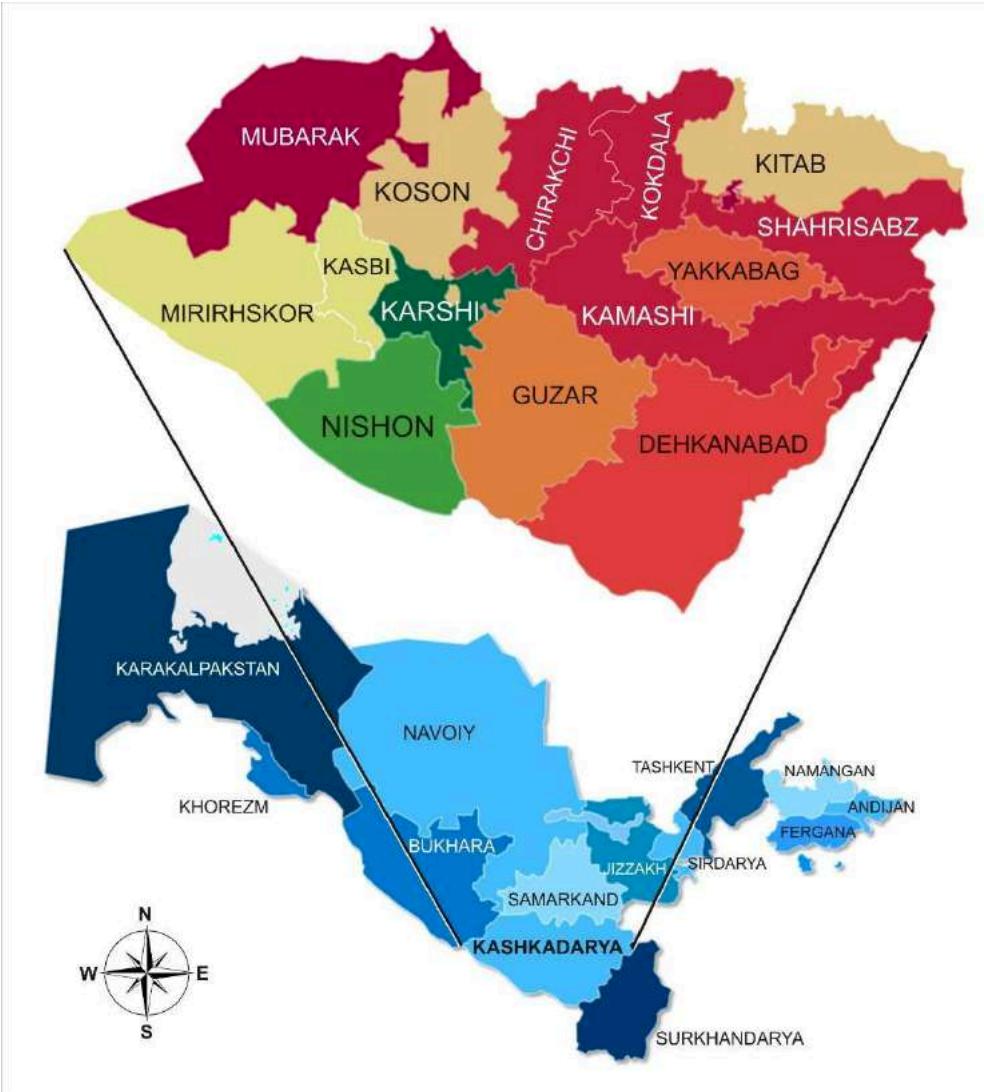
The Kashkadarya province of Uzbekistan was selected as the main study area (Fig.1.). It is geographically located at N; . According to natural conditions, the Kashkadarya region is split into western plains and eastern mountains. The flatlands are mainly the Karshi, Guzar, Nishan and Kasbi steppes (300-400 m elevation), featuring ancient river terraces, residual mountains, and saline-filled depressions . Kashkadarya is a fertile region having a 23.4% share in the agricultural GDP of the country and 18.9% share of Uzbekistan total wheat production. The rainfall pattern in Kashkadarya is wide-ranging and mostly associated with the spring winds. About 45%–65% of the total rainfall occurs during the winter-spring season.
 Figure 1: Selected study areas
After wheat harvesting, in April and May 2022, a survey of the study area was conducted using a multistage sampling technique to collect primary data. In stage-1, the Kashkadarya province was selected specifically. In stage-2, 14 districts (D) were chosen: Nishon, Mirishkor, Kasbi, Koson, Guzar, Karshi and Mubarak from cotton-wheat cropping zone and Kamashi, Yakkabag, Shahrisabz, Chirakchi, Kokdala, Dehkanabad and Kitab from mixed cropping zone. During the first quarter of 2022, these districts were found to be the most vulnerable due to windstorms, thunderstorms, and hailstorms. In stage-3, using a convenient sampling two villages were chosen from each district. In stage-4, five wheat growers (farmers) were interviewed from each village randomly using the prepared questionnaire.
Focus group discussions were also conducted with participants to discuss details of damage caused by extreme weather events. In total, one province, 14 districts, 28 Villages, and 120 farmers were interviewed about the required information.
All participants verbally consented to interviews, assured of confidentiality for research purposes. Data collected covered wheat yield, institutional services, socioeconomic profiles, and strategies adopted to cope with extreme weather events.
3.1 Impact evaluation of extreme weather events on wheat yield
To assess the impact of extreme weather events on wheat yield, we employed both parametric and non-parametric econometric techniques. The primary data collected from 120 wheat growers in the Kashkadarya province provided a comprehensive dataset, allowing for a detailed analysis of the effects of different weather shocks on wheat production.
Following the protocols studied by Elahi et al., the Cobb-Douglas (CD) production function was employed to estimate the impact of storms and management strategies on wheat yield[18]. The CD production function was selected due to its ability to estimate the direct elasticities of the parameters. The general form of the CD production function is expressed as:
To linearize this non-linear production function, the logarithmisation was performed to both sides, resulting in:
Where represents the wheat yield and/or yield damages in centres per hectare for the i-th farm; -denotes the j-th variable for the i-th farm; is the intercept; is the vector of parameters.
The information about wheat yield, institutional services, socio-economic profiles, and the use of physical and non-physical strategies to cope with extreme weather events was also collected.
IV. RESULTS AND DISCUSSIONS
Figure 2 presents the intensity of storms (categorized as less than moderate, moderate, and severe) and their impact on the wheat crop. There were no reports of storms during the sowing period, and there are not any hailstorms reported during sowing or between sowing and harvesting. More than two-thirds of farmers experienced less than moderate thunderstorms between sowing and harvesting, while a significant majority (74%) encountered severe thunderstorms at the time of wheat maturity, coinciding with the peak of harvesting. This severe weather damaged the standing crops. Fields exposed to severe thunderstorms yielded 0.23 and 0.1 times less wheat than those affected by less than moderate and moderate thunderstorms, respectively.
Similarly, more than 90% of farmers reported experiencing less than moderate windstorms between sowing and harvesting. In contrast, about 95% of the farmers faced severe windstorms precisely at the time of harvesting. Farms affected by severe windstorms during harvesting reported significantly lower wheat yields compared to those that experienced mild or less than mild windstorms.
4.1. Effectiveness of innovative management strategies
The study evaluated several innovative management strategies to mitigate the adverse effects of extreme weather events. The key findings include:
Watercourse maintenance: Farms that maintained watercourses effectively managed excess water from heavy rains, reducing waterlogging and subsequent yield losses by 9-13%.
Shelterbelt plantation: Farms with shelterbelts experienced about 14% less crop loss compared to those without, demonstrating the effectiveness of windbreaks in protecting crops from windstorms.
Irrigation schedule adjustments: Adjusting irrigation schedules based on weather forecasts reduced yield losses by 3-9%, highlighting the importance of flexible water management practices.
Crop insurance: Although the adoption rate of crop insurance was low, insured farmers reported significantly lower financial stress and were better able to recover from yield losses.
Farmer education and weather forecast access: Farmers who received training and had access to reliable weather forecasts were better prepared to implement protective measures, resulting in lower yield losses.
{"image_source":{"path":"images/e328d4557ff1a60e7ce109678388174fe0a55800d86e709cbfa1c5253e9f2297.jpg"},"content":"","chart_caption":[{"type":"text","content":"Figure 2: The intensity of storms."}],"chart_footnote":[]}
V. CONCLUSIONS
This study evaluates the impact of extreme weather events on wheat production in the Kashkadarya region of Uzbekistan and highlights the effectiveness of various management strategies to mitigate these risks. Data collected from 120 wheat growers demonstrated significant adverse effects of thunderstorms, windstorms, and hailstorms on wheat yield. Severe thunderstorms, windstorms, and hailstorms caused substantial yield reductions, with the most severe losses occurring during the harvesting period. Severe thunderstorms led to a yield reduction of 0.14 units per parameter, severe windstorms resulted in a yield reduction of 1.32 units per parameter, and severe hailstorms caused the highest yield reduction of 1.98 units per parameter. Innovative management strategies proved effective in mitigating these impacts. Effective watercourse maintenance reduced waterlogging and subsequent yield losses by 9-13%. Shelterbelt plantation reduced crop loss by approximately 14%, providing critical protection from windstorms. Adjusting irrigation schedules based on weather forecasts reduced yield losses by 3-9%. Although the adoption rate of crop insurance was low, insured farmers experienced significantly lower financial stress and were better able to recover from yield losses. Farmers who received training and had access to reliable weather forecasts were better prepared to implement protective measures, resulting in lower yield losses. The study highlights the necessity of financial and technical support for farmers to adopt innovative management strategies. Policymakers, researchers, and practitioners are urged to prioritize climate-smart agriculture practices to safeguard food security in rural Kashkadarya and similar agro-ecological zones globally. Further research is recommended to explore additional effective adaptation measures and refine existing strategies to better protect crops from weather shocks. This research calls for stakeholders to invest in and implement innovative agricultural practices to enhance the resilience of the agricultural sector against climate change and extreme weather events, ensuring sustainable food production for future generations.
Author Contributions: Conceptualization, writing—original draft preparation, visualization, writing—review and editing, supervision O.S. Author has read and agreed to the published version of the manuscript.
Funding: Not applicable.
Institutional Review Board Statement: Not applicable.
Informed Consent Statement: Not applicable.
Conflicts of Interest: The authors declare no conflict of interest.
Conflict of Interest
The authors declare no conflict of interest.
Ethical Approval
Not applicable
Data Availability
The datasets used in this study are openly available at [repository link] and the source code is available on GitHub at [GitHub link].
Funding
This work did not receive any external funding.
References
Cite this article
Related Research




Special Issue
Launch a focused special issue to highlight research, emerging trends, and expert insights in your academic field.
