





IntelliPaper
Abstract
The purpose of the government's rural revitalization is to use flexible market means to guide a large number of farmers (business entities) to participate in rural revitalization. Governments at all levels are the promoters, managers and supervisors of rural revitalization. Enterprises (cooperatives) participate in rural revitalization as organizers of farmers (operating entities), and are participants and organizers of rural revitalization. The government's policies and support, and the number of farmers (operating entities) participating in rural revitalization are the key factors that affect the enthusiasm of enterprises (cooperatives) to participate in rural revitalization.
Explore Digital Article Text
INTRODUCTION
The purpose of the government's rural revitalization is to use flexible market means to guide a large number of farmers (business entities) to participate in rural revitalization. Governments at all levels are the promoters, managers and supervisors of rural revitalization. Enterprises (cooperatives) participate in rural revitalization as organizers of farmers (operating entities), and are participants and organizers of rural revitalization. The government's policies and support, and the number of farmers (operating entities) participating in rural revitalization are the key factors that affect the enthusiasm of enterprises (cooperatives) to participate in rural revitalization.
According to each subject relationship, the following assumptions are put forward:
Assumption 1, without considering other constraints, the government (g), enterprises (cooperatives) (c) and farmers (operating entities) (u) are regarded as a complete system, the three parties follow the assumption of bounded rationality and incomplete information symmetry. All parties constantly adjust their behavioral strategies to achieve the equilibrium of the evolutionary game.
Assumption 2, the government chooses the strategy of investing and not investing in rural revitalization, and the probability of the corresponding investment strategy is x and 1-x; The strategy chosen by the enterprise (cooperative) is to organize farmers and not organize farmers to participate in industrialization, and the probability corresponding to the participation strategy is y and 1-y; The strategies chosen by farmers (operating entities) are to participate in and not to participate in industrialization, and the corresponding probability of participating in the strategy is z and 1-z. Among them, x,y,z are functions of time t and satisfy x, y, z∈[0, 1].
Assumption 3, the economic benefit of the government's investment in farmers (operating entities) to join rural revitalization is , the government's credibility is increased to , the subsidies to enterprises are , and the subsidies to farmers are . When the enterprises do not organize farmers (operating entities), the government undertakes additional The cost of establishing an information platform and market transaction behavior is ; When the government does not provide subsidies but farmers (operating entities) actively participate, the government benefit is .
Assumption 4, the enterprise (cooperative) provides additional services to farmers (operating entities) to obtain benefits , the sum of labor costs, learning costs and other costs required to provide services , and the government subsidy is , and the potential market value increase due to the provision of services is ; The enterprise does not organize farmers (operating entities) and does not suffer losses.
Assumption 5, the income of farmers (business entities) participating in rural revitalization is , the cost of participating in enterprise organizations is , the cost of farmers (business entities) participating alone is , and the government subsidies are ; Farmers (business entities) do not participate. The loss paid is .
Based on the above assumptions, the income matrix under different strategies of each participant can be obtained.
Table 1: Game income matrix of government, enterprises (cooperatives) and farmers (operating subjects)
| The parties and their actions | Farmer (operating entity) | ||||
| participating (z) | not participating (1-z) | ||||
| government | Input (x) | Enterprise (Cooperative) | organize (y) | $R_g - A_c - A_u + L_g$ | $L_g - A_c$ |
| $R_c - C_c + A_c + L_c$ | $L_c - C_c + A_c$ | ||||
| $R_u - C_u + A_u$ | $-R_{0u}$ | ||||
| not organized (1-y) | $R_g + L_g - A_u - C_g$ | $L_g - C_g$ | |||
| 0 | 0 | ||||
| $R_u - C_{0u} + A_u$ | $-R_{0u}$ | ||||
| No input (1-x) | organize (y) | $R_{0g}$ | 0 | ||
| $R_c - C_c + L_c$ | $L_c - C_c$ | ||||
| $R_u - C_u$ | $-R_{0u}$ | ||||
| Not organized (1-y) | $R_{0g} - C_g$ | $-C_g$ | |||
| 0 | 0 | ||||
| $R_u - C_{0u}$ | $-R_{0u}$ | ||||
I. CONSTRUCTION OF THE EVOLUTIONARY GAME MODEL OF THE THREE PARTIES IN RURAL REVITALIZATION
1.1 Government's Replication Dynamic Equation and Equilibrium
The expected benefits of the government choosing not to invest and investing in rural revitalization are and , respectively, then:
Then the government's replication dynamic equation is:
Derivating the government's replication dynamic equation gives:
According to Friedman's theory, if , are satisfied, do asymptotic stability analysis on the strategy chosen by the government and its evolution: if , then , the government can choose to invest or not to invest. If , let , and two equilibrium points of , are obtained. When , there are , , at this time is a stable strategy, and the government chooses not to invest; otherwise, if , , , then is the stabilization strategy, and the government chooses the strategy of raising investment.
1.2 Replication dynamic equation and equilibrium point of enterprises (cooperatives)
The expected benefits of enterprises (cooperatives) not organizing farmers (operating entities) to participate in rural revitalization and organizing farmers (operating entities) to participate in rural revitalization are and respectively, then:
Then the replication dynamic equation of the enterprise (cooperative) is:
The derivation of the replication dynamic equation of the enterprise (cooperative) can be obtained:
1.3 Replication dynamic equation and equilibrium point of farmers (operating entities)
The expected benefits of farmers (operating entities) choosing not to participate in rural revitalization and choosing to participate in rural revitalization are and respectively, then:
Then the replication dynamic equation of the farmer (manager) is:
The derivation of the replication dynamic equation for farmers (operating subjects) is:
1.4 Analysis of evolutionary stability strategy of tripartite subjects in rural revitalization
From the above analysis, the replication dynamic equations of the government, enterprises (cooperatives) and farmers (operating entities) are obtained:
This equation system describes the relationship between the government, enterprises (cooperatives) and farmers (operating entities) in rural revitalization. When the correction speed of the equation system is zero, that is, the evolution direction does not change, the system is considered to be in a stable equilibrium state, that is, the nash equilibrium is reached.
Let , , , we can get 8 pure strategy local equilibrium points as 、 、 、 、 、 、 、 .
According to Lyaounov's first law, the Jacobin matrix of the system can be obtained by derivation of each dynamic replication equation as follows:
Then the stable condition can be obtained:
The evolution equilibrium solution and stability conditions can be obtained from the Jacobin matrix at each equilibrium point.
II. ESTABLISH THE SYMBIOTIC MODEL OF THE GOVERNMENT, ENTERPRISES AND FARMERS
According to the rural revitalization of the relevant subject symbiotic logic, put forward the following assumptions: (1) under the background of agricultural modernization strategy, the government whether enterprises (cooperatives) and farmers (operators) to participate in the rural revitalization, will promote the development of rural revitalization, due to enterprises (cooperatives) and farmers (operators), the government for enterprises (cooperatives) and farmers (operators) have a role. (2) Suppose that the amount of investment provided by the government, the income available from enterprises (cooperatives) to farmers (operators) by providing services related to rural revitalization and the income of farmers (operators) from participating in rural revitalization are three different data, and the three initial values of the system are not zero.(3) In the case of limited economic resources and limited market resources, the government unit of time investment resources is limited, namely the government investment amount has a maximum, the same enterprise (cooperatives) can also have a maximum income, farmers (operators) can also have a maximum income, namely the three at the same time each have a maximum environmental capacity. In addition, the government's investment policy is a phased and supportive policy, and the government will consider withdrawing from this investment policy when the rural revitalization development reaches a certain stage.
Combined with the combination of symbiosis theory, the three group symbiosis models of rural revitalization considering both the government, enterprises (cooperatives) and farmers (business entities) are established.
Table 2: Model parameters and their implications
| symbol | explain | symbol | explain |
| The amount of government money invested in rural revitalization | $y_c$ | Profits of enterprises (cooperatives) participating in rural revitalization | |
| $z_u$ | Income from farmers (business entities) participating in rural revitalization | $r_g$ | The self-growth rate of the government input policy |
| $r_c$ | The self-growth rate of enterprises (cooperatives) participating in rural revitalization | $r_u$ | The self-growth rate of farmers (business entities) participating in rural revitalization |
| $m_g$ | The maximum amount of government spending | $m_c$ | The maximum profits for enterprises (cooperatives) can participate in rural revitalization |
| $m_u$ | The biggest benefit of peasant households (business entities) from participating in rural revitalization | $\delta_{gc}$ | The function coefficient of government effect on enterprises (cooperatives) |
| $\delta_{gu}$ | The function coefficient of the government on farmers (management subject) | $\delta_{cu}$ | The function coefficient of enterprises (cooperatives) on farmers (operating subjects) |
| $\delta_{uc}$ | The function coefficient of farmers (operating subject) on enterprises (cooperatives) |
In the formula: , , respectively represent the retardation coefficient caused by the consumption of limited resources such as financial resources by the government, enterprises (cooperatives) and farmers (operating entities).
III. ANALYSIS OF THE SYMBIOTIC STABILITY OF THE GOVERNMENT, ENTERPRISES AND FARMERS
The equations are now collated into the standard Lotka-Volterra equations.
The internal interaction coefficient matrix between the government and enterprises (cooperatives) and farmers (Operating subjects) is shown in.
Solve the symbiosis equation to get the symbiosis balance point between the government, enterprises (cooperatives) and farmers (operating subjects).
| $x_g$ | $y_c$ | $z_u$ | |
| O | O | O | |
| $N_2$ | $m_g$ | O | O |
| $N_3$ | O | $m_c$ | O |
| $N_4$ | O | O | $m_u$ |
| $N_5$ | $m_g$ | $\frac{m_c(\delta_{uc}-1)}{\delta_{uc}\delta_{cu}-1}$ | O |
| $N_6$ | $m_g$ | O | $\frac{m_u(\delta_{cu}-1)}{\delta_{uc}\delta_{cu}-1}$ |
| $N_7$ | O | $\frac{m_c(\delta_{uc}-1)}{\delta_{uc}\delta_{cu}-1}$ | $\frac{m_u(\delta_{cu}-1)}{\delta_{uc}\delta_{cu}-1}$ |
| $N_8$ | 1 | $\frac{\delta_{gc}+\delta_{gu}\beta_{uc}-\delta_{cu}\delta_{uc}-1}{1-\delta_{cu}\delta_{uc}}$ | $\frac{\delta_{gu}-\delta_{cu}+\delta_{cu}\delta_{gc}+1}{1-\delta_{cu}\delta_{uc}}$ |
In the table, is the equilibrium point of symbiotic stability. According to the symbiotic stability condition, the matrix determinant of the formula should be less than zero, namely:
At the same time, since , , , , , , and satisfies , , , needs to meet the following conditions.
When the interaction coefficient between the government, enterprises (cooperatives) and farmers (operating subjects) in rural revitalization and development satisfies the above formula, the development of rural revitalization can evolve to the point where the government invests in rural revitalization and development, and enterprises (cooperatives) provide support for farmers (operating entities) to participate in rural revitalization, and farmers (operating entities) actively participate in a good situation.
IV. SYMBIOSIS SIMULATION ANALYSIS OF GOVERNMENT, ENTERPRISES AND FARMERS
In order to further study the dynamic development characteristics of the symbiosis between the government, enterprises (cooperatives) and farmers (operating subjects) in rural revitalization and development, MATLAB was used to explore the symbiosis process of the three through simulation. The corresponding relationship and initial value setting of each initial variable in the simulation model and the corresponding variable of the theoretical model.
Table 4: Initial variable initial value setting table of simulation model
| Symbol | Initial Value | Symbol | Initial Value |
| 0.2 | $m_c$ | 200 | |
| $r_c$ | 0.35 | $δ_{gc}$ | 1.4 |
| $r_u$ | 0.45 | $δ_{gu}$ | 0.2 |
| $m_g$ | 100 | $δ_{uc}$ | 0.3 |
| $m_u$ | 100 | $δ_{cu}$ | 1.2 |
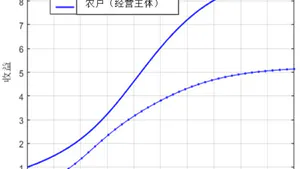
{"image_source":{"path":"images/10548581dfc91d70e976479ba2e480c9e556512f455b053588361212f70bfdc2.jpg"},"content":"","chart_caption":[{"type":"text","content":"Figure 1: Government-guided Symbiosis Evolution Map of Enterprises (Cooperatives) and Farmers (Business Principals)"}],"chart_footnote":[]} From the simulation results:
There is a symbiosis-dependent game evolution relationship between the government, enterprises (cooperatives) and farmers (operating subjects). The evolution of the tripartite symbiosis system to a balanced and stable state in symbiotic development is a long-term process, which promotes each other and evolves and grows.
The growth rate of the three parties' income in rural revitalization is dynamic and different. In the early stage of rural revitalization development, it developed rapidly due to less market restrictions. The enthusiasm of the participants has been improved. Compared with the initial stage of the number of enterprises (cooperatives) and farmers (operating entities) participating in rural revitalization with government investment, the growth rate of the two has gradually decreased to zero.
The growth rate of the three parties' income in rural revitalization is dynamic and different. In the early stage of rural revitalization development, it developed rapidly due to less market restrictions. Under the existing condition (i.e., without considering the government's late adjustment of input Policy), as participation subjects become more active, the number of enterprises (cooperatives) and farmers (operating entities) participating in rural revitalization with government input compared with the initial stage, the growth rate of both gradually decreases to zero.
In the early stage of rural revitalization development, affected by the number of enterprises (cooperatives) participating and market acceptance, the participation of enterprises (cooperatives) and farmers (operating entities) in rural revitalization was relatively slow. With the increasing enthusiasm of participants and market development, the role of rural revitalization can be brought into play, the growth rate of the government's investment in enterprises (cooperatives) and farmers (operating entities) participating in rural revitalization gradually increased to a peak, and then gradually decreased. Constrained by market prices, the marginal rate of return of the government's implementation of the input policy will gradually decrease, and the benefits such as the improvement and the increase of public credibility obtained by the government will gradually approach the maximum value. Similarly, the benefits obtained by the participants will also decrease as the number of participants in rural revitalization increases, and gradually approach the maximum value.
The simulation results show that: (1) There is a symbiotic evolution relationship between enterprises (cooperatives) and farmers (operating subjects), and it is a long-term process for the symbiotic system of enterprises (cooperatives) and farmers (operating subjects) to evolve to a balanced and stable state; (2) Under the current situation (that is, regardless of the government's later adjustment and development of rural revitalization investment policies), in the early stage of rural revitalization and development, limited by the limited number and capacity of participation, enterprises (cooperatives) and farmers (operating entities) have continued to gain benefits. However, as the popularity and participation of poets increase, the growth rate of both parties' income gradually slows down and becomes stable.
{"image_source":{"path":"images/898a3137e50f1dbee2b50415b3911cde5d49f496cbbc4e973d7504fcd208f4e5.jpg"},"content":"","chart_caption":[{"type":"text","content":"Figure 2: Symbiosis simulation of enterprises (cooperatives) and farmers (operating entities)"}],"chart_footnote":[]}
V. ANALYSIS OF THE SYMBIOSIS MECHANISM BETWEEN ENTERPRISES AND FARMERS UNDER THE GOVERNMENT'S WITHDRAWAL FROM INVESTMENT
5.1 Construction of symbiosis model under government withdrawal and input
First, enterprises (cooperatives) and farmers (operating entities) can achieve common development through information exchange and resource sharing due to their proximity in space, providing an ideal common "evolution" path for each; Second, the two will act in a cooperative manner for the common good; Third, there is a certain relationship between the subjects of rural revitalization in terms of material and information. and symbiosis will deepen or disappear as this relationship strengthens or fades. The formation of this symbiotic relationship between the subjects of rural revitalization is the result of the mutual game between the participants, and the construction of this symbiotic relationship is the need to promote the development of rural revitalization.
Enterprises (cooperatives) and farmers (operating entities) achieve common development through symbiotic evolution, which is essentially a process in which the distribution of rural revitalization benefits and comprehensive benefits tends to be reasonable. According to the symbiotic logical relationship between the two parties, the following assumptions are put forward: First, enterprises (cooperatives) and farmers (operating subjects) are both bounded rational decision-makers and will adopt a certain symbiotic behavior model in the process of participating in rural revitalization. Second, the change in the income of enterprises (cooperatives) participating in rural revitalization and the change in the per capita income of farmers (operating entities) participating in rural revitalization respectively represent the status of their participation in rural revitalization. The third is that enterprises (cooperatives) and farmers (operating entities) need to consume growth resources (various policy resources and technical resources, etc.) to obtain benefits from participating in rural revitalization. Fourth, the process of enterprises (cooperatives) and farmers (operating subjects) participating in rural revitalization satisfies the growth law of LOGISTIC. The total amount of growth resources limits the growth of the income of enterprises (cooperatives) and farmers (operating subjects). Its income growth rate is not only affected by its own income level, but also related to the income level of the symbiotic subject. At the same time, it is assumed that the benefits of enterprises (cooperatives) and farmers (operating entities) participating in rural revitalization at time t are and , respectively, and the growth rates of revenue are and , respectively, and the maximum benefits under certain growth resources are and , respectively.; the symbiotic effect coefficient of farmers (operating subjects) on enterprises (cooperatives) is , and the symbiotic effect coefficients of enterprises (cooperatives) on farmers (operating subjects) is , and its absolute value indicates the degree of symbiosis; and respectively. Represents the development trend of enterprises (cooperatives) and farmers (operating subjects) participating in rural revitalization, and respectively represent that the enterprises (cooperatives) and farmers (operating subjects) are affected by the consumption of growth resources. Get the retardation effect of revenue growth.
Then the dynamic evolution equation of enterprises (cooperatives) and farmers (operating subjects) participating in rural revitalization can be expressed as:
Then the symbiotic dynamic evolution equation of the interaction between the two is:
Let the symbiotic dynamic evolution equation be equal to 0, , four equilibrium points.
5.2 Analysis on the symbiosis stability of enterprises (cooperatives) and farmers (operating entities) under the withdrawal of government investment
According to the stability theory of differential equations, it can be seen that:
is the unstable equilibrium point.
is the stable equilibrium point, then . Currently, enterprises (cooperatives) have a blocking effect on farmers (operating entities) participating in rural revitalization. Enterprises (cooperatives) use growth resources to obtain maximum benefits, while farmers (cooperatives) Business entities choose not to participate in rural revitalization due to insufficient growth resources, which is meaningless.
is a stable equilibrium point, then . Currently, farmers (operating subjects) have a blocking effect on the participation of enterprises (cooperatives) in rural revitalization. Farmers (operating subjects) use growth resources to obtain maximum benefits, while enterprises (Cooperatives) choose not to participate in rural revitalization due to insufficient growth resources, which is also meaningless.
is the stable equilibrium point, when and , the evolution equilibrium results of the equilibrium point under different and values are obtained, indicating that the symbiotic relationship between enterprises (cooperatives) and farmers (operating subjects) shows different evolutionary equilibrium results with the change of the symbiotic interaction coefficient. Moreover, the symbiotic model of enterprises (cooperatives) and farmers (operating subjects) is not static, and their symbiotic relationship has also undergone a process of evolution from constant development and change to stability. The distribution of benefits between the two tends to be rationalized with the influence of the policy system, the market environment and the increase in the scale of farmers (operating subjects).
Table 5: The symbiotic behavior model of enterprises (cooperatives) and farmers (operating entities)
| Symbiosis coefficient value | Equilibrium | Benefit distribution form | Symbiosis mode |
| $0 < \lambda_u < 1,$ $0 < \lambda_c < 1$ | $P_1$ | Since rural revitalization is voluntary participation and individual declaration, the two parties are decentralized and independent for limited resource competition. | independent symbiosis |
| $\lambda_u = 0, \lambda_c = 0$ | $P_2$ | Both sides do not affect each other | independent symbiosis |
| $0 < \lambda_u < 1, \lambda_c < 0$ | $P_3$ | Farmers benefit, enterprises (cooperatives) suffer | parasitic symbiosis |
| $\lambda_u < 0,0 < \lambda_c < 1$ | $P_4$ | Enterprises (cooperatives) benefit, farmers suffer | |
| $\lambda_u = 0, \lambda_c < 0$ | $P_5$ | Enterprises (cooperatives) are harmless, farmers benefit | Symbiosis |
| $\lambda_u < 0, \lambda_c = 0$ | $P_6$ | Enterprises (cooperatives) benefit, farmers suffer no loss | |
| $\lambda_u < 0, \lambda_c < 0$ | $P_7$ | Mutual benefit for both parties to achieve the goal of carbon neutrality in rural revitalization | Mutualism |
divide the phase plane into S1, S2, S3 and S4 four areas. The S1 area is located below and . In this area, the growth rates of enterprises (cooperatives) and farmers (operating entities) are both greater than zero, and their incomes will increase with time. If the initial relationship between the enterprise (cooperative) and the farmer (operating subject) is in this area, it will move to the upper right as time goes by, and it may approach the equilibrium point E4, or move to the S2 and S3 areas. If the symbiotic relationship between the enterprise (cooperative) and the farmer (operating subject) is in the S2 area, where the growth rate of the scale of the enterprise (cooperative) is greater than zero, and the growth rate of the farmer (operating subject) is less than zero, over time, the symbiotic relationship between the two will become stronger. Move down to the right and approach the equilibrium point E4 or enter the S4 area. If the initial symbiotic relationship between the enterprise (cooperative) and the farmer (operating subject) is in the S4 area, and the scale growth rate of the two in this area is lower than zero, the phase point will move to the lower left and tend to the equilibrium point E4, or enter S2 or S3 area. If it enters the S2 area, it will eventually tend to the equilibrium point E4 according to the above analysis. If the symbiotic relationship between enterprises (cooperatives) and farmers (operating entities) is in the S3 area, where the growth rate of the scale of enterprises (cooperatives) is less than zero, and the growth rate of farmers (operating entities) is greater than zero, with the increase of time, the symbiosis of the two will occur. The state will move to the upper left, either approaching the equilibrium point E4 or entering the S4 area. As analyzed above, the phase point entering the S4 area will eventually tend to the equilibrium point E4. To sum up, when , , the equilibrium point of the symbiotic evolution of enterprises (cooperatives) and farmers (operating subjects) is E4, that is, regardless of the initial state of the two, the enterprises (cooperatives) and The symbiotic evolution of farmers (operating subjects) will eventually be stable at the equilibrium point E4. In the same way, the other six situations can reach stability at the equilibrium point (in other cases, the phase plan of the symbiotic evolution of enterprises (cooperatives) and farmers (operating entities) is similar to the above analysis. This shows that the symbiosis coefficient determines the enterprise (cooperative) The symbiotic relationship (symbiotic model) with the farmer (operating subject), different symbiotic relationships will produce different evolutionary equilibrium results.
{"image_source":{"path":"images/212eebd9c3c8cfff61d9aabb9f2e0597af31b2fd4d18d7d17db6756582d4bdf4.jpg"},"content":"","chart_caption":[],"chart_footnote":[]}
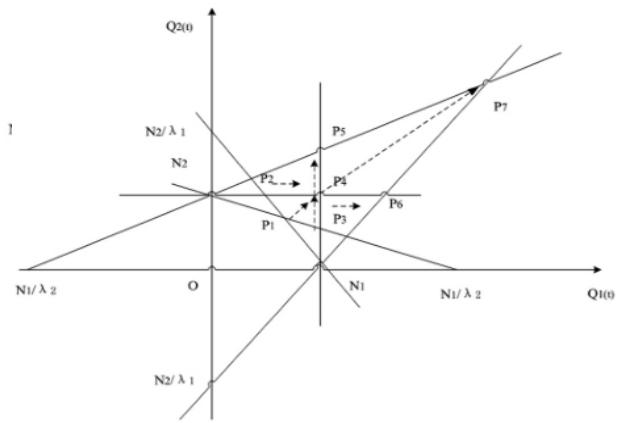 Figure 3: Phase diagram of the symbiotic evolution of enterprises (cooperatives) and farmers (operating entities) Figure 4: The dynamic path of symbiotic evolution between enterprises (cooperatives) and farmers (operating entities)
VI. CONCLUSION
From a practical point of view, with the development of rural revitalization, enterprises (cooperatives) and farmers (operating subjects) form a symbiotic relationship, which has roughly gone through the following stages: in rural revitalization and development, enterprises (cooperatives) and farmers (operating subjects) in the process of symbiosis evolution, it has experienced different symbiosis stages:
First, the independent symbiosis stage, the two parties have not formed a stable transaction relationship, enterprises (cooperatives) focus on the benefits and market effects in rural revitalization, and farmers (operating entities) focus on participation costs and enterprises. Services, this stage is manifested as the competition between the two parties for limited resources such as government incentives;
The second is the parasitic symbiosis stage. Under the guidance of the government and the promotion of market demand, enterprises (cooperatives) gradually organize and organize farmers' production, and farmers (operators) gradually realize the benefits and begin to participate in large-scale operations. However, there is no clear right and Obligation, which easily breeds speculation and short-term behavior;
The third stage is the partial benefit symbiosis. Under stable cost and income conditions, enterprises (cooperatives) focus on the number of farmers (operators) involved and business expansion, while farmers (operators) concentrate on information and market services. The number of farmers (operators) participating in enterprises (cooperatives) has significantly increased. At this point, the supply side is dominant, with enterprises (cooperatives) holding a leading position in production and benefit distribution, resulting in one party benefiting while the other loses.
Fourth, in the stage of mutual benefit and symbiosis, both parties pay more attention to the improvement of technical information services and the development of agricultural industrialization. Enterprises (cooperatives) and farmers (operating entities) combine to form a "benefit-sharing and risk-sharing" consortium, and enterprises (cooperatives) return large-scale incremental benefits and government rewards and subsidies to farmers (operating entities), improves the service level and quality, and at the same time, farmers (operating subjects) actively participate in rural revitalization, and make use of the number of farmers (operating subjects) and group effects to expand and strengthen the agricultural industry.
Conflict of Interest
The authors declare no conflict of interest.
Ethical Approval
Not applicable
Data Availability
The datasets used in this study are openly available at [repository link] and the source code is available on GitHub at [GitHub link].
Funding
This work did not receive any external funding.
References
Cite this article
Related Research



Special Issue
Launch a focused special issue to highlight research, emerging trends, and expert insights in your academic field.
