



IntelliPaper
Abstract
Interest in urban cycling is increasing and the number of bike share programs has grown rapidly in recent years. Therefore, the objective that is intended to be achieved in this study is to know if factors such as seasons, routes and altitudes affect the project of a shared bicycle system in the city of Guayaquil, Ecuador. A quantitative and longitudinal study has been designed with the collection and analysis of data from the bicycle-sharing system (BSS) of the city of Guayaquil, registering a total of 84,183 observations (Men n=59,159; Women n=25,024). The data extracted from the Iguana Bike Tours organization was collected and statistically analyzed through the IBM SPSS version 21.0 program. A significance value of p < 0.05 has been established. The most used station was the one located in the center of the city, representing a total of 39% of the observations. The neutral elevation, that is, leaving a station and depositing the bicycle in another with the same altitude, represented 65.5% of the total records. The city of Guayaquil has some favorable topographical characteristics to create a profitable service that promotes healthy habits as a means of active transportation in the urban environment, as well as an improvement in urban mobility and a less polluted environment.
Explore Digital Article Text
I. INTRODUCTION
Interest in urban cycling is on the rise and the number of bicycle-sharing system (BSS) has grown rapidly over the last 10 years or so. The BSS have existed for almost 50 years, but the recent change in the technology used and the interest in promoting the practice of physical activity among the population can make cities more sustainable, habitable places and change the activity habits of the local population (Nieuwenhuijsen and Rojas-Rueda, 2020; Soriguera and Jiménez-Meroño, 2020). In this same way, the BSS have been implemented in several cities around the world as policies to mitigate climate change, reduce traffic congestion, promote physical activity, public health (Bauman et al., 2017; Clockston and Rojas-Rueda, 2021; Munkácsy and Monzón, 2017; Nieuwenhuijsen and Rojas-Rueda, 2020; Otero et al., 2018; Sanmiguel-Rodríguez, 2015; Sanmiguel-Rodríguez, 2019; Sanmiguel-Rodríguez, 2020; Sanmiguel-Rodríguez, 2022; Sanmiguel-Rodríguez y Arufe Giráldez, 2019; Soriguera and Jiménez-Meroño, 2020; Zhang et al., 2015), are economically profitable and sometimes promote healthy and enjoyable social factors (Munkácsy and Monzón, 2017; Zhang et al., 2015). For Bauman et al. (2017) the most important health objective is to increase cycling levels in the population, thus contributing to a greater proportion of the population meeting physical activity guidelines and improving population health.
Bike sharing is also an emerging topic of research related to urban transport and sustainable mobility. In this way, the BSS acquire a great dimension and relevance as a healthy and economic means of transport that favors a change of approach in the choice of trips within the urban nucleus, in order to develop new policies that promote the development of mobility urban and physical activity as a means of transportation (Munkácsy and Monzón, 2017). In Europe, the urban environment offers options and possibilities to reduce the use of private vehicles (Dekoster and Schollaert, 2000). The bicycle is generally associated with certain countries such as
Holland or Denmark. The Netherlands has the highest level of cycling in the developed world.
However, the bicycle requires physical effort and it is, therefore, in the flat countries where it is easier to use. In general, the bicycle is used in many European countries regardless of their topography (Dekoster and Schollaert, 2000; DeMaio, 2009). Its less use in southern countries is due, in large part, to the social image of this vehicle, often considered an old-fashioned and uncomfortable means of transport (Dekoster and Schollaert, 2000; Ogilvie and Goodman, 2012; Scheiner, 2010; Unwin, 1995). Switzerland is not a flat country and, even so, the bicycle is used in 23% of all journeys in Basel and 15% in Bern, where many streets have slopes of 7% (Dekoster and Schollaert, 2000). The slopes constitute an obstacle to be taken into account by untrained cyclists or those with bicycles in poor condition.
But even in such circumstances, there is potential for cycling, as shown in some cities with steep slopes: Trondheim in Norway or San Francisco in the United States (Dekoster and Schollaert, 2000, Pucher, Buehler et al., 2011; Pucher et al., 1999; Tin et al., 2012). Nevertheless, the flat topography facilitates cycling, as well as the absence of steep slopes and the availability of cycling routes, which encourage residents of an urban area to cycle (Beenackers et al., 2012; Hunt and Abraham, 2007; Menghini et al., 2010; Pucher, Buehler et al., 2011; Rietveld and Daniel, 2004; Vandenbulcke et al., 2011).
Therefore, there is a need to analyze the factors that affect the demand for shared bicycles to promote the creation of infrastructures within the urban environment that can favor active displacement, the practice of physical activity, and health to combat in a more efficient way against climate change and the sedentary lifestyle of the population. For all these reasons, the main objective to be achieved with this study was to analyze whether the location of the stations, the routes and the altitudes of the city of Guayaquil have been factors that affect the use of active displacement by its users within the city of Guayaquil of the urban environment.
II. MATERIALS AND METHODS
2.1 Participants and design
A quantitative and longitudinal study has been designed with the collection and analysis of data from the BSS of Guayaquil (Ecuador). These data included the uses of the 3,268 users registered in the Guayaquil BSS. The user's identification is associated with a numerical value, maintaining their anonymity at all times. The number of uses of the Iguana Bike Tours bicycle system of the Guayaquil City Council was counted daily and a total of 84,183 observations were recorded (Men n=59,159; Women n=25,024). The data was provided and authorized by the Guayaquil City Council.
2.2 Process
The variable studied was the minutes of use, whose behavior was determined according to blocks of age, sex and minutes of use. From this information, other variables have been derived that were also the object of study, which were: the journeys between the five stations and the minutes of use (calculated from the start and end dates of the trips). The data was encoded according to the use records by means of the bicycles that are at the five stations, so it was decided to decode the stations of origin and destination to establish the routes and slopes according to a numerical value through a formula from the spreadsheet. Excel calculation so that the statistical program SPSS could correctly identify it. The stations of the system have been categorized as follows (Figure 1):
-
Malecón 2000, in the city center: 4 meters above sea level.
-
Malecón del Salado: 11 meters above sea level.
-
Samanes Park (outskirts): 2 meters above sea level.
-
Santay Island (outskirts): 4 meters high.
5. Chongón (periphery): 19 meters.
The difference in altitude of the Iguana Bike Tours stations (in meters) was determined with Google Maps.
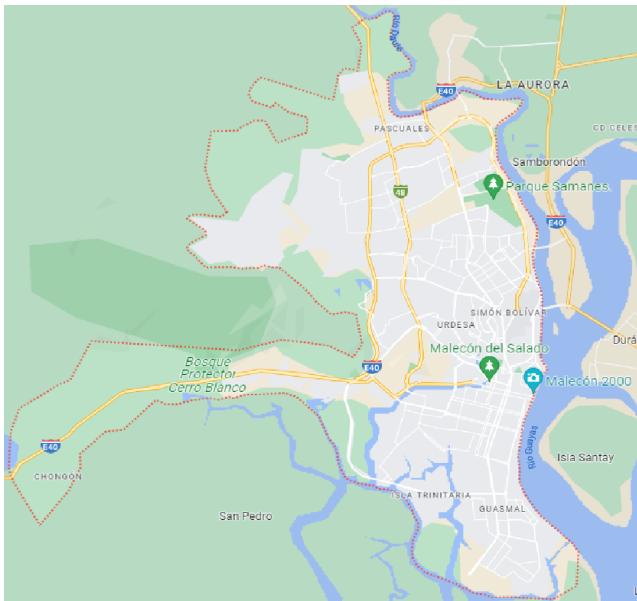 Fig. 1: Location of bicycle service stations in Guayaquil (Made with the Google Maps)
Iguana Bike Tours has, scattered throughout Guayaquil, five stations with bicycles so that they can be used by users previously registered in the system. The bicycles are anchored in the stations and to use them you need a magnetic card. When the user uses this magnetic card to release the bicycle, a computer system records their data and the starting point of the journey. When the user leaves the bicycle, the computer system records the user's data and the place of destination. In this way, we categorize the service stations as follows: 1= Malecón 2000 (Center), 2= Malecón del Salado, 3= Parque Samanes, 4= Isla Santay and 5= Chongón. Combining the routes between Iguana Bike Tours stations, we have 25 travel possibilities.
2.3 Data Analysis and Ethical Aspects
First, the Guayaquil City Council was contacted to obtain an anonymized database of the system and the consent for the transfer of data was signed.
Subsequently, the data extracted from the system was collected and statistically analyzed through the IBM SPSS version 21.0 program. A significance value of p < 0.05 has been established. The code of ethics for research in general has been complied with, as well as the commitment to data confidentiality and good research practices. The research conducted is not related to human or animal use. All procedures performed in this manuscript were performed in accordance with ethical research standards. On the other hand, the informed consent of the administration that governs Iguana Bike Tours was obtained.
III. RESULTS
The most used station of origin of Iguana Bike Tours was that of the Malecón 2000, downtown, representing a total of 39% of the observations, followed by that of the Malecón del Salado (outskirts) with 23.8% (Figure 2 and Table 1). In terms of gender, men used the downtown station with 40.2%, followed by Parque Samanes (21.2%), Isla Santay (15.2%), Malecón del Salado (14.1%) and Chongón (9.3%) as shown in Table 1. For their part, women have made use of most of the downtown station (36%), followed closely by the Parque Samanes station (29.9%), as can be seen in Table 1.
Regarding the destination station, the most represented station was the one in the center, with a total of 43.7%, followed by Parque Samanes with 22.2% (Figure 2 and Table 1). Considering the gender according to the destination stations, the downtown station in Guayaquil was the most represented of all, with 43.6% in men and 43.8% of the observations in women. Regarding the rest of the stations, Parque Samanes remained second with a representation of 21.1% in men and 25% in women (Table 1).
{"image_source":{"path":"images/94229e9643b60008dec7108eea0118de14806111b5cf9fbbc8a05baf63a76000.jpg"},"content":"","chart_caption":[{"type":"text","content":"Fig. 2: Total observations of origin and destination at Iguana Bike Tours stations"}],"chart_footnote":[]}
Table 1: Total percentages by genre of stations according to origin and destination
| Variable | All (n=84183) | Men (n=59159) | Women (n=25024) | ||||||
| Station_Origin | % | Stat error | (95% IC) | % | Stat error | (95% IC) | % | Stat error | (95% IC) |
| 1 | 39,0 | 0,16 | 38,6-39,2 | 40,2 | 0,20 | 39,7-40,5 | 36,0 | 0,30 | 35,3-36,5 |
| 2 | 14,3 | 0,12 | 14,0-14,5 | 14,1 | 0,14 | 13,9-14,4 | 14,6 | 0,22 | 14,1-15,0 |
| 3 | 23,8 | 0,14 | 23,4-24,0 | 21,2 | 0,16 | 20,8-21,4 | 29,9 | 0,28 | 29,3-30,4 |
| 4 | 14,2 | 0,12 | 14,0-14,4 | 15,2 | 0,14 | 14,8-15,3 | 12,2 | 0,20 | 11,8-12,6 |
| 5 | 8,7 | 0,09 | 8,5-8,9 | 9,3 | 0,11 | 9,1-9,6 | 7,3 | 0,16 | 7,0-7,6 |
| Station Destination | % | Stat error | (95% IC) | % | Stat error | (95% IC) | % | Stat error | (95% IC) |
| 1 | 43,7 | 0,17 | 43,2-43,9 | 43,6 | 0,20 | 43,1-43,9 | 43,8 | 0,31 | 43,1-44,3 |
| 2 | 12,8 | 0,11 | 12,5-13,0 | 12,4 | 0,13 | 12,2-12,7 | 13,6 | 0,21 | 13,1-13,9 |
| 3 | 22,2 | 0,14 | 21,9-22,4 | 21,1 | 0,16 | 20,6-21,3 | 25,0 | 0,27 | 24,4-25,5 |
| 4 | 14,7 | 0,12 | 14,4-14,9 | 15,8 | 0,15 | 15,5-16,1 | 12,2 | 0,20 | 11,7-12,6 |
| 5 | 6,6 | 0,08 | 6,4-6,8 | 7,1 | 0,10 | 6,9-7,3 | 5,4 | 0,14 | 5,2-5,7 |
Of the 25 available among the five stations distributed around the town, the most represented route, both in men and women, was the one that corresponds to the downtown station in Malecón 2000 (Figure 3 and Table 2), in other words, it was picks up the bike and deposits it at that station. Therefore, route 11, which corresponds to the central station, has had 19% of the total observations. The path between station 3 (Parque Samanes) and 1 (center), that is, path 31, is quantified with 11.3% of the total observations, followed by path 13 (which corresponds to the stations in the center and Parque Samanes) with 9.6%. With respect to gender, routes 11 (Malecón
2000-Malecón 2000), 33 (Parque Samanes-Parque Samanes), 31 (Parque Samanes-Malecón 2000) and 13 (Malecón 2000-Parque Samanes) were the most representative in the male gender, with the percentages being 20.2%, 9.4%, 9.1% and 8.6%, respectively (Figure 3 and Table 2). On the other hand, routes 31 (Parque Samanes-Malecón 2000), 11 (Malecón 2000-Malecón 2000), 13 (Malecón 2000-Parque Samanes) and 33 (Parque Samanes-Parque Samanes) were the most representative in the female gender, with percentages of 16.6%, 16.1%, 11.9% and 9.7% respectively (Figure 3 and Table 2).
{"image_source":{"path":"images/7f5b0318c29e7b08ed45720e258e39776f63ddff0b34618ff20de45a75e79265.jpg"},"content":"","chart_caption":[{"type":"text","content":"Fig. 3: Percentage of observations according to routes and gender"}],"chart_footnote":[]}
Table 2: Percentage of observations according to routes and gender
| Variable | All (n=84183) | Men (n=59159) | Women (n=25024) | ||||||
| Journey | % | Stat error | (95% IC) | % | Stat error | (95% IC) | % | Stat error | (95% IC) |
| 11 | 19,0 | 0,13 | 18,6-19,2 | 20,2 | 0,16 | 19,8-20,4 | 16,1 | 0,23 | 15,6-16,5 |
| 12 | 3,4 | 0,06 | 3,1-3,4 | 3,8 | 0,07 | 3,5-3,8 | 2,4 | 0,09 | 2,1-2,5 |
| 13 | 9,6 | 0,10 | 9,3-9,7 | 8,6 | 0,11 | 8,2-8,7 | 11,9 | 0,20 | 11,4-12,2 |
| 14 | 5,6 | 0,07 | 5,4-5,7 | 6,0 | 0,09 | 5,7-6,1 | 4,8 | 0,13 | 4,4-4,9 |
| 15 | 1,5 | 0,04 | 1,4-1,6 | 1,9 | 0,05 | 1,7-1,9 | 0,9 | 0,06 | 0,8-1,0 |
| 21 | 4,8 | 0,07 | 4,6-4,9 | 5,4 | 0,09 | 5,1-5,5 | 3,4 | 0,11 | 3,1-3,6 |
| 22 | 6,4 | 0,08 | 6,1-6,4 | 5,9 | 0,09 | 5,6-6,0 | 7,5 | 0,16 | 7,1-7,7 |
| 23 | 1,8 | 0,04 | 1,7-1,9 | 1,5 | 0,05 | 1,4-1,6 | 2,5 | 0,09 | 2,3-2,6 |
| 24 | 0,6 | 0,02 | 0,6-0,7 | 0,6 | 0,03 | 0,6-0,7 | 0,6 | 0,05 | 0,5-0,7 |
| 25 | 0,6 | 0,02 | 0,6-0,7 | 0,7 | 0,03 | 0,6-0,8 | 0,5 | 0,04 | 0,4-0,6 |
| 31 | 11,3 | 0,10 | 11,0-11,4 | 9,1 | 0,11 | 8,8-9,2 | 16,6 | 0,23 | 16,1-17,0 |
| 32 | 1,7 | 0,04 | 1,6-1,7 | 1,4 | 0,04 | 1,3-1,5 | 2,5 | 0,09 | 2,2-2,6 |
| 33 | 9,5 | 0,10 | 9,2-9,6 | 9,4 | 0,11 | 9,1-9,5 | 9,7 | 0,18 | 9,2-10,0 |
| 34 | 0,7 | 0,02 | 0,6-0,7 | 0,6 | 0,03 | 0,6-0,7 | 0,7 | 0,05 | 0,6-0,8 |
| 35 | 0,5 | 0,02 | 0,5-0,6 | 0,6 | 0,03 | 0,5-0,6 | 0,5 | 0,04 | 0,4-0,6 |
| 41 | 5,7 | 0,07 | 5,4-5,7 | 5,7 | 0,09 | 5,5-5,8 | 5,6 | 0,14 | 5,2-5,7 |
| 42 | 0,4 | 0,02 | 0,3-0,4 | 0,3 | 0,02 | 0,3-0,4 | 0,5 | 0,04 | 0,4-0,6 |
| 43 | 0,7 | 0,02 | 0,6-0,7 | 0,8 | 0,03 | 0,7-0,9 | 0,3 | 0,03 | 0,3-0,4 |
| 44 | 6,9 | 0,08 | 6,6-6,9 | 7,5 | 0,10 | 7,2-7,6 | 5,4 | 0,14 | 5,0-5,5 |
| 45 | 0,6 | 0,02 | 0,5-0,7 | 0,7 | 0,03 | 0,6-0,7 | 0,4 | 0,04 | 0,4-0,5 |
| 51 | 3,0 | 0,05 | 2,8-3,1 | 3,4 | 0,07 | 3,1-3,4 | 2,2 | 0,09 | 2,0-2,3 |
| 52 | 1,0 | 0,03 | 0,9-1,1 | 1,1 | 0,04 | 1,0-1,2 | 0,8 | 0,05 | 0,7-0,9 |
| 53 | 0,6 | 0,02 | 0,6-0,7 | 0,6 | 0,03 | 0,6-0,7 | 0,5 | 0,04 | 0,5-0,6 |
| 54 | 0,9 | 0,03 | 0,8-1,0 | 1,0 | 0,04 | 0,9-1,0 | 0,7 | 0,05 | 0,6-0,8 |
| 55 | 3,2 | 0,05 | 3,0-3,2 | 3,2 | 0,07 | 3,0-3,3 | 3,0 | 0,10 | 2,7-3,1 |
In relation to the altitudes between the routes, no great differences were analyzed between the observations made. The neutral elevation, that is, leaving a station and depositing the bicycle in another with the same altitude, represented 65.5% of the total records. On the other hand, the decreasing elevation, that is, starting from a higher station of origin to one that is at a lower altitude, has been 17.5%, while the increasing elevation, that is, leaving a station of departure of lower altitude than in which the journey ends, has been 17% (Figure 4 and Table 3). Regarding gender, men made 63.6% of trips between stations of the same altitude, 18.3% with decreasing elevation and 18.1% with increasing altitude (Figure 4 and Table 3). For their part, women performed 69.9% of the neutral altitude, 15.7% of the decreasing altitude and 14.4% of the increasing altitude (Figure 4 and Table 3).
{"image_source":{"path":"images/50a07f7c5477ccbf234f9f66c6e1decd8a7824493da3d20b443a78bc4b9ba2a3.jpg"},"content":"","chart_caption":[{"type":"text","content":"Fig. 4: Percentage of observations between the different stations and the elevations that occur between them"}],"chart_footnote":[]}
Table 3: Percentage of observations according to the altitude of the paths between stations
| Variable | All (n=84183) | Men (n=59159) | Women (n=25024) | ||||||
| Altitude | % | Stat error | (95% IC) | % | Stat error | (95% IC) | % | Stat error | (95% IC) |
| -17 | 1,0 | 0,03 | 0,9-1,1 | 1,1 | 0,04 | 1,0-1,2 | 0,9 | 0,05 | 0,7-0,9 |
| -15 | 3,7 | 0,06 | 3,5-3,7 | 4,1 | 0,08 | 3,8-4,1 | 2,8 | 0,10 | 2,5-3,0 |
| -9 | 0,4 | 0,02 | 0,3-0,4 | 0,3 | 0,02 | 0,3-0,4 | 0,5 | 0,04 | 0,4-0,6 |
| -8 | 0,9 | 0,03 | 0,8-1,0 | 1,0 | 0,04 | 0,9-1,0 | 0,8 | 0,05 | 0,6-0,8 |
| -7 | 6,4 | 0,08 | 6,1-6,5 | 6,6 | 0,10 | 6,3-6,7 | 5,9 | 0,14 | 5,6-6,1 |
| -2 | 5,1 | 0,07 | 4,8-5,1 | 5,2 | 0,09 | 4,9-5,3 | 4,8 | 0,13 | 4,4-5,0 |
| 0 | 65,5 | 0,16 | 65,1-65,7 | 63,6 | 0,19 | 63,1-63,9 | 69,9 | 0,29 | 69,2-70,4 |
| 2 | 6,7 | 0,08 | 6,4-6,7 | 7,0 | 0,10 | 6,7-7,1 | 5,9 | 0,14 | 5,5-6,1 |
| 7 | 6,3 | 0,08 | 6,1-6,4 | 6,7 | 0,10 | 6,4-6,8 | 5,5 | 0,14 | 5,1-5,7 |
| 8 | 0,6 | 0,02 | 0,5-0,7 | 0,7 | 0,03 | 0,6-0,7 | 0,4 | 0,04 | 0,4-0,5 |
| 9 | 0,6 | 0,02 | 0,6-0,7 | 0,6 | 0,03 | 0,6-0,7 | 0,6 | 0,05 | 0,5-0,7 |
| 15 | 2,2 | 0,05 | 2,0-2,2 | 2,4 | 0,06 | 2,3-2,5 | 1,5 | 0,07 | 1,3-1,6 |
| 17 | 0,6 | 0,02 | 0,6-0,7 | 0,7 | 0,03 | 0,6-0,8 | 0,5 | 0,04 | 0,4-0,6 |
For their part, Talavera-García et al. (2021) indicated that the cycling flow of frequent users on the BiciMAD in Madrid (Spain) is dispersed, covering more areas than that of occasional users who tend to concentrate their trips in the most touristic areas such as the city center. As for frequent users, they observed that the cyclist flow grows on weekdays around the northern districts of Madrid, which are prominent workplaces.
According to Pucher, Garrard et al. (2011) rates of cycling were higher in urban areas of central Melbourne and Sydney, Australia.
The results of this investigation showed that most of the records of use of Iguana Bike Tours both at origin and destination were at the station located in the center of the town at the same altitude. In the same way, Sanmiguel-Rodríguez (2015, 2019) pointed out that the greatest number of trips have their origin and end in the city center and on the routes that run along the coast with hardly any slopes. Following these findings, Contardo et al. (2012) pointed out that most of the journeys recorded on the Bixi in Montreal (Canada) were made in the city center for labor reasons. Garrard et al. (2008) have indicated, in the same way, that 78% of the journeys in the morning in Australia have been made to go to workplaces in the urban center, with 69.7% of the journeys made during the afternoons outside from the urban center.
IV. DISCUSSION
Instead, weekends tend to travel more on the north-south axis, which connects residential areas in the north with tourist and entertainment spots in the south. According to Chen et al. (2020) the characteristics of the built environment: such as population density, bicycle infrastructure and having public transport nearby play a fundamental role in the use of the BSS and the stations of the urban center when it comes to active commuting.
The results of Mix et al. (2022) in the BSS of Santiago de Chile (Chile) showed a relationship between the urban environment, the presence of bicycle lanes near the stations of the system and the use of public bicycles. This study (Mix et al., 2022) confirmed the benefit of integrated commuting modeling and station location in encouraging greater use of public bicycles and promoting more sustainable and active mobility among the population. Following these lines, Buck and Buehler (2012) analyzed the Capital Bikeshare system in Washington DC (United States) and found a significant positive correlation between bicycle lanes, population density and the use of shared bicycles. Similar results have been found by Rixey (2013), who examined three US BSSs and identified significant positive associations between population density, labor density, and the presence of bike lanes in the urban environment. For Sun et al. (2018), users tend to use shared bicycles more in stations that are closer to bus stops or other public transport.
The demand for shared bicycles is mainly concentrated in the six central districts of the city, with more than 80% of the total demand (Hu et al., 2022). The advantages of bicycle sharing can be better exploited to promote the sustainable development of active transport in the future (Hu et al., 2022).
On the other hand, in relation to altitudes, the results of this study have shown that the greatest number of routes between stations have been made at the same altitude. In other words, it has been observed that a large part of the paths has occurred between stations at the same level or between the stations themselves. Likewise, the data indicated that more trips have been made to destinations with stations located in the lower areas, that is, with decreasing slopes. Following these contributions, DeMaio (2009) pointed out that in Vélib de Paris (France) in high-elevation stations there are more trip initiations than returns, because people avoid traveling uphill. As it takes more physical effort and more time to reach the higher altitude stations, the Vélib system successfully offered an extra 15 minutes to access about 100 of these designated uphill stations. Altitudes and elevations could be an impediment to the use of public bicycles, since users normally avoid traveling uphill as much as possible (DeMaio, 2009).
Other researchers (Contardo et al., 2012; Midgley, 2009) have indicated that the topography enhances this effect, since the stations located at higher altitudes are the ones that have the greatest demand at the beginning of the journey, while the stations located in the lower altitude or flat areas were the ones that registered the highest returns. Similarly, the stations that were at a higher altitude have been used less by users (Midgley, 2009). Pucher, Garrard et al. (2011) pointed out that flat topography plays a determining role in the use of BSS in the urban environment in Australia. This pattern of use of the Brisbane CityCycle (Australia) is repeated according to Mateo-Babiano et al. (2016), since the users of the system avoid returning the bicycles to the stations located on the tops of the hills. Talavera-Garcia et al. (2021) analyzed the impact of the topography of the city of Madrid on the use of the BiciMAD system. These authors (Talavera-García et al., 2021) pointed out that the elevation of the city decreases from north to south, with the areas closest to the river being the ones with the lowest elevation and the greatest presence of steep streets. This could affect the cycling flow by making it asymmetric, with a greater number of users descending towards the south, an imbalance already detected by other research (Faghih-Imani et al., 2017) in cities such as Barcelona (Spain).
Following these lines, Munkácsy and Monzón (2017) pointed out that topographical factors, such as the unevenness and slopes of the urban center, can make it difficult to promote active trips by bicycle and the use of Madrid's BiciMAD.
V. STUDY LIMITATIONS
One of the main limitations of this study is that it has not been possible to measure the exact routes with GPS. On the other hand, pulse meters could also be used to measure heart rate and pulse oximeters to be able to quantify the intensity of the journeys made by the different users of the system. Each ID could also be studied individually on a daily basis to see if city barriers affect the use of the system. In any case, these results can be very useful for health professionals and public bodies, since they will know the profile of bicycle users and their patterns of use in order to improve the urban environment to encourage the practice of physical activity among the population and develop healthy infrastructures and policies to combat sedentary habits in the population.
VI. CONCLUSIONS
The data analyzed indicated that the station with the most observations of use was the one in the city center (Malecón 2000), followed by the one in Parque Samanes (outskirts). The data showed that the routes between the stations with the same elevation and low altitude with respect to sea level have been the ones that registered the most use in the Iguana Bike Tours system. However, Guayaquil has few elevations and slopes and, therefore, may be ideal for promoting the practice of physical activity in a healthy way in the population. To do this, different policies that encourage safe spaces and infrastructures should be taken into account, since the largest records of use have occurred in the center (where there are lanes designated for bicycles) and between the center station and the one located in Samanes Park (outskirts) that joins the center of the town by means of a walk separated from motor vehicles. The data indicated that the routes that ran along the coast between the center and Parque Samanes (outskirts) were preferred by women.
Surely this is due to the greater sense of security. In addition, the city of Guayaquil has some favorable topographical characteristics to be a profitable service that promotes healthy habits as a means of active transportation in the urban environment.
REFERENCIAS (APA 6TA EDICIÓN)
Conflict of Interest
The authors declare no conflict of interest.
Ethical Approval
Not applicable
Data Availability
The datasets used in this study are openly available at [repository link] and the source code is available on GitHub at [GitHub link].
Funding
This work did not receive any external funding.
References
Cite this article
Related Research


Special Issue
Launch a focused special issue to highlight research, emerging trends, and expert insights in your academic field.
