




IntelliPaper
Abstract
Microalgae are resources with several scientific and industrial uses, under this framework, the study aims to explore the possibility of taking advantage of the microalgae present in saline lagoons in southern Bolivia to obtain microalgae rich in β-carotene. The microalgae samples were cultured in Erlemeyer flasks with Ben-Amostz Avron culture medium, by successive tests the Dunaliella salina was separated, later this inoculum was cultured in a 5-liter photobioreactor, then in 90 liters until reaching 140 liters culture using macronutrients and artificial light 20000 lux, it was possible to obtain microalgae composed of the Dunaliella salina known as the green phase, whose average cell density is 113929 cell/ml. From this phase, carotenogenic induction of the microalgae was carried out with the removal of nitrogen and phosphorus in the culture medium, the average content of β- carotene in the red phase biomass was 12 mg/Li equivalent to 890 mg/100 g, and the conversion was 4.8 g β-carotene/g chlorophyll, which contrasts with the fact that biomass contains a higher percentage β-carotene. In the same way, it was possible to obtain biomass in the red phase by carotenogenic induction using natural light with 100000 lux maximum daily, the β-carotene content was 4.26 mg/Li. This shows the feasibility of obtaining biomass rich in β-carotene with natural light and macronutrients.
Explore Digital Article Text
I. INTRODUCTION
Microalgae, due to their remarkable versatility and applicability in various scientific and industrial fields, are used for various uses. They are not only nutritious, but also have bioactive compounds with antioxidant properties (Pulz & Gross, 2004), as well as the Dunalliella salina that inhabits natural and artificial hypersaline environments Borowitzka, M. A. (2018) y Raja, R., Hemaiswarya, S., et al. (2008), one of the most important characteristics of Dunalliella salina is its ability to accumulate large amounts of β-carotene in response to environmental stress, particularly in conditions of high salinity, intense solar radiation, and nutrient deficiency Raja, R., Hemaiswarya, S., et al. (2008) and Ben-Amotz, A., & Avron, M. (1983). Bolivia is a country with a remarkable diversity of ecological floors due to its geographical location and variable altitude, ranging from tropical plains in the east to highlands and mountains in the west. To the southwest is the Salar de Uyuni, a salt reserve, around this region there are several lagoons, the most important being Colorada lagoon, one of the most emblematic natural sites in Bolivia. It is characterized by its high salinity, unique reddish color that varies in intensity throughout the day due to the chemical composition of its saline waters and the interaction with sunlight that offers the conditions for the presence of
Dunaliella salina and other species of microalgae. Therefore, the objective of this document is to explore the possibilities of using the microalgae of the Colorada lagoon through the cultivation in photobioreactors with artificial and natural light to obtain -carotene with macronutrients as a growing medium.
II. MATERIAL AND METHODS
2.1. Colorada lagoon source of microalgae
Colorado lagoon is located in southwestern Bolivia (22°13'22" - 22°09'58" S and 67°49'22" - 67°43'56" W) at an average altitude of 4,278 Meters above sea level, with a total area of approximately 60 km2. The prevailing climate in the region is characterized by its aridity, low rainfall 65 mm, wide daily thermal oscillation that can reach extremes of , intense solar radiation, strong winds and low atmospheric pressure, Rocha, O. (1997). Due to the geographical conditions of the region, the water maintains low temperatures, although on some occasions it reaches about especially during the winter due to the average shallow depth of the lagoon, which is 35 cm, some authors report at 80 cm. This lagoon suffers a strong evaporation leaving areas with salt, however, there are areas with enough water, those changes can be seen in the Figure 1, and most importantly the color due to the presence of Dunaliella salina, as well as the time of sampling.
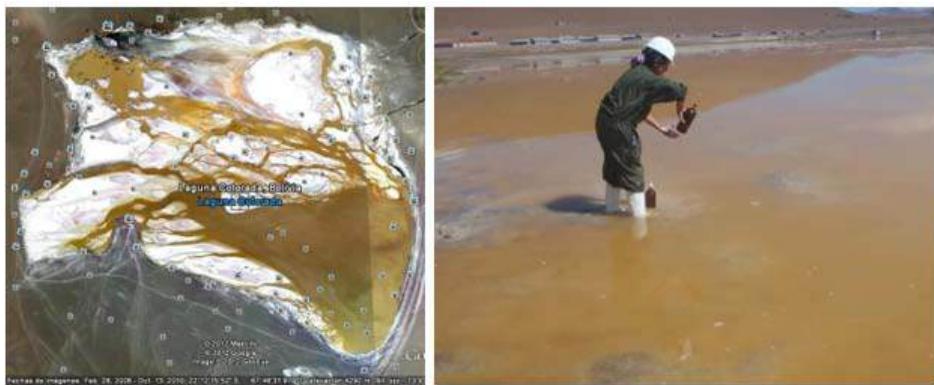 Figure 1: Shape of the lagoon and sampling
2.2. Culture medium
The samples obtained from the lagoon were treated in Erlenmeyer vessels to initiate culture in a medium proposed by Ben-Amotz, A., & Avron, M. (1983) specifically designed for halophilic microalgae and this was subsequently used for mass biomass cultures using a macronutrient-enriched medium consisting of NaCl, , , and .
2.3. Separation of the Dunalliella strain
From the samples collected in the Colorado lagoon, the microalgae were concentrated by centrifugation, these were cultured in test tubes of approximately 10 ml, the upper part of the centrifugation is discarded, while the lower part that contains the largest amount of Dunaliella salina and other microalgae, these are concentrated in other containers maintaining the vital activity with the medium of Ben Amotz Avron. After 25 days, the presence of two species was verified, with the predominance of the species Dunaliella salina, which is separated later. A series of cultures were prepared in Ben Amotz Avron medium in eppendorf and test tubes at different salinities starting from 65‰ to 117‰, maintaining the pH approximately 8.5‰, with continuous light from 18watt fluorescent bulbs to achieve 18000 lux and recorded temperature of 20-22 °C. The test was carried out until the disappearance of the other species is evidenced, obtaining an inoculum of Dunaliella salina.
2.4. Massification of biomass in photobioreactors
Samples of the inoculum of Dunalliella salina were cultured using macronutrients as a culture medium in containers of 50, 100, 500 ml until reaching 5 liters. This strain was then cultured in the 140-liter photobioreactor, the volume was increased at a three-day interval until it reached 90 liters then 140 liters of culture. The conditions were at pH 8, 20000 lux, temperature of 15 °C and agitation less than 75 rpm, the resulting biomass turned green, which is known as the green phase. In this phase, the induction of carotenogenic began by eliminating nitrogen and phosphorus in the culture medium, obtaining after several days an orange biomass, called the red phase. From this phase, the concentration of -carotene was determined. Figure 2 shows the biomass in the green phase and the red phase in the photobioreactor.
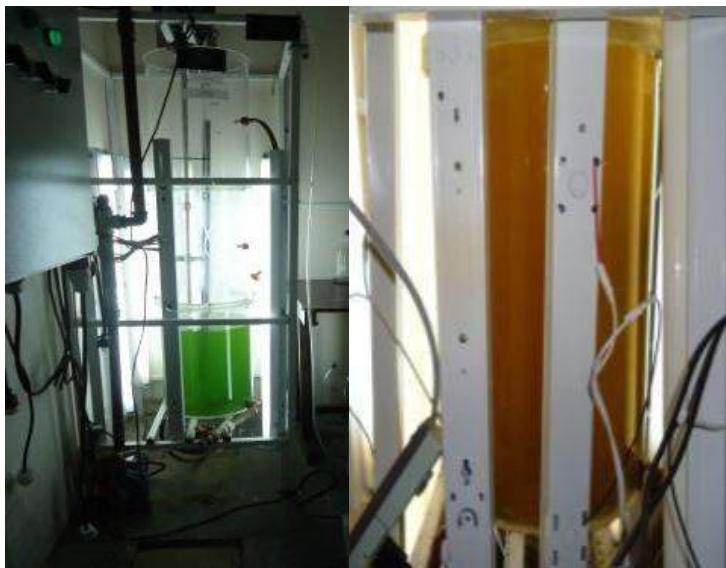 Figure SEQ Figura * ARABIC 2: Dunaliella salina in green phase and red phase roja
Less than one liter of biomass was taken from the green phase and cultured in 30 liters in rectangular containers with sunlight reaching a maximum of 100000 lux per day, see Figure 3. After 20 days of exposure, biomass rich in
Dunalliella salina in the green phase was obtained, and by eliminating nitrogen and phosphorus, carotenogenic was induced. Then the biomass turned orange due to the presence of Dunaliella salina rich in -Carotene.
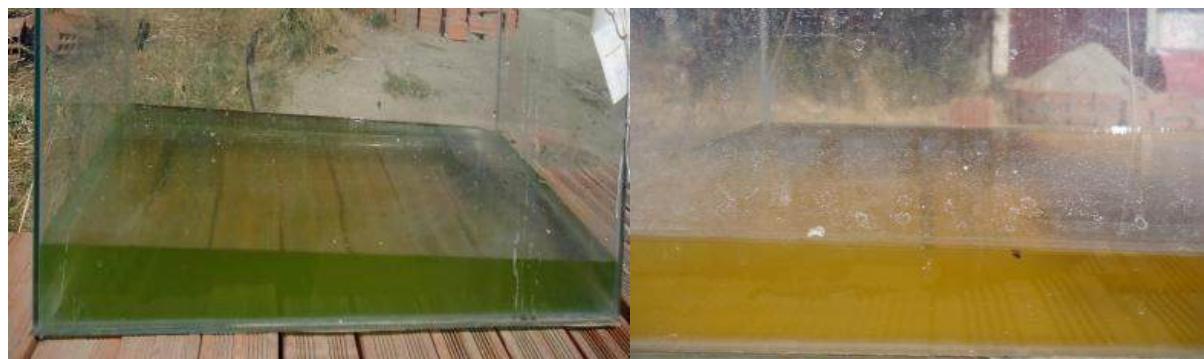 Figure SEQ Figura * ARABIC 3: Biomass in green phase and red phase with natural light
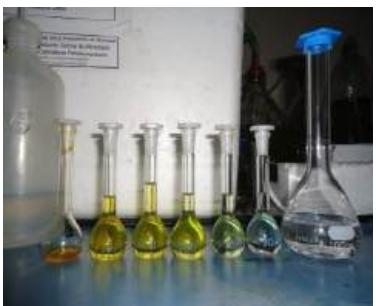
2.5. -carotene quantification To determine the -carotene content, several standard solutions were prepared using analytical-grade -carotene. A standard solution of concentration 0.2892mg of -carotene per ml was prepared. From this diluted and measured solutions were prepared in 10 ml flasks, in Figure 4 is shown the standard concentrations and calibration ratio.
{"image_source":{"path":"images/6d76851ab9e361acafd11c5ec7b74bd16ef2986c58638e526f33d6f6bc238964.jpg"},"content":"","chart_caption":[{"type":"text","content":"Figure SEQ Figura \* ARABIC 4: Standard β-carotene solutions and calibration ratio"}],"chart_footnote":[]}
III. RESULTS AND DISCUSSION
3.1. Speed of massification
The speed of massification of biomass at temperatures above decreases, while at low temperatures growth is better, coinciding with the conditions of the Colorado lagoon where water temperatures are low. For its part, it was recorded that the higher the solar intensity, the better the growth, also coinciding with the conditions of the Colorada lagoon. The values handled in growth are similar to other studies, Prieto Arcas Antulio (2008) recorded that the maximum cell densities were and cell/ml respectively obtained at 10000 lux compared to those of and reached at 20000 lux respectively in this study, in Figure 5 can be seen the trend of growth under different conditions.
{"image_source":{"path":"images/c153138a98ac81b29a7b259a1b43a5068e23805260f4641b19ef76da43d79325.jpg"},"content":"","chart_caption":[],"chart_footnote":[]} {"image_source":{"path":"images/0107c2d8f8f5c0154c301b324975f741e38d16c33b6e52b2a769d5a6a06b6319.jpg"},"content":"","chart_caption":[{"type":"text","content":"Figure SEQ Figura \* ARABIC 5: Environmental factors that control the photosynthesis process"}],"chart_footnote":[]}
3.2. Biomass and quantification of B-Carotene product with artificial light
Samples of Dunaliella salina collected directly in the Colorado lagoon were analyzed in HPLC and the presence of 1325 mg of -carotene in 100 g of biomass was detected. On the other hand, biomass samples produced in the photobioreactor on average was 890 -carotene, the results are shown in Table 1.
Table 1: Concentration of B Carotene in biomass
| Biomass | β-carotene | β-carotene | β-carotene | β-carotene | β-carotene | ||
| Tests | mg/ml | cel/ml | mg/ml | mg/Li | pg/cel | g/100g | mg/100g |
| 1 | 0,58 | 229063 | 0,018 | 18 | 79 | 3,1 | 3103 |
| 3 | 1,89 | 37188 | 0,018 | 18 | 484 | 0,95 | 952 |
| 4 | 2,15 | 121563 | 0,008 | 8 | 66 | 0,37 | 372 |
| 6 | 2,37 | 237813 | 0,016 | 16 | 67 | 0,68 | 675 |
| 7 | 1,9 | 42188 | 0,003 | 3 | 71 | 0,16 | 158 |
| 8 | 2,11 | 53438 | 0,018 | 18 | 337 | 0,85 | 853 |
| 9 | 2,58 | 76250 | 0,003 | 3 | 39 | 0,12 | 116 |
| Average | 1,94 | 113929 | 0,012 | 12 | 163 | 0,89 | 890 |
| Standard Desv. Est. | 0,65 | 86387 | 0,007 | 7 | 175 | 1,029 | 1029 |
| Max. | 2,58 | 237813 | 0,018 | 18 | 484 | 3,1034 | 3103 |
| Min. | 0,58 | 37188 | 0,003 | 3 | 39 | 0,1163 | 116 |
Comparing the data obtained in the project, are within the ranges that were usually observed in other investigations under different culture conditions, based on these values it is concluded that in the project proposed here it is possible to produce biomass with a high content of -carotene (mg/ml) of biomass under culture conditions of an inoculum achieved by the centrifugation and subsequent concentration of water from the Colorado lagoon with a medium Prepared with macronutrients and common salt in drinking water.
The value of 890 mg of B-carotene per 100 grams of average biomass found in the cultured biomass, is lower than 1325 mg of β-carotene per 100 grams of pure biomass recorded from the samples collected in the Colorado lagoon. This is reasonable because it is a site sample with a high concentration of Dunaliella salina. However, in one test it was found at values of 3103 mg of B-carotene per 100 grams of biomass; besides, Dunaliella salina Measurement Institute (Australia) and Craft Technologies Inc. (USA) report the presence of beta-carotene in Dunaliella salina at 1100 to 2100 mg β-carotene /100 g; therefore, the average value found in the project is close to these typical values.
3.3. Biomass and quantification of -caraotene produced with natural light
The biological sludge grown under environmental conditions in winter resulted in a yield of 0.47 mg/ml of biomass in the red phase, which is equivalent to 473.75 mg of biomass per liter, from which 4.26 mg of -carotene/Li of biomass in the red-orange phase are produced, although it is lower than the average obtained in photobioreactor with artificial light (12 mg/Li).
IV. CONCLUSIONS AND PROYECTIONS
-
The results obtained show that it is possible to cultivate Dunaliella salina from the Colorado lagoon in photobioreactors under controlled conditions. It is also possible to induce the obtaining of -carotene, in both cases, using widely studied protocols.
-
The concentrations -carotene obtained by the culture in photobioreactors are similar to the content of the sample taken in high concentration sites of the Colorado lagoon. The most important finding in this study is the evidence of obtaining biomass rich in -carotene using solar radiation and macronutrients that are possible to find in a comfortable way, in addition the cost is much lower than synthetic media, although the concentration -carotene is lower than that produced in photobioreactors with artificial light, but it is possible to improve yields with feasible adjustments. For example, high nitrogen and phosphorus fluxes, which are currently an environmental problem, could be used, and the high radiation of western Bolivia.
-
Based on the relevance of biomass production in photobioreactors with artificial light, especially with natural light, it is possible to use it immediately in aquaculture based on its protein, lipid and carbohydrate content as Rainbow trout feed, especially for the -carotene content to help in the pink color conversion of trout meat. Indeed synthetic dyes are currently used.
-
Several studies have been carried out on the incorporation of beta carotene into the diet of rainbow trout (Oncorhynchus mykiss) to improve the color of its meat. Carotenoids, including beta-carotene, are precursors to astaxanthin, which is the most efficient pigment for intensifying the characteristic reddish color in the flesh of these species. In addition, it contributes to the health of the trout thanks to its antioxidant properties.
-
Subsequently, through advanced chemical processes, biomass rich in -carotene could be used either in pharmaceutical products or in the food industry and for various uses. Its sustainable exploitation of hidden natural resources is an open challenge to diversify economic activities in the future.
PRIMARY REFERENCES
Conflict of Interest
The authors declare no conflict of interest.
Ethical Approval
Not applicable
Data Availability
The datasets used in this study are openly available at [repository link] and the source code is available on GitHub at [GitHub link].
Funding
This work did not receive any external funding.
References
Cite this article
Related Research



Special Issue
Launch a focused special issue to highlight research, emerging trends, and expert insights in your academic field.
