



IntelliPaper
Abstract
The main purpose of this study is to extract the material properties of a composite plate. Hence, a non-destructive fast convergence method has been proposed to achieve this aim. In this regard, the free vibration test data is first measured using modal analysis. Using the differential quadrature method (DQM) based on first-order deformation theory (FSDT), a standard eigenvalue problem is then provided to calculate natural frequencies. The genetic algorithm is then coupled with the differential quadrature method to find the material properties of a composite plate. Finally, the obtained results are compared and validated with available results in the literature, which show high accuracy and a fast convergence rate.
Explore Digital Article Text
I. INTRODUCTION
Many mechanical structures are composed of composite materials in different mechanical, aerospace, and marine industries. Hence, the exact identification of material properties of the composite structure is vital to achieving a safe design because the manufacturing process is effective on final product specifications. There are some destructive methods to obtain material properties of composite structures. The main idea of such methods is based on failure, which these methods are not proper for sensitive industries. Regarding this issue, a non-destructive method was introduced based on modal test data .
They indicated that such a method is exact and suitable for calculating the material properties of composite plates. High computational cost is the main drawback of this method. Therefore, many researchers have suggested methods to overcome this problem, such as the genetic algorithm, colony algorithm, and PSO algorithm.
The optimization of the fundamental natural frequency was presented by Narita for composite plates. He used the Ritz method for solving governing equations derived from the Kirchhoff–Love theory of plates. The presented results showed high accuracy in reducing the search time and computational cost . Apalak et al. optimized the maximum fundamental frequency of composite plates. They derived the governing equation based on classical theory. The optimal stacking sequences of thin laminated composite plates were searched utilizing the Genetic Algorithm, which combined with an artificial neural network model based on FEM. However, the mentioned optimization methods are known as powerful tools; a suitable computational method, such as finite element method, differential quadrature method, etc., should be used to the reduction of computational cost because of their positive features, including fast convergence and high accuracy [9-12]. In this regard, Shahverdi et al. [13] introduced a fast convergence method to calculate layups that led to the maximum fundamental frequency in free vibration analysis. Also, they obtained a layup that led to postponed flutter phenomena. They coupled the differential quadrature method with the genetic algorithm based on the first-order deformation theory to achieve these aims. The obtained results showed that the introduced method is an exactly fast convergence method for solving optimization problems.
In the present study, a coupled genetic algorithm method with the Generalized Differential Quadrature (GDQ) method is implemented to obtain the material properties of a composite plate. For this purpose, the governing equations are extracted based on the first shear deformation theory of plates. Also, the eight natural frequencies are obtained using an analysis modal to define the objective function based on these frequencies. The obtained results are evaluated with the available results in the literature.
II. GOVERNING EQUATIONS
The governing equations for a plate based on the first shear deformation theory of is defined by :
where
where and are the components of out-of-plate moment. and denote the intensity of transverse distributed load and the plate mass density per unit area, respectively. and dente the component of in-plane forces. and are the transverse force resultant. Also, and denote the transvers displacement and the plate's mass moment of inertia.
Based on the first shear deformation theory of plates, the displacement field of a plate is defined by :
where u, v and w denote the displacement component in the x, y and z directions, respectively. and are the in-plane displacement components, and denote the out-of-plane displacement component of the mid-plane of the plate.
the linear strains are expressed by :
where and denote the midplane membrane and bending strain vectors :
The out-of-plane moments are related to the curvatures through the following relations :
The out-of-plane moments are related to the curvatures through the following relations :
where , and denote the extensional stiffnesses, the bending-extensional coupling stiffnesses and the bending stiffnesses, which are associated with the lamina stiffnesses via [13-14]
where are the plane stress-reduced stiffnesses, which are defined with young modulus and poison ratio via
The shear force and the total transverse force components are expressed by :
Substituting Eq. (6), Eq. (7) and Eq. (11) into Eq. (1) and neglecting in-plane load, , yields :
III. GENERALIZED DIFFERENTIAL QUADRATURE METHOD
In this section, the formulation of the GDQM is presented. For this aim, the governing equations of a plate in the form of Eq. (12) is initially discretized by using the GDQ method. The key of this method is to determine the derivative of a function with respect to a space variable at a specific point as a weighted linear summation of all the functional values at all other sampling points along the domain [13]. Therefore, the first order partial derivative of a function with respect to the space variable x for the regular domain may be written as:
where N is the number of sampling points in the domain and is the first-order weighting coefficients to be defined as follows (16):
Also, the higher-order weighting coefficients are defined as follows:
It should be noted that the weighting coefficients are only dependent on the derivative order and on the number and distribution of sampling points along the domain. A well-known method of defining these points is to use Chebyshev-Gauss-Lobatto point distribution given by as:
IV. BOUNDARY CONDITIONS
In this section, free boundary condition is presented.
Hence, at edges or : and .
These equations can be written in DQ form as [13]
At edges or : and . These equations can be written in DQ form as [13]
V. SOLUTION METHODOLOGY
To solve the discretized the governing equations of free vibration problem with applying boundary conditions by generalized differential quadrature method, the combination of discretized equations is essential in which these equations have been expressed by a system of linear equations shown in Eq. (20) [13]
where the subscripts B and D denote the boundary and interior points along the domain, respectively. and imply the influence coefficients appeared in the discretized equations. is the degree of freedom vector including transverse displacements and slope states which considered on the boundaries of domain and defined by: [13]
Also, is the degree freedom vector including transverse displacement of the interior points along a domain and defined by: [13]
Computing from the first row of Eq. (39) and substituting it into the second row results in the following relation. [13]
Where
The Eigen-frequencies of Eq. (20) can be determined through a standard eigenvalue solver.
VI. OPTIMIZATION PROCEDURE
The optimization problem is based on finding those material properties, which is led to the minimum possible objective function. The fibers material properties are behaved as design variables. The optimization problem and the related constraints are expressed as
where the objective function is defined as
VII. RESULTS AND DISCUSSION
In this section, material properties of a composite plate are extracted by modal test data using the coupled method of genetic algorithm and GDQ method. To achieve this aim, the influence of increasing computational points on natural frequencies has been studies for a fully clamped isotropic plate. Also, the obtained results are then validated with available results in the literature. Finally, the material properties of a composite plate based on convergence of experiment results and present work is calculated.
In order to evaluate the accuracy and fidelity of the present approach, free vibration analysis of a square plate with three different boundary conditions is carried out. Table 1 shows the first five non-dimensional natural frequency of a clamped plate in comparison with those reported in [15] where used Ritz method to determine the non-dimensional natural frequencies. In order to perform the convergence study of the present method, different number of computational points has been considered. The convergence of the results is achieved in the sampling point.
Table 1: Non-Dimensional Natural Frequencies of a Square Plate With Clamped Boundary Conditions
| Mode sequence | |||||
| Method | 1 | 2 | 3 | 4 | 5 |
| [15] | 35.992 | 73.413 | 73.413 | 108.270 | 131.640 |
| Present (8×8) | 35.9601 | 48.2587 | 60.7376 | 60.7376 | 83.3110 |
| Present (10×10) | 35.9835 | 59.9761 | 74.0714 | 74.0714 | 80.8834 |
| Present (11×11) | 35.8948 | 73.3901 | 73.3901 | 91.4196 | 108.2071 |
| Present (12×12) | 35.9850 | 70.4137 | 73.3705 | 73.3705 | 100.3230 |
| Present (14×14) | 35.9852 | 73.3923 | 73.3923 | 80.2989 | 108.0977 |
| Present (16×16) | 35.9852 | 73.3934 | 73.3934 | 89.8957 | 108.1927 |
| Present (18×18) | 35.9852 | 73.3937 | 73.3937 | 99.2756 | 108.2699 |
Moreover, the first four shape modes of the plate with simply supported edges have been presented in Fig 1.
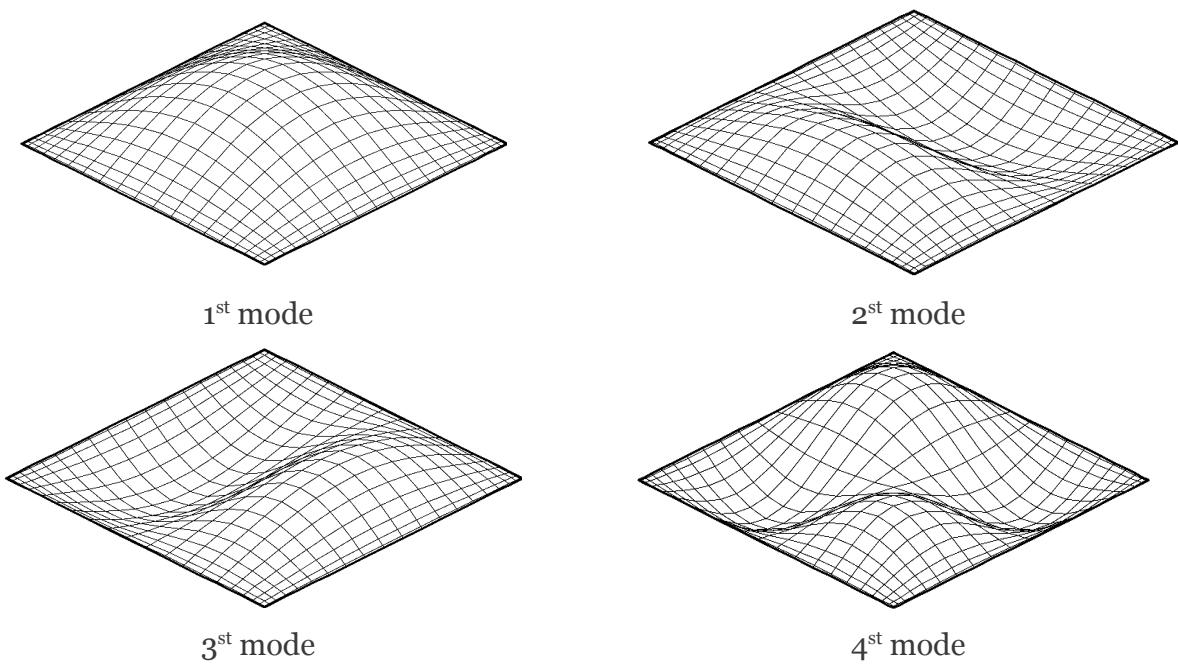 Figure 1: The First Four Mode Shapes of Clamped Square Thin Plate
In the next study, material properties of a composite plate are calculated by using the coupled method of the genetic algorithm with differential quadrature method. In this regard, free vibration data of a composite plate is first done by using modal analysis in which the objective function is calculated based these natural frequencies. The length, width, and thickness of plate is measured 0.25 m, 0.25 m and 0.0028 mm respectively so that the layups orientation of the considered plate is . The lower and upper bound is selected to find material properties of the composite plate according to Eq. (27).
The material properties of the composite plate are presented by Table 2 that are compared with material peripeties obtained by experimental test.
Table 2: The Physical Parameters of Composite Plate
| $E_{11}(Gpa)$ | $E_{22}(Gpa)$ | $G_{12}(Gpa)$ | $G_{23}(Gpa)$ | $v_{12}$ | |
| present | 102.1 | 8.1 | 4.2 | 3.5 | 0.27 |
| Experimental test | 99 | 7.6 | - | - | 0.3 |
The presented results in Table 2 show the accuracy of the present method to calculate material properties of composite plate. The natural frequencies of the composite plate are presented by Table 3 achieved by modal analysis test and the generalized differential quadrature method. The obtained results show good agreement between experimental and numerical methods.
Table 3: Natural Frequencies and Residuals (Hz)
| Modes | Experimen | GDQM | Δ% |
| 1 | 90.2 | 90.11 | 0.01 |
| 2 | 131 | 130.72 | 0.2 |
| 3 | 223.9 | 223.42 | 0.2 |
| 4 | 345 | 344.73 | 0.08 |
| 5 | 361 | 360.99 | 0.5 |
| 6 | 418 | 417.92 | 0.02 |
| 7 | 427.1 | 426.84 | 0.06 |
| 8 | 565 | 563.82 | 0.7 |
IIV. CONCLUSIONS
The actual material properties of the composite plate were extracted. The composite plate's governing equations were derived using the first-order deformation theory to achieve this aim. The free vibration of the isotropic plate has been conducted in which the obtained result was compared with available results in the literature to validate the provided discretized equations. The genetic algorithm with the generalized differential quadrature method was coupled to calculate the objective function. Regarding this issue, modal analysis was performed to calculate the objective function based on modal test data. The evaluation of the presented results clarifies the accuracy and convergence of the present method.
Great Britain Journal Press Membership For Authors, subscribers, Boards and organizations

Great Britain Journals Press membership is an elite community of scholars, researchers, scientists, professionals and institutions associated with all the major disciplines. Great Britain memberships are for individuals, research institutions, and universities. Authors, subscribers, Editorial Board members, Advisory Board members, and organizations are all part of member network.
 For Authors
 For Institutions
 For Subscribers
Author Membership provide access to scientific innovation, next generation tools, access to conferences/seminars/symposiums/webinars, networking opportunities, and privileged benefits. Authors may submit research manuscript or paper without being an existing member of GBJP. Once a non-member author submits a research paper he/she becomes a part of "Provisional Author Membership".
Society flourish when two institutions Come together." Organizations, research institutes, and universities can join GBJP Subscription membershipor privileged "Fellow Membership" membership facilitating researchers to publish their work with us, become peer reviewers and join us on Advisory Board.
Subscribe to distinguished STM (scientific, technical, and medical) publisher. Subscription membership is available for individuals universities and institutions (print & online). Subscribers can access journals from our libraries, published in different formats like Printed Hardcopy, Interactive PDFs, EPUBs, eBooks, indexable documents and the author managed dynamic live web page articles, LaTeX, PDFs etc.
Conflict of Interest
The authors declare no conflict of interest.
Ethical Approval
Not applicable
Data Availability
The datasets used in this study are openly available at [repository link] and the source code is available on GitHub at [GitHub link].
Funding
This work did not receive any external funding.
References
Cite this article
Related Research




Special Issue
Launch a focused special issue to highlight research, emerging trends, and expert insights in your academic field.
