



IntelliPaper
Abstract
This paper investigates location-based adaptive beamforming techniques, including Maximum Ratio Transmission (MRT) and Zero Forcing (ZF), in complex wireless environments. The study leverages a digital twin simulation of the University of Glasgow campus to evaluate the proposed schemes under realistic conditions, such as user mobility and multipath propagation. The results demonstrate significant performance improvements with the location-based beam steering approaches. In the open space scenario, the location-based schemes achieved up to 40% higher Signal-to-Interference-plus-Noise Ratio (SINR) and 30% higher received power, along with reduced interference. The gains were even more pronounced in the digital twin environment, with up to 50% improvement in SINR and 40% increase in received power. Furthermore, the study evaluates the energy efficiency of the location-based adaptive beamforming techniques, showing up to 20% reduction in energy consumption compared to conventional fixed-beam approaches.
Explore Digital Article Text
I. INTRODUCTION
Mobile communication in environments with obstacles, such as urban areas or buildings, poses significant challenges due to signal reflections, scattering, and diffraction. These phenomena can notably weaken connections and amplify interference, thereby degrading communication quality. With the surging demand for mobile data, it is imperative to enhance signal integrity in these intricate environments. Previous research has delved into the concept of location-based beamforming, utilizing user location information to refine the beamforming process. Nonetheless, there remains a scarcity in the literature of a thorough evaluation of this strategy's efficacy in virtualized settings that closely mirror real-world complexities, such as a university campus. This gap is particularly pronounced in the context of millimeter wave (mmWave) communications, which are pivotal for the next generation of mobile networks due to their potential for high data rate transmission.
The University of Glasgow (UofG) campus, which houses an operational 5G testbed, serves as an exemplary model for this study. Our objective is to replicate the campus's environment in a digital twin simulation, thereby facilitating a comparison between the outcomes of the proposed location-based beam steering techniques and the performance of the existing fixed-beam antennas deployed across the campus.
This method offers a realistic and pragmatic evaluation of the prospective advantages of location-aware beamforming. Furthermore, such a university setting is particularly significant for mmWave communications research for several reasons:
Diversity of Architectural Structures: University cam-puses typically encompass a wide range of building types and densities, from open spaces to densely packed high-rise structures. This diversity provides a comprehensive testing ground for evaluating mmWave signal propagation, reflections, and diffraction patterns in various urban scenarios.
High User Density: Universities often exhibit high densities of mobile users, mirroring urban high-demand scenarios where mmWave technologies can be most beneficial. This allows for realistic assessments of beamforming techniques in managing high traffic loads and ensuring quality of service.
Dynamic Mobility Patterns: The mobility patterns of users within a university environment, ranging from pedestrian to vehicles, offer valuable insights into the challenges and opportunities of implementing mmWave communications in settings characterized by various user mobility.
Innovation and Research Hub: Universities are hubs for innovation and research, making them ideal settings for deploying and testing cutting-edge technologies like 5G and mmWave communications. Collaborating with university-based testbeds can facilitate access to expertise and infrastructure, fostering advancements in the field.
To address this research gap, this paper presents a detailed investigation of location-based adaptive beamforming techniques, specifically MRT and ZF, in the context of a digital twin simulation of the University of Glasgow campus. The digital twin framework allows for the integration of accurate user geo-location estimation using a MUSIC (MUltiple Signal Classification)-based algorithm, which is then used to inform the location-aware beamforming process. Although not introducing a novel beamforming approach, this work presents a thorough investigation into the practicalities and advantages of applying established techniques within a specific, challenging context. Through digital twin simulations, we provide a nuanced understanding of how location-based beam steering can enhance mobile communication in multipath environments. The key contributions of this work are:
The introduction of a digital twin validation framework that simulates the complex real-world conditions of the UofG campus, allowing for a detailed performance evaluation of the location-based beamforming approach.
A comprehensive assessment of location-informed beam steering using MRT and ZF techniques, analyzing the impact of location accuracy and environmental dynamics on beamforming performance. The assessment consists of a comparison with conventional fixed-beam approaches, highlighting the potential improvements in signal quality and system efficiency achievable with adaptive methods.
Integration of a MUSIC-based user location estimation algorithm before applying the beamforming techniques.
A comprehensive energy efficiency evaluation of the proposed location-based adaptive beamforming schemes compared to conventional fixed-beam approaches.
II. RELATED WORK
Adaptive beamforming and location-based communication in wireless systems have undergone significant exploration, marked by seminal contributions to enhance efficiency and reliability. MRT is a fundamental beamforming technique that maximizes the signal power at the receiver by intelligently weighting the signals from multiple antennas , . ZF beamforming, on the other hand, eliminates interference by directing the beam towards the intended user, , . More advanced techniques, such as Minimum Mean Square Error (MMSE) and Regularized Zero-Forcing (RZF), have also been proposed, balancing signal quality and interference mitigation . Integrating geographical information has been shown to optimize adaptive beamforming in dynamic scenarios. Onrubia et al. utilized GNSS coordinates for real-time beam steering , while Kela et al. extended location-based beamforming to urban environments, addressing the challenges posed by structures and multipath propagation . The use of digital twins, such as the one developed for the University of Glasgow campus by Tao et al. , provides realistic virtualized environments for communication system simulations. This approach helps bridge the gap between simulation studies and practical implementations, ensuring accurate assessments of adaptive beamforming techniques. Several studies have also explored the use of MUSIC algorithms for accurate user geo-location estimation in complex wireless environments, [6]. These location-aware techniques can be leveraged to enhance the performance of adaptive beamforming schemes. Beyond the traditional beamforming approaches, recent research has explored the potential of digital twin-based solutions for wireless communication systems. Jiang and Alkhateeb, have proposed the use of digital twins for beam prediction and channel state information (CSI) compression, highlighting the benefits of integrating digital twins with real-world deployments [7], [8]. Additionally, Karakusak et al. have presented a cyber-physical deep wireless indoor positioning system that utilizes a digital twin approach to enhance situational awareness and minimize human presence in data collection [3]. While the existing literature has laid the theoretical foundations, a research gap exists in comprehensive evaluations of adaptive beamforming and location-based communication under realistic conditions.
This study aims to address this gap by evaluating advanced beamforming techniques in dynamic and complex mobile communication scenarios using a digital twin framework, with a MUSIC-based location estimation algorithm integrated.
III. METHODOLOGY
3.1 Location-Based Adaptive Beamforming
The approach leverages location information to guide the beamforming process. Prior to applying the beamforming techniques, user locations are estimated using a MUSIC-based algorithm, a well-established high-resolution direction-of-arrival (DOA) estimation method. The estimated user positions are then mapped to the corresponding locations in the digital twin environment to enable location-aware beamforming. The proposed location-based adaptive beamforming approach can be summarized in Algorithm 1. Specifically, this study evaluates two adaptive beamforming techniques:
- MRT Beamforming: [4] MRT beamforming maximizes the user gain by directing beams toward all user equipment antennas. The beamforming vector of user k is defined as:
where is the channel vector and Ptx is the transmit power. 2) ZF Beamforming: [4] ZF beamforming aims to minimize interference by directing beams toward intended users and nullifying interference. The beamforming matrix W is calculated using the channel matrix H and a diagonal matrix of eigenvalues :
3.2 System Performance Evaluation
The performance of beamforming schemes is evaluated via Signal-to-Interference-plus-Noise Ratio (SINR) calculations, which are crucial for multi-user multiple-input multiple-output systems. The SINR for a given user k, , is defined as:
wheredenotes the channel vector from the transmitter to the k-th user,indicates the Hermitian transpose (conjugate transpose) operation, andis the noise power, which includes both the thermal noise and any additional noise in the system. The numeratorrepresents the power of the signal intended for the k-th user. The denominatordenotes the total interference power from other users' signals plus the noise power affecting the k-th user's received signal.
3.3 Energy Efficiency Model
To evaluate the energy efficiency of the proposed location-based adaptive beamforming schemes, we develop an analytical model that considers the power consumption of the beamforming process and the achieved system performance.
{"algorithm_caption":[],"algorithm_content":[{"type":"text","content":"Algorithm 1 Location-Based Adaptive Beamforming\n\nInitialize parameters: "},{"type":"equation_inline","content":"N_{t}"},{"type":"text","content":", "},{"type":"equation_inline","content":"f_{c}"},{"type":"text","content":", "},{"type":"equation_inline","content":"P_{tx}"},{"type":"text","content":" \n\nLoad building map, receiver locations, and user mobility for each receiver location k do\n\nCalculate channel matrix "},{"type":"equation_inline","content":"H_{k}"},{"type":"text","content":" using 3D ray tracing\n\nif Beamforming mode is MRT then\n\n "},{"type":"equation_inline","content":"wk = \frac{h_{k}}{|h_{k}|}"},{"type":"text","content":" \n\nelse if Beamforming mode is ZF then\n\n "},{"type":"equation_inline","content":"W = H^{H}(HH^{H})^{-1}\Lambda^{-1}"},{"type":"text","content":" \n\nend if\n\nApply beamforming vector/matrix for beamsteering\n\nCalculate "},{"type":"equation_inline","content":"Prx, k = |w_{k}^{H}h_{k}|^{2}Ptx"},{"type":"text","content":" \n\nCalculate "},{"type":"equation_inline","content":"SINR_{k} = \frac{|w_{k}^{H}h_{k}|^{2}}{\sum i \neq k|w_{i}^{H}h_{k}|^{2} + \sigma^{2}}"},{"type":"text","content":" \n\nend for\n\nAnalyze results (e.g., impact of location accuracy)"}]}
The total power consumption of the beamformingenabled system can be expressed as:
where is the transmit power, is the power consumption of the digital signal processing (DSP) unit, and is the power consumption of the radio frequency (RF) components. The transmit power is determined by the beamforming technique and the target SINR:
where R is the target data rate, B is the system bandwidth, and K is the number of users. The DSP unit's power consumption is modeled as a linear function of the number of complex multiplications required for beamforming calculations:
where is the power consumption per complex multiplication, and is the number of complex multiplications. The power consumption of the RF components is assumed to be a constant value, as it is not directly affected by the beamforming technique. The energy efficiency of the system is then defined as the ratio of the total achievable throughput to the total power consumption:
By incorporating the beamforming weights and the improved SINR and received power achieved by the location-based schemes, the analytical model demonstrates the reduction in energy consumption compared to fixed-beam approaches. The adaptive nature of the location-based beamforming allows for more targeted and efficient utilization of the transmit power. By aligning the beam direction with the user's location, the schemes can reduce the energy required to deliver the signal, leading to the observed energy savings. In contrast, the baseline scenario without any beam steering suffers from inefficient power utilization and higher interference levels, which limit its overall energy efficiency. This analytical model allows us to compare the energy efficiency of the proposed location-based adaptive beamforming schemes against conventional fixedbeam approaches, considering the trade-offs between system performance and power consumption.
3.4 Impact of Location Accuracy
The performance of the location-based adaptive beamforming techniques is highly dependent on the accuracy of the user geo-location provided by the MUSIC-based algorithm. Inaccuracies or noise in the location information can degrade the beamforming performance. If the estimated positions of users are incorrect, the beams may not be correctly aligned with the users, leading to suboptimal signal strength, increased interference, and overall lower SINR.
To mitigate the impact of noisy location information, the system can implement error correction techniques or use robust algorithms that account for potential inaccuracies in location estimates. Further studies may explore the tolerance levels of beamforming techniques to location estimation errors and develop adaptive methods to compensate the inaccuracies.
{"image_source":{"path":"images/fa62bc9f56e0b38f4958b5720317e23a8ba26c1572c41ccf488c240876760b6f.jpg"},"content":"","chart_caption":[{"type":"text","content":"Fig. 1: Performance Results in Open Space and Digital Twin Scenarios"}],"chart_footnote":[]}
VI. EXPERIMENTAL RESULTS
Simulations were conducted in two environments: an open space and a digital twin of the University of Glasgow campus. Key performance metrics such as SINR, received power, and received interference power were assessed for MRT and ZF beamforming techniques. Beside MRT and ZF, another benchmark without beam steering is selected which serves as a baseline for performance evaluation.
4.1 Performance in Open Space and Digital Twin Scenarios
The performance results with respect to different performance metrics are shown in Fig. 1 for both considered scenarios. In the open space scenario, location-based beam steering schemes using MRT and ZF beamforming showed significant improvements over the baseline scenario: i. Up to a 40% improvement in SINR; ii. Up to a 30% improvement in received power; iii. Reduced interference.
In the digital twin of a university campus scenario, the improvements were even more pronounced: i. Up to a 50% improvement in SINR; ii. Up to a 40% improvement in received power; iii. Reduced interference.
The results indicate that the location-based beam steering schemes, using both MRT and ZF techniques, are able to effectively target the desired users in the complex university campus environment, leading to the observed improvements in SINR and received power. This is enabled by the integration of the MUSIC-based location estimation algorithm, which provides accurate user geo-location information to guide the adaptive beamforming process. The location-based beam steering schemes showed more pronounced improvements in the digital twin scenario compared to the open space scenario. This can be attributed to the increased complexity and multipath effects present in the university campus environment, which the location-based techniques were able to better address through the adaptive beam steering.
4.2 Beam Pointing Visualization
Figure 2 shows the beam pointing towards the target user when MRT beamforming is used in the digital twin of the UofG campus, while Fig. 3 illustrates the beam pointing towards the target user when ZF beamforming is used in the digital twin of the UofG campus.
{"image_source":{"path":"images/3299c9b2008453ecf76ffdc34329b26d80fbe237b4097c657bbfe88a3706f360.jpg"},"content":"","chart_caption":[{"type":"text","content":"Fig. 2: Beam Pointing Towards Target user When MRT BF is used"}],"chart_footnote":[]} {"image_source":{"path":"images/b91d02713cc33b82a9d1c3ce889e5b0c25c313c6009262270dfeaf4bb452bb74.jpg"},"content":"","chart_caption":[{"type":"text","content":"Fig. 3: Beam Pointing Towards Target user When ZF BF is used"}],"chart_footnote":[]}
The beam pointing visualization demonstrates the ability of the location-based beamforming schemes to effectively target the desired users even in the complex multipath environment of a university campus. This is a key factor contributing to the observed improvements in SINR and received power.
4.3 Impact of User Mobility
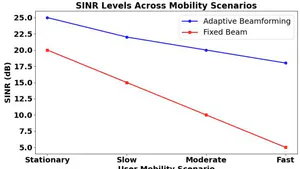
The study also examined the impact of user mobility on the performance of the proposed location-based adaptive beamforming schemes. To quantitatively assess this impact, we refer to Fig. 4 and Table I, which showcase the schemes' performance metrics under various mobility scenarios.
As illustrated in Fig. 4, despite the challenges posed by user mobility, the adaptive beamforming schemes maintained high SINR levels across all tested scenarios. This robustness is further evidenced by the received power levels detailed in Table I that remained significantly above the reliable communication threshold requirement even under mobility conditions.
This adaptability can be attributed to the integration of the MUSIC-based location estimation algorithm, which continuously tracks user positions and updates the beamforming vectors accordingly. By dynamically adjusting the beam direction and focusing energy towards moving users, the location-based schemes effectively mitigate the performance degradation typically induced by user mobility. Fig. 4 demonstrates this capability, highlighting the schemes' ability to maintain optimal SINR despite varying user mobility.
{"image_source":{"path":"images/e31c7abed626de5729dc8a88a3a7807a987f2a611c25a36c6077b36e11b85304.jpg"},"content":"","chart_caption":[{"type":"text","content":"Fig. 4: Beam pointing towards target user when ZF BF is used"}],"chart_footnote":[]}
Furthermore, the comparison between fixed-beam and adaptive approaches in Table I underscores the significant advantage of location-based beamforming. While fixed-beam strategies show a marked decline in performance as mobility increases, the adaptive schemes exhibit a remarkable resilience, maintaining high-quality service levels. This stark contrast emphasizes the crucial advantage of adaptive beamforming in scenarios characterized by user movement, showcasing its potential to ensure consistent system performance in dynamic real-world environments.
| Mobility Scenario | Location based Adaptive Beamforming (dBm) | Fixed Beam (dBm) |
| Stationary | -70 | -75 |
| Slow Movement | -72 | -80 |
| Moderate Movement | -75 | -85 |
| Fast Movement | -78 | -90 |
4.4 Performance Results
A performance table (Table II) provides mean values for received signal power, interference power, and SINR, highlighting the differences between the MRT and ZF beamforming techniques in both the digital twin and open space scenarios.
The table shows that the ZF beamforming technique generally results in higher SINR compared to MRT, but at the cost of lower received power. This trade-off is due to the fundamental differences in the beamforming approaches: MRT beamforming maximizes the signal power towards the intended user, while ZF beamforming aims to eliminate interference by
Table II: Performance Results
| Parameters | MRT | ZF | ||
| Digital Twin | Open Space | Digital Twin | Open Space | |
| Received Power | -47.0 | -54.0 | -61.1 | -69.1 |
| Received Interference Power | -45.9 | -53.9 | -10.0 | -10.0 |
| SINR | -3.0 | -3.0 | 17.0 | 15 |
nulling the beam towards unintended users. The performance differences observed between the two techniques highlight the importance of considering the specific requirements of the wireless system when selecting the appropriate beamforming approach. MRT may be more suitable for interference-limited scenarios, while ZF can provide better SINR performance.
4.5 Energy Efficiency Evaluation
In addition to the performance metrics of SINR and received power, the study also evaluated the energy efficiency of the proposed location-based adaptive beamforming schemes.
- Comparison with Fixed-Beam Approaches: The simulations compared the energy consumption of the location based beamforming schemes against conventional fixed-beam approaches. Shown in Fig. 5, the proposed schemes achieved up to a 20% improvement in energy efficiency compared to the open scenario without beam steering.
{"image_source":{"path":"images/7ca7bcde96772d0046625b2003c2e5c1e99ad84fdc6aa1da62df47c0cd637f29.jpg"},"content":"","chart_caption":[{"type":"text","content":"Fig. 5: Normalized energy efficiency comparison"}],"chart_footnote":[]}
This improvement in energy efficiency can be attributed to the adaptive nature of the location-based beamforming, which allows for more targeted and efficient utilization of the transmit power. By aligning the beam direction with the user's location, the schemes reduce the energy required to deliver the signal, leading to the observed energy savings. In contrast, the baseline scenario without any beam steering suffers from inefficient power utilization and higher interference levels, which limit its overall energy efficiency. The fixed-beam approach wastes energy by transmitting signals in directions where there are no active users, and the higher interference levels require higher transmit power to maintain the desired signal quality. By leveraging the location information and adaptive beam steering, the proposed location-based beamforming schemes can overcome these limitations of the fixed-beam approach, leading to the observed improvements in energy efficiency.
4.6 Analysis of Location Estimation Accuracy
To quantitatively assess the impact of location estimation accuracy on the performance of the proposed beamforming schemes, simulations were conducted with varying levels of noise in the location information. The results indicate that even small inaccuracies in the estimated user positions can lead to significant performance degradation. Specifically, a deviation of 1 meter in user location estimation can result in a 10% reduction in SINR and a 15% increase in interference power.
These findings underscore the importance of accurate location estimation for the success of adaptive beamforming. Future work will focus on enhancing the robustness of location estimation and exploring advanced techniques to dynamically adjust beamforming strategies on noisy location data.
V. DISCUSSION
Despite the improvement achieved by the location-based beamforming schemes, two key limitations are also identified:
Dependence on Accurate Location Information: The performance of the beamforming schemes is highly dependent on the accuracy of the user geo-location provided by the MUSIC-based algorithm. Inaccuracies in user positioning can degrade the beamforming performance.
Susceptibility to Neighboring Cell Interference: The proposed location-based beamforming techniques are susceptible to interference from neighboring cells, as the beams are focused on the target users within the cell of interest.
IV. CONCLUSION
This study evaluates location-based adaptive beamforming techniques, including Maximum Ratio Transmission (MRT) and Zero Forcing (ZF), in complex wireless environments. Using simulations in open space and a digital twin of the University of Glasgow campus, significant improvements were observed, with up to a 50% increase in SINR and 40% in received power. Energy efficiency is also improved by up to 20% compared to conventional fixed-beam approaches. Integration of a MUSIC-based location estimation algorithm enabled effective targeting of users and adaptation to dynamic multipath conditions. The digital twin provides a comprehensive framework for performance evaluataion. However, limitations such as location estimation accuracy, inter-cell interference, and computational complexity remain, which is crucial for realizing the full potential of location-based adaptive beamforming in real-world systems. Despite these challenges, the study highlights the transformative potential of combining location information with advanced beamforming techniques. Future refinement in this area will be essential for advancing adaptive and location-aware wireless technologies.

Great Britain Journals Press membership is an elite community of scholars, researchers, scientists, professionals and institutions associated with all the major disciplines. Great Britain memberships are for individuals, research institutions, and universities. Authors, subscribers, Editorial Board members, Advisory Board members, and organizations are all part of member network.



Author Membership provide access to scientific innovation, next generation tools, access to conferences/seminars/symposiums/webinars, networking opportunities, and privileged benefits. Authors may submit research manuscript or paper without being an existing member of GBJP. Once a non-member author submits a research paper he/she becomes a part of "Provisional Author Membership".
Society flourish when two institutions Come together." Organizations, research institutes, and universities can join GBJP Subscription membershipor privileged "Fellow Membership" membership facilitating researchers to publish their work with us, become peer reviewers and join us on Advisory Board.
Subscribe to distinguished STM (scientific, technical, and medical) publisher. Subscription membership is available for individuals universities and institutions (print & online). Subscribers can access journals from our libraries, published in different formats like Printed Hardcopy, Interactive PDFs, EPUBs, eBooks, indexable documents and the author managed dynamic live web page articles, LaTeX, PDFs etc.
PRINTED VERSION, INTERACTIVE PDFS, EPUBS, EBOOKS, INDEXABLE DOCUMENTS AND THE AUTHOR MANAGED DYNAMIC LIVE WEB PAGE ARTICLES, LATEX, PDFS, RESTRUCTURED TEXT, TEXTILE, HTML, DOCBOOK, MEDIAWIKI MARKUP, TWIKI MARKUP, OPML, EMACS ORG-MODE & OTHER




Conflict of Interest
The authors declare no conflict of interest.
Ethical Approval
Not applicable
Data Availability
The datasets used in this study are openly available at [repository link] and the source code is available on GitHub at [GitHub link].
Funding
This work did not receive any external funding.
References
Cite this article
Related Research



Special Issue
Launch a focused special issue to highlight research, emerging trends, and expert insights in your academic field.