

Abstract
In this paper, we discuss how the simple concept of parity of numbers could be used to improve students’ ability to understand a real-life problem in an efficient way and have a better retention rate. In college, first-year students enrolled in Algebra, Precalculus, or Calculus courses most likely have a lack of knowledge of operations in arithmetic in connection with algebra, geometry, and trigonometry. A certain group of students quite often face difficulty in recognizing mathematical patterns. One goal of this note is to recognize a mathematical pattern, connect it with other related areas of mathematics and science, and find a solution strategy as a general case based on the student’s background knowledge. The overarching goal of this work is to identify the topics in first-year mathematics courses from algebra to calculus, where the students find it difficult because of a lack of understanding or lack of working knowledge and skills. The aim is to determine whether the difficulty involves conceptual or procedural deficiency and to develop resources that could be used to overcome the difficulties.
We discuss some of the mathematical concepts and procedures students find most difficult and provide possible solution outlines. We argue that a possible understanding of the number system and mathematical pattern recognition may provide a strong foundation that enhances the ability, and confidence of a student for better performance, and good retention. Teaching and learning with mathematical parity prepare students for modeling real-life problems in STEM education.
Explore Digital Article Text
I. INTRODUCTION AND DEFINITIONS
In mathematics, parity is a term to express if a given integer is even or odd. The parity of a number depends only on its remainder after dividing the number by 2. Suppose, , , the set of all positive integers. It is known that if x is even than it is divisible by 2. Otherwise it is an odd integer.
Suppose is an even integer. If the quotient is again an even integer, it is doubly even or evenly even. Otherwise, it is known as singly even or oddly even.
The mathematical form of the evenly even and the oddly even numbers:
is the set of evenly even integers and
is the set of oddly even integers.
On the other hand, the odd numbers are not divisible by 2. The odd numbers set is . It is very interesting to observe the unique behavior of odd numbers in many applications.
II. POWERS OF IMAGINARY NUMBER
To evaluate , and
| Evenly even | ||
| Oddly even | ||
| Odd | ||
The general rule: , where r = 0, 1, 2, 3.
III. PYTHAGOREAN THEOREM
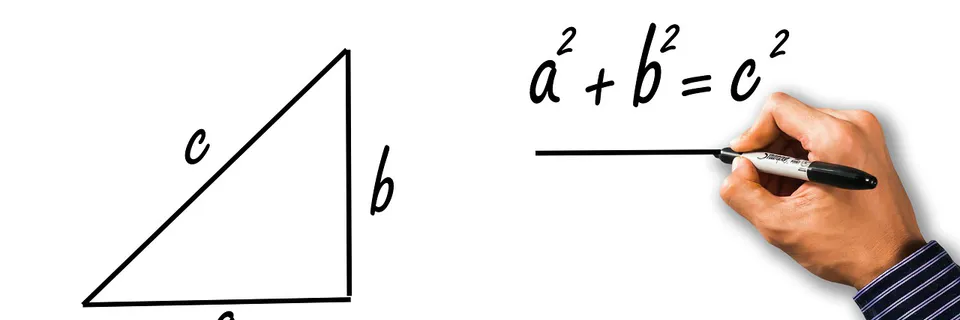
In a right-triangle, the square of hypotenuse is equal to the sum of the squares of the other sides called the legs. This is known as the theorem of Pythagoras [1]. These three measurements are known as Pythagorean Triplets or Pythagorean Triples.
For the positive real numbers, a, b, and c, which are the measures of three sides of a right triangle the Pythagorean Theorem is , c is the measure of the hypotenuse.
We will discuss the known formulas in terms of evenly even, oddly even and odd numbers to determine the pattern.
Here we discuss some well-known results on Pythagorean triplets , , .
Proposition 1: Suppose is an odd number greater than 1, then is evenly even of the form , , and is odd, where .
Proposition 2. Suppose is an evenly even number, then is odd of the form , , and is also odd, where .
Proposition 3. Suppose is an oddly even number greater than 2, then is even of the form , and is also even, where .
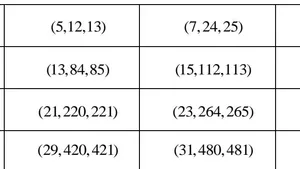
| (3,4,5) | (5,12,13) | (7,24,25) | (9,40,41) |
| (11,60,61) | (13,84,85) | (15,112,113) | (17,144,145) |
| (19,180,181) | (21,220,221) | (23,264,265) | (25,312,313) |
| (27,364,365) | (29,420,421) | (31,480,481) | (33,544,545) |
Table 3: The following results are Pythagorean Triples
, is an even number, Proposition 2 and 3.
| (2,0,2)Does not form a triangle | (4,3,5) | (6,8,10) | (8,15,17) |
| (10,24,26) | (12,35,37) | (14,48,50) | (16,63,65) |
| (18,80,82) | (20,99,101) | (22,120,122) | (24,143,145) |
| (26,168,170) | (28,195,197) | (30,224,226) | (32,255,257) |
More Pythagorean Triples can be found by using the form , , set of positive real numbers.
| k=1, (3,4,5) | k=2, (6,8,10) | k=3, (9,12,15) | k=4, (12,16,20) |
| k=0.1, (0.3,0.4,0.5) | k=0.2, (0.6,0.8,0.1) | k=0.3, (0.9,1.2,1.5) | k=0.4, (1.2,1.6,2) |
Another known approach: Two numbers can be selected and then find the third number of the Pythagorean Triples.
We will select two numbers p and q such that a=2pq, then and . The relation follows the Pythagorean Theorem.
| 2pq=12, q=1, p=6 | 2pq=12, q=2, p=3 | 2pq=12, q=0.5, p=12 | 2pq=12, q=1.5, p=4 |
| (12,35,37) | (12,5,13) | (12,143.75,144.25) | (12,13.75,18.25) |
IV. PYTHAGOREAN PRIMES (FERMAT'S THEOREM ON SUMS OF TWO SQUARES)
In the number theory, Fermat's theorem on sums of two squares states that an odd prime can be expressed as , with , set of positive integers, iff , [3].
The known such prime numbers are
We propose a method to find the Pythagorean primes using the magic rule 8-4-12.
Magic rule 8 - 4 - 12: Choose a Pythagorean prime, then add 8, 4, or 12 in order to collect the next Pythagorean prime. In this process one needs to observe the output. If the output is not a prime, filter it or mark it and continue with the process. Given below is an elastration step by step.
The first Pythagorean prime is .
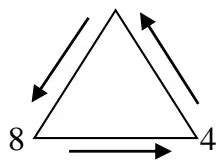
73 + 12 = \textcircled{85}, largest non-prime is 85 in this case.
Box the non-primes, if repeated three times in a row, use the largest non-prime as follows.
Continuing in this process one may easily find infinitely many Pythagorean primes.
We further check the following:
It is interesting to note that each Pythagorean prime number is the sum of one even squares and one odd squares congruent to 1 mod 4 and this representation is unique.
Following list shows the prime positions of Pythagorean primes. The Pythagorean primes are in row 1, their prime positions are in row 2.
| 5 | 13 | 17 | 29 | 37 | 41 | 53 | 61 | 73 | 89 | 97 | 101 | 109 | 113 | 137 | 149 | 157 | 173 |
| 3 | 6 | 7 | 10 | 12 | 13 | 16 | 18 | 21 | 24 | 25 | 26 | 29 | 30 | 33 | 35 | 37 | 40 |
V. PYTHAGOREAN TRIPLES IN FINDING AN ARC LENGTH
The parity among direct variations, Pythagorean triplets, and similar right triangles have applications in determining arc length of a certain types of functions.
The identity is a Pythagorean.
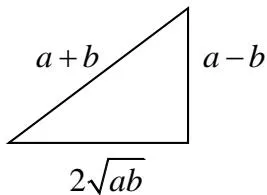
Example 1. Find the arc length of the curve given by the function with the given restricted domain, , .
, then to evaluate the definite integral .
It is expected that the readers know how to simplify the integrand.
It is not too difficult to check that , which is a Pythagorean. One has to verify that or .
VI. HINGES
Definition. Hinges are positions when we split an ordered data set into pieces. John Tukey's upper hinge and lower hinge are the measures of positions, known as third and first quartiles.
Let be a positive integer. Two integers and are congruent modulo , if there is an integer , such that , and commonly known by the notation
Notice that the condition " " for some integer " is equivalent to the condition " divides ".
Suppose we have N discrete ordered data points and to find p segments keeping m data points in each segment. The number of hinges must be p-1.
To determine how many hinges are integer ranked and how many are non-integer ranked.
We observe that when , the number of data points in each segment is and there are r integer ranked hinges.
For simplicity we discuss a special case for four equal divisions commonly known as quartiles [4], and the same idea is extended for deciles [2] and further on even order of divisions or segments.
Suppose N is an even number, the middle most hinge will be non-integer ranked.
Further if N is doubly even, the first and third hinge are non-integer ranked as well. The number of data points N is divisible by 4. This result is confirmed by the remainder rule
, there is no integer ranked hinges.
If N is singly even, then the remainder is 2 when N is divided by 4. The middle most hinge will be non-integer ranked and the other two must be integer ranked. The first hinge therefore is th data point and the third one is th data point, [4], [5].
Corollary 1: If the divisor p is an even number, then there exist midhinge (median) and data set shows symmetry about midhinge.
The midhinge is considered as the median of the ordered data set [4]. If p is odd, midhinge does not exist for the ordered data set and there is no symmetry.
Corollary 2: If the number of data points N is divisible p and N = mp, r = 0, then there is no integer ranked hinge. The positions of the hinges would be between each consecutive groups of m observations.
Note that if N is an odd number and p=4, then the remainder is either 1 or 3. On the other hand if N is an even number then remainder is either 0 or 2.
Remainder r=1 confirms the middle most hinge (median) as integer ranked and other two non-integer ranked keeping m data points in each segment.
Remainder r=3 or p-1=3 confirms all three hinges are integer ranked keeping m data points in each segment. Let us define : m-th observation in the ordered data set.
| r | : first quartile | : median | : third quartile |
| 0 | |||
| 1 | |||
| 2 | |||
| 3 |
The remainder rule we propose works for hinges when the divisor p is an even number. But the remainder rule still works when p is an odd number. In this case, the number of hinges is even, which shows an interesting behavior. Finding integer ranked hinges we keep as an open question.
For example, we have 22 ordered data points and to find 8 hinges for nine segments.
We have N=22, p=9, therefore , where r=4, m=2. It is not difficult to verify that there are 4 integer-ranked hinges and remaining 4 hinges are non-integer ranked. The number of data points in each segment is m=2.
Following are the possible selections.
Observation 1: Integer ranked to non-integer ranked respectively.

Observation 2: Non-integer ranked to integer ranked

Observation 3: With symmetry around the middle line.
Suppose there are N elements in an ordered data set, we are interested to find f-1 fractiles. In this model f is an even number, [2], [4].
Let us consider , where
The number of observations in each segment is known by .
The -th fractile is calculated as follows
, where and are positive integers.
The following model produces fractiles by the following rounding notion:
Condition 1. If , round to the nearest integer when .
Condition 2. If , round to the nearest integer when or .
Condition 3. Otherwise take average of two consecutive terms in the groups with m data points in each.
Example 1. Suppose N = 64, f = 8, , r = 0. In this example all the fractiles are non-integer ranked, with 8 ordered data points in each segment.
| Hinge | |||||||
| Position |
Example 2. Suppose , , , .
In this example all the fractiles are non-integer ranked except the median
, with 8 ordered data points in each segment.
| Hinge | |||||||
| Position |
Example 3. Suppose N = 66, , , r = 2 In this example we have two integer ranked hinges. There are 8 ordered data points in each segment.
One needs to identify integer ranked hinges using the proposed conditions.
| Hinge | |||||||
| Position |
It is very easy to check that and are integer ranked.
The third position is and the sixth position is
VIII. CONCLUSION
In this paper, we proposed several methodologies to solve complex mathematical problems, portraying pattern recognition and parity which could make complex math problems easier. We proposed strategies to determine powers of imaginary roots, calculating Pythagorean triplets and Pythagorean primes using our "Magic Rule 8-4-12", and finding arc lengths and fractiles. Applying these methods could enhance students' background knowledge and skills to face the challenges in STEM education. These methods would be further studied to determine if students are able to implement these tactics to solve mathematical problems more efficiently.
Conflict of Interest
The authors declare no conflict of interest.
Ethical Approval
Not applicable
Data Availability
The datasets used in this study are openly available at [repository link] and the source code is available on GitHub at [GitHub link].
Funding
This work did not receive any external funding.
References
Cite this article
Related Research

Special Issue
Launch a focused special issue to highlight research, emerging trends, and expert insights in your academic field.