





IntelliPaper
Abstract
The impression we have that we are in the future, but we think with the mind of the past. Not only for the war of the last Tsar of Russia, which shakes the remains of the post-Soviet empire but also for the religious war in the Middle East. Our world is also marred by other wars in Africa, in the Caucasus, in ex-Soviet Asia but they are conflicts of an economic nature for the control of the great resources of the black continent. Thus defined the geopolitical framework, the current horizon is clarified, and the gaze is freed for the near future. Because, as in the times of the Homeric wars, what is up for grabs is the economy and the coordination of growth to accelerate common development. There is an urgent need for humanity to free itself from the constraints that hinder progress yesterday and today. First, dedicate large resources to changing the resources we can use as energy, to restore good relations between humanity and the planet that welcomes us. It is not enough. Because the potentials in the West and East are blocked by laws of nature, such as inflation and deflation, monetary anomalies that slow down development and excite old grudges and ideas from the past. We can get rid of the monetary anomalies that excite selfishness (speculation) and return to constant and coordinated development. In fact, the objective of accelerating coordinated development as a whole is certainly important, as opposed to today's messy situation, with countries lagging behind on the path to progress and civilization. The perspective is already underway although, due to the myopia that distinguishes us, it is not fully perceived. The sign of novelty comes from the social and economic tensions that have allowed the creation of supranational bodies, starting with the UN and the planned and ongoing continental unions which indicate the way to finally relegate the very idea of wars and conflicts to the history books. With the angle from the economic side, the tense relations between the West and China can be simplified. The problems of the economy do not absolve anyone. Let's consider that half the world is in the grip of deflation and the other half is in the grip of inflation. All of us, and together, we must face the planet's malaise and the coordination of development between continents. A reality awaits us where science is destined to overcome the value of money and, at the same time, to change social values.
Explore Digital Article Text
I. INTRODUCTION
That we are in a transition phase says it the almost wonder that assails us in front of the geopolitical scenario. Studded with wars that are like shadows of a past that for some does not pass. It is certainly singular that the wars in Europe and the Middle East broke out in the aftermath of the great epidemic that hit humanity in the 2020s and the scenario is moving on fearfully obsolete settings. Wars that only the autocrats of large countries can imagine while humanity struggles to face and resolve major racial problems, migration from the poorest areas, the disordered and differentiated development of continents, the development model that cannot be against the planet that welcomes us. From the geopolitical scenario, a sort of decoupling between the Western Anglosphere, Japan and Africa, etc. is demonstrated. and countries that start wars. Don't be surprised that I include Africa among the countries that appear to be in the first group, because it is true that the Black continent is struggling with local wars. But they are wars born of poverty and the contrast with the presence of essential natural riches in the African subsoil. The West is capable of carrying out the great task of accelerating the development of the Black continent and it would be enough to ease the internal struggles to give strength to the African Union and strengthen relations between the EU and the African Union.
Even China, the economic giant of Central Asia, is in no way comparable to the bloc of the war masters. Meanwhile, Western concern that China wants to invade the island of Taiwan remains only an unsupported hypothesis. Furthermore, China is facing problems that are not easy to solve, after a long period of more than fifty years of breakneck economic growth. An unsustainable pace that lasted beyond the limits due to the state of malaise of the planet which did not tolerate the mandarins' lack of attention to the state of the planet and tolerance for excess waste and greenhouse gases. This means that China has internal problems that are too significant to be able to give in to warmongering flattery. Autocratic or democratic regimes are however subjected to the evaluation of the communities. Which decide consensus or dissent on the basis of the economic and social advantages that the regime, whether libertarian or liberalidical, guarantees or not. It seems clear in light of this precept that the strength of the post-communist regime in China also depends on the strength of the development that has characterized the Asian giant. What can happen at this point, when the success of the Chinese economy is languishing and the conditions can be depressing, starting with unemployment. Without appealing to data that are not always truly truthful, nor to the limitations on technologies envisaged by Westerners about technologies, the interest that Chinese leaders are giving to the delegations of representatives of the economy of Western countries is certainly significant. Confirming that it is not just the weakness of the real estate sector that worries those in charge of the Middle Empire.
Let's not forget that an indicator of the slow decline of the Chinese economy is underway and is creating concerns in the old and new continent:
deflation. For Chinese exports, it is driven by natural dumping due to the drop in industrial and food prices and the indirect transmission of deflation to importing countries, in the old continent, in Germany, France and Italy. Of course, it is premature to think of social unrest due to economic and social problems, due to resentment over the decline in the economy. Yet, the behavior of the leaders of the large Asian country already seems to take into account an ongoing change in the relationship between the enormous community and post-communist power.
The area of democratic countries appears interested in giving consistency and powers to supranational unions, on a political, social, and commercial level. Even under the improper impulse of China's alleged warmongering attitude. This trend is moving towards the right horizon of minimizing differences and aiming for the harmonization of common development. Unfortunately, the issue to be addressed in common is precisely that of development. Which must finance not only the growing expenditure on scientific research but also jointly find the recipes and new discoveries necessary to bring global warming under control. (Fagan 2017) A theme certainly ignored by the warlord countries and still grappling with the obsolete religious wars, used as a curtain for the decadence that afflicts them. Obviously, it is not enough to understand the absolute need to give strength to economic development, we must look at Africa, a continent that was first colonized and then abandoned to historical social, cultural and economic delay. A very serious mistake which can only be remedied by acknowledging that the accelerated development of the black continent requires adequate and substantial funding which only development supported by the rest of the world can ensure.
Not crumbs, therefore, but a common commitment based on a community vision and equally common orientation in terms of commerce, industry, family, and commonality of purposes and objectives. Let us consider that if Europe and North America accept this common vision of the prospects, we can witness, alongside the accelerate improvement of conditions on the African continent, a new winning collaboration. We consider that the accusation that blame the West for the vision based everywhere on democracy and freedom are completely off track. As always, the real division that separates between the countries that have reached an acceptable level of democracy and the others, is the presumption that the state of the economy, is the center of gravity in which the order of the world is being played out. Just as the world of the Cold War revolved around the relative efficiency of systems between the West and the Soviet Russia, no differently today the battleground is always on the level of the efficiency of economic systems.
It is therefore not singular that at the height of an alleged conflict there is the relationship between China, a new entrant in the geopolitical circuit, and the West, understood as a special relationship between the USA and the European Union. The terrain of the solution is once again economic, in the sense that efficiency will decide who has the control stick. Now this approach is really wrong because it is based on competition and not collaboration. It would be absurd for the group of democratic countries not to take note that humanity doesn't have to choose the most beautiful or most fascinating of the contenders. Rather, it is casting the net to attract into the area the countries that have suffered the denial of slavery and colonization and that are waiting to regain the fortunes of a development that history has denied, starting with Africa. (Dozon, 2011)
1.1 In Truth, the Turning Point Could be Africa Uniting Without Hesitation with the West
"Wanting peace is preparing for war" is the opposite of the present condition. I repeat, it is not the competition of arms that is at stake but the competition of the economy. The claim that war decides is wrong. It's an old arsenal to be buried in the history books, there's no use. Instead, the difference between levels of development between continents needs to be overcome by any means. Consider that Humanity needs new work resources in terms of scientific research and financial resources to be mobilized to address the common evil of global warming. A sort of redde rationem that makes us understand what the world needs and doesn't need. The common fight against the planet's malaise cannot be a device in the hands of the great governments of the world. It makes no sense for the West to pay attention to the issue while others are not affected by everyone's problem. (Cossiga, 2023) In the same way, it is no longer possible that on economic issues, i.e. the direction of development, the search for votes and consensus with the usual selfish attitude is entrusted to the narrow vision of individual governments. It is certainly no coincidence that the idea of coordination at a supranational level is gaining strength in communities, in America, Europe, Africa and between the continents of Europe and South America, the Anglosphere, etc.
{"image_source":{"path":"images/3a5e4c0775f7cf65bfda3597d398232b4dd10c0ffb7d7688a52de7c2de3fbe1e.jpg"},"content":"","chart_caption":[],"chart_footnote":[]}
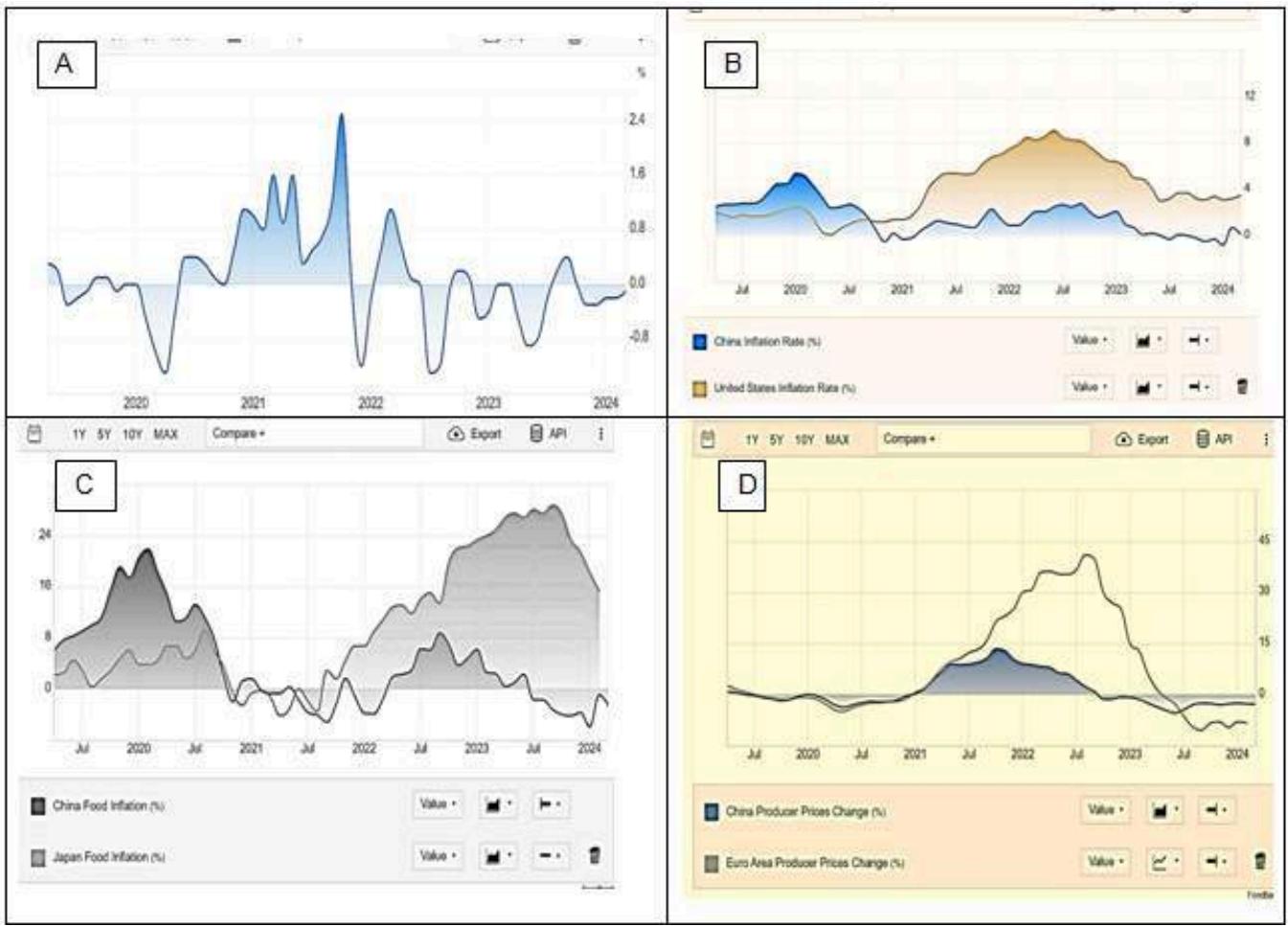 Figure 1 A: China inflation rate (%) C: China Food inflation & Japan Food Inflation B: China Inflation Rate (%) & USA Inflation Rate (%) D: China & Area Euro Production Prices Charge (%)
The geopolitical picture is thus simplified. The comparison does not see two blocks pitted against each other. Each with its allies and enemies. In truth, the turning point could be Africa uniting without hesitation with the West, as the pivot around which the entire geopolitical framework evolves. (See: Sixth European Union - African Union Summit: A Joint Vision for 2030). The contrast between the USA and China seems rather a metaphor for the expected trend of the two economies. But as I was saying, the topic of comparison takes place in the field of development of two large economies. THE assumption that in the next few years or decades the economy of the Middle Empire can continue the domineering march of the previous half century is pure fantasy. Unfortunately, China has hit the wall of building speculation which, as in the episodes that affected Japan and the West in 2008-2009, marks the inevitable end of the acceleration phase and the return to a period of waiting. The Asian country was taking into account the progress in the future to address the great economic and social differences between city and countryside, between great wealth and equally great poverty to relaunch the post-communist model of power. I'm not saying the Chinese economy will be crippled. Of course not, but it will undergo a slow inexorable decline which certainly does not encourage the adventure of a comparison with the rest of the world. (Oliver & Shapiro, 2006).
And from the context of the confrontation that is believed to be underway, let's remove China. Not that it fits in with the world of democracy but that it dilutes the in vain purpose of a world in Sino-structure projection. Have we perhaps gone back with the nostalgia to the "victorious" America at the time of the Cold War? The confrontation between regimes, the freedom and rights allowed by advanced democracies and the post-communist centrality, yesterday and today. Although yesterday as today the problems under management are the development of the economies on one side and the other. As I have had the opportunity to say, if we look at the relations between states and continents, placing the issue of the economy at the center is a winner and above all simplifies the picture.
On the other hand, it does not seem reasonable to blame the liberal policies of the last fifty years, which have moved industrial production from the West to China and have therefore attenuated the development trends from this part of the world towards the East. In reality, this shift towards lower wages and savings for businesses could not be circumvented. Just as discreet backwards movement cannot be circumvented today (reshoring). The problem today is not to slow down China's development to restore the order of primacy. It is not so. Nor is it possible that our governments can succeed in the task. In reality it is not the geopolitical framework that conditions relations but always the driving force exerted by the development of the economy. Well, it makes no sense to kill a dead man just as it makes no sense to punish China for the favorable conditions that were created in the last century to sustain accelerated march that brought the Asian country among the protagonists.
It makes sense instead to consider (see figure 1) that unrepeatable conditions had been created for in terms of costs, availability of expert manpower, liberalization of markets and communication routes that allowed a common advantage. These facilities are now partly worn out and no longer repeatable. It therefore seems like a singular dispute that has been ongoing for some years between the West and China. In reality, apart from these political skirmishes, the natural path of relationships proceeds according to the rule. That is, the need for a renewed conduct of human activity towards the environment. Also, because it escapes no one that the formidable push and development in Asia and the rest of the world has contributed to the planet's reaction. As if to say that human work is at the mercy of the well-being or malaise of the Earth that welcomes us, and it certainly makes no sense to build political signals when natural orientations have changed and require a reflection of all Humanity.
All this to say that the geopolitical framework, apart from the harsh declarations, which also hide problems within the large countries, can be considered lightened. Leaving the decisions on the decentralization or centralization of plants to economic and commercial interests, as in the last fifty years. From this point of view, it appears that the position expressed with great impetus by the former American president Trump is dictated rather by political emphasis. It would therefore be excluded that the world is divided into two parts, between good and bad, although it is not clear who be it one or the other party. It seems rather that the tendency of mutual distrust, especially between the USA and China, can be dictated by issues linked to the natural need for a change in the essential parameters on which the development of humanity is based. We may consider that the issue of discord concerns the exchange between energy factors provided by nature, between fossil energies and renewable energies. A topic on which the next G20 should agree, on the assumption that this sword suspended above humanity requires a common vision and political commitment from all participating countries. With these considerations the geopolitical picture is simplified. We do not have two sides of good and bad, but rather one big side with most continents. With the exclusion of Russia and Iran, which are the oil-producing countries that see with anxiety and trembling the inevitable decline of fossil energy on which the warmongering arrogance that characterizes them is based.
China does not appear in the geopolitics picture, as simplified according to the economic aspect. It's like waiting. The large Asian country must reconcile post-market communism with the potential decline, natural I would say, of the overwhelming development of the recent past. There is no point in a trade war which, as mentioned, must be channeled into a profile of natural compatibility. Not even competition on cutting-edge technologies seems appropriate, both because collaboration and not antagonism must prevail in this matter.
1.2 The Stasis of Economic Development which, Like Sleeping Beauty, May Remain Flat for Several Decades
Having simplified the geopolitical scenario on the basis of the general economic framework, there is the cumbersome demand for the resources necessary to face the planet's troubles with a probability of success. Without forgetting, however, that everything is subject to the ability of the global economic system to create the greater necessary resources. As I was saying, the problem is not the recompositing of the reserves of weapons and ammunition, which are the dark side of the opposition between the blocs. But, on the contrary, the possibilities offered on the economic side, to coordinate the harmonious development of the continents, which is the basis for tackling the curse of unnatural development. As if to say that the problem of global warming requires first overcoming the distortion of disorderly economic growth. In fact, the conflict between humanity and the planet that hosts us must be addressed by all communities. The attention of some and the inattention of others making no sense. But harmony in action is necessary.
The starting point, therefore, is the state of the global economy. Why in the last thirty years has the world economy been affected by violent speculative processes that have led to serious financial crises. In short, the speculative race until the final crisis affected Japan in 1990, much of the West in 2008 2009 and finally China in recent years, again in the real estate sector. I would add that the ultra-speculative phenomenon has always manifested itself with the aftermath of a serious deflation. For our purposes, i.e. the medium-term economic horizon, the ongoing story in China is important. The race of financial values is a dramatic event but generally underestimated, except in the face of the fearful crisis that is its natural severe sequel. It seems difficult to digest but the financial crisis puts an end to the process of values growing without rules, albeit with serious damage to the economy.
{"image_source":{"path":"images/7bd6116c49c4d2214d53772685a1f5e37813e4b884d924caa733d4963b63d94a.jpg"},"content":"","chart_caption":[],"chart_footnote":[]} {"image_source":{"path":"images/8535074b54a37dbc23349a6163aaa265f4651b44acbe48c34d8e6fb8f9373690.jpg"},"content":"","chart_caption":[],"chart_footnote":[]}
{"image_source":{"path":"images/23cacacdd41e9e86d71417bd5bbb47a794e77ea9a8cfac52c3554942188c3e18.jpg"},"content":"","chart_caption":[{"type":"text","content":"Source: Elaborations on Trading Economics"},{"type":"text","content":"Figure 2 A: China & USA Inflation Rates"},{"type":"text","content":"B: China & Euro Area Inflation Rates"}],"chart_footnote":[]}
C: China, Euro Area, India, USA Producer Prices Change (%)
The underestimation of the phenomenon, while it is ongoing, is in facts. Not differently in China, the progressive insolvency of three real estate giants (Evergrande, Country Garden, Shimao Group), and the related excess of construction without a market and prepaid and undelivered houses, is partly contained with public spending. Also to contain social resentment. The experience of the speculative booms of the past seems to confirm that interventions are necessary on a social level, but without as much importance on the economic level, which inevitably suffers a serious recessionary crisis and at the same time the tendency towards deflation which shall prolonged over time –
The underlying issue that needs to be addressed is not so much the trend of the cycle in China but rather the sinking of deflation, which already from the first signs of excesses in residential construction showed the change in the direction of inflation. For what reason? Previous experience in theme of hard speculation shows that countries with weak finances are especially affected, in which there can be a noticeable drop in gross product. Countries, like Japan, which have not hesitated to support the economy post speculative boom, even at the cost of an acceleration of public debt to unusual levels, show a different fate. In fact, deflation has remained an unwelcome guest for over twenty years in the land of the rising sun. With an additional price. The stasis of economic development which, like Sleeping Beauty, are remained flat for several decades.
The Asian country is adopting the same strategy used by its historic competitor. That is, an increase in public spending to avoid the bankruptcy of the real estate giants. This strategy to support the economy, and especially the residential sector, has profound social as well as economic reasons. Let us not forget that the country is the veteran of a long period of excellent results on the path of accelerated development and that the social acceptance of the non-libertarian regime is perhaps based on the economic achievements of which the regime boasts. It must be said that it seems risky to argue that the exceptional steps taken by China after the Second World War are thanks to the Chinese autocracy. It was a composite result in which, alongside the traditional culture of imperial China, a favorable global scenario converged. Well, apart from the search for the paternity of the exceptional economic leap in China, the fact remains that these excellences have undoubtedly favored an autocratic, post-communist regime.
Therefore, it is also the social tensions that have rumbled about the consequences of the near bankruptcies of giants in the real estate sector that recommend widening the public spending cord to contain the hardship of families waiting for homes, even prepaid ones. This brief aside consolidates the idea that the Chinese government is forced to keep these moribund real estate giants afloat. Which is to say that China is following the Japanese strategy after the exceptional speculative boom for many reasons, not just economic ones. On a macro data level, this may mean that the decline in the pace of development, which until the end of the last decade ran in double digits, "obtorto collo", may undergo a considerable decline in the coming years. Until the peaceful haven of zero development for as many years as the duration of deflation in the country.
A mortgage on China's future that can give value to the thesis we support. China should not be considered a potential antagonist of a group that we can generally consider democratic and/or converging towards democracy. The country has internal problems and seems to aim not to disappoint the Chinese community which has an imperial past of excellent culture which, like the United States and other large countries, has an originality that made Morse, Jerome (1783) say "that the new country would expand westward, would propagate principles of freedom throughout the Americas and would become the supreme crowning achievement of human civilization throughout that period and beyond" "In that period America passionately argued that the challenge was not territorial expansion in the traditional sense, but the divinity-preordained diffusion of the principles of freedom." (Kissinger, 2015) – (Gordon (2016)) As I was saying, however, it is necessary above all to monitor the trend of domestic and export prices to measure the effects that current and future deflation may make slowing down the forces of development. In the coming years, the expectation is that the gross product in China will grow modestly and perhaps within the limits of 3-4%. Only to then suffer a decline and disappear to zero. As is known, deflation cannot be counteracted with the attempt to support the declining economy or, as in the case under examination, to avoid the financial collapse of the real estate giants. There is only one method to stem the decreasing or negative rates of prices (as well as the automatically accelerating rates of inflation), that is, recession. Because inflation and deflation are phenomena without a certain paternity, which are ideally modeled by physical laws such as those that regulate matter. They aim to send a message to the community that things in the economy are going badly and that a change of management is needed. In democratic systems, the change of management is implemented by the communities through periodic recourse to the ballot box. For countries with autocratic management, the natural message on the fate of the local economy does not remain without meaning. Because the presence of inflation and deflation everywhere changes the community's framework of consensus and dissent. On the inevitable assumption that no autocrat can go against the current of community sentiment and sooner or later community negative feelings will prevail over illiberal power.
It must be added that both inflation and deflation are opposite phenomena that cannot coexist. Therefore, if a country is struggling with deflation, it cannot be allowed to coexist with natural inflation (therefore linked to an automatic mechanism that fuels the rise in prices). Therefore, the deflationary base that continues to characterize many areas of the West (especially Europe) could not have coexisted with natural inflation equipped with automatic acceleration. Therefore, the inflation that hit the West in the years 2021-2023 was an inflation from international costs (fossil energy), devoid of accelerating automatism.
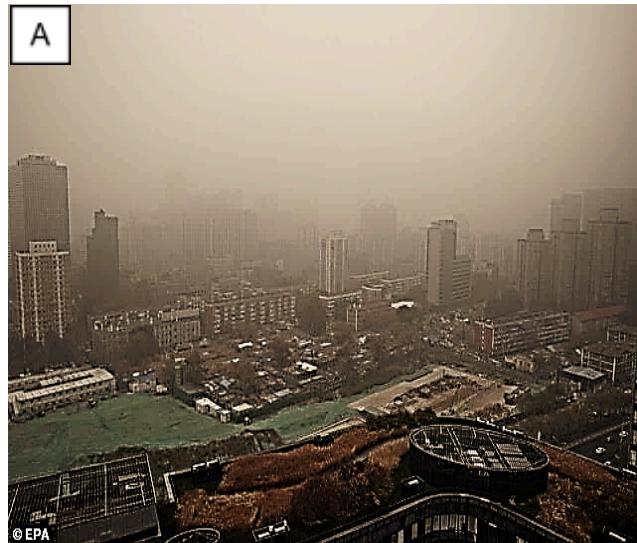
{"image_source":{"path":"images/cce3a5880308dbfc21423a6500defb1c20bd8dfef1afb1ef4c31069f4fc3d9a1.jpg"},"content":"","chart_caption":[{"type":"text","content":"Figure 3 A: Thick cloud of pollution in Beijing \nC: Shanghai, US 500 trend 2023 - 2024"}],"chart_footnote":[]} {"image_source":{"path":"images/48b12aab3d451711f5d627072b2ad959b3f25068cdaf05ea8ad7ccc8e4faadf4.jpg"},"content":"","chart_caption":[],"chart_footnote":[]}
{"image_source":{"path":"images/e5c02325455bfce789e504143110c0cba55b659b3eb4d38b8de1450aaa9a688e.jpg"},"content":"","chart_caption":[],"chart_footnote":[{"type":"text","content":"Source: Elaborations on data Trading Economics"},{"type":"text","content":"B: CN, Euro, US, India Producer Prices Inflation MoM\nD: EU 50, US 400, US 2000 Trend stock exchanges"}]}
This brief overview introduces us to the topic of deflation and the consequences of this monetary morbidity. Unfortunately, they are undervalued because the index usually falls weakly or tends cautiously to negative. The consequences on the economy, therefore, can be underestimated or even welcomed positively, especially in a country that is considered the world's factory. In truth it is a rope that tightens the economy around the neck and sucks its potential. At first glance, as we have already said, the fall in gross product undergoes a slow decline, reviving hopes that the counteracting game carried out by public deficit spending can balance the attraction towards the recession typical of deflation. This is a serious mistake. Stemming the financial fall in a deflationary context can have convincing motivations and effects. However, the hope that we can fight deflation with the use of (excessive) liquidity is a mistake that Japan has paid for with the twenty-year stasis of the development trend. The issue, however, of deflation in China is not an event destined to remain within the country, precisely because of the size reached by the Chinese economy and the widespread network of commercial relationships with the rest of the world.
I am talking about the contagion that deflationary China can export to many Western countries that have extensive commercial links with Chinese entrepreneurship. Let us remember that one of the "natural" conditions that allowed the Asian giant to make a great leap for decades were American and European companies, attracted to China by the low cost of labor and a workforce with an adequate level of education. In response to the attraction to relocate industrial plants, China has become the factory of the world. I just note in passing that the move towards China has had no consequences, if not worsening, on global warming. The images of cities of the Middle Empire enveloped in a pall of soot and dust are sadly known. (Collins, & Margo, 2004) In return (hyperbolic) to the transfer of industrial plants to China, today and over time we will have a return deflation in all countries that maintain commercial relations with the Asian country. We could say that it will be a light deflationary wave.
However, the impact that the countries will suffer will be proportional to the export harvest that will reach individual Western and Asian neighboring countries from China. The concern may be intensified because many countries in Europe, Asia and Latin America already suffer from a residue of deflation, which is in the economic veins of half the world as a result of the financial crisis of 2008-2009. The question we can ask is the following. Can the residual deflation that has existed in Europe for over a decade be added to that we are importing from China? And with what consequences? To seek auspices regarding the summability of domestic and imported deflation, we can remember that even in the recent inflation from international costs the latter was added to the residual existing deflation. I would say, thus contributing to the somewhat impulsive collapse of the leap in inflation.
IN conclusion, in the coming years the countries most exposed to Chinese contagion can expect some steps in imported deflation. Imported deflation behaves like international cost inflation; the in-corpore and imported deflation are algebraically added. With what practical effects? We have seen them in almost all European countries in which international cost inflation which had reached a level of 12% on average was reduced to 2.5% on average, I would say anticipating the also decreasing prices of fossil energy.
I would like to add that the transmission of Chinese deflation to Western and Asian countries moves in the wake of Chinese export prices around the world. The novelty lies in the strong impulse of the mass of Chinese exports, certainly not to be underestimated. I doubt we have an antidote to rid the world of the influence the Chinese economy will have on monetary anomalies outside of China. We also believe that China's export costs impose a downward trend on the production of export-oriented countries, including Germany and Italy. With the result of setting in motion a further push towards deflation, in particular, as a reaction in countries with an export vocation and which suffer from monetary dumping of exported Chinese products.
1.3 The Risk is Underestimating the Dangers Inherent in Deflation
The thorniest issue is the real or expected behavior of the main Western central banks. Not only because of the uncertainty that seems to dominate interest rate trends. The panorama is complicated by the presence in Europe, and consequently in America, of the carambola of inflation and then of ongoing or imported deflation. Venturing into the jungle of forecasts is difficult because the disturbances that the wars in Europe and the Middle East will cause on the economies of the main countries are unknown. For the next meeting sessions of the FED or the ECB, the greatest concern remains regarding the direction, up or down, that prices will take in the major countries. Dynamics on the cost of money are therefore expected. On the other side of the Atlantic, it is excluded rate adjustments which remain at 5-1/4 to 5-1/2%. If to simplify the reasoning we exclude the geopolitical framework for now, the thermometer seems linked to the strength of the American economy, which excludes interventions to lower rates for now. The expected decision of an initial downward adjustment of rates in the Euro Area is more problematic.
The euro area, in fact, is subject to residual inflation, due to international costs, and natural deflation, which remains in its veins with the impact of deflation imported especially from the Chinese market. The result is before our eyes. A perhaps too rapid decline in the inflationary wave that hit the costs of fossil energy. A condition has therefore been created that seems favorable to the expectations of a decline in the cost of money in the Euro Area with a first cut of 25 basis points by June. The positions remain somewhat conflicting. Which position to take and why? The geopolitical situation advises against anticipating monetary policy moves. But in the hope that the context does not worsen, we must insist on the inadvisability of reducing the cost of money. Let's see why. The economy of the area would benefit from a limited drop in the cost of money. Little or nothing, it would in fact be a conceptual push that relies on the hope of further cuts in the coming months. Well, this prospect seems harmful. The problem is the persistence of deflation and the downward pressure on the cost of imported Chinese products. The latter is a non-limited downward tension, destined to last for a long time. With what results. The downward pressure on industrial production in Europe due to the competitive pressure (monetary dumping) exerted by Chinese industry.
A real puzzle. Because the "natural" deflation that Europe inherited from the 2008-2009 financial crisis cannot be fought at the pace of favorable monetary and economic policy. Unfortunately, easing economic and monetary policies has a harsh cost: the fall in the economy's productivity and, in combination, the probable new race to the top of stock markets and asset values. It can be added that an adjustment to interest rates would be welcomed in the commercial and industrial sectors to compete with Chinese competition. Furthermore, sharing the need for the European area to stem the innovation of below-cost products, it seems appropriate to implement anti-damping actions in defense.
We add that the geopolitical framework looms with fluctuations in the costs of fossil energy, with the consequence that cost inflation adds to the deflation in the field. Thus, it obscures the true presence of underlying deflation in many economic systems. In other words, modest variations above 2-3% in prices in the western area must be deciphered considering the confluence of disturbing elements on the prices scale. On the other hand, deflation and inflation are not tools at our disposal. Instead, they are, or we should consider them as such, instruments that have no paternity and which emerge to give alarm messages about the unbalanced direction of the economy. Therefore, help to avoid a potential irreversible fall on economic systems. As said, monetary messages are directed to the community whose task is to control and give correct direction to the economy. (Kose, Otrok, Whiteman, 2019).
In other words, following the natural order and not the selfishness of some leaders, it would be possible to maintain the course of development along the line of constant and gradual growth. Which instead is lost for the global economy due to wrong decisions. In this regard, it must be considered that it is up to the community to give consent or dissent to government programs. (Cossiga, 2023) Under non-democratic conditions, the principle always remains that no autocrat can rule against his citizens. In some way, the economy's tendency towards constant and gradual growth is written into natural laws, in accordance with the nature that welcomes us. The frequent deviations from the natural path of development of human societies are the reason and the cause that brings inflation and deflation into the field of economics. Two different and opposite monetary anomalies that come into play not by chance, but to correct distinct developmental ailments. As I have already said, deflation comes into play when speculation pushes asset values to levels incompatible with the market. If this upward race could continue, the moment of no return would be reached. Well, to avoid the looming danger, deflation comes into play and informs the community about the serious malaise that looms. In order for the community can play its part as a guarantor of good governance for advanced democratic countries and to disagree elsewhere. It's not enough because the good rules don't end here. If the message of deflation is not enough to correct the status quo, it means that speculation will continue its crazy race. But here too there is a limit that cannot be overcome. Beyond which the unscrupulous race stops due to the looming financial crisis and the lack of liquidity.
It is difficult not to see in this relaunch between imbalance and sudden stops, on the threshold of grave danger for the fate of humanity, a wonderful natural shield against our ignorance. It's true that in economics nothing is free and if you make a mistake you pay. The community pays, as it is the spokesperson for the laws that regulate the economy and has the task of supervising the direction of development. Not only in countries of advanced democracy, which are responsible for political leadership, even in countries governed by autocrats who survive only if they increase the well-being of the community. (Cossiga, 2021)
The risk is underestimating the dangers inherent in deflation. The long-term monetary anomaly coexists with the phenomenon of speculation of financial values, which take on an autonomous character with respect to the real economy. The off-roading of asset values and stock markets is pushed towards increasing values independent of the condition of the real economy. On the other hand, the attraction exerted by the financial market takes away means and financing from the languishing real economy. Monetary policy then comes into play. It is considered reasonable for interest rates to fall in conjunction with deflated prices. A cheap credit market therefore opens, which fuels speculation and the rise in asset values. All this, while the real economy remains weak.
I repeat, the risk is the reiteration of the speculation process which stops with the financial crisis and the consequent damage to the development of the territory. The danger may intrude by an accommodating monetary policy, but it is an accommodation for speculation and leaven without substance for stock market and asset values. Given that interest rates have been affected by the recovery of inflation (from international costs), the claim that the conditions have been created in Europe for a reduction in rates, on several occasions until 2025, seems improvident. The issues of support for the economy are up to economic policy while monetary policy must look to the long term. And there is also, albeit remotely, the danger of the resurgence of a new speculative bubble that once again affects the economy at all levels. For those who suggest a drop in rates to give breathing space to industry and commerce, it must be confirmed that in times of even imported deflation, development potential languishes, while the availability of credit moves in favor of speculation. It must be repeated that deflation can only be fought with a restrictive monetary policy that allows the economic system to follow the path to recovery of equilibrium.
{"image_source":{"path":"images/0239361ca60b9b0f9b382d9ab3578c0545351918ff68e226943876700452c9d4.jpg"},"content":"","chart_caption":[{"type":"text","content":"Figure 4A: EU, US, JP GDP Annual Growth Rates"}],"chart_footnote":[]}
Still about the global economy, the danger of the current direction is confirmed among other things by the run of the US stock markets (see figures 4 B), which show the irresistible climb of stocks in American territory. The abrupt interruption marked in the 2020s confirms that not all evils come to harm. The serious Worldwide epidemic has severely affected life on the planet but has blocked the rise on the financial market. A deep pause. However, as can be seen, the attractive force of speculation has regained strength. An undoubted sign of the lack of attention paid to deflation, which instead fuels a danger that is as serious as long-term inflation. Also significant is the acceleration marked by the Nasdaq, the US stock exchange for technology companies, which are more sensitive to the tensions imposed by speculation. (figures 4 B)
Faced with the challenges that await humanity in relations with the planet and the various communities, the essential problem is to accelerate the development of the global economy by taking the path of constant gradual development, not in conflict with the laws of nature. Well, the current condition, which sees half the globe grappling with deflation and therefore with a chronic slowdown in economic growth, becomes in itself an unknown danger.
{"image_source":{"path":"images/d5071653c94c87cac4f47062a0719688b6a98cef21d1207822d08247c8417e70.jpg"},"content":"","chart_caption":[],"chart_footnote":[]}
There is always a lurking theory that the good condition of the stock markets and finance is a good omen for the real economy. Unfortunately, this is not true. Why? The natural task of deflation is to correct the excess financialization of the market, which leads to speculative excesses. Letting the natural control mechanism operate means:
-
Take note that support for the economy, for the relaunch of the declining economic cycle, goes against the natural ongoing correction.
-
The cost of money plays a primary role in curbing the tendency towards a gap between the strength of the financial market and the weakness of the real economy.
It is naive to believe that we can circumvent the natural barrier represented by deflation. This is demonstrated by the singular weakness shown in the last decade by the euro countries and in particular by Germany, France and Italy. In compliance with the rule that in economics those who make mistakes pay, we must have the political courage not to intervene and to let the natural mechanism of recovery of imbalances operate.
The path that monetary policy must take in Europe and America is more difficult. Above all, we must not listen to the market sirens calling for interest rate cuts. An imminent danger in Europe, where the siren song of deflation hides the reality and presents a scenario of prices in equilibrium close to 2%. A false equilibrium which in concrete terms is the algebraic result of inflation from slowly falling international prices and continued deflation present in the EU area for well over a decade and exasperated by the financial crisis of 2008 2009. I would add that I agree with the economic and political analysis recently made by Mario Draghi, but without the discipline to ward off the siren of deflation, it will not be possible to recover the balance of constant and gradual development (to respect nature).
II. CONCLUSION
In short, after having discussed the hypothesis that the resolution of the war in Europe could be the epicenter on which to reconstruct the transition towards a new era, still distant but whose contours can be glimpsed. It is suggestive to think that the topic in question is not a new balance between West and East, a new hierarchy between East and West but rather a change of perspective dictated once again not by the hierarchy of weapons but by the change in the economic paradigm. It is not a question of measuring the economic strength of each individual, because war can objectively be overcome, because it is in turn based on the variable wave of the economy. The idea is that the new economic paradigm is abundance. Therefore, abandon the ideology of scarcity on which the social scheme of relations between territories is built and instead admit that we have reached the threshold of an era that abandons wealth as a privilege of the few. (Smith,1922) Choose the path of coordinated and accelerated development, which is now possible for humans only if we realize that the solution is never war. Also for the challenges that life has ahead of it.
Conflict of Interest
The authors declare no conflict of interest.
Ethical Approval
Not applicable
Data Availability
The datasets used in this study are openly available at [repository link] and the source code is available on GitHub at [GitHub link].
Funding
This work did not receive any external funding.
References
Cite this article
Related Research


Special Issue
Launch a focused special issue to highlight research, emerging trends, and expert insights in your academic field.
