




IntelliPaper
Abstract
INTRODUCTION: The Solanum boldoense Dunal & A.DC, is endemic to Cuba, where it is found in forests and forest edges at low to medium elevations. It has two synonymous species, Solanum cardiophyllum Dunal and Solanum scandens Sessé & Moc. . In Cuba it is used as an ornamental because of the color of the blue flowers. In the form of a vine, the fruit is a globular berry, 1-1.2 cm in diameter, red when ripe. It is occasionally confused with the Mexican and Central American Species S. dulcamaroides Dunal, to which it is probably closely related. OBJECTIVES: For not having previous studies Phytochemistry it was decided to study trying to know the steroidal compounds of the species. MATERIALS AND METHODS. The plant was collected in the Serra da Grande Pedra, in Santiago de Cuba, by Dr. Victor Ramón Fuentes Fiallo, who in addition identified it and made the desiccant, which was deposited at the Experimental Plant of Medicinal Plants, Dr. Don. Tomás Roig, Minsap, Cuba. The plant was transferred to the Organic Chemistry laboratory of the Faculty of Chemistry, where the organs were separated, and placed to dry in the shade and then in an oven with air flow at 40-50 ºC, for 48 hours. After drying, the material was ground to a homogeneous powder. For the extraction, the decoction method was used for 4 hours, which was repeated 4 times. The extracts were concentrated in vacuum to syrup. From the column layer chromatographic study, it was possible to purify three steroidal compounds, which were soon identified through the layer chromatographic study, using isolated and identified steroid patterns from other Solanum species. RESULTS: From our phytochemical study, the isolation and identification of three steroidal compounds was obtained, such as Solasodine, Solasodieno and Diosgenina. CONCLUSIONS: Solanum boldoense Dunal & A. DC, has steroidal compounds such as Solasodine, Solasodiene and Diosgenin.
Explore Digital Article Text
I. INTRODUCTION
The Antilles (Bahamas, Greater Antilles and Lesser Antilles) are an area with great floristic wealth and, most importantly, with a high level of endemicity in many groups. The West Indies are generally defined as the islands of the Caribbean comprising the Greater Antilles (Cuba, Hispaniola, Jamaica, Puerto Rico), the Bahamas and the Lesser Antilles (Windward and Sotavento Islands), but excluding the islands of Trinidad and Tobago, which are continental origin. [1] Solanum (Solanaceae) is a very diverse genus in the region, which has 25 endemic species. Nineteen of these taxa are endemic to a single island, and some have not been collected since the early 20th century. A synopsis is now presented of the endemic species of the Antilles, with all the synonyms and their distribution and with the citation of a representative specimen of each species. All accepted names and synonyms are to have lectotyped when necessary; many of these taxa were described from collections that were preserved in Berlin (B), but have disappeared. The Lectotypes designated here are illustrated [1].
In Cuba there are six species of the genus Solanum that are endemic and that have not yet been studied phytochemically, among them the Solanum boldoense Dunal & A. DC. A species that grows mainly in the eastern region of the country, specifically in the Serra da Grande Pedra, in Santiago de Cuba. According to Knapp 2009, the other endemic species are; Solanum chamaeacanthum Griseb; Solanum gundlachi Urb.; Solanum maestrense Urb. & Ekman; Solanum moense Britton & Wilson.; Solanum pachyneurum O.E. Schulz. and Solanum pachyneuroides Amshoff. [1]. These species must be located and updated in our inventories of endemic plants, as they have been located and identified for many years, not being able to find them in the regions indicated in the current inventories.
The Solanum boldoense Dunal & A.DC, is endemic to Cuba, where it is found in forests and forest edges at low to medium elevations.
It presents two synonymous species, Solanum cardiophyllum Dunal and Solanum scandens Sessé & Moc. [two].
This interesting Cuban woody vine has a very wide local distribution in this region widely separated actions; ex: In Matanzas this grows especially in the famous gorge of the Yumury or Rio Yumury. This gorge is one of the scenic attractions on the north coast of Cuba. In Pinar del Rio in San Diego de los Banhos. Specimen 381 by C. Wright was collected in Oriente. [3]. A species that grows mainly in the eastern region of the country, specifically in the Serra da Grande Pedra, in Santiago de Cuba, where it was collected for our study.
In Cuba it is used as an ornamental because of the color of the blue flowers. It is occasionally confused with the Mexican and Central American species Solanum dulcamaroides Dunal, to which it is probably closely related. It is also somewhat morphologically similar to Cuba's Solanum boldoense. The filaments of Solanum dulcamaroides and Solanum boldoense are the same. The tube, while the pedicels of Solanum dulcamaroides and Solanum seaforthianum are articulated at the base by a small sleeve. [2] Belongs to the Subgenus Solanum, Section: Dulcamaroides [6].
Solanum boldoense Dunal & A. DC has no previous phytochemical studies carried out and that is why its study was interesting, to evaluate the presence or absence of steroidal alkaloids and sapogenins.
II. MATERIALS AND METHODS
2.1 Collection of plant material and its preparation
The collection was carried out in the Grande Pedra area, in Santiago de Cuba, by Dr. Victor Ramón Fuente Fiallo, who made his taxonomic identification. A branch was used to obtain his exsiccate, which was deposited in the Herbarium of the Experimental Plant of Medicinal Plants Dr. Don Tomás Roig.
To obtain the extracts, the plant was taken to the Organic Chemistry Laboratory of the Faculty of Chemistry, University of Havana, Cuba. The organs were separated (leaves and stems) and allowed to dry at room temperature in the shade and then in an oven with forced air ventilation at 48-50 °C, for 48 hours. Soon the dry plant material was ground to a homogeneous powder, in a mill with water recirculation
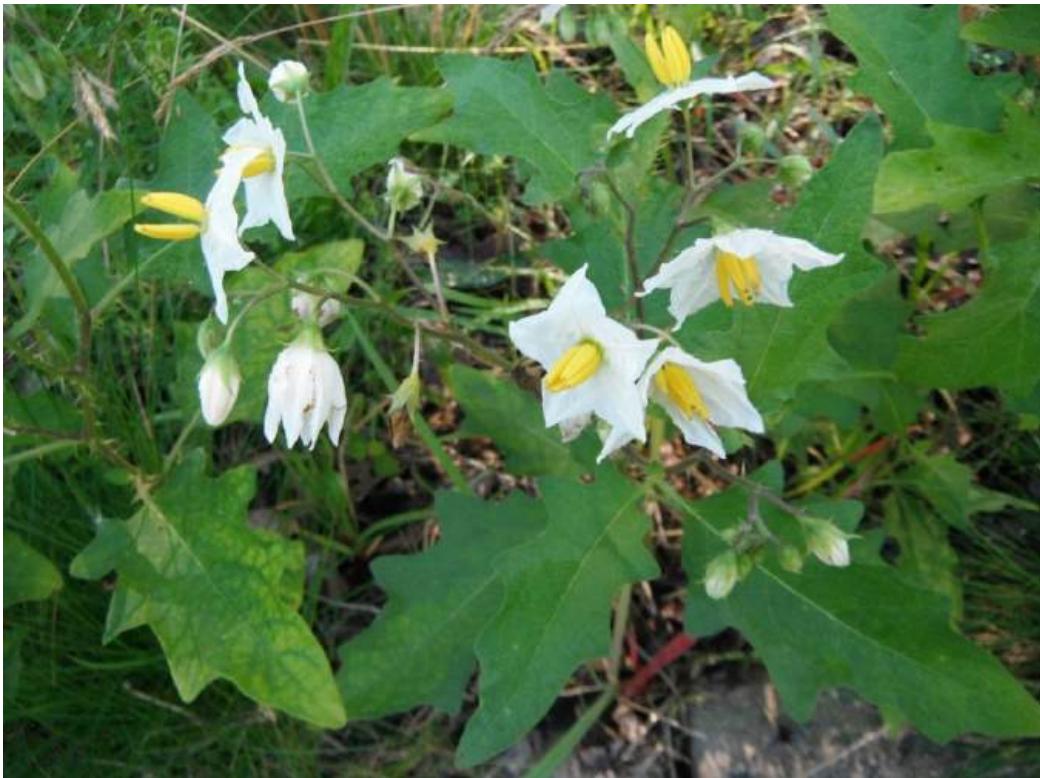 Figure. 1: Solanum boldoense Dunal & A. DC plant. Showing your flowers. (Photo. [3].)
III. BOTANICAL DESCRIPTION OF SOLANUM BOLDOENSE DUNAL & ADC [2]
Woody vine bush or liana; flexuous rods, glabrous; minutely pubescent new growth, trichomes ca. 0.4 mm, simple, unified, then glabrous; bark of older dark reddish-brown stems.
3.1 Plurifoliated sympodial units.
Simple leaves, 4.5-7 x 3-5 cm, ovate to strings or narrowly strands, glabrous on both surfaces or with a few simple uniseriate simple trichomes along the central rib above; primary veins 5-7 pairs, drying reddish; corded or truncated and oblique base; entire margins; apex acuminate; petioles 2.3-3.5 cm, glabrous, twisted to assist in climbing the supports.
Opposite or terminal leaf inflorescences, 10-30 cm, ovoid to ellipsoid in general, branching 5 times, with 50-100 flowers, glabrous; peduncle 1.5-9 cm, glabrous; thin pedicels, 1.2-1.7 cm, ca. 0.5 mm diameter at the base, ca. 1 mm in diameter at the apex, inclined, glabrous, articulated in the distal room just below the calyx tube, leaving an elongated nail, occasionally articulated in the basal of the pedicel, but always leaving a distinct nail; well-spaced pedicle scars ca. 1 cm apart, a series of pins elongated due to the point of articulation. Globular and somewhat inflated buds, the corolla is strongly exerted from the calyx tube.
Perfect flowers; calyx tube 3.5-4 mm (for the joint), the upper part 2-2.5 mm on a comical structure similar to a receptacle, the lobes absent or mere undulations on the edge of the tube, glabrous; corolla 2-2.3 cm in diameter, purple or violet, starry, lobed ca. from the path to the base, the lobes 0.8-1 x 0.4-0.6 cm, flat (or slightly shell-shaped?) In anthesis, the margins and tips of densely papulous cucumbers; anthers 4-4.5 x 2-2.5 mm, robust, poricidal at the tips, pores widening for cracks with age;
free portion of the filaments ca. 0.75 mm, the filament tube \<0.1 mm, glabrous; conical, glabrous ovary; style 0.8-0.9 cm, glabrous, the stigma capitate, the surface minutely papillary.
The fruit is a globose berry, 1-1.2 cm in diameter, red when ripe, the pericarp thin and shiny; fruiting pedicels 1.1-1.3 cm, ca. 0.5 mm diameter at the base, ca. 1 mm in diameter at the apex, not particularly woody, reflected, the basal portion of the goblet tube expanding in fruit to be clearly differentiated above the point of articulation, looking somewhat swollen.
Seeds ca. 10 per berry, 3-3.5 x 1.5-2 mm, flattened reniform, light brown, meticulously punctuated surfaces, sinuous test cells in contour.
3.2 Extraction method.
The extraction method used was by Decoction, using 95% Ethanol as solvent. The process is carried out for 4 hours at boiling point and then the solvent is filtered and the process is repeated four times, until the plant material is exhausted. All extracts are concentrated under reduced pressure in rotate evaporator, up to a syrup. Then the concentrated extract is studied by column chromatography and thin layer chromatography, to purify and isolate the steroidal compounds.
3.3 Chromatographic study in column and thin layer
To determine the compounds, present in the crude ethanolic extract of the stem and leaves, a chromatographic analysis was performed, using column chromatography. The column was prepared wet, with Silicagel as a stationary phase and as a chloroform/methanol solvent in varying concentrations. After the column was prepared, the extract was added with the aid of a 10 ml pipette, the elution of the mobile phase was adjusted to 60 drops per minute and the eluates were collected in small flasks in a volume of 20 ml each. Each eluate was chromatographed using thin layer chromatography, using 5 X 10 cm chromate plates. With Silicagel G 60, as a stationary phase and as a mobile phase with a mixture of solvent (chloroform/methanol (95: 5) v/v. Rf was calculated for all spots, to identify possible steroidal compounds, with the aid of standards of alkaloids and sapogenins isolated and identified from other Solanum species.
IV. RESULTS AND DISCUSSION
4.1 Results obtained from the study of extraction of the active ingredients.
The result obtained from the plant material was 565 grams of stems and 475 grams of leaves. After the extraction, a syrup of leaves of 50 grams was obtained, for a 10% yield and for the stems of 48 grams, for an 8% yield.
4.2 Result of the column chromatographic study
From the column chromatographic study of the extracts of the Stems and Leaves, we were able to isolate and purify three steroidal compounds and their calculated Rf, to be compared with isolated steroid patterns from other species of the genus Solanum. [7]. Table 1 shows the results obtained.
Table No. 1: Result of the thin layer chromatographic study of the compounds isolated from the Leaves and Stems of Solanum boldoense Dunal & A. DC.
| Extracts/Standards | Rf-1 | Rf-2 | Rf-3 | Rf-4 |
| Stems | 0,45 | 0,64 | 0,74 | 0,81 |
| Leaves | 0,42 | 0,63 | 0,73 | 0,83 |
| Solasodine | 0,43 | |||
| Solasodiene | 0,73 | 0,73 | ||
| Diosgenin | 0,65 | 0,65 | ||
| Tigogenin | 0,68 | |||
| Yucagenin | 0,55 |
Eluent: Chloroform/Methanol (95: 5) (v/v).
In order to corroborate the identified structures, studies were carried out with steroid patterns, which confirmed the presence of Solasodine, Solasodiene and Diosgenin. Melting points were performed mixed with the standards, without any change in the results. In addition, mixed co-chromatographies were performed without any deviation observed in the study.
Isolated and identified compounds
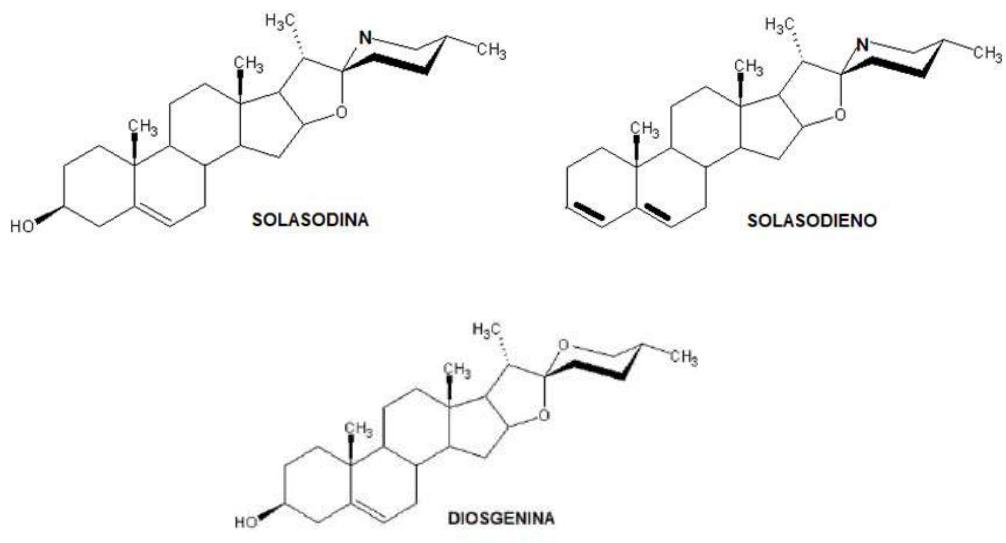
 Figure. N° 2: Isolated and identified steroidal structures of the stalks and leaves of Solanum boldoense Dunal & A. DC.
The samples identified as Solasodine and Diosgenin were sent for resonance study. In order to corroborate the identified structures, studies were carried out with steroid patterns, which confirmed the presence of Solasodine, Solasodiene and Diosgenin. Melting points were performed mixed with the standards, without any change in the results. In addition, mixed co-chromatography's were performed without any deviation observed in the study.
Isolated and identified compounds Nuclear Magnetic Resonance, managing to confirm the structures of these two compounds. Solasodiene is an artifact formed by acid hydrolysis of Solasodine, in the extraction process [5]. Table No. 2 shows the chemical discharge of the studied compounds and their comparison ith data from the specialized literature.
Table N° 2: Chemical discharge of the compounds isolated and identified through the C NMR of the stems and leaves of Solanum boldoense Dunal & A. DC. (DCCl ) / TMS/ppm.
| RMN, $C^{13}$ , $CDCl_{3}$ – TMS (ppm): SOLASODINE | |||||
| C-1 (37,3) | C-2 (31,6) | C-3 (71,6) | C-4 (39,6) | C-5 (141,1) | C-6 (121,4) |
| C-7 (32,4) | C-8 (31,9) | C-9 (50,3) | C-10 (36,65) | C-11 (21,4) | C-12 (39,9) |
| C-13 (41,6) | C-14 (56,4) | C-15 (32,5) | C-16 (83,6) | C-17 (62,0) | C-18 (16,6) |
| C-19 (19,0) | C-20(42,1) | C-21 (15,2) | C-22 (99,0) | C-23 (32,8) | C-24 (30,5) |
| C-25 (31,9) | C-26 (46,0) | C-27 (19.8) | X | X | X |
| $RMN\ C^{13}, CDCl_3/ TMS (ppm): DIOSGENIN.$ | |||||
| C-1 (39.81) | C-2 (33-08) | C-3, (71.74) | C-4 (44.84) | C-5 (139.20) | C-6(121.39) |
| C-7 (32.07) | C-8 (32.07) | C-9 (50.08) | C-10 (37.23) | C-11 (19.44) | C-12(40.29) |
| C-13(41.62) | C-14(56.54) | C-15 (31.27) | C-16 (80.83) | C-17 (62.11) | C-18(17.15) |
| C-19(20.89) | C-20 (42.29) | C-21 (14.53) | C-22 (109.28) | C-23 (32.07) | C-24(28.82) |
| C-25(31.47) | C-26 (66.86) | C-27 (17.1) | X | X | X |
Solasodiene
This compound is an artifact that is formed in the process of hydrolysis of glycoalkaloids and its abundance depends on the conditions of hydrolysis. [5].
It was recrystallized from acetone, obtaining a TF 176-177 °C solid. Thin layer chromatography using Silicagel 60 F254 (0.25 mm) and as a mobile phase CHCl3/MeOH (95: 5) showed a Rf = 0.71. A mixed melting point of the compound and a sample of Solasodieno isolated from Solanum guanicense Urb., Showed no depression. [7]
V. DISCUSSION
The Solanum boldoense Dunal & A.DC, is endemic to Cuba, where it is found in forests and forest edges at low to medium elevations, had no previous phytochemical studies. According to our study, satisfactory results were obtained, managing to isolate and identify three steroidal compounds such as Solasodine, Solasodiene and Diosgenin. The main steroidal compounds were identified using chromatographic techniques and C NMR spectroscopic studies. Thus, the structures of Solasodina, Solasodieno and Diosgenina were confirmed. This result is in line with the result developed by Raquel in 1987, in which she reported the isolation and identification of Solasodine, Tomatidenol and Diosgenin of this species. [8].
VI. CONCLUSIONS.
The study of the aerial part stem and leaves of Solanum boldoense Dunal & A. DC, allowed the isolation and identification of three steroidal compounds, which were identifying chromatographic and spectroscopic studies of NMR, such as Solasodine, Solasodiene and Diosgenin.
Conflict of Interest
The authors declare no conflict of interest.
Ethical Approval
Not applicable
Data Availability
The datasets used in this study are openly available at [repository link] and the source code is available on GitHub at [GitHub link].
Funding
This work did not receive any external funding.
References
Cite this article
Related Research


Special Issue
Launch a focused special issue to highlight research, emerging trends, and expert insights in your academic field.
