


IntelliPaper
Abstract
Background: Chronic rhinosinusitis is a common otorhinolaryngologic condition that is often encountered in daily practice. Nasal obstruction has been found to be the most disturbing symptom in patients with chronic rhinosinusitis which could predispose them to otologic pathologies.
Aim: to assess the prevalence and determinants of hearing loss among patients with chronic rhinosinusitis in the Lagos State University Teaching hospital.
Method: an analytical cross-sectional study which was conducted among 256 patients diagnosed with chronic rhinosinusitis in Lagos State University Teaching Hospital. Participants’ audiological profiles was assessed by conducting Pure Tone Audiometry and tympanometry. Data obtained were analyzed with SPSS software version 27.0.
Result: The participants aged 40-49 years constituted the largest age group (30.1%) and most of them were female (69.5%). The prevalence of hearing loss among the participants was 40.2%. There was reduced odds for hearing loss among participants aged 20-29 years (AOR= 0.043, 95% C.I= 0.012- 0.157), 30-39 years (AOR= 0.042, 95% C.I= 0.010- 0.171) and 40-49 years (AOR= 0.075, 95% C.I= 0.027- 0.209). Also there was reduced odds for hearing loss in male (AOR= 0.142, 95% C.I= 0.057- 0.357), but those with facial pain had increased odds for hearing loss (AOR= 5.814, 95% C.I=1.742- 19.231) and those that with nasal polyp had increased odds for hearing loss (AOR= 2.134, 95% C.I= 1.023- 4.451).
Conclusion: the prevalence of hearing loss was high in chronic rhinosinusitis and its determinants were age group, gender, facial pain and nasal polyps.
Explore Digital Article Text
I. INTRODUCTION
Chronic rhinosinusitis (CRS) is a common otorhinolaryngologic disease often encountered in ear, nose and throat (ENT) clinics. It usually lasts for at least 12 consecutive weeks with inflammation of the mucosa of the nose and paranasal sinuses. CRS is not a life-threatening disease, but not all patients achieve control of their symptoms with medical or surgical intervention. Globally, the prevalence of CRS ranges between 5.5% and 27.1%. In Nigeria, it's prevalence ranges between 7.3% and 24.7%. It constitutes 78.2% of rhinologic cases seen in Nigerian tertiary hospitals. Furthermore, studies have elucidated the high economic burden and the debilitating social health impact CRS confers on those who suffer from it. It has been reported that in patients with CRS, though the main disturbing symptom is nasal obstruction, this could predispose the individuals to otologic pathologies. These otologic pathologies have been attributed to the tendency of patients with CRS to develop Eustachian tube dysfunction (ETD). Other proposed mechanism includes the post nasal drip of mucus that causes inflammation/oedema of the Eustachian tube opening in the nasopharynx. Chronic ETD can result in reduced middle ear ventilation and other pathologies. A study by Li et al on hearing loss among patients with CRS concluded that, in addition to conductive hearing loss, there was sensorineural hearing loss among patients with CRS. The study attributed their observation to immunoreactivity in the inner ear of patients with CRS. Sandi et al also found both conductive and sensorineural hearing loss among patients with Allergic rhinitis. There is a paucity of research studies on the hearing loss among patients with Chronic Rhinosinusitis (CRS) in Nigeria. This study is aimed at assessing the prevalence and determinants of hearing loss among patients with CRS in a tertiary hospital in Nigeria. The outcome of this study will contribute to the body of knowledge on the management of hearing loss in patients with CRS.
II. MATERIALS AND METHODS
Study Area: This study was conducted in the ENT department of Lagos State University Teaching Hospital (LASUTH), Ikeja, Lagos. The facility is one of the tertiary hospitals in Nigeria. It is expected to attend to the medical needs of an estimated 20 million residents alongside other hospitals within Lagos state. There are 750 beds in the facility, although it is still expanding with ultra-modern equipment.
Study Design and Population: The study was an analytical cross sectional study. The eligible participants were patients diagnosed with chronic rhinosinusitis with or without nasal polyps based on clinical features, nasoendoscopy and/or computerized tomography (CT) scan findings. All participants were 18 years and above.
Ethical Approval and Consent: Ethical approval for this research was obtained from the Health Research Ethical Committee of Lagos State University Teaching Hospital. All participants gave their Informed consent, and their information was kept confidential.
Sample and Data collection: Sample participants consist of 256 patients with chronic rhinosinusitis with or without nasal polyps. A proforma was administered to the participants by the researcher to collect their data. Thereafter, otological examination was done. Those with wax in the ear canal were syringed. Pure Tone Audiometry, and Tympanometry were then carried out on them.
Pure Tone Audiometry: Hearing assessment was performed using a calibrated Amplivox audiometer (United Kingdom) with well-fitting earphones and a bone vibrator. Participants were seated in a soundproof booth and instructed to press a response button whenever they perceived a tone. Air-conduction thresholds were obtained using the Hughson–Westlake ascending method, testing one ear at a time. Pure tones from 250Hz in octave spacing to 8000Hz were delivered to the tested ear. Each tone was initially delivered above the presumed threshold, then reduced in 10 dB steps until muffled, and subsequently increased in 5 dB steps until a response was given. The process was repeated until a stable threshold (defined as the level at which the participant responded on three occasions) was determined. The procedure continued until a single hearing level at which the participant responds thrice was obtained. For bone conduction audiometry, the vibrator was placed on the mastoid of the test ear, and pure tones between 250 Hz and 4000 Hz were presented using the same procedure. Masking was applied to the non-test ear to prevent crossover responses. Thresholds were plotted on an audiogram, and the pure-tone average (PTA) was calculated at 500 Hz, 1000 Hz, 2000 Hz, and 4000 Hz. Hearing level was classified according to the World Health Organization (2008) criteria, ranging from no impairment to profound impairment.
Tympanometry: The Amplivox otowave 102A Tympanometer from Amplivox United Kingdom was used to conduct Tympanometry. Each ear was individually tested using a probe of appropriate size, with a tone of 220Hz delivered. Tympanograms obtained for each ear of the participant were categorised as Type A (normal), Type As (low compliance at ambient pressure), Type Ad (increased compliance at ambient pressure), Type B (no change in compliance with pressure change), and Type C (maximum compliance at negative pressure).
Data Analysis: Data analysed with Statistical Package for Social Sciences (SPSS) version 26.0.
The result was presented in tables, bar charts and pie chart. The determinants of hearing loss in CRS were identified with binary logistic regression. The level of statistical significance was set at P < 0.05.
III. RESULT
A total of 256 participants with chronic rhinosinusitis were recruited for the study. The participants aged 40-49 years constituted the largest age group (30.1%), and most of them were female (69.5%). Most of them were traders (27.7%), married (62.9%) and had secondary education (64.5%) (Table 1).
| Variables | Frequency, n=256 | Percent (%) |
| Age group (years) | ||
| <20 | 12 | 4.7 |
| 20- 29 | 42 | 16.4 |
| 30-39 | 44 | 17.2 |
| 40-49 | 77 | 30.1 |
| 50-59 | 27 | 10.5 |
| ≥60 | 54 | 21.1 |
| Gender | ||
| Male | 78 | 30.5 |
| Female | 178 | 69.5 |
| Occupation | ||
| Trader | 71 | 27.7 |
| Artisan | 20 | 7.8 |
| Civil servant | 58 | 22.7 |
| Private firm employee | 50 | 19.5 |
| Retired | 16 | 6.3 |
| Student | 28 | 10.9 |
| Unemployed | 13 | 5.1 |
| Marital status | ||
| Single | 67 | 26.2 |
| Married | 161 | 62.9 |
| Divorced/separated | 7 | 2.7 |
| Widow/widower | 21 | 8.2 |
| Education | ||
| None | 10 | 3.9 |
| Primary | 25 | 9.8 |
| Secondary | 165 | 64.5 |
| Tertiary | 56 | 21.8 |
The most common clinical presentations were mucopurulent discharge (98.4%) and nasal congestion (85.2%). Some had fatigue (77.0%), headache (67.2%), hyposmia/anosmia (62.1%), dental pain (47.7%), nasal polyp (40.6%) and ear pain (34.8%) while a few had halitosis (20.3%) and facial pain (17.2%) (Figure 1).
{"image_source":{"path":"images/87ceef647b57bd6c589f556aa1f8ff221d9a008d7d5e92f6f4699ab2dd952352.jpg"},"content":"","chart_caption":[{"type":"text","content":"Figure 1: Clinical Presentation among Study Participants"}],"chart_footnote":[{"type":"text","content":"The prevalence of hearing loss among the participants was 40.2% (Figure 2)."}]}
{"image_source":{"path":"images/af9ff471afc683211b5bc76431a0baf103b0a7b713ff4688cbf3fa7f5e6be7d3.jpg"},"content":"","chart_caption":[{"type":"text","content":"Figure 2: Prevalence of Hearing Loss Among Study Participants"}],"chart_footnote":[]}
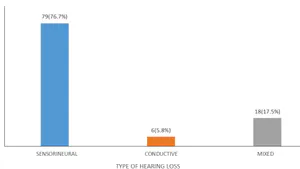
The most common hearing loss was sensorineural (76.7%), some had mixed hearing loss (17.5%) while few had conductive hearing loss (5.8%) (Figure 3).
{"image_source":{"path":"images/f46176e7ae9399c0a282d4eed393c7a72cf4b36e67ab98ecb207f3a83f19a605.jpg"},"content":"","chart_caption":[{"type":"text","content":"Figure 3: Types of Hearing loss among Study Participants"}],"chart_footnote":[]}
Majority of the participants had type A 3.1%), B (5.5% vs 2.7%) and C (4.3% vs 4.7%) as tympanometry in right and left ears (80.5% vs 85.5%), few had Ad (5.5% vs 3.9%), As (4.3% vs
| Tympanometry | Right Ear | Left Ear |
| A | 206(80.4) | 219(85.6) |
| Ad | 14(5.5) | 10(3.9) |
| As | 11(4.3) | 8(3.1) |
| B | 14(5.5) | 7(2.7) |
| C | 11(4.3) | 12(4.7) |
From the bivariate analysis, the significant determinants of hearing loss among the study participants were age group, gender, facial pain, fatigue, dental and ear pain. In contrast, multivariate analysis revealed age group, gender, facial pain and nasal polyp as significant determinants of hearing loss. There was reduced odds for hearing loss among participants aged 20-29 years (AOR= 0.043, 95% C.I= 0.012-0.157), 30-39 years (AOR= 0.042, 95% C.I= 0.010- 0.171) and 40-49 years (AOR= 0.075, 95%
C.I= 0.027- 0.209) when compared with those that were 60 years and above. Also there was reduced odds for hearing loss in male (AOR= 0.142, 95% C.I= 0.057- 0.357) compared with female, those with facial pain had increased odds for hearing loss (AOR= 5.814, 95% C.I=1.742- 19.231) compared with those that did not have facial pain while those that with nasal polyp had increased odds for hearing loss (AOR= 2.134, 95% C.I= 1.023-4.451) (Table 3).
| Variables | COR | 95% C.I | P value | AOR | 95% C.I | P value |
| Age group (years) | ||||||
| <20 | 0.000 | 0.000 | 0.998 | 0.000 | 0.000 | 0.998 |
| 20- 29 | 0.071 | 0.026-0.191 | <0.001* | 0.043 | 0.012- 0.157 | <0.001* |
| 30-39 | 0.051 | 0.018- 0.141 | <0.001* | 0.042 | 0.010- 0.171 | <0.001* |
| 40-49 | 0.109 | 0.047- 0.252 | <0.001* | 0.075 | 0.027- 0.209 | <0.001* |
| 50-59 | 0.331 | 0.118- 0.926 | 0.035* | 0.821 | 0.238- 2.834 | 0.755 |
| ≥60 | Reference | Reference | ||||
| Gender | ||||||
| Male | 0.395 | 0.219- 0.710 | 0.002* | 0.142 | 0.057-0.357 | <0.001* |
| Female | Reference | Reference | ||||
| Dental pain | ||||||
| Present | 1.946 | 1.170- 3.236 | 0.010* | 1.282 | 0.580- 2.833 | 0.540 |
| Absent | Reference | Reference | ||||
| Nasal congestion | ||||||
| Present | 2.083 | 0.964- 4.501 | 0.062 | 2.320 | 0.713- 7.545 | 0.162 |
| Absent | Reference | Reference | ||||
| Halitosis | ||||||
| Present | 0.598 | 0.312-1.146 | 0.121 | 1.241 | 0.507- 3.038 | 0.637 |
| Absent | Reference | Reference | ||||
| Fatigue | ||||||
| Present | 1.914 | 1.020- 3.593 | 0.043* | 1.385 | 0.600- 3.202 | 0.446 |
| Absent | Reference | Reference | ||||
| Facial pain | ||||||
| Present | 3.650 | 1.621- 8.264 | 0.002* | 5.814 | 1.742- 19.231 | 0.004* |
| Absent | Reference | Reference | ||||
| Ear pain | ||||||
| Present | 2.639 | 1.502- 4.630 | 0.001* | 1.292 | 0.602- 2.770 | 0.511 |
| Absent | Reference | Reference | ||||
| Nasal polyp | ||||||
| Present | 1.414 | 0.851- 2.348 | 0.182 | 2.134 | 1.023- 4.451 | 0.043* |
| Absent | Reference | Reference |
IV. DISCUSSION
This study assessed the prevalence and determinants of hearing loss among patients with chronic rhinosinusitis (CRS). The finding of this study showed that hearing loss among patients with CRS was higher than the global prevalence of hearing loss of 19.3%. The overall prevalence of hearing loss in Mahabubnagar district, Telangana state, India is 8.9%, while disabling hearing loss was 4.5%. The prevalence of hearing loss was 25.48% in a study conducted in Iraq. In a population-based survey from Gao'an county, Jiangxi province, China reported, a hearing loss prevalence of 53.2%. Many population-based investigations from Cameroon reported that the prevalence of hearing impairment ranges from 0.9 to 3.6%. Hearing loss affects 23% of population in United States of America (USA). The present study reported a prevalence of hearing impairment of 40.2% among patients with CRS, a value lower than 60% hearing impairment reported in previous study among patients with allergic rhinitis in India. The difference in the prevalence between the two studies might be attributable to variation in the distribution of the demographic of the study populations and sample size of the studies. A study carried out by Adeyemi et al, looking at hearing loss in patients with allergic rhinitis reported a prevalence of 24.2% in their study. The latter study was conducted among children aged 4 to 16 years, thus this might be responsible for the lower burden of hearing loss. The high prevalence of hearing loss among participants in this study might be due to the morphological and/or functional abnormalities of the Eustachian tubes caused by inflammation and the activation of inflammatory mediators in CRS. Retrograde inflammation of the middle ear can result in conductive deafness. A population-based study found a correlation between CRS and sudden sensorineural hearing loss. It has been suggested that CRS can potentially result in sensorineural hearing loss by impairing inner ear function by releasing different regional cytokines. There are lots of complement factors, lymphocytes, and macrophages in the endolymphatic sac. The cytokines and adhesion molecules that are produced are crucial for the inner ear's immunological responses. Tumor necrosis factor alpha (TNF- ), generated by activated macrophages and lymphocytes in response to cross-antigens produced by the pathogenic microorganism, and tissues in the endolymphatic sac during nasal cavity and paranasal sinus infection can boost immune response. Tumor necrosis factor alpha can create an aberrant inner ear microcirculation by activating the sphingosine 1-phosphate signaling system. Tumor necrosis factor alpha level has been shown to be significantly associated with the result of sensorineural hearing loss in idiopathic sudden sensorineural hearing loss (ISSNHL), according to an analysis of blood inflammatory variables. Treatment with TNF- inhibitors may improve ISSNHL.
In this study, age, gender, facial pain and nasal polyp were significant determinants of hearing loss. This finding is in line with Tsimpida et al, in a cross-sectional study of the English Longitudinal Study of Ageing (ELSA) that reported age, gender and other demographic characteristics as factors associated with the likelihood of HL. The trajectory of hearing loss in this study and latter study increased with the increase in age because more hearing loss was observed among older individuals. However, the odds of hearing loss were lower in men in this study but higher in men in the latter study. Kerschaver et al, also observed more hearing loss among male than female individuals. Facial pain and nasal polyps were clinical presentations in chronic rhinosinusitis patients associated with hearing loss in this study. These two presentations can be linked to roles of infection and allergy in the pathophysiology of CRS. Allergic reactions could impede the nasal mucociliary function, resulting in CRS. Numerous immunity-related plasma cells, mast cells, and other tissue constituents that can generate lysosomes, leukocytes with the capacity to phagocytose and fibrinolyze, and myoblasts with reparative properties are found in the nasal mucosa, lamina propria, and submucosal layer. Sensorineural hearing loss can be caused by allergic rhinitis as a result of an immune response in the inner ears.
In conclusion, the prevalence of hearing loss was high in patients with CRS. Majority of the hearing loss was sensorineural hearing loss. The determinants of hearing loss were age group, gender, dental pain and nasal polyps. Based on these findings, it is advisable that ENT specialists screen patients with CRS for hearing loss and provide timely interventions to prevent potential complications.
Conflict of Interest
The authors declare no conflict of interest.
Ethical Approval
Not applicable
Data Availability
The datasets used in this study are openly available at [repository link] and the source code is available on GitHub at [GitHub link].
Funding
This work did not receive any external funding.
References
Cite this article
Related Research


Special Issue
Launch a focused special issue to highlight research, emerging trends, and expert insights in your academic field.