


IntelliPaper
Abstract
In developing economies, public debt has increasingly been used as a fiscal policy instrument to finance development objectives amid revenue shortfalls, raising concerns about its effectiveness in delivering long-term economic development. Thus, this study investigated the impact of public debt on economic development in Nigeria over the period 1986 to 2023. The study employed time series data on economic development, proxied by the human development index, external debt, domestic debt, gross domestic saving, and oil revenue collected from the Central Bank of Nigeria Annual Statistical Bulletin, World Bank Development Indicators, and the Debt Management Office, Nigeria. In the analysis, descriptive statistics, trend analysis, unit root test, and autoregressive distributive lag technique were employed. The cointegration test revealed that a long-run equilibrium relationship exists among the variables. From the empirical evidence, external debt had a negative and significant impact on economic development, while domestic debt had a positive but insignificant impact on economic development. In conclusion, the study highlights that domestic debt has a more favorable association with development outcomes, while external debt poses risks if not properly managed. Based on the findings, the study recommended, among others, the government should adopt debt ceiling policies, as well as effective debt sustainability frameworks. The public procurement reform should be sustained and strengthened. This will encourage due process in government dealings. Also, there is a need for the government to partner with civil society organizations to monitor how external debt is being distributed and expended.
Explore Digital Article Text
I. INTRODUCTION
The attempt by the government to finance budget deficits and projects with high capital requirements led to the emergence of public debt. The budget may include capital expenditures for things like building roads, railways, refineries, steel plants and public social goods like electricity, but there aren't enough funds to support these projects. Investment is a key factor in a country's development, and even while it necessitates domestic savings, it is insufficient to guarantee development (Oloyede, 2002). Governments are responsible with raising living standards through increased salaries, job creation, improved education and more economic and social options with the objective to guarantee that residents have access to necessities like food, shelter, healthcare and protection (Ughulu & Ughulu, 2020).
According to Soludo (2003), there are two main reasons why countries borrow money: macroeconomic ones, like financing increased investment or consumption or to get around strict budgetary restrictions. This suggests that investment serves as a foundation for countries to achieve economic expansion. Government borrowing is used to make large investments in the economy's manufacturing and industrial sectors, which raise income levels, lower poverty and unemployment and boost Gross Domestic Product (GDP). This is a common strategy used by countries to close the gap between revenue and spending, especially when revenues are not enough to cover rising expenditures. The government of Nigeria has employed deficit finance as a means of fostering economic development and expansion. Since many countries look to borrow from both domestic and foreign financial institutions, including the World Bank and the International Monetary Fund (IMF), public debt is inevitable for governments. No developing country, like Nigeria, can function successfully and efficiently on its own; it needs assistance. The fundamental goal is that developing countries need foreign loans because they lack the funds to undertake capital-intensive projects.
Both the amount of domestic and foreign debt has risen throughout the past year. According to reports, the external debt increased from 9.71 billion in 2014 during President Jonathan's leadership. According to the Debt Management Office Nigeria's statistics (DMO), the nation's external borrowings have been steadily rising since then. Between 2015 and the end of the first quarter of 2020, they were 11.40 billion, 25.27 billion, 27.666 billion, respectively. This indicates that President Buhari's current government has the most external debts (Debt Management Office, 2020; Akinsanmi, 2020). On the other hand, the nation's internal debt increased from 58.02 billion in 2014 before falling to 52.08 billion at the end of 2017, 56.38 billion at the end of 2019, after government began borrowing more from domestic sources in 2017. The entire amount of outstanding domestic debt was $51.64 billion as of the end of March 2020 (Debt Management Office, 2020).
The Nigerian government has responded to these issues by putting in place a number of programs aimed at promoting and maintaining high growth profiles. With an anticipated yearly growth rate of more than 9%, the government's 2008 Vision 20:2020 plan aims to place Nigeria among the world's 20 biggest and most developed economies by 2020 (Ojo, 2010). Moreover, in 2017, the ERGP was presented with the aim of connecting Nigeria's economy with a 4.5% annual growth rate (Okwuni, 2019). Despite these attempts, the country remains among the least developed and inflation continues to go up. Nigeria is struggling with broken infrastructure, negative changes in various industries, low comfort for the people and a high poverty rate, despite the benefits of borrowing money. Even though government debt is often paid for by borrowing from both inside and outside the country, these issues remain. There has been a continual increase in Nigeria's budget deficit since 1980, with most of the biggest increases occurring in different years (CBN, 2014). The above issues of public debt fluctuation without significant improvement in infrastructure motivate this study.
Several studies (Hlongwane, 2023; Asravor et al., 2023; Isidora and Luciano, 2020; Nymphas, Emmanuel and Auta, 2023; Biliqees, 2022) have concentrated on the impact of public debt on economic growth and other macroeconomic indicators. Only a few studies (Ikwuo, Ikwor et al., 2024; Anaemena, Onwuatuelo et al., 2023; Ogwu, 2023; Okafor and Isibor, 2022) directed their analysis specifically toward economic development. But the research shows that the role of public debt in economic progress is unclear. To give an example, Anaemena, Onwuatuelo et al. (2023) and Benjamin and Alexander discovered that neither kind of debt played a major part in supporting economic development. On the other side, studies by Okafor and Isibor (2022) and Ogwu (2023) showed that domestic debt was the only type to show positive results. These conflicting results is another motivator of the study.
Hence, based on the aforementioned issues, the study will investigate the impact of public debt on economic development in Nigeria. The following sections is divided into review of literature, methodology, results and discussion and concluding remarks and recommendations.
II. REVIEW OF LITERURE
2.1 Conceptual Review
2.1.1 The Concept of Public Debt
Public Debt Concept Public debt, national debt and sovereign debt are other names for government debt. In comparison, the yearly government budget deficit is a flow variable that represents the difference between government income and expenditures for a single year. The total of all previous deficits is the debt, which is a stock variable that is quantified at a particular moment in time. "Bureau of the Public Debt Homepage".
Numerous writers and academics have offered explanations for public debt. One of the most straightforward explanations of the idea may be found in Favour, Idenyi, Oge, and Charity (2017). Public debt, according to their definition, is the entire sum of money that the federal, state, and municipal governments owe at any one moment. According to Rais and Anwar (2012), public debt is the debt incurred when the government chooses to borrow money rather than raise taxes to cover the budget deficit. Public debt is defined as the entire amount of debt owed by the federal, state, and municipal governments, as evidenced by public spending through borrowing rather than taxes (Nassir and Wani, 2016, quoted in Eze et al., 2019). Public debt is, however, different from national debt (which is same as federal government debt). The latter precisely indicates the amount borrowed by the national government alone, whereas the former shows the total amount of debt acquired by all levels of a nation's government.
Public debt is defined by the Central Bank of Nigeria (2013) as government borrowing. Additionally, the nation's top bank asserts that it happens when the government chooses to borrow money in order to close budget deficits or support economic growth. This corresponds to the debt owed by every level of a nation's government. The public sector, which includes the government and its agencies, is responsible for these debts. It is, in essence, the entire amount of debt owed by the
State (Chartered Accountants Australia and New Zealand, 2016; Szybowski, 2018).
Public debt is typically contracted to bridge budgetary gaps, for capital formation during economic depression, to finance developmental projects (Akhanolu, Babajide, Akinjare, Oladeji, Osuma), to finance public goods that promote the welfare of the people and increase the growth of the country (Gill and Pinto, 2005), even though the government has other sources of income, such as raising taxes and printing money (Institute of Chartered Accountants of Nigeria, 2014). "Macroeconomic reasons (higher investment, higher consumption (health and education) or to finance transitory balance of payments deficits [to lower nominal rates abroad, lack of domestic long-terms credit or to circumvent hard budget constraints]" are the two main reasons why nations borrow, according to Soludo (2003) (cited in Central Bank of Nigeria, 2013:3). Other reasons, generally advanced to justify the need for a country (or its government) to obtain loans or borrow are as follows:
Rapidly increasing population, especially in many developing countries; this results into government borrowing in order to expand public enterprise and public utilities to meet the need of the rising population;
Outbreak of war/crisis and natural disasters, such as: flood, earthquake, sectarian violence and other natural catastrophe, could make the government borrow in order to embark on rehabilitation and reconstruction projects and provision of relief to victims; Opting for public debt allows a more effective way in which country can leverage on opportunities of investment with long congestion periods;
Government also borrows as an alternative to redundant dependence on printing of money which may result to peaked and capricious inflation;
Excessive spending, that may be caused by the militarization of the economy, extensive administration or high social transfer (The Institute of Chartered Accountant of Nigeria, 2014; Gill and Pinto, 2005:3; Szybowski, 2018:61).
Domestic debt is the gross liability of government, and if properly considered should include federal, state and local governments transfer obligations to the citizens and corporate forms within the country. They are debt instrument issued by the federal government and denominated in local currency. State and Local government can also issue debt instrument, but instrument currently in use consist of Nigerian treasury bills, government development stock, treasury bonds and federal government bonds.
Domestic debt is debt that originates from within the geographical region of a country which is contracted through debt instrument such as treasury certificate. Internal debt is an asset arrangement that results in citizens giving up their existing purchasing power in exchange for government security; this arrangement has no direct correlation to an increase in real resources. In other words, it is a situation in which the borrowing units obtain the funds from themselves. Therefore, it is possible to say that taxpayers are borrowing from them. The government creates internal debt by tapping personal and corporate savings directly and indirectly. The issue of government bonds or security constitutes `direct government absorption of domestic savings. An indirect method of absorbing private sector's savings by government is by borrowing from the banking system through the sale of bonds and security. However domestic financing or borrowing can also be through outright money creation of borrowing from the CBN. This borrowing has no effect on increasing or decreasing national income.
External Borrowing to refer to as resources borrowed from a foreign nation that are paid back over time with principal and interest. The outstanding amount of balance of payments support that was not able to be paid back when it became due is known as external debt. On the other hand, external debts are due by a nation to international organizations or nations; in other words, the creditors are foreigners. In that event, the servicing and repayment of those foreigners will result in a harm to the nation's resources. "The amount of money that citizens of a nation have expended and outstanding contractual obligations to non-residents to repay principal, with or without interest or to pay interest, with or without principal, is known as the external debt (World Bank, 2019).
2.1.2 Concept of Economic Development
According to Todaro and Smith (2015), economic development is the gradual improvement of a community as a whole. It entails converting impoverished economies into contemporary industrial ones (Myint & Krueger, 2000). Increases in measures like life expectancy, poverty rates and literacy rates are frequently used to gauge this process (Pritchett et al., 2013). The United Nations Development Programme's (UNDP)-Human Development Index (HDI) is a composite metric that evaluates nations according to GDP per capita, life expectancy and educational attainment (UNDP, 2011).
2.2 Review of Theoretical Literature
2.2.1 The Keynesian Theory
In 1936, John Maynard Keynes wrote The General Theory of Employment, Interest and Money. Keynes' upbringing in the classical economics tradition was severely criticized in the article. Keynes advocated for the state to take "an ever-better accountability for openly organizing investment in the economy" and for the inclusive socialization of investment. According to Keynes, the government should borrow money to fund projects like public works and deficit spending would boost the economy's purchasing power and generate jobs. Keynes believes that since fiscal policy serves the interests of the whole public, it is the best way to stimulate economic growth. According to Keynes, when the government borrows money from the general population to pay for its expenses, unemployed people's money is taken out of their pockets, which has no impact on their level of consumption. When the government reinvests these monies in the economy, the aggregate demand rises, which in turn boosts output and employment. Therefore, borrowing by the public can have an impact on macroeconomic performance.
The repayment of debt decreases the resources that can be utilized for investment, which is the transmission mechanism via which debts impact growth. Additionally, public debt can burden future generations by reducing the flow of income from a smaller stock of private capital, so acting as an implicit tax on the resources produced by a nation. This could therefore result in higher long-term interest rates, a reduction in accumulation of capital and a crowding out of private investments that are essential for productivity growth.
2.2.2 Classical Macroeconomics Theory
According to Say (1830), supply generates demand on its own. Put another way, the money made during the production phase is always adequate to purchase all of the items and services that are produced. This indicates that an economy's purchasing power is always enough to cover the cost of all generated products and services. In other words, the total amount of goods and services supplied and demanded is always equal.
The foundation of classical macroeconomics is Say's Law, which is predicated on self-regulating markets. The self-policing money market or credit guarantees that savings do not negate Say's Law. The credit market makes sure that household savings end up in the hands of companies who use them to fund investments. Rising interest rates are said to decrease investment and increase the tendency to save as explained by classical economics. The variable interest rate will always be adjusted to help match the savings of households and the spending by companies. In classical economics, the rise in spending to invest is enough to take up all extra revenue from lower tax or tariff income. As long as investment and savings equal each other, Say's Law will work and situations involving overproduction, persistent unemployment or lower output would not happen. According to classical theory, an increase in savings has positive results since it encourages investment and allows everyone in the economy to be employed at the highest levels at all times.
2.2.3 Harrod-Domar Growth Model
Harrod (1939) and Domar (1946) posit that savings boost economic growth by increasing investment, arguing that since savings are primarily used for investment, an increase in investment will subsequently result in an increase in economic growth. The model looks like this:
Where Y is output or income, s is the savings rate, k is the capital output ratio and G is the output growth rate. The model demonstrates that savings and growth are directly correlated. Because savings lead to investment, which in turn spurs economic growth, raising the savings rate will accelerate output growth.
2.2.4 Human Development Theory
The goal of human development theory, as put out by academics such as Sen (2001), is to increase each person's freedoms and capacities. According to this theory, real progress entails improving social facilities, economic possibilities, political liberties, security and transparency. This could result in government policies in Nigeria that enhance social safety nets, healthcare and education, allowing people to live fulfilling lives and successfully contribute to economic progress.
2.3 Review of Empirical Literature
This study provides empirical review for both cross-country and country-specific research as follows:
Hlongwane (2023) examined the relationship between a number of macroeconomic variables, including real economic growth, domestic and external debt, budget deficit, inflation rate and investment and the impact of public debt on economic growth in South Africa using the ARDL bound test approach. The empirical findings demonstrated that there is a long-term equilibrium relationship between the budget deficit, inflation rate, economic growth and foreign and domestic debt. Additionally, external debt has a negative impact on South Africa's RGDP during both eras.
Asravor et al. (2023) assessed the connection between Ghana's economic growth and the sustainability of its domestic debt. Using information from the Ministry of Finance and the World Bank for the years 1994–2018. The actual results from the ARDL model showed that while an increase in imports slowed economic development and prosperity, an increase in Ghana's domestic debt improved economic growth performance.
Isidora and Luciano (2020) looked into the effect of domestic and local borrowing on the growth of capital markets in South American nations. The study's use of the regression model showed that the inflation rate has a detrimental impact on the growth of the financial markets.
In their analysis of the symmetric and asymmetric effects of external debt on inflation in Sudan between 1970 and 2020, Sharaf and Shahen (2023) used an ARDL model to look at the symmetric effect and a nonlinear ARDL (NARDL) model to look at the asymmetric effect. The empirical results demonstrated that, over the long term, external debt had no statistically significant impact on inflation. Furthermore, the NARDL model showed that both positive and negative external debt shocks have a statistically significant long-term effect on inflation. The findings also showed that inflation is positively and statistically significantly impacted by the domestic money supply.
Ikwuo, Ikwor, Abagha et al. (2024) examined the impact of public debt on economic development in Nigeria (2000–2023) using an econometric analysis of Ordinary Least Square, regression analysis, Augmented Dickey Fuller (ADF), Unit Root Test, Johansen Co-integration Test, and Error Correction Model. The co-integration test evaluation showed that there is an equilibrium long-term relationship between the variables. The analysis's empirical findings demonstrated that Nigeria's economic development is negatively and negligibly impacted by domestic debt.
Ogwu (2023) looked at how Nigeria's economic development, paying off debt and deficit financing changed over the years 1981 to 2022. In the study, economic development was proxy by HDI and inflation, interest rates, debts and other external and government debt were considered uncontrollable factors. According to the research, an increase in domestic debt led to an improved HDI over the years. Besides, countries with high levels of economic development often experience less inflation, lower interest rates and healthier debt and debt service. In an additional study, Anaemena, Onwuatuelo et al., (2023) examined how government debt affects Nigeria's economy. Researchers collected data from the Central Bank of Nigeria's Statistical Bulletin and the variables examined were HDI and PCI which depended on the exogenous factors of internal and external debts. According to the results of the Granger causality test, neither domestic nor public debt seems to affect PCI or HDI.
Nymphas, Emmanuel and Auta (2023) carried out an evaluation of how the level of Nigeria's state debt had an effect on economic expansion from 1981 until 2020. Stationarity of the effects of external debt, external debt servicing payments and domestic debt on GDP was tested using the unique Phillips Perron test and the Augmented Dickey Fuller unit root test (ADF) which were run on data from the Central Bank of Nigeria and the World Development Indicator. With the ARDL method, it was concluded that both domestic and foreign debt greatly contribute to Nigeria's economic growth. In addition, Nigeria's economic growth over time is weakened because of the money it pays to foreign lenders.
Biliqees (2022) investigated the impact of state debt on economic growth in Nigeria using secondary data spanning 1987 to 2020. The study's findings, as determined by the ARDL approach, showed that foreign debt has a favorable impact on Nigeria's economic expansion. Furthermore, with a coefficient value of 0.0005, local domestic debt has had a substantial and adverse impact on Nigeria's economic growth.
Between 1981 and 2020, Christopher, Godly and Johnbosco (2023) examined the asymmetric link between oil rents and human growth in Nigeria. The research variables' time-series data came from the World Development Indicators (WDI) and the Human Development Report of the United Nations Development Programme (UNDP). Oil rent has a positive and negligible effect on HDI, according to empirical results obtained using the nonlinear autoregressive distributed lag model. Chima and Chidi (2023) conducted a similar study from 1980 to 2020 using the same methodology in conjunction with the linear and non-linear autoregressive distributed lag (NARDL) approach. The results showed that there are uneven relationships between Nigerian well-being and oil revenue.
Okafor and Isibor (2022) looked at how state debt influenced Nigeria's economic development from 1999 to 2020 using domestic and foreign debt. Since the relationship between the variables needed to be identified, statistics such as mean and standard deviation were calculated. Data for the research was processed by applying the multiple linear regression method. The results indicate that local debt is beneficial for the economic development of Nigeria, whereas external public debt reduces the country's development as indicated by GDP.
To look at government debt on the Nigerian economy, Abdulkarim and Saidatulakmal (2021) ran an ARDL estimate between the time periods 1980-2018. Of the exogenous variables, interest rates, investment in fixed capital, foreign investment, debt service, debt owned domestically and external debt were used and real GDP represented economic growth. Researchers have noted that external debt increased growth of the economy in the short run but reduced long-term economic expansion. The country's economy saw improvements over the years thanks to local domestic debt, but the effect on short-term growth was very slight. In that period, the nation had its economic development hindered by having to make debt payments.
Abdulkarim and Saidatulakmal (2021) used information from 1980 to 2018 to assess the effect of public debt on Nigeria's economic growth. The findings revealed that, even though external debt helped the economy in the short term, it caused harm to long-term growth. Although domestic debt boosted long-term development, it hurt growth in the current year. There was a delay in economic growth caused by paying off debt which proved the debt overhang effect.
Benjamin and Alexander (2021) studied the link between public debt and economic development in Nigeria from 1981 to 20119 with the help of Johansen cointegration, Ordinary Least Square and Vector Error Correction Mechanism. According to the findings, the growth of Nigeria's economy was limited by their governmental debt. It was revealed that Nigeria's economic growth depends on the prices of oil, changes in interest rates, inflation levels and the amount of investment.
Through the analysis of secondary data sources, Nyekachi (2020) looked at how crude oil trade affected human welfare in Nigeria over the period of 1981 to 2017. Crude Oil Trade was explained by using Crude Oil Revenue as an exogenous variable. Besides, FDO and EXR were used as control variables in all the models. The use of co-integration and error correction mechanism (ECM) showed that, while crude oil revenue seemed linked to human welfare, the relationship was of little significance.
Mathias and Wilson (2019) looked at how gross domestic savings influence the growth of the Nigerian economy between 1986 and 2019 with the help of the error correction model. World Bank World Development Indicators provided the data for gross domestic product, household final consumption expenditure, gross domestic savings, general government final consumption expenditure and net export. Apart from net export, it was found that all the variables have a positive and significant impact on GDP.
2.4 Gaps in Literature
Public debt and its effect on economic development have been the main subjects of the studies included in this review. Harrod-Domar Growth Model, Keynesian theory and classical macroeconomic theory formed the main basis of the discussion. Several studies (Hlongwane, 2023; Asravor et al., 2023; Isidora and Luciano, 2020; Nymphas, Emmanuel and Auta, 2023; Biliqees,
- reviewed have concentrated on the impact of public debt on economic growth and other macroeconomic indicators. Only a few studies (Ikwuo, Ikwor et al., 2024; Anaemena, Onwuatuelo et al., 2023; Ogwu, 2023; Okafor and Isibor, 2022) directed their analysis specifically toward economic development. But the findings from previous research show that the impact of public debt on economic progress is unclear. To give an example, Anaemena, Onwuatuelo et al. (2023) and Benjamin and Alexander discovered that neither kind of debt played a major part in supporting economic development. On the other side, studies by Okafor and Isibor (2022) and Ogwu (2023) revealed that domestic debt was the only type to show positive influence. These conflicting results motivated this study. Also, despite these insights, other critical gaps remain unaddressed in the existing literature. First, none of the reviewed studies considered gross domestic saving as a potential mechanism for reducing reliance on borrowing and promoting development. Second, oil revenue, which constitutes Nigeria's primary source of income was excluded from the models examined. Hence, this study includes gross domestic saving and oil revenue among its variables to better examine the effect of public debt on Nigeria's economic growth.
III. METHODOLOGY
This study utilized the ex-post facto research design. According to (Ogwu, 2023), ex-post facto research design makes used of already existing data on historical events. Such information is already in occurrence and cannot be manipulated. The justification for using this design is that the current study utilized already existing quantitative data on the controlled variable and regressors for which the applicable variables cannot be manipulated. This study made used of time series data spanning between 1986 and 2023, and were sourced from Central Bank of Nigeria Annual Statistical bulletin and World Development Indicators (WDI). To determine the order of integration, the econometric methods of the Unit Root Test (ADF) and the preliminary diagnostics test of Ordinary Least Square (OLS) model were employed prior to the application of the appropriate econometric methods of data analysis.
The functional relationship between the dependent variable and the regressors is model in-line with the framework specified by Ogwu (2023), expressing that Nigeria's economic development could be enhance through government external debt (GED), government domestic debt (GDD), cost of serving debt (CSD), inflation rate (INFL) and interest rate (INTR). Thus:
Based on the empirical literature gap in this study, Ogwu (2023) model is modified in terms of the variables. That is, Human Development Index (HDI) as proxy for economic development,
3.1
External Debt (EXDBT), Domestic debt (DDBT), and using Gross Domestic saving (GDS) and oil revenue (OILR) as check variables. The re-modified functional form is re-expressed as:
Rewriting 3.2 in econometric form gives the equation below;
The study carried out logarithmic transformation of the variables so as to linearize the relationship in the model. The expected relationship of the exogenous variables with economic development is that .
After examining the unit root test to make sure there was no spurious regression, the ARDL bounds testing method from Pesaran, Shin and Smith (2001) was applied. This is done after examining the properties of the series shown in the Table 2. Because some of the variables are stationary at level, I(o) and others are stationary only after one difference, I(1), the ARDL method analysis was chosen. Equation (3.3) outlines the equations for the specification of the ARDL model which are presented below.
IV. RESULTS AND DISCUSSION
4.1 Descriptive Analysis
| HDI | EXDBT | DDBT | GDS | OILR | |
| Mean | 0.471447 | 3991.047 | 5255.427 | 36.92868 | 2972.170 |
| Median | 0.465000 | 961.8768 | 1448.116 | 34.90000 | 2942.919 |
| Maximum | 0.560000 | 38220.00 | 30210.00 | 68.81000 | 8878.970 |
| Minimum | 0.392000 | 41.45000 | 28.44000 | 13.08000 | 8.107300 |
| Std. Dev. | 0.052816 | 7191.904 | 7263.571 | 14.83816 | 2652.154 |
| Skewness | 0.017966 | 3.306307 | 1.714205 | 0.283084 | 0.402720 |
| Kurtosis | 1.580699 | 15.03501 | 5.453020 | 2.142134 | 1.978459 |
| Jarque-Bera | 3.191535 | 298.5660 | 28.13789 | 1.672759 | 2.679444 |
| Probability | 0.202753 | 0.000000 | 0.000001 | 0.433276 | 0.261919 |
| Sum | 17.91500 | 151659.8 | 199706.2 | 1403.290 | 112942.5 |
| Sum Sq. Dev. | 0.103211 | 1.91E+09 | 1.95E+09 | 8146.328 | 2.60E+08 |
| Observations | 38 | 38 | 38 | 38 | 38 |
Table 1 reveals that Human Development Index (HDI) recorded a mean value of 0.4714, external debt (EXDBT) averaged ₦3,991.047 billion, while domestic debt (DDBT) recorded a mean of ₦5,255.427 billion. Gross Domestic Saving (GDS) as a percentage of GDP averaged 36.9287%, and oil revenue (OILR) showed a mean of ₦2,972.170 billion. The standard deviation values indicate varying levels of dispersion, with EXDBT ( ₦7,191.904 billion) and DDBT ( ₦7,263.571 billion) showing the highest variability. The coefficient of skewness shows that all the variables are positively skewed, suggesting longer right tails in their distributions. However, the normality distribution results (based on the Jarque-Bera probability values) indicate that all variables, except external debt and domestic debt, are normally distributed.
{"image_source":{"path":"images/497b1fa1c1c06fd69faa1f22786ffeec780556166fcdd07d62a409fe3d580f89.jpg"},"content":"","chart_caption":[],"chart_footnote":[]}
{"image_source":{"path":"images/765d730aab215e4be8463eccf06c131c5575a4ce5d3b496184360396df998b90.jpg"},"content":"","chart_caption":[{"type":"text","content":"Gross Domestic Saving (GDS)"}],"chart_footnote":[]}
{"image_source":{"path":"images/c8a5f31f07fe57f7f09080b5ece37603852182db4e90bb262ff9a7b8a45b0432.jpg"},"content":"","chart_caption":[],"chart_footnote":[]}
{"image_source":{"path":"images/cde563edc8b6bd948617ae6b1aea8657224a877256af1d8b9710bb4316c75897.jpg"},"content":"","chart_caption":[],"chart_footnote":[]}
{"image_source":{"path":"images/28309ad82ba98edc38a20a60325721ab949e34733a6e2f515f380297acb39e34.jpg"},"content":"","chart_caption":[],"chart_footnote":[{"type":"text","content":"Source: Authors' computation (2025)"}]}
Figure 1: Trend Analysis of the Selected Variables
Between 1986 and 2023, Nigeria's HDI rose steadily from 0.392 to 0.56, reflecting gains in education, health, and income, especially post-2000. External debt grew sharply after 1999, hitting ₦38,220 billion by 2023, while domestic debt rose from ₦28.44 billion to ₦30,210 billion, with major growth after 2005. Gross domestic savings fell from 56.31% of GDP in 1986 to 34.6% in 2023, bottoming at 13.08% in 2016. Oil revenue peaked at ₦8,878.97 billion in 2011 but declined to ₦5,663.59 billion by 2023 due to market volatility.
| Variable | ADF @ Level | Critical Value 5% | ADF @ Difference | Critical Value 5% | Prob. | Status I(d) |
| -2.2389 | -3.5403 | -5.2471*** | -3.5403 | 0.0007 | I(1) | |
| -1.7293 | -3.5403 | -4.2299** | -3.5403 | 0.0101 | I(1) | |
| -2.9575 | -3.5403 | -4.6726*** | -3.5403 | 0.0033 | I(1) | |
| -2.2917 | -3.5403 | -8.1328*** | -3.5403 | 0.0000 | I(1) | |
| 3.7794*** | -2.9484 | ---- | --- | --- | I(o) |
The unit root stationary test was evaluated using Augmented Dickey-Fuller (ADF) unit root test. The outcomes show that human development index (HDI), external debt (EXDBT), domestic debt (DDBT), and gross domestic savings (GDS) became stationary after first differencing, while only oil revenue was stationary at level form. Thus, the series combine the integration of I(o)
and I(1) fulfilling the requirement for the use of bounds test cointegrating relationship.
4.3 Cointegration Test Result
The cointegration test adopted in this work is the bounds test approach by Pesaran, Shin and Smith (2001).
| F-Bounds Test | Null Hypothesis: No levels relationship | |||
| Test Statistic | Value | Signif. | I(0) | I(1) |
| F-statistic | 4.164302 | 5% | 3.05 | 3.97 |
| K | 4 | |||
The result above indicates cointegrating relationship given the fact that F-statistics obtained as 4.164302 is higher than the critical value at level I(o) and I(1) series at 5% levels of significance. Based on this, the null hypothesis
Source: Authors' computation (2025)
which assumes that there is no cointegration among the series is rejected. This implies further that in the long run human development index, external debt, domestic debt, gross domestic savings, and oil revenue have similar trend.
4.4 Model Estimation: Long and Short-run Results (1, 4, 2, 2, 2) Table 4: ARDL Long and Short Run Results
| Dependent Variable: | ||||
| Panel I: Long Run Results | ||||
| Variable | Coefficient | Std. Error | t - Stats | Prob. |
| -0.0158*** | 0.0059 | -2.6599 | 0.0165 | |
| 0.0016 | 0.0297 | 0.0527 | 0.9586 | |
| -0.0121 | 0.0238 | -0.5057 | 0.6196 | |
| -0.0069 | 0.0076 | -0.9053 | 0.3780 | |
| Panel II: Short Run Results | ||||
| Variable | Coefficient | Std. Error | t - Stats | Prob. |
| C | -0.5534*** | 0.0981 | -5.6397 | 0.0000 |
| -0.0154*** | 0.0053 | -2.9330 | 0.0093 | |
| -0.0058 | 0.0057 | -1.0120 | 0.3257 | |
| 0.0122** | 0.0055 | 2.2281 | 0.0397 | |
| -0.0106** | 0.0045 | -2.3905 | 0.0287 | |
| 0.0203 | 0.0143 | 1.4244 | 0.1724 | |
| 0.0309 | 0.0150 | 2.0682 | 0.0542 | |
| -0.0287** | 0.0121 | -2.3778 | 0.0294 | |
| -0.0483*** | 0.0115 | -4.1844 | 0.0006 | |
| 0.0124 | 0.0060 | 2.0662 | 0.0544 | |
| 0.0164** | 0.0063 | 2.5836 | 0.0193 | |
| -0.6903*** | 0.1214 | -5.6863 | 0.0000 | |
| R2 = 0.6941, Adjusted R2 = 0.5411, | Durbin-Waston=1.9025 | |||
The ARDL long- and short-term effects of domestic debt (DDBT), external debt (EXDBT), gross domestic savings (GDS), and oil revenue (OILR) are demonstrated by the results above. Impact of oil revenue and gross domestic savings on HDI's proxy for economic progress. In Panel I, the exogenous variables are analyzed to reveal their long-term effect on HDI and in Panel II, the same variables are shown to represent their immediate effect.
In the long-run model, External debt shows a statistically significant negative correlation with economic development, which is not in line with economic expectations. Economic development will decline by 0.0158% for every unit increase in external debt. The coefficient of domestic debt is statistically negligible, aligns with apriori economic expectations, and has a positive association with economic progress. For every unit rise in domestic debt, economic development increases by 0.0016%. However, both oil revenue and gross domestic savings are statistically insignificant, have a negative correlation with economic development and diverge from apriori economic expectations.
In the short-term period, higher external debt deviates apriori expectation, and has a negative impact on the country's economic development. Although domestic debt has no discernible effect on economic development, it is positively correlated with it and is consistent with apriori economic expectations. Gross domestic saving had a statistically significant effect on HDI, deviates from the connection predicted by economic theory and shows a negative correlation with economic development. Oil revenue is positively related to economic development, even though it does not significantly affect economic growth, as expected by the theory. The speed from the short-term dynamic to the long-term equilibrium relationship is 69.03%, according to the statistically significant and accurately described error correction mechanism.
4.5 Post-Estimation Test
In order to guarantee the model's stability and dependability of the ARDL technique, validation of Classical Regression Model assumptions for normality, heteroscedasticity and serial correlation was carried out and is shown in Table 5.
| Tests Statistics | CLRM Assumptions | Statistics Value | Prob. Value | Decision Rule |
| Breusch-Godfrey LM | Serial Correlation | 0.9772 | 0.9899 | Serial independence |
| Breusch-Godfrey | Heteroscedasticity | 0.1232 | 0.0671 | Constant Variance |
| Jarque-Bera | Normality | 0.7866 | 0.6748 | Normal residuals |
| CUSUM of Squares | Stability | - | - | Stable Model |
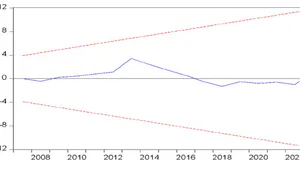
According to the aforementioned findings, the model met the requirements of the classical linear regression model for serial correlation, the random term's constant variance, the normality distribution, and stability. By looking at the CUSUM of squares plot in Figure 2, it is clear that the distributions' estimates do not change or experience any structural failures.
{"image_source":{"path":"images/b9b205b35b1986e75c1d9e94cb2373751fbe4b70abd31fa3cfa3abb6f98066ac.jpg"},"content":"","chart_caption":[],"chart_footnote":[]} {"image_source":{"path":"images/517266f3c5713d8d05f27190f85fa119de5a8f4ed80aa1a634bdda6d89d03bfd.jpg"},"content":"","chart_caption":[{"type":"text","content":"Source: Authors' computation (2025)"}],"chart_footnote":[]}
Figure 2: CUSUM of Square plot
V. DISCUSSION OF FINDINGS AND POLICY IMPLICATIONS
The discussion of findings of ARDL results between public debt and economic development in Nigeria is as follows.
Firstly, external debt negatively impacts on economic development but is statically insignificant, which is not consistent with economic theory. Economic development decreases by 0.0158% for every unit increase in external debt. External debt also deviates from theoretical predictions in the short run and continues to have a statistically significant detrimental effect on economic development. This result in the short-term aligns with that of the long-term period. This short-term outcome is consistent with the long-term one. The results are consistent with Okafor and Isibor (2022). Policy Implication: It is urged to exercise prudence when taking on external debt; instead, policy should concentrate on increasing the effectiveness of debt usage and making sure borrowed money is used for profitable ventures. Secondly, the coefficient of domestic debt over the long term is statistically weak, conforms to theoretical expectations, and shows a positive relationship with economic development. A unit rise in domestic debt raises economic development by 0.0016%. In the short-term, domestic debt shows no notable impact on development but remains positively related and consistent with theoretical assumptions. The short-run result supports the long-term observation. This finding corroborates with the result of Okafor and Isibor (2022) and Ogwu (2023). Policy implication, emphasis should be placed on improving the structure and application of domestic debt to foster long-term economic advancement. Thirdly, gross domestic saving is statistically significant in the dynamic model, it still deviates from expected theory and is negatively correlated with development. In contrast, it is statistically not significant in the static model. The small variation in results is because importance only became apparent in the short-term context. Policy Implication: For beneficial development impact, it is imperative to increase the conversion of savings into investments. Last but not least, oil revenue seems to be statistically negligible, inversely correlated with development, and inconsistent with long-term economic theory. However, oil revenue is consistent with theoretical expectation and has a positive but insignificant impact on economic development in the short-term dynamic model. The finding agreed with the work of significant Chima and Chidi (2023). Policy decisions should focus on diversifying the revenue stream because it helps to smooth out economic changes and ensure better results.
VI. CONCLUDING REMARKS
Public debt impacts on economic development in Nigeria was investigated by this study from the period of 1986 to 2023. Using time series data, sourced from World development indicators and Central Bank of Nigeria annual statistical bulletin, the model was analyzed using the ARDL technique. The empirical findings revealed that external debt negatively and significantly impacts economic development. Economic development was positively impacted by domestic debt but not statistically significant. In addition, gross domestic saving negatively affected economic development while oil revenue has a positive directional effect on economic development in the short run, but negatively impairs development progress in the economy in the long-term period. In conclusion, the study highlights that despite the fact that domestic debt promotes favorable development, it is external debt that carries a huge burden and impedes the overall progress of Nigeria's economic development.
Policy recommendations: The government has to develop effective and prudent borrowing practices and properly watch how external debt is distributed to channel loans into areas that promote the economy's growth and development. Policy changes ought to boost the efficiency of domestic debt and in parallel, strengthen reforms that help people save money and invest it for the nation's development. Invest in Non-Oil Areas: By putting energy into agriculture, manufacturing and technology and using them for revenue, Nigeria can address the long-term problems that come from depending on oil. These suggestions, when properly carried out, could benefit Nigeria's economy by making growth more inclusive.
Conflict of Interest
The authors declare no conflict of interest.
Ethical Approval
Not applicable
Data Availability
The datasets used in this study are openly available at [repository link] and the source code is available on GitHub at [GitHub link].
Funding
This work did not receive any external funding.
References
Cite this article
Related Research


Special Issue
Launch a focused special issue to highlight research, emerging trends, and expert insights in your academic field.