

IntelliPaper
Abstract
Agriculture employs more than 80% of the population of Burkina Faso and contributes nearly 40% to the Gross Domestic Product (GDP). rainfed agriculture and occupy an important place because the crop employs nearly 4 million people and contributes more than 4% to GDP and about 14% of export earnings in recent years (AICB (2023a).The area sown in 2016-2017 are estimated at nearly 740,000 ha, and the production was estimated at nearly 683,000 tons of seed cotton with relatively low yields of less than one ton per hectare (AICB (2023b). The cotton sector has experienced a significant decline in recent years producing 407,308 tons with yields of 655 kg/ha during the 2022-2023 agricultural season (AICB (2008).This situation can be explained, among other things, by uncertain climatic conditions (rainfall and temperature) and damage due to crop pests (AICB (2008).
Explore Digital Article Text
I. INTRODUCTION
Agriculture employs more than of the population of Burkina Faso and contributes nearly to the Gross Domestic Product (GDP). rainfed agriculture and occupy an important place because the crop employs nearly 4 million people and contributes more than to GDP and about of export earnings in recent years (AICB, 2023a). The area sown in 2016-2017 are estimated at nearly 740,000 ha, and the production was estimated at nearly 683,000 tons of seed cotton with relatively low yields of less than one ton per hectare (AICB, 2023b). The cotton sector has experienced a significant decline in recent years producing 407,308 tons with yields of during the 2022-2023 agricultural season (AICB, 2008). This situation can be explained, among other things, by uncertain climatic conditions (rainfall and temperature) and damage due to crop pests (AICB, 2008). Finally, the intensification of agricultural production in the cotton-growing area has favored the development of pests and diseases and the destruction of the many beneficial auxiliary organisms present in the soil (Berimey, 2012). Indeed, the cotton plant is attacked by many pests, including plant-parasitic nematodes, which is observed at high population levels in the country's main Cotton-growing areas. However, significant losses due to this group of pests, and particularly to the root-knot nematodes Meloidogyne incognita is reported on cotton throughout the world Taylor et al. (1982), Pages (1983), Sawadogo et al. (1998-1999) have noted that the genera Helicotylenchus, Pratylenchus, Hoplolaimus and Rotylenchulus are considered as the most important and likely to cause yield losses on Cotton. Meloidogyne incognita and Rotylenchulus reniformis are considered to be the major pests limiting Cotton yield in the United States of America (Lawrence, 2022). Cotton is known to be heavily attacked by the root-knot nematodes Meloidogyne spp. with yield losses of up to for population densities of 1,000 nematodes/100 of soil estimated as a threshold of harmfulness (Blasingame et al. (2002), Doshi et al. (2010), Moore and Lawrence (2012). M. incognita is one of the world's most lethal nematodes, with estimated annual losses of US 283 million on Cotton in the United States of America Forghani and Hajihassani (2020), Lawrence (2022). The aim of the inventory is to identify parasitic nematodes associated with cotton in order to develop appropriate control methods with a view to improving productivity and production of Cotton.
II. MATERIALS AND METHODS
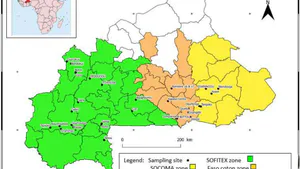
The inventory of cotton parasitic nematodes concerns the three cotton-growing areas represented by the Société des Fibres Textiles (SOFITEX), the Société Cotonnière du Gourma (SOCOMA) and Faso Coton, during the 2017-2018 agricultural campaign (Map 1).
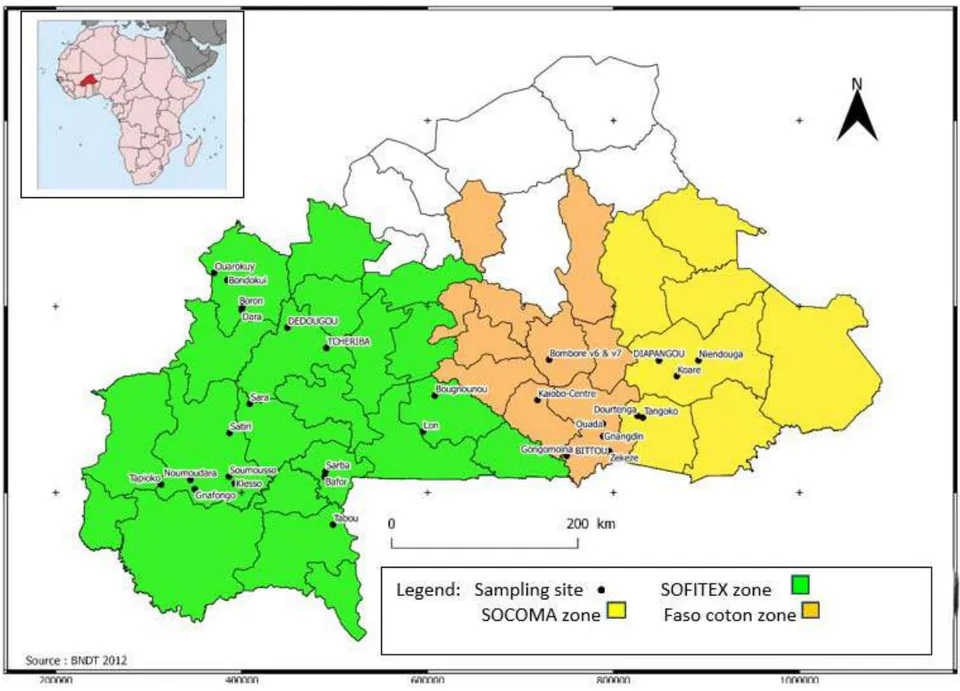
Fig. 1: Cotton-growing areas of Burkina Faso
The composite sample consisted of 10 samples of roots and adjoining soils in horizon was collected for seed production fields at the capsulation-early maturity stage. 94 samples of roots and adjoining soils is taken and nematological analyses is carried out at the Nematology Laboratory of the Institute of Environment and Agricultural Research (INERA), Farako-Ba/Bobo-Dioulasso Station. Nematodes are extracted from 250 cubic centimeters (cc) of soil using the Seinhorst (1962) elutriator method. The nematodes present in the roots are extracted by the sprinkler method Seinhorst (1950). Population densities are expressed in terms of number of nematodes/dm3 of soil and number of nematodes/g of roots. The morpho-biometric identification of the nematodes was done according to the identification key of Mai and Lyon (1975). The data analysis focused on the frequency and abundance of parasitic nematode populations recorded. Frequency is calculated as the total Number of samples where the nematode is present divided by the total Number of samples collected multiplied by 100.
Abundance is calculated by the sum of the samples where the nematode divide by the number of samples.
The importance of the main genera of nematodes parasitic on Cotton is determined according to the method of (Fortuner and Mery (1973), which proposed that a nematode is said to be abundant in the soil, if the abundance is individuals/dm3 of soil and in the roots if the abundance is individuals/g of roots. A nematode is said to be present in soil or roots, if it is observed in at least of the samples. Statistical analyses are performed with the XLSTAT 2016 software and the separation of the means according to the Newman Keuls test.
III. RESULTS AND DISCUSSION
3.1 Results
3.1.1 Frequency and abundance of observed nematodes
About ten genera of parasitic nematodes are associated with the cotton plant and represented by Meloidogyne, Pratylenchus, Helicotylenchus, Scutellonema, Tylenchorhynchus, Telotylenchus, Rotylenchulus, Xiphinema, Criconemella and Paratrichodorus (Table 1).
3.1.2 Nematodes extracted from soil samples
Helicotylenchus, Scutellonema, Tylenchorhynchus, Pratylenchus and Telotylenchus are frequent and abundant with frequencies between and for densities varying between 7,328 and 1,360 nematodes/dm of soil. According to the method of Foster and Merz (1973), this group of nematodes can be capitalized as the most important on Cotton and likely to cause significant damage (Frequency and Abundance nematodes/dm of soil. Xiphinema, Rotylenchulus and Meloidogyne are infrequent but abundant nematodes/soil dm and their presence may be associated with particular environmental conditions (soil texture, humidity, etc.). Paratrichodorus minor and Crimonemella onoensis are uncommon and not very abundant nematodes/dm of soil and can be considered as little damage to Cotton.
3.1.3 Nematodes extracted from the roots
Pratylenchus is observed in of the samples with root population densities of 30 nematodes/g of roots; This nematode is viewed to be frequent and abundant (frequency and abundance ) and can be considered as a parasite of Cotton according to the method of Mai and Lyon (1975). The nematodes Scutellonema and Helicotylenchus are infrequent and scarce nematodes/g of roots. This group of nematodes is considered mainly as ectoparasites and therefore little observed in the roots.
3.1.4 Nematode community densities by cotton-growing areas and prospecting localities
The nematode samples were taken in the 3 cotton-growing areas represented by the cotton companies SOFITEX (18 sites), SOCOMA (7 sites) and Faso Coton (7 sites).
The high population densities of Pratylenchus are observed in the SOFITEX zone with 1,029 nematodes/dm of soil with the highest densities observed on the Sarba site with 2,960 nematodes/dm of soil . Respective population densities of 350 and 187 individuals/dm of soil are observed, respectively in the SOCOMA and Faso Coton zones. The cotton-growing area of SOCOMA appears to be more infested with Helicotylenchus (1,040.8 individuals/dm soil), Scutellonema (1,546/dm soil), Tylenchorhynchus (243/dm soil) and Telotylenchus (264/dm soil) , representing, with Pratylenchus, the group of nematodes likely to cause significant damage to cotton. The SOFITEX zone appears to be less infested for these nematodes, compared to the Faso Coton zone, except for Helicotylenchus, with an average density of 7,239 individuals/dm of soil. The highest population densities of Helicotylenchus were observed at the Dedougou site with 29,600 individuals/dm of soil in the SOFITEX zone and at the Gongongwana/Pama site with 25,280 individuals/dm of soil in the Faso Coton zone. The total population densities of all parasitic nematodes observed in soil samples are higher in the SOCOMA zone, with 12,911 individuals/dm of soil . In the SOFITEX zone, the total soil populations are estimated at 9,583 nematodes/dm of soil and 6,624/dm of soil in the Faso Coton zone. Total populations of root-extracted nematodes are relatively low across cotton-growing areas with less than 10 nematodes/g of roots.
| Nematode genera | Frequency | Minimum | Maximum | Average | standard error |
| Extracted from soils | (%) | Nber N/dm3 | Nber N/dm3 | Nber N/dm3 | Nber N/dm3 |
| Helicotylenchus | 100 | 40 | 37,040 | 7,328 | ± 781 |
| Scutellonema | 100 | 60 | 4,800 | 1,133 | ± 107 |
| Tylenchorhynchus | 75 | 0 | 7,560 | 464 | ± 117 |
| Pratylenchus | 71 | 0 | 4,940 | 584 | ± 93 |
| Telotylenchus | 36 | 0 | 1,360 | 121 | ± 27 |
| Xiphinema | 26 | 0 | 380 | 25 | ± 781 |
| Rotylenchulus | 19 | 0 | 1,460 | 41 | ± 18 |
| Meloidogyne | 13 | 0 | 200 | 7 | ± 3 |
| Paratrichodorus | 9 | 0 | 120 | 6 | ± 2 |
| Crimonemella | 3 | 0 | 20 | 1 | ± 0 |
| Extracted from roots | (%) | Nber N/g | Nber N/g | Nber N/g | Nber N/g |
| Pratylenchus | 73 | 0 | 30 | 3 | ± 1 |
| Scutellonema | 14 | 0 | 7 | 1 | ± 0 |
| Helicotylenchus | 27 | 0 | 14 | 1 | ± 0 |
Legend: Nber/dm³: number of nematodes/dm³ of soil; Nber/g: number of nematodes/g of roots
| Cotton-Zone | Location | Pray/dm3 | Heli/dm3 | Scute/dm3 | Tyle/dm3 | Telo/dm3 | Tot/dm3 | Tot/grac. |
| SOFITEX | Satiri | 4,680 | 3,360 | 680 | 560 | 0 | 9,280 | 12 |
| Sara | 1,160 | 10,030 | 650 | 180 | 0 | 12,070 | 5 | |
| Bondokuy | 1,180 | 3,755 | 1,030 | 55 | 0 | 6,140 | 7 | |
| Ouarkoye | 1,193 | 4,267 | 587 | 67 | 0 | 6,307 | 5 | |
| Dédougou | 0 | 29,600 | 800 | 80 | 0 | 30,560 | 1 | |
| Dara | 847 | 3,167 | 733 | 207 | 0 | 4,960 | 1 | |
| Boron | 700 | 10,640 | 1,180 | 180 | 0 | 12,940 | 1 | |
| Tcheriba | 900 | 6,040 | 340 | 340 | 0 | 7,640 | 2 | |
| Bognounou | 380 | 3,180 | 880 | 100 | 0 | 4,620 | 3 | |
| Lon | 1,345 | 4,250 | 915 | 90 | 25 | 6,675 | 7 | |
| Tabou | 1,090 | 3,390 | 1,273 | 170 | 203 | 6,243 | 2 | |
| Sarba | 2,960 | 10,920 | 1,720 | 40 | 280 | 16,600 | 4 | |
| Bafor | 45 | 6,290 | 1,280 | 170 | 0 | 7,810 | 4 | |
| Klesso | 1,320 | 3,140 | 420 | 0 | 120 | 5,160 | 4 | |
| Soumousso | 260 | 5,380 | 1,820 | 180 | 260 | 7,940 | 7 | |
| Gnafogo | 150 | 8,720 | 1,030 | 60 | 110 | 10,110 | 1 | |
| Noumoudara | 193 | 5,527 | 733 | 53 | 20 | 6,600 | 3 | |
| Tapoko | 120 | 8,640 | 1,860 | 20 | 0 | 10,840 | 1 | |
| Average | 1,029 | 7,239 | 996 | 142 | 57 | 9,583 | 4 | |
| SOCOMA | Kouaré | 749 | 7,832 | 335 | 886 | 349 | 10,194 | 7 |
| Niendouga | 270 | 7,410 | 590 | 80 | 460 | 8,830 | 26 | |
| Gongongwana | 25 | 25,280 | 2,205 | 45 | 435 | 28,560 | 1 | |
| Diapangou | 80 | 17,100 | 1,330 | 260 | 20 | 18,830 | 4 | |
| Dourtenga | 327 | 1,660 | 1,393 | 147 | 60 | 3,593 | 2 | |
| Tangonko | 7 | 973 | 3,800 | 173 | 433 | 5,400 | 9 | |
| Koghin | 990 | 12,600 | 1,170 | 110 | 90 | 14,970 | 3 | |
| Average | 350 | 10,408 | 1,546 | 243 | 264 | 12,911 | 7 | |
| Faso Coton | Gonbloré V6 | 67 | 1,567 | 247 | 4,793 | 0 | 6,680 | 1 |
| Gonbloré V7 | 0 | 1,560 | 100 | 4,640 | 0 | 6,300 | 0 | |
| Gnangdin | 0 | 7,707 | 2,107 | 7 | 0 | 9,820 | 1 | |
| Bittou | 100 | 3,090 | 870 | 150 | 70 | 4,280 | 1 | |
| Zekeze | 900 | 5,967 | 1,740 | 20 | 0 | 8,647 | 2 | |
| Ouadav1 | 200 | 260 | 3,560 | 0 | 0 | 4,020 | 1 | |
| Kaïbo Sud | 45 | 4835 | 1,085 | 648 | 8 | 6,620 | 1 | |
| Average | 187 | 3,569 | 1,387 | 1,465 | 11 | 6,624 | 1 |
Legend: Praty: Pratylenchus; Heli: Helicotylenchus; Scute: Scutellonema Tyle: Tylenchorhynchus; Telo: Telotylenchus; Tot: Total in soil and roots
3.2 Discussion
The results of this study, which covered all major areas of Burkina Faso, are in line with the work of Sawadogo et al. (1998-1999) which had identified Helicotylenchus, Pratylenchus, Hoplolaimus, Tylenchorhynchus, Rotylenchulus and Meloidogyne as the main nematodes associated with the cotton-maize-sorghum cropping system in the cotton basin of the Houndé zone in western Burkina Faso. This study did not make it possible to rule on the pathogenicity of the root-knot nematodes Meloidogyne spp. on cotton, unlike several studies conducted in the primary production areas of the United States and South Africa where Meloidogyne incognita race 3, is known to cause significant damage Starr et al. (2005). M. incognita (Cophoid and white), Chitwood, and Rotylenchulus reniformis (Linford and Oliveira) are identified as major yield-limiting pests of upland cotton Moore and Lawrence (2013). M. incognita is considered to be the nematode causing yield losses on a global scale on crop plants Wram and Zasada (2019). Our research in the main cotton-growing areas of Burkina Faso shows that the root-knot nematodes Meloidogyne spp. do not constitute a significant problem because they are observed at low frequencies and at average densities of 7 nematodes/dm³ of soil. Studies on the pathovars of Meloidogyne incognita, recognized as the dominant species, would make it possible to decide on its pathogenicity. However, M. acronea, known to be a parasite on cotton and, present in South Africa and Malawi, is not present in Burkina Faso CABI (2019). The present study showed a predominance of the lesion nematode Pratylenchus brachyurus in the SOFITEX zone, a former cotton production area in western Burkina Faso where cotton is generally in rotation with maize, the preferred host plant of this group of nematodes. Its abundance in this area confirms its adaptation to this culture. The lesion nematode Pratylenchus is known to cause significant damage to cotton and Gay and Bird (1973) have shown that the presence of P. brachyurus would induce a decrease in Meloidogyne incognita populations. Similar competition has been observed between Meloidogyne incognita and Rotylenchulus reniformis. As for the kidney-shaped nematode Rotylenchulus reniformis, it is known as an important pest of cotton throughout the world mainly, in soils with a high silt/clay content Starr et al. (2005), Gordon et al. (2022). This species may pose a danger to cotton in Burkina Faso is where it is observed in high populations but limited to a few sites with 1,460 nematodes/dm³ of soil. The species has experienced a substantial expansion in the southern United States, causing significant damage and losses to cotton Bridge (1992), Lawrence (2022). Several ectoparasitic nematodes are identified on Cotton, mainly in the Central, Cotton-producing states of the United States of America, but their pathogenicity has not been demonstrated. These are mostly Helicotylenchus, Paratrichodorus minor, Tylenchorhynchus spp. but with very low population levels (less than 100 nematodes/100cm of soil or less than of soil) Bridge (1992), Wrather et al. (1992). On the other hand, other studies have shown high densities of these groups of nematodes, which are often considered secondary but likely to cause yield losses on cotton Singh and Mishra (2016), Schumacher et al. (2020). The high populations of the nematodes Helicotylenchus, Scutellonema, Tylenchorhynchus and Telotylenchus annulatus observed on cotton can cause significant damage to this crop under the conditions of Burkina Faso McLean and Lawrence (2003).
IV. CONCLUSION
About ten genera of parasitic nematodes are associated with cotton in Burkina Faso, seven (7) of which are likely to cause yield losses on cotton in Burkina Faso. Meloidogyne, Pratylenchus, Helicotylenchus, Scutellonema, Rotylenchulus, Tylenchorhynchus and Telotylenchus. The nematodes Meloidogyne and Rotylenchulus, known as major cotton pests throughout the world, have been observed at low frequencies but often at high population levels, suggesting their development in particular soil and soil moisture conditions. In perspective, it will be a question of identifying the existence of races of nematodes belonging to the species Meloidogyne javanica and M. incognita by molecular characterization that can attack cotton in Burkina Faso.
Competing Interests
Authors have declared that no competing interests exist.
Conflict of Interest
The authors declare no conflict of interest.
Ethical Approval
Not applicable
Data Availability
The datasets used in this study are openly available at [repository link] and the source code is available on GitHub at [GitHub link].
Funding
This work did not receive any external funding.
Cite this article
Related Research

Special Issue
Launch a focused special issue to highlight research, emerging trends, and expert insights in your academic field.