




IntelliPaper
Abstract
This article is about narrating the nation in the Moroccan theatre.Nation is hardto define and some say it did not exist in the past because of brute force. For me, the intellectually-advanced Islamic Spain emerges as an intercultural, luminary beacon and constitutes a nation. Individuals, nowadays, make the nation by writing about things that truly matter. These individuals have things in common but coloniality made de-territorialization extremely hard. We do not live in imagined communities, but we narrate the nation by theatre with a common cause, and transfer to posterity folklore as heirloom, which aims at preservation of Moroccan culture from historical erasure. Specifically, I will try to talk about how the Moroccan theatre began through al-halka, al-bssat, sayid alkatfii; sultan al-Talba, Ebidat Erma; al-Maddahun; Munshidoo al-Mawloudia and finally Boujeloud. In the modern sense of the word, the Moroccan theatre emerges as narration with its visual effects and stories that tell the Other our shared identity and sense of national belonging, making them live with us in imagined communities, helping us to define and redefine ourselves constantly in what is known as “becoming,”with the contingencyof historical continuation. I will try to sketch a brief history of the notion nation and relate it to Moroccan theatre. Then, I shall delve into analysis of some aspects of Moroccan theatre in Morocco that helps constitute the modern nation, by blending past and present with a springboard towards the future, and/or consent. I chose to talk about the inception of Moroccan theatre because it is groundedin history. To prove the existence of nation, I will try to talk about the inception of the Moroccan theatre and its strategies of narration. I hope to showhow nation is narrated through theatre. My primary sources are an article entitled, “What is a nation?” (1886) by “Orientalist” Ernest Renan (I will try to debunk his ideas); Homi Bhabha’s book Nation and Narration (1990) and the book by Mohamed Adib el Slaoui, al-Massrah al-Maghribii: al-Bidaya wa al-imtidad (1996).
Explore Digital Article Text
I. INTRODUCTION
Before I discuss the Moroccan theater, its forms and aspects, I want to share a few thoughts on what is a nation with major theorists in the field. First, it does not entail race or language, or religion. Islamic Spain understood that early on in history, which makes her a nation par excellence in the modern sense of the word. It understood this early on in the Middle Ages, and laid the grounds for the Italian Renaissance; and later on, to the Enlightenment ideals in the spirit of what is called entente or convivencia.
Nation exists in Moroccan theater. The inception of the Moroccan theater, its aspects and the narration strategies it uses to construct or build the nation will be discussed here. Before that, I will dwell a little bit on the notion itself. What does nation signify? Can it be defined? Does it exist in narratives? Is it new? What makes a nation? Politics? Ideology? Does it have a past? A future? What does it mean to have consent? A warm heart and mind? Besides, is it mythic? Imagined? Or real and aligns with memory and history? The central question which this presentation grapples with is how does Moroccan theater narrate the nation? By showcasing some aspects of Moroccan theater in its nascent, unfledged form, I aim to revisit the Moroccan theater in its early inception.
Homi Bhabha states that to write the story of the western nation demands that we articulate that archaic ambivalence that informs modernity. Questioning the progressive metaphor of modern social cohesion is needed. Two accounts hold here, which are representing the diametrically opposed world views of master and slave which "between them account for the major historical and philosophical dialectic of modern times." John Barrell sees that the "positions open to an equally wide survey and demonstrates how the demand for a holistic, representative vision of society could only be represented in a discourse that was at the same time obsessively fixed upon, and uncertain of, the boundaries of society, and the margins of the text."
According to my knowledge, Homi Bhabha talks about the splitting of the nation and its ambivalent modalities/characteristics. Splitting the nation in terms of writing means that the temporality of the nation that can be understood/felt/lived in the third space of enunciation, that uncertain grey zone. For him, there is no locality to the nation in history but lies within the space of the present perfect. Moving in time and space, as an emigre does, splitting the nation in terms of writing happens and examples are many in this respect, Hanif Kureishi's The Black Album is one such example. The time of nation for him is not linear or horizontal but contemporaneous, hence the diasporic seventh man, the émigré. He finds himself hurled into this splitted space of the nation as if lost in the ambivalence of time.
Specifically, Bhabha talks about the time of the nation, stating that the Western nation is as obscure as ubiquitous. Its form lives in the locality of culture. The locality of culture, for him, is only a temporal dure lived by what John Berger calls the diasporic seventh man, the times for gatherings as well as emergence for Bhabha. This state of ambivalent in-betweenness can be defined, in the diasporic space, as a form of "living more complex from country; less patriotic that patrie, more mythological than ideology, less centered than the citizen, more hybrid in the articulation of cultural differences and identifications—gender, race or class—than can be presented in any hierarchical or binary structuring of social antagonism."3
It is the mark of the ambivalence of the nation as a narrative strategy—and an apparatus of power—that it produces a continual slippage into analogous, even metonymic, categories, like the people, minorities, or 'cultural difference' that continually overlap in the act of writing the nation. What is displayed in this displacement and repetition of terms is the nation as the measure of the liminality of cultural modernity.
In this liminal space, the émigré becomes a stranger to one's own country, language, sex and identity.5 Which brings about the question of nation as metaphor which Said describes as a secular act of interpretation. The nation as metaphor is "to take account of this horizontal, secular space of the crowded spectacle of the modern nation... implies that no single explanation sending one back immediately to a single origin is adequate.6 Their metaphoric movement, Bhabha suggests, requires a kind of doubleness in writing or "a temporality of representation that moves between cultural formations and social processes without a 'centered' casual logic."7
Partha Chatterjee sees that to assert its sovereignty, as the universal ideal, Nationalism needs its others, "if it could ever actualize itself in the real world as the truly universal, it would in fact destroy itself." The cultural shreds and patches used by nationalism are often "arbitrary historical inventions. Any old shred would have served as well. But in no way does it follow that the principle of nationalism is itself accidental."
The other is not the double, but acts almost as an ambivalent twin laden with racial undertones and
The transgressive, invasive structures of the Black 'national' text, which thrives on rhetorical strategies of hybridity, deformation, masking, and inversion is developed through an extended analogy with the guerrilla warfare that became a way of life for the marron communities of runaway slaves and fugitives who lived dangerously, and insubordinately 'on the frontiers or margins of all American promise, profit and modes of production.'
Both gentleman and slave, with different cultural means and to very different historical ends, demonstrate that forces of social authority and subalternity may emerge as displaced, even decentered strategies of signification... indeed the exercise of power may be both more politically effective and psychically affective because their discursive liminality may provide greater scope for strategic maneuver and negotiation. We then have a contested cultural territory where the people must be thought in a double-time; the people are the historical 'objects' of a nationalist pedagogy, giving the discourse an authority that is based on the pre-given or constituted historical origin or event, the people are also the 'subjects' of a process of signification that must erase any prior or originality presence of the nation-people to demonstrate the prodigious, living principle of the people as that continual process by which the national life is redeemed and signified as a repeating and reproduction process.
It is very bold to state that Egypt and China were not nations. Such is the thought of a French Orientalist, Ernest Renan. He avows that nations are new to history: They were flocks led by a son of the sun or by a son of heaven. Such are his secular and mythological thoughts on nation, highlighting its mythological aspect in the past. For him, it did not exist in time immemorial, because of the use of brute force and the lack of a secular, enlightening alternative, but the precursor Islamic Spain or Al-Andalus helped the West progress and constituted a fair polity. For Renan, then, force does not make a nation. Nor does force, language or religion, or any unifying force or fixity of meaning. Even though philosophers such as Max Weber stress that the most important aspect of power is violence, I think that in today's time power should be understood as a social relation, not as a repressive force leveled at bodies from a high, Ivory tower. Viewed in this light, one ought to analyze deeply the relations and practices of everyday life in what they are encountering and facing, in what oppresses them and in what they aspire to.
Frontiers are articulations, boundaries, are constitutively crossed and transgressed. It is across such boundaries, both historical and pedagogical, that Martin Tom places Renan's celebrated essay "What is a nation?"
Renan avers that to depend on ethnographic analysis alone is to surrender the nation to a chimera, a mythic creature. A Frenchman/woman cannot call themselves a Gaul; a Frank or a Burgundian in today's history because that would entail the purity of race and hauteur. Rather, a nation, which I like a great deal, should never stop defining and redefining itself. It is in Bhabhan "becoming" that nations, like narratives, lose their origins in the myth of time and only fully realize their horizons in the mind's eye. It is in becoming that a man and a woman can build the nation.
In the past, which Renan calls "classical antiquity," Republics, municipal kingdoms, confederations of local republics and Empires existed. Though Athens was patriotic; Gaul a clan before the Roman invasion, they were not nations per se. Nor was the Empire of Alexander the Great a patrie either.
Though the purity of blood persists, no nation can trace its origins back because that would entail racist undertones. Sometimes it is positive in the case of the Granadinoes who were forced to leave their rightful homes in Islamic Spain. Here the Moorish identity should be brought to light as the place has spirituality in the heart and mind of Muslims. Nowadays, racial slurs and epithets extend from the past to the present against Arab peoples. But the case of Islamic Spain is an example of the rare and positive concept of descent, which is highlighted in Necklace and Pomegranates (2024).
To debunk western stereotyped images, the Moor emerges as a noble and brave persona: Sayfudeen narrates the loss of his great nation through memory but highlights the bravery and chivalry of the Moor: "Gibraltar means Jabal Tariq. It was here where the Berber chieftain, Tariq ibn Zayad, landed his warriors. Having burned all the vessels, he addressed his men, 'The sea is behind you and the foe is in front of you.'" The stress on the place and the endless chain of signification entails revisiting this enriching past in memory.
According to Benedict Anderson, nation is "large cultural systems" that came to being by replacing tight-held political ideologies, which has their own history , different from ours. In this novel, I think that borders are fluid imaginatively speaking. Anderson views space and time in the modern nation as an extension of narrative culture in the realist novel. Post-imperial racism "infests the febrile, neo-romantic poetry." The memory of an Islamic Spain, however, persists as the protagonist, Sayfudin, was born at sea, in a no-man's land, between Gibraltar and Spain, but sometimes the claim of descent is negative as Nazi Germany; Vichy France and Fascist Italy, and Inquisitorial Spain before that persecuted the Other relentlessly on racial grounds. Nation's narrator's antagonistic and ambivalent perspective leads to the establishment of the cultural boundaries which are pregnant with meaning(s) that must be crossed, erased and translated while attempting to produce culture.
Still, power and cultural authority emerge as the irreducible excess of the syntactic over the semantic."
What I like most about Renan's lecture in the Sorbonne is that the nation should be felt in the mind and heart. It sounds poetic, but it is not chauvinistic at least. Only poetical, which is accepted. For Renan, soul and spirituality constitute the nation, It is a common possession of a rich legacy of memories, and present-day consent; the desire to live together; the will to preserve the cultural heritage, its values that ancestors passed down as heirlooms unto us, in an undivided form. Nation, then, is a shared history and a future consent.
In the past, race was the common unifying marker. The sign of Sparta, Athens and some Arab tribes was race. With the Roman invasion, however, race was diluted as it came to be seen as a "great agglomeration of cities and provinces different from each other."
Even frontier changes during the Middle Ages were not based on ethnographic divisions, the best case being Islamic Spain or Andalousia. Nation does not mean race, but a common desire to live together and a future consent: "The primordial right of races is as perilous for genuine progress as the national principle is just and legitimate." In this way, difference insulates the dominance of race. Nation has a logical sentimentality to it as it is both soul and body, and wit if I may add.
Why not grant separation to those most recalcitrant to the idea of nation, on condition that in that self same separation, work should be done to unite, building and rebuilding the patrie constantly and practically. Two opposites working hand-in-hand to build the nation for it is in the debilitating dichotomies that the sources of all evil existed.
A nation, therefore, should share nothing and everything. Synthesis should hold so as to disrupt all the fixities that hamper the builders of culture, man and woman. Let us break asunder all disparities so as the nation could emerge as a "large-scale solidarity, constituted by the feeling of the sacrifices that are made and those that are yet to come in the future. It presupposes a past residing in the present by a tangible fact, consent, which would lead to the future, and the clearly expressed desire to continue a common life."
II. HOW MOROCCAN THEATRE STARTED
Now let us discuss the Moroccan theater in relation to the nation. In the modern sense of the word, to write about a nation, for a nation is narration , is to deal with serious matters that mean so much to culture, which is made by man and woman. There has to be an entente to write about the nation in the theater, which is my prime focus today. These writers should have a common national cause: The Moroccan theater is one such example. Here are some aspects and characteristics that are peculiar to it.
In Morocco, the inception of theater, as a European form, began in the second half of the 20th century with playwrights such as Mohamed el Quorri; Mohamed el Hadad; Abd elKhaliq Torris; Ahmed Tayib el Aleg; Tayib Seddiqi; Nabil Lahlou; Abd el Khalek Zerouali and others.
As an image, however, it dates back to the Alaouite Sultan, Al-Mawla Rachid (1666-1672). Morocco knew the art of theater and performed it long before it was introduced by the French and Spanish occupiers from 1912-1955 with their social structures, institutions, military and cultural so-called civilizing mission that tried to alter national landmarks or features, so as to replace it with other alien and odd ones of theirs, and crush Arab pride if I might add.
The Moroccan theater in its Greek form, which is like a spectacle, deploys the tools of modern theater: actors, audience, mise en scene, song, dance and dialogue, which makes it close in form to the improvised comedy and to open theater. It is an embryonic attempt and a dramatic form amenable to further progress and to be fledged out.
III. SOME ASPECTS OF MOROCCAN THEATRE
To unmute the place, the Moroccan theater in its initial phases used several strategies such as the metaphor, suggestion or insinuation, language and pantomime/mime. With the help of the audience, the writer hones his artistic talent and imagination. He even shares his feelings with them.
Many Arab intellectuals realized that it was high time for them to reach a somewhat artistic independence in Arabic history. This helped them refurnish Arabic culture with its rightful distinction at the international level. It harkens back with its rich ancient roots, to the end of transcending the excluded self in the annals of history. To build a new reality that is in line with the expectations and hopes of the new Arabic human being. To this end, many Moroccan and Eastern writers sought to do research to lay the ground for the Moroccan theater and enshrine it in popular folklore with its different forms which we will introduce after this section. This is done because the continuity of culture in its different forms is a civilizational necessity, because any discontinuation in the making of it will certainly lead to historical gaps in terms of historical development/continuation as it would corrode its seminal characteristics.
Some academic research stressed the idea that the written and oral Arabic cultural heritage is pregnant with artistic forms that connect it to theater; and that these cultural forms are rooted in the history of the Arab human being and are capable of being theatricalized/dramatized, and thus Arabizing the Arabian theater. Cultural heritage is not devoid of theatrical instances that function as the modern theater does. In addition to texts that can be theatricalized, there are other forms that have a strong relation to the theatre as an art at the level of form and aesthetics, and at the level of its dramatic themes.
IV. FORMS OF MOROCCAN OPEN THEATRE
a. Al-Halqa
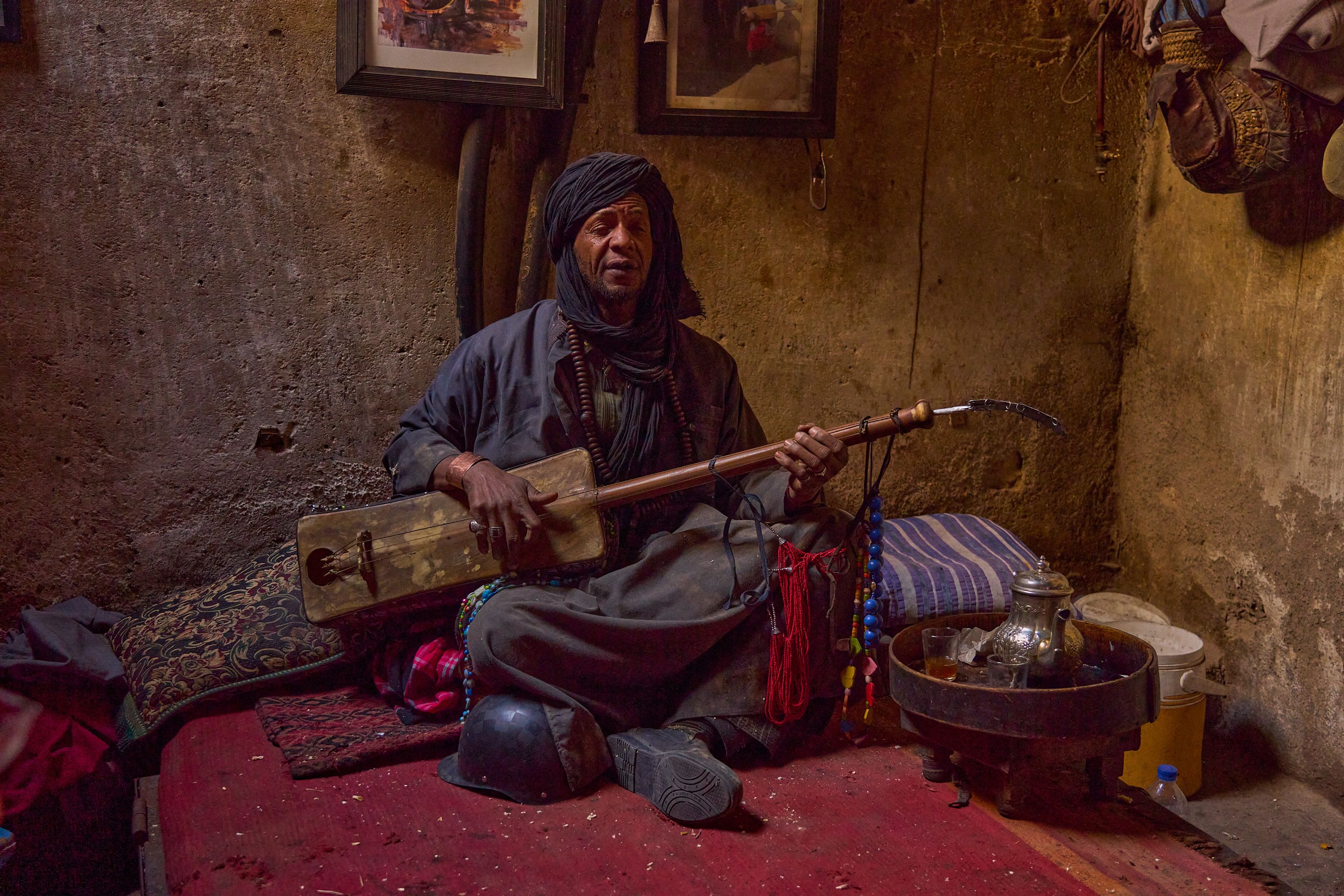
It is a circular gathering in one of the public squares, where the narrator and his assistant stand in the center, in the middle of the crowd, recounting heroic stories, legends and fantastic tales in a dialogic manner that uses characterization and pantomime interacting with the audience. As well as incorporating songs.
As any theatrical endeavor, it relies on continuous interaction with the audience. Mixed with these mythic, fantastic stories is the human, the animal, imps/leprechauns and the devil. The narrator also sings and performs acrobatic moves using pantomime which is profoundly expressive. Accompanied by the narrator is an actor that plays musical instruments, who tells in a suspenseful language stories of heroic quests and terrifying, tragic battles that are mixed with love, chivalry, magic and adventures.
b. Al-Bssat
Al-Bssat means humor in Darija, which is a funny enactment that uses dialogue, pantomime, dancing and the active engagement of the audience in this humorous spectacle. This visual art was first introduced by the Palace. Then, it was appropriated by the public and was performed in open spaces, to become a popular visual art. Al-Bassatun are actors that perform, through this art, social problems which couldn't be resolved in public courts. Through improvisation, al-Bassatun try to find solutions for it. Some historians sources divulge that this form of art harkens back to ancient times and is part of the remnants of the Roman theatre that was widespread in some Moroccan cities like: Chala; Walili; Lukoos and Tangiers.
c. Sayid el-Katfii
Sayid el-Katfii is another art derivative of al-Bssat or humor, which relies on characterizing some causes that have to do with Sufism and its Zawayas. It is performed in public squares, respectable houses or markets by chanting Sufi songs, dancing, improvising and some Sufi invocations of God.
On one special occasion, it celebrates the day of birth of the prophet PBUH. The spectacle of Sayiid el-Katfii is held in squares, markets and some houses in the capital of Morocco, Rabat. It seeks to introduce this form of art into the modern age.
According to Abdellah Chekroun, the followers of Sayid el-Katfii usually consist of twelve actors headed by a foreman or headman called Mqeddem in Darija, who takes care of the organization and the artistic and administrative matters. The headman (Mqeddem) opens the ceremony by giving the actors some instructions on how to perform in a serious manner away from laughter. It is not a comic. By falling into character in a tasteful, creative way, these plays deal with social, agricultural and craft matters.
d. Sultan al-Talba
The celebration of this event dates back to the Alaouite Sultan Moulay Rchid, the founder of the Alaouite dynasty, Who ruled from 1666-1672. The Sultan Moulay Rchid institutionalized this cultural event in recognition for the help He received from His subjects to defeat his enemies, far and domestic.
In the spring of each year, al-Quaraouine university convenes an imaginary, miniature Sultanate inside one week for the purpose of requesting royal patronage on matters educational and vocational.
Headed by a brilliant student given the title of sultan al-Talba, the ceremony commences by heading in a procession to Oued Fes, where tents are erected, and a cabinet appointed, consisting in a ministry of interior; of justice; of finance and an accountant for the state.
The king generously sends the brilliant Talib gifts and holds a meeting with him in one of the annexes of the Qaraouine university in Fez before the Friday Prayer held in al-Qaraouine mosque.
When the King dismounts his mount, this Talib beseeches Him to look into the educational and vocational requests of his schoolmates. Tradition requires the Talib to address the King in a rhymed and improvised speech.
On the seventh day this event comes to a close, the make-belief sultan al-Talba goes back with his classmates to pursue their studies with the Royal the reassurance that their requests will be looked into.
e. Al-Madahun
Al-madahun are considered to be skilled artists at the level of pantomime and creation/characterization. Strolling about in squares, cities and villages, they praise big known political figures, novelists, religious scholars and Sufists using improvised and spontaneous poetry in different Moroccan accents. As well as recounting tales, legends and myths, they engage audiences with public matters using a language that verges on the symbolic.
f. Munshidu al-Mawludia
These Sufi groups chant religious, Sufi songs commemorating the birth of the Prophet PBUH at traditional houses, Zaouiyas, schools and mosques. They call their art form al-Mawludiyya. The ceremony commences by a choir chanting Sufi poetry. Then individual chanting, followed by a choir once more.
g. Boujeluud
Boujeluud is a theatrical clown. On Eid Al-Adha, he wears goat and sheep's skin trolling about in streets, neighborhoods and suqs, serenading his audience with proverbs, words-of-wisdom and Sufi poetry. Then, he entertains the little ones with humor and laughter.
h. Ebidat el-Rrma
These are groups of imitators of an acting vocation that talk about various social problems. Their typical stages are Palace squares and public squares. Their themes revolve around modest people's matters. When they form their circle, they initiate dialogue with the audience, song and dance in groups. Using musical instruments like the tambourine, the flute and percussion machines. This theater of theirs was very popular in Moroccan cities such as Fez, Meknes, Rabat and Marrakesh in the 17 century onward.
V. DISCUSSION
Moroccan folklore is an extension to the collective memory as the continuous civilizational discourse is rooted in national culture, laden with sentiments and aspirations. Moroccan folklore uses visual tools, and is considered as an inspiration to other cultural forms such as dancing, music, novels. These are interconnected with history, space and society. Creative forms such as these are considered to be as a resilient memory amenable to the future as it is laden with the playwrights aspirations and dreams.
The colonial administration sought to undermine the Moroccan theater in its inception. As resistance, folklore emerged in cities and villages enshrining national heritage. Social squares became open stages for the sons and daughters of Morocco, where the narrator/actor of al-Halqa tried to reflect the misery under the occupation by telling heroic, Islamic stories intermingled with magic. The Moroccan national theater was founded in the second half of the 20 century with zeal and great patriotic excitement to narrate the nation/the patrie which is deeply rooted in history.
The Other is never outside or beyond us. Discourse makes a transnational culture possible, because when we think we "speak most intimately and indigenously 'between ourselves', the Other emerges forcefully. Thus, Europe leads to Africa; the nations of Europe and Morocco meet in Tangiers; the margins displace the center, the peoples of the periphery return to rewrite the history and fiction of the metropolis through postcolonial Magical realism, theater and poetry.
VI. CONCLUSION
Moroccan folklore serves as a profound extension of the collective memory, deeply intertwined with the continuous civilizational discourse rooted in national culture. Laden with sentiments and aspirations, Moroccan folklore employs visual tools and serves as a wellspring of inspiration for various cultural forms such as dance, music, and literature. These creative expressions are not merely artistic endeavors but interconnected narratives that reflect the history, spatial contexts, and societal fabric of Morocco.
Historically, Moroccan folklore emerges as a resilient response to colonial efforts to suppress local theater traditions. In cities and villages, it became a vehicle for preserving national heritage and cultural identity, transforming social squares into stages where narratives of resistance and resilience unfolded. The tradition of al-Halqa, with its blend of heroic, Islamic, and magical stories, exemplifies this defiance and cultural assertion against the former French and Spanish Protectorates.
The establishment of Moroccan national theater in the latter half of the 20th century further underscored the nation's zeal and patriotic fervor to narrate/narrativize its rich historical tapestry. This cultural resurgence not only reclaimed narratives but also redefined them within a global context, bridging boundaries and engaging in dialogue with the broader world.
Moreover, Moroccan folklore and its cultural expressions challenge the dichotomy of Self and Other, asserting that transnational cultural exchange is not one-sided but reciprocal and transformative. Through postcolonial magical realism, theater, and poetry, Morocco asserts its presence on the global stage, reshaping the narratives of the metropolis from the perspectives of the periphery.
In short, Moroccan folklore is not just a repository of tales and traditions but a dynamic force that shapes the national consciousness, connects past with present aspirations, and fosters a resilient memory that continues to evolve and inspire future generations.
Conflict of Interest
The authors declare no conflict of interest.
Ethical Approval
Not applicable
Data Availability
The datasets used in this study are openly available at [repository link] and the source code is available on GitHub at [GitHub link].
Funding
This work did not receive any external funding.
Cite this article
Related Research



Special Issue
Launch a focused special issue to highlight research, emerging trends, and expert insights in your academic field.
