


Abstract
Rupert Billingham, Leslie Brent and Peter Medawar showed in 1953 that the state of sensitization to an antigen could be passively transferred to a recipient with a transplant of specifically sensitized donor lymphoid cells, which continued to function successfully in their new body [1]. This transfer of immunity was designated by R. Billigham and co-authors [2] as adoptive transfer, and the immunity itself was called adoptive or perceived immunity.
Adoptive transfer of lymphocytes is currently used to assess the functional activity of individual cell forms or to develop cell therapy techniques, for example in experimental oncology, using T-lymphocytes specifically sensitized to tumor antigens [3, 4, 5, 6, 7]. However, the problem of adoptive transfer of immune response remains far from being resolved. It is believed that adoptive transfer of sensitization to a specific antigen is possible only through the introduction of lymphoid cells of an immunized donor to the recipient [8, 9, 10, 11].
We have previously shown that adoptive transfer in a syngeneic system (BALB/c mice) can also be accomplished via platelets [12 ]. In the available literature, we have not found information on the possibility of adoptive transfer of sensitization via platelets in a xenogenic system. In this regard, the goal of the present study was chosen.
Explore Digital Article Text
I. INTRODUCTION
Rupert Billingham, Leslie Brent and Peter Medawar showed in 1953 that the state of sensitization to an antigen could be passively transferred to a recipient with a transplant of specifically sensitized donor lymphoid cells, which continued to function successfully in their new body [1]. This transfer of immunity was designated by R. Billigham and co-authors [2] as adoptive transfer, and the immunity itself was called adoptive or perceived immunity.
Adoptive transfer of lymphocytes is currently used to assess the functional activity of individual cell forms or to develop cell therapy techniques, for example in experimental oncology, using T-lymphocytes specifically sensitized to tumor antigens . However, the problem of adoptive transfer of immune response remains far from being resolved. It is believed that adoptive transfer of sensitization to a specific antigen is possible only through the introduction of lymphoid cells of an immunized donor to the recipient .
We have previously shown that adoptive transfer in a syngeneic system (BALB/c mice) can also be accomplished via platelets . In the available literature, we have not found information on the possibility of adoptive transfer of sensitization via platelets in a xenogenic system. In this regard, the goal of the present study was chosen.
The aim of the study was to determine whether adoptive transfer of the immune response to SRBC from immunized rabbits to intact recipients (BALB/c mice) is possible using platelets.
II. MATERIALS AND METHODS
In this work, 30 male BALB/c mice weighing at least 20.0 grams were used. Mice of this strain are known to be highly susceptible to SRBC immunization and are widely used in adoptive transfer studies .
In addition to mice, 10 chinchilla rabbits weighing no more than 2000.0 g were used in the experiments. The experimental animals were kindly provided by the nursery of the Technological Center of the Academy of Sciences of Turkmenistan. The rabbits and mice were on a standard diet adopted in vivariums.
At the first stage of the experiment, mice and rabbits were immunized with sheep red blood cells (SRBC). Using a tuberculin syringe, 0.1 ml of a 20% SRBC suspension in physiological solution was injected into the mice intraperitoneally. Rabbits were immunized by injecting 1.0 ml of a 20% SRBC suspension into the marginal vein of the ear. The study design is presented in the diagram (Fig. 1).
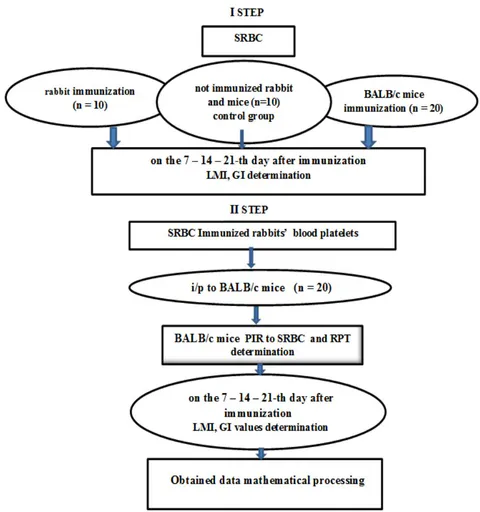
Platelets were isolated by two-stage centrifugation. [15]. Before and on days 3, 7, 14 and 21 after immunization, the mice were determined to have the leukocyte migration index (LMI) in the modified leukocyte migration inhibition reaction (LMIR) [and the granulocyte index (GI) – the ratio of poly- and mononuclear cells in the blood [16, 17]. We have previously established that these indicators are very informative in assessing the severity of the immune response of mice to immunization with SRBC [18].
At the second stage of the study, on the 7th day after immunization with SRBC, 2.0 ml of blood were taken from the marginal ear vein of immunized rabbits to isolate platelets (PLT). The obtained platelets were washed three times with sterile physiological sodium chloride solution and a suspension containing cells was prepared. 0.1 of the suspension was administered intraperitoneally to intact BALB/c mice. Before the administration and on the 3rd, 7th, 14th, 21st day after the administration of platelets from immune rabbits, the MMI and GI values were determined in mice. Cryolysates of SRBC (ERL) and platelets (PLT) were used as migration inducers.
The obtained data were mathematically processed using the SPSS program (USA statistics).
III. RESULTS OF THE STUDY AND THEIR DISCUSSION
The study showed that BALB/c mice immunized with SRBC adequately respond in vitro to ERL (Fig. 1). Diagram A shows that the LMI value steadily increases and reaches its maximum values on the 14th day after immunization – .
By day 21 (observation period), the LMI value decreases to but remains significantly higher than the initial level (p<0.05). This indicates the development of an adequate immune response in mice to SRBC immunization.
{"image_source":{"path":"images/b089a00a9db02b65b839c3e05bc0f95903f0133cdf0fc52446574575ea00e74e.jpg"},"content":"","chart_caption":[],"chart_footnote":[]} {"image_source":{"path":"images/e96b1da632c26f682d1806a3fa75ff21280670688f42bd3dda508c45893d9b8a.jpg"},"content":"","chart_caption":[{"type":"text","content":"A"},{"type":"text","content":"B"},{"type":"text","content":"Fig. 2: The value of IML in the dynamics of the response of mice to i/p administration of EB and TR suspension in vitro (A) The value of LMI in the dynamics of the response of mice that received i/p administration of platelet suspension from immune rabbits to EB and LTR in vitro (B)"}],"chart_footnote":[]}
Intraperitoneal administration the intact rabbit' PLT suspension to mice also resulted in the immune response formation (Fig. 1 A). The diagram shows that the initial value of LMI in the presence of ERL and PLTL is almost the same and is and , respectively, the difference is not significant ( ). But then the value of IML in the presence of PLTL rapidly decreases and on the 7th day is , while in mice immunized with SRBC, by this time it increases to ( ). By the 14th day, LMI in the presence of PLTL rapidly increases and reaches . This is significantly higher than the maximum value of LMI in mice in response to ERL in vitro ( ).
Thus, when immunizing BALB/c mice with intact rabbit platelets, a pronounced immune response develops, the dynamics of which differ significantly from the academic response of mice to immunization with SRBC by a drop in the LMI value in the first 7 days.
The study showed that the dynamics and magnitude of LMI in the presence of ERL and PLT in vitro depend on the inducer of leucocytes migration (Fig. 1B). The value of LMI progressively increases and reaches maximum values (122.7±10.7) on day 21 (observation period). However, the dynamics of the response to PLT in mice of the same group differs from the response to ERL (Fig. 1 B). In the first 7 days, LMI in the presence of PLT progressively decreases, then rapidly increases and by day 21 is 135.7±11.2. This is slightly higher compared to LMI in the presence of ERL, but the difference is not mathematically reliable (p>0.05).
Thus, despite the not very high values of LMI in the presence of ERL, we can speak of the completed transfer of the immune response to SRBC in BALB/c mice that received an intraperitoneal injection of a platelet suspension from rabbits immunized with SRBC.
Another confirmation of the conclusion made is the results of determining the GI value in the dynamics of the immune response of animals to ERL and PLT (Fig. 2, A. B).
{"image_source":{"path":"images/9af2f7287eb0581e9fdcd1896bc186c67d2a7c4173dd1b466b638d8c967a4365.jpg"},"content":"","chart_caption":[{"type":"text","content":"A"}],"chart_footnote":[]} {"image_source":{"path":"images/5824655d38370ebd47b639a6c2ab1e198856fb53f1941361451cbf180b00d133.jpg"},"content":"","chart_caption":[{"type":"text","content":"B"},{"type":"text","content":"Fig. 3: The GI value in the dynamics of the response of mice to i/p administration of EB and TR suspension in vitro (A), The GI value in the dynamics of the received i/p administration of platelet suspension mice response that from immune rabbits to SRBC and PLTL in vitro (B)"}],"chart_footnote":[]}
The study showed that after immunization of mice with PLT suspension, the GI value by day 3 sharply increases and is versus before immunization, and remains at this level until day 14 (p<0.01). From day 14 it decreases and by day 21 it practically corresponds to the control level (p>0.05). That is, in the first 3 days, the mice's organism responds to PLT suspension immunization with a pronounced inflammatory reaction and the release of granulocytes into the peripheral blood, resulting in a GI increasing. In these same mice group the response to ERL in vitro differs significantly from the response to PLTL (Fig. 2, A). In the first 3 days, the GI value decreases to (p<0.01), on the 7th day it increases, reaching the maximum value , then gradually decreases and by the 21st day it corresponds to the initial value. Thus, the response to immunization from the blood depends significantly on the type of antigen.
Despite the fact that both antigens, SRBC and PLT, are xenogenic in relation to mice, the response to PLTL has its own peculiarities. The reason is most likely that SRBC is a corpuscular antigen, an inert object of attack by the immune system of mice . A suspension of platelets introduced into the mice peritoneum apparently initiates a "graft versus host" reaction , which leads to the release of lymphocytes into the bloodstream and a drop in the GI value. However, the low dose of platelets introduced (2x10 cells in 0.1 ml) does not allow platelets to fully carry out this reaction and the immune system of mice "copes" with them. As a result, an immune response to PLT antigens are formed, which is manifested by an increase in the response to platelet lysate in vitro.
When mice were injected with a suspension of platelets from SRBC -immunized rabbits, the response to ERL in vitro was practically identical to the mice immune response on the intraperitoneal administration of SRBC (Fig. 2, B). The same, albeit less significant, decrease in the GI value was observed in the first days after immunization (09.2±0.03) with a subsequent peak on days 7-14 (1.5±0.1). In the diagram, the response curve of mice to PLT in vitro corresponds to that of the primary response to the injection of platelet suspension. That is, the GI value in the first 3 days after immunization increases to 1.5±0.03 and gradually decreases in the following days; on day 21, the GI value corresponds to the initial value (p>0.05). The release of granulocytes in response to immunization with PLT indicates an attempt by platelets to initiate the "graft versus host" reaction [1, 20, 24, 22, 23].
IV. CONCLUSION
Until recently, platelets were traditionally associated exclusively with hemostasis. However, primary hemostasis, according to R. Zinkernagel, may be a phylogenetic relic of primitive leukocytes, since they have a wide range of potent inflammatory factors that can induce or enhance temperature inflammatory reactions .
However, the role of platelets in the adaptive immune response is just emerging and has not yet been clearly elucidated . Increasing evidence suggests that platelets and their derivative products influence adaptive immunity and play a significant role in shaping the immune response. For example, platelets have been shown to express functional CD154 (CD40L) , a molecule critical for modulating the adaptive immune response . It is known that during adoptive transfer there is a different direction of immunological reactions between the immunocompetent cells of the donor and recipient.
Platelets are able to recognize foreignness thanks to a huge set of receptors. The role of platelets in innate immune responses is becoming increasingly clear, but is still not clearly understood . The question of how we acquire immunity has been studied for more than a century. In this regard, the concept of R. Zinkernagel is interesting, who believes that the ability to tolerate an immune response is not related to their "immunological memory." According to the author, "immunological memory", of course, exists, but is not a key mechanism of recognition and protection .
Protection depends on the pre-existing neutralizing antibodies in the body or pre-activated T cells, the levels of which are determined by antigens . This finding has serious implications for our understanding of vaccines and maintaining human protection against old and new infectious diseases . However, the ability of lymphocytes and platelets to tolerate an immune response to an intact recipient still indicates the presence in them the "memory" on antigen. Besides, more recently, evidence has emerged that platelets have the ability to recruit lymphocytes and activate the functions of innate effector cells, modulate antigen presentation, and enhance the adaptive immune response. This allows us to consider platelets as the organizer of the functional activity of the immune system. Consequently, studying the role of platelets in the adoptive transfer of the immune response is becoming an increasingly relevant area of research.
Vaccines are one of the best preventive measures public health has to offer to protect against infections. WHO emphasizes that the vaccine is a significant advance in immunology and microbiology, but that context-specific and multifactorial studies are needed in this direction . Although some aspects of the vaccine challenge are well understood, new paradigms, such as the importance of innate cells and inducible immune structures in providing protection, offer opportunities to rethink our approach to vaccine development . In this regard, it seems promising to us to conduct research on the development of fundamentally new vaccines – platelet-based ones. The evolutionary advantages of immunological memory possessed by platelets may play a critical role in resolving this issue.
Acknowledgments
None to declare
Financial Disclosure
The authors received no financial support from any funding agencies for this study.
Conflict of Interest
None to declare.
Informed Consent
Informed consent was obtained.
Author Contributions
This work was carried out in collaboration among all authors. All authors read and approved the final manuscript.
Data Availability
The authors declare that data supporting findings of this study are available within the article.
SRBC: sheep red blood cells,
LMI: leukocyte migration index,
GI: granulocyte index,
PIR: primary immune response,
LMIR: leukocyte migration inhibition reaction, PLT: platelet,
ERL: erythrocytes (SRBC) lysate,
PLTL: platelets lysate, i/p: intraperitoneal,
WHO: world health organization.
Conflict of Interest
The authors declare no conflict of interest.
Ethical Approval
Not applicable
Data Availability
The datasets used in this study are openly available at [repository link] and the source code is available on GitHub at [GitHub link].
Funding
This work did not receive any external funding.
References
Cite this article
Related Research

Special Issue
Launch a focused special issue to highlight research, emerging trends, and expert insights in your academic field.