


Abstract
Background: Iron deficiency anemia is the most frequent cause in the world and derives from the negative balance of iron, due to an inadequate contribution or absorption in the diet, as well as physiological periods such as pregnancy.
Methods: Correlational descriptive research, 42 pregnant women who attended their obstetric consultation and nutritional consultation between the ages of 18 and 40 years were interviewed. The 24-hour food consumption recall and the food frequency assessment were used. A descriptive and inferential analysis was carried out with the SPSS program.
Results: Iron consumption was deficient by 76.19% in the study group. 64.29% of the pregnant women did not have anemia; Only 19.05% had mild anemia, 7.14% moderate and 9.52% severe anemia. In relation to the consumption of vitamin C, it was deficient by 40.48%.
Conclusions: 35.71% of the pregnant women studied presented anemia. The percentage of adequacy of vitamin C iron consumption were deficient by 76.19% and 40.48%, respectively.The main source of heme iron consumption was the liver (Rho= 0.54); of non-heme iron, broccoli (Rho = 0.600) and of vitamin C, orange (Rho = 0.42)
Explore Digital Article Text
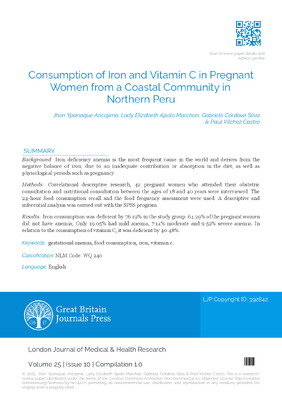
Consumption of Iron and Vitamin C in Pregnant Women from a Coastal Community in Northern Peru
Jhon Ypanaque Ancajima, Lady Elizabeth Apolo Marchan, Gabriela Cordova Silva
& Paul Vilchez Castro
SUMMARY
Background: Iron deficiency anemia is the most frequent cause in the world and derives from the negative balance of iron, due to an inadequate contribution or absorption in the diet, as well as physiological periods such as pregnancy.
Methods: Correlational descriptive research, 42 pregnant women who attended their obstetric consultation and nutritional consultation between the ages of 18 and 40 years were interviewed. The 24-hour food consumption recall and the food frequency assessment were used. A descriptive and inferential analysis was carried out with the SPSS program.
Results: Iron consumption was deficient by in the study group. of the pregnant women did not have anemia; Only had mild anemia, moderate and severe anemia. In relation to the consumption of vitamin C, it was deficient by .
Keywords: gestational anemia, food consumption, iron, vitamin c.
Classification: NLM Code: WQ 240
Language: English

Great Britain Journals Press
LJP Copyright ID: 392842
London Journal of Medical & Health Research
Volume 25 | Issue 10 | Compilation 1.0

Consumption of Iron and Vitamin C in Pregnant Women from a Coastal Community in Northern Peru
Consumo De Hierro Y Vitamina C En Gestantes De Una Comunidad Costera Del Norte Del Perú
Jhon Ypanaque Ancajimaa, Lady Elizabeth Apolo Marchan°, Gabriela Córdova Silvap & Paul Vilchez CastroG)
RESUMEN
Fundamentos: La anemia por deficiencia de hierro es la causa más freciente de anemia gestacional en el mundo. Deriva del balance negativo de hierro,upon inadeudo aporte o absorcción en la alimentación,adelmas de periodos fisiológicos como el embarazo.
Métodos: Investigación descriptiva correlacional, se entrevistaron a 42 gestantes que acudieron a su consulta obstétrica y su interconsulta nutricional en edades de 18 a 40 años. Se realizó el recordatorio de consumo de alimentos de 24 horas y la evaluación de Frequencia de alimentos. Los análisis descriptivo e inferencial fueron realizados con el programa SPSS.
Resultados: El consumo de hierro fue deficiente en un en el grupo de estudio. El de las gestantes no presentaban anemia; solo el presentaba anemia leve, el moderada y el anemia severa. En relacion al Consumo de vitamina C, fue deficiente en un .
Conclusions: El de las gestantes estudiadas presentaron anemia. El percentaje de adecuacion del Consumo de hierro de vitamina C fueon deficientes en un y , respectively. La principal fuente de consumo de hierro hemo fue el higado (Rho= 0,54); de hierro no hemo, el brócoli (Rho = 0,60) y de la vitamina C, la naranja (Rho = 0,42).
Palabras Clave: anemia gestacional, consumo alimentario, hierro, vitamina c.
SUMMARY
Background: Iron deficiency anemia is the most frequent cause in the world and derives from the negative balance of iron, due to an inadequate contribution or absorption in the diet, as well as physiological periods such as pregnancy.
Methods: Correlational descriptive research, 42 pregnant women who attended their obstetric consultation and nutritional consultation between the ages of 18 and 40 years were interviewed. The 24-hour food consumption recall and the food frequency assessment were used. A descriptive and inferential analysis was carried out with the SPSS program.
Results: Iron consumption was deficient by in the study group. of the pregnant women did not have anemia; Only had mild anemia, moderate and severe anemia. In relation to the consumption of vitamin C, it was deficient by .
Conclusions: of the pregnant women studied presented anemia. The percentage of adequacy of vitamin C iron consumption were deficient by and , respectively. The main source of heme iron consumption was the liver ; of non-heme iron, broccoli and of vitamin C, orange
Keywords: gestational anemia, food consumption, iron, vitamin c.
Author a o p C: Universidad Nacional de Tumbes, Perú.
I. INTRODUCCION
La anemia gestacional es un serio problema de salute Pública que开战an los País endesarrollo. A pesar de los esfuerzos por los sistemas sanitarios de abordar esta problemática, aún la prevalencia e incidencia es muy alta. Si bien, la organización Mundial de la salute (OMS), ha descririto patrones de descenso de anemia gestacional entre los años 2000 y 2010, partir del ano 2015 existe un estancimiento a una prevalencia del en todo el mundo (1).
En Perú, si bien existe una reducción paulatina de la prevalencia de anemia gestacional desde el ano 2012 (26,8%) al 2018 (19,1%), esta cifra suguesiendo relativamente alta. Para el 2021 Perú registró una prevalencia de anemia del observándose que, en的一些 regiones, como la de Tumbes, dicha prevalencia presentaba una tasa del (2). Sin embargo, en el distrito costero de Zorritos, de la region de Tumbes, se reportó una prevalencia aproximada del de anemia gestacional para el 2019 (3). Si bien, existen estrategias de intervención para melhorar el estado de salute de esta povlación, aun se reflejan brechas de cobertura de atencion como la entrega de suplementación de hierro, el dosaje de hemoglobina y la atencion integral de salute a工程技术 del control prenatal (4).
Se estima que el de todos los casos de anemia es de origin ferropénico, lo que ocurre cuando el cuerpo no tiene suficiente calidad hierro. Otras posibles causas de anemia son las deficiencias nutricionales como las de folatos y/o vitaminas B12, A y C (5). El hierro obtenido de los cuales alimentos se enquiryra en forma heminica y en forma no heminica o iónica. El hierro heminico o hemo es el que forma parte de la hemoglobina, mioglobina, citocromos y除外 hemoproteñas y se enquiryra en los alimentos de tipo animal,@mstead que hierro no heminico es de origen vegetal, siendo Beneficioso el consumo de vitamina C para mejorar la absorcción de este tipo de hierro (6,7).Así,la vitamina C participa en la absorcción del hierro ya que esta pueda formar
quelatos de bajo peso molecular que Facilitan la absorcción o nivel gastrointestinal, y también permite una mayor movilización de hierro desde los depósitos (8, 9).
Diferentes investigaciones indican que sería buena para la gestante que el consumo de vitamina C o acido ascórbico AUGMENTASE durante el proceso de embarazo, por lo que sugieren AUGMENTAR deforma adiconal diez miligramos (10 mg) llgando a un total de cincuenta y cinco miligramos (55 mg).Durante el parto la placenta cede al neonato la vitamina C, de forma que al nacer los depósitos del recién nacimiento duplican a los de la puérpera, por estareason las madres gestantes y lactantesrequirecen dosis adiconiales de vitamina C (10).
Se ha descririto como la ingesta de vitamina C incrementa la absorccion del hierro no hemo al reducir el efecto inhibitor de的一些 sustancias presentes en distinctos alimentos. Algunos ejemplos son los cereales y las leguminosas, incluyendo la soja que deprimen la absorccion del hierro no hemo,@m间隙 que los fitatos, presentes en la harina de maiz y trigo,la caseina y el calcio, presentes en la leche de vaca,la clara y la yema de huevo,el te y/o el cafe inhiben la absorccion del hierro no hemo (11). Ademas, la presencia de esta vitamina en el organismo, a nivel gastrointestinal permite un mayor desplazamento del hierro desde los depuestos de almacenamento (12).Por todo el,deriventes investigaciones indican que el consumo de vitamina Co acido ascobicoDebe aumento durante el proceso de embarazo (10, 13).
Varios estudios realizados en Perú hanluckado que la dieta tradicional no alcanza acubrir el incremento de las necessities de hierro y folatos durante la gestación (14,15).En elcontexto regional no se hallaron publicaciones enla Region Tumbes, que pudieran demostrar la relacion del consumo de hierro y vitamina C y el nivel de anemia en un grupo de mujeres gestantes;siendo necessario abordar esta problemática,a fin de tener informacion quepermita hacer medidas efectivas para la prevencion de la anemia.
II. MATERIAL Y METHODOs
Investigación de enfoquequantitativo, no experimental, descriptiva correlacional, prospective de corte transversal. Se envestaron 42 gestantes de segundo yutherc trimestre del embarazo, con o sin anemia; que acudieron a su consulta obstetrica y su interconsulta nutricionale n la comunidad costera del Distrito de Zorritos, Region Tumbes en el ano 2022.
Se aplicaron@cuestionarios anónimos para evaluer el Consumo alimentario de hierro y vitamina C en la consulta del service de nutrición, previo consentingimiento informado. La的技术ica para la recoleccion de datos de la adecuacion de hierro y vitamina C, fue la entrega de fecuencia de consumo alimentario en el recordatorio de 24 horas, que tuvo por finalidad describir todos los alimentos y bebidas que la gestanteibiaconsumido durante tres días no consecutivos que equivalen al Consumo seminal, extrapolando ese consumo a un patrón mensual. Para la determinacion del Consumo, se uso el cuestionario de fecuencia de consumo de hierro y vitamina C en las escalas: nunca; numero de vezes al mes (consumo poco freciente); numero de vezes a la semana (consumo freciente) y numero de vezes al dia (consumo muy freciente).
El@cuestionario de Frequencia de consumo de hierro y vitamina C, se sometio al analisis de correlacion interno con la prueba alfa de Cronbach y se obtuvo como resultado 0,74,siendo calificado como acceptable para su aplicacion. Respecto al juicio de expertos se obtuvo un indice de validez de contenido de 0,90.
Para el calculo de la adecuacion de hierro y vitamina C en la dieta se emploe la?sigenete formula: de adecuacion ingesta/ requerimiento x 100). Para la obtencion del percentaje de adecuacion de hierro y vitamina C se realizaron los requerimientos y recomendaciones del Ministerio de Salud del Peru (MINSA) (16) y la Organizacion de las Naciones Unidas para la Alimentacion y la Agricultura (FAO) (17),onde precise; si el resultado es mayor o igual al ,significa que la ingesta cubre o supra el querimiento. Si es menor que el ,indica un deficit en la ingesta del
nutrique. Se consideraron el segundo y tresc trimestre del embarazo, dato la instalacion del cuadro clnico de anemia en estas fases del embarazo.
Para determinar el origen del hierro, como de los moduladores de la absorccion de este micronutriere aportados por la dieta, se listaron los alimentados segun su contenido de: 1) hierro hemo: sangrecita, higado, carne de vacuno, bofe/pulmon, carne de cerdo,azo y carne de ovino y pescado; 2) hierro no hemo: lentejas, tomate, frejol, arvejas, brocoli, pallar, habas, quinua cañihua y alfalfa; 3) potenciadores de absorccion de hierro: naranja, mandarina, limon, granadilla, piña, lima y toronja (18).
Para la determinación de los niveles de hemoglobina se realizó la技术水平ica de cianometahemoglobina directa con Colorimetric Detection Kit. El instrumento para determinar el nivel de hemoglobina fue el equipo analizador de hematología automatico BHA-3000.
Los datos fueron sometidos a la estadística descriptiva para el análisis univariado de Frequencias absolutas y relativas de cada variable. Se disparrollaron tablas de contingencia para determinar la asociación entre las variables. Se realizó el análisis bivariado con la prueba de corrección Rho Spearman, con una significancia estadística menor a 0,05. Para la realización de"These analysis se uso el paquete estadístico SPSS® v.23.
Durante el estudio, se respetaron cada uno de los principioséticos:la libre participacion,y la no maleficencia,el anomalato y la confidencialidad. Se brindo complimiento a la Resolución Ministerial -MINSA (19),siguiendo las consideracioneséticas para la investigacion en salute con seres humanos.
III. RESULTADOS
En este estudio participaron un total de 42 gestantes, de las cuales el no presentaron anemia; solo el presentaba anemia leve, el anemia severa, y el anemia moderada. El percentaje de adecuacion del consumo de hierro fue deficiente en un y
del consumo de vitamina C deficiente en un (Tabla 1).
Tabla 1: Datos Descriptivos, De An
| Edad gestacional | n | % |
| II trimestre | 30 | 71,43 |
| III trimestre | 12 | 28,57 |
| Nivel de anemia | n | % |
| Anemia leve | 8 | 19,05 |
| Anemia moderada | 3 | 7,14 |
| Anemia severa | 4 | 9,52 |
| Sin anemia | 27 | 64,29 |
| %ADEUCAUDUCION DE Hierro | n | % |
| Deficiente | 32 | 76,19 |
| Normal | 5 | 11,90 |
| Exceso | 5 | 11,90 |
| %ADEUCAUDUCION VITAMINA C | n | % |
| Deficiente | 17 | 40,48 |
| Normal | 8 | 19,05 |
| Exceso | 17 | 40,48 |
Deficiente: ; Normal: ; Exceso: .
El promedio de Frequencia de consumo de hierro fue de 1 vez a la hora para la sangrecita, higado, carne de vacuno, frejol, arvejas y brocoli. Además, se registró un consumo freciente de lentejas de 2
a 4 vezes pormana y un consumo de pescado de 5 a 6 vezes pormana. La Frequencia de consumo de vitamina C fue de 5 a 6 vezes pormana para la naranja, mandarina y limón (Tabla 2).
Tabla 2: Frecuencia De Consumo Alimentario De Hierro Y Vitamina C
| Consumo de hierro | Media | Frecuencia | DE |
| Hierro Hemo | |||
| Sangrecita, hídado, carne de vacuno | 3 | Frecuente, 1 vez a la semana | 1,31 |
| Bofe/pulmón, carne de cerdo | 2 | Poco frecuente, 1 a 3 veces al mes | 1,22 |
| Bazo y carne de ovino | 1 | Nunca consume | 0,53 |
| Pescado | 5 | Frecuente, 5 a 6 veces a la semana | 1,1 |
| Hierro No Hemo | |||
| Lenteja, tomate | 4 | Frecuente, 2 a 4 veces a la semana | 0,82 |
| Frejol, arvejas, brócoli | 3 | Frecuente, 1 vez a la semana | 1,00 |
| Pallar, habas, quinua | 2 | Poco frecuente, 1 a 3 veces al mes | 0,84 |
| Cañihua, alfalfa | 1 | Nunca | 0,63 |
| Consumo de vitamina C | |||
| Naranja, mandarina limón | 5 | Frecuente, 5 a 6 veces a la semana | 1,22 |
| Granadilla, pña | 3 | Frecuente, 1 vez a la semana | 1,53 |
| Lima, Toronja | 1 | Nunca | 0,91 |
DE: desviación estandar
1 = Nunca; 2 = poco frecuente 1 a 3 vezes al mes; 3 = frecuente 1 vez a la peninsula; 4 = frecuente 2 a 4 vezes a la peninsula; 5 = frecuente 5 a 6 vezes a la peninsula
Al establerc la correlacion del consumo alimentario de hierro hemo y el nivel de hemoglobina, se evidencio una corrlacion positiva media para el consumo de sangrecita , bofe/pulmon (Rho= 0,37) y carne de vacuno (Rho= 0,32). El consumo de higado presento una corrlacion positiva considerable . Asimismo, entre el consumo de hierro hemo y el nivel de hemoglobina, se observo una corrlacion positiva considerable (Rho= 0,60) para el consumo de brocoli. Por otherado, el
consumo de frejolmostatúa corrécción positiva media (Rho=0,34) (Tabla 3).
En cuando al consumo de potenciadores de hierro y su relacion con el nivel de hemoglobina, se evidencia una correlacion positiva media para el consumo de granadilla (Rho= 0,37), piña (Rho= 0,34) y naranja (Rho= 0,42). Por otro lado, en relacion con los inhibidores de hierro y el nivel de hemoglobina (Tabla 4).
Tabla 3: Correlación Del Consumo De Hierro, Adecuación Y Nivel De Hemoglobina
| Hierro Hemo | PrUEba | % adecuación hierro | %adecuación vitamina C | hemog lobina | Hierro No Hemo | PrUEba | % adecuación hierro | % adecuación vitamina C | Nivel de hemoglobina |
| Sangrecita | Rho | 0,70** | 0,25 | 0,36* | Lenteja | Rho | 0,25 | 0,04 | 0,25 |
| p valor | 0,00 | 0,09 | 0,01 | p valor | 0,09 | 0,76 | 0,11 | ||
| Bofe/pul món | Rho | .332* | 0,24 | 0,37* | Frejol | Rho | 0,26 | 0,01 | 0,34* |
| p valor | 0,03 | 0,12 | 0,01 | p valor | 0,08 | 0,93 | 0,02 | ||
| Hígado | Rho | 0,35* | 0,58** | 0,54** | Pallar | Rho | 0,26 | 0,02 | 0,22 |
| p valor | 0,02 | 0,00 | 0,00 | p valor | 0,09 | 0,85 | 0,15 | ||
| Bazo | Rho | 0,01 | 0,00 | 0,05 | Arvejas | Rho | 0,13 | 0,13 | 0,21 |
| p valor | 0,94 | 0,98 | 0,73 | p valor | 0,39 | 0,39 | 0,17 | ||
| Carne de vacuno | Rho | 0,03 | 0,07 | 0,32* | Habas | Rho | 0,31* | -0,03 | 0,20 |
| p valor | 0,83 | 0,62 | 0,03 | p valor | 0,04 | 0,82 | 0,19 | ||
| Carne de cerdo | Rho | 0,20 | 0,09 | 0,16 | Quinua | Rho | 0,27 | 0,01 | 0,26 |
| p valor | 0,20 | 0,55 | 0,28 | p valor | 0,08 | 0,92 | 0,09 | ||
| Pescado | Rho | 0,15 | 0,29 | 0,21 | Cañihua | Rho | 0,15 | -0,03 | -0,03 |
| p valor | 0,31 | 0,05 | 0,18 | p valor | 0,32 | 0,81 | 0,83 | ||
| Rho= corrécción de Spearman p valor < 0,05 significativo la corrección | Brócoli | Rho | 0,52** | 0,29 | 0,60** | ||||
| p valor | 0,00 | 0,05 | 0,00 | ||||||
| Tomate | Rho | 0,46** | 0,04 | 0,24 | |||||
| p valor | 0,00 | 0,78 | 0,11 | ||||||
| Alfalfa | Rho | -0,11 | 0,01 | -0,08 | |||||
| p valor | 0,49 | 0,90 | 0,59 | ||||||
Tabla 4: Correlación Del Consumo De Vitamina C Y Nivel De Hemoglobina
| Potenciadores de hierro | Prueba | % adecuación hierro | % adecuación vitamina C | Nivel de hemoglobina |
| Naranja | Rho | 0,24 | 0,21 | 0,42* |
| p valor | 0,11 | 0,18 | 0,00 | |
| N | 42 | 42 | 42 | |
| Mandarina | p valor | 0,32* | 0,54** | 0,21 |
| Rho | 0,03 | 0,00 | 0,17 | |
| N | 42 | 42 | 42 | |
| Lima | Rho | 0,16 | 0,14 | 0,19 |
| p valor | 0,28 | 0,35 | 0,22 | |
| N | 42 | 42 | 42 | |
| Limón | p valor | 0,06 | 0,23 | 0,21 |
| Rho | 0,68 | 0,13 | 0,16 | |
| N | 42 | 42 | 42 | |
| Toronja | Rho | 0,00 | -0,07 | 0,28 |
| p valor | 0,98 | 0,64 | 0,07 | |
| N | 42 | 42 | 42 | |
| Granadilla | p valor | 0,16 | 0,17 | 0,37* |
| Rho | 0,29 | 0,27 | 0,01 | |
| N | 42 | 42 | 42 | |
| Piña | Rho | 0,29 | 0,27 | 0,34* |
| p valor | 0,05 | 0,07 | 0,02 | |
| N | 42 | 42 | 42 |
Rho= correlación de Spearman. valor significativo la correlación
IV. DISCUSión
El Consumo de hierro y vitamina C fue deficiente en el grupo de estudio, lo que es congruente con estudios previos los cuales conclusuen que la ingesta de hierro en las gestantes está por bajo de lo recommendado para este grupo populacional (16). Diversas investigaciones (20,21) han demostrado la asociacion de la ingesta dietética de hierro, deserollando un patron muy cambiente en la ingesta dietética de energia, proteinas, grasas y vitamina C. Además, describen una disposicion de la oferta de vitamina C y hierro baja, escenario similar en povlaciones de paises de bajos recursos economicos. En esta linea de affirmacion, López et al (11) realizaron un estudio sobre la suplementacion con hierro en mujeres embarazadas en México y encontrararon que el consumo de este micronutriente vario a lo largo de la gestacion. Antes del embarazo, lacantidad diaria de hierro ingerida fue en promedio de 8,7 mg, fluctuando entre 4,9 y 19,8 mg. Sin embargo, en el primer trimestre, la ingesta aumento significativamente a 24,0 mg diarios, con una variacion de 14,3 a 39,4 mg. A medida que avanzaba la gestacion, la suplementacion se incremento aun mas, alcancando un promedio de 60,3 mg diarios durante el segundo yutherc trimestre, con valores que oscilaron entre 48,6 mg y 98,2 mg. Estos hallazgos evidencian una mayor necessities de hierro conforme prograsa el embarazo, probablemente bajo a los requisimientos fisiologicos de la madre y el feto, asi como a la implementacion de estrategias de suplementacion para prevenir la anemia domesterna. Kumar et al (22), indican una asociacion directa entre laidad gestacional y la anemia.
Específamente, las encuestadas en su segundo trimestre de gestación tenian mayores probabilitades de ser anémicas que aquellas en su primer yuther trimestre. Es un hecho bien establishido que,debido al aumento del volumen plasmático durante el embarazo,los niveles de hemoglobina y hematocrito disminuyen en el primer trimestre, alcanzan su punto más bajo al final del segundo trimestre, y se incrementan-Newvamente en eluther trimestre (23).De manera similar,la anemia fue más prevalente entre las encuestadas en su segundo trimestre que entre las de su primo yuther trimestre .La caida en la concentracion de hemoglobina可以使afectar negativamente la salute de la madre si no se toman las medidas adequadas.
Keats et al (24) mentionan que las deficiencies de multíples micronutrientes suelen coexistir entre las mujeres enidadreproductive enpañés de ingresos bajo y medios. Se exacerban durante el embarazodeferado a las mayores demandas del feto endesarrolloapartir delsegundo ytercem trimestre del embarazo, lo queleva a efectos potencialmente adversos para la madre y el feto (25).
Los estudios han demostrado que una proportión significativa de mujeres embarazadas sufrenmultiples deficiencies concurrentes demicronutrientes, especially during el embarazo cuando augmentan las demandas nutricionales. Estas deficiencias se han asociado con una serie de malos resultados del embarazo, incluidos bajo peso al nacer, prematuridad, mortalidad perinatal y mortalidad domesterna.
Diversos estudios (25,26), han comparado la suplementación con hierro con o sin acido fólico, determinando algunos Beneficios, como que probablemente existe una ligera reducción en los nacimiento prematos. La suplementación con micronutrientes posiblemente también redojo los nacimiento de neonatos que fueon considerados微量元素 para suidad gestacional (PEG), redojo los nacimiento que se consideraron de bajo peso al nacer (BPN) y tuvo poca o ninguna diferencia en la mortalidad perinatal. Deforma similar a los nacimiento prematos, hubo una ligera reduccion en los mortinatos, excepte el intervalo de confianza para la estimacion del efecto agrupado apenas cruzo la linea de ningún efecto.
Es importante Mentionar que el presente estudio describe que las asociaciones son muy significativas para el hierro hemo, precisando enterances, que el hierro obtenido de los differentes alimentos se enquiryra en forma hemo y en forma no hemo o iónica (27). Estudios similares reportados por Del Castillo (6)asnwaron como resultado que el Consumo de hierro provenía de fuentes de origen animal y vegetal como el pescado ,lentejas ,verduras verdes ,higado carne de res ,sangrecita ,bofe y molleja y yema de nuevo respectivamente.El Consumo de vitaminas C lo obtenian de liquidos que toma con la suplementacion, bebidas a base de limon ; naranja ,maracuya yothers
Un estudio en Ghana obtuvo datos del CJuestionario de recordatorio de 24 horas de 3 días, que se utilizesn para estimar la ingesta absoluta de nutrientes dietéticos de los encuentados y se compararon con las cantidades recomendadas para las mujeres embarazadas. Los hallazgos del estudio lostraron que mas del de las mujeres embarazadas corrián el riesgo de tener una ingesta diaria inadequada de vitaminas A, E, B2, B3, B6, folato, hierro, proteinas, calcio y zinc. Además, no se observó ninguna diferencia significativa entre la ingesta dietética de these micronutrientes y vitamins entre las participantes residentes en和地区 rurales y las de和地区 urbanas (28).
La puntoación media de diversidad alimentaria de las mujeres de este estudio fue inferior a la puntoación minima de diversidad alimentaria recomendada para las embarazadas. La baja ingesta alimentaria, e inadecuada, de la mayoría de los nutrientes entre las embarazadas es unaindrónica de que es poco probable que las mujeres satisfagan sus necessities nutricionales necessarias para apoyar el crecimiento y el desarrollo de su feto. Las embarazadas nécessitan comer una amplia variedad de alimentos para mejorar su nutrición y también parapreventir los resultados adversos asociados con la desnutrición en el embarazo (29).
Obtener una dieta rica en nutrientes durante el embarazo es un desafío para las mujeres embarazadas que viven en páíses de bajos ingresos (29). El Ministerio de Salud del Perú, recomienda consumiradelmasde alimentos como higado, sangrecita, bajo, carne, bofe, pescado, consumirdiariamente frutas y verduras de preferencia de color naranja,amarillo y hojas de color verde oscuro, por su alto contenido de minerales y vitaminas que fortalecen el aprovechimiento de los alimentos ricos en hierro (30).
Igualmente, a pesar de que numerosos estudios que confirman la importancia de una dieta equilibrada durante el embarazo, muchas mujeres embarazadas en el mundo, incluidas las de los países desarrollados, todas corren el riesgo de una ingesta subóptima de elementos esencias y vitamins (31). El conocimiento de los factores que influyen en las options dietéticas y, en consecuencia, el estado nutricional durante el embarazo es crucial para la evaluación de las necessities de la povlación y el desarrollo de mensajes e intervenciones de salute Pública eficaces (32).
Las implicaciones del estudio permitirán hacer propuestos de salute Pública para la promoción de alimentos propios delcontexto regional,asi la seguridad alimentaria sera sostenible en las regiones de bajos recursos économicos.
AGRADECIMIENTOS
Los autores agradecen a la comunidad costera de Zorritos, Tumbes, Perú.
REFERENCIAS
Vásquez C, Gonzales F. Situación mundial de la anemia en gestantes. Nutr. Hosp. [Internet]. 2019; 36(4): 996-997. Disponible en: http://scielo.isciiii.es/scielo.php?script= sci ARTICLE&id=So21216112019000400034&lng=es.Epub17-Feb-2020. https://dx.doi.org/10.20 960/ nh. 02712.
Ministerio de Desarrollo Social. Red Informa. Reportes interactivos deindicadores sociales Region Tumbes 2021. Available en: http:// sdv.midis.gob.pe/RedInforma/Reporte/Reporte/17
Ministerio de Desarrollo e Inclusion Social. REDinforma. Indicações de gestante. [citado 2021 mayo 18]. Disponible en: http://sdv.midis.gob.pe/RedInforma/Reporte/Reporte/18
Shankar H, Kumar N, Sandhir R, Singh MP, Mittal S, Adhikari T, Tarique M, Kaur P, Radhika MS, Kumar A, Rao DN. Association of dietary intake below recommendations and micronutrient deficiencies during pregnancy and low birthweight. J Perinat Med. 2019 Sep 25;47(7):724-731. doi: 10.1515/jpm-2019-0053. PMID: 31318696
Stevens G, Finucane M, De-Regil L, Paciorek C, Flaxman S, Branca F et al.; Nutrition Impact Model Study Group (Anaemia). Global, regional, and national trends in haemoglobin concentration and prevalence of total and severe anaemia in children and pregnant and nonpregnant women for 1995-2011: a systematic analysis of population-representative data. Lancet Glob Health. 2013;1:e16-e25. doi:10.1016/S2214-109X(13)70001-9
Del Castillo N. consumo de hierro en gestantes con anemia atendidas en el centro de salute chilca 2019. Repository [Tesis grado]. Huancavelica: Universidad Nacional del Huancavelica. disponible en: http:// repository.unh.edu.pe/handle/UNH/2995
Resolución Ministerial N° 126-2004/MINSA, que aprueba el Documento Tecnico: N° 006-MINSA-INS-V 0.1 Lineamientos de Nutrición Materna.
Milman N. Fisiopatologia e impacto de la deficiencies de hierro y la anemia en las mujeres gestantes y en los reciens nacios/infantes. Revista Peruana de Ginecología y Obstetricia [Internet] 2012 [citado el 19 de mayo del 2021]; 58 (4): 293-499. disponible en: https://www.redalyc.org/pdf/3234/323428206009.pdf
Castro V. Prácticas sobre alimentación en el embarazo y su relacion con la anemia ferropénica en gestantes aTERMino. Hospital Nacional Sergio E. Bernales, Comas. Marzo-mayo, 2017 [Tesis grado]. Lima: Universidad Nacional Mayor de San Marcos; 2017. Disponible en: https://core.ac.uk/download/pdf/323342556.pdf
Ministerio de Salud. Guía alimentaria para la mujer durante el periodo de embarazo y lactancia [Internet] Bolivia: Ministerio de Salud y Deporte; 2014 [citado el 19 de mayo del 2021]. Disponible en: https://www.minsalud.gob.bo/images/Libros/Dgps/Pds/P345_g_dgps_uan_guia_alimentaria Para la mujer durante el periodo de embarazo y lactancia.Pdf
López A, Romero I, Leyva A, et al. Consumo de suplementos, hierro y acido folico en la etapa pre-gestacional y durante el embarazo en mujeres mexicanas. Arch Med Fam. 2018;20(1):23-33.
Montero J. Estado Nutricional y Practicas alimentarias durante el embarazo en las gestantes a termino atendidas en el Instituto Nacional Materno Perinatal durante enero-febrero del 2016 [Tesis grado]. Lima: Universidad Nacional Mayor de San Marcos; 2016. Disponible en: https://core.ac.uk/download/pdf/323352494.pdf
Stevens G, Finucane M, De-Regil L, Paciorek C, Flaxman S, Branca F et al.; Nutrition Impact Model Study Group (Anaemia). Global, regional, and national trends in haemoglobin concentration and prevalence of total and severe anaemia in children and pregnant and nonpregnant women for
1995-2011: a systematic analysis of population-representative data. Lancet Glob Health. 2013;1:e16-e25. doi:10.1016/S2214-109X(13)70001-9.
14. Ramírez D; Rocha N. Consumo de hierro y vitamina C en la anemia. Repositorio [Tesis grado]. Lima: Universidad Peruana Unión; 2019. Disponible en: https://repositorio. upei.edu.pe/handle/UPEU/2688
15. Quisp A. Prevalencia de desnutrición crónica y anemia en niños de 6 a 36erahes en el Distrito de Sarhua Ayacucho. Universidad Nacional Agraria la Molina. 2010.
16. Ministerio de Salud del Perú. Documento Técnico Aprobado con Resolución Ministerial N° 958-2012/Minsa. Manejo Terapéutico Y Preventivo De La Anemia En Niños, Adolescentes, Mujeres Gestantes Y Puerperas. Disponible en: http://bvs.minsa.gob.pe/local/ MINSA/4190.pdf
17. Food and Agricultural Organization. World Health Organization. United Nations University. Human Energy Requirements: Report of a Joint FAO/OMS/UNU Expert Consultation, 2001. 2004.
18. Ministerio de Salud. Guía alimentaria para la mujer durante el periodo de embarazo y lactancia [Internet] Bolivia: Ministerio de Salud y Deporte; 2014 [citado el 19 de mayo del 2021]. Disponible en: https://www.minsalud.gob.bo/images/Libros/Dgps/Pds/P345_g_dgps_uan_guia alimentaria Para la mujer durante el periodo de embarazo y lactancia.Pdf
19. Decreto Supremo. D.S N° 011-2011-JUS. Lineamientos éticos para la Investigación en salute con seres humanos. disponible en: https://sni.org.pe/establecen-lineamientos-pa para-garantizar-el-ejercimiento-de-la-bioética-desde -el-reconocimiento-de-los-derechos-humanos/
20. Ampuero C; Consumo de hierro en la gestación y nive del hemoglobina en el puerperio, Hospital Nacional Hipólito Unanue, El Agustino, 2018. Repositorio [Tesis grado]. Trujillo: Universidad Cesar Vallejo. disponible en: https://repositories.ucv.edu.pe/handle/20.500.12692/16515
21. Colque G. Adecuación y Frequencia del consumo alimentario de Hierro y Vitamina C
en relacion con los niveles de hemoglobina en niños de 6 a 59aces deidad,según el area de residencia del distrito de Azangaro 2018. Repository [Tesis grado].Puno: Universidad Nacional del Altiplano.Disponible en: http://thesis.unap.edu.pe/handle/UNAP/9966
22. Kumar KJ, Asha N, Murthy DS, Sujatha MS, Manjunath VG. Anemia materna en various trimestres y su efecto en el peso y la madrez del recién nacimiento: un estudio observacional. Revista internacional de medicina Preventiva. 2013; 4 (2):193
23. Bencaiova G, Burkhardt T, Breymann C. Anemia-prevalence and risk factors in pregnancy. European Journal of Internal Medicine (2012) 23, 529
24. Keats EC, Haider BA, Tam E, Bhutta ZA. Multiple-micronutrient supplementation for women during pregnancy. Cochrane Database Syst Rev. 2019 Mar 14;3(3):CD004905. doi: 10.1002/14651858.CD004905.pub6. PMID: 30873598; PMCID: PMC6418471
25. Kulkarni B, Christian P, LeClerq SC, Khatry SK. Determinantes del accomplishment de la suplementacion prenatal con micronutrientes y percepciones de las mujeres sobre el uso de supplementos en las zonas rurales de Nepal. Public Health Nutrition 2010; 13 (1):82-90
26. Adu-Afarwuah S, Lartey A, Okronipa H, Ashorn P, Ashorn U, Zeilani M, et al. La suplementación materna con suplementos nutricionales a base de lipidos enpeguas cantidades en comparación conmultiple micronutrientes, pero no con hierro y acido fólico, reduce la prevalencia de bajo aumento de peso gestacional en Ghana semiurban: un ensayo controlado aleatorzano. Journal of Nutrition 2017; 147 (4):697-705.
27. Brough L, Rees GA, Crawford MA, Morton RH, Dorman EK. Effecto de la suplementacion con multiples micronutrientes en el estado nutricionai materno, el peso al nacer del bebé y la calidad gestacional al nacer en una povlacion multiétnica de bajos ingresos. British Journal of Nutrition 2010; 104 (3): 437-45
28. Montero J. Estado Nutricional y Practicas alimentarias durante el embarazo en las gestantes a terme atendidas en el Instituto Nacional Materno Perinatal durante
enero-febrero del 2016 [Tesis grado]. Lima: Universidad Nacional Mayor de San Marcos; 2016. Disponible en: https://core.ac.uk/download/pdf/323352494.pdf
29. Nga HT, Quyen PN, Chaffee BW, Diep Anh NT, Ngu T, King JC. Effect of a nutrient-rich, food-based supplement given to rural Vietnamese mothers prior to and/or during pregnancy on birth outcomes: A randomized controlled trial. PLoS One. 2020 May 29;15(5):e0232197. doi: 10.1371/journal.pone.0232197. PMID: 32469870; PMCID: PMC 7259625.
30. Blumfield ML, Hure AJ, Macdonald-Wicks L., Smith R., Collins CE Una revisión sistémática y un metanálisis de la ingesta de micronutrientes durante el embarazo en páises desarrollados. Nutr. Rev. 2013; 71: 118-132. doi: 10.1111/nure.12003.
31. Instituto Nacional de Salud. Consumo de alimentos en adultos peruanos. [citado 2021 mayo 18]. Disponible en: https://web.insgob.pe/sites/default/files/Archivos/cenan/van/sala_nutricionai/sala_6/2020/consumop eruano_de_alimentos_en_adultos_peruanos. pdf
32. Gardner B., Croker H., Barr S., Briley A., Poston L., Wardle J., en representation del ensayo UPBEAT Predictores psicológicos de las intenciones alimentarias en el embarazo. J. Hum. Nutr. Diet. 2012; 25 :345-353. doi: 10.1111/j.1365-277X.2012.01239.x.
Conflict of Interest
The authors declare no conflict of interest.
Ethical Approval
Not applicable
Data Availability
The datasets used in this study are openly available at [repository link] and the source code is available on GitHub at [GitHub link].
Funding
This work did not receive any external funding.
Cite this article
Related Research

Special Issue
Launch a focused special issue to highlight research, emerging trends, and expert insights in your academic field.