




IntelliPaper
Abstract
This comprehensive study explores the intricate dimensions of global health, focusing on the humanitarian response to conflicts and disasters. It grapples with the evolving definition of global health in the 21st century. Emphasizing the shift from the disease-centric approaches to holistic well-being. Rooted in the principles laid by pioneers like William Farr and Rudolf Virchow. Global health now prioritizes evidence-based decision-making, population-centric focus, social justice, and preventive care.
This narrative will help to distinguish global health from public health and international health, highlighting its transnational focus on disparities and cross-border issues. The discourse extends to the interconnected determinants of health, encompassing genetics, access to services, and governmental interventions. This paper will underscore the collaborative effort required from various global actors, including UN agencies, foundations, and NGOs.
Delving into humanitarian response, this study elucidates the principles of humanity, impartiality, neutrality, and independence that guide modern humanitarian work. Historical cases, such as the Rwandan genocide, underscore the necessity of standardized humanitarian practices exemplified by the Sphere Handbook. The analysis traces the professionalization of humanitarian assistance post-Goma; emphasizing the importance of anticipatory planning and coordination.
Finally, this article explores the link between health and broader societal aspects, exemplified by the recent global response to COVID-19. It concludes with a call for continued recognition, application, and research in humanitarian response, guided by leading physicians dedicated to alleviating global suffering within the realm of a robust and interconnected global health framework.
Explore Digital Article Text
I. INTRODUCTION
The humanitarian crisis and health disasters have affected a lot of countries in many ways, which has ended in severe tragedy for us all as a global community.
So, we come to the question, how do we define global health in the 21st century?
When we look for references on global health, the data appears only around the millennium, around the 2000s. This is how this concept responds to a globalized world.
The focus today is to help our patients live longer, not just in time, but in terms of a full and healthy life including the quality of life .
William Farr, Edwin Chadwick, Rudolf Virchow, Robert Koch, and Lemuel Shattuck helped establish this discipline on a firm foundation of four factors .
-
Data and evidence-based decision-making (vital statistics, surveillance and outbreak investigations, laboratory science).
-
A focus on populations rather than individuals.
-
A goal of social justice and equity.
-
An emphasis on prevention rather than curative care .
We must stop defining health as merely the absence of disease to move forward. Health for all goes beyond; clinics, medical solutions, and public health interventions to include culture, community, environment, animal health, belief systems, government, law, economics, technology, housing, and all other factors of health .
It is difficult to find a universal concept of "Global Health". Whatever the situation, finding a definition that fully responds to the different visions and interests behind this issue will be difficult. But nevertheless, does it mean that it is necessary to achieve universal acceptance. When we speak about global health, we are referring to situations that are no longer the exclusive responsibility and management of a specific state, and that, to build their solution, it is necessary to work in a coordinated and collaborative manner among all nations, or in groups for these specific purposes of common interest .
Global health must also be truly global. To allow a free flow of ideas and encourage global learning and dissemination of best practices. We must leave behind the myth of the first-world country "helping" the third-world country and become truly collaborative; recognizing that all countries contribute to the search for better solutions and all countries learn from each other. It is a fundamental strategic element for the human security, peace, prosperity, and stability of all nations, and in this sense, it has been gaining in value understanding over time .
Global health is part of the academic conception of the disciplinary development of public health as a political-scientific area and it is important to distinguish it from terms such as public health and international health. (see table 1)
Table 1: Differences between global health, international health, and public health
| Global health | International health | Public health | |
| Geographical reach | Focuses on issues that directly or indirectly affect health but that can transcend national boundaries. | Focuses on health issues of countries other than one's own, especially those of low-income and middle-income. | Focuses on issues that affect the health of the population of a particular community or country. |
| Level of cooperation | The development and implementation of solutions often require global cooperation. | The development and implementation of solutions usually require binational cooperation. | The development and implementation of solutions do not usually require global cooperation. |
| Individuals or populations | Embraces both prevention in populations and clinical care of individuals. | Embraces both prevention in populations and clinical care of individuals. | Mainly focused on prevention programs for populations. |
| Access to Health | Health equity among nations and for all people is a major objective | Seeks to help people of other nations | Health equity within a nation or community is a major objective. |
| Range of disciplines | Highly interdisciplinary and multidisciplinary within and beyond health sciences | Embraces a few disciplines but has not Emphasized multidisciplinary | Encourages multidisciplinary approaches, particularly within health sciences and social sciences |
| Table adapted from Koplan, J. P.,et all, (2009). Towards a common definition of global health. The Lancet, 373(9679), 1993–1995. doi:10.1016/s0140-6736(09)60332-9. | |||
II. PUBLIC HEALTH
Public health is understood as the care and promotion of health applied to the whole population or a specific group of a population and promotes multidisciplinary approaches, particularly within the health sciences . The definition suggested by Winslow almost 90 years ago: "Public health is the science and art of preventing disease, prolonging life and promoting physical health...".
III. INTERNATIONAL HEALTH
International health, meanwhile, has a simpler history. For decades, it was the term used for health work abroad, with a geographic focus on developing countries and often with the content of infectious and tropical diseases, water and sanitation, and maternal and child health. It is defined by authors Merson, Black, and Mills as "the application of public health principles to the problems and challenges affecting low- and middle-income countries and the complex set of global and local forces that influence them" .
IV. GLOBAL HEALTH
Now, the global concept of global health refers to the scope of problems, not their location.
Thus, like public health, but unlike international health, global health can focus on national health disparities as well as cross-border problems .
It is an area of study, research, and practice that prioritizes improving health and achieving health equity for all people worldwide. It emphasizes transnational health problems, determinants, and solutions. It involves many disciplines within and beyond the health sciences and promotes interdisciplinary collaboration. It is the result of a global synthesis of world-class medicine .
Now let's look at these very brief clinical cases:
Ramesh is a three-year-old boy in India. He weighs almost half the weight of the average three-year-old Indian child; he is also exceptionally small for his age, is not growing properly, and has features of marasmus.
Juan is a 40-year-old man in Mexico City. Juan has diabetes, he also has heart disease, and several complications of diabetes.
Shereen was a young woman in a poor province of Pakistan, who died in labor. She was married at 16 and this was to be her first child.
V. HEALTH DETERMINANTS
Understanding the disease background of these cases leads us to the study of health determinants (Figure 1) as this interaction between various factors from the intrinsic sphere of the patients themselves such as their genetics, sex, age, access to health services, as well as public policies and government interventions . All of them as a constant interaction, as a perfect orchestra with the direction of health as the axis.
Figure 1. Key Determinants of Health {"image_source":{"path":"images/20ba3603dd287214f3caf9c9ac080ef58f24cfd77ce66719bcacdf83e52578b4.jpg"},"content":"","chart_caption":[],"chart_footnote":}
VI. VIRCHOW. SOCIAL MEDICINE AS A FORM OF BIOPOLITICS
Rudolf Virchow (1821-1902) is considered one of the fathers of social medicine. It was he who said:
"Medicine is a social science and politics is just medicine on a broader scale". He considered that political action fell within the field of medicine and social reforms within the interests and duties of the physician. Medicine became a social science and politics became a medical instrument, as the main tool of prevention. In this sense, health workers would become "natural advocates for the poor.12"
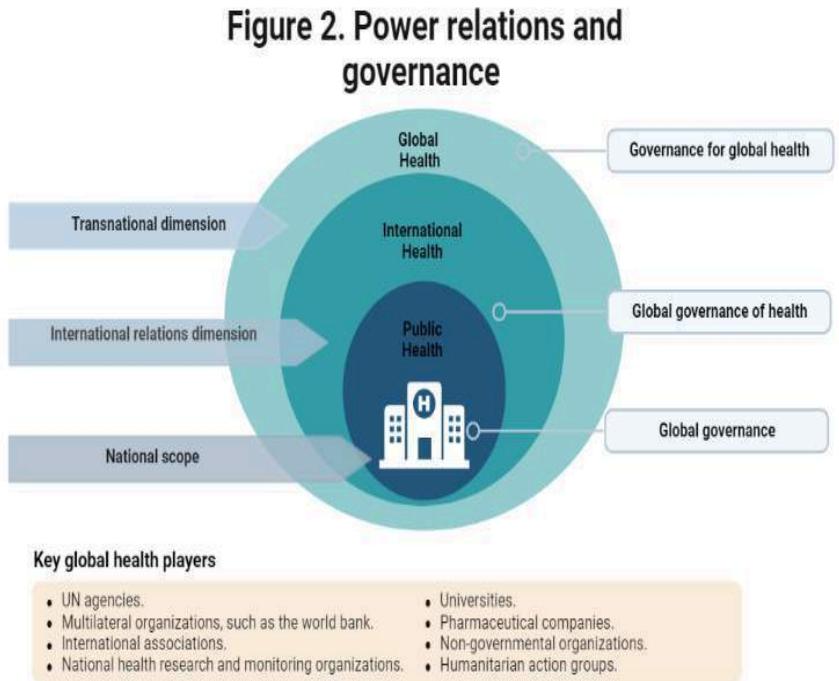
Within global health, there are different main actors. It is a concept that, of course, needs institutions, and real people to enact it, to transform it into real action . And it starts with international institutions. Historically speaking, the first global health institution was the World Health Organization. Governments realized that health issues could not just be dealt with at the local level but had to be considered at a more global level.
Some others to mention are (Figure 2) 9,10,11:
-
UN agencies.
-
Multilateral organizations, such as the World Bank.
-
International associations.
-
Foundations.
-
National health research and monitoring organizations.
-
Universities.
-
Pharmaceutical companies.
-
Non-governmental organizations.
-
Humanitarian action groups.
VII. HUMANITARIAN RESPONSE TO CONFLICTS AND DISASTERS
Humanitarian emergencies and disasters affect different countries, but they affect us all as a global community . As we discussed, global health is about global cooperation to address common problems as well as challenges to humanity in the field of disease, illness, and disability .
VIII. HUMANITARIAN CRISES
The first thing to say is that humanitarian crises exert an enormous amount of cost.
The Japanese tsunami in 2011, for example, is estimated to cost more than $300 billion .
Civil wars, since 1945, killed more than 20 million people and displaced another 67 million people .
In response to these grim figures, there has been a huge growth in humanitarian aid spending.
There are now more than 4,000 NGOs with about 275,000 employees working in a humanitarian context .
Historically, the term humanitarian was first used, in the English language, around the abolition of the slave trade. It brought together groups from different sectors, whether religious, political, or philanthropic, among others, under the banner of humanitarian aid .
IX. HUMANITARIAN PRINCIPLES
Humanitarian operations in recent decades have improved dramatically. The key principles guiding modern humanitarian work are four :
The first is the principle of humanity, which deals with the lives and dignity of the population. The point here is how humanitarian action should focus on the maintenance of life, the preservation of life, and the dignity of the population. This principle states that "human suffering must be addressed wherever it is found," and that "the purpose of humanitarian action is to protect life and health and to ensure respect for human beings." While straightforward in theory, implementing the principle of humanity poses several challenges in humanitarian crises.
The second principle is impartiality. To achieve this goal, assistance and protection must focus on the most vulnerable group and their greatest needs. The principle of impartiality requires that "humanitarian action should be carried out solely based on need, giving priority to the most urgent cases of distress and without distinction as to nationality, race, gender, religious belief, class or political opinion". It stresses that humanitarian action must be proportionate to humanitarian needs. Along with "humanity", "impartiality" sets the substantive objective and moral compass for humanitarian action.
The third principle is neutrality. Neutrality consists of not taking sides in hostilities or engaging in controversies of a political, racial, religious, or ideological nature. It is a form of guarantee of impartiality. By not taking sides, we guarantee that assistance is strictly impartial and purely humanitarian. This principle aims to gain the trust of all parties. One of the best ways to gain the trust of the population is to aid, reopen schools, and hospitals, to allow normal life to be restored. But how can we be seen as neutral if we take sides in these situations? For example, a very prominent case in Iraq under British and US occupation in the early 2000s, where the UN, as a humanitarian organization, was taken as an enemy and there was the attack on the Canal Hotel where more than 20 people were killed .
Finally, there is the principle of independence. The principle of independence is not much of an absolute principle that should not have any dependencies. On the contrary, we have many dependencies on a personal and institutional level. Organizations live through their dependencies on donors and stakeholders, and it is how this dependency is managed in a professional manner that ensures the integrity of decision-making. Independence assures that you are truly neutral, truly impartial, and humanitarian as an organization .
So, these are the four humanitarian principles that assure that when operating in very sensitive environments, such as a battlefield, conflict, or disaster zone, you can claim to be humanitarian .
This raises several challenges, and questions about protracted conflict. Since humanitarian action has been conceived as if the conflict is of limited duration, people are helped to cope with the conflict as a parenthesis of peace, we help with food, medical care, some protection against displacement, and so on. And then we hope that things will be settled politically, and peace will return.
In a situation where the conflict is prolonged, it can last for months, years, if not decades and humanitarian assistance will be insufficient. As in Somalia or Sudan, where there is a conflict that seems to have no end. So, life and dignity are not enough to maintain society, to maintain industry, to maintain development, or the rights system.
The difference between humanitarianism and charity is that the human spirit is guided not only by a condescending approach to helping the poor and unfortunate but also by asking the questions :
Why is there suffering?
What can we do about the causes of suffering?
So, it's not simply a matter of picking up the pieces or applying a compress on the wound, we generate a momentous impact when we ask ourselves...
Why is a society in pieces?
Why is the person injured or wounded?
Those people affected by disasters, conflicts, and crises do not like to be on the receiving end of charity. They don't like to be treated simply as beneficiaries who should be grateful for the kindness from strangers. They want to participate in changing their own lives. They want to regain their dignity as human beings rather than simply being turned and kept as victims.
The challenge for humanitarianism, then, is how to move from condescending charity to a dignified partnership . Aid needs to be more reflective. Conflict- or disaster-sensitive approaches are required. Given the danger of exacerbating local conflicts, aid must not prolong conflict or reward aggression.
Thus, NGOs have adopted tripartite programming, in which relief, development, and peacebuilding objectives are pursued under the same programmatic umbrella. Indeed, the success of this approach was recognized when Médecins
Sans Frontières (MSF) received the Nobel Peace Prize in 1999 .
In accepting the Nobel Prize, MSF said, and we quote them:
"Silence has long been mistaken for neutrality and has been presented as a necessary condition for humanitarian action". From its inception, MSF was set up in opposition to this assumption. "We are not sure that words can always save lives, but we know that silence can certainly take them". For MSF, the humanitarian action is to seek to alleviate suffering, to seek and restore autonomy, bear witness to the truth of injustice, and insist on political accountability.
Humanitarian emergencies today are reaching unprecedented dimensions and proportions. As the need for humanitarian assistance grows, it begs the question...
How can efforts to alleviate human suffering evolve effectively?
How do local and international humanitarian organizations coordinate their efforts?
X. SPHERE HANDBOOK
These questions are addressed through the sphere movement, which was founded in 1997 by a group of humanitarian professionals to improve the quality of humanitarian work in the event of disasters . With this goal in mind, a humanitarian charter was drafted, and a set of humanitarian standards were identified for application in humanitarian responses. The handbook is one of the best-known and globally recognized sets of universal principles and minimum standards for humanitarian response.
The handbook uses co-creative intelligence, collective creativity, and co-creative cooperation to establish a humanitarian axis of action .
How do local and international humanitarian organizations coordinate their efforts?
The United Nations Office for the Coordination of Humanitarian Affairs (OCHA) coordinates humanitarian action to ensure that people affected by a crisis receive the assistance and protection they need. It works to overcome obstacles that prevent humanitarian assistance from reaching people affected by crises and provides leadership on behalf of the humanitarian system this leadership is often a trained physician who acts as an honest broker, facilitator, thought leader, and global advocate, providing support to the humanitarian system .
Now, through two historical cases, we will discuss those events that drive change in the world of humanitarian assistance.
XI. RWANDA CASE
The Rwandan genocide was an attempted extermination of the Tutsi population by the hegemonic Hutu government of Rwanda, between April 7 and July 15, 1994, Rwanda triggered one of the largest and most rapid population displacements in recent history . More than one million people were displaced within Rwanda and more than two million people fled to neighboring Tanzania, Burundi, and Zaire. The largest and most precarious refugee settlement was centered around a small lake town of Goma, across the border in Zaire, now known as the Democratic Republic of Congo. This refugee crisis overwhelmed the international humanitarian community, as the growing needs of the refugee population could not be met, calling into question the professionalism of various actors, the limits of an international response, the ability of humanitarian workers to protect vulnerable groups, and the potential of the humanitarian response to intensifying suffering .
This raised important questions that the humanitarian community would be forced to address.
How can the aid world anticipate complex emergencies like Goma?
How can needs in all sectors of humanitarian response, including food, water, sanitation, shelter, and security, best be addressed?
These questions sparked a movement toward the professionalization of humanitarian assistance in
1997, culminating in the Sphere Handbook mentioned above.
XII. CASE ANALYSIS
If we could simplify the analysis of this case, it would undoubtedly be the lack of humanitarian standards, and the inability to plan, prepare and escalate for complex emergencies like the one in Goma.
On July 14-15, between 10,000 and 12,000 refugees crossed the border per hour, mostly through the only border crossing between Rwanda and Zaire, on the northern shore of Lake Kivu. By the end of that short week (July 14-19), approximately 1.2 million Hutu refugees arrived in the North Kivu region of Zaire, with 850,000 refugees crossing into the city of Goma and traveling further north. The unprecedented size and scale of the refugee presence dwarfed Goma's population of 15,000, and with nowhere to go, the refugees settled near the lake and headed north to form a vast camp on the volcanic plains of Mount Nyaragongo . The lava terrain at the foot of the hills was so hard that it was almost impossible to dig wells or latrines. As refugees resorted to scarce water supplies trucked in from Lake Kivu as a reservoir for drinking, washing clothes, bathing, and sewage, conditions were created for rapid and large-scale outbreaks of infectious diseases, exacerbated by dehydration, malnutrition, and exhaustion .
By the end of July, an epidemic of cholera and dysentery was affecting all camps in the area, and the strained humanitarian community was struggling to meet the demands for adequate drinking water, sanitation, and hygiene. More than 48,000 Rwandan refugees would die during the first month after they arrive in Zaire, a mortality rate of two to three times higher than previously recorded in any refugee population .
On the worst day in late July, at least 7,000 people died in 24 hours, 90% of these deaths were due to diarrheal disease caused by a cholera outbreak, the rest from dehydration, malnutrition, and exhaustion. Those who witnessed the suffering in Goma described it as "hell on earth". Many organizations arrived and established themselves as "humanitarian NGOs" to contribute to the relief effort. In the first two weeks of the Goma operation, the international community spent approximately $2 billion on the response, and nearly 200 organizations, including UN agencies, NGOs, civil defense and disaster response agencies, and several military contingents from donor countries, played a role. This proliferation of response personnel resulted not only in duplication and waste of resources but also in some egregious cases, the unnecessary loss of life .
Independent evaluations conducted after the epidemic revealed that some organizations had sent poorly trained and equipped personnel, others committed to covering a particular sector and failed, and some were unwilling or unable to coordinate their activities with other organizations.
XIII. COVID-19 GLOBAL THREAT, LOCAL RESPONSE
It shouldn't take us this long to understand the links between health and the economy, productivity, education, etc., but if we ever needed an example to remind us, COVID-19 is certainly the clearest example.
COVID-19 became the global health issue par excellence. Nothing like this had ever been seen before, but the world community came together for the same purpose. An example of this is the WHO SOLIDARITY project, where different countries joined together to create scientific information based on the treatment of COVID-19 . COVID-19 highlights the importance of, first, it is never too early and almost always too late to prepare for the next pandemic, it has highlighted the critical importance of global health.
XIV. CONCLUSIONS
Global health refers to the scope of problems; it is an area of study, research, and practice that prioritizes improving health and achieving health equity for all people worldwide. Within global health, there are different main actors. Global health is a concept, of course, that needs institutions, and real people to enact it, to transform it into real action. Humanitarian emergencies and disasters affect different countries, but they affect us all as a global community. Humanitarian response is an integral part of a development response, today, humanitarianism means an organized form of assistance, which aims to prevent the suffering of the most disadvantaged around the world, guided by manuals, laws, conventions, and guided by the principles of Humanity, Neutrality, Impartiality, and Independence. The recognition, application, and research of Humanitarian Response to Conflicts and Disasters must be guided by leading physicians in the field with a solemn interest in alleviating the suffering of the world's population.
Global health is marked by the determinants of health, which are understood as an interaction between various factors from access to health services, as well as public policies, government interventions, the intrinsic sphere of the individual and that as an individual is indivisible, so public health continues and will continue to have an important role in global health as a solid foundation serving patients in their bio-psycho-social and spiritual sphere.
Conflict of Interest
The authors declare no conflict of interest.
Ethical Approval
Not applicable
Data Availability
The datasets used in this study are openly available at [repository link] and the source code is available on GitHub at [GitHub link].
Funding
This work did not receive any external funding.
References
Cite this article
Related Research


Special Issue
Launch a focused special issue to highlight research, emerging trends, and expert insights in your academic field.
