

IntelliPaper
Abstract
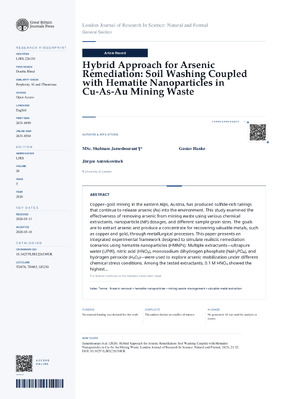
Copper–gold mining in the eastern Alps, Austria, has
produced sulfide-rich tailings that continue to release arsenic (As) into
the environment. This study examined the effectiveness of removing
arsenic from mining waste using various chemical extractants,
nanoparticle (NP) dosages, and different sample grain sizes. The goals
are to extract arsenic and produce a concentrate for recovering valuable
metals, such as copper and gold, through metallurgical processes. This
paper presents an integrated experimental framework designed to
simulate realistic remediation scenarios using hematite nanoparticles
(HMNPs). Multiple extractants—ultrapure water (UPW), nitric acid
(HNO₃), monosodium dihydrogen phosphate (NaH₂PO₄), and
hydrogen peroxide (H₂O₂)—were used to explore arsenic mobilization
under different chemical stress conditions. Among the tested
extractants, 0.1 M HNO₃ showed the highest arsenic removal
efficiency, significantly outperforming UPW, 0.1 M NaH₂PO₄, and 3%
H₂O₂. The addition of NPs improved overall arsenic removal;
however, the efficiency did not increase proportionally with higher NP
concentrations. A concentration of 0.05 HNPs g/L resulted in slightly
higher arsenic removal rates compared to 2.5 HNPs g/L and 5 HNPs
g/L, likely due to particle aggregation at higher concentrations, which
reduced the available reactive surface area. The texture of the mining
waste also influenced removal efficiency. Finer particles promoted
greater arsenic release under the H₂O₂ + HNP treatment, whereas
coarser particles showed better responses to UPW and NaH₂PO₄. In
contrast, HNO₃ consistently delivered high removal efficiencies across
all particle sizes by directly dissolving the mineral compositions. The
distinct oxyanion behavior of As underscores the necessity for strong
extractants or NP-assisted approaches, as conventional methods
optimized for cationic metals are less effective. Overall, HNO₃ proved
to be the most effective single extractant, achieving removal
efficiencies of up to 87.6% for As, 63.8% for Zn, 90.7% for Pb, and
85.97% for Cu. Post-treatment filtrates were analyzed using
Inductively Coupled Plasma Mass Spectrometry (ICP-MS) and
Instrumental Neutron Activation Analysis (INAA) to quantify As
removal.
Explore Digital Article Text
Introduction
The reprocessing of polymetallic low-grade ores previously considered economically unfeasible has gained renewed significance due to advances in extraction technologies and the increasing global demand for critical metals, such as copper, zinc, silver, and gold. Historically discarded materials, including tailings and mining residues, represent not only potential secondary metal resources but also persistent environmental hazards; due to the presence of sulfide minerals and associated potentially hazardous elements (PHEs), particularly arsenic . These environmental risks are exacerbated by natural weathering processes that induce sulfide oxidation, resulting in acid mine drainage (AMD) and the subsequent mobilization of toxic elements into surrounding ecosystems .
This study examines the effectiveness of HMNPs combined with various chemical extractants to reduce arsenic bioavailability in legacy mining waste from the eastern Alps, Austria, an area historically affected by orogenic copper-gold mining activities. The main objectives are twofold: (1) to evaluate HMNPs’ ability to adsorb and remove arsenic under different extraction conditions, and (2) to understand how soil particle size, mineralogical composition, and solution chemistry influence arsenic mobility and remediation success.
The significance of this research lies in addressing the dual challenge of environmental protection and sustainable resource recovery. Conventional mining waste remediation techniques often prove inadequate when dealing with the heterogeneity and chemical complexity of mine-contaminated substrates, emphasizing the need for adaptable and targeted approaches . Nanotechnology offers a promising alternative in this regard, with iron oxide-based nanomaterials demonstrating exceptional surface reactivity, tunable physicochemical properties, and relatively low toxicity, making them highly suitable for environmental remediation applications .
Previous studies have explored a range of nanomaterials for arsenic remediation, including zero-valent iron, goethite, magnetite, and various carbon-based composites, highlighting their efficiency under specific environmental conditions . Earlier works have demonstrated the potential of HMNPs to interact with a range of PHEs in complex mining waste matrix; however, their role in real-world remediation scenarios, particularly under field-representative extractant conditions, remains underexplored.
Role of Nanotechnology in Arsenic Remediation
Traditional methods for arsenic removal—such as physicochemical adsorption, redox reactions (both photochemical and chemical), and filtration—have shown limitations in efficiency and flexibility. The advent of nanotechnology has significantly advanced the remediation of arsenic from mining waste by enhancing removal methods and improving detection accuracy.
Nanoscale iron oxides
Iron oxide nanoparticles (IONPs) and iron nanoparticles (FeNPs) have been extensively studied for their high efficiency in removing pollutants, particularly arsenic, from contaminated soils and water. IONPs are especially effective due to their ability to bind arsenic through chemisorption, forming strong and stable chemical bonds with arsenic species. In contrast, carbon-based NPs typically rely on physisorption, which involves weaker, non-specific interactions; however, their adsorption performance can be significantly enhanced through surface modification.
Nanoscale iron oxides (nFeOs) demonstrate exceptional efficiency not only in removing arsenic but also in eliminating other toxic metals such as V, Cr, Co, Mn, Se, Mo, Cd, Pb, Sb, Tl, Th, and U. Their low toxicity, high reactivity, and resistance to desorption make them a promising material for environmental remediation. Among the various forms of iron oxides, goethite , hematite , maghemite , and magnetite are recognized as the most efficient for such applications. The adsorption mechanism—whether chemisorption or physisorption—ultimately depends on the NP’s composition and surface chemistry, which govern their interaction strength and selectivity toward contaminants.
Studies confirm that nFeOs efficiently remove arsenite and arsenate while minimizing secondary contamination risks. They also immobilize toxic metals in mining waste. Factors influencing the stability and transport of nFeOs include particle size, concentration, magnetism, solution chemistry, and environmental conditions .
NPs in concentrated solutions tend to aggregate due to increased collision rates, reducing stability compared to dilute solutions. For instance, smaller HMNPs exhibit higher aggregation rates due to surface property changes at reduced sizes . Additionally, strong magnetic properties in IONPs contribute to increased aggregation. However, studies suggest that IONPs generally have low or negligible toxicity to living organisms .
Hematite nanoparticles
Hematite is a stable, well-crystalline NP commonly found in mining waste and plays a key role in the iron biogeochemical cycle. Its high surface area, thermal stability, and abundant hydroxyl sites make it highly effective for adsorbing metalloids and trace metals . Due to these properties, hematite is widely used in contaminant remediation, catalysis, gas sensing, and battery applications .
Studies have shown its ability to adsorb contaminants like copper, nickel, cobalt, cadmium, lead, zinc, and anions such as uranyl, phosphate, sulfate, and selenate. Common synthesis methods include precipitation, hydrothermal, and solvothermal techniques, which are valued for their simplicity and high yield. Preventing precursor coagulation is crucial for producing monodispersed HMNPs .
Factors influencing NP performance
The effectiveness of nanomaterials in arsenic remediation is governed by various environmental and operational factors. Among these, the pH and redox potential of mining waste are particularly important, as they significantly influence the chemical speciation and mobility of arsenic in mining waste. The presence of organic matter and the mineralogical composition of the mining waste also significantly affect how NPs interact within the mining waste matrix. Additionally, the specific surface area of IONPs is a key factor in optimizing their adsorption efficiency, as it determines the number of active sites available for binding arsenic. Particle size is vital to adsorption efficiency because it affects surface area, crystallinity, and site density. Hematite particles range from nanoscale to microns, with smaller sizes generally providing better adsorption due to increased surface reactivity .
Advantages of nanotechnology
Nanomaterials offer several advantages for arsenic remediation. Nanomaterials possess a high surface area that significantly increases their adsorption or catalytic activity. This structural feature also contributes to improved detection capabilities and greater selectivity, allowing for lower detection limits and increased accuracy in identifying arsenic presence.
In the context of mining waste reclamation, various nanomaterials have proven effective. These include zeolites, IONPs, phosphate-based NPs, and carbon nanotubes. Among them, zero-valent iron (nZVI) and IONPs have been the most extensively studied due to their strong chemical affinity for arsenic and their effectiveness across a wide range of mining waste types . IONPs tend to aggregate based on concentration and pH. Brownian motion increases collisions, leading to aggregation, especially at concentrations above 50 mg/L .
Chemical and mineralogical composition of the mine waste
The tailings waste contains primary minerals like chalcopyrite (), bornite (), and covellite (), which were part of the original ore. Secondary minerals formed through weathering and oxidation include malachite (), azurite (), cuprite (), and brochantite (). These minerals show the transformation of sulfides into oxides, carbonates, and sulfates over time. Various techniques have been developed to treat mining waste, primarily focusing on containing or immobilizing pollutants or on cleaning up and removing them. Each case is different, so methods need to be tailored or combined. However, many remediation options face significant challenges .
The mineral composition of historical tailing waste significantly affects arsenic (As) removal efficiency. Iron oxides (e.g., hematite, goethite, magnetite) are the primary arsenic adsorbents, while quartz is inert and does not contribute to removal. Clay minerals moderately aid adsorption, carbonates help stabilize arsenic through precipitation, and sulfides can release arsenic, requiring pre-treatment.
Magnesium minerals enhance stability but may compete with iron for binding, while phosphates reduce arsenic removal by competing for adsorption sites. Silicates (e.g., feldspar, mica) have minimal impact. Understanding these minerals is crucial for effective arsenic remediation strategies . The chemical composition of the samples before treatment is presented in Table [tab:mining_waste_comp], which also indicates the presence of precious and base metals, as well as some hazardous elements such as arsenic.
| Sample Name | Particle size (mm) | As (ppm) | Au (ppb) | Ag (ppm) | Cu (ppm) | Mn (ppm) | Mg (%) |
|---|---|---|---|---|---|---|---|
| WBaa_12 | 0.18–2 | 570 | 81 | 0.14 | 252 | 895 | 0.77 |
| WB_12 | 3180 | 792 | 0.72 | 983 | 1210 | 1.45 | |
| WBbb_13 | 0.18–2 | 3450 | 415 | 0.26 | 440 | 1700 | 0.55 |
| WB_13 | 5920 | 858 | 1.51 | 1780 | 1730 | 0.91 |
Selected components and particle sizes of the mining waste
aWeißenbach12 (WB) 1.5 m depth from surface; bWeißenbach13 (WB) 2.5 m depth from surface
Material and Methods
Sample collection and preparation
Samples containing sulfide-rich tailings were obtained from one mine waste dump at two different depths (WeiBenbach12: and WeiBenbach13: ). The samples were air-dried and sieved to and for general characterization and arsenic removal.
Reagents and pH conditions for removal of arsenic
A 0.1 M phosphate solution prepared from salts such as was used to facilitate the displacement of arsenate ions from grain size particles, operating effectively at a pH of 6.1. Additionally, hydrogen peroxide was employed to oxidize sulfide minerals, promoting the release of arsenic and associated metals into the aqueous phase at a pH of approximately 6.5. UPW served as a blank solution and was also utilized to assess the influence of HMNPs under near-neutral conditions (pH 6–7). Furthermore, concentrated nitric acid (), a strong oxidizing agent, was applied under highly acidic conditions (pH 1) to ensure the complete oxidation and dissolution of mineral constituents.
Hematite nanoparticles
HMNPs were utilized to evaluate their impact on the removal of potentially harmful elements (PHEs) in mining waste. Stock suspensions of HMNPs were prepared at concentrations of , , and using various extractants: UPW, nitric acid , monosodium dihydrogen phosphate , and hydrogen peroxide . To prevent NP aggregation, sodium citrate was added as a stabilizing agent. The suspensions were stirred for 30 minutes and subsequently sonicated for 15 minutes before soil application.
Samples were introduced into the NP suspensions, and the mixtures were agitated on a rotary shaker at 13 rpm for periods of 5 days and 10 days in the dark. The pH of the solutions was adjusted to between 6.0 and 7.2 using 0.1 M HCl or NaOH except for the -based suspensions, which maintained an acidic pH of . For the treatment, 10 g of sample was mixed with 100 ml of 3% hydrogen peroxide and stirred at 77 and 240 rpm for 2 hours to promote oxidation of sulfide minerals. Subsequently, 0.5 g of HMNPs was added, and the mixture was stirred at 40 for 24 hours, with pH adjusted to 6.5. Parallel control experiments were conducted under identical conditions but without the addition of NPs.
Mining waste treatment and metal extraction
For each treatment, 5 g or 10 g of sample was combined with 50 mL or 100 mL of NP suspension and control solution in polypropylene containers (ratio is 1:10). The mixtures were homogenized by shaking for 5 days and 10 days under dark conditions. After treatment, samples were centrifuged at 2400 rpm for 10 minutes, and the supernatants were filtered through 0.45 m membrane filters. The filtered extracts were then analyzed to determine the concentration of bioavailable PHEs and removal efficiency. The treated samples were dried at room temperature and stored for further analysis by INAA following 4-acid digestion and ICP-MS .
Results and Conclusions
The study demonstrated that arsenic (As) removal efficiency is heavily dependent on the type of extract, NP dosage, and grain particle size. Among the tested extractants, delivered the highest As removal efficiency, performing significantly better than UPW, , and . However, had a much shorter reaction time (1 hour) compared to the other methods (5 and 10 days), but still produced promising results, especially with NPs, and could be further optimized for improved performance.
The addition of NPs generally enhanced As removal; however, increasing the mass fraction of NPs does not always result in a proportional increase in contaminant removal. Higher nominal NP loading () can underperform because the extra mass no longer translates into available active surface due to aggregation, passivation, mass-transfer limits, or changes in solution chemistry—or because of experimental artifacts.
Particle size of samples also influenced performance: for , finer particles () improved As removal, because more reactive surface area and coatings were available for oxidation and release. For UPW and , which are weak extractants, coarser particles () were more effective because As was more weakly bound and could leach, whereas finer particles held As too strongly for pure water to remove. Strong extractants like dissolve the mineral composition and release As regardless of grain size. Finer particles may still give slightly higher efficiency (more surface area, faster dissolution), but the difference is less pronounced because is powerful enough to attack both coarse and fine fractions. Furthermore, deeper layers (up to depth) contained higher concentrations of hazardous elements as well as Au, Cu, and Ag.
Chemically, arsenic behaves differently from heavy metals due to its oxyanion nature, which makes it harder to remove with methods designed for cationic metals. Thus, if NPs are not used, a strong extract such as is necessary to achieve effective As removal (). Importantly, the extractant that works best for As may not be the most efficient for other hazardous metals. However, the could remove of the Zn, of As, of the Cu, and of Pb. Comparison of the removal efficiency of As with the blank solution, with the solution, and the removal efficiency of different extractants on As removal is shown in Figures [fig:as_removal_hno3] and [fig:as_removal_extractants].
| Symbol | Condition and Description |
|---|---|
| S1 | UPW, sample of 0.18–2 mm, 5 HNPs g/L |
| S2 | UPW, sample of 0.18–2 mm without NPS |
| S3 | , sample of 0.18–2 mm, 5 HNPs g/L |
| S4 | sample of 0.18–2 mm without NPS |
| S5 | sample of 0.18–2 mm, 5 HNPs g/L |
| S6 | sample of 0.18–2 mm without NPS |
| S7 | UPW, sample of 0.18–2 mm, 0.05 HNPs g/L |
| S8 | UPW, sample of 0.18–2 mm, 2.5 HNPs g/L |
| S9 | UPW, sample of 0.18–2 mm, 5 HNPs g/L |
| S10 | with 5 HNPs g/L, sample of mm |
| S11 | with 5 HNPs g/L, sample of 0.18–2 mm |
Conditions and descriptions of the suspensions
The As removal of the blank suspension vs. the HNO3 with HNPs and without HNPs
The efficiency of combining chemical extraction with HMNPs for arsenic removal depends on the mineralogical and chemical properties of the mining waste. Nitric acid () proved to be the most effective extractant, achieving up to arsenic removal, while also extracting copper (Cu), zinc (Zn), and lead (Pb) in parallel. In cases where the mineralogical and chemical characteristics of the mining waste are compatible with the NPs, these NPs can be partly reused through selective extraction methods, improving cost efficiency and sustainability.
After As removal, both the filtrate and the solid leach residue will be further treated to recover as many different valuables as possible. From the filtrate, copper could be separated from arsenic, for example, by means of cementation, while the solid concentrate or leach residue could be treated using different approaches depending on the amount of valuable elements present. Low-Cu material could be leached with cyanide to obtain Au, whereas Cu-rich material could be treated following pyro- or hydrometallurgical standard procedures, where Au will be enriched in a potential anode slime. Ultimately, the extraction of As is an important part of treating these historical mine wastes; however, As is only one of the many components in focus.
The As removal of different extractants under different conditions
This work was supported by the European Union’s Horizon Europe research and innovation programme under grant agreement No.101177746 (SCIMIN-CRM project).
Conflict of Interest
The authors declare no conflict of interest.
Ethical Approval
Not applicable
Data Availability
The datasets used in this study are openly available at [repository link] and the source code is available on GitHub at [GitHub link].
Funding
This work did not receive any external funding.
References
Cite this article
Related Research


Special Issue
Launch a focused special issue to highlight research, emerging trends, and expert insights in your academic field.