



IntelliPaper
Abstract
Research on the vitality of Chetti Malay Creole, the heritage language of the Melaka Chetti community at Kampung Chetti, Malacca, have all reported a language shift. Since language shift often leads to language loss, this study seeks evidence of language loss and attrition among the younger generations, specifically among the fourth and fifth generations (G4/Gen Y and G5/Gen Z) Chettis. Using a language loss assessment (adapted from O’Grady et al. 2009), the study found that Chetti lexicon is largely absent from the younger generations’ vocabulary and they struggle to construct short sentences in Chetti Malay, which indicate the lack of a working knowledge and use of their heritage language. Focus group interviews further reveal that many Chetti lexical items are unfamiliar to the younger generations since the language is spoken sporadically at festivals or among older generations. The findings place the vitality of Chetti Malay at Level 7 Shifting on the EGIDS while on the UNESCO Language Vitality and Endangerment framework Chetti Malay is definitely endangered. The study confirms that there is language shift, loss and attrition at Kampung Chetti. The study raises a critical question for further research on whether the lack of knowledge of Chetti vocabulary and the inability to use the language among the millennials and digital natives a case of attrition (total or partial forgetting of the vocabulary as a result of the language being rarely used) or incomplete acquisition (a language never acquired due to non-intergenerational transmission of Chetti Malay in their homes).
Explore Digital Article Text
I. INTRODUCTION
Malacca (Melaka in Malay), the historic city of Malaysia, is the epitome of ethnic and language blending. As early as the century, there was already an international community of traders trading at the port during the Malacca Sultanate (Figure 1).
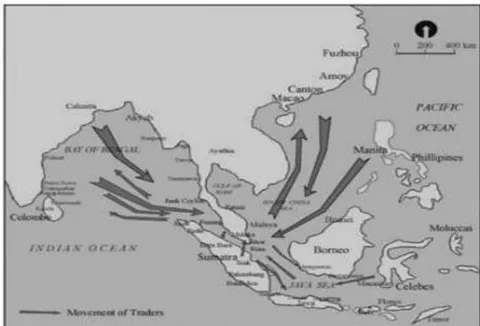
Figure 1: Movement of traders in the Malay Archipelago
Linguists who visited Malacca in the 1930s were acutely aware of the inhabitants' bilinguality:
'In Hilir the people are almost all polyglots: they speak Christian (i.e. Portuguese), they make fun in English, and they market in Malay...'
(Silva Rêgo, 1936 cited in Knowlton, 1964: 212) In addition to the multiculturalism and bilingualism taking place, intermarriages between the foreigners and local women further enhanced the long-term mingling of different cultures and languages, resulting in three creole communities: the Melaka Portuguese (Kristang) community, the Baba Nyonya (Peranakan Chinese) community, and the Melaka Chetti/Chetti (Peranakan Indian) community. These Peranakan (locally born from mixed marriages between foreign conquerors or traders and local women) communities became permanent settlers in Melaka thus creating new ethnic and cultural groups (Hussin 2007) and displayed a high degree of sociocultural adaptation towards the dominant Malay culture in the Malay Archipelago. A prominent feature of these heritage communities is their creole language which often comprises a lexifier language (superstrate) and a substrate: for instance, Papia Kristang or Malacca Creole Portuguese has Portuguese as the lexifier and Malay as the substrate; in the case of the Melaka Chetti Malay creole, naturally the superstrate is Malay infused with Tamil vocabulary and a few Hokkien (a dialect from Fujian, China) words adopted from the Baba Malay creole.
As a mother tongue Chetti Malay creole is used by the older generations for communication and in their worship to the Hindu deities. However, researchers assessing the vitality of the language (Omar et al. 2016; Hamzah et al. 2020; Hamzah and Chong 2021; Hamzah et al. 2022) have consistently reported a language shift taking place thus raising concerns about the vitality and endangerment of Chetti Malay. Since language shift often results in language loss (Wurm 1991), this study seeks evidence of language loss among the younger generations. Accordingly, the research questions are: What is the vitality status of Chetti Malay on the EGIDS and UNESCO
Language Vitality and Endangerment (LVE) framework based on the findings of this study? What is the evidence of language loss among the fourth and fifth generation (Gen Y and Gen Z) Chettis?
1.1 The Melaka Chetti (or Chetti) Community and Kampung Chetti: A Brief Background
The Melaka Chetti (Chetti) community are descendants of social amalgams (interethnic marriages) between South Indian traders from the Coromandel coast in India and the local female population in Malaya (now Malaysia) between 1402 and 1511 (Mohamed, 2009a; Neo & Varghese, 2017). Despite their Indian names and celebration of Indian and Hindu festivities such as Ponggal, Deepavali, Bhogi Parchu (Chetti ancestor worship), Chetti acculturalization into the Malay indigenous culture is largely reflected in their language, dressing and cuisine.
Most of the Chetti community live at Kampung Chetti (Chetti village) (Figure 2). The residential Chetti village comprises thirty families (Mohamed 2009a) or a hundred plus Malay-speaking Hindus (Pillai 2015) living in quaint half brick half wooden houses (Figure 3).


Kampung Chetti is highly prized by the Chetti community for its identification with their ancestral roots and is a popular research site for research on minority groups, language and cultures in Malaysia .
II. LITERATURE REVIEW
2.1 Chetti Malay creole (CMC) or Chetti Malay
The mother tongue of the Chettis is 'a variety of Malay which displays a rich and interesting mix of different cultures' (Mohamed 2009b: 8). According to Mohamed (2009a; 2009b), the Melaka Chetti Malay creole (henceforth CMC) developed from the pidgin Bazaar Malay which was the lingua franca among the foreign traders in the Malay Archipelago during the Malacca Sultanate (c.1400 - 1511). CMC is therefore a result of language contact between Malay, the dominant language spoken in Melaka and Tamil, the paternal ancestral language of the community. Frequent, close interactions with the Baba Nyonya community brought substantial influences from Baba Malay creole especially in its pronunciation and the incorporation of Hokkien words such as bimpo (handkerchief) and Hokkien pronouns such as gua (I) and lu (you) into Chetti Malay. Nevertheless, Baba Malay creole contains more
Hokkien lexical items while a large proportion of the vocabulary of CMC is borrowed directly from the Tamil language, for example, nalla (good), illa (no), ubayam (auspice), poosari (priest), abishegam (bathing the deity), maalai (garland), thaltha (grandfather), tenggai (coconut), ingi (ginger) (Raghavan, 1977; Sarkissian, 1997; Sukri, 2017, Mohamed 2009a).
According to Mohamed (2009a), CMC has six vowels (Table 1) and nineteen consonants (Table 2).
| Front | Central | Back | |
| Close | i | u | |
| Close-mid | e | ə | o |
| Open | a |
| Manner of Articulation | Place of Articulation | |||||
| Bilabial | Alveolar | Alveolar-Palatal | Palatal | Velar | Glottal | |
| Plosive voiced voiceless | b p | d t | č | g k | ? | |
| Approximant voiced | j | |||||
| Nasal voiceless | m | n | s | ŋ | ŋ | |
| Fricative voiced | h | |||||
| Trill | r | |||||
| Lateral Approximant | l | |||||
| Half (Mid) vowel | w | y | ||||
Although CMC shares a number of similarities with other Malay dialects in the region, according to Mohamed (2009a) there are distinctive phonological and linguistic characteristics in CMC such as variation of the phoneme /a/, deletion of phoneme /r/, deletion of phoneme /h/, monophthongisation of /ai/ and /au/, phoneme deletion in consonant clusters of trisyllabic words, phoneme insertion and replacement of phonemes /f/, /v/, /z/.
2.1.1 Variation of the Phoneme /a/
2.1.2 Deletion of the Phoneme /r/
Historically, the /r/ diaphones existed in the Malay language in Peninsula (West) and East Malaysia but linguistic development caused the /r/ diaphones to disappear in the central and southern states in West Malaysia (Asmah 1991). In CMC the phoneme /r/ at word final position was part of the its structure but due to the influence of language use, education and the media, the phoneme /r/ at word final position has been dropped thus the younger Chettis, like most Malaysian and Singaporean speakers would say /bəna/ instead of /bənar/ (Mohamed 2009b).
2.1.3 Deletion of the Phoneme /h/
Another prominent characteristic of CMC is the deletion of the phoneme /h/ in almost all positions. Some examples of /h/ being dropped at word final position are /dara/ for /darah/, /suda/ for /sudah/ and /itam/ for /hitam/, /alos/ for /halus/ for deletion of /h/ at word initial position. With reference to this, Mohamed (2009b) points out that Chetti Malay displays the characteristics of its origin, the Bazaar Malay pidgin which has the phoneme /h/ deleted at word initial and word final positions. The same process occurs in other Malay dialects such as the Malayu Ambong creole language, the Jakarta Malay dialect and the Sri Lanka Malay creole which most likely also originated from Bazaar Malay, the lingua franca in the Malay Archipelago spoken in the ports and trading centres of Malacca, Jakarta and the islands of Borneo. The /h/ sound is also almost completely non-existent in the Bazaar Malay spoken by Tamil speakers (who were the fore fathers of the Chetti community). The deletion of /h/ in all positions in Malay words was also highlighted by Collins and Schmidt (1992:299 cited in Mohamed, 2009a) such as /ari/ for /hari/, /idgo/ for /hijau/, /payit/ for /pahit/, /cassian/ for /kasihan/, /mira/ for /merah/, /sompa/ for /sumpah/ .
2.1.4 Monophthongisation of /ai/ and /au/
CMC has only diphthong /oi/ and a limited number of words using it. Of greater importance are the diphthongs /ai/ and /au/. The diphthong /ai/ in CMC underwent the process of monophthongisation (the process of two vowel sounds shifting to one vowel sound) thus words that have /ai/ at word final position in Standard Malay (SM) are articulated as /e/ which is a half-close front vowel in Chetti Malay and the diphthong /au/ at word final position in SM words undergoes a shift in vowel quality and is articulated as /o/, a half-close back vowel in CMC. Some examples of words in SM ending with /ai/ and their pronunciation in CMC are gadai (SM) → gade (CMC), misai (SM) → mise (CMC), serai (SM) → sere (CMC); words in SM ending with /au/ and their pronunciation in CMC include kalau (SM) → kalo (CMC), kurau (SM) → kuro (CMC), limau (SM) → lemo (CMC) (Mohamed 2009b:15-16).
It is said that the monophthongisation process causes the vowels /i/ and /u/ to be lowered and articulated as /e/ and /o/ respectively. Mohamed (2009b) highlights that this process is also evident in Baba Malay which strongly suggests that Baba Malay creole share the same source of origin, that is, the pidgin Bazaar Malay (Pasar Malay/Market Malay).
2.1.5 Phoneme Deletion in Consonant Clusters of Trisyllabic Words
Ellipsis (leaving out a sound or sounds in speech) is common in Malay words with three syllables that contain consonant clusters at the border of the syllables. Mohamed (2009b) explains that the clusters are usually a voiced plosive consonant /b/ but when it is also followed by a nasal, often in speech the cluster loses its consonant sound and is left with the nasal sound. Examples of trisyllabic Standard Malay (SM) words that underwent the clipping in CMC are 'sembilan' → 'semilan', 'sembahyang' → 'semayang', 'sembunyi' → 'semunyet'.
2.1.6 Phoneme Insertion
In CMC insertion of phoneme /k/ and the glottal stop /?/ usually occur at word final position especially with words ending with the vowel sounds of /i/, /a/, /u/. Examples of these phoneme insertions are: 'bawa' → 'bawak', 'bapa' → 'bapak', 'cari' → 'carik', 'garu' → 'garok', 'nasi' → 'nasik'.
2.1.7 Replacement of Phonemes /f/, /v/, /z/
According to Mohamed (2009a), in CMC the consonants /f/, /v/, /z/ are replaced by /p/, /b/, /j/ respectively. Examples of these replacements are: 'faham' → 'paham', 'fasal' → 'pasal', 'vitamen' → 'bitumen', 'zaman' → 'jaman', 'rəzəki' → 'rəjəki'.
2.2 Assessing Language Vitality and Endangerment
Different metrics are available for assessing language vitality and endangerment: Fishman's (1991) Graded Intergenerational Disruption Scale (GIDS), the University of Hawaii's Language Endangerment Index (LEI), Ethnologue (2009) Language Vitality Categories, the UNESCO (2011) Language Vitality and Endangerment (LVE) Framework and the Expanded Graded Intergenerational Disruption Scale (EGIDS) (Lewis & Simons 2010). Among these, the vitality scales most often used by researchers are the UNESCO framework and the EGIDS.
The UNESCO Language Vitality (LV) Index identified nine factors for the assessment of language vitality and endangerment and measures for maintenance or revitalization. With reference to Figure 4, Factors 1 – 6 assess the vitality of the language from the community's engagement with its language, Factors 7 – 8 focus on the attitudes towards the language and Factor 9 evaluates the urgency for documentation.
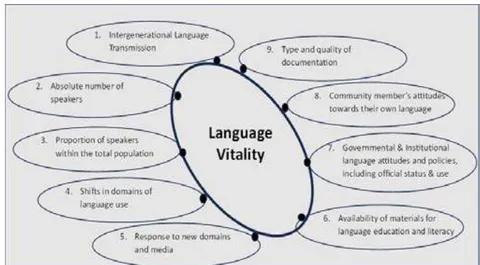
Despite advice that no single factor in the LV Index be used to assess a language's vitality, not all researchers applied the nine factors in their investigations. Factor 1 (Intergenerational Transmission of the Language) is the most critical factor in language vitality thus researchers often focus on this variable alone and accordingly, use the six degrees of endangerment with regard to intergenerational transmission to assess the vitality and endangerment of the language (Table 3).
| Grade | Degree of endangerment | Intergenerational Language Transmission |
| 5 | Safe | The language is spoken by all generations; intergenerational transmission is uninterrupted. |
| 4 | Vulnerable | Most children speak the language, but it may be restricted to certain domains (e.g. home). |
| 3 | Definitely endangered | Children no longer learn the language as mother tongue in the home. |
| 2 | Severely endangered | The language is spoken by grandparents and older generations; while the parent generation may understand it, they do not speak it to children or among themselves. |
| 1 | Critically endangered | The youngest speakers are grandparents and older, they speak the language partially and infrequently. |
| 0 | Extinct | There are no speakers left. |
There is also Lewis and Simons' (2010) thirteen level EGIDS which is a combination and alignment of three evaluative frameworks of language endangerment (Fishman's (1991) GIDS, UNESCO (2009) Language Endangerment Framework and Ethnologue (2009) Language Vitality Categories). According to the authors, the EGIDS provides an efficient alternative to categorizing all (not only endangered) languages and can be used for language planning, revitalization and other language projects.
The labels on the EGIDS (Table 4) summarizes the state of vitality of the language. Levels 6 – 8 focus on the daily use and intergenerational transmission of the language with levels 6a, 6b, 8a, 8b providing a finer description of the state of intergenerational transmission in the presence of language shift (or revitalization). Levels 9 and 10 focus on whether the language is a marker of identity.
Despite the availability of a number of typologies of language vitality for assessing vitality and language endangerment, the methodology used to gauge language vitality can be varied. SIL language assessment specialists study language vitality by exploring the functions (domains of use), acquisition (transmission across generations), motivation for use, governmental policy regarding language use, and distinctive niches (particular contexts where the language is used), as these factors foster the ongoing use of a language. The vitality of each language within a community is also further assessed by looking at the specific purposes, social contexts, opportunities and frequency that a given language is used. Sociolinguists and linguistic anthropologists investigating on language vitality seek to identify trends in language use through various means including changes in the number of speakers or changes in the use of the language in certain domains or functions. Thus, depending on the aim and purpose of the study, besides language vitality and endangerment inventories, some studies employ only basic research tools such as questionnaires, interviews and observations for data on patterns of language choice and language use in various domains to determine whether a language is undergoing shift and showing low vitality and signs of endangerment.
| Level | Label | Description | UNESCO |
| 0 | International | The language is used internationally for a broad range of functions. | Safe |
| 1 | National | The language is used in education, work, mass media, government at the national level. | Safe |
| 2 | Regional/Provincial | The language is used for local and regional mass media and government services. | Safe |
| 3 | Trade/Wider Communication | The language is used for local and regional work by insiders and outsiders. | Safe |
| 4 | Educational | Literacy in the language is being transmitted through a system of public education. | Safe |
| 5 | Written/Developing | The language is used orally by all generations and is effectively used in written form in parts of the community. | Safe |
| 6a | Vigorous | The language is used orally by all generations and is being learnt by children as their first language. | Safe |
| 6b | Threatened | The language is used orally by all generations but only some of the child-bearing generations are transmitting it to their children. | Vulnerable |
| 7 | Shifting | The child-bearing generation knows the language well enough to use it among themselves but none are transmitting it to the children. | Definitely Endangered |
| 8a | Moribund | The only remaining active speakers of the language are members of the grandparent generation. | Severely Endangered |
| 8b | Nearly Extinct | The only remaining speakers of the language are members of the grandparent generation or older who have little opportunity to use the language. | Critically Endangered |
| 9 | Dormant | The language serves as a reminder of heritage identity for an ethnic community. No one has more than symbolic proficiency. | Extinct |
| 10 | Extinct | No one retains a sense of ethnic identity associated with the language, even for symbolic purposes. | Extinct |
2.2.1 Language Vitality, Shift, Loss and Attrition
According to SIL (2014), language vitality is demonstrated by the extent that the language is used as a means of communication in various social contexts. The most significant indicator of a language's vitality is its daily use in the home. A language with high vitality is used extensively in daily communication by members of a community, inside and outside the home, by all generations, and for most topics of conversations; in contrast, a community language that is not used suffers decreasing number of speakers and the threat of language loss and attrition as it undergoes language shift.
When language shift takes place, it is 'manifested as loss in the number of speakers, level of proficiency or a range of functional use of the language (Hornberger 2012: 412). According to Anderson (2014:104), 'language shift also constitutes a loss' with the former referring to the community's ongoing change from using their first/native language to another language over a century while loss denotes vocabulary and registers that have fallen into disuse during the language shift process. Schmid (2011:3) considers language loss a generic term that can refer to any of these states: the phenomenon of change or reduction of linguistic knowledge, the shift from one language to another in a community over several generations or to the overall extinction or death of a particular language. Literature on language loss and language attrition generally refer to loss as pertaining to loss of the use of a language at the community level while attrition refers to individual loss of proficiency and vocabulary due to lack of regular use of a language. Schmid defines language attrition as the loss of a (first) language in healthy (not aphasic) individuals due to total or partial forgetting of a language as a result of the language being rarely used.
First language attrition is usually caused by isolation from speakers of the first (native) language alongside increasing use of a second language for communication. Language attrition involves simplification in the tense system, disuse of some vocabulary of the native language and/or re-structuring of phonetic features. In attrition, children are more likely to lose their first language than adults (Köpke & Schmid, 2004). According to Schmid (2011), the bilingual mental lexicon is often the most vulnerable area of linguistic knowledge in language attrition. To investigate whether lexical access and lexical knowledge have attrited, a number of tasks can be given to the speakers such as picture naming tasks, picture word matching tasks, verbal fluency tasks, grammatical judgement tasks, to name a few.
2.3 Investigations on Language Vitality and Endangerment in Malaysia
According to Ethnologue language vitality count there are 93 endangered languages in Malaysia (https://www.ethnologue.com/country/MY/). To date, studies on the vitality and endangerment of minority languages in Malaysia can be categorized into three groups: research on the indigenous languages of Malaysia, research on the Chinese dialects spoken in Malaysia, research on the creole languages of Malacca (Melaka). As this study is on the Melaka Chetti Malay creole, we shall only review studies on Chetti Malay.
2.3.1 Past Research on Chetti Malay Creole (CMC) or Chetti Malay
The first major documentation of Chetti Malay creole as a written language was published by Noriah Mohamed (2009a) in her book Bahasa Melayu Kreol Chetti Melaka: Deskripsi Leksiko-Fonologi (Malacca Chetti Malay creole: A Lexical-Phonological Description). Despite her focus on the linguistic system of Chetti Malay, in her concluding chapter she highlighted the challenge of maintaining the use of the Chetti language among the younger generations due to urbanization, migration, and competition from English and Standard Malay. Following this, Omar et al. (2016) investigated language choice among the Chettis in the family and social domains. Using (self-report) questionnaires on 50 respondents they found that a) only when communicating with their peers Chetti is used, b) in the home domain English and the Chetti language are the main language choices for communication, c) in the social domain English is the preferred choice followed by Malay. They concluded that generally the Chetti language has high vitality since it is still chosen as a conversational language by family members in the home domain and to a lesser extent in the social domain. Nevertheless, the authors opined that a language shift has already been initiated when a dominant language like English is competing with the Chetti language as a means of communication. After this language choice study, there were three consecutive research discussing the survival of the Melaka creole languages (Hamzah et al. 2020), the vitality of Chetti Malay creole (Hamzah & Chong 2021) and language shift in the Chetti community (Hamzah et al., 2022).
Hamzah et al. (2020) reviewed all literature on the three creole languages of Malacca (Papia Kristang or Malacca Creole Portuguese, Baba Malay creole, Chetti Malay creole) and came to the conclusion that language shift is inevitable and the future of the Melaka creoles is bleak. Following this, Hamzah and Chong (2021) investigated on the vitality of the Chetti Malay language. Self-reported data was collected mostly online from 36 respondents through a 'Language Use and Attitude' questionnaire replicated from Coluzzi et al.'s (2018) preliminary study on the vitality of Baba Malay in Malacca. Responses to the questionnaire indicated that the majority of their Chetti respondents a) claim to speak Chetti Malay fluently, b) identify CMC as their mother tongue, c) use CMC with family members and d) have a positive attitude towards Chetti Malay. With these findings, the researchers assessed the vitality of Chetti Malay as straddling between Level 6a Vigorous and Level 6b Threatened on the EGIDS. Using data from this 2021 study, Hamzah et al. (2022) then examined how differences in language choice between the younger and older generations indicate whether there is language maintenance or shift in the Chetti community. From the responses, they identified a pattern of reported language use: firstly, although the younger generations maintained the use of Chetti in the family domain they have also begun to use English while in the social domain English is definitely the preferred choice; secondly, the older generations are more determined to use Chetti Malay on a personal level but at societal level there is a tendency to use other language(s). In sum, despite a favourable attitude towards their heritage language, CMC is losing ground as the language of the majority is gaining dominance and domains therefore language shift is definitely taking place within the Chetti community.
III. THE STUDY: INVESTIGATING LANGUAGE VITALITY IN THE MELAKA CHETTI COMMUNITY, KAMPUNG CHETTI, MELAKA
The project which is part of a research training program to mentor (especially junior) academic staff in the principal investigator's institution to conduct research, comprises two parts: Part A 'Investigating cultural maintenance and identity in the Melaka Chetti community' (this has been published); Part B 'Investigating language vitality in the Melaka Chetti community'.
In addition to previous studies highlighting Chetti Malay is undergoing an inevitable language shift, incidentally, during our fieldwork for Part A of the research project, we observed that while the older generations spoke Chetti in their ancestor worship rituals and during the Dato Chachar ceremonies, the younger generations hardly converse in Chetti (Lee & Ravindran 2024). Taking into consideration that language shift often leads to language loss (Wurm 1991), we decided to extend the investigation on the vitality of Chetti Malay, focusing on obtaining concrete evidence (instead of self-reported data) of language loss among the and generation (G4 and G5) Chettis. Henceforth, what is needed is a simple and concise assessment of knowledge of the creole and the use of Chetti Malay among G4/Gen Y and G5/Gen Z.
3.1 Methodology
3.1.1 Research Instrument 1: The Language Loss Assessment (LLA)
O'Grady et al.'s (2009) psycholinguistic tool in the HALA (Hawaii Assessment of Language Access) Project was designed for the assessment of and early diagnosis of language loss. Due to its adaptability, it is being used to investigate a variety of phenomena, including heritage language acquisition, linguistic proficiency as well as language attrition in children. Hamilton et. al (2013) adapted it to assess language change in Eastern Indonesia. For our investigation to detect language loss and attrition among Generations 4 and 5 (Gen Y and Gen Z) in the Chetti community, we have adapted it into a language loss assessment with specific aims and focus to suit our enquiry. In addition to the body-part naming task, we added two more sections and the sections and test items are ordered with increasing difficulty; secondly, naming times are not recorded as the focus is not on the speed (not to correlate naming times with the frequency of use of the word) but on their accuracy in naming the body parts in Chetti Malay. Lastly, unlike the HALA project, the (bilingual) respondents in the Language Loss Assessment (LLA) are not tested in two languages but are assessed for their knowledge of and use of only one language, the Chetti mother tongue.
The LLA was designed with input from two principal informants who are fluent speakers of Chetti Malay. The LLA (see Appendix A) comprises fifty items designed to test knowledge of Chetti vocabulary and use of the Chetti language. The LLA contains three sections:
Section A (with picture stimulus) is a simple body-part naming exercise for participants to name parts of the body in Chetti Malay; Section B (with picture stimulus) comprises a list of common daily actions which participants are to describe in Chetti Malay; Section C (without picture stimulus) comprises two tasks: Task 1 is a list of everyday vocabulary (such as 'bathroom', weekdays) in English and respondents are to give the Chetti Malay equivalent of the vocabulary items listed in Questions 1 – 17 while Task 2 (questions 18 – 23) are short sentences in English for respondents to construct in CMC.
3.1.2 Research Instrument 2: Focus Group Interviews (FGI)
The focus group interview (see Appendix B) is intended to initiate the two generational groups to discuss their responses in the LLA. The FGI is also a means to elicit information on the language choice and languages used in the respondents' homes which would inform us on the language shift situation in the community.
3.1.3 Participants
As the aim of the investigation is to confirm that there is language loss as a result of the language shift taking place in the Melaka Chetti community at Kampung Chetti, Melaka, the participants selected for the LLA and the FGI have to be living in the Chetti village. Unfortunately, there are not many youngsters living at the Chetti village hence in total we were able to recruit only thirteen participants (seven from G4, six from G5) (Table 5).
| The younger generations* (Generational cohorts) | Born Between: | Age range at the time of the study (years old) | No. of participants |
| G4 Gen Y (Millennials) | 1981 - 1996 | 38-23 | 7 |
| G5 Gen Z (Digital Natives) | 1997 - 2012 | 22 – 9 | 6 |
| Total | 13 | ||
*G4 and G5 are the younger generations; in Part A of the project G1 (The Silent Generation), G2 (The Baby Boomers), G3 (Gen X) are the older generations (cf. Lee & Ravindran 2024).
3.1.4 Procedure
The LLA was administered by the principal investigator (PI) with the assistance of a Chetti speaker and two research assistants (RA) in the house of the principal informant. Two rooms were allocated for the LLA: Room 1, the test room and Room 2, the quarantine room. RA 1 ushers each participant into Room 1 for the LLA oral test. Upon completion of the test, RA 2 ushers each participant into Room 2 to be quarantined until all the participants have undergone the assessment. The 'quarantine' is to ensure there is no discussion/contact between those who have not and those who have taken the assessment.
English is used in the instructions and communication with the respondents. The PI conducts the LLA while the Chetti speaker records the responses. Testing of each section begins with an explanation of the task in each section. For Section A the PI holds up the picture stimulus and points to the part of the body in each picture, the respondent names the body part in Chetti Malay and the Chetti speaker records the answers. For Section B, each picture is shown accordingly, the respondent describes the actions in Chetti Malay and the responses are recorded. For Section C Task 1 the PI reads out each word from the list in English, the respondent says it in Chetti Malay and the responses are recorded; likewise, in Task 2 the PI reads the short sentences in English, the respondent say it in Chetti Malay and the responses are recorded. All sessions were audio recorded for checking purposes when the responses are analysed.
Following the LLA, the two generations form two focus groups and take part in the focus group interviews led by the PI and two academic staff. The aim of the focus group interviews is to discuss the language tasks in the LLA: what the respondents found difficult and reasons behind the challenges. In addition, there were also questions prompting information on Chetti language use in the homes and community. Clearly, the aim of the focus group interviews is twofold: to discuss the Chetti lexical items and sentences in the LLA and to also elicit information on Chetti language use or disuse in the community.
IV. FINDINGS AND DISCUSSION
This section presents the findings from the language loss assessment and the focus group interviews. Figure 5 presents the average scores of G4 and G5 across the three sections of the LLA. Note that as the respondents progress from Section A to Section C, the scores decrease indicating that they have difficulty in responding to the tasks.
{"image_source":{"path":"images/6227fa364b143df30f2d7607e08171a25eac66e2a0d22f8355f8b0201d3f64a7.jpg"},"content":"","chart_caption":[{"type":"text","content":"Figure 5: Average scores in the Language Loss Assessment"}],"chart_footnote":[]} In Section A, both generations performed well (only 9 'errors' out of the twenty items) and almost perfect average scores of 19.6 and 18.8 for G4 and G5 respectively. The nine 'errors' are one incorrect answer for Question 7 from a G5 respondent, three incorrect entries for Question 11 from G4 & G5, two no answers for Question 18 from G4 and G5, three incorrect answers for Questions 19 – 20 from G4 and G5. At first glance, the overall high scores seem to indicate that G4 and G5 can speak or have been speaking Chetti Malay. However, further analysis reveals the actual situation: the names of the body parts in Chetti Malay are the same as they are in the lexifier language (Standard Malay); in other words, there is no variant lexicon or different pronunciation for body parts in Chetti Malay. In view of this, the respondents are most likely naming the body parts in Standard Malay but we are not able to discern this since the Chetti lexicon and their pronunciation for body parts are similar to Standard Malay. This being the case, the body-part naming exercise alone is insufficient to assess knowledge of Chetti Malay vocabulary (including its pronunciation).
Section B assesses the respondents' knowledge of action words in Chetti Malay. Of the seven action words, two verbs have a Chetti creole version (unlike Section A where all the items had no variant form from the lexifier language, Standard Malay). G4 performed well with an average score of 6.1 out of a total of seven questions since three respondents (out of seven) responded correctly to all the items in Section B. In contrast, none of G5 had an all-correct response to the section thus decreasing the average score to 4.5. Five G5 respondents answered incorrectly using Standard Malay 'pergi' while one of them did not respond at all. Incorrect answers due to the Standard Malay form 'pergi' being used instead of Chetti Malay 'pegi' show no knowledge of 'Deletion of the phoneme /r/' ruling (cf. section 2.1.2) while usage of Standard Malay 'fikir' instead of Chetti Malay 'pikir' indicate no knowledge of 'Replacement of phoneme /f/ with /p/ (cf. section 2.1.7).
Section C, without any picture stimulus, is definitely the most difficult level. For Task 1 respondents need to possess a ready knowledge of Chetti vocabulary to mentally retrieve for the common Chetti words listed in questions 1 to 17 while Task 2 demands the productive skills of constructing short sentences in Chetti Malay. The extremely poor results of an average score of 1.7 and 1.4 out of 17 for G4 and G5 respectively in Task 1 reveal that these Chetti vocabularies are definitely not part of the younger generations' lexicon while the drastic decrease of scores to 0.3 and 0 for G4 and G5 respectively for Task 2 confirm the respondents' almost zero working knowledge of Chetti Malay. These findings signify that there is language loss taking place in the Chetti community manifested as lexical attrition among the fourth generation G4 and the fifth generation G5 (Gen Y and Gen Z respectively).
| Questions | Gen 4 (Gen Y) | Gen 5 (Gen Z) |
| 1. What do you think of the language tasks in Section A? | Ok.Doable.Easy. | Not really difficult.Can do. |
| 2. What do you think of the language tasks in Section B? | Qs 1 – 3: ok. Qs 4 I said 'pergi' but incorrect?I didn't know it's 'pegi'.Never heard it before.I think it should be 'fikir'lah. | Why 'pergi' not correct?'Pegi'? But in school it's 'pergi'.'Pikir' I've heard before. My grandma used to say, 'Pikir baik baik'. |
| 3. What do you think of the language tasks in Section C?Task 1:Task 2: | Ayo, this section susah.'Chiwan'?Never heard this word.I think I only know nbr (question) 6.My grandma used to cook 'kepiting', that's why I know.'Nyari' for today, what a strange term.Why 'Hari' is 'Ari'?'Loteng'?My grandma said 'pande'.Maybe 'pande'and 'pake' is the same way to say it.'Kasi' also not baku, it's colloquial, right?I've heard '(h)ijo' but didn't know it's the short form for 'hijau'. | Yes, difficult especially Task 2.I think I got zero [laughter].'Piso'? What is that?Haven't heard of 'bimpo'.I've heard of 'besok' but never thought it's Chetti Malay.Strange that you add numbers (numerals) (Satu, Dua, Tiga...) to days of the week.Don't know this word.We don't know all these words...pande, pake...'Gua' and 'lu' is not Bahasa baku, right?Strange how 'nasi' has 'k' so become 'nasik'.'Ijo'? What's that? |
| 4. Who speaks Chetti in your family? How fluent? How often? Do they speak Chetti to you? | My parents can speak here and there but they usually speak English more. When relatives come, my grandparents and parents will use Chetti more. | My grandparents can speak well but parent I don't know how good. Very seldom, we speak more English. |
| 5. Do you hear Chetti being spoken when you go about the village? Do you (try to) speak Chetti? | Unless the older folks are together, you can hear some Chetti. If I speak we mix languages especially when not sure of the words. | Sometimes but at festivals yes, a bit more. Young people very seldom, maybe names of food. Yes we mix languages cause that's how we talk in Malaysia, kan? |
The thread of discussion on language loss at the community level and attrition at the individual level continues with the focus group interviews. With reference to Table 6, respondents found Section C difficult as they do not know most of the Chetti lexicon and struggled to construct sentences in Chetti Malay. Responses in the interviews reveal that a) the respondents realised that they have no knowledge of many Chetti lexical items b) some of the younger generations find the words like 'nyari' for 'today' and adding numerals (Satu, Dua, Tiga...) to denote days of the week strange (alien) c) the younger generations do not understand why 'Hari' is 'Ari' or why 'pergi' is 'pegi' indicating ignorance of the distinctive characteristics in Chetti Malay such as the deletion of the phonemes /h/ or /r/.
On an equally important note, the focus group interviews report Chetti being spoken sporadically at festivals or when relatives visit. On whether the younger generation (try to) speak Chetti, the 'Very seldom, we speak more English...' replies indicate the younger generations' notable proclivity toward the use of English, even in intimate family settings. In addition to English gradually supplanting Chetti, the language dynamics also include a discernible trend of blending Chetti with other languages. These linguistic adaptations among the youth signify a dynamic shift in linguistic preferences and raise legitimate concerns about the potential threats to the sustained use of the Chetti language. Another pivotal point is that although the older generations (grandparents and parents) are able to speak Chetti there is no attempt to transmit Chetti Malay to the younger generations since only 'when the older folks are together, you can hear some Chetti.' All these indicate that the younger generations are not exposed to much Chetti language use in the community as well as in the private domains of their homes which strongly suggest that they did not acquire their ancestral language as a mother tongue in the home.
The dynamics of language loss and attrition did not go unnoticed in the recent studies on the vitality of the Chetti language. In Hamzah et al.'s (2020) comprehensive review of the three creole languages of Malacca, a widespread decline in the usage of creoles within family domains foreshadows an inevitable language shift and impending language loss and attrition. The prevailing sentiment prioritizing English acquisition over creole proficiency further exacerbates the loss of these heritage languages. Within the Chetti community, Hamzah & Chong (2021) identify a perceptible shift where English increasing replaces Chetti in social interactions while at the same time there is a gradual, steady tendency to use more English in the family domain. In terms of a generational shift in language proficiency, Hamzah et al. (2022) observe that while the older Chettis predominantly regard the Chetti language as their most fluent language and their mother tongue, among the younger generations, a subtle shift is observed, with some expressing greater fluency in English and Standard Malay. The convergence of findings from these three prior investigations on the vitality of the Chetti language underscores the complex interplay of linguistic dynamics, generational shifts, and external influences contributing to the disuse of Chetti Malay in the community and leading to a reduction of linguistic knowledge and proficiency among the younger Chettis.
V. CONCLUSION
The aim of the study was to find evidence of language loss to support earlier claims that an inevitable language shift is taking place in the Chetti community at Kampung Chetti, Melaka. Based on the findings of the study, the current vitality of Chetti Malay on the EGIDS would be at Level 7 Shifting (The child-bearing generation knows the language well enough to use it among themselves but none are transmitting it to the children) while on the UNESCO Language Vitality and Endangerment Framework it is 'definitely endangered' (Children no longer learn the language as mother tongue in the home). This low vitality status of CMC is obviously the result of the third and to some extent the second generation's (G3 and G2) decision to cease using Chetti Malay in their communication with their young in the private domain of family and home. This shift to other languages spoken in Malaya/Malaysia then and now and the non-intergenerational transmission of the ancestral language in the Chetti homes bore grave repercussions of language loss at the community level and attrition at the individual level. With decreasing Chetti language use across the generations, the Chetti patois suffered a loss in the number of Chetti speakers in the community. Language attrition manifests most noticeably in the speaker's vocabulary, that is, in their lexical access and their mental lexicon (Ammerlaan 1996; Kitaek Kim and Hyunwoo Kim 2022). Evidence of lexical loss is revealed most significantly in the very poor scores especially in Section C in the language loss assessment administered on the 4 and 5 generations (Gen Y and Gen Z). Their inability to mentally retrieve Chetti lexicon due to unfamiliarity with Chetti Malay vocabulary indicate lexical access and lexical knowledge have attrited in the two generations investigated in the study. A main cause of language attrition is lack of regular use (of a language) (Köpke and Nespoulous 2001 cited in Anderson 2014:122). The younger generations' struggle to construct simple sentences in Chetti Malay reveal insufficient exposure and poor working knowledge of CMC due to the lack of regular use of their ancestral language. To conclude, the study confirms that there is language shift, loss and attrition in the Melaka Chetti community at Kampung Chetti, Malacca.
This is the first research on Chetti Malay that highlights how language shift, loss and attrition are closely linked; secondly, the study provides (preliminary) empirical evidence (instead of self-reported data) on the loss of the language. Due to the language shift and loss of Chetti Malay, the younger generations at Kampung Chetti are subjected to reduced Chetti language input which naturally provides inadequate language acquisition of Chetti Malay. In Montrul's (2010) discussion of issues in heritage language acquisition, reduction of input & use of the target language in restricted contexts led to incomplete heritage language acquisition as they remain imperfectly acquired, depending on the amount of input received. With reference to the findings of our study, is the lack of Chetti lexical knowledge and wanting proficiency in Chetti Malay among the millennials and digital natives a case of language attrition (total or partial forgetting of the vocabulary as a result of the language being rarely used) or incomplete (L1 or heritage language) acquisition? As these queries are beyond the scope of this study, these topics certainly deserve a separate investigation in future research.
ACKNOWLEDGEMENT
We are grateful to Berjaya UC for funding this research project (RMC/SASG/082019). We thank Gen Y and Gen Z for partaking in the LLA & the FGI and also the Chetti speakers for their assistance in our study.
Conflict of Interest
The authors declare no conflict of interest.
Ethical Approval
Not applicable
Data Availability
The datasets used in this study are openly available at [repository link] and the source code is available on GitHub at [GitHub link].
Funding
This work did not receive any external funding.
References
Cite this article
Related Research


Special Issue
Launch a focused special issue to highlight research, emerging trends, and expert insights in your academic field.